Take three B2B fintechs that have each raised a round and need more pipeline. The first sells lending software to community banks and credit unions. The second sells a treasury and payments platform to finance teams at mid-sized companies. The third sells payment processing to merchants and other payments firms. On paper, they share a category. In practice, they share almost nothing in how they win customers.
The bank-focused fintech wins through reputation: trade press, industry research, conferences, and the confidence of risk-averse buyers who answer to regulators. The treasury platform wins through demand generation aimed at finance leaders who research quietly and compare carefully. The payments firm wins inside a tight-knit industry where everyone knows everyone and credibility travels by word of mouth and events. An agency built for one of these motions can struggle badly with the others.
After analysing growth programmes across more than 200 B2B SaaS accounts, the most common mismatch in fintech was not a lack of sector knowledge. It was an agency whose main strength suited a different buyer from the one the client actually sold to.
This review compares five B2B fintech marketing agencies, explains which buyer each is built to reach, and gives a direct verdict on where each fits.
Who You Sell To Decides Which Agency Fits
B2B fintechs usually sell to one of four kinds of buyer, and each calls for a different kind of marketing partner.
Banks and credit unions. Conservative, relationship-driven buyers who rely on trade media, peer references, analyst views, and industry events. PR, research, and reputation matter as much as lead generation. William Mills Agency is built for this buyer.
Large financial institutions and enterprises. Asset managers, global banks, and market infrastructure firms that buy slowly and judge vendors on credibility and thought leadership. Integrated communications, executive profile building, and media relations carry weight. Vested and CCgroup serve this buyer.
The payments industry. Acquirers, processors, issuers, and merchants in a community where events, associations, and trusted names drive deals. Deep industry relationships help. Blue Train Marketing specialises here.
Growth-stage businesses and finance teams. Companies buying payments, spend management, or finance software, who research online and compare options. Demand capture, conversion, and nurture drive pipeline. dimartec is built for fintechs selling to this buyer.
Many fintechs sell to more than one of these. The point is to match the agency's strongest motion to your most important buyer first.
How We Reviewed These Agencies
Each agency was assessed on the same five questions:
- Buyer fit: Which kind of fintech buyer is its approach built for?
- Financial services depth: How long and how exclusively has it worked in finance and fintech?
- Motion: Does it lead with PR and reputation, industry relationships, or demand generation?
- Commercial measurement: Can its work be tied to pipeline and revenue?
- Evidence: Named clients, published research, industry recognition, or independent profiles.
Facts come from agency sites, press releases, and independent directories. Where a claim is self-reported, we say so.
The 5 Best B2B Fintech Marketing Agencies, Reviewed
1. dimartec
Best for: B2B fintechs at €2M–€10M ARR selling to businesses and finance teams that research online and need a steady, measurable pipeline
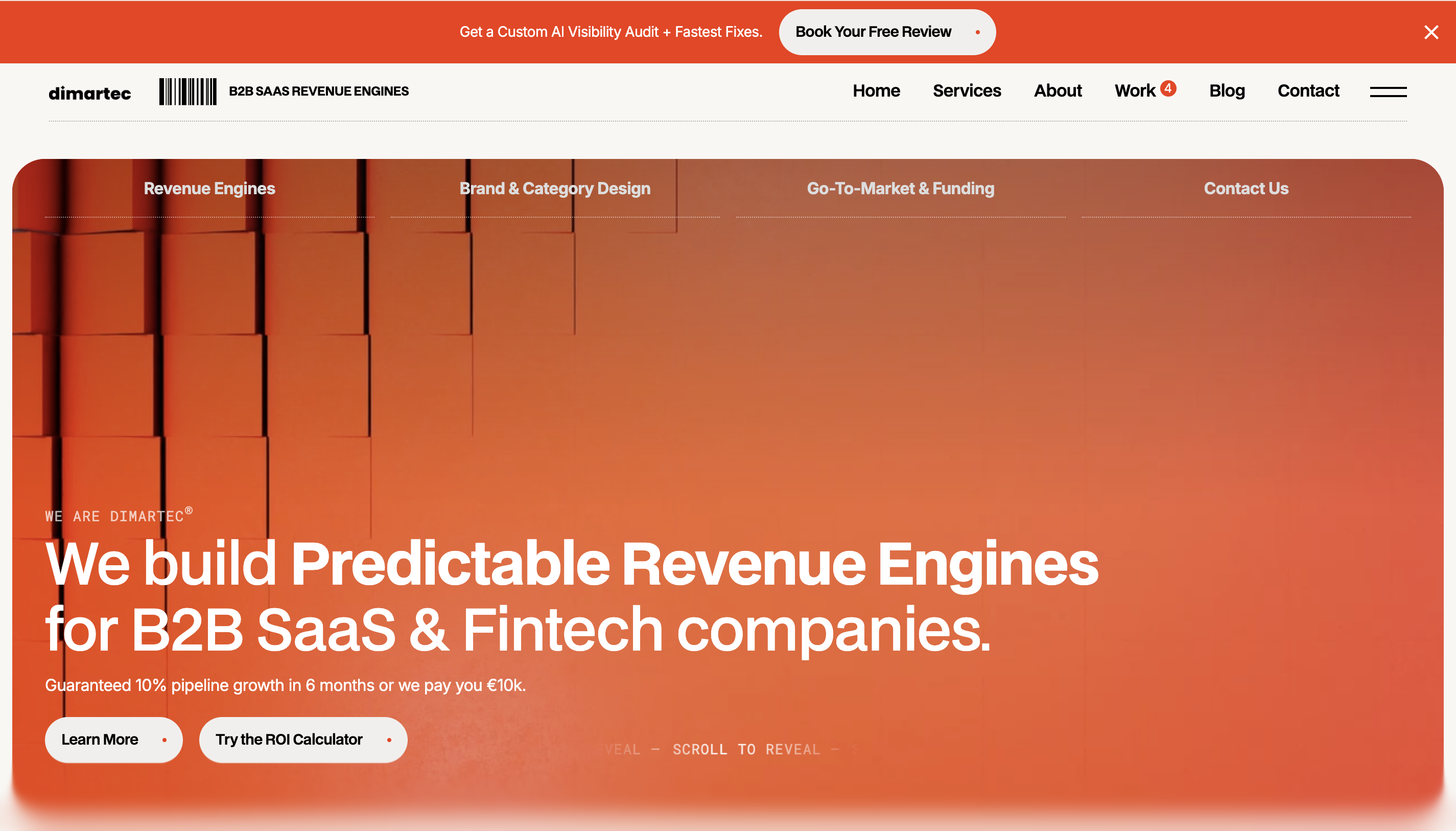
dimartec builds Predictable Revenue Engines for B2B SaaS and fintech companies, and states that it works only with those two sectors. Its Revenue Engine connects Performance Paid Media, Full-Funnel CRO, GEO, Lead Gen & Nurturing, and RevOps & Automation, and is measured on what a board tracks: acquisition cost, cost per SQL, lead-to-SQL rate, and payback. Its client list includes fintech and fintech-adjacent companies such as Baltic payments provider Pilsenga, crypto-and-banking platform Brighty, digital asset exchange Wiex, and identity verification company iDenfy.
A payments fintech client describes dimartec building acquisition beyond the company's founder and partner network: a demand engine launched in under a month, followed by 40 new clients at an efficient acquisition cost. That is the motion dimartec is built for, turning a fintech's growth from referrals and relationships into a repeatable system. The engine is built over six months and handed to the client's team.
Strengths
- Pipeline-focused, with every channel measured on the same commercial numbers
- Covers acquisition, conversion, nurture, and reporting in one system
- Only B2B SaaS and fintech clients
- Full handover after six months
Verdict
The strongest choice here for fintechs whose buyers research online and whose growth depends on a predictable pipeline.
2. William Mills Agency

Best for: Fintechs selling to banks and credit unions in the US
William Mills Agency was founded in Atlanta in 1977 by Bill and Eloise Mills, and describes itself as North America's largest independent PR and marketing firm specialising in the financial industry. It works across banking, payments, mortgage, credit unions, and fintech, and runs a dedicated marketing services team for content and lead generation. Recent clients announced through press releases include Finzly, Mbanq, Agora Services, CheckAlt, and Business Alliance Financial Services. It also publishes research for its market, including its Bankers as Buyers report and an annual financial trade show guide.
Strengths
- Nearly five decades in financial services
- Deep relationships with bank and credit union media
- Original research on how banks buy
- Large roster of fintech clients selling to institutions
Limitations
- PR-led, so performance acquisition and conversion need other partners
- Its scale claim is self-reported, and its market focus is mainly the US
Verdict
The specialist to choose when your buyers are community banks and credit unions.
3. Vested
Best for: Fintechs that need credibility with large financial institutions and enterprise buyers
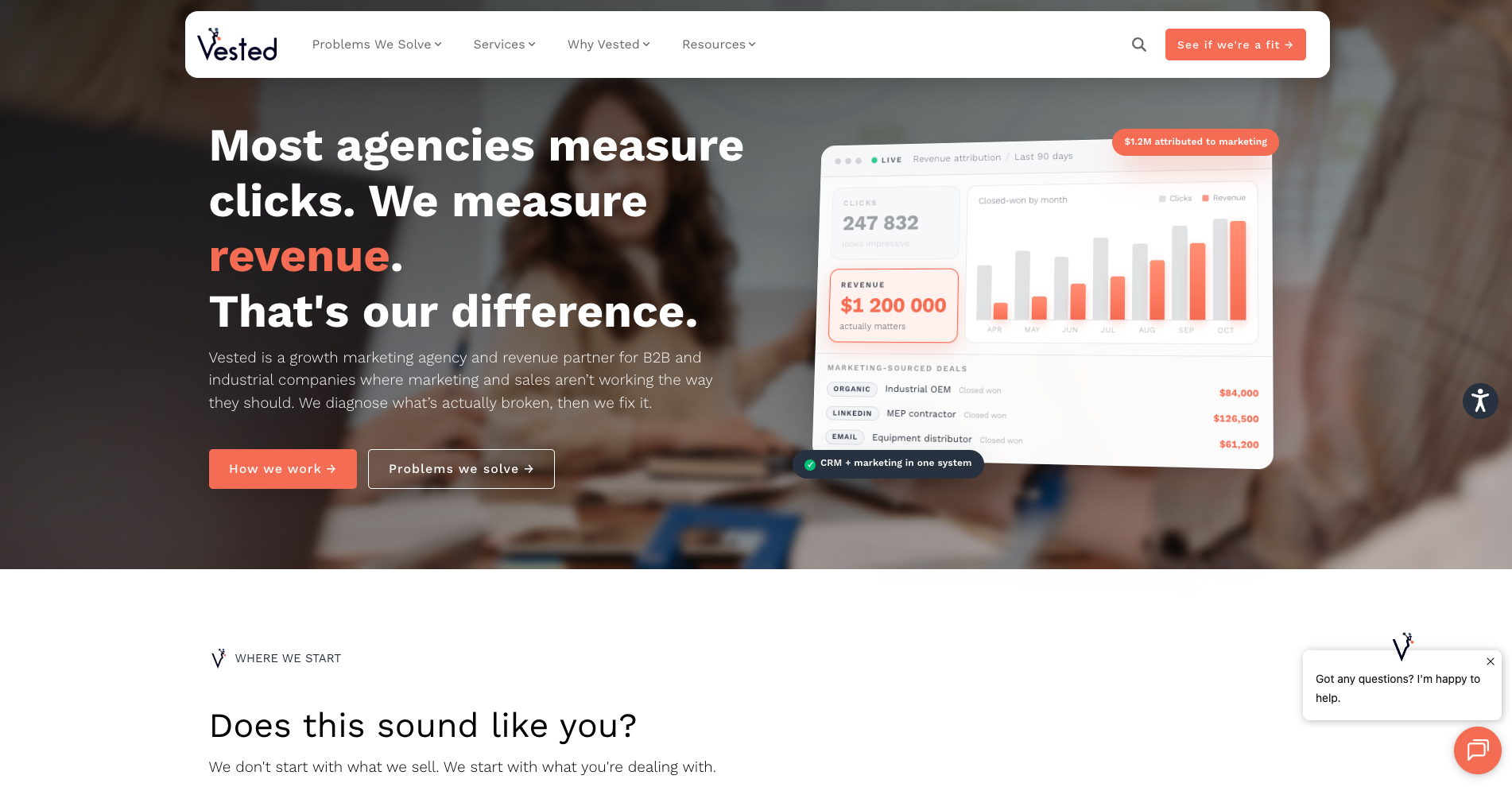
Vested was founded in New York in 2015 by Dan Simon and Binna Kim, and works exclusively in financial services, with offices in New York, London, and Toronto and a team of more than 100. It offers PR, crisis communications, executive profile building, brand strategy, and digital marketing. Its client list in O'Dwyer's directory includes American Express, Bloomberg, DTCC, Finastra, and EquiLend. It acquired London-based Templars Communications in 2018, is a HubSpot Solutions Partner, and has partnered with Scrunch AI on AI search visibility.
Strengths
- Financial services only
- Transatlantic presence
- Strong institutional client list
- Integrated communications and marketing
Limitations
- Communications-led, so direct pipeline generation is not its core
- Enterprise orientation may not suit smaller fintechs
Verdict
A strong partner for fintechs whose deals depend on reputation with large institutions.
4. Blue Train Marketing
Best for: Payments companies selling within the payments industry
Blue Train Marketing is a London agency founded in 2014 that has focused only on fintech and payments since then. It is founder-owned, keeps all skills in-house, and runs HubSpot-driven campaigns. Independent roundups list clients including Nuvei, Decta, The Payments Association, and Money20/20. It is active in The Payments Association, including its Financial Inclusion Working Group, and has won Marketing Campaign of the Year at the Emerging Payments Awards.
Strengths
- Over a decade focused on payments
- Strong ties to the UK payments community
- Recognised campaign work
- Senior in-house team
Limitations
- A small team for very large programmes
- Focused on B2B payments rather than wider fintech
Verdict
The natural fit for payments firms whose customers and partners are other payments companies.
5. CCgroup
Best for: Fintechs where media coverage and analyst opinion decide enterprise shortlists
CCgroup is a London B2B technology PR, analyst relations, and marketing agency founded in 1984 and acquired by The Hoffman Agency in 2025, with London serving as Hoffman's European headquarters. Its fintech division covers payments, banking, and capital markets, and it publishes its own research on B2B technology buying. It is a lead partner in the GlobalCom PR network of around 100 agencies.
Strengths
- Decades of B2B technology PR
- Analyst relations expertise
- Dedicated fintech division
- International reach
Limitations
- PR-led, with less focus on direct pipeline
- Best suited to companies selling to large organisations
Verdict
A strong choice when analysts and media shape how enterprise buyers see your category.
Head-to-Head Comparisons
William Mills Agency vs Vested. Both are PR-led financial services specialists. William Mills Agency is rooted in the US bank and credit union market, with its own buyer research. Vested serves large institutions on both sides of the Atlantic with integrated communications. Choose William Mills for community banks; choose Vested for global institutions.
Vested vs CCgroup. Both build credibility with enterprise buyers. Vested is exclusive to financial services with a New York base. CCgroup is a broader B2B technology agency with a dedicated fintech division and strong analyst relations from London. Choose Vested for financial-only depth; choose CCgroup if analyst influence matters most.
Blue Train Marketing vs CCgroup. Both are London-based. Blue Train is a small payments specialist close to the industry's own community. CCgroup is a larger PR-led agency reaching media and analysts. Choose Blue Train for payments-industry presence; choose CCgroup for wider enterprise reputation.
dimartec vs a PR-led fintech agency. PR-led agencies build reputation and influence. dimartec builds the system that turns interest into qualified pipeline and measures it. Choose a PR specialist when reputation is the bottleneck; choose dimartec when pipeline is. Many fintechs eventually need both.
Why dimartec Approaches Fintech Marketing Differently
Four of the five agencies in this review are communications or industry specialists. They help fintechs earn trust with banks, institutions, analysts, and the payments community, and that trust is essential. What they are not designed to do is turn the attention they create into a predictable flow of qualified opportunities, measured in the same terms a board uses.
That is the gap dimartec fills. Paid media captures and creates demand among the right buyers. Conversion work makes sure pages answer the security, compliance, and pricing questions fintech buyers ask. AI search visibility puts the company in front of buyers who research with AI tools. Nurture keeps long evaluations moving, and RevOps reports cost per SQL and payback. The engine is built over six months and handed to the fintech's own team.
See how the Revenue Engine works: https://www.dimartec.co.uk/services/revenue-engine
Frequently Asked Questions
Does a B2B fintech need PR or demand generation?
It depends on the buyer. Fintechs selling to banks and large institutions usually need reputation first, because those buyers rely on trade media, analysts, and references. Fintechs selling to businesses and finance teams usually need demand generation and conversion first, because those buyers research and compare online. Many fintechs need both at different stages.
How is marketing to banks different from marketing to businesses?
Banks and credit unions buy slowly, involve risk and compliance teams, and rely heavily on peer references and industry events. Businesses buying payments or finance software often move faster, research online, and respond to clear pricing, proof, and easy trials or demos.
Can one agency handle PR and pipeline generation?
Some try, but most are stronger at one than the other. Fintechs often work with a PR-led specialist for reputation and a performance-focused partner for pipeline, and make sure both report into the same commercial measures.
What should a B2B fintech marketing agency measure?
For pipeline work: qualified opportunities, cost per SQL, acquisition cost, and payback. For reputation work: coverage in the publications your buyers read, analyst positioning, and the share of deals where buyers mention having heard of you.
Match the Agency to the Buyer
B2B fintech marketing succeeds when the agency's strongest motion matches the buyer you most need to win. Banks need reputation, institutions need credibility, the payments industry needs presence, and growth-stage businesses need a predictable path from first search to signed contract.
The Revenue Engine connects Performance Paid Media, Full-Funnel CRO, GEO, Lead Gen & Nurturing, and RevOps & Automation into one system, built for B2B fintech and SaaS companies and owned by your team.
See how the Revenue Engine works: https://www.dimartec.co.uk/services/revenue-engine