A B2B fintech company usually reaches Series A on the strength of a small number of relationships. The first customers were introduced by an investor, met at a payments conference, or worked with a founder at a bank years earlier. They bought because they trusted the people before they had much reason to trust the product. That is how most financial infrastructure gets its first foothold.
The round changes the arithmetic. The plan in the investment memo assumes growth that relationships alone cannot supply, and the next buyers have never heard of the company. They work in treasury, risk, compliance, or finance operations. They are paid to be cautious, they answer to regulators and auditors, and they will ask for a security questionnaire before they agree to a second call. Winning them takes marketing, and fintech marketing is constrained in ways SaaS marketing is not: claims need checking, case studies need clients' permission, and a careless phrase about returns or safety can become a compliance issue.
After analysing go-to-market programmes across more than 200 B2B SaaS and fintech accounts, Series A is where fintech companies most often stall. The cause is rarely a lack of effort or budget. It is that the marketing built after the round speaks to the wrong level of the buying committee, makes promises the compliance team then softens until they mean nothing, or produces leads that the sales team cannot take through a procurement process designed to say no.
This guide looks at five marketing agencies for B2B fintech companies at Series A: how well each understands regulated buyers, how it handles the trust problem, and whether its work produces pipeline a small sales team can actually close.
What Makes B2B Fintech Marketing at Series A Different
Much of what a Series A fintech needs from marketing is the same as any Series A software company: a clear position, a steady flow of qualified conversations, and numbers the board can trust. Four features of the category change how that work has to be done.
The buyer is professionally sceptical. A head of treasury or a chief risk officer evaluating a payments provider, a lending platform, or a compliance tool is responsible for what happens if it fails. Claims that would pass unremarked in general SaaS, such as faster, safer, or fully compliant, invite questions here. Marketing that cannot answer those questions with specifics loses credibility on first contact.
Every asset passes through a review. Licensing, regulators, and the client's own legal team all shape what can be said. Case studies need written permission from financial institutions that rarely give it quickly. A Series A company without an efficient review process can spend more time approving content than producing it.
Several people buy, and they want different things. An operations lead wants to know the product works. Compliance wants evidence it is safe. Procurement wants the vendor to look stable. IT wants to understand the integration. Marketing aimed at one of them leaves the others to be persuaded by the salesperson alone.
The niche is narrow and specialised. A B2B fintech often sells to a few thousand institutions in a handful of markets, using vocabulary that outsiders get slightly wrong. Generalist writers and generalist agencies tend to produce content that reads correctly to a layperson and naively to an expert. In this market, the experts are the audience.
Why Trust and Compliance Shape the Agency Choice
In most of B2B software, an agency's industry knowledge is useful. In fintech at Series A, it decides whether the work can be used at all.
Consider what happens when a generalist agency writes a landing page for a lending infrastructure company. The copy is persuasive and the structure is sound. Then it goes to the compliance lead, who removes the claim about approval speed, softens the line about risk, and asks where the default rate figure came from. What survives is accurate and bland, and three weeks have passed. Multiply that by every ad, article, and email, and the marketing programme spends most of its time waiting.
Agencies that know the category write within the constraints from the start. They know which claims need evidence, which phrases regulators dislike, and how to make a point specific without making it a promise. The work is approved faster and keeps more of its edge.
Trust works the same way. Fintech buyers notice when a vendor's content gets their world slightly wrong: a mislabelled payment rail, a confused regulatory regime, a case study that implies a bank endorsed something it only piloted. Each mistake signals that the vendor does not understand the environment its product will run in. Specialist agencies make fewer of them.
That does not mean only fintech-only agencies are worth considering. It means any agency on a Series A fintech's shortlist should be able to show how it handles review, claims, and technical accuracy, in detail.
How We Chose These Agencies
- Category knowledge: Does the agency work only or mainly with fintech and financial services, or show clear evidence of B2B fintech work?
- Fit with Series A: Are its client base and pricing suited to a company with a lean team and a first serious budget?
- Handling of regulated content: Is there a visible approach to claims, technical accuracy, and approval?
- Connection to pipeline: Does the work lead to sales conversations and measurable revenue, or stop at awareness?
- Evidence: Are there named fintech clients and published results?
Each profile says which part of a Series A fintech's marketing the agency covers best, and which parts it leaves to others.
The 5 Best B2B Fintech Marketing Agencies for Series A Companies
1. dimartec
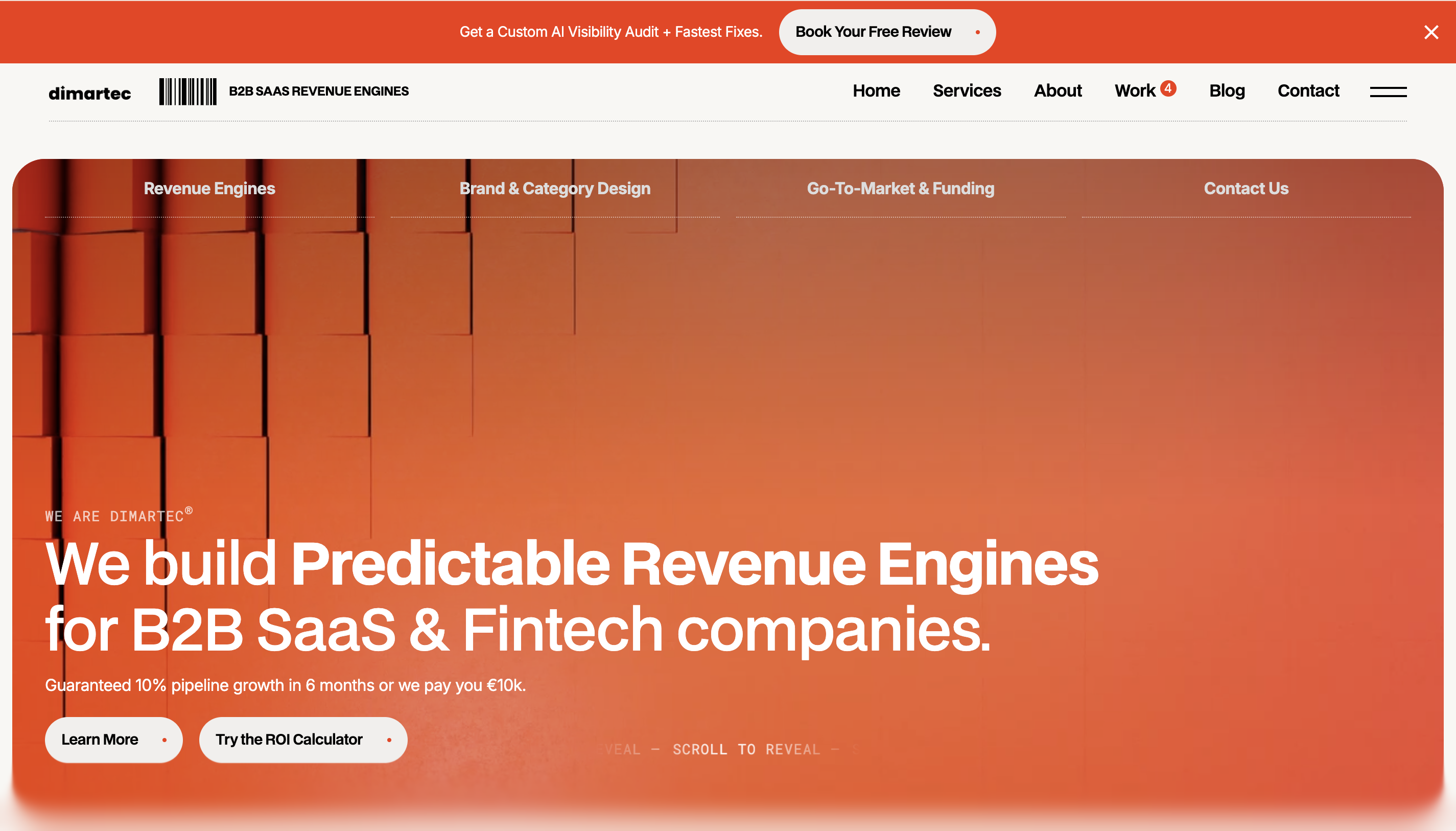
Best for: Post-PMF B2B fintech and SaaS companies at €2M–€10M ARR that have raised a Series A and need a pipeline engine a small sales team can rely on, with every channel measured against closed revenue
dimartec builds Revenue Engines for B2B SaaS and fintech companies. Its five services, Performance Paid Media, CRO, GEO, Lead Gen & Nurturing, and RevOps & Automation, are delivered as one programme. For a Series A fintech, that answers the problem of a company that needs marketing to work across several channels at once but has neither the team nor the time to coordinate several agencies.
The programme starts from the buyers who have already signed. Their roles, institution types, and buying triggers become the targeting for paid campaigns on Google and LinkedIn and the scoring rules in the CRM. Lead Gen & Nurturing is built around the long, multi-person fintech evaluation: early contacts receive content aimed at the questions their compliance and procurement colleagues will raise, so that by the time a deal reaches review, the answers are already in circulation. CRO designs pages and forms that capture the information a sales team needs to judge regulatory fit before the first call.
GEO matters particularly in this category. Finance and risk professionals increasingly use AI search tools to research unfamiliar vendors, and a Series A fintech is by definition unfamiliar. Appearing in those answers with accurate, well-sourced information gives the brand a degree of credibility before any salesperson is involved. RevOps & Automation then ties every source to closed revenue, so the numbers presented at the next board meeting come from the system.
dimartec suits a Series A fintech when:
- The first customers came through founders' and investors' networks, and there is no proven channel for reaching strangers
- Sales has a small team and cannot afford to spend weeks on prospects who fail compliance review
- Several agencies or freelancers handle different channels, and nobody owns the result
- The board expects reporting on pipeline by source, and the data does not yet exist
Key services
- Performance Paid Media: Google and LinkedIn campaigns aimed at the institution types and roles that have bought
- Lead Gen & Nurturing: scoring and nurture designed for multi-stakeholder, compliance-heavy evaluations
- CRO: pages and forms that collect the information needed to assess regulatory fit early
- GEO: accurate visibility in AI search, where cautious buyers research unfamiliar vendors
- RevOps & Automation: attribution from first touch to closed revenue and board-ready reporting
Why dimartec stands out for Series A fintech
- One team accountable for every channel, suited to a company without a marketing department
- Qualification that accounts for compliance and procurement, not only firmographic fit
- GEO as a credibility source for a brand that buyers do not yet know
- Built for the €2M–€10M ARR stage and handed to the client's team
Best fit: Series A B2B fintechs with product-market fit, a small sales team, and pressure to show the board a repeatable source of pipeline.
2. Blue Train Marketing
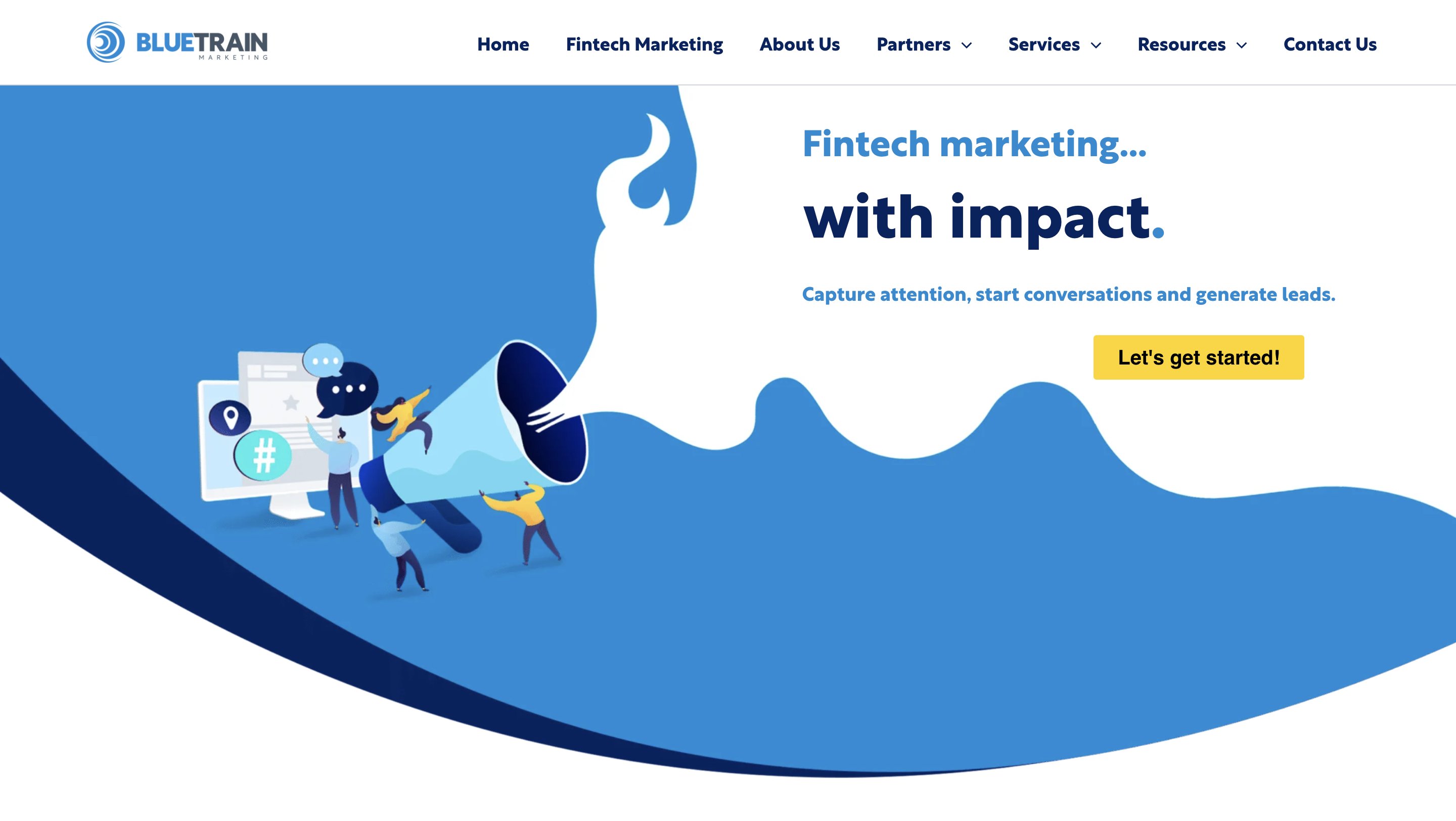
Best for: Series A payments companies selling to banks, processors, acquirers, and merchants, where credibility inside the payments community matters as much as reach
Blue Train Marketing is a London agency founded in 2014 that has worked exclusively in fintech and payments ever since. It is founder-owned, keeps its skills in house, and covers branding and messaging, content, SEO, paid search, and social. Its CEO, Jeff Banks, was previously international marketing director at First Data, now part of Fiserv.
Its value to a Series A payments company is fluency. Blue Train is the marketing partner for industry bodies including the Payments Association, Open Banking Excellence, and Vendorcom, and its clients include Nuvei and Decta. It has won Marketing Campaign of the Year at the Emerging Payments Awards. An agency with that position understands how payments buyers talk, which events and publications they trust, and what distinguishes one payment provider's story from another's.
For a company that has just raised and needs to explain itself to a sceptical, well-networked industry, that knowledge shortens the time to credible messaging. The agency is small, which suits Series A budgets and keeps senior people close to the work.
Its focus is payments. Fintechs in lending, wealth, insurance, or regtech will find less depth.
Key services
- Branding and messaging for payments companies
- Content production for web, social, and events
- SEO and paid search
- Social media marketing
- Sales enablement material
Why Blue Train Marketing stands out for Series A fintech
- More than a decade spent solely in fintech and payments
- Close ties to payments industry bodies and events
- Leadership with senior payments marketing experience
- Small, senior team suited to Series A budgets
Best fit: Series A payments and payment infrastructure companies that need to establish themselves in the payments community. Less suited to other fintech segments or to companies whose main need is a measured demand generation engine.
3. Evara (formerly Inbound FinTech)
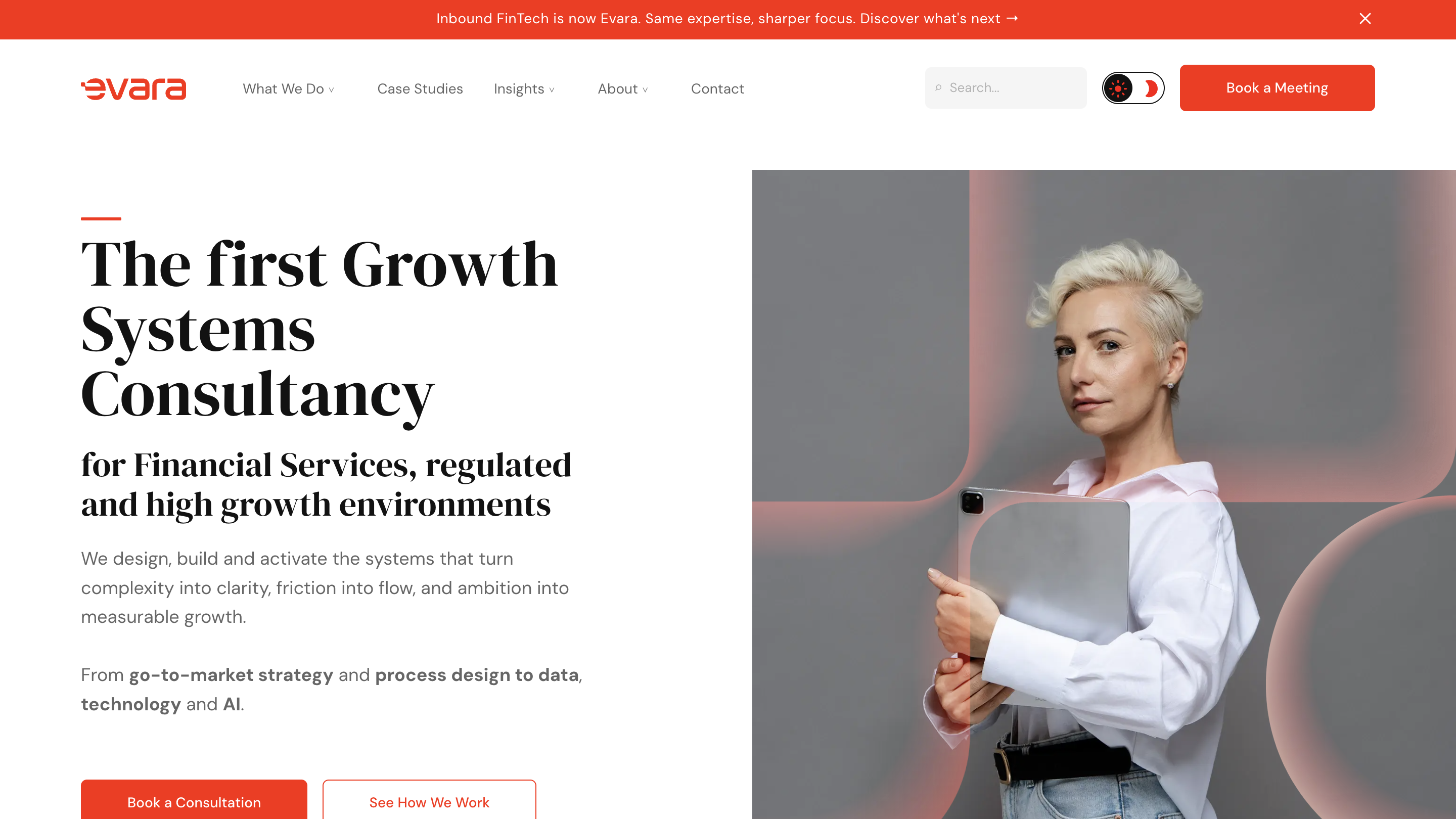
Best for: Series A fintechs choosing HubSpot as the system their marketing and sales will run on, and wanting it built with financial services requirements in mind
Evara, which traded as Inbound FinTech until recently, is a London HubSpot partner founded in 2017 that works with financial services and fintech companies. It describes itself as a growth-systems consultancy for regulated businesses and holds ISO 9001 and ISO 27001 certification. Its services span HubSpot implementation, revenue operations, data governance, consent and compliance management, SEO, and website development.
Series A is usually the moment a fintech moves from spreadsheets and a basic CRM to a proper marketing and sales system. Getting that system right matters more in fintech than elsewhere, because consent records, data handling, and audit trails are subject to regulation. Evara builds HubSpot with those requirements included: lifecycle stages, consent management, integrations, and reporting configured for a regulated business.
Its ISO 27001 certification also helps in a practical way. Fintech clients' security teams often scrutinise agencies with access to customer data, and a certified partner passes that review more easily. Published clients include ConnexPay and Apply Financial.
Evara's strength is the system and the inbound activity that runs on it. Companies needing aggressive paid acquisition or outbound will need more.
Key services
- HubSpot implementation and optimisation
- Revenue operations and data governance
- Compliance and consent management
- SEO and inbound content
- Website design and development
Why Evara stands out for Series A fintech
- Focused on financial services and fintech
- ISO 27001 certified, useful when clients audit suppliers
- Builds HubSpot with regulatory requirements included
- Combines systems work with inbound marketing
Best fit: Series A fintechs committing to HubSpot that want a compliant foundation for marketing and sales. Less suited to companies on Salesforce or those whose priority is paid acquisition.
4. Mint Studios
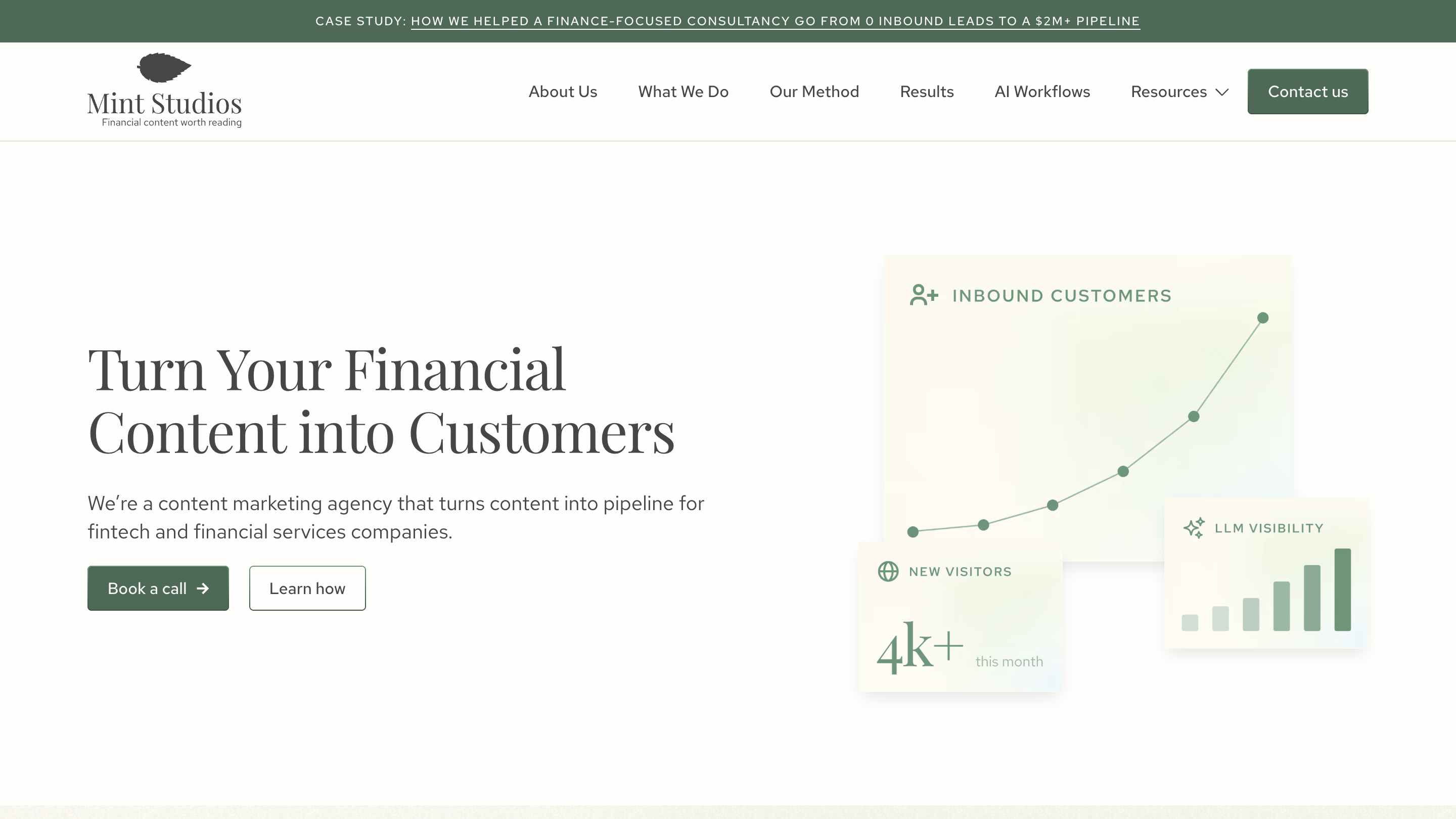
Best for: Series A fintechs that need content expert enough to persuade specialist buyers and specific enough to turn readers into pipeline
Mint Studios is a content marketing agency working only with fintech and financial services companies. Its clients include Modulr, Zai, Jeeves, Persona, GBG, and ClearBank. Founder and managing director Araminta Robertson built the agency around a single problem: proving that fintech content produces revenue.
Its method suits a Series A company well. Content is planned around bottom-of-funnel topics, the searches and questions buyers have when they are close to choosing a provider, instead of broad awareness subjects. Each piece is built from interviews with the client's own sales and product people, so it carries real expertise instead of desk research. Performance is tracked through to pipeline using attribution, and the agency now pairs SEO with optimisation for AI search on every engagement.
This approach addresses two Series A constraints at once. The company cannot afford content that produces traffic without leads. And its experts, often the founders, do not have time to write. Mint Studios turns a short interview into a publishable, technically accurate piece.
Mint Studios is a content specialist. Paid media, systems, and sales processes are outside its scope.
Key services
- Bottom-of-funnel content strategy
- Expert interview-led writing
- Editing and publishing
- SEO and AI search optimisation
- Content attribution and reporting
Why Mint Studios stands out for Series A fintech
- Exclusively fintech and financial services
- Content built from the client's own expertise
- Focus on content that converts, measured to pipeline
- Recognisable fintech client list
Best fit: Series A fintechs that see content as a primary channel and have expertise worth capturing. Companies needing paid acquisition or a full demand engine will need additional partners.
5. Omnius
Best for: European B2B fintechs that want search, including AI search, to become a lasting source of qualified signups and demos
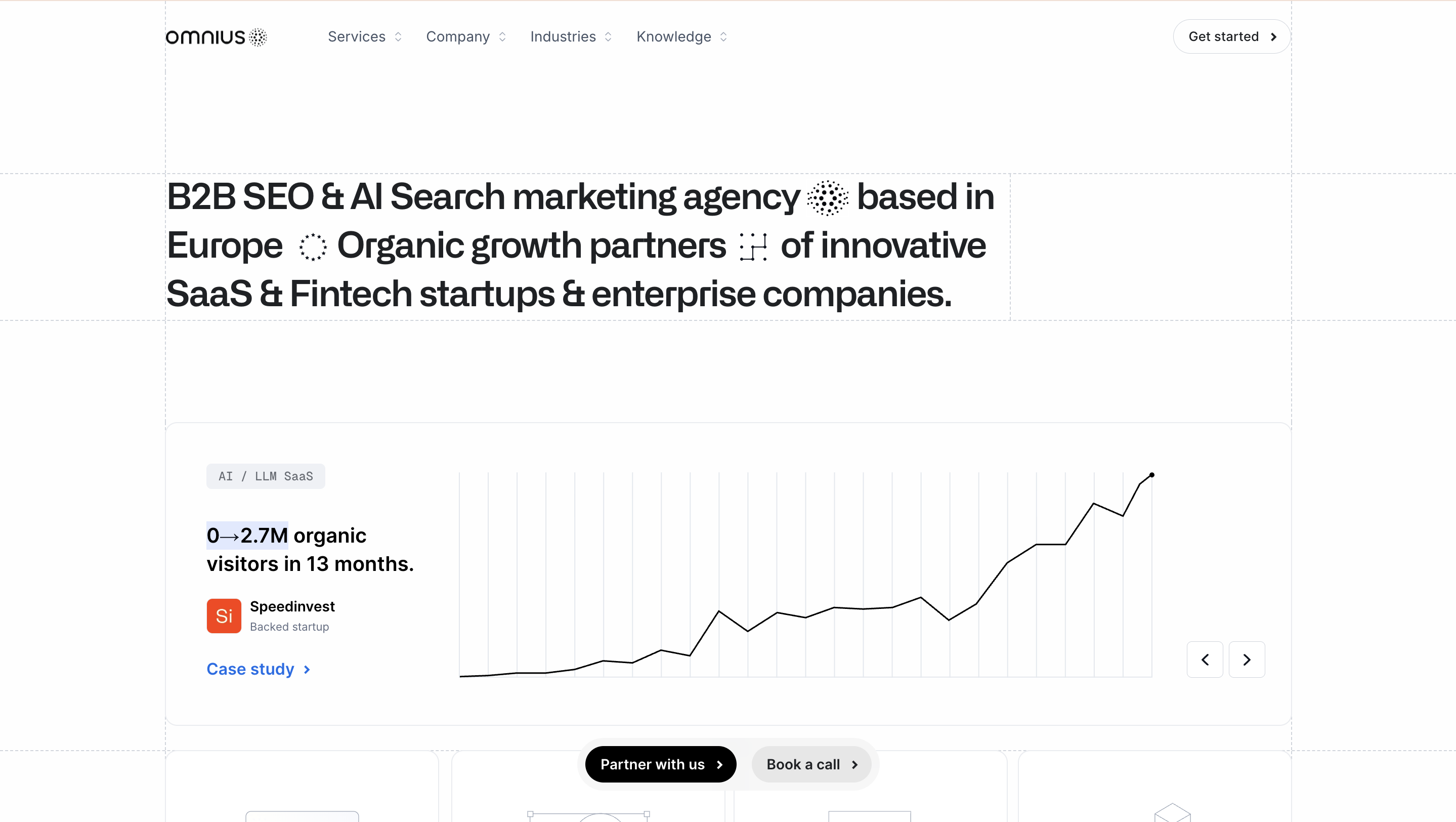
Omnius is a European SEO and generative engine optimisation agency that works exclusively with SaaS, fintech, and AI companies. Its published fintech work includes ANNA Money, a business account provider, which grew signups by 60%, and Myos, a working capital provider, which increased signups by 227.9% in six months. It holds a 4.8 rating on Clutch.
For a Series A fintech, organic search has an appealing property: once built, it keeps producing without proportional spend. The difficulty is that fintech search terms are competitive and the content has to meet high standards of accuracy and authority. Omnius combines technical SEO, programmatic page creation, content, and digital PR, and has added GEO work aimed at getting clients cited in AI answers.
Its European orientation suits fintechs operating across EU markets, where localisation and multiple languages complicate search.
Search is a slower channel than paid media. A Series A company needing pipeline this quarter will need something running alongside it.
Key services
- Technical SEO
- SEO strategy and content
- Programmatic SEO
- SEO localisation
- Generative engine optimisation
Why Omnius stands out for Series A fintech
- Exclusive focus on SaaS, fintech, and AI
- Published fintech results with named clients
- GEO alongside conventional SEO
- Experience with European, multi-language markets
Best fit: European fintechs prepared to invest in search as a long-term channel. Companies needing immediate pipeline should pair it with paid acquisition or outbound.
Why dimartec Approaches Series A Fintech Marketing Differently
The four specialists above each solve a real part of the Series A problem. Blue Train Marketing gives payments companies a voice the industry recognises. Evara builds a compliant system to run marketing and sales on. Mint Studios turns a company's expertise into content buyers trust. Omnius makes search a durable channel in European markets.
A Series A fintech usually needs several of those things at once, and that is where the difficulty lies. Content without distribution is read by few. Paid campaigns without credible content convert poorly with cautious buyers. A well-built CRM records leads but cannot improve them. Search takes a year to mature while the board wants pipeline in two quarters. Each specialist is right about its own part and has no reason to manage the others.
The person who ends up managing them is normally the founder or a single new marketing hire, who now spends the week coordinating briefs, approvals, and reports from four suppliers instead of talking to customers.
dimartec treats the Series A fintech's marketing as one system. Performance Paid Media produces pipeline from the start. GEO builds the credibility that cautious buyers look for when they research an unknown vendor. CRO and Lead Gen & Nurturing make sure the people who respond are qualified for regulatory fit and nurtured through a long, multi-person evaluation. RevOps & Automation connects all of it to closed revenue so the board sees one set of figures. One team owns the result, which leaves the founder free to sell.
See how the Revenue Engine works: https://www.dimartec.co.uk/services/revenue-engine
Three Things to Check Before Hiring a Fintech Marketing Agency
One: Ask how their work gets through compliance. Ask for the approval rate of first drafts with current fintech clients, the typical review time, and an example of a claim they rewrote to keep its force while making it defensible. Agencies new to fintech tend to answer in generalities.
Two: Test their understanding of your buyer. Ask them to describe, in their own words, how a deal for a product like yours moves through a bank or financial institution: who is involved, what each person worries about, and where deals usually stall. An agency that cannot do this will produce marketing aimed at only one of those people.
Three: Ask what they will report to your board. A Series A board wants to see pipeline by source, cost per opportunity, and the time from first contact to closed deal. If the agency's reporting stops at traffic, impressions, or leads, someone else will have to build the bridge to revenue, and at Series A that someone is usually the founder.
Frequently Asked Questions
Should a Series A fintech hire a fintech-specialist agency or a B2B SaaS agency?
It depends on where the difficulty lies. If the main challenge is credibility and regulated messaging, a fintech specialist will usually produce usable work faster. If the main challenge is building a measurable acquisition engine, a B2B SaaS agency with genuine fintech experience may serve better. The safest test is evidence: named B2B fintech clients, examples of compliance-approved work, and results reported in pipeline.
How much should a Series A fintech spend on marketing?
There is no standard figure, and fintech budgets vary widely by segment and contract size. A more useful starting point is the plan agreed with investors: the number of new customers needed, the expected contract value, and the conversion rates through the sales process. From those, a company can work out how many qualified opportunities marketing must produce and what it can afford to pay for each. Agency fees and media should be judged against that.
How long does B2B fintech marketing take to produce pipeline?
Paid campaigns aimed at buyers already searching for a solution can produce conversations within weeks. Content, search, and AI search visibility take several months to build and then continue to deliver. Because fintech sales cycles are long, closed revenue from new marketing often lags by six months or more. Agree in advance which earlier signals, such as qualified opportunities and meetings with the right roles, will be used to judge progress.
What marketing channels work best for B2B fintech at Series A?
Most Series A fintechs combine a fast channel with a slow one. Paid search and LinkedIn reach buyers quickly and can be targeted precisely at institution types and roles. Expert content, search, and AI search visibility build credibility and keep producing over time. Industry events and partnerships matter more in fintech than in most software categories, because trust travels through networks. The right mix depends on the segment and how concentrated the buyers are.
Turn the Round Into Repeatable Pipeline
A Series A round buys a fintech time to prove it can win customers who have never heard of it. Those customers are cautious, regulated, and connected to each other, and they judge a vendor partly by how well its marketing understands their world. The agency chosen at this stage shapes whether the company reaches Series B with a working engine or with a set of disconnected experiments.
The Revenue Engine joins Performance Paid Media, CRO, GEO, Lead Gen & Nurturing, and RevOps & Automation into one programme, built for B2B SaaS and fintech companies that need pipeline, credibility, and clean reporting at the same time.
See how the Revenue Engine works: https://www.dimartec.co.uk/services/revenue-engine














.png)







.png)

















































.png)
.png)
.png)
.png)
.png)
.png)
.png)
.png)
.png)
.png)