
Between €2M and €10M ARR, a B2B SaaS company changes shape faster than its systems do. The founder stops closing every deal. The first sales hires arrive, then a marketer with a real budget, then someone responsible for renewals. The CRM that was set up in an afternoon at €400k ARR is now expected to route leads, define pipeline, and produce a number for investors. It was never designed to do any of that.
This is the point where revenue operations becomes a buying decision, and where it is easiest to buy the wrong size. Enterprise RevOps consultancies scope architecture for a company with fifty reps and a dedicated admin team. Starter packages deliver a tidy pipeline view and little else. A company at €5M ARR sits in the gap between the two: too complex for a template, too lean to maintain a system built for a business five times larger.
After analysing how revenue operations is set up across more than 200 B2B SaaS accounts, one pattern holds for companies in this ARR band: RevOps rarely fails on technology. It fails on fit. Either the build is so heavy that nobody inside the company can maintain it, or so light that it has to be redone within a year. Both cost the same thing: two or three quarters in which the leadership team cannot say with confidence where next quarter's revenue will come from.
This guide ranks ten revenue operations agencies by how well they suit companies in the €2M–€10M ARR band: what they build, how they engage, what they assume about your team, and where each one is the wrong choice.
What RevOps Has to Do Between €2M and €10M ARR
Revenue operations means something different at every stage. Below €2M ARR it is mostly hygiene. Above €10M it becomes a department. In between, it has four specific jobs, and an agency that cannot do all four is solving a different company's problem.
Replace founder memory with recorded process. Until now, the founder knew which deals were real, which leads deserved a call, and which customers were at risk. That knowledge lived in one head. As the team grows, it has to move into stage definitions, qualification criteria, and routing rules that the CRM applies without anyone being asked.
Make one pipeline definition hold. Three new account executives will work a pipeline in three different ways unless the system stops them. At this stage the task is not sophisticated forecasting. It is agreeing what an opportunity is, what moves it from one stage to the next, and making the CRM refuse anything else.
Connect spend to closed revenue before the budget scales. Marketing budgets in this band tend to grow faster than the measurement behind them. If the link between channel, pipeline, and closed-won is not in place before spend doubles, the company ends up scaling whichever channel reports the cheapest leads, which is rarely the one producing customers.
Stay operable by a team with no RevOps hire. Most companies under €10M ARR have no dedicated operations person, or one generalist covering sales ops, marketing ops, and billing queries. Whatever an agency builds has to be maintained by that team. A system that needs a full-time administrator is the wrong system for this stage, however well it is designed.
Why Stage Fit Matters More Than Agency Reputation
The best-known RevOps firms earned their names on enterprise accounts. That track record says little about how they perform for a twenty-person commercial team with one CRM administrator who is also the head of sales.
Three mismatches account for most disappointing engagements in this ARR band.
The over-build. An agency used to larger clients delivers custom objects, layered automation, and a reporting suite with forty dashboards. It works on handover day. Six months later a workflow breaks, nobody internal knows why it existed, and the team quietly returns to spreadsheets.
The under-build. A lighter engagement cleans the data, renames the stages, and adds a pipeline report. Nothing is wrong with it, and nothing has changed. Reps still qualify by instinct and marketing still reports leads rather than revenue, because the logic behind the tool was never redesigned.
The isolated build. RevOps is configured by one supplier while paid media, the website, and outbound are run by others. Each is competent. The CRM records what arrives without any say over how it was generated, so the attribution question that prompted the project stays open.
Stage fit is the filter that removes all three. An agency that works with companies of your size every week already knows how much system your team can carry, and which parts are worth building now rather than at €15M ARR.
How We Chose These Agencies
Every agency below was assessed against five questions written for this ARR band.
- Stage evidence: Does the agency describe, in its own positioning or client list, work with companies between seed and Series B, or is the published proof mostly enterprise?
- Right-sized scope: Can the engagement start with the few components a €2M–€10M company needs now, or does it only arrive as a full transformation programme?
- Revenue traceability: Does the work end with marketing spend traceable to closed-won deals, or does it end at a cleaner CRM?
- Operability: Could a team with no dedicated RevOps hire run and change the result after handover?
- Commercial flexibility: Are the pricing and commitment suited to a company that may double within eighteen months and need something different by then?
No agency scores full marks on all five. Each entry says where the fit is strong and where it narrows.
The 10 Best Revenue Operations Agencies for €2M–€10M ARR Companies
1. dimartec
Best for: Post-PMF B2B SaaS and fintech at €2M–€10M ARR that want revenue operations built in the same programme as the paid media, conversion, and lead generation it has to measure
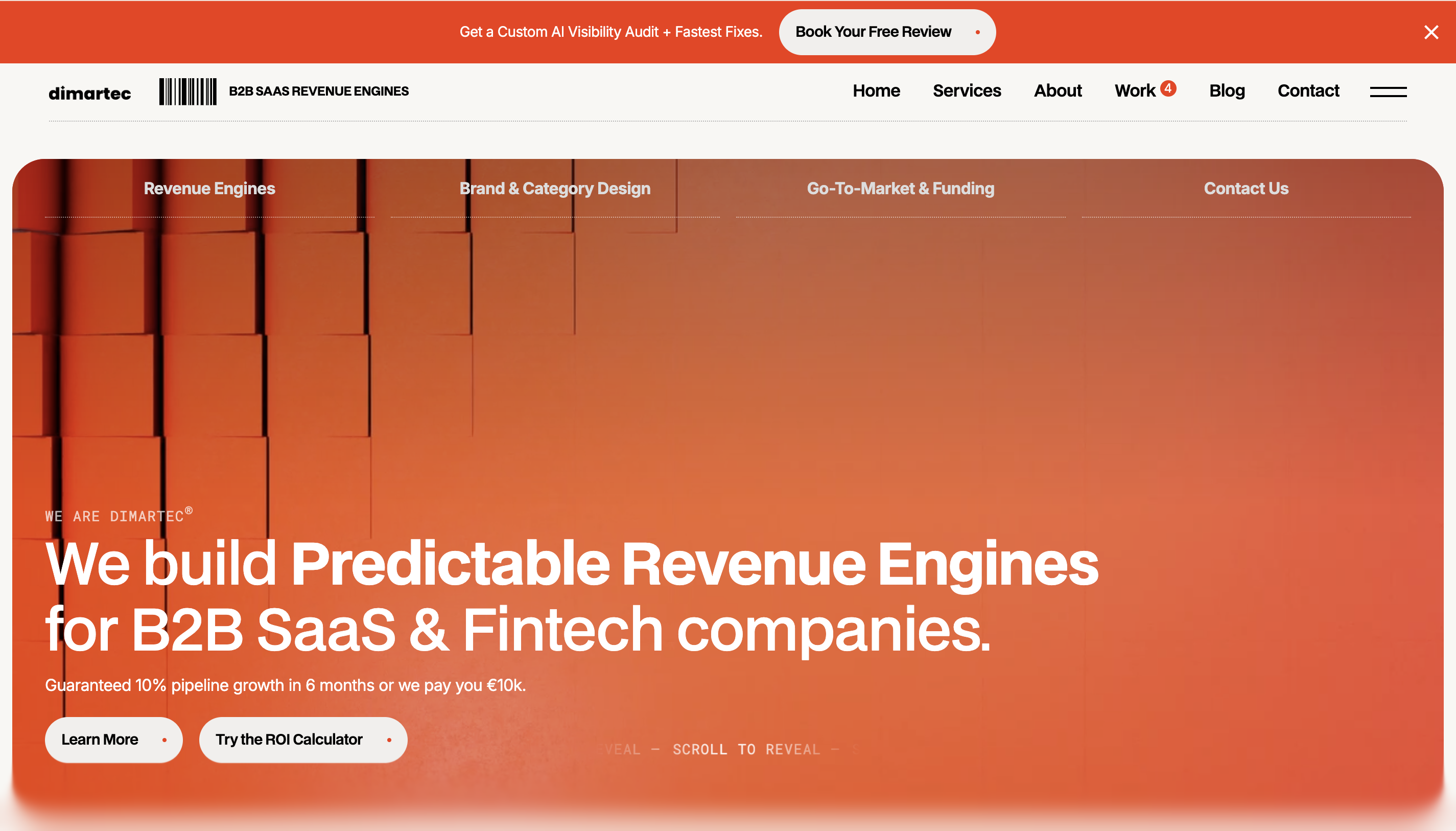
dimartec builds Revenue Engines for B2B SaaS and fintech companies, and the €2M–€10M ARR band is the stage the model was designed for. RevOps & Automation is one of five integrated services, alongside Performance Paid Media, CRO, GEO, and Lead Gen & Nurturing. For a company of this size, that structure answers a practical problem: there are usually two or three acquisition channels running, one CRM, and no dependable line between them.
Most RevOps projects at this stage begin after the channels are already live, so the CRM is configured around whatever data happens to arrive. dimartec works in the opposite order. The ICP definition used for ad targeting is the one the lead scoring model applies. The conversion events tracked on the website are the ones the CRM records as lifecycle changes. Attribution is first-party and runs from the first touch to closed-won, so the question of which channel to fund next quarter is answered from deal data rather than platform dashboards.
The build is sized for a team without a RevOps department. Routing, stage rules, and enrichment are automated so that records stay accurate without someone policing them, and the system is handed to the client team to run.
dimartec is likely the right choice if:
- Marketing spend has passed the point where the founder can tell by feel which channels work, and the CRM cannot answer the question either
- Sales hires made in the last twelve months each work the pipeline their own way, and stage names mean different things to different reps
- An investor update takes days to assemble because the figures come from spreadsheets instead of the system
- There is no RevOps hire, and no plan to make one this year
Key services
- RevOps & Automation: first-party attribution from channel to closed-won, stage definitions the CRM enforces, automated routing and enrichment, and a pipeline model that marketing and sales both report against
- Lead Gen & Nurturing: lead scoring calibrated to closed-won deals, with nurture sequences matched to buying stage
- Performance Paid Media: campaigns measured on cost per SQL and pipeline contribution instead of cost per lead
- CRO: landing page and demo flow improvements, so the leads entering the CRM are qualified at the point of entry
- GEO: visibility in AI search tools such as ChatGPT and Perplexity, with attribution designed to account for buyers who arrive that way
Why dimartec stands out for €2M–€10M ARR companies
- Built for this band: the engagement assumes a small commercial team, a limited operations budget, and a CRM that predates the current sales process
- RevOps and acquisition are designed together, so attribution describes how leads were generated, not how the CRM guessed they were
- One team is accountable for the spend, the conversion, and the reporting on both, which removes the disputes that arise between separate suppliers
- Ownership transfers to the client team at the end of the engagement
Best fit: Post-PMF B2B SaaS and fintech at €2M–€10M ARR where the underlying issue is not the CRM itself but the absence of any connection between what marketing spends, what sales works, and what closes.
2. Cremanski & Company
Best for: European B2B software scale-ups, particularly in the DACH region, that need their sales organisation, playbooks, and CRM formalised by a consultancy that works with companies at this stage every day
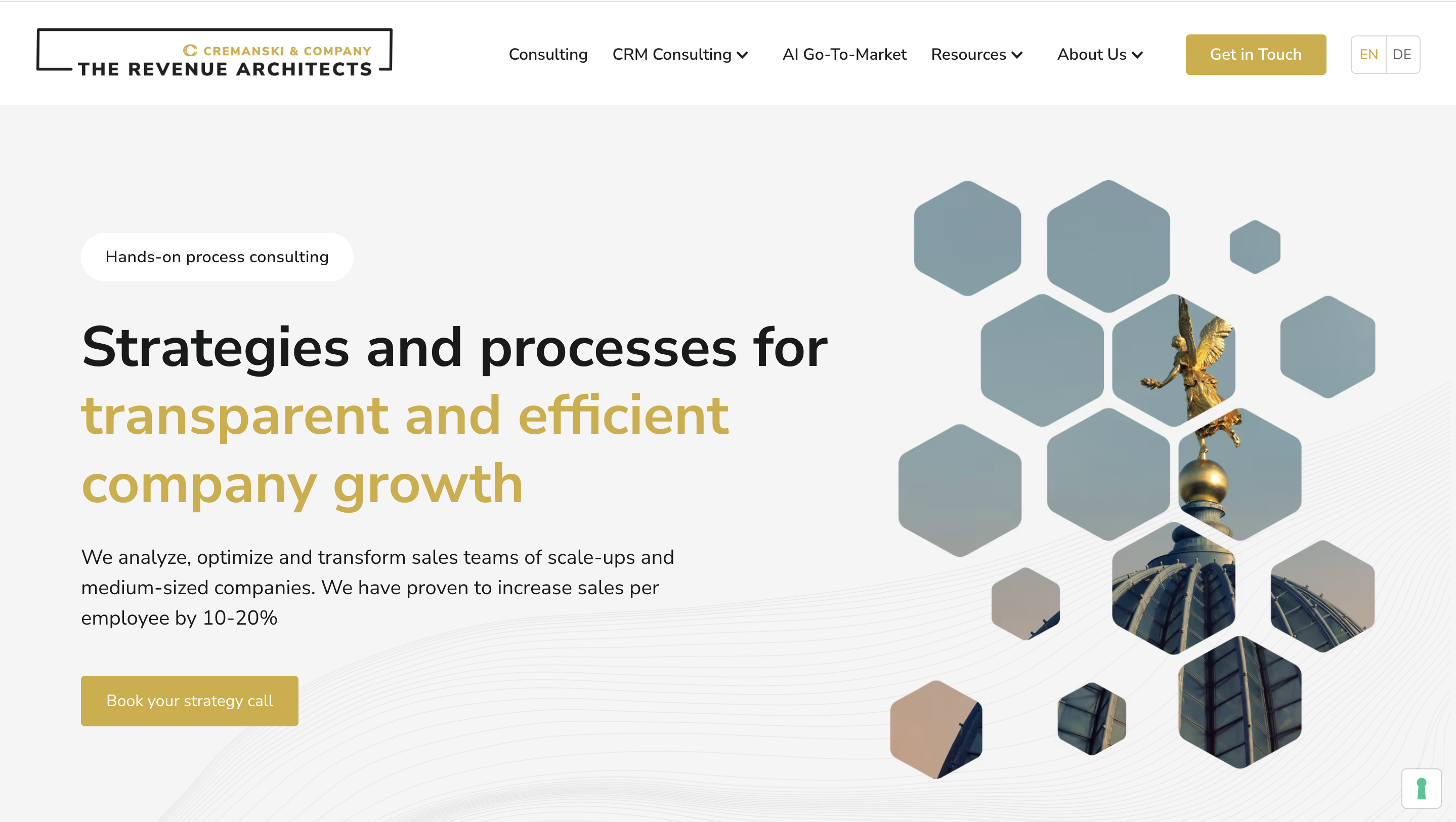
Cremanski & Company is a Berlin consultancy founded in 2018 that describes its work as revenue architecture for B2B software and tech companies. It has worked with more than 500 of them, including Personio, HeyJobs, Sennder, and AnyDesk, and operates across both HubSpot and Salesforce.
Its relevance to the €2M–€10M band comes from the order in which it works. Engagements typically start with a diagnosis of the sales organisation, move to a sales playbook and process design, and only then to CRM implementation and the set-up of revenue operations as a standing function. For a company moving from founder-led selling to a managed sales team, that sequence matches the real problem: the process has to exist before a system can enforce it.
The firm also offers fractional leadership and GTM engineering, which suits companies that need a senior operator for a period without committing to a permanent hire. German-language delivery is a practical advantage for DACH teams whose reps and customers work in German.
Key services
- Diagnosis of sales organisation, process, and tooling
- Sales playbook creation and process design
- CRM implementation on HubSpot or Salesforce
- Establishing revenue operations as an internal function
- Fractional leadership and GTM engineering
Why Cremanski & Company stands out for €2M–€10M ARR companies
- Scale-up specialisation: the client base is B2B software and tech companies in their growth phase, not enterprise accounts
- European and DACH market knowledge, including delivery in German
- Process comes before tooling, which prevents automating a sales motion nobody has agreed on
- Works across both major CRMs, so the recommendation is not tied to a single vendor
Best fit: European scale-ups, especially German-speaking ones, moving from founder-led sales to a structured team. The scope centres on sales and CRM, so marketing attribution and acquisition channels will usually need separate attention.
3. RevPartners
Best for: HubSpot-based SaaS teams that want a full operations team on a subscription instead of a single RevOps hire
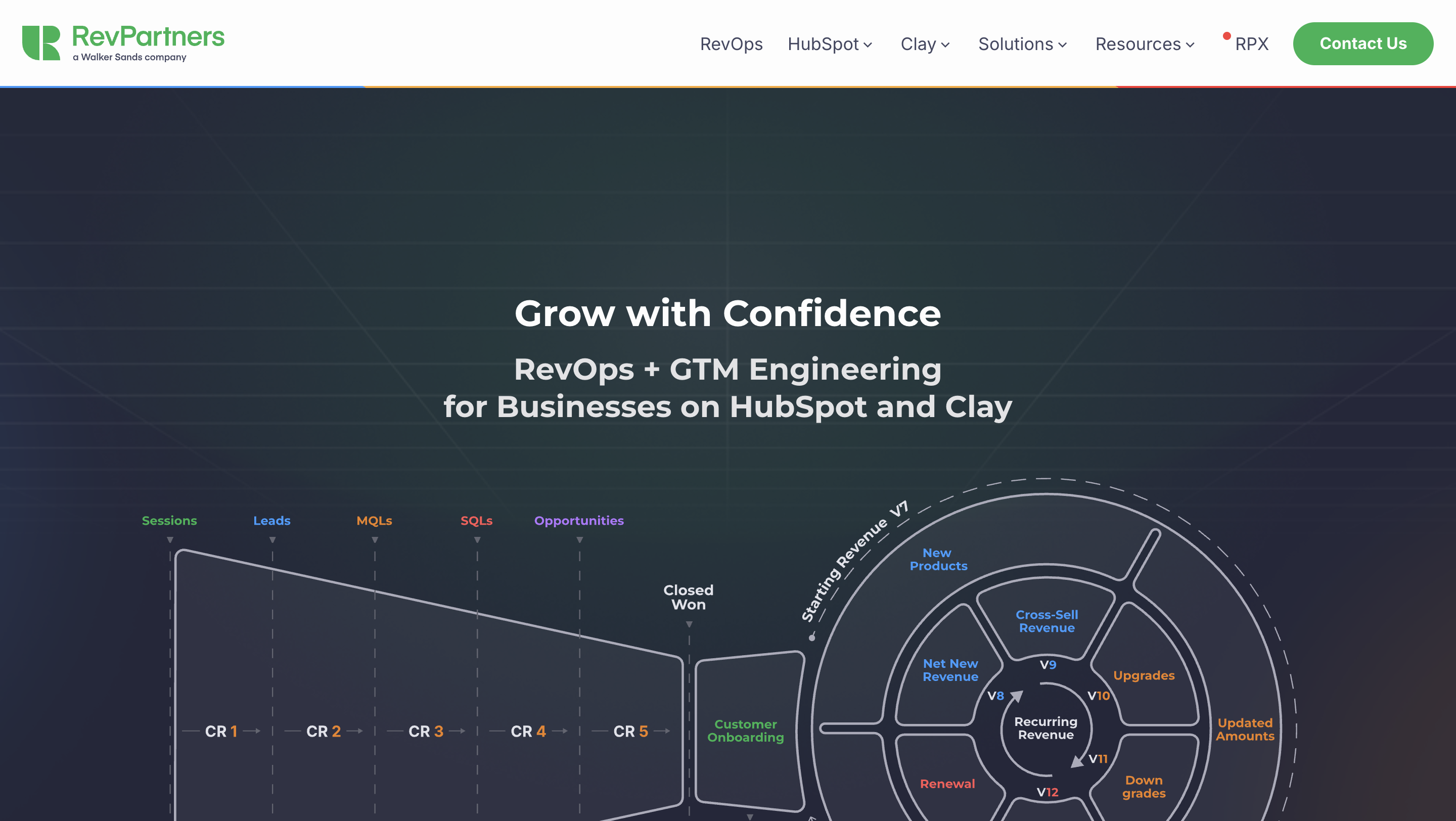
RevPartners started in 2021 by offering fractional RevOps: a team of specialists in place of one generalist employee. That model fits the €2M–€10M band well, because the company gets strategy, HubSpot administration, and reporting skills together at a point where it cannot justify hiring each separately.
It is the only firm to hold both HubSpot Elite Solutions Partner and Clay Elite Studio Partner status, which matters for teams that run outbound and enrichment through Clay and want that data landing correctly in HubSpot. Day-to-day work covers HubSpot implementations, migrations, integrations, CRM architecture, and the reporting on top.
In June 2026 RevPartners was acquired by Walker Sands, a B2B growth agency, and continues to operate under its own name. Buyers should ask how the acquisition affects team allocation and pricing for smaller accounts.
Key services
- Fractional RevOps on a subscription basis
- HubSpot implementation, migration, and integration
- CRM architecture and data work
- GTM engineering with Clay
- Revenue reporting and RevOps training
Why RevPartners stands out for €2M–€10M ARR companies
- A team of specialists for a monthly fee, at the stage where a single operations hire would be stretched across too many disciplines
- Elite status with both HubSpot and Clay, a combination no other firm holds
- Subscription structure lets the scope grow or shrink as the company does
- Deep experience of Sales Hub implementations
Best fit: Companies committed to HubSpot that want operations capacity quickly and expect to keep the arrangement running. It is a weaker fit for Salesforce-first teams, and for companies whose main gap is the link between acquisition spend and revenue.
4. Six & Flow
Best for: UK and European B2B teams towards the upper end of the band that run on HubSpot and need the platform rebuilt around a defined revenue process, with security credentials procurement will accept
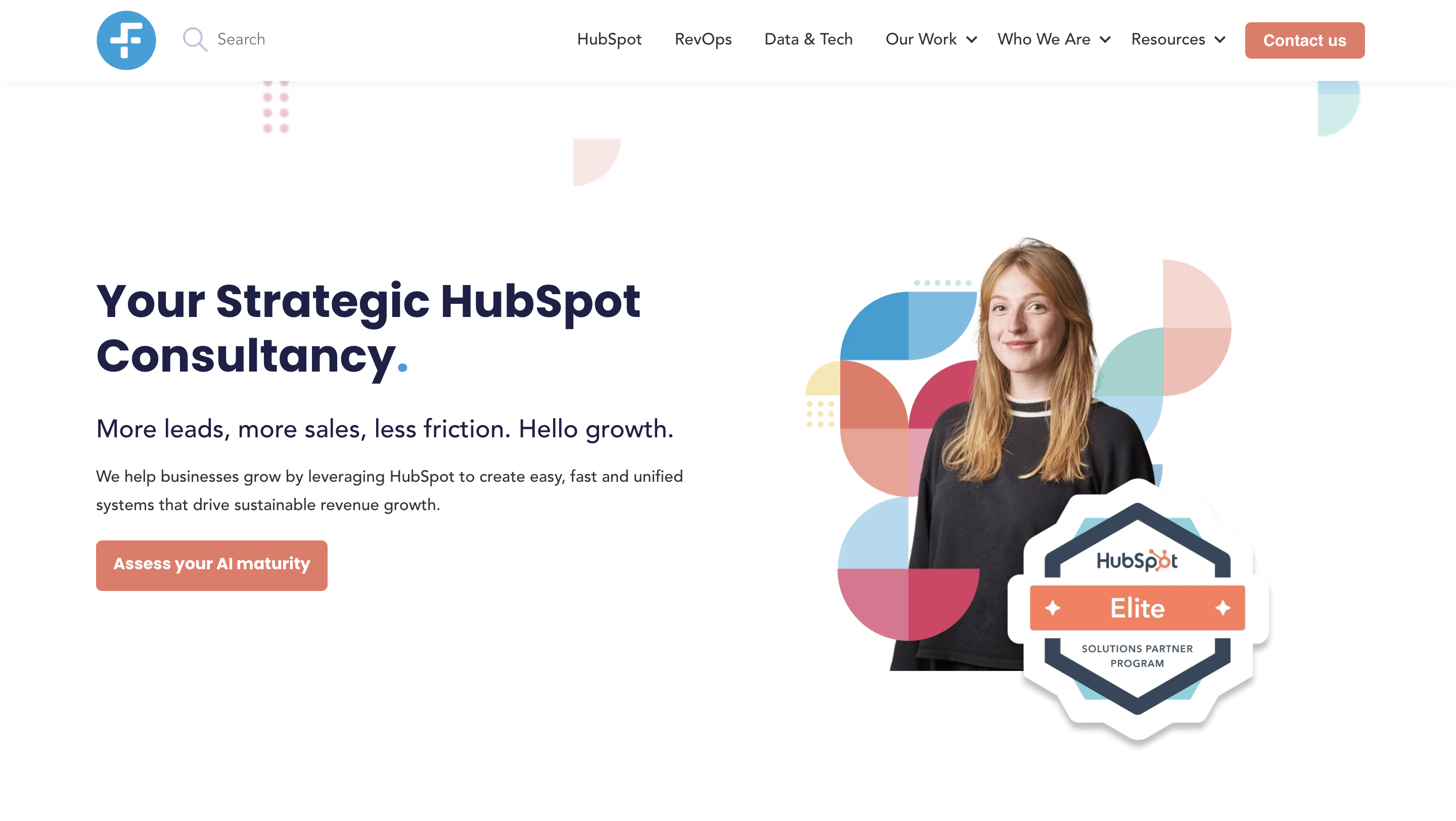
Six & Flow is a HubSpot Elite Partner with more than ten years of delivery and teams across the UK, the Netherlands, Ireland, and Canada. It describes itself as an AI-first HubSpot consultancy and RevOps partner, and holds ISO 27001:2022 certification.
For a company approaching €10M ARR, two things make it relevant. The first is its RevOps method, which maps the customer journey using the bowtie model, identifies where process gaps sit, and then configures HubSpot to close them. The second is governance. SaaS companies selling to regulated or enterprise buyers increasingly face security questionnaires about their suppliers, and a certified implementation partner shortens that conversation. Its FLAIR framework applies the same discipline to adopting AI features inside the CRM.
Six & Flow's stated client base is mid-market and enterprise. A company at €2M–€3M ARR may find the engagement larger than it needs. One at €7M–€10M with a HubSpot portal showing its age is closer to the profile.
Key services
- HubSpot CRM implementation, optimisation, and integration
- RevOps process assessment and bowtie mapping
- CRM and data architecture
- AI enablement under the FLAIR framework
- Ongoing RevOps enablement and support
Why Six & Flow stands out for €2M–€10M ARR companies
- UK headquarters and European presence, with working hours and commercial context that suit European teams
- ISO 27001:2022 certification, useful for fintech and for SaaS selling into regulated sectors
- A structured approach to AI inside HubSpot at a time when most teams are switching features on without a plan
- Process assessment comes before configuration
Best fit: HubSpot-based companies at the top of the band, especially in the UK and Ireland, preparing their systems for the next stage. Smaller teams should check that the proposed scope matches what they can maintain.
5. Iceberg RevOps
Best for: Venture-backed SaaS companies building their first dedicated sales and marketing teams, with no operations hire in place
Iceberg is a revenue operations consulting firm whose clients are mostly SaaS startups at seed, Series A, and Series B. It provides what it calls a RevOps team as a service: architects and administrators who clean up the go-to-market systems a company already has, implement new ones where needed, and set the strategy for what comes next.
That description places it squarely at the lower and middle part of this ARR band. A company at €2M–€4M ARR with a handful of reps and a newly hired head of marketing typically has a CRM full of duplicate records, no routing rules, and no agreed lifecycle stages. Iceberg's work addresses that directly: systems strategy first, then the build, on either Salesforce or HubSpot.
Its consultants are expected to advise as well as execute, which matters when the client has no internal operations lead to write the brief. The firm frames its cost against that of a senior sales operations hire, a comparison founders at this stage are already making.
Key services
- RevOps team as a service
- Clean-up and restructuring of existing go-to-market systems
- Salesforce and HubSpot implementation
- Operational roadmaps and systems strategy
- Marketing automation and routing set-up
Why Iceberg RevOps stands out for €2M–€10M ARR companies
- A client base concentrated on seed to Series B SaaS, so the patterns it has seen match the problems at this stage
- Works on both Salesforce and HubSpot
- Combines advice and hands-on build, for teams with no one internal to direct the work
- Positioned as an alternative to an early senior operations hire
Best fit: Companies at €2M–€5M ARR formalising sales and marketing operations for the first time. Companies closer to €10M with an established operations lead may need deeper specialisation in one area.
6. Domestique
.png)
Best for: Lean commercial teams that want fractional RevOps delivered through documented go-to-market playbooks they keep
Domestique is a fractional RevOps firm based in Boulder, Colorado. Its service is organised around GTM operations playbooks: written definitions of how leads are handled, how pipeline is managed, and how the tech stack is configured, delivered by a fractional team working across HubSpot and Salesforce.
The playbook emphasis is what earns its place on a list for this ARR band. A €2M–€10M company loses a great deal of operating knowledge every time a rep or an early marketer leaves, because the process was never recorded. A written playbook, implemented in the CRM, gives the next hire something to follow and gives leadership something to change deliberately.
Domestique's published focus runs from seed to Series B, so its scope and pricing assume a small team. It is a US firm, which European buyers should factor into time-zone overlap and into any questions about data protection practice.
Key services
- Fractional RevOps leadership and execution
- GTM operations playbooks
- CRM implementation on HubSpot or Salesforce
- Tech stack selection and configuration
- Sales and marketing operations support
Why Domestique stands out for €2M–€10M ARR companies
- Documentation is the product: the playbook stays with the client when the engagement ends
- Fractional structure priced for early-stage budgets
- Covers both major CRMs
- Stage focus that stops at Series B, so attention is not pulled towards larger accounts
Best fit: Teams that want process written down and implemented without hiring a full-time operations lead. Less suited to European companies that need local market presence or in-person working.
7. RevPal
Best for: SaaS companies whose CRM has fallen behind the sales motion and who want a senior operator running RevOps month to month
RevPal is a revenue operations firm built for SaaS companies, based in Bend, Oregon. Its model is RevOps as a service: fractional leadership combined with hands-on execution, run as a continuing partnership instead of a project with an end date. It works across HubSpot and Salesforce.
The fit for this ARR band is strongest in the middle of it. By €5M ARR, a company has usually changed its pricing, added a segment, and hired a second sales team since the CRM was first configured. The result is CRM debt: fields nobody uses, automation that fires for reasons nobody remembers, and a forecast built outside the system. RevPal's sequence of assessment, strategy, implementation, and adoption is designed to work through that debt while the business keeps selling.
Because the engagement is ongoing, the question for buyers is dependency. Ask what the internal team will be able to run alone after twelve months.
Key services
- Fractional RevOps leadership
- CRM architecture and technical debt remediation
- Forecasting and pipeline reporting
- Attribution and revenue reporting
- AI workflow development for sales, marketing, and customer success
Why RevPal stands out for €2M–€10M ARR companies
- Works only with SaaS, so recurring revenue mechanics do not need explaining
- Senior leadership is part of the service, not an upgrade
- Handles both HubSpot and Salesforce, including moves between them
- Monthly cadence suits companies whose priorities shift each quarter
Best fit: SaaS teams at €4M–€10M ARR with accumulated CRM debt and no senior operations owner. Companies that want a fixed project with a clear end may prefer a different model.
8. Aptitude 8
Best for: Companies with a technically demanding HubSpot requirement, or with HubSpot and Salesforce running side by side
Aptitude 8 is a HubSpot Elite partner known for complex, product-minded HubSpot implementations. Where most partners configure standard objects and workflows, Aptitude 8 takes on custom data models, non-standard integrations, and environments where HubSpot has to coexist with Salesforce.
Most €2M–€10M ARR companies do not need that depth. Some do. A usage-based pricing model, a marketplace with two customer types, or a product-led motion feeding a sales team all require CRM structures that the default set-up cannot represent. In those cases a lighter implementation produces a system that misdescribes the business, and every report built on it inherits the error.
Its published stage fit runs from Series A to enterprise, so a company in this band sits at the smaller end of its client range. That is worth raising when scoping.
Key services
- Complex HubSpot implementation and custom data modelling
- HubSpot and Salesforce hybrid environments
- Custom integrations
- Migrations to HubSpot
- Managed services after launch
Why Aptitude 8 stands out for €2M–€10M ARR companies
- Technical depth for business models the standard HubSpot configuration does not cover
- Experience running HubSpot alongside Salesforce, common after an acquisition or a partial migration
- A product mindset: the CRM is treated as something to be designed, not just set up
- Elite partner status
Best fit: Companies in this band with a complicated commercial model or a two-CRM estate. For a conventional sales-led SaaS business with a single pipeline, it is more capability than the problem requires.
9. Winning by Design
Best for: Leadership teams that need marketing, sales, and customer success working from one operating model before any system is touched
Winning by Design is a recurring revenue consultancy. Its Revenue Architecture method, including the Bowtie model and the SPICED framework for qualification, gives a company a common vocabulary for the whole customer lifecycle, from first contact through renewal and expansion.
At €2M–€10M ARR this matters when the disagreement is about meaning, not tooling. If marketing counts a lead one way, sales counts an opportunity another, and customer success is not counted at all, then no CRM project will help until the definitions are settled. Winning by Design settles them, and trains the team to use them through its own courses.
It is not an implementation agency. A company that adopts the model will still need someone to configure the CRM to reflect it, whether an internal administrator or one of the other firms on this list.
Key services
- Revenue Architecture design
- Bowtie model for lifecycle measurement
- SPICED qualification framework
- Sales and customer success playbooks
- Training for commercial teams
Why Winning by Design stands out for €2M–€10M ARR companies
- Fixes definitions first, the step most often skipped by companies at this stage
- Frameworks widely used in SaaS, so new hires often arrive already knowing them
- Includes customer success and expansion, which early RevOps work tends to leave out
- Training means the knowledge stays in the team
Best fit: Companies where the commercial functions cannot agree on what the numbers mean. It should be paired with an implementation partner, and is less relevant if the operating model is already agreed and the gap is technical.
10. Avidly
Best for: SaaS companies selling into several European markets that need one HubSpot portal to serve all of them
Avidly is a HubSpot Elite agency with teams in the UK, Germany, the Nordics, and Canada, and more than 200 customer reviews in HubSpot's partner directory. Its scope is broader than RevOps alone, covering marketing, web, and brand work on top of CRM delivery.
International expansion often begins inside this ARR band. A company founded in one country opens a second and third market, and the CRM has to handle multiple currencies, languages, sales teams, and consent rules. Portals built for a single market struggle with this, and the usual symptom is regional reporting that cannot be reconciled with the group total.
Avidly's local teams are the practical advantage here: specialists who work in the language of each market and understand how buying differs between them. Companies operating in one country will not need that, and may find a specialist RevOps firm more focused.
Key services
- HubSpot implementation across marketing, sales, and service
- Multi-market and multi-language portal design
- System integration
- Web development and content
- Ongoing HubSpot support
Why Avidly stands out for €2M–€10M ARR companies
- Local delivery teams in several European markets
- A large volume of public reviews, which makes references easy to check
- Can combine CRM work with the website and marketing that feed it
- Elite partner status
Best fit: Companies on HubSpot expanding across European markets. Single-market companies, and those on Salesforce, should look elsewhere on this list.
Why dimartec Approaches RevOps Differently at This Stage
Each of the other nine agencies is strong at a defined part of the job. Cremanski & Company structures the sales organisation of European scale-ups. RevPartners supplies a HubSpot operations team by subscription. Six & Flow rebuilds HubSpot with certified governance. Iceberg RevOps and Domestique give early teams their first working operations function. RevPal takes ongoing ownership of a CRM that has drifted. Aptitude 8 handles the technically difficult builds. Winning by Design settles the operating model. Avidly makes one portal work across several countries.
What they have in common is a starting point. Each begins at the CRM and works outwards from the data already in it. None of them runs the campaigns, pages, and sequences that put the data there.
For a company at €2M–€10M ARR, that boundary is where the money is lost. The budget is too small to waste a quarter on the wrong channel, and the team is too small to coordinate three suppliers who each define success differently. When the agency building the reporting has no influence over how leads are generated, the reports describe the past accurately and change nothing about the next quarter.
dimartec treats RevOps as the measurement layer of a single programme. Performance Paid Media, CRO, GEO, and Lead Gen & Nurturing generate and qualify demand. RevOps & Automation records what happens to it through to closed-won, and that evidence decides where the next euro of spend goes. The same team is answerable for both halves.
See how the Revenue Engine works: https://www.dimartec.co.uk/services/revenue-engine
Three Things to Check Before You Sign
One: Who maintains it in month seven? Ask the agency to name the role inside your company that will own the system after handover, and what that person will need to know. If the honest answer is a RevOps manager you do not employ, the build is sized for a larger company. A good answer describes what your head of sales or marketing operations generalist can change alone, and what would still need outside help.
Two: What would they choose not to build yet? An agency that understands this stage will have a list of things it deliberately leaves out: territory models, complex scoring, multi-touch attribution with weighting schemes. Ask for that list. Agencies that cannot name anything they would postpone tend to deliver the over-build.
Three: Where does their responsibility stop? Establish exactly which parts of the revenue process the agency controls and which it only reports on. If it configures the CRM but has no part in campaigns, landing pages, or outbound, decide in advance who will act on what the reporting shows. Without that, the project produces insight with no owner.
Frequently Asked Questions
Should a company at €2M–€10M ARR hire a RevOps agency or a RevOps manager?
For most companies in this band, an agency or fractional team comes first and the hire comes later. A single RevOps manager is asked to cover CRM administration, process design, reporting, and tooling decisions, which is four jobs. An agency supplies those skills together and has already seen the common mistakes. The usual path is to have the system built externally, run it for two or three quarters, and then recruit someone to own a system that already works, which is a far easier role to fill.
How much does a RevOps agency cost at this stage?
Published 2026 buyer's guides put RevOps as a service at roughly $5,000 to $18,000 per month, depending on scope and seniority. Fixed-scope implementation projects are priced separately and vary with CRM complexity. The more useful comparison is with the fully loaded cost of a senior operations hire plus the months it takes to recruit one. Ask every agency for the price of the first ninety days and for what will exist at the end of them.
Is HubSpot or Salesforce the better CRM for a SaaS company at €2M–€10M ARR?
Either can work, and the choice matters less than how it is set up. HubSpot is generally quicker to implement and easier for a small team to administer, which is why many agencies serving this stage specialise in it. Salesforce allows more customisation and suits companies with complex deal structures or plans to sell to large enterprises, at the price of needing more administration. The deciding question is who will maintain it. If nobody on the team can administer Salesforce, the extra flexibility will go unused.
What should RevOps cover first at €2M ARR?
Start with three things: one agreed definition of each pipeline stage, enforced by the CRM; automatic routing so that every inbound lead reaches the right person quickly; and source tracking that survives from first touch to closed-won. Forecasting models, lead scoring, and customer success integration come afterwards, once there is clean data for them to use. Building the later layers first is the most common reason early RevOps work has to be repeated.
Buy RevOps for the Company You Are, Built to Hold at €10M
The right revenue operations partner for a €2M–€10M ARR company is not the largest or the most technical. It is the one whose work your current team can run on Monday morning and that will not need replacing when the team doubles. That means recorded process in place of founder memory, one pipeline definition, a clear line from spend to closed revenue, and nothing that requires a department to maintain.
The Revenue Engine brings Performance Paid Media, CRO, GEO, Lead Gen & Nurturing, and RevOps & Automation into one programme, so the system that measures your growth is designed with the activity that produces it.
See how the Revenue Engine works: https://www.dimartec.co.uk/services/revenue-engine






.png)







.png)

















































.png)
.png)
.png)
.png)
.png)
.png)
.png)
.png)
.png)
.png)