
Predictable revenue is not a higher volume of leads. It is a system where the forecast is accurate, the pipeline can be defended in a board meeting, and the growth rate does not depend on which individual happens to be having a good quarter. Most B2B SaaS companies at the growth stage have one of these properties some of the time. Almost none have all three consistently.
The distinction matters because the most common response to unpredictable pipeline is to add more: more ad spend, more outbound sequences, more content, more channels. Adding more to a system that is structurally unpredictable produces more variability, not less. The pipeline grows in volume but remains impossible to forecast with confidence, because the variability was never in the volume. It was in the qualification standard drifting between team members, in the close rate depending on which account executive managed the deal, in the attribution model that cannot reliably connect pipeline generation to a specific channel in a specific month.
Predictable revenue requires three things working in sequence. A consistent top-of-funnel signal where the demand generation programme produces roughly the same number of qualified opportunities in roughly the same time window every month. A stable mid-funnel conversion rate where the same type of lead converts at the same rate through each pipeline stage regardless of which team member handles it. And a reliable close rate where deals of the same size and segment close within an expected window with an expected win rate. Break any one of these three and the number that arrives at the board table is a guess with historical context, not a defensible forecast.
The agencies below are evaluated specifically against this three-layer requirement. Any agency can generate more leads. The agencies that build predictable revenue are the ones that fix the conversion rate stability and close rate reliability alongside the top-of-funnel volume.
The Predictability Stack: Why Most Agencies Fix One Layer and Leave Two Broken
The three layers of predictable revenue are dependent. Fixing the top-of-funnel without fixing the mid-funnel produces more leads entering a conversion rate that varies by 30 to 50% depending on which team member receives the lead and how their version of the qualification process compares to the next person's. The volume metric improves. The forecast does not.
Fixing the mid-funnel conversion rate without fixing the top-of-funnel produces consistent conversion of whatever comes in, but the volume that comes in is still irregular. A campaign that over-delivers in one month and under-delivers the next produces a consistent conversion rate applied to an inconsistent input, which means the SQL output remains unpredictable even when the conversion efficiency has been improved.
Fixing attribution without fixing the other two produces accurate reporting on an unpredictable number. The board can now see exactly where each quarter's miss originated. That is useful for diagnosis. It is not the same as predictability.
The agency market is structured to fix one layer per engagement. Paid media agencies fix the top-of-funnel volume but do not own the qualification infrastructure that determines what happens to the leads they generate. CRM and RevOps consultancies fix the attribution and routing logic but do not own the demand generation that creates the pipeline they are routing. Sales enablement consultancies fix the close rate by improving the sales playbook but do not own the channels generating the accounts the sales team is closing.
The result is a company that runs three separate agency engagements, co-ordinates the outputs manually, and discovers that the qualification standard the paid media agency is optimising against is different from the one the RevOps consultant implemented in the CRM, which is different again from the one the sales enablement firm built the playbook around. The three layers are fixed in isolation. Predictability requires them to be fixed against the same ICP definition, the same qualification standard, and the same attribution model.
The diagnostic metrics for each layer:
Top-of-funnel consistency: Monthly qualified opportunity volume variance. A programme delivering between 40 and 120 SQLs per month over a rolling six-month period is not predictable, even if the six-month average meets the target. Predictable top-of-funnel delivers within 15 to 20% of the monthly target consistently.
Mid-funnel conversion stability: MQL-to-SQL conversion rate variance by team member. If the best-performing SDR converts at 35% and the newest hire converts at 9%, the conversion rate system is not stable. The gap should be under 10 percentage points across the team. Anything larger indicates that the qualification standard is an individual capability rather than a documented process.
Close rate reliability: Win rate variance by deal size and segment. If enterprise deals close at 28% when one account executive handles them and 11% when another does, the close rate is person-dependent, not system-dependent. Predictable close rates require a documented sales playbook specific enough that new hires reach 85% of the team average within 90 days of ramping.
What Separates Predictable Revenue Programmes from High-Volume Lead Generation
The distinction between a predictable revenue programme and a high-volume lead generation programme is not the number of leads. It is the variance in outputs relative to inputs.
A high-volume lead generation programme delivers more leads per month than the company had before. The conversion rate is whatever it is. The forecast is the lead volume multiplied by the historical average conversion rate, which is itself an average across a distribution of outcomes wide enough to make the forecast a range rather than a number. When the board asks whether the company will hit the quarterly target, the honest answer involves a probability and several assumptions.
A predictable revenue programme delivers a specific number of SQLs within a specific range every month, converts them at a stable rate, and closes them within an expected window. The forecast is a number with a documented confidence interval derived from system performance, not from individual intuition. When the board asks whether the company will hit the quarterly target, the answer is based on stage-by-stage pipeline data that the head of marketing and head of sales have both signed off on because it comes from a shared CRM model they both trust.
The difference is not in the agencies' creative quality, channel expertise, or content sophistication. It is in whether the agency builds the measurement infrastructure alongside the demand generation programme, or treats measurement as a reporting layer that gets added after the campaigns are producing results. Predictable revenue requires measurement-first design: the attribution model, the qualification standard in the CRM, and the pipeline stage definitions all need to be agreed before the first campaign goes live, not retrofitted six months later when the board asks where the forecast gap came from.
1. dimartec
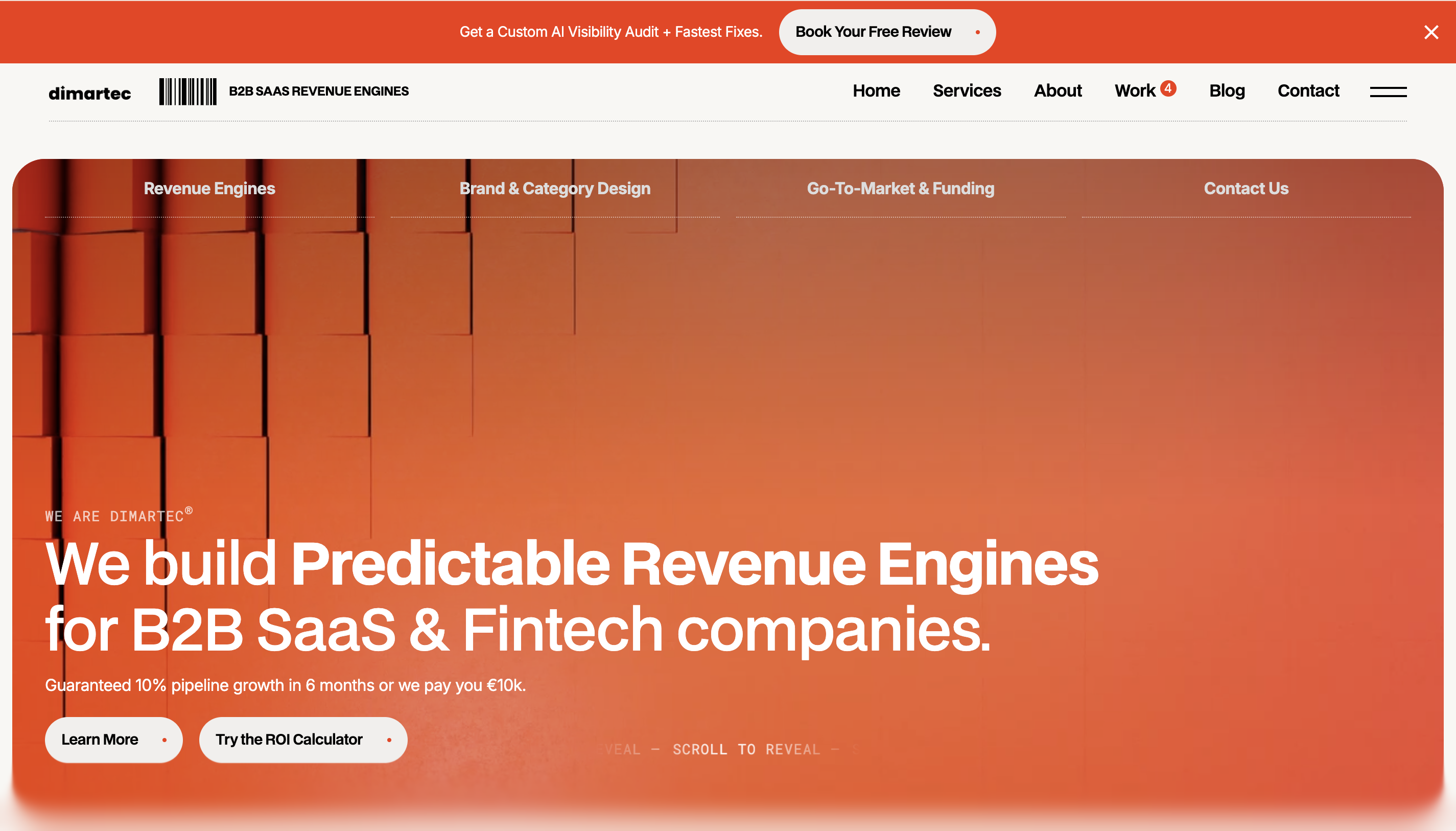
What they do: dimartec builds Revenue Engines for B2B SaaS and fintech companies at €2M–€10M ARR. The five integrated services are Performance Paid Media, CRO, GEO, Lead Gen and Nurturing, and RevOps and Automation. The architecture addresses all three layers of the Predictability Stack simultaneously: demand generation for top-of-funnel consistency, CRO and lead nurturing for mid-funnel conversion stability, and RevOps for attribution that makes close rate analysis and forecast construction possible from clean CRM data.
Top-of-funnel consistency: Performance Paid Media is calibrated against closed-won ICP profiles from the first session rather than against platform-reported conversion events. This means the audience the paid campaigns target is defined by the accounts that have already produced closed revenue at acceptable CAC payback, not by the broadest available proxy for the target market. The result is top-of-funnel volume that is qualified at point of entry rather than volume that requires extensive qualification work after the lead arrives in the CRM. GEO extends the top-of-funnel to the AI-assisted discovery channels where the target ICP is forming vendor shortlists before any paid impression reaches them, building a compounding demand creation layer that reduces month-to-month volume variance over time.
Mid-funnel conversion stability: Lead Gen and Nurturing translates the ICP definition established in the paid acquisition targeting into a documented qualification standard implemented in the CRM routing logic. Leads that meet the agreed standard are routed to sales. Leads that do not meet the standard enter a nurture sequence built around the buying triggers identified in the ICP validation work. The MQL-to-SQL conversion rate stabilises because every member of the revenue team is applying the same documented standard rather than their individual version of it. CRO ensures that the landing pages and conversion paths the paid and GEO programmes drive traffic to are converting at the rates the ICP targeting should produce, removing the mid-funnel leak that occurs when qualified intent arrives at a page that does not immediately confirm the message that created the intent.
Close rate and attribution: RevOps and Automation connects every stage of the pipeline to closed-won ARR in a single attribution model. Win rates by segment, CAC payback by channel, pipeline coverage ratios by quarter, and NRR by acquisition cohort are all produced from the same CRM data structure rather than assembled manually from three disconnected systems. This is the specific infrastructure that converts a marketing team's outputs into the investor-grade forecast a Series A or Series B board needs.
Verified outcomes: iDenfy generated €475k in qualified pipeline within three months. Wialon reduced cost per SQL by 52% year-on-year. Pilsenga achieved a 3,000% ROI on total ad spend with a 7.41% CTR against a 3.8% industry benchmark. Pinyya generated €2.04M in MQL pipeline value. These outcomes reflect system-level performance across all three predictability layers, not single-channel results from one part of the programme.
Best fit: Post-PMF B2B SaaS and fintech at €2M–€10M ARR where pipeline is growing but the forecast remains unreliable because qualification is inconsistent, attribution is fragmented across disconnected systems, or the demand generation programme produces volume with high monthly variance.
See how the Revenue Engine works
2. Ironpaper
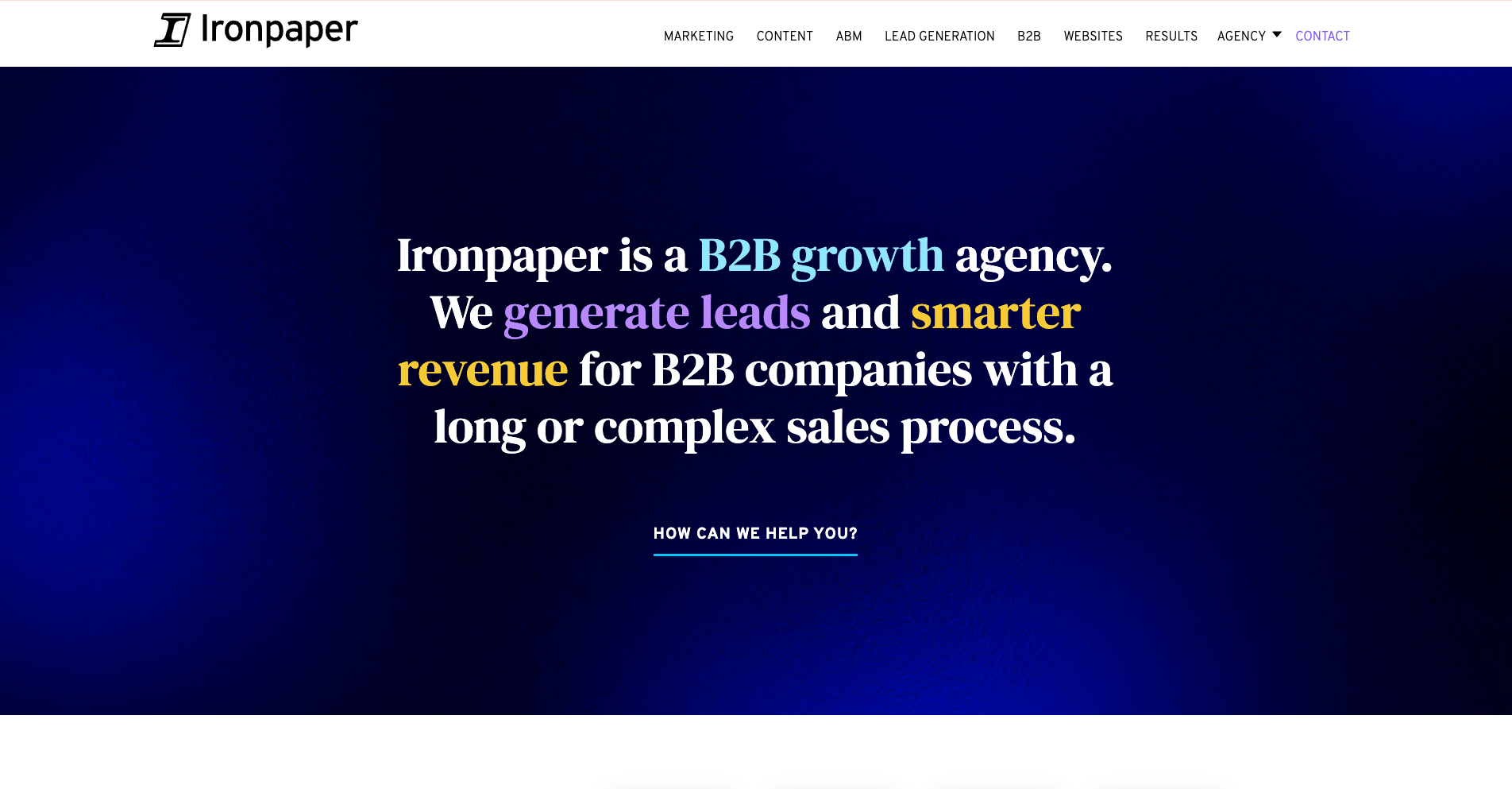
What they do: Ironpaper is a B2B growth agency for technology companies that specialises in demand generation built on an explicitly agreed qualification standard. Their methodology begins with a structured exercise that produces the shared definition of a sales-ready lead before any campaign is built: what specific firmographic and behavioural signals indicate evaluation readiness, what confidence level is required for routing to sales, and what context the sales team needs attached to each lead to make the first conversation productive rather than diagnostic. The demand generation programme that follows is built to identify and advance accounts meeting those criteria specifically.
Why the qualification standard comes first: The most common source of mid-funnel conversion instability in B2B SaaS is not the quality of the campaigns generating the leads. It is the absence of a shared definition of what the campaigns should be generating. Marketing optimises against form fills. Sales qualifies against conversation readiness. The two standards are not the same, and the gap between them is the source of the MQL-to-SQL conversion rate variance that makes the forecast unreliable. When marketing passes leads that meet their definition and sales rejects them for not meeting theirs, neither team has the data to determine which definition was right, because neither definition was documented precisely enough to be tested.
Ironpaper addresses this by making the qualification standard development the first deliverable of the engagement. The exercise produces a written document that both the marketing and sales team sign off on: the specific ICP criteria, the specific intent signals at each stage of the buying journey, the specific context that should accompany each lead when it is routed to sales, and the specific follow-up timeline that defines when a routed lead should be re-evaluated. This document becomes the architecture of the CRM routing logic, the campaign optimisation criteria, and the SDR qualification framework. When every component of the revenue system is built on the same written standard, the conversion rate between stages becomes a function of how well the programme is executing against the standard rather than of which team member happened to handle each lead.
Demand generation built on qualification criteria: Ironpaper's campaigns are designed to generate the signals the agreed qualification standard specifies, not to maximise the volume of contacts who interact with any content. This produces lower raw lead volume than a volume-optimised programme and higher MQL-to-SQL conversion rates. At the B2B SaaS growth stage, where the sales team's capacity is the scarce resource, converting that capacity against qualified pipeline is worth more than converting it against a high-volume unqualified list.
Best fit: B2B SaaS at €2M–€7M ARR where the MQL-to-SQL conversion rate is declining or inconsistent, where the sales team and marketing team have different working definitions of a qualified lead, and where the primary predictability gap is in the mid-funnel conversion rate rather than the top-of-funnel volume.
3. Lean Labs
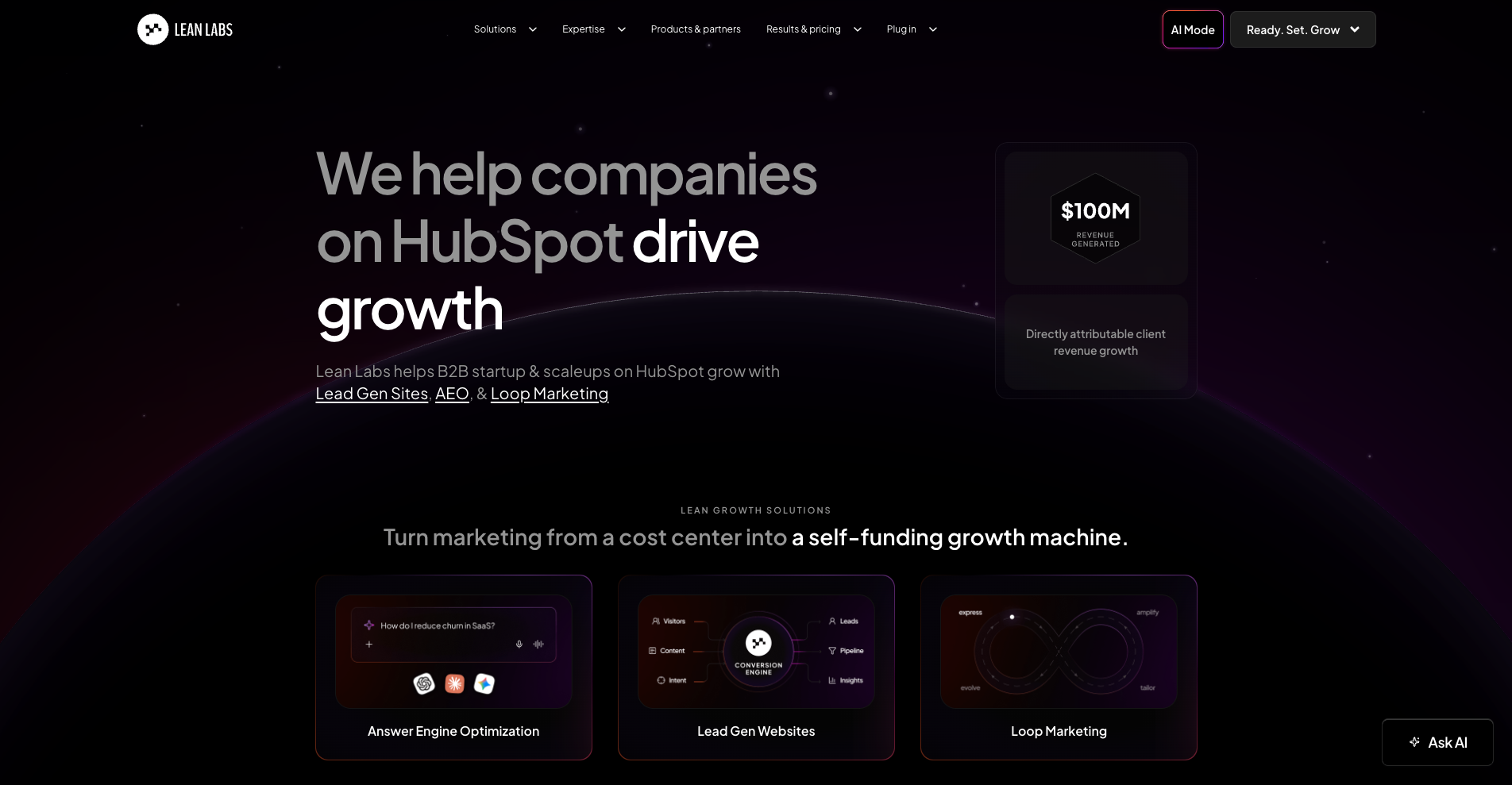
What they do: Lean Labs is a HubSpot-native inbound marketing agency for B2B SaaS and technology companies that builds demand generation programmes connected to revenue attribution from the first month of the engagement. Their model integrates content strategy, SEO, paid promotion, and HubSpot CRM architecture into a single programme where every inbound lead is attributed to the content or channel that generated it, tracked through each pipeline stage, and connected to closed-won ARR. The result is an inbound programme that produces board-reportable pipeline contribution data rather than content performance metrics that have no direct line to revenue.
The attribution-first design: The most common problem with inbound demand generation at the B2B SaaS growth stage is not the quality of the content or the volume of the traffic. It is that the programme's contribution to pipeline is visible only in aggregate, if at all. Content teams can report on organic traffic growth, time-on-page, and whitepaper downloads. They cannot typically tell the board which blog post, which content sequence, or which inbound channel contributed to which closed deal. This means the inbound budget is evaluated against proxies for value rather than against actual revenue contribution, which makes the case for continued or increased investment difficult to sustain when the board is under pipeline pressure.
Lean Labs builds the HubSpot CRM architecture before the content programme launches, so that every lead entering through an inbound channel carries attribution data that follows it through the pipeline. When a deal closes, the attribution chain from the first inbound content touchpoint to the closed-won opportunity is recorded in HubSpot and reportable. This transforms the inbound programme from a cost centre that produces traffic metrics to a revenue programme that produces pipeline attribution data with a direct line to the board's growth metric.
Top-of-funnel consistency through compounding channels: Lean Labs focuses on inbound channels that compound over time: organic search, pillar content, and HubSpot-native lead nurturing that converts inbound contacts into sales-ready leads over a defined timeline. The compounding nature of these channels is specifically valuable for predictable revenue because a mature inbound programme produces a more consistent monthly SQL volume than paid acquisition, which is subject to budget decisions, platform changes, and audience saturation. The combination of a compounding inbound floor and a paid acquisition programme that handles monthly demand variation produces the top-of-funnel consistency that makes forecasting reliable.
HubSpot depth: Lean Labs operates at a technical depth in HubSpot that most agencies presenting themselves as HubSpot partners do not reach. Their CRM architecture work covers lead scoring model calibration, lifecycle stage definitions, pipeline stage exit criteria, and workflow automation that routes leads based on the agreed qualification standard rather than on default HubSpot settings. This technical depth is what makes the attribution data reliable: the tracking is not dependent on manual data entry or on team members following a convention; it is built into the CRM architecture and fires automatically on the events the programme generates.
Best fit: B2B SaaS at €2M–€8M ARR on HubSpot where the inbound programme is producing traffic and content engagement but the pipeline contribution of that activity cannot be demonstrated from CRM data, and where the lack of inbound attribution is making it difficult to defend the content investment to the board or to scale it confidently.
4. Inturact
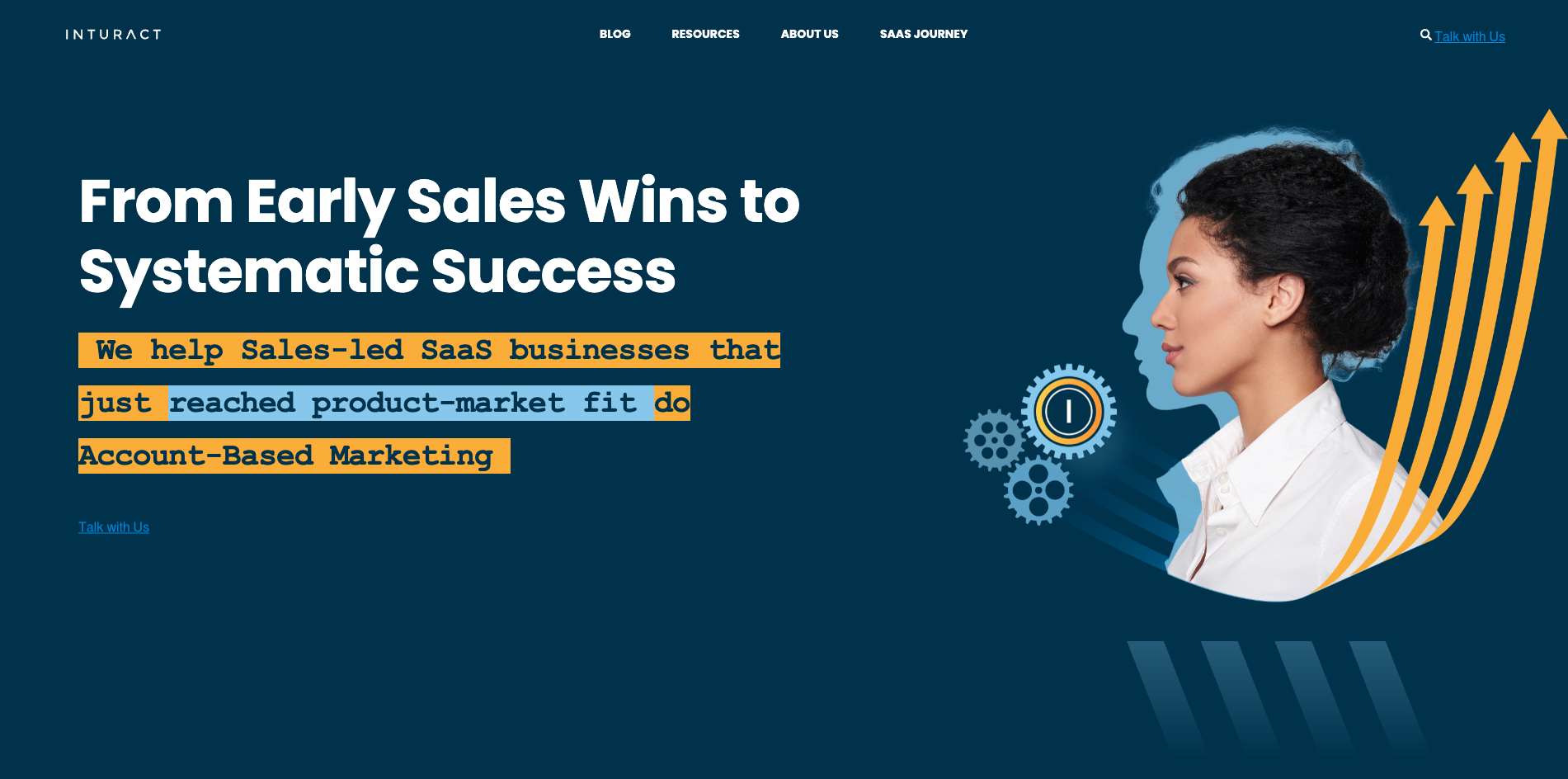
What they do: Inturact is a SaaS-specific growth agency that connects acquisition strategy to the full revenue lifecycle: activation, expansion, and retention. Their methodology is built on the observation that most SaaS marketing programmes stop measuring at the point of acquisition, treating the marketing team's job as ending when a lead converts to a paid customer. Inturact's model measures through activation (does the customer reach the first meaningful product action?), through expansion (does the customer's account value grow after the initial close?), and through retention (what is the NRR by acquisition cohort, and what does it reveal about ICP quality?). These downstream metrics feed back into the acquisition strategy, making the demand generation programme progressively more accurate in targeting the accounts that produce the best lifetime commercial outcomes.
Why post-acquisition data changes the acquisition strategy: The most expensive mistake in B2B SaaS demand generation is acquiring customers who churn quickly or fail to expand. These customers look identical to high-LTV customers at the point of acquisition; the qualification criteria that allowed them into the pipeline are the same criteria that allowed the best customers in. The difference becomes visible only 6 to 12 months post-close, when the NRR by cohort shows which acquisition channels, content assets, and campaign types produced customers who expanded and which produced customers who churned at the first renewal.
Inturact builds this cohort analysis into the RevOps infrastructure and uses it to recalibrate the acquisition targeting every quarter. Channels that produced high-NRR cohorts receive proportionally more budget. Channels that produced low-NRR cohorts receive less, regardless of their cost per acquisition, because the cost per acquisition is only half of the CAC payback calculation. The other half is the LTV the customer produces, and that number is not visible at the point of acquisition. Making it visible retroactively and connecting it to the acquisition channel decisions is the mechanism that produces the compounding improvement in revenue quality that eventually makes the forecast not just accurate but consistently conservative relative to actual closed ARR.
Activation as a predictability lever: Inturact's attention to activation is specifically relevant to B2B SaaS predictable revenue because activation failure is the most common cause of early churn, and early churn is the most common cause of NRR falling below 100%. A customer who churns at the first renewal was never activated: they bought the product but never reached the workflow integration or the specific capability that makes the product valuable enough to renew. Identifying the activation milestone that predicts renewal and building the customer success onboarding around reaching that milestone reduces early churn systematically rather than through individual CS heroics.
Best fit: B2B SaaS at €3M–€10M ARR where the acquisition programme is producing customers but NRR is below 105%, early churn is compressing the ARR growth rate, or the expansion revenue contribution is below 25% of net new ARR, indicating that the acquisition strategy is generating the wrong customer profile at scale.
5. Roketto

What they do: Roketto is a B2B SaaS demand generation agency whose methodology begins with positioning clarity and ICP concentration before any channel is activated. Their foundational argument is that predictable top-of-funnel volume requires a precisely defined ICP and a positioning statement that the target buyer recognises as written for their specific situation, because campaigns built on a broad ICP and generic positioning produce irregular volume: the ads reach the right accounts some of the time and the wrong ones most of the time, the conversion rate is an average across a wide dispersion of account quality, and the monthly SQL output varies with whichever subset of the audience happened to respond in a given period.
ICP concentration from existing customer data: Roketto's engagement begins with an analysis of the client's existing customer base to identify the segment responsible for the highest LTV, fastest sales cycles, lowest CAC payback, and strongest NRR. This segment is the concentrated ICP around which the demand generation programme is built. The positioning statement, the ad creative, the content strategy, and the SEO topic priorities are all derived from the pain points, buying triggers, and language patterns of this specific segment rather than from a market-level approximation of the target audience.
The practical consequence of this concentration is that the demand generation programme produces a more consistent quality of inbound SQL than a broad-ICP programme, because the audience being targeted is defined precisely enough to be consistently identifiable across channels. A precisely defined ICP produces top-of-funnel volume with lower monthly variance because the targeting criteria are stable and the conversion rate from targeting to qualified opportunity is consistent within the segment. A broad ICP produces higher raw lead volume with higher variance because the segment composition changes month to month depending on which part of the broad audience the campaigns happened to reach.
Positioning clarity as a forecasting input: An underappreciated source of forecast unreliability in B2B SaaS is positioning that is specific enough to generate interest but not specific enough to qualify intent. A positioning statement that resonates with a broad range of buyers produces a broad range of inbound leads: some who are ready to evaluate, many who are curious but not in-market, and a proportion whose company profile places them outside the ICP entirely. All of these leads enter the pipeline and require qualification effort to sort. The conversion rate from this broad inbound stream is structurally lower and more variable than the conversion rate from a stream generated by positioning that is specific enough to function as a self-qualification filter.
Roketto's positioning work produces copy specific enough that readers who are not in the ICP self-select out before converting: the ad headline, the landing page above the fold, and the first line of the form confirmation message all signal clearly enough who the product is built for that accounts outside the ICP do not convert at a material rate. This reduces the mid-funnel qualification burden and stabilises the conversion rate between MQL and SQL, which is one of the two primary inputs to a reliable pipeline forecast.
Predictable demand generation methodology: Roketto's demand generation programme sequences channel activation against the validated ICP and positioning work: organic search and content are built to compound over time, paid acquisition is activated once the landing page conversion rate is established, and each channel is added in the order that produces the most consistent SQL output for the specific ICP rather than the order that produces the fastest raw lead volume. The resulting programme takes longer to reach full output than a simultaneous multi-channel launch but produces more consistent monthly SQL volume once it reaches operating pace, which is the specific property that makes the pipeline forecast reliable.
Best fit: B2B SaaS at Series A and above where the demand generation programme is producing SQLs but the monthly volume is inconsistent, the ICP definition has never been formally narrowed from the broad early-stage definition, and the positioning is generating interest across a wide range of accounts without creating the self-qualification filter that would stabilise inbound quality.
How to Diagnose Which Predictability Layer Is the Primary Constraint
Before engaging any agency, it is worth identifying which layer of the Predictability Stack is causing the most forecast variance. The answer determines the type of agency engagement that will produce the fastest improvement and the one that should start first.
If the top-of-funnel volume varies by more than 25% month to month, the constraint is usually in the demand generation programme itself. The ICP definition is too broad to target consistently, the channel mix is too dependent on a single source that fluctuates, or the paid campaigns are optimised against a conversion event that does not correlate reliably with SQL quality. Roketto or Lean Labs address this through ICP concentration and compounding inbound channel architecture respectively. dimartec addresses it through closed-won calibrated paid acquisition combined with a GEO programme that reduces month-to-month paid volume dependence.
If the top-of-funnel volume is consistent but the MQL-to-SQL conversion rate varies by more than 15 percentage points across the team or across months, the constraint is in the mid-funnel qualification infrastructure. The leads being generated are inconsistent in quality, or the qualification standard being applied to them is inconsistent, or both. Ironpaper addresses this directly by making the qualification standard development the first deliverable before any campaign architecture is built. dimartec addresses it through the Lead Gen and Nurturing service, which implements the ICP-calibrated qualification standard in CRM routing logic.
If the conversion rates are stable but the close rate varies significantly by deal size or account executive, the constraint is in the sales motion documentation rather than in the marketing programme. This is outside the scope of most marketing agencies and requires sales enablement work specifically. The RevOps attribution infrastructure dimartec and Lean Labs build can identify this problem precisely, which is the necessary precondition for addressing it correctly rather than investing in more demand generation to compensate for a sales motion problem.
If all three metrics are consistent but the forecast is still unreliable, the attribution model is the constraint. The three metrics are being measured in different systems that disagree with each other and are assembled manually into a forecast that inherits the inconsistencies of the source data. dimartec's RevOps service and Lean Labs' HubSpot attribution architecture both address this by building a single source of truth for pipeline data that all three metrics are produced from.
Three Questions to Ask Any Agency Before Engaging
What is your first deliverable, and does it produce a measurement model or a campaign? An agency whose first deliverable is a campaign is building output before the measurement infrastructure exists to evaluate whether the output is producing the right outcomes. An agency whose first deliverable is a qualification standard, an attribution model, or an ICP validation document is building the measurement infrastructure first, which means every subsequent campaign is evaluated against a stable and agreed benchmark.
How do you define predictable pipeline, and what metric do you use to measure it? An agency that defines predictable pipeline as "growing MQL volume" is not measuring predictability. An agency that defines it as "monthly SQL volume within 15% of target for six consecutive months" is measuring the right thing. The answer to this question reveals whether the agency is managing a volume metric or managing a system.
What happens to your attribution model when a deal closes 90 days after the first marketing touch? B2B SaaS sales cycles are typically 60 to 120 days. An attribution model that does not capture the full journey from first touch to closed-won is missing the most important data for making channel allocation decisions. An agency that cannot answer this question with specificity about how they handle multi-touch attribution across long sales cycles is not producing the data the pipeline forecast requires.
Frequently Asked Questions
What is predictable revenue for a B2B SaaS company?
Predictable revenue for a B2B SaaS company is the condition where the board can ask what the company will close this quarter and receive a number with a documented confidence interval based on stage-by-stage pipeline data, conversion rates verified against historical performance, and a clear attribution chain connecting current pipeline to the channels and campaigns that generated it. The number may turn out to be wrong. The important property is that it is derived from a system rather than from a collection of individual intuitions, which means when it is wrong, the data shows exactly which stage of the system produced the error.
How long does it take to build a predictable revenue programme?
A programme that produces defensible board-level forecasts typically takes four to six months to build from scratch and an additional two to three months of operating history to validate. The first three months are measurement and qualification infrastructure: the ICP definition, the CRM architecture, the attribution model, and the qualification standard all need to be in place before the demand generation programme begins producing data that is reliable enough to inform a forecast. The next three months are the first operating cycle, during which the monthly SQL volume, conversion rates, and close rates are tracked against the targets set in the infrastructure design. The forecast becomes defensible when six months of consistent performance against targets gives the revenue team enough historical data to calculate a confidence interval.
Should a B2B SaaS company hire one agency for predictable revenue or several specialists?
The case for a single integrated agency is the predictability argument itself: if the demand generation programme, the qualification standard, and the attribution model are owned by different agencies, the ICP definition used by each will diverge over time. The paid media agency will optimise against the audiences that produce the most conversions by their measurement. The RevOps consultancy will define qualification against the criteria the CRM has been configured to capture. The sales enablement firm will build the playbook around the accounts the existing sales team has been closing. None of these definitions is wrong, and none of them is the same. The qualification standard that makes the forecast reliable requires all three to agree, which requires them to be built against the same ICP from the start.
What is the most common reason predictable revenue programmes fail?
The most consistent failure mode is building the demand generation programme before the measurement infrastructure exists to evaluate it. A programme that launches campaigns before the qualification standard is documented, the CRM routing logic is configured, and the attribution model is agreed produces data that cannot be used to improve the programme: when the conversion rate is low, the team cannot determine whether the leads were low quality, the qualification was inconsistently applied, or the pipeline stage definitions were ambiguous. All three produce the same outcome in the data. Without a stable measurement system, the team's response to underperformance is to change the campaigns, which is the least likely source of the problem, because the campaigns are the one component that was designed carefully before launch.
How does NRR connect to the predictable revenue programme?
NRR is the most reliable indicator of ICP quality available to a B2B SaaS company. A cohort of customers acquired through a specific channel or campaign that renews at 85% NRR reveals that the channel or campaign is generating customers who are not deriving the value from the product that the marketing positioned them to expect. A cohort renewing at 120% NRR reveals that the channel is generating customers who are expanding because the product is delivering value that exceeds the initial use case. Connecting NRR by acquisition cohort to the demand generation programme is what converts the programme from a pipeline generation activity into a revenue quality programme: the goal shifts from maximising the number of customers acquired to maximising the LTV of the customers acquired, which produces a progressively more efficient CAC payback over time as the acquisition targeting concentrates on the channels that produce the best NRR cohorts.





.png)







.png)

















































.png)
.png)
.png)
.png)
.png)
.png)
.png)
.png)
.png)
.png)