
Scaling revenue in B2B fintech requires something no general marketing agency can provide: the ability to build institutional trust at speed, in a category where trust is the primary purchase criterion and the timeline for building it is measured in months, not weeks.
Fintech founders scaling from €2M to €10M ARR face a specific version of the founder-led sales transition problem. The first €2M came from the founder's personal credibility: their network, their reputation, their ability to personally reassure a risk-averse CFO or compliance officer that this vendor is safe to evaluate. That credibility does not transfer to a marketing programme automatically. It has to be systematised: documented in the form of case studies with specific commercial outcomes, expressed through a content programme that demonstrates regulatory fluency, reinforced by reference clients whose names carry institutional weight in the target market, and connected to a demand generation system that reaches the right buyer at the right intent stage.
After working with B2B fintech companies at this specific stage, the pattern that separates founders who successfully scale past €5M ARR from those who stall is consistent. The ones who scale replace founder credibility with institutional credibility before they scale acquisition spend. They build the trust infrastructure first: the proof, the compliance-aware content, the reference client programme, and the positioning framework that survives the compliance team's scrutiny. The ones who stall scale spend before this work is complete and discover that fintech buyers will not shortlist a vendor they have not already decided to trust.
This guide evaluates the five best B2B fintech marketing agencies for founders scaling revenue: the ones whose methodology accounts for the trust-building requirement that precedes acquisition efficiency, and whose output is a revenue system that works without the founder's personal credibility in every conversation.
The Founder's Fintech Scaling Problem
Fintech founders face four revenue scaling challenges that do not appear at the same intensity in general SaaS, and that determine which agency types are worth evaluating.
Founder credibility does not scale. A payments infrastructure founder who has spent three years building personal relationships with CFOs at mid-market banks has a pipeline that is almost entirely dependent on their presence. Every significant deal was influenced by a conversation they personally had. That presence cannot be delegated to an SDR team without first building the institutional credibility that makes the brand, rather than the founder, the entity being evaluated. Agencies that start with demand generation before this work is complete will generate interest from buyers who do not find the brand credible enough to proceed past the first compliance review.
The compliance layer slows every channel. Fintech marketing claims that cannot survive risk and legal review do not survive publication. An agency without documented compliance workflows adds review cycles to every content asset and campaign, stripping the specificity that makes messaging convert and adding weeks to the time between idea and market. For a founder managing a small team, this friction consumes the internal capacity that should be going to product and sales.
Institutional trust has a 12–18 month build time. Financial services buyers, particularly banks, credit unions, and regulated financial institutions, build vendor trust over time rather than through a single impressive pitch. A brand that has been consistently visible across industry publications, conferences, and AI search for 12 months is fundamentally more credible to a compliance officer than one that has run a paid campaign for four weeks. Agencies that promise fast pipeline from cold demand generation in fintech are describing a different buyer than the one a regulated financial institution sends to evaluate enterprise technology vendors.
The investor narrative requires fintech-specific metrics. Series A and B investors evaluating a fintech company ask different questions from those evaluating a general SaaS company: regulatory coverage, compliance history, the security posture visible from public documentation, the quality of reference clients, and the depth of the sales cycle evidence. A marketing programme that produces MQL volume but cannot show a compelling investor narrative built from these specific signals is not serving the founder's fundraising objective alongside the revenue objective.
What We Looked For
The agencies on this list were selected against criteria specific to the founder's fintech scaling challenge, not against generic fintech marketing criteria. We looked for agencies with documented compliance workflows built into their production process, not claimed as a capability. We looked for evidence of work at the founder stage specifically, not at enterprise scale applied to smaller clients. We looked for methodologies that address institutional trust building as a prerequisite to demand generation, not as a parallel workstream. We looked for fee structures and engagement models that match the financial constraints of a €2M–€10M ARR fintech company. And we looked for named fintech clients at comparable stages with specific commercial outcomes, not case studies that describe the work without the results.
The 5 Best B2B Fintech Marketing Agencies for Founders Scaling Revenue
1. dimartec
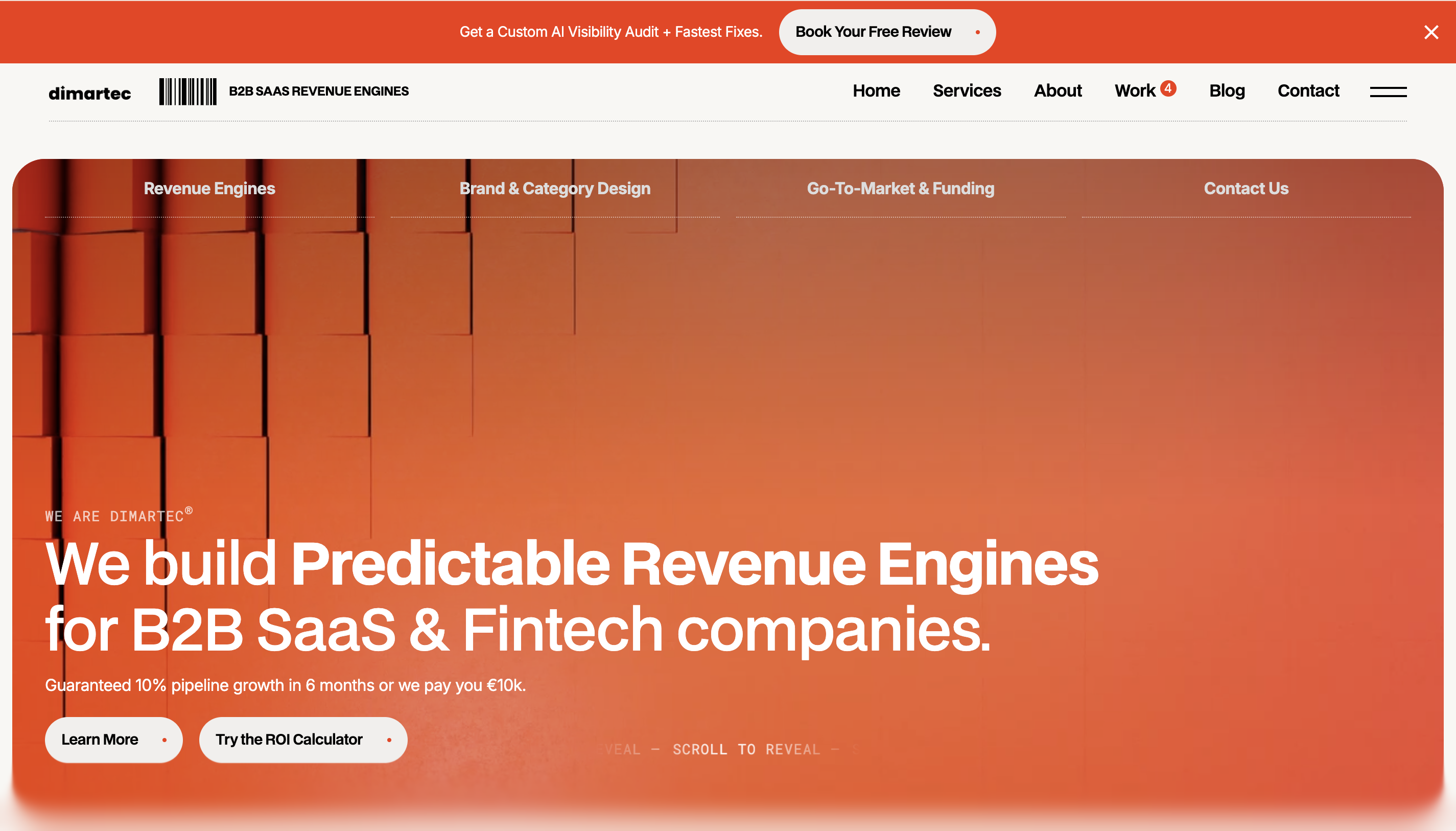
Best for: Post-PMF B2B SaaS and fintech founders at €2M–€10M ARR who need the full revenue scaling system built simultaneously: institutional trust through GEO and compliance-aware content, qualified demand through paid acquisition, and RevOps attribution connecting every channel to closed ARR
dimartec builds Revenue Engines for B2B SaaS and fintech companies. For fintech founders specifically, the five services (Performance Paid Media, CRO, GEO, Lead Gen & Nurturing, and RevOps & Automation) address the institutional trust problem and the demand generation problem as one connected system, not as sequential phases that the founder manages separately.
GEO is the service most specific to the fintech founder's trust-building requirement. B2B fintech buyers increasingly research vendor categories in ChatGPT, Perplexity, and Claude before engaging with any sales or marketing touch. A fintech founder whose brand appears in AI-generated answers to compliance, payments, or regtech category questions has established institutional visibility with the buyer before any paid campaign reaches them. That visibility compounds over time and reduces the cost of demand generation as buyers arrive pre-aware rather than entirely cold. Building GEO from the first session ensures the trust-building work starts immediately rather than being deferred until the brand has more content to structure.
Performance Paid Media in the fintech context is calibrated to ICP fit and intent stage rather than to volume: the compliance layer means reaching the wrong buyer at the wrong intent stage is more costly in fintech than in general SaaS, because the review cycles triggered by a misqualified lead consume founder and compliance team time proportionately. Lead Gen & Nurturing builds the qualification and routing logic that ensures leads reaching the sales team have already been filtered against the regulatory, firmographic, and intent criteria that define a genuinely workable opportunity. RevOps & Automation connects every channel to closed ARR from the first session, producing the investor-grade metrics (CAC payback, MQL-to-SQL rate by channel, pipeline velocity) that fintech founders need before the Series A or B conversation rather than after.
If any of the following apply, dimartec is worth a conversation:
The brand does not appear in AI-generated answers to the category questions fintech buyers research before evaluating vendors, leaving a growing share of top-of-funnel discovery entirely unaddressed
Paid campaigns are generating fintech leads that stall at the first compliance or procurement review, confirming the qualification layer is not filtering for regulatory alignment before leads reach the sales team
The investor conversation requires CAC payback, pipeline velocity, and attribution data that the current marketing programme cannot produce from system data
The founder is still personally involved in qualification decisions for most significant deals, confirming that the Lead Gen & Nurturing qualification infrastructure has not yet replaced their instinct
Key services
GEO: brand visibility in ChatGPT, Perplexity, and Claude, building institutional trust with fintech buyers before any direct marketing reaches them
Performance Paid Media: fintech ICP-calibrated acquisition across Google and LinkedIn, measured by cost per SQL and pipeline contribution, not cost per click
Lead Gen & Nurturing: regulatory-alignment pre-qualification built into lead scoring, intent-stage nurture sequences, and CRM-enforced routing
CRO: compliance-aware landing page design ensuring the conversion layer meets the trust standard fintech buyers apply before submitting a form
RevOps & Automation: first-party attribution connecting every channel to closed ARR, with investor-grade reporting available from the first quarterly review
Why dimartec stands out for fintech founders scaling revenue
GEO addresses the institutional trust-building requirement directly: brand presence in AI search is the fastest way to establish credibility with buyers who form shortlists before any direct marketing reaches them
Lead Gen & Nurturing qualification includes regulatory-alignment filtering, preventing the compliance review failures that consume founder and sales team time on leads that were never viable
All five services share one ICP definition and one attribution model, so the investor metrics are consistent and defensible rather than assembled from separate dashboards
The system belongs to the client team at the end of the engagement
Best fit: B2B fintech founders at €2M–€10M ARR who need to scale revenue without scaling founder involvement, and who recognise that the trust-building requirement in fintech means the demand generation system must be built on a credibility foundation, not layered on top of a cold-outreach programme.
2. CSTMR
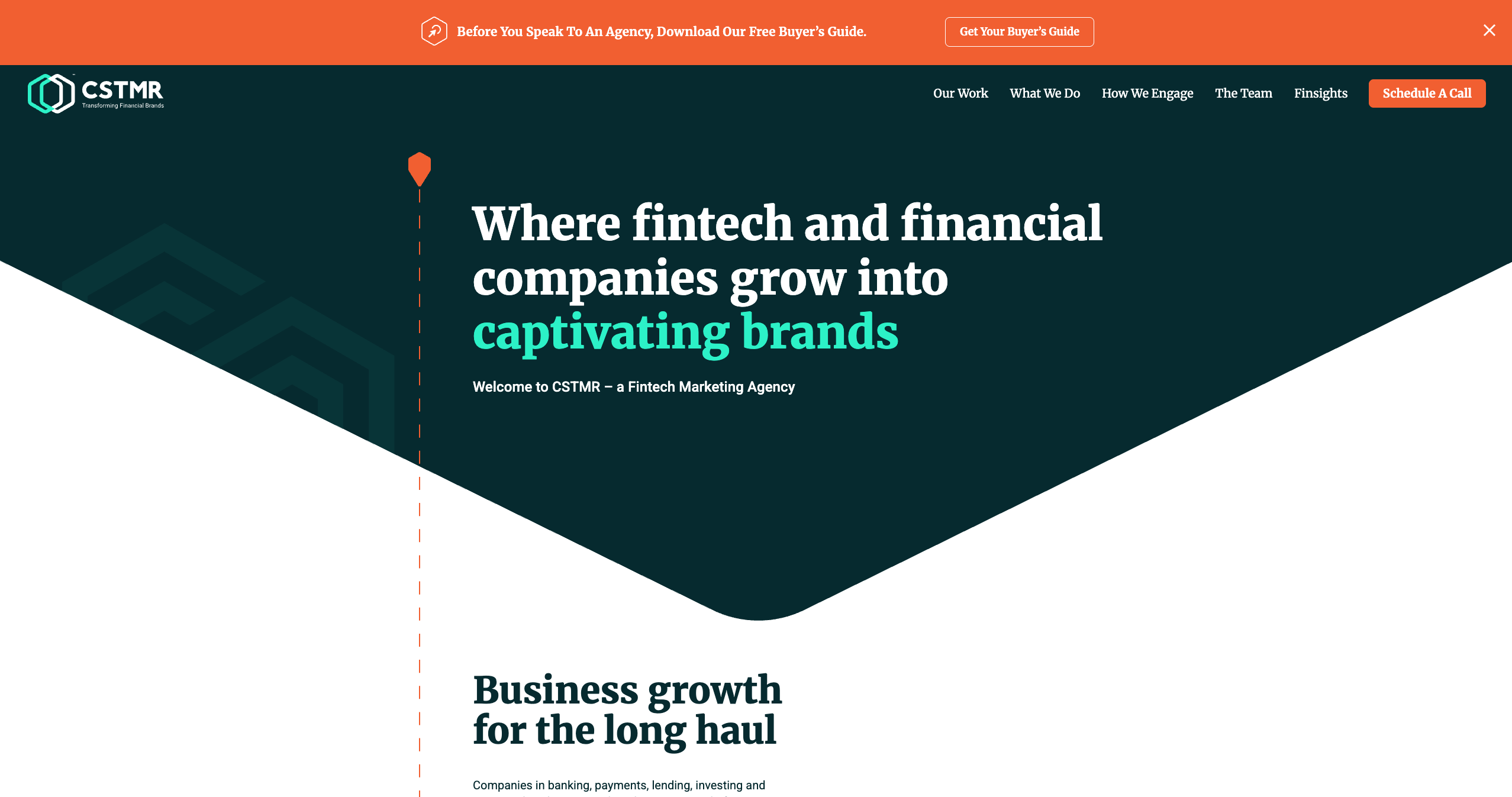
Best for: Fintech founders at Series A and beyond who need to transition from founder credibility to institutional brand credibility: building the trust signals, reference client programme, and compliance-appropriate content that allow the brand to survive procurement scrutiny without the founder's personal involvement
CSTMR is a fintech-only marketing agency founded in 2014. Their specific relevance to founders scaling revenue is in the institutional trust transition that precedes acquisition efficiency. A fintech founder who has closed the first ten deals on personal credibility needs a marketing programme that builds the brand evidence base those deals depended on: named reference clients with specific commercial outcomes, security and compliance documentation positioned as marketing assets, thought leadership in the publications and formats that regulated financial services buyers trust, and a brand position visible enough in the category that the compliance team's first search for the vendor returns institutional-quality evidence.
CSTMR builds this evidence base as part of their demand generation programme rather than as a separate brand investment. The case studies, compliance documentation, and thought leadership assets produced in the first phase of the engagement serve as both credibility signals and conversion assets in the demand generation phase that follows. This integration is the relevant differentiation for founders who cannot afford to run brand and demand generation as sequential phases: the trust infrastructure and the pipeline programme are built simultaneously.
SOC 2 Type 1 compliance and $150M-plus in managed fintech ad spend across payments, lending, banking, and financial software verticals ground their credibility at the institutional level. Named clients include LendingTree and Credit Karma.
Key services
Fintech brand strategy and institutional credibility positioning
Reference client programme: case study development with specific commercial outcomes for use as both trust signals and conversion assets
Compliance-appropriate thought leadership across fintech industry publications and formats
Performance paid media with claim substantiation built into creative and landing pages
Demand generation connecting brand credibility assets to acquisition campaigns
SOC 2 Type 1 compliant data and content handling
Why CSTMR stands out for fintech founders scaling revenue
Institutional trust transition is a specific programme output, not a parallel brand investment: the credibility assets built in the first phase directly enable the demand generation efficiency in the second
Reference client programme produces the named commercial outcomes that fintech procurement teams use to validate a vendor's credibility before approving an evaluation
Fintech-only client base since 2014 means the understanding of which credibility signals matter to which fintech buyer segments is accumulated experience, not adapted theory
SOC 2 Type 1 compliance removes one compliance barrier that would otherwise add friction to the vendor evaluation process
Best fit: Fintech founders at Series A and above who have closed the first cohort of deals on personal credibility and need the agency that will extract and systematise that credibility into a brand evidence base before scaling the acquisition programme that depends on it.
3. BrainDonors
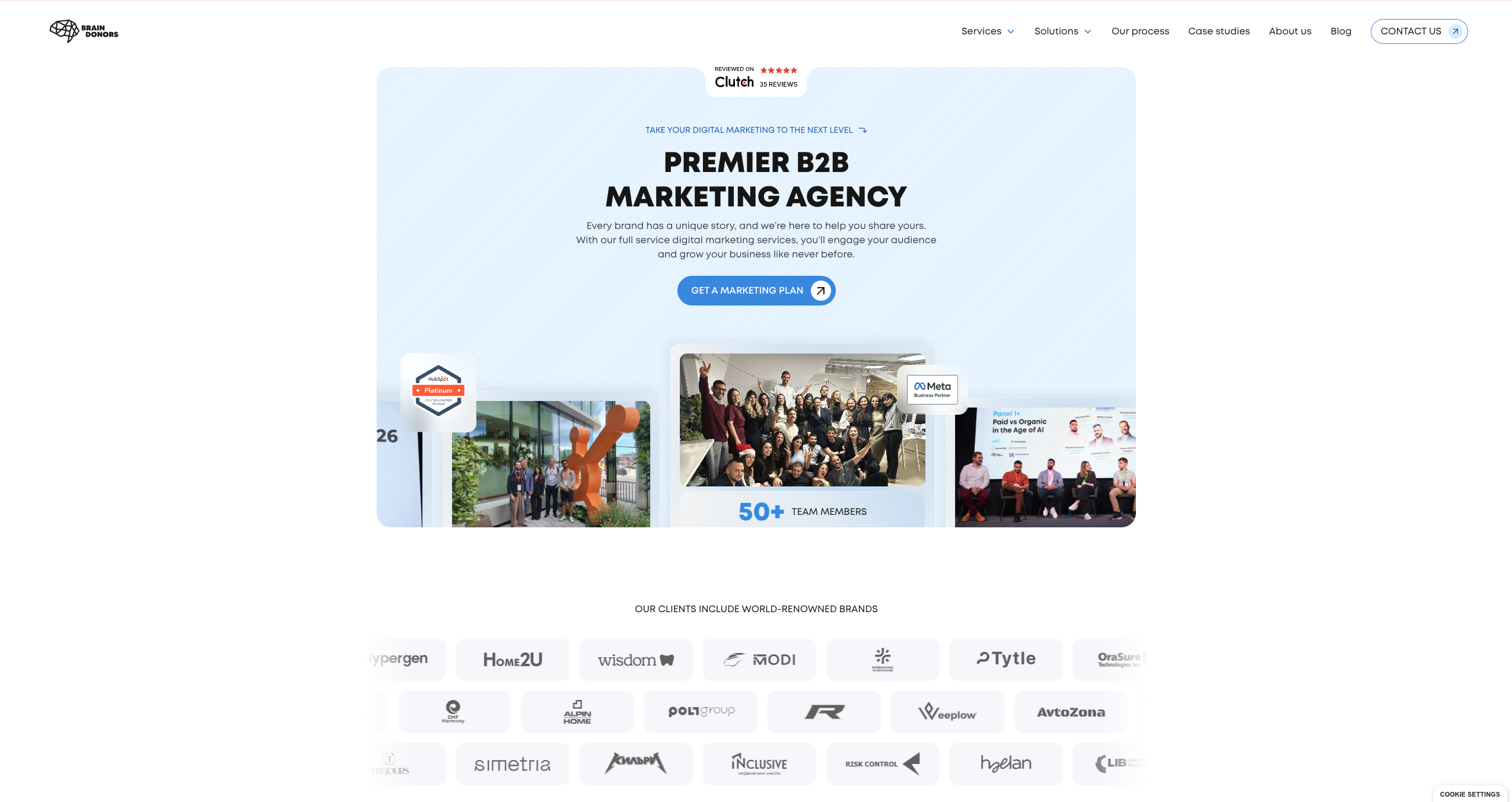
Best for: B2B fintech founders and early marketing leaders who need a full-funnel, fintech-specialist agency combining HubSpot RevOps, performance marketing, SEO, GEO, and AEO under one team, with particular strength for companies operating in European and competitive fintech markets
BrainDonors is a B2B fintech and technology marketing agency with more than 60 specialists across Bulgaria and the Netherlands, serving fintech brands from ambitious startups to established growth-stage companies. Their specific relevance to fintech founders is in the full-funnel scope of their work: HubSpot implementation and RevOps, performance marketing, SEO, content, web design, and conversion optimisation all operate under one engagement, alongside GEO and AEO strategies that address the 2026 shift in how fintech buyers research vendors before any sales touch.
Their AEO (Answer Engine Optimisation) and GEO capabilities are specifically relevant to the institutional trust-building problem. A fintech brand that appears in structured, authoritative AI-generated answers to category questions earns credibility with buyers who have never encountered the brand directly. For a founder whose personal credibility has been the primary trust signal, building AI search visibility is the fastest way to create institutional-scale trust signals that do not require the founder's presence in every discovery conversation.
Their HubSpot and RevOps practice ensures the demand generation programme feeds a qualification and attribution layer that produces the commercial metrics fintech founders need for investor conversations: pipeline by source, CAC payback by channel, and MQL-to-SQL conversion rate tracked to closed ARR.
Key services
Full-funnel fintech marketing: HubSpot RevOps, performance marketing, SEO, content, and web development under one engagement
GEO and AEO: fintech brand visibility in AI search engines and answer platforms
Performance marketing with compliance-appropriate claim substantiation
HubSpot implementation and RevOps for fintech pipeline and attribution reporting
Conversion optimisation calibrated to fintech trust and compliance buyer expectations
Why BrainDonors stands out for fintech founders scaling revenue
Full-funnel scope under one team eliminates the coordination overhead between separate RevOps, performance marketing, and content vendors that consumes founder time at this stage
GEO and AEO built into standard engagements: AI search visibility is a structural programme component, not a future phase
European fintech market experience with operations in the Netherlands: relevant for founders scaling across European regulatory environments where GDPR and financial services regulation affect both marketing execution and buyer trust signals
Startup-to-enterprise client range means the methodology is calibrated to the resource constraints of the founder stage, not scaled down from an enterprise programme
Best fit: B2B fintech founders and early marketing leads who need a full-funnel agency covering RevOps, performance marketing, SEO, and GEO under one team, particularly where European regulatory context and AI search visibility are both relevant to the trust-building programme.
4. OTReniX
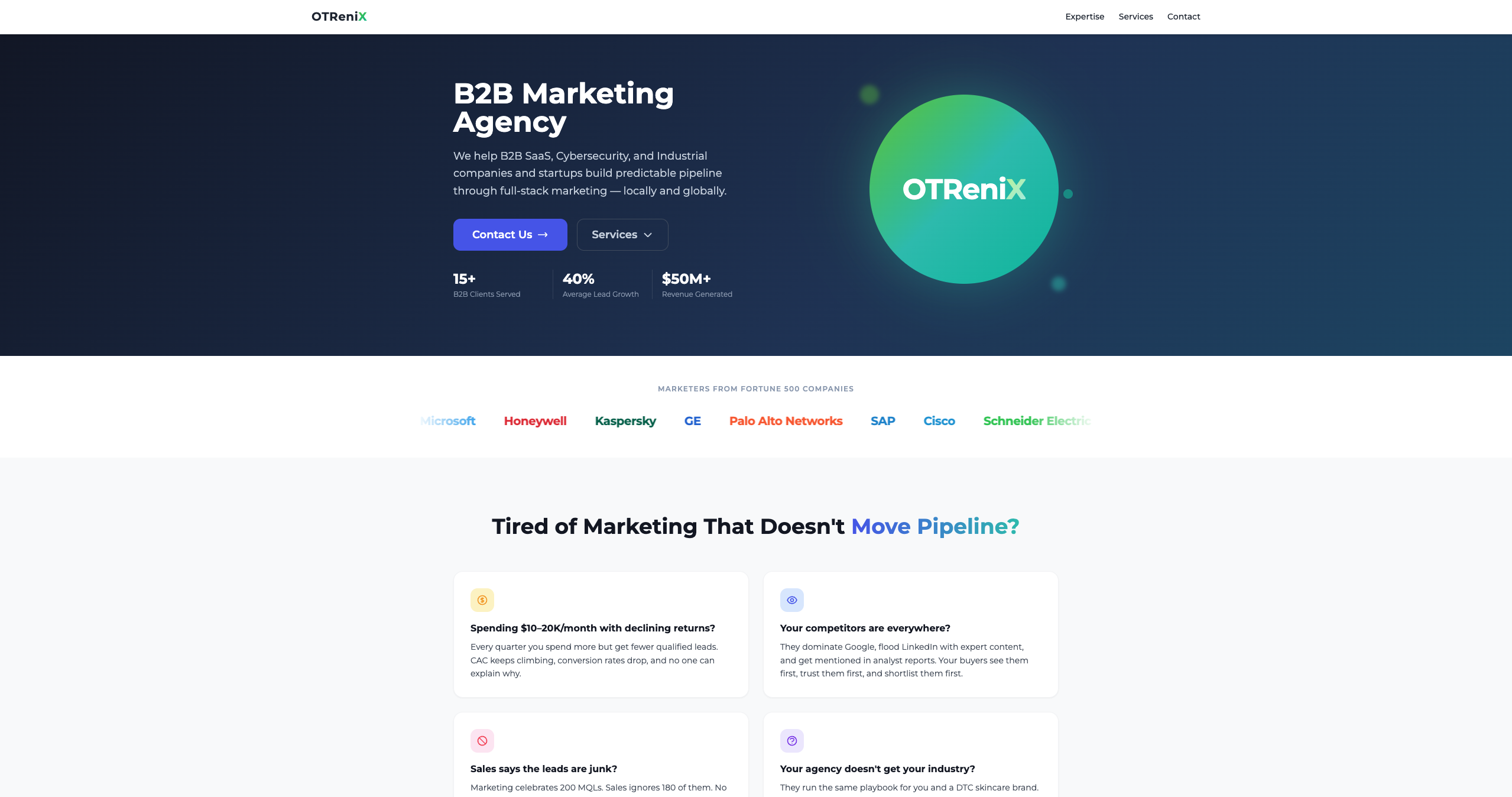
Best for: Fintech founders at pre-revenue to €10M ARR who need a Fractional CMO with 20-plus years of senior financial services experience, specifically to build the institutional credibility and GTM infrastructure that a first full-time marketing hire cannot provide at this stage
OTReniX is a B2B fintech marketing agency focused exclusively on fintech, with a specialty in Fractional CMO engagements for startups and growth-stage companies between pre-revenue and $50M ARR. Their Fractional CMO model brings a senior operator with 20-plus years of experience at Fortune 500 companies including Siemens, Cisco, and Kaspersky Lab, providing the institutional knowledge and credibility infrastructure that a founder-stage fintech company needs before it can build a marketing function that operates independently.
For fintech founders specifically, the OTReniX Fractional CMO model fills the gap that appears between the founder owning GTM personally and the company being large enough to justify a full-time senior marketing leader. The CMO brings the institutional market knowledge to validate ICP assumptions, the regulatory fluency to ensure the marketing programme is compliance-ready from the start, and the senior network to accelerate the reference client and thought leadership programme that builds institutional credibility.
Their fintech-only scope means every engagement is built around the specific trust, compliance, and buyer dynamics of financial technology, rather than applying general SaaS or B2B marketing frameworks to a regulated context.
Key services
Fractional CMO engagement: senior fintech marketing leadership from week one
Institutional credibility programme: thought leadership, industry publication strategy, and conference positioning
ICP validation and positioning framework built for fintech buying committee dynamics
Compliance-aware demand generation: campaign strategy and content review workflows
GTM infrastructure: pipeline process, qualification framework, and investor-grade reporting setup
Why OTReniX stands out for fintech founders scaling revenue
Fractional CMO with 20-plus years of senior financial services experience at Fortune 500 companies brings the institutional credibility and market knowledge that a founder-stage marketing hire rarely has
Fintech-only scope: every engagement framework, compliance review process, and market knowledge asset is built for financial technology, not adapted from a general B2B playbook
Pre-revenue to $50M ARR range means the engagement model is calibrated to the resource and runway constraints of the founder stage specifically
CMO model fills the leadership gap before the first marketing hire is in place, giving the founder senior strategic support and compliance expertise without a hiring timeline
Best fit: Fintech founders at pre-revenue to €10M ARR who need a senior marketing leader with institutional financial services experience to lead the credibility-building and GTM infrastructure work before or alongside a first marketing hire, and who cannot afford the cost or timeline of a full-time CMO hire at this stage.
5. Right Left Agency
Best for: Fintech scale-ups and B2B companies targeting regulated markets that need a performance marketing partner explicitly focused on reducing CAC and improving CAC payback in complex, compliance-constrained sales cycles
Right Left Agency is a performance marketing agency focused on fintech scale-ups and B2B companies serving regulated markets. Their commercial positioning is specific to the fintech founder's revenue scaling pressure: lowering CAC, speeding up payback cycles, and improving lead quality in categories where the compliance layer makes standard performance marketing approaches either non-compliant or commercially inefficient.
For fintech founders, the CAC payback problem intensifies at the €2M–€5M ARR stage because acquisition spend begins to scale just as the founder's personal sales efficiency advantage is declining. The gap between what the founder closes (efficiently, from warm relationships) and what a scaling acquisition programme closes (less efficiently, from cold demand) is where CAC payback extends beyond the board's acceptable range. Right Left Agency's explicit focus on payback cycle reduction rather than volume growth is the correct commercial framing for this stage: the question is not how many leads to generate but what it costs to generate a lead that closes.
Their experience spans fintech scale-ups, SaaS firms targeting regulated markets, and B2B companies with complex sales cycles, with documented work across multiple fintech verticals and a stated focus on the metrics that determine whether an acquisition programme is commercially viable at scale.
Key services
Performance marketing for fintech with compliance-appropriate claim handling across Google, LinkedIn, and Meta
CAC and payback cycle optimisation: programme calibrated to closed-revenue efficiency rather than lead volume
Lead quality improvement: targeting and qualification logic designed to reduce the proportion of leads that fail compliance or procurement review
Attribution modelling for complex fintech sales cycles: connecting paid acquisition to closed ARR across 6–12 month evaluation periods
Conversion rate optimisation for fintech landing pages and demo request flows
Why Right Left Agency stands out for fintech founders scaling revenue
Explicit CAC payback focus rather than volume focus: the commercial objective matches the fintech founder's revenue scaling challenge at this stage
Compliance-appropriate campaign handling built into creative and targeting, reducing the rewrite cycles and compliance delays that inflate effective marketing cost
Fintech scale-up experience: the methodology is calibrated to the stage where acquisition spend is beginning to scale and CAC efficiency becomes a board-level metric
Attribution modelling for long fintech sales cycles prevents the misattribution that causes founders to cut the channels doing the most demand creation work because the standard attribution model cannot see it
Best fit: Fintech founders at €2M–€10M ARR whose primary revenue scaling constraint is acquisition cost efficiency: CAC payback is extending beyond the acceptable range as spend scales, and the programme needs to be rebuilt around closed-revenue efficiency rather than lead volume.
The Integration Argument
Every agency on this list solves a specific dimension of the fintech founder's revenue scaling challenge. CSTMR builds the institutional trust infrastructure that makes demand generation credible. BrainDonors runs the full-funnel programme with GEO and RevOps integrated. OTReniX provides the senior marketing leadership that closes the institutional knowledge gap. Right Left Agency focuses the acquisition programme on CAC payback rather than volume.
The gap each of them shares is the same gap that appears in every category where specialist agencies solve their problem and hand the rest back to the founder. The institutional trust programme does not automatically feed the demand generation programme. The demand generation programme does not automatically connect to the RevOps layer that attributes which campaigns produced the ARR that closed. The CAC payback programme does not automatically account for the GEO visibility that compounds over time and reduces the paid channel dependency the payback calculation assumes.
A fintech founder scaling from €2M to €10M ARR cannot manage five separate agency relationships simultaneously alongside running the business and preparing for a funding round. The coordination overhead alone consumes the capacity that should be going to investor relationships, product decisions, and key account management.
dimartec builds the integrated system that removes this coordination overhead. GEO builds institutional trust at scale before any paid campaign reaches the buyer. Lead Gen & Nurturing qualifies for regulatory alignment before leads reach the sales team. RevOps & Automation produces the attribution and investor metrics from the first session. Performance Paid Media and CRO scale once the trust infrastructure and qualification layer are in place. The founder's time goes to the business, not to coordinating between agencies that each own one part of the problem.
See how the Revenue Engine works: https://www.dimartec.co.uk/services/revenue-engine
Founder's Decision Framework
The primary question before choosing a fintech marketing agency is not which channel to scale. It is whether the institutional trust infrastructure required to make that channel work in fintech is already in place.
If the brand cannot survive a compliance team's vendor due diligence search without the founder's personal involvement to contextualise it, the first priority is the trust infrastructure programme. CSTMR, BrainDonors, and OTReniX address this directly.
If the trust infrastructure exists but CAC payback is extending as spend scales, the primary need is acquisition efficiency and attribution depth. Right Left Agency and dimartec address CAC efficiency from different angles: Right Left Agency through performance marketing optimisation, dimartec through the full-system approach that connects GEO, Lead Gen & Nurturing, and RevOps & Automation to produce compounding CAC reduction.
If the trust infrastructure and acquisition efficiency are both in place but investor-grade metrics cannot be produced from system data, the primary need is RevOps and attribution. All five agencies on this list address attribution at some level; dimartec addresses it as a first-order deliverable from session one.
Ask any agency before signing: what does week one of the engagement produce, and what investor metrics can you show me from a current fintech client at my stage? The answers to those two questions separate the agencies built for this problem from the ones that will learn it on your runway.
Frequently Asked Questions
Why does institutional trust matter more in fintech than in general SaaS?
Fintech buyers are making decisions that carry financial, regulatory, and reputational exposure. A CFO at a mid-market bank who approves an unverified payments vendor and that vendor has a compliance failure or security incident is personally accountable for the decision. The due diligence process that precedes a fintech evaluation is not a formality. It is a risk management exercise. A brand that has built visible, credible institutional signals (case studies with named clients and specific outcomes, security documentation, compliance history, AI search presence, industry publication coverage) clears that due diligence faster and at lower cost to the sales team. A brand without it requires the founder's personal credibility to close the gap, which is the scalability problem founders at this stage are trying to solve.
How long does it take to build institutional trust through marketing?
The research published in 2026 on Series B fintech GTM suggests that building meaningful brand recognition with financial services buyers typically takes 12–18 months of consistent visibility across the right channels. The practical implication for founders is that the trust-building programme needs to start before the revenue scaling pressure peaks, not in response to it. A GEO programme started today begins producing AI search visibility in 3–6 months. A thought leadership content programme begun today produces industry publication presence in 6–9 months. Both compound over time. Starting either programme when the board is already asking for faster pipeline growth means the trust infrastructure arrives late to the revenue scaling conversation.
Should a fintech founder hire a CMO or an agency first?
The right answer depends on which gap is more critical at the current stage. If the primary gap is institutional market knowledge and senior strategic leadership, OTReniX's Fractional CMO model fills that gap from week one at a lower cost and shorter timeline than a full-time hire. If the primary gap is execution capacity across demand generation, RevOps, and GEO, an integrated agency like dimartec or BrainDonors provides the execution function while the founder retains strategic ownership. If both gaps exist simultaneously, the Fractional CMO and an integrated execution agency working together is typically more effective than attempting to hire both roles internally at a stage where the hiring timeline itself consumes runway.
What investor metrics does a fintech marketing programme need to produce?
At Series A, the minimum metric set investors expect from a fintech marketing programme: CAC by channel, CAC payback period, MQL-to-SQL conversion rate, pipeline velocity by stage, and total qualified pipeline value with source attribution. At Series B, investors additionally expect NRR and GRR trends, LTV:CAC ratio, and evidence that the acquisition programme is producing qualified pipeline rather than volume that the sales team is sorting. The agencies on this list vary significantly in how quickly they produce this metric set: dimartec builds it from session one; others produce it as the programme matures. Founders heading into a raise within 12 months should prioritise agencies that produce investor-grade attribution from the start.
Build the Revenue Engine That Does Not Depend on the Founder
The most important commercial decision a fintech founder makes when scaling past €2M ARR is not which acquisition channel to invest in. It is whether to build the institutional credibility infrastructure before or after scaling acquisition spend. The founders who build it first scale their revenue faster and with lower CAC because their acquisition programme reaches buyers who are already predisposed to trust the brand. The ones who scale spend first discover that fintech buyers are not cold prospects who respond to a well-targeted ad. They are risk-averse evaluators who research extensively before engaging, and who can always find another vendor whose compliance team they trust more.
The Revenue Engine connects Performance Paid Media, CRO, GEO, Lead Gen & Nurturing, and RevOps & Automation into one system so the institutional trust layer (GEO), the demand generation layer (Performance Paid Media), the qualification layer (Lead Gen & Nurturing), and the attribution layer (RevOps & Automation) are all built simultaneously, measured against the same commercial outcome, and owned by the client team at the end of the engagement.
See how the Revenue Engine works: https://www.dimartec.co.uk/services/revenue-engine






.png)







.png)
















































.png)
.png)
.png)
.png)
.png)
.png)
.png)
.png)
.png)
.png)