
There is a number most B2B SaaS PPC programmes report, and a number they should report instead. The number they report is cost per lead: the total paid spend divided by the forms submitted. The number they should report is cost per SQL: the total paid spend divided by the opportunities the sales team has accepted as qualified. The gap between those two numbers is where most PPC budgets disappear.
The 2026 data makes this gap concrete. The median cost per lead from Google Search for B2B SaaS sits at $140. The median cost per SQL from the same channel sits at $560: a 4x multiplier driven by the MQL-to-SQL conversion rates that Google's standard lead-optimised campaigns actually produce. LinkedIn's median CPL is $220, its median cost per SQL $1,037. A channel with a cost per lead of $50 and a 5% MQL-to-SQL conversion rate costs $1,000 per SQL. A channel with a cost per lead of $200 and a 25% conversion rate costs $800 per SQL. The cheaper channel costs more when measured against the outcome that matters.
The finding that separates PPC agencies that reduce cost per SQL from those that reduce cost per lead is consistent across more than 200 B2B SaaS accounts. The agencies that reduce cost per SQL are not running smarter creative or better bidding strategies on the same optimisation signals. They are running the campaigns against fundamentally different signals: offline CRM conversion data connecting each form fill to whether it became a sales-accepted opportunity. Offline conversion tracking delivers a 30 to 50 per cent improvement in SQL volume at identical spend levels, because Smart Bidding trained on SQL signals learns to reach the audience profiles that convert through qualification rather than the audience profiles that convert on forms. The agencies that have not rebuilt their infrastructure around this signal are optimising for the wrong outcome at scale, every day their campaigns run.
This guide evaluates the five best PPC agencies for B2B SaaS that measure and optimise against cost per SQL rather than cost per lead: the ones whose attribution infrastructure connects paid spend to CRM qualification outcomes, whose reporting surfaces the CPL-to-CPSQL multiplier by channel, and whose optimisation decisions are made from SQL conversion data rather than form-fill volume.
The CPL-to-CPSQL Multiplier: The Metric That Reveals PPC Agency Quality
Before evaluating any PPC agency, one diagnostic question reveals more about their methodology than any case study: do they report the CPL-to-CPSQL multiplier? The multiplier is the ratio of cost per lead to cost per SQL on the same channel. A multiplier of 2.5x means a channel producing $200 CPL costs $500 per SQL. A multiplier of 7x on the same channel means $200 CPL costs $1,400 per SQL.
Industry data for 2026 shows the following multipliers by channel for B2B SaaS:
- Customer referral: 2.5x (highest conversion quality)
- Content and SEO: 3.5x
- Google Search: 4.0x (median; ranges from 2.8x with offline conversion to 6.5x without)
- LinkedIn ABM: 4.7x
- Organic social: 6.7x
Channels above a 6x multiplier are difficult to justify in a budget allocated against cost per SQL. The most revealing comparison is not between channels but between the same channel managed with and without offline CRM conversion data: Google Search with offline SQL conversion signals active produces a multiplier in the 2.8x to 3.5x range. Without offline conversion signals, the multiplier rises to 5x to 6.5x as the algorithm trains on form-fill audiences rather than qualification-conversion audiences.
An agency that does not report this multiplier is almost certainly not managing campaigns against it. An agency that reports only CPL is optimising for a metric that has no direct relationship to the commercial outcome the board is measuring.
How We Chose These Agencies
- SQL as the primary optimisation metric: Does the agency explicitly measure cost per SQL as its primary paid metric, or does it report CPL and leave the SQL conversion calculation to the client?
- Offline CRM conversion infrastructure: Does the agency build and maintain the CRM-to-ad-platform data connection that trains Smart Bidding on SQL signals from day one?
- CPL-to-CPSQL multiplier reporting: Does the agency surface the multiplier by channel so the budget allocation decision is made from qualification conversion evidence?
- B2B SaaS stage fluency: Does the agency understand the MQL-to-SQL conversion dynamics specific to B2B SaaS sales cycles, or does it apply lead generation benchmarks from other sectors?
- Verified outcomes at the SQL level: Named B2B SaaS clients with documented cost per SQL improvements, not CPL reductions presented as proxy evidence for pipeline improvement.
The 5 Best PPC Agencies for SaaS for Reducing Cost Per SQL
1. dimartec
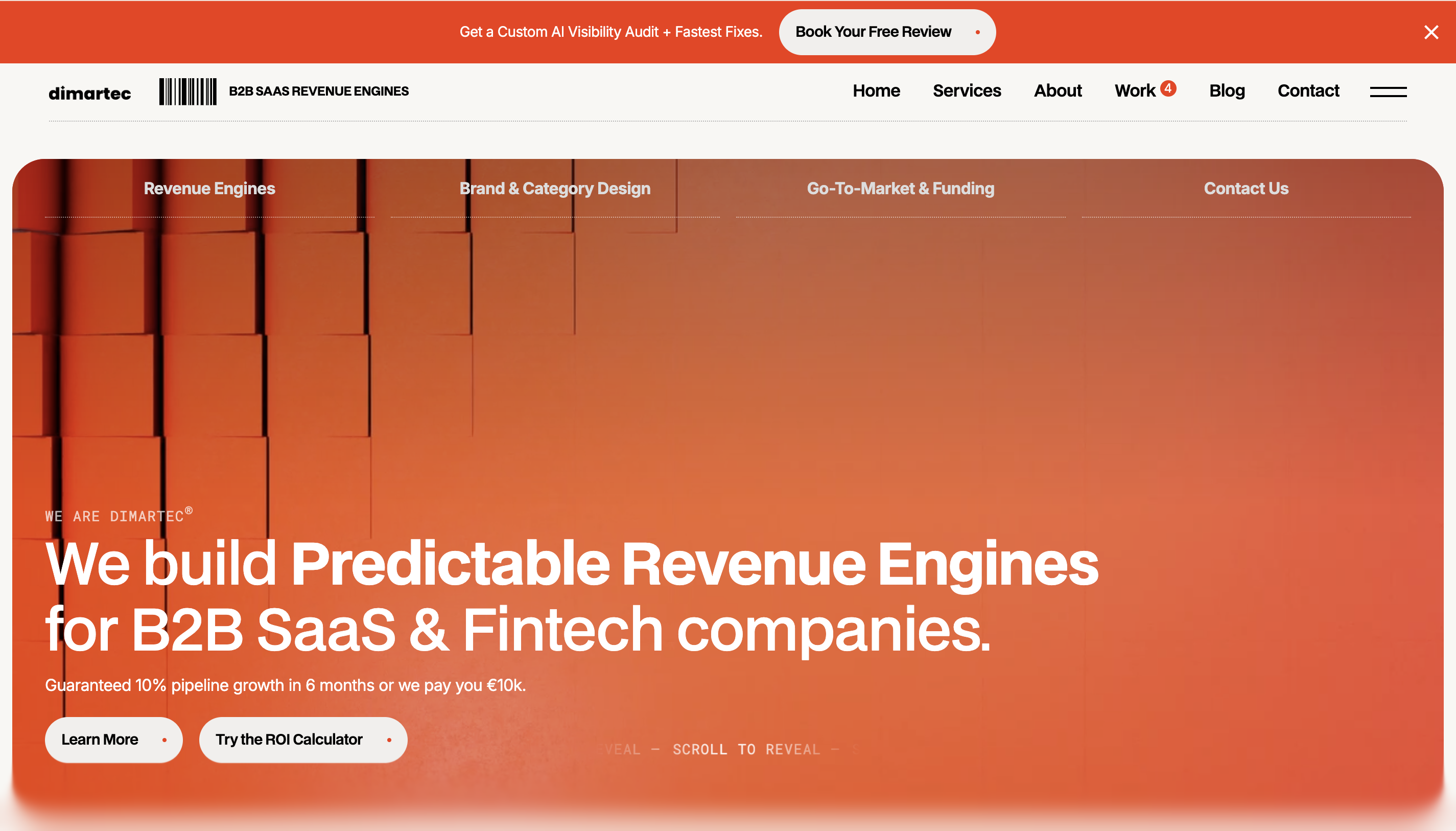
Best for: Post-PMF B2B SaaS and fintech at €2M–€10M ARR where paid campaigns are generating form fills the sales team cannot qualify, the cost per SQL is either unknown or rising, and the attribution infrastructure that would connect ad spend to CRM-qualified pipeline does not yet exist
dimartec builds Revenue Engines for B2B SaaS and fintech companies. The five integrated services (Performance Paid Media, CRO, GEO, Lead Gen & Nurturing, and RevOps & Automation) address cost per SQL not as a reporting metric but as the organising principle of the entire paid acquisition programme from session one.
The specific mechanism by which dimartec reduces cost per SQL differs from the standard agency approach of optimising campaigns harder. The standard approach assumes the targeting and qualifying infrastructure is correct and optimises creative and bid strategy within it. dimartec starts by auditing the qualifying infrastructure itself: what signal is currently feeding the paid platforms' bidding algorithms, whether that signal is a form-fill event or a CRM qualification event, and what the multiplier between the two reveals about how far off the current optimisation target is from the commercial outcome the programme is supposed to produce.
At the €2M to €10M ARR stage, the most common finding is that campaigns are trained on form-fill conversion events because the CRM integration required to pass offline SQL conversion signals back to Google and LinkedIn has not been set up. The algorithm is doing exactly what it was instructed to do: finding the audiences that complete forms. Those audiences are rarely the same as the audiences that pass qualification. The gap between them is the CPL-to-CPSQL multiplier, and it compounds at scale: as spend increases against form-fill signals, the budget reaches a larger audience optimised for form completion, and the qualification rate falls further.
RevOps & Automation sets up the CRM-to-ad-platform pipeline in the first session, sending SQL conversion events (not form-fill events) back to Google and LinkedIn as the bidding signal. Performance Paid Media then rebuilds the campaign targeting around the ICP profiles that have historically converted to SQLs in the CRM rather than the broad audience that has historically completed forms. Within 60 to 90 days, the algorithm has enough SQL conversion data to begin learning the audience patterns associated with qualification rather than form completion.
The CRO layer addresses the multiplier from the other side: improving the MQL-to-SQL conversion rate by qualifying intent at the landing page and form level before the lead reaches the sales team. A form that routes high-intent visitors to immediate booking and lower-intent visitors to a nurture sequence reduces the volume of low-qualification leads reaching sales, which improves the overall MQL-to-SQL conversion rate without changing the paid targeting. Both levers together (better SQL signals into the algorithm, better qualification before the SQL gate) produce the compounding reduction in cost per SQL that neither lever achieves alone.
If any of the following apply, dimartec is worth a conversation:
- The cost per lead from paid campaigns is known, but the cost per SQL requires a manual calculation from two systems that each report a different number
- The MQL-to-SQL conversion rate for paid leads is below 20%, indicating the paid traffic does not match the qualification standard the sales team applies
- CAC payback has been rising for two or more quarters despite stable or declining cost per lead, which is the primary symptom of a rising CPL-to-CPSQL multiplier
- The sales team describes the leads from paid as low quality relative to leads from other sources, indicating the paid audience targeting is optimised against form-fill signals rather than qualification profiles
Key services
- Performance Paid Media: CRM-offline-signal integration from session one; campaign targeting rebuilt from closed-won ICP profiles
- RevOps & Automation: CRM-to-ad-platform data pipeline passing SQL events back to Google and LinkedIn bidding
- CRO: intent qualification at landing page and form level, improving MQL-to-SQL conversion rate before leads reach the sales team
- Lead Gen & Nurturing: routing high-intent visitors to booking and lower-intent visitors to nurture, reducing the unqualified lead volume reaching sales
- GEO: demand creation layer reducing paid CPL over time as AI-search-referred visitors arrive with prior brand familiarity and convert at higher rates
Why dimartec stands out for cost per SQL reduction
- Both SQL optimisation levers addressed simultaneously: better signals into the bidding algorithm and better qualification before the SQL gate
- RevOps and Performance Paid Media under one owner means the CRM integration that feeds the bidding signal is maintained by the same team managing the campaigns it informs
- Cost per SQL as the primary reported metric from session one, not a calculation the client assembles from separate system exports
- 90% of clients see improved lead quality within 90 days
Best fit: Post-PMF B2B SaaS and fintech at €2M–€10M ARR where the paid programme is generating volume that is visible in the platform dashboard and invisible in the sales team's pipeline, and where the cost per SQL is either unknown, rising, or both.
2. Obility
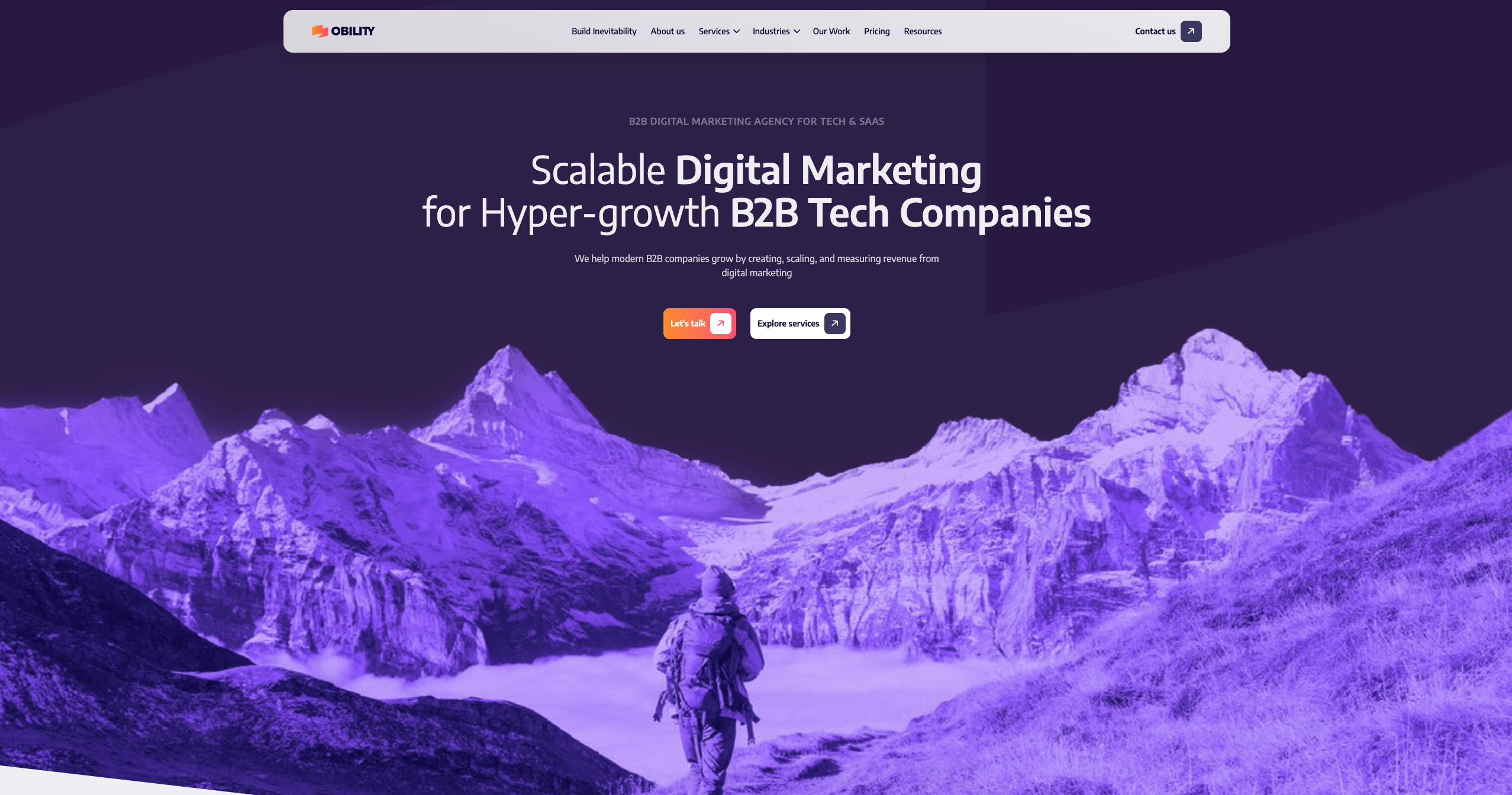
Best for: Series A–B B2B SaaS and enterprise tech where the primary gap between current and achievable cost per SQL is the absence of deal-level CRM attribution connecting paid spend to pipeline and closed revenue across HubSpot, Salesforce, or Marketo
Obility is a B2B-only paid media agency that has operated exclusively in the B2B technology market since 2011. Their Build Inevitability framework is built around the specific commercial reality of B2B SaaS buying: decisions are committee-driven, sales cycles average 84 days, and the signal between a paid click and a closed deal is separated by enough time that standard last-touch attribution produces systematically wrong conclusions about which campaigns produced the revenue.
The Build Inevitability approach addresses this by treating paid media as a presence across every touchpoint where the ICP researches, evaluates, and validates a buying decision: paid search for active evaluators, paid social for the buying committee building familiarity, and connected channels for the accounts where awareness needs to compound before the evaluation begins. The attribution infrastructure connects each of these touchpoints to pipeline contribution and closed revenue through deal-level CRM integration, making the multi-touch contribution to a closed deal traceable from the first paid impression through to closed-won in HubSpot, Salesforce, or Marketo.
The cost per SQL implication of this methodology is that budget allocation decisions are made from the channel's contribution to closed revenue rather than from the channel's contribution to form fills. A LinkedIn campaign that appears expensive on a CPL basis may produce a CPL-to-CPSQL multiplier of 3x rather than the median 4.7x because it is reaching the specific buying committee roles that pass qualification rather than the broader audience that completes forms. Obility's B2B-only client base since 2011 provides the benchmark data to assess whether a given multiplier is achievable or whether the targeting needs rebuilding before the budget scales.
Named clients include Cloudflare, Snowflake, Fastly, Autodesk, and Hitachi Vantara. Their 4.8 rating across 27 Clutch reviews represents consistent third-party validation of commercial outcomes rather than channel performance.
Key services
- B2B-only paid media: Google Search, LinkedIn, display, and connected channels for B2B technology companies exclusively
- Deal-level CRM attribution across HubSpot, Salesforce, and Marketo from the first campaign
- Build Inevitability framework: paid presence across every evaluation touchpoint rather than concentration at bottom-of-funnel only
- Cost per SQL and pipeline contribution as the primary reporting metrics
- B2B SaaS paid media benchmarks calibrated to the B2B buying committee and sales cycle, not adapted from consumer or general B2B contexts
Why Obility stands out for cost per SQL reduction
- B2B-only since 2011 means every benchmark they apply to a client's CPL-to-CPSQL multiplier is calibrated to B2B technology buying dynamics, not borrowed from e-commerce or B2C contexts
- Deal-level CRM attribution from the first campaign produces the cost per SQL metric from day one rather than after a future phase of attribution setup
- Build Inevitability framework reduces the CPL-to-CPSQL multiplier by reaching buyers across multiple evaluation touchpoints, improving the qualification rate of the paid audience rather than just the quantity of form fills it generates
- Named enterprise technology clients provide credible evidence that the methodology produces commercial outcomes at the scrutiny level that enterprise procurement and investor review impose
Best fit: Series A–B B2B SaaS and enterprise technology companies with active paid acquisition programmes where the CPL-to-CPSQL multiplier is either unknown (attribution infrastructure not yet built) or above 5x (indicating the paid audience is optimised against form-fill rather than qualification signals).
3. KlientBoost
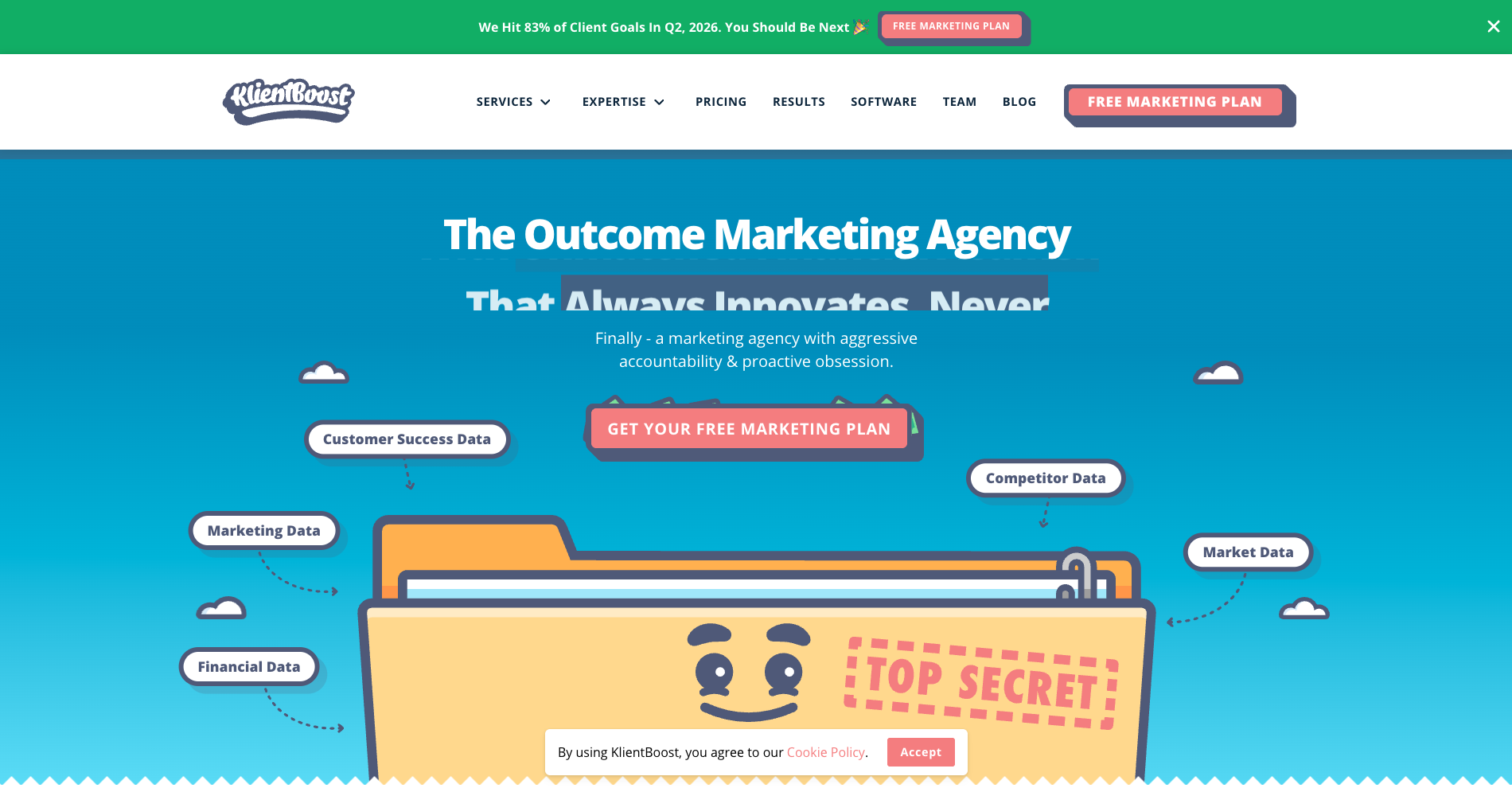
Best for: B2B SaaS at Series A and above where the paid budget is already material and the primary problem is that budget has been allocated to channels by convention or platform recommendation rather than by SQL conversion evidence, producing a channel mix that is collectively generating leads at acceptable CPL and pipeline at unacceptable cost per SQL
KlientBoost is a PPC and CRO agency with a specific methodology for connecting campaign activity to SQL conversion outcomes: the Growth Grid scorecard, which maps every campaign decision against the financial goals the paid programme is supposed to contribute to rather than against the channel metrics the platform reports. Their documented 88% client goal achievement rate in Q1 2026 is the most specific recent performance evidence available for their methodology at the campaign-outcomes level.
The Growth Grid is relevant to cost per SQL reduction because it addresses the budget allocation problem directly. Most B2B SaaS paid programmes arrive at their channel mix through a combination of historical convention (we have always run Google Search), platform recommendation (LinkedIn suggested adding this audience), and availability (the budget was there). The Growth Grid evaluates each channel allocation decision against the SQL conversion evidence for that channel in that account, identifying where the budget is producing the best CPL-to-CPSQL multiplier and where it is producing volume that looks acceptable on a CPL basis but is not converting through qualification.
KPI-paced budget reallocation implements this analysis as an ongoing process rather than a quarterly review: the budget moves to follow the SQL conversion evidence within reporting cycles rather than waiting for a strategy review that arrives after several months of misallocated spend. For B2B SaaS at Series A and above, where the paid programme budget is large enough that a 2x improvement in cost per SQL on 40% of the budget produces material CAC payback improvement, this reallocation methodology is more commercially valuable than any creative or bidding optimisation applied to the existing channel mix.
Their CRO capability alongside PPC is relevant because both levers of SQL reduction (better signals into the algorithm and better qualification before the SQL gate) are addressed within one engagement rather than requiring separate vendors whose optimisation decisions may work against each other.
Key services
- PPC across Google, LinkedIn, Meta, and Microsoft Ads with Growth Grid financial goal alignment
- Growth Grid scorecard: channel evaluation against SQL conversion rate and cost per SQL rather than against CPL and impression share
- KPI-paced budget reallocation: budget moves to follow SQL conversion evidence within each reporting cycle
- CRO integration: landing page and form optimisation alongside paid, improving the MQL-to-SQL conversion rate the paid programme feeds
- Offline conversion tracking setup: CRM SQL events sent back to platform bidding algorithms
Why KlientBoost stands out for cost per SQL reduction
- Growth Grid addresses the budget allocation problem that produces high blended cost per SQL even when some channels within the mix are performing well: the budget concentrated on the SQL-efficient channels and reduced on the inefficient ones
- 88% Q1 2026 client goal achievement rate is the most specific recent outcome evidence available at the campaign-goals level
- KPI-paced reallocation prevents the 3-to-6-month lag between SQL conversion evidence appearing and budget following it, which is where most cost per SQL improvement is lost in monthly or quarterly review cycles
- PPC and CRO under one engagement means the qualification rate improvement from the CRO layer is immediately visible in the same programme's cost per SQL metric
Best fit: B2B SaaS at Series A and above with paid budgets above €10k per month where the blended cost per SQL across channels is above the CAC payback tolerance, but where individual channels within the mix are performing differently and the budget allocation has not been updated to reflect what the SQL conversion evidence shows.
4. Powered by Search
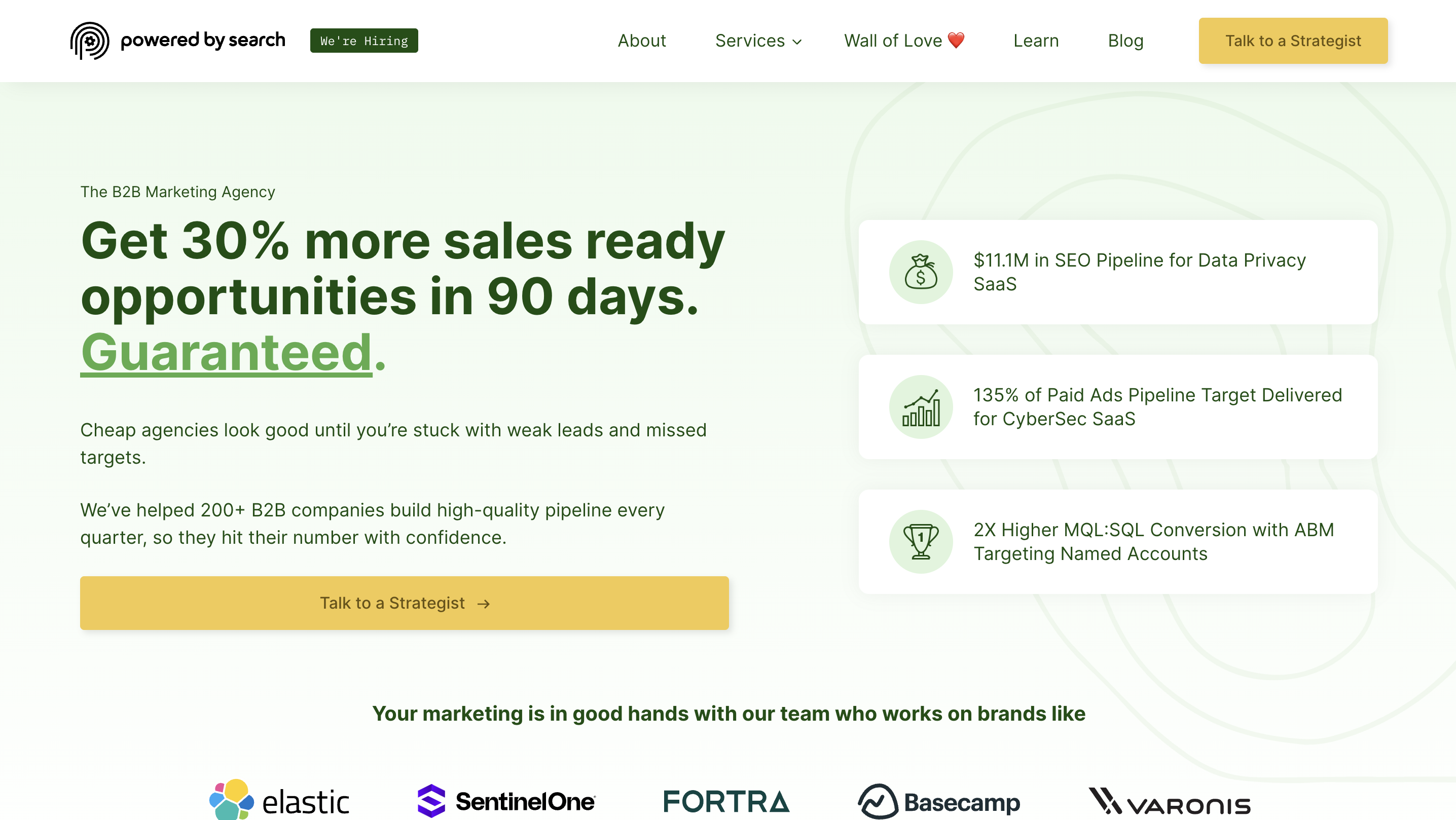
Best for: B2B SaaS on HubSpot where paid search, SEO, and CRM are each managed as separate systems, the cost per SQL from paid is either unknown or incomputable without manual assembly from multiple dashboards, and the attribution gap between paid spend and CRM pipeline is the primary obstacle to PPC budget decisions that hold up at board level
Powered by Search is a B2B SaaS marketing agency whose Predictable Growth methodology explicitly connects paid search, SEO, and RevOps through a HubSpot-native attribution model. Their specific relevance to cost per SQL reduction is in the attribution infrastructure that makes cost per SQL a computable, real-time metric rather than a manual calculation assembled from Google Ads, HubSpot, and the CRM on a reporting day that is already two weeks old by the time the board reviews it.
The Predictable Growth model treats paid and organic as two components of one demand generation system rather than as separate programmes with separate attribution models. Paid search produces the fast-feedback SQL pipeline while organic SEO compounds over time to reduce the paid volume required to maintain the same SQL target. The HubSpot-native RevOps layer attributes both to the same CRM pipeline, making the cost per SQL from paid visible alongside the cost per organic SQL and the blended cost per SQL across both. For SaaS companies with product-led growth components, their PLG attribution tracks the paid and organic sources of trial starts through to conversion, connecting the paid programme to qualified product users as a qualification signal rather than only to form-fill conversions.
The attribution infrastructure Powered by Search builds is a prerequisite for every other cost per SQL optimisation: you cannot reallocate budget toward the best-performing channels on a CPL-to-CPSQL multiplier basis if the multiplier is not computable from a shared attribution model. Their HubSpot specialisation is specifically relevant because HubSpot's native attribution reporting understates paid contribution to pipeline when the last-touch model attributes credit to the organic or direct visit that preceded the form submission, making paid appear less efficient than the multi-touch model that includes all paid impressions in the evaluation period.
Named clients include Freshbooks, Basecamp, and Collibra, with a documented track record of reducing CAC through integrated channel attribution over more than 15 years working with B2B SaaS companies exclusively.
Key services
- Paid search with HubSpot-native CRM attribution connecting each campaign to pipeline contribution and closed revenue
- SEO compounding alongside paid: the organic demand layer reduces paid CPL over time as branded and category search volume grows
- PLG attribution: paid sources traced through trial start and product activation to SQL conversion, not only to form fill
- RevOps in HubSpot connecting paid and organic attribution to the same pipeline model
- Blended cost per SQL reporting: paid, organic, and combined SQL cost in one view from the HubSpot attribution layer
Why Powered by Search stands out for cost per SQL reduction
- HubSpot-native attribution from the first session produces real-time cost per SQL by channel rather than a manual calculation assembled on reporting day
- PLG attribution traces paid sources through product activation to SQL, capturing the qualification signal that standard form-fill attribution misses in product-led SaaS
- Paid and organic in one programme means the CPL-to-CPSQL multiplier improvement from growing organic share is visible alongside the paid optimisation in the same attribution model
- 15-plus years of B2B SaaS exclusivity provides the historical benchmark data for what cost per SQL is achievable on Google Search and LinkedIn for a given ACV and ICP at the current stage
Best fit: B2B SaaS on HubSpot where the paid programme is live and generating leads, the cost per SQL requires manual assembly from multiple systems that each report a different attribution number, and the CRM pipeline view does not currently connect to the paid programme's channel-level performance data in a way that makes budget allocation decisions from evidence rather than convention.
5. NoGood
Best for: VC-backed B2B SaaS at Series A and B where the cost per lead from paid has been declining but cost per SQL has not, indicating the paid programme is reaching a broader audience at lower CPL but with a lower qualification rate, and where rapid creative iteration against SQL conversion rate (rather than click-through rate) is the highest-leverage optimisation available
NoGood is a growth agency whose full growth loop methodology is relevant to cost per SQL reduction because it connects paid acquisition to the qualification and activation stages that determine whether a paid lead becomes an SQL. Most PPC agencies manage the paid layer and hand the SQL conversion problem to whoever manages sales or qualification. NoGood's squad model integrates paid, CRO, and lifecycle under one team, which means the creative iteration that reduces CPL and the qualification improvement that reduces the CPL-to-CPSQL multiplier are managed by the same people looking at the same attribution data.
The specific cost per SQL problem NoGood addresses is the scenario where CPL has been optimised down (through creative testing, bid efficiency, or audience refinement) but cost per SQL has not improved proportionally. This happens when the CPL reduction comes from reaching a broader or cheaper audience that produces cheaper form fills but the same or worse qualification rate. The multiplier rises as the CPL falls, and the net effect is a paid programme that looks more efficient on the platform dashboard while becoming less efficient at producing pipeline.
NoGood's rapid creative iteration methodology tests creative against SQL conversion rate alongside click-through rate, which reveals the difference between creative that generates cheap clicks and creative that generates qualified interest. Creative that produces a 12% CTR and a 15% MQL-to-SQL rate is less valuable than creative that produces an 8% CTR and a 30% MQL-to-SQL rate. Without testing creative against the SQL conversion signal, the programme will systematically optimise toward the 12% CTR creative because it looks better on the metric the platform reports.
Their 84% client retention rate across VC-backed SaaS accounts (where the investor reporting cycle creates a quarterly accountability standard that marketing agencies rarely survive unless the programme is producing commercial outcomes) is the most reliable available proxy for whether the methodology produces cost per SQL improvement under scrutiny rather than CPL improvement that reads as growth until the board asks about pipeline.
Key services
- Full growth loop: paid acquisition integrated with CRO and lifecycle under one squad
- Creative iteration tested against SQL conversion rate alongside click-through rate
- Pipeline quality measurement as the primary programme success metric
- AEO and GEO alongside paid: AI search visibility reducing the paid CPL over time as brand familiarity builds in the ICP
- Attribution connecting paid creative and audience decisions to MQL-to-SQL conversion rate, not only to click volume
Why NoGood stands out for cost per SQL reduction
- Creative testing against SQL conversion rate catches the optimisation failure that produces cheap leads with poor qualification, which is the most common reason cost per SQL rises while CPL falls
- Full growth loop methodology means the qualification improvement work is managed by the same team running the paid programme, preventing the disconnect between paid and qualification that produces the rising multiplier
- 84% retention across VC-backed SaaS provides the most reliable available evidence that the programme produces commercial outcomes under investor scrutiny rather than channel metrics that look strong in agency reporting
- AEO and GEO alongside paid compounds over time: as brand presence builds in AI search, the paid audience arrives with prior familiarity that improves qualification rates without changing the paid targeting
Best fit: VC-backed B2B SaaS at Series A and B where the cost per lead from paid has been improving but cost per SQL has not, and where the rapid creative iteration required to test the thesis (is the creative reaching cheap traffic or qualified interest?) is the highest-leverage optimisation available given the current state of the attribution infrastructure.
Why dimartec Addresses Cost Per SQL From Both Sides
Every agency on this list addresses one primary mechanism for reducing cost per SQL. Obility addresses the attribution infrastructure that makes cost per SQL computable and feeds the right signal back to bidding algorithms. KlientBoost addresses the budget allocation problem by reallocating toward the channels with the lowest CPL-to-CPSQL multiplier. Powered by Search addresses the HubSpot attribution gap that prevents cost per SQL from being computable without manual reconciliation. NoGood addresses the creative optimisation gap that produces cheap clicks without improving qualification.
The mechanism each of them does not address is the one on the other side of the multiplier from their primary lever. When Obility improves the SQL signal feeding the bidding algorithm and the landing page conversion rate produces a 10% MQL-to-SQL rate, the algorithm is learning from a small and slow-arriving SQL dataset and the multiplier improvement is limited by the baseline qualification rate at the form. When KlientBoost reallocates budget to the best-performing channel and the attribution infrastructure connecting that channel to SQL events has gaps, the reallocation decision is made from incomplete data. When Powered by Search builds the HubSpot attribution model and the paid creative is optimised against click-through rate rather than SQL conversion rate, the attribution model becomes visible while the optimisation signal it reveals is not being used.
dimartec addresses both sides simultaneously. RevOps & Automation builds the CRM-to-ad-platform pipeline that feeds SQL signals to bidding algorithms and makes cost per SQL computable in real time. Performance Paid Media rebuilds campaign targeting against the ICP profiles that appear in the closed-won CRM data rather than the form-fill audiences the previous campaigns optimised toward. CRO improves the MQL-to-SQL conversion rate at the qualification stage, so the SQL dataset feeding the bidding algorithm is both cleaner and faster-arriving. The three levers compound rather than each working at the margin of what the other two's limitations allow.
See how the Revenue Engine works: https://www.dimartec.co.uk/services/revenue-engine
How to Choose the Right PPC Agency for Reducing Cost Per SQL
Establish whether cost per SQL is currently computable before evaluating agencies
The first diagnostic is not which agency to hire. It is whether the organisation currently has a computable cost per SQL from its paid programmes. If cost per SQL requires manual assembly from Google Ads, HubSpot, and a CRM export, it is not a live optimisation metric: it is a reporting-day calculation that is already two weeks stale and cannot be used to make budget allocation decisions within a campaign cycle. Before evaluating any agency's SQL optimisation methodology, confirm whether the attribution infrastructure that produces cost per SQL in real time is in place. If it is not, the first session's most valuable deliverable is the CRM-to-ad-platform integration, not the campaign itself.
Require the CPL-to-CPSQL multiplier by channel as a first-week deliverable
Any agency claiming to optimise against cost per SQL should produce the CPL-to-CPSQL multiplier by channel in the first week of the engagement, from the historical CRM and ad platform data available before the first new campaign launches. If the historical data does not exist (no CRM attribution to paid sources), the agency should document that absence as the primary problem to solve before any campaign optimisation makes sense. An agency that accepts the attribution gap and launches campaigns anyway is optimising against an unknown signal.
Evaluate whether the agency manages both levers or one
The CPL-to-CPSQL multiplier is determined by two variables: the signal the bidding algorithm learns from (does it receive SQL events or only form-fill events) and the qualification rate of the audience the algorithm reaches (what percentage of form fills pass the sales team's qualification standard). An agency that addresses only the signal lever improves the algorithm's targeting without improving the baseline qualification rate. An agency that addresses only the qualification rate lever improves what happens after the form fill without improving who the algorithm reaches. Reducing cost per SQL efficiently requires both levers.
Frequently Asked Questions
What is a realistic cost per SQL reduction target from a paid programme in B2B SaaS?
The most reliable benchmark is the difference between the current programme's CPL-to-CPSQL multiplier and what is achievable with offline CRM conversion signals active. Programmes currently running without offline SQL conversion signals feeding the bidding algorithm typically see 30 to 50 per cent improvement in SQL volume at the same spend level once the signal is connected, which is a 23 to 33 per cent reduction in cost per SQL. Programmes where the CPL-to-CPSQL multiplier is above 5x should assess whether the audience targeting is optimised against the right profiles before assigning a target, because the improvement potential varies significantly depending on how far the current optimisation signal is from the SQL conversion signal.
Why does CPL sometimes decrease while cost per SQL increases?
This happens when the optimisation that reduces CPL reaches a broader or cheaper audience whose qualification rate is lower than the audience at higher CPL. If a paid programme reduces CPL from $200 to $150 by expanding audience targeting to include adjacent job titles or lookalike audiences, and the MQL-to-SQL conversion rate from those audiences is 12% rather than the 20% the original targeting produced, cost per SQL rises from $1,000 to $1,250 despite the cheaper lead. The scenario is specific to programmes optimised against form-fill events rather than SQL events: the platform is doing what it was instructed, finding cheaper form completions, without any signal that the cheaper form completions are less likely to pass qualification.
How long does it take to see cost per SQL improvement after connecting offline CRM conversion signals?
Google's Smart Bidding algorithm requires approximately 50 conversion events in a 30-day window to reach learning completion. For B2B SaaS at the €2M to €10M ARR stage, where monthly SQL volume from paid may be 10 to 30 events, the SQL signal alone often does not reach the learning threshold within a 30-day window. The practical approach is to feed the algorithm both MQL events (faster-arriving, higher volume) and SQL events (slower-arriving, higher value), weighted so the SQL signal carries more optimisation weight as it accumulates. The typical timeline to observable cost per SQL improvement from this approach is 60 to 90 days.
Reduce Cost Per SQL Before You Scale Paid Spend
Scaling a paid programme against form-fill signals before the cost per SQL is established and improving is the most common and most expensive mistake in B2B SaaS paid acquisition. The scale amplifies the CPL-to-CPSQL multiplier rather than the SQL volume: more budget reaches more cheap-form-fill audiences, the sales team's lead quality perception declines further, and the attribution conversation at the next board meeting produces the same answer as the last one, which is that no one can agree on a number.
The Revenue Engine connects Performance Paid Media, CRO, GEO, Lead Gen & Nurturing, and RevOps & Automation into one system so the CRM attribution that feeds the bidding algorithm is built by the same team managing the campaigns it informs, the qualification improvement that reduces the CPL-to-CPSQL multiplier is connected to the paid targeting that determines who the algorithm reaches, and the cost per SQL metric is visible in real time rather than assembled manually on reporting day.
See how the Revenue Engine works: https://www.dimartec.co.uk/services/revenue-engine


.png)







.png)

















































.png)
.png)
.png)
.png)
.png)
.png)
.png)
.png)
.png)
.png)