
Series A changes the marketing problem. Before the raise, the question was whether the product could sell at all. After it, the question is whether the sales motion can be made repeatable, attributable, and fundable at Series B. Those are not the same question, and most marketing activity that answered the first one cannot answer the second.
The founder-led sales that built the first €1M–€2M ARR will not build the next €5M. Network referrals dry up. Early adopters are already customers. The pipeline that was never properly measured can no longer be left unmeasured when an investor board is asking what the CAC payback period is, what the LTV:CAC ratio looks like, and what the forecast for next quarter is based on. At Series A, the marketing function needs to exist as a system rather than as an activity, and the agency or partner that helps build it needs to understand the specific commercial constraints of this stage.
Across the B2B SaaS companies we have worked with at this stage, the single most common reason Series A marketing programmes underperform is that the agency was hired before the positioning was settled. A demand generation programme built on an unsettled value proposition amplifies the uncertainty rather than resolving it. The companies that exit Series A with a repeatable pipeline and a fundable set of metrics are the ones that validated positioning before scaling acquisition, and chose an agency whose methodology forces that sequence.
This guide evaluates the five best B2B SaaS marketing agencies specifically for Series A companies: the ones whose methodology accounts for the stage-specific constraints of a first real marketing budget, investor-grade reporting requirements, and the transition from founder-dependent to system-dependent pipeline.
What Makes Series A Marketing Different
Series A sits at a specific junction that most marketing frameworks are not designed for. The company is past validation but has not yet built the repeatable GTM machine that Series B investors will want to see evidence of. The budget is real for the first time, but the team is small. The pressure to show growth is immediate, but the time horizon for building compounding channels runs 12–18 months.
Three constraints define the Series A marketing challenge specifically.
Positioning is often still being validated. Many Series A companies have found an ICP by accident rather than design: the first ten customers were won because of founder relationships or specific use-case coincidences, not because of a deliberate targeting decision. The marketing agency that skips positioning validation and goes straight to demand generation at this stage will generate demand for the wrong buyer profile, produce a CRM full of leads the sales team cannot close, and compound a CAC problem that gets worse as spend scales.
The first marketing hire decision and the agency decision are intertwined. At Series A, the choice between a fractional CMO, a full-time marketing lead, and an agency is often made simultaneously. The agencies that work well at this stage understand this and design their engagement to either replace or complement an internal hire, not to assume one already exists. The ones that do not will deliver strategy documents an absent marketing leader would need to execute.
Investor reporting sets the metrics bar. Series A investors expect MQL-to-SQL conversion rate, CAC payback period, pipeline velocity, and a forecast built from system data rather than founder intuition. The marketing programme at this stage needs to produce these metrics from the start, not retrofit them six months in when the board asks. Agencies that do not build attribution and reporting infrastructure into the engagement leave the company unable to answer the basic investor questions with confidence.
Quick Comparison
What a Series A Marketing Agency Should Do
Series A is the wrong moment for a single-channel agency. A paid media agency that does not own the landing page it is pointing campaigns at, the lead scoring logic that determines which conversions reach sales, and the attribution model that tells investors what the spend produced is running a programme the board will not be able to evaluate. A content agency producing organic traffic at a stage where the first investor metrics are due in six months is optimising for the wrong timeline.
The agencies that work at Series A understand three things about this stage that agencies designed for larger companies or earlier stages do not.
Positioning validation comes before acquisition. The ICP at Series A is a hypothesis based on a small sample. Before scaling demand generation spend, it needs to be tested against actual buyer conversations, refuted where it is wrong, and refined into a positioning statement that the sales team will also use. Agencies that include this diagnostic as part of their engagement structure tend to produce programmes that compound. Agencies that start with channel execution tend to produce programmes that plateau.
Attribution from day one, not day ninety. The board wants metrics at the first quarterly review, not after the agency has spent three months running campaigns and another three months building the reporting layer. The attribution infrastructure connecting marketing spend to pipeline to closed revenue needs to be built before the campaigns go live, not after the board has already asked where the data is.
System ownership at the end of the engagement. Series A companies that exit an agency relationship with a system their internal team can operate are ahead. Those that exit with a retainer dependency that disappears when the contract ends are back to where they started. The agencies worth hiring at this stage are explicit about what the internal team will own at the end of the engagement.
How We Chose These Agencies
- Stage fit: Is there documented, named evidence of work with B2B SaaS companies specifically at Series A ($1M–$10M ARR), not just claimed startup experience?
- Positioning discipline: Does the agency validate or refine positioning before scaling acquisition, or does it default to immediate channel execution?
- Attribution infrastructure: Does the agency build reporting that produces investor-grade metrics from the start of the engagement?
- Leadership model: Does the engagement model account for the absence of a senior internal marketing leader, or does it assume one exists?
- System transfer: Does the engagement produce a system the internal team can operate, or a configuration that requires the agency to maintain?
Where an agency is a strong fit for Series A specifically, we have said so. Where the methodology is better suited to a different stage, we have noted it.
The 5 Best B2B SaaS Marketing Agencies for Series A Companies
1. dimartec
Best for: Post-PMF B2B SaaS and fintech at €2M–€10M ARR where the Series A raise has created the pressure to move from founder-dependent pipeline to a system that produces investor-grade metrics: a defensible forecast, a clean CAC payback calculation, and a pipeline number that marketing and sales agree on
dimartec builds Revenue Engines for B2B SaaS and fintech companies. The Series A context maps directly to the Revenue Engine's design: four integrated pillars (Performance Paid Media, CRO, AI Optimization (GEO), and RevOps & Automation) deployed as one system from the first session, producing the attribution infrastructure, the pipeline forecast, and the channel efficiency data that investor reporting requires.
Most Series A companies arrive at the first board meeting after the raise with a pipeline number that was assembled manually from the founder's knowledge of the sales team's activities. The RevOps & Automation pillar at dimartec replaces that assembly process with a system: automated lead routing, a shared pipeline definition that marketing and sales report against the same number, and first-party attribution connecting every channel to closed-won data. The board can interrogate the forecast because the forecast is a product of the system, not a calculation the CEO did the night before the meeting.
The Performance Paid Media and CRO pillars address the Series A scaling risk directly. CRO work is done before paid spend scales, ensuring the conversion rate is not the bottleneck that turns a budget increase into a CAC increase. Paid media is measured by cost per SQL and pipeline contribution, not cost per click, so the investor question about which channels are working is answerable from system data rather than directional judgement.
GEO builds brand visibility in ChatGPT, Perplexity, and Claude from day one: the compounding organic layer that reduces paid channel dependency over time and provides the pipeline floor stability that a single-channel paid programme cannot.
If any of the following apply, dimartec is worth a conversation:
- The Series A board is asking for a CAC payback calculation and the company cannot produce one from clean data because attribution was never built
- Pipeline is growing but the growth is inconsistent: some months well above the target, others significantly below, with no clear explanation for the variance
- Marketing and sales define the pipeline number differently, and the reconciliation before each board meeting takes more time than the meeting itself
- The next funding round will require a forecast the company cannot currently build from system data
Key services
- RevOps & Automation: first-party attribution infrastructure, automated pipeline tracking, shared lead scoring built from closed-won data, and investor-grade reporting from day one
- Performance Paid Media: acquisition across Google, LinkedIn, and Meta measured by cost per SQL and pipeline contribution
- CRO: structural conversion diagnostic before spend scales, ensuring the page converts the intent the campaigns are targeting
- AI Optimization (GEO): brand presence in ChatGPT, Perplexity, and Claude, building the compounding discovery layer alongside paid acquisition
Why dimartec stands out for Series A
- All four pillars run under one owner, removing the coordination overhead that consumes senior time when paid media, CRO, and RevOps are each managed by a different vendor
- GEO is a structural pillar rather than an optional add-on, building the compounding channel that Series B investors will want to see evidence of alongside paid efficiency
- The system belongs to the client team at the end of the engagement: the Series B raise is supported by a functioning marketing infrastructure, not an agency retainer
Best fit: B2B SaaS and fintech at €2M–€10M ARR where the post-raise pressure is investor-grade metrics, a defensible forecast, and a pipeline that the sales team and marketing team report the same way to the same board.
2. Kalungi
Best for: Series A SaaS teams without a senior marketing leader that need positioning validation, demand generation, and RevOps implemented under one contract, without the 4–6 month ramp time of a full-time hire
Kalungi operates as an outsourced marketing department for B2B SaaS companies, built around the T2D3 growth framework (triple, triple, double, double, double ARR) and a fractional CMO model that puts senior marketing leadership in place from the first week. Their model is designed for the specific Series A gap: the company needs a marketing function that operates at the level a Head of Marketing would run, but hiring and ramping that person takes six months the post-raise timeline cannot absorb.
Their engagement structure is explicit about positioning first: every Kalungi engagement begins with ICP validation and messaging refinement before any demand generation work begins. This sequence matters at Series A more than at any other stage because the cost of scaling acquisition against an unvalidated ICP is paid in CAC and pipeline quality, not just wasted ad spend.
Documented results include DataGuard (330% MQL growth and $4M in pipeline in 6 months), Patch (1,500% MQL growth in 6 months), and consistent evidence of reducing sales cycle length through ICP clarification and messaging precision. Their pay-for-performance model aligns the agency's commercial incentives with pipeline outcomes rather than retainer continuation.
Key services
- CMO-as-a-Service: fractional senior marketing leadership from week one, covering strategy, execution oversight, and investor reporting
- Positioning and ICP validation: customer interview programme and messaging refinement before acquisition channels are activated
- Demand generation: paid media, ABM, SEO, and content strategy calibrated to the validated ICP
- HubSpot implementation and RevOps: CRM setup, lead scoring, and pipeline reporting for investor-grade metrics
- Pay-for-performance engagement model aligned to pipeline outcomes
Why Kalungi stands out for Series A
- T2D3 framework is explicitly built for the ARR growth trajectory that Series A investors are funding, making the engagement structure directly aligned to the company's board-level targets
- Positioning-first methodology prevents the most common Series A marketing mistake: scaling acquisition before the ICP is confirmed
- Fractional CMO model fills the leadership gap without the hiring timeline, giving the Series A company senior decision-making on marketing from the day the engagement starts
- Pay-for-performance model removes the misaligned incentive of a retainer that continues regardless of pipeline outcomes
Best fit: Series A B2B SaaS at $1M–$5M ARR that do not yet have a senior marketing leader and need a full marketing function operating from week one, including positioning validation, demand generation, RevOps, and investor reporting.
3. GrowthSpree
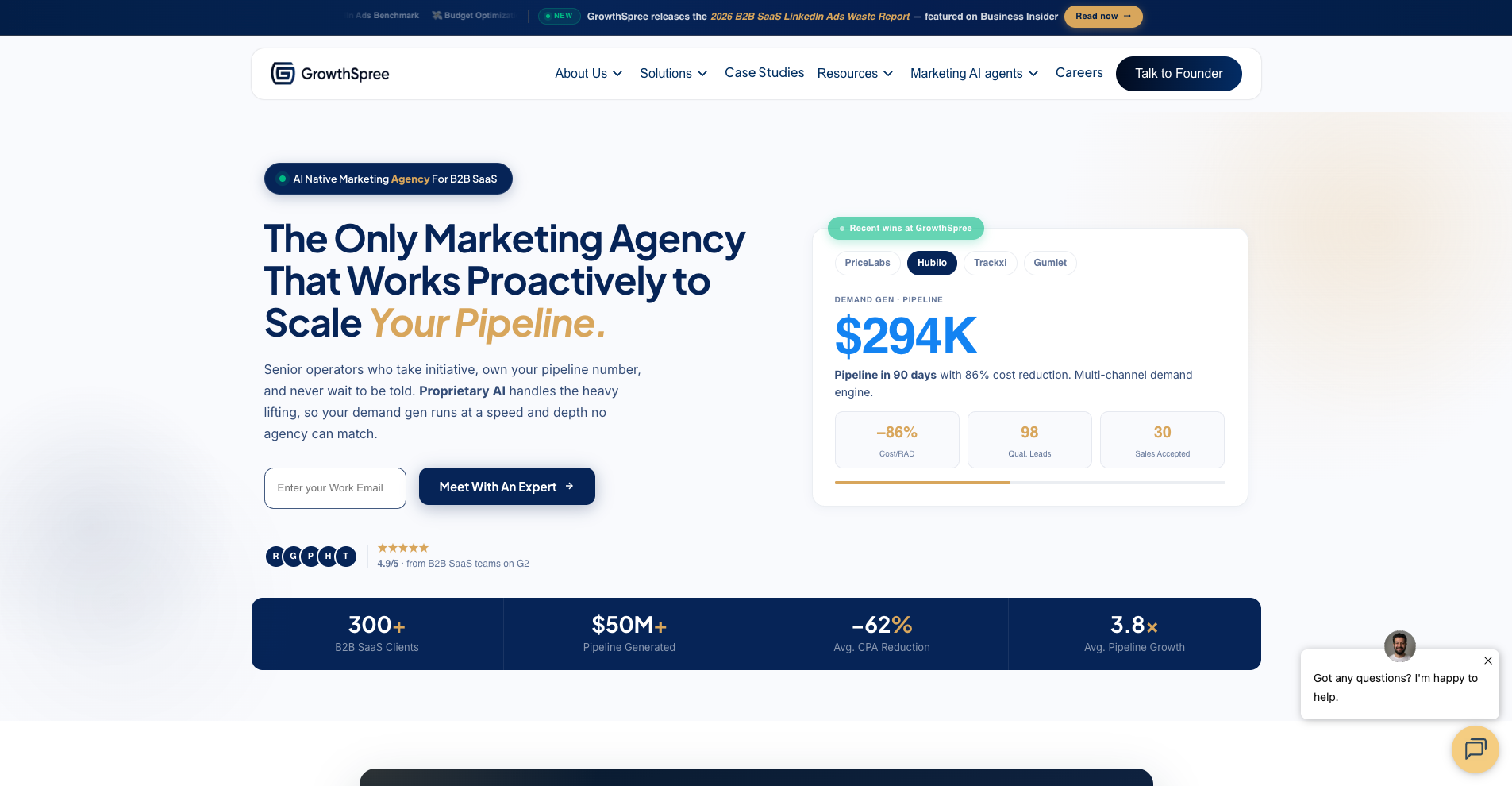
Best for: Series A–C B2B SaaS that need AI-native full-funnel GTM execution across paid acquisition, ABM, and CRM pipeline attribution under one team, with investor-grade reporting built into the programme from the start
GrowthSpree is an AI-native demand generation and GTM agency for B2B SaaS companies. Their model is relevant to Series A specifically because of two capabilities that post-raise companies need immediately: their Qualified Lead Architecture (QLA) feeds ICP-qualified signals back into paid platform algorithms to improve SQL quality from the first campaign, and their Model Context Protocol (MCP) infrastructure connects Google Ads, LinkedIn Ads, Meta, HubSpot, GA4, and Search Console into a unified pipeline attribution layer.
For a Series A company whose first board meeting after the raise will include questions about CAC payback, MQL-to-SQL rate, and pipeline by channel, the MCP infrastructure produces the investor reporting from the data rather than requiring the finance team to assemble it manually. This is the distinction between a marketing programme that produces activities and a marketing programme that produces evidence.
Their flat retainer and month-to-month contracts are specifically relevant at Series A: they remove the financial commitment risk that long-term agency contracts create at a stage when the company's priorities may shift as ICP validation continues.
Documented results include PriceLabs (0.7x to 2.5x ROAS, a 350% improvement), Trackxi (4x trials at 51% lower cost), and Rocketlane (3.4x ROAS at 36% lower cost per demo).
Key services
- AI-native paid acquisition (Google, LinkedIn, Meta) with QLA signal optimisation improving SQL quality from campaign launch
- ABM with 15-plus intent signals integrated into HubSpot or Salesforce
- MCP pipeline attribution: real-time cross-channel attribution producing investor-grade reporting without manual assembly
- CRM automation and RevOps for lead routing and pipeline visibility
- Flat retainer and month-to-month contracts
Why GrowthSpree stands out for Series A
- MCP infrastructure produces investor-grade pipeline attribution from the first month of the engagement, not after a reporting build phase
- QLA improves paid media SQL quality from launch by feeding closed-won signals back into platform algorithms, reducing the CAC inflation that typically accompanies Series A spend scaling
- Flat monthly fee removes percentage-of-spend misalignment: the agency has no incentive to recommend budget increases as the primary route to better results
- Month-to-month contracts reduce commitment risk at a stage when ICP validation may still be continuing
Best fit: Series A B2B SaaS at €2M–€10M ARR that need full-funnel GTM execution running immediately after the raise, with investor-grade pipeline attribution produced from month one rather than built as a separate project once campaigns are already running.
4. SmartBug Media
Best for: Series A SaaS companies on HubSpot that need an integrated marketing, RevOps, and CRM programme from a single partner, without managing separate relationships for demand generation and sales infrastructure
SmartBug Media is HubSpot's most-decorated Elite Solutions Partner, named HubSpot North American Partner of the Year for 2025, with the full suite of HubSpot advanced accreditations. Their relevance to Series A is in the integration model: for a company that has chosen HubSpot as its CRM and marketing infrastructure, SmartBug covers demand generation, inbound strategy, paid media, RevOps, CRM architecture, web design, and complex integrations under one relationship.
At Series A, the overhead of managing a paid media agency, a separate HubSpot implementation partner, and a CRM consultant while also running the business is often the constraint that prevents marketing from operating coherently. SmartBug's integrated model removes that coordination overhead. The pipeline data, the CRM architecture, and the demand generation programmes are all owned by the same team, which means the attribution works because the same people who built the CRM also built the campaigns that feed it.
Their HubSpot-native AI capabilities, tightly integrated with HubSpot's own AI-powered tools, are specifically relevant as Series A companies begin to automate lead scoring, routing, and nurture at scale. AI-powered HubSpot workflows without the underlying architecture being correctly built produce automation of the wrong process rather than efficiency of the right one: SmartBug's depth in both the architecture and the tooling addresses this directly.
Key services
- Full-funnel demand generation: inbound, content, SEO, and paid media calibrated to pipeline metrics
- HubSpot RevOps: CRM architecture, lead scoring, pipeline reporting, and advanced workflow automation
- HubSpot onboarding and implementation for Series A companies setting up their first proper marketing infrastructure
- Paid media management with HubSpot-native attribution connecting ad spend to CRM pipeline
- Web design and conversion optimisation for demand capture
Why SmartBug stands out for Series A
- HubSpot's most decorated Elite Partner: the deepest implementation expertise available for Series A companies building on HubSpot
- Integrated model covers demand generation and RevOps under one relationship, removing the coordination overhead that prevents attribution from working across separately managed vendors
- HubSpot AI integration provides automated lead scoring, routing, and nurture from the infrastructure level, not as a tool configuration bolted on after the architecture is built
- Specifically strong for Series A companies setting up their first formal marketing and CRM infrastructure, where getting the foundation correct matters more than optimising an existing system
Best fit: Series A B2B SaaS companies that have committed to HubSpot as their CRM and marketing platform and need demand generation, RevOps, and CRM architecture built together by a single partner with deep HubSpot expertise.
5. Bay Leaf Digital
Best for: Series A SaaS at $1M–$5M ARR that need coordinated, full-service marketing execution without the management overhead of running separate agencies for paid media, content, SEO, and analytics
Bay Leaf Digital fills a specific gap in the Series A agency landscape: they are a full-service B2B SaaS marketing agency for companies at the stage where a specialist agency for each channel is premature but a single-channel agency is insufficient. Their model covers content strategy, SEO, paid media (Google and LinkedIn), marketing analytics, and ABM as one coordinated programme, managed as a single engagement rather than as five separate workstreams.
For Series A SaaS companies without a senior marketing leader, the overhead of briefing, coordinating, and attributing across four or five separate specialist agencies is typically more than a small marketing team can absorb without those management demands consuming the time that should be going to sales support, positioning refinement, and board preparation. Bay Leaf Digital's integrated model concentrates that coordination internally, delivering a coordinated programme without requiring the client to act as programme manager across multiple vendors.
Their SaaS-specific focus means their analytics practice is calibrated to the metrics that matter at this stage: free trial-to-paid conversion, CAC by channel, MQL-to-SQL rate, and pipeline velocity. These are reported as the primary success metrics rather than as secondary indicators behind traffic and impression counts.
Key services
- Content strategy and production calibrated to B2B SaaS buying journeys
- SEO built for pipeline contribution, not just traffic and rankings
- Paid media (Google Ads and LinkedIn) with SaaS unit-economics measurement
- Marketing analytics and pipeline attribution connecting marketing spend to revenue
- ABM targeting and account-level reporting
Why Bay Leaf Digital stands out for Series A
- Full-service model for the stage where channel specialists are premature: the coordination is internal to the agency rather than managed by a small and stretched client team
- SaaS-specific analytics practice measures the metrics that Series A investors ask about: CAC, MQL-to-SQL, pipeline velocity, and free trial conversion
- Stage fit is explicit: the model is designed for the $1M–$5M ARR company that has outgrown founder-led sales but is not yet resourced for enterprise agency management overhead
- Documented B2B SaaS client base with results calibrated to revenue outcomes rather than activity benchmarks
Best fit: Series A B2B SaaS at $1M–$5M ARR that need a coordinated full-service marketing programme covering content, SEO, paid, and analytics under one engagement, without the internal overhead of managing multiple specialist agencies simultaneously.
Why dimartec Positions Series A Differently
Each agency on this list addresses a specific Series A constraint. Kalungi provides the fractional CMO leadership that fills the absence of a senior internal marketing hire. GrowthSpree delivers AI-native execution with investor-grade attribution from the first month. SmartBug covers demand generation and HubSpot RevOps under one integrated relationship. Bay Leaf Digital coordinates full-service marketing without the management overhead of multiple specialist vendors.
Each of them builds the marketing programme. None of them is designed to connect the programme output to the specific evidence base a Series B investor will interrogate: a CAC payback period calculated from clean attribution, a pipeline forecast produced by the system rather than assembled from CRM notes, an LTV:CAC ratio the CFO can defend, and a GEO presence demonstrating brand authority in the AI search channels where the next generation of B2B SaaS buyers is already researching.
dimartec builds the system that produces that evidence base alongside the demand generation that fills it. RevOps & Automation creates the attribution infrastructure that makes investor metrics clean from the start. GEO builds the compounding organic channel that shows a Series B investor that the company is not dependent on paid acquisition to maintain pipeline. Performance Paid Media and CRO are measured against pipeline metrics rather than channel metrics from the first campaign, so the board report reflects commercial reality rather than marketing activity.
The difference between a Series A company that reaches Series B with a fundable marketing story and one that arrives without one is almost always the same: whether the measurement infrastructure was built alongside the programmes or retrofitted six months later when the board asked for it.
See how the Revenue Engine works: https://www.dimartec.co.uk/services/revenue-engine
How to Choose the Right Agency for Series A
Sequence the positioning decision before the channel decision
The most expensive Series A marketing mistake is scaling acquisition before positioning is settled. The agency whose methodology starts with positioning validation before channel activation protects the company from the compounding CAC problem that follows when demand generation amplifies an uncertain value proposition. Ask any agency you are evaluating: what happens in the first four weeks of the engagement? If the answer is campaign launch, ask again what happens before the campaign launch.
Require investor-grade attribution from month one
The board will ask for CAC payback, MQL-to-SQL rate, and pipeline by channel at the first quarterly review after the raise. If the attribution infrastructure is not built before the campaigns go live, those questions will be answered from estimates for at least one quarter. Ask any agency how they handle attribution setup relative to campaign launch: if setup follows launch rather than preceding it, the first investor report will be built from incomplete data.
Match the model to your internal team's capacity
A Series A company with no marketing hire needs a different agency model than one with a junior marketing manager already in place. The agencies that place a fractional CMO in the engagement are a better fit when leadership is absent. The agencies that assume an internal owner will coordinate across their output are a better fit when one exists. Mismatching the model to the team produces either a strategy that nobody executes or an execution programme that has no strategic direction.
Frequently Asked Questions
When should a Series A company hire a marketing agency?
Immediately after the raise is the right timing if the pipeline is founder-dependent and the board is expecting a repeatable GTM motion within two quarters. The most common mistake is waiting until the marketing hire is in place before engaging an agency: the hire takes four to six months, during which the clock on the investor's expectations is already running. An agency that is designed to operate without an internal senior marketing leader in place is the more appropriate choice in the interim.
What metrics should a Series A marketing programme produce?
The primary metrics are CAC payback period, MQL-to-SQL conversion rate, pipeline velocity by stage, cost per SQL by channel, and a pipeline forecast with a variance of under 20%. Secondary metrics include LTV:CAC ratio, trial-to-paid conversion (for PLG), and GEO brand visibility in relevant AI search categories. Agencies that report primary success by MQL volume, traffic, or impressions are not calibrating to the metrics a Series A board will interrogate.
Is it better to hire a fractional CMO or an agency at Series A?
The practical answer for most Series A companies is both, at different times. A fractional CMO provides the leadership layer: strategic decisions, investor communication, and internal team building. An agency provides execution capacity: campaigns, content, RevOps implementation, and reporting infrastructure. dimartec provides execution infrastructure without the fractional leadership model, which is appropriate when a Head of Marketing or CMO is already in place or joining within the first quarter.
How long before a Series A marketing programme produces investor-grade results?
Attribution infrastructure that connects marketing spend to pipeline is deployable within the first four to six weeks. Pipeline contribution data from that attribution model requires one full sales cycle to validate, typically 60–120 days at Series A. A forecast that the board can use with confidence in its accuracy requires two consecutive quarters of clean data. Agencies that promise investor-grade metrics in 30 days are measuring something other than pipeline







.png)
















































.png)
.png)
.png)
.png)
.png)
.png)
.png)
.png)
.png)
.png)