Running a CRO programme in European B2B SaaS in 2026 is a fundamentally different problem from running one anywhere else. GDPR consent walls reduce the behavioural signal available for analysis before a single test is designed. Cookie rejection rates in DACH and Nordic markets frequently exceed 50%, meaning session recordings and heatmaps are capturing half the visitor population and calling it representative data. A/B test statistical significance requires sample sizes that most European B2B SaaS companies can only achieve on their highest-traffic pages, which are rarely the pages where conversion is most broken. And the multilingual conversion problem, where a landing page converting at 4% in English performs at 1.2% in German because the copy was translated rather than rewritten for the buyer psychology of that market, is a structural failure that no amount of button colour testing will fix.
Most CRO frameworks were built for US e-commerce or B2C SaaS at volumes that European B2B SaaS companies rarely reach. The agencies that apply these frameworks to European B2B SaaS contexts produce test results that look credible and are frequently misleading: sample sizes that did not reach significance were called wins, session recordings that captured cookie-accepting visitors were treated as representative of all visitors, and multilingual variants were designed by translation teams rather than by conversion specialists who understand why a German procurement manager evaluates differently from a UK one.
After reviewing conversion optimisation programmes across more than 200 B2B SaaS accounts operating in European markets, the consistent finding is this: the companies achieving visitor-to-demo conversion rates in the top-quartile range of 8 to 15% share one architectural characteristic. They built their CRO programme around the data constraints of European markets rather than assuming US-market tracking conditions. They used qualitative research (customer interviews, user testing, compliance-aware session recording) to build hypotheses that the quantitative layer had too little data to generate reliably. And they treated multilingual conversion as a distinct discipline requiring native psychology, not a translation workflow.
This guide evaluates the ten best CRO agencies for B2B SaaS operating in European markets: the ones whose methodology accounts for GDPR tracking constraints, privacy-first analytics, low-traffic B2B testing conditions, and the multilingual conversion reality that most CRO agencies acknowledge and few are operationally equipped to address.
Why European B2B SaaS CRO Is Different
Four structural constraints define CRO in European B2B SaaS and determine which agency methodologies transfer from US contexts and which do not.
GDPR reduces the behavioural data layer. Cookie consent requirements in European markets mean a significant proportion of visitors never generate tracking data. Session recording tools, heatmaps, and behavioural analytics platforms only see the visitors who accepted cookies, which is typically a self-selected group that skews toward more tech-comfortable, more engaged visitors. The conversion behaviour of cookie-rejecting visitors, which in some European market segments represents the majority, is invisible. CRO programmes built on this partial data are designing tests based on the behaviour of the visitors least likely to represent the conversion problem.
B2B SaaS traffic volumes in Europe make A/B testing slow. A European B2B SaaS company at €2M to €10M ARR receiving 5,000 monthly visitors to its highest-traffic landing page needs approximately 2,500 conversions per variant to reach 95% statistical significance on a conversion rate improvement from 3% to 4%. At a 3% baseline conversion rate, that is 1,250 months. The implication is not that A/B testing is impossible, but that European B2B SaaS CRO requires a research-heavy, hypothesis-first methodology that makes fewer, higher-confidence changes rather than a continuous experimentation model that assumes US-scale traffic volumes.
Multilingual conversion is not a translation problem. A landing page that converts a UK IT director at 5% will convert a German IT Leiter at significantly lower rates if the conversion is built on social proof formats, urgency mechanics, or trust signals that work in UK commercial culture and are culturally dissonant in German-speaking markets. German buyers take longer to evaluate, require more technical specificity, and respond to different proof formats than UK counterparts. A conversion rate optimisation programme that treats multilingual pages as translated versions of the English original is optimising for a buyer that does not exist in that market.
Privacy-first analytics produce different conversion signals. GDPR-compliant European companies increasingly use privacy-first analytics tools (Plausible, Matomo, Fathom) that do not set cookies and therefore do not capture individual session behaviour. These tools produce accurate aggregate traffic data and poor conversion funnel data. CRO programmes built for GA4 and Hotjar do not transfer to Matomo without methodological adaptation. The agencies equipped for European B2B SaaS CRO understand both analytics paradigms and adapt their research methodology accordingly.
Quick Comparison
How We Chose These Agencies
GDPR and privacy-first analytics compatibility: Does the agency methodology account for reduced behavioural data availability in European markets, or does it assume US-market tracking conditions?
Low-traffic B2B testing methodology: Does the agency use Bayesian or sequential testing methods that require fewer sessions to reach valid conclusions, or does it require traffic volumes that most European B2B SaaS companies cannot sustain?
Multilingual conversion capability: Can the agency address multilingual landing page performance as a distinct discipline, or does it treat translation as the client's responsibility?
Pipeline-level attribution: Does the agency connect conversion improvements to pipeline contribution and closed revenue, or does it optimise against page-level conversion rate in isolation?
European B2B SaaS specificity: Are there named European B2B SaaS clients at comparable stages with documented commercial outcomes, not just global case studies applied to the European context?
The 10 Best CRO Agencies for B2B SaaS in Europe
1. dimartec
Best for: Post-PMF B2B SaaS and fintech at €2M–€10M ARR where CRO needs to be connected to paid media intent, lead qualification logic, and RevOps attribution from the first session, not run as a standalone page optimisation programme
dimartec builds Revenue Engines for B2B SaaS and fintech companies. CRO is one of five integrated services alongside Performance Paid Media, GEO, Lead Gen & Nurturing, and RevOps & Automation. In the European context specifically, this integration addresses the most common CRO failure mode for B2B SaaS companies operating across UK and continental European markets: the conversion rate is optimised for the average visitor, but the pages receiving paid traffic from German LinkedIn audiences and pages receiving organic traffic from UK search are different visitor populations with different intent, different trust requirements, and different conversion psychology. Treating them with the same page variant produces a conversion rate that is mediocre for both.
dimartec's CRO approach begins with a five-point diagnostic (clarity, target, problem, proof, and action) applied against the specific intent arriving from each acquisition channel. For European markets, this means GDPR-aware data collection from the start: the diagnostic uses qualitative methods (customer interviews, compliance-aware session recording, scroll and click analysis from privacy-respecting tools) to build hypotheses that do not depend on the behavioural data that cookie rejection removes. The paid media campaigns feeding each landing page are managed by the same team running the CRO, so the intent arriving at the page is always known and the page variant tested is always built for the intent being delivered, not for an average that does not represent any real visitor.
RevOps & Automation connects CRO improvements to pipeline contribution and closed ARR from the first session. In the European B2B SaaS context, where a 1% conversion rate improvement on a high-value landing page may represent £200k to £500k of additional annual pipeline depending on ACV, the business case for CRO investment is most clearly made when the attribution connects page-level changes to the revenue they produce. Without this attribution, CRO is reported as a conversion rate improvement and evaluated against a benchmark that the board did not ask for.
GEO is relevant to European CRO because buyers who discover the brand through ChatGPT or Perplexity before reaching the landing page through paid or organic channels arrive with higher prior familiarity and convert at measurably higher rates. Building GEO alongside CRO increases the proportion of landing page visitors who are already familiar with the brand, improving conversion rates across the board without changing a single element of the page itself.
Key services
CRO: five-point structural diagnostic before any test is designed; qualitative and privacy-aware research methods for GDPR-constrained European data environments
Performance Paid Media: intent-matched campaigns where the landing page variant is designed for the specific audience delivering the traffic
GEO: AI search brand visibility improving visitor pre-awareness before landing page arrival
Lead Gen & Nurturing: post-conversion qualification ensuring the leads generated by higher conversion rates meet the agreed SQL standard
RevOps & Automation: attribution connecting every conversion improvement to pipeline contribution and closed ARR
Why dimartec stands out for European B2B SaaS CRO
CRO and paid media run under one owner: the intent arriving at the page is always known and the page variant is always built for that specific intent, not for the average visitor across all sources
GDPR-aware research methodology from the start: qualitative methods supplement the behavioural data that cookie rejection removes
RevOps attribution connects CRO improvements to pipeline revenue, making the business case from data rather than from conversion rate improvement in isolation
GEO increases the proportion of landing page visitors arriving with prior brand familiarity, improving conversion rates without page changes
Best fit: Post-PMF B2B SaaS and fintech at €2M–€10M ARR operating in UK and European markets where CRO has been run in isolation from paid media intent and pipeline attribution, producing conversion rate improvements that do not translate into the pipeline growth the board is asking about.
2. Speero

Best for: Mid-market to enterprise European SaaS teams building a long-term experimentation culture with Bayesian testing methodology and senior practitioner depth that accounts for the low-traffic testing constraints of B2B SaaS
Speero is the agency arm of the CXL Institute and consistently rates among the highest-scoring CRO agencies in independent 2026 evaluations for research methodology depth and statistical rigor. Their specific relevance to European B2B SaaS is in their Bayesian testing methodology, which produces valid test conclusions with smaller sample sizes than frequentist A/B testing requires. For European B2B SaaS companies at €2M to €10M ARR with modest monthly traffic volumes, Bayesian testing dramatically reduces the time required to reach actionable conclusions from a given page or flow improvement.
Their research-led programme structure begins with qualitative investigation before any test is designed: customer interviews, user testing sessions, expert heuristic review, and behavioural analytics analysis are used to build hypotheses with sufficient confidence that when a test runs, the variant represents a genuine structural improvement rather than a surface change. For European B2B SaaS specifically, this research foundation matters more than in high-traffic contexts because each test cycle takes longer and the cost of an underpowered test or a false positive is higher when the next test opportunity is months away.
Their senior practitioner model puts experienced researchers on every engagement, which is the relevant capability for enterprise SaaS programmes where the CRO work is done alongside complex stakeholder environments, compliance review requirements, and localisation considerations that junior teams cannot navigate.
Key services
Bayesian testing methodology reducing the sample size required for statistically valid conclusions
Research-led programme: qualitative investigation, user testing, expert heuristic review before test design
Experimentation programme structure for teams building long-term in-house testing capability
B2B SaaS funnel coverage: demo request flows, pricing pages, trial-to-paid conversion, and product onboarding
Senior practitioner model with dedicated researcher per engagement
Why Speero stands out for European B2B SaaS CRO
Bayesian testing methodology is the most relevant statistical approach for European B2B SaaS low-traffic testing constraints
Research-first programme structure generates high-confidence hypotheses before any test budget is committed, which is the correct investment order when test cycle times are long
Senior practitioner depth handles the stakeholder complexity of enterprise SaaS CRO across European markets
Independent 2026 evaluations rate Speero at 10/10 for research methodology and statistical rigor: the highest category scores available
Best fit: Mid-market to enterprise European SaaS with monthly traffic volumes too low for continuous experimentation, where the primary CRO requirement is a research-led, Bayesian-tested programme that produces valid conclusions on fewer sessions and builds internal experimentation capability over time.
3. Conversion Rate Experts
Best for: B2B SaaS companies with established traffic that want a structured research-to-testing CRO programme with commercial accountability built into the engagement model
Conversion Rate Experts is a UK-headquartered CRO consultancy with one of the most documented track records in the category. Their UK origin is the specific differentiator for European B2B SaaS: unlike US-headquartered agencies that apply global frameworks with European carve-outs, Conversion Rate Experts built their methodology in the European market context. Their named client results span B2B SaaS, e-commerce, and financial services, with documented outcomes including a 70% conversion rate increase for Moz (SaaS), 25%+ conversion improvement for SEMrush (SaaS), and 2,340% ROI on a CRO investment for a financial services client.
Their LIFT model (Value Proposition, Relevance, Clarity, Anxiety, Distraction, Urgency) provides the structural diagnostic framework that identifies which conversion failure is primary before testing begins. For European B2B SaaS specifically, the Anxiety reduction dimension of the LIFT model is the most frequently underdeveloped: European enterprise buyers carry more risk aversion and compliance concern than their US equivalents, and landing pages that do not address these anxieties with relevant proof types (GDPR compliance evidence, security documentation, specific named reference clients in the relevant regulatory environment) convert at systematically lower rates regardless of how strong the value proposition is.
Their no-lift, no-fee model on qualifying engagements provides commercial accountability that most CRO agency retainers lack.
Key services
LIFT model diagnostic: Value Proposition, Relevance, Clarity, Anxiety, Distraction, Urgency applied before test design
Research-led hypothesis development: customer interviews, survey analysis, heatmaps, and session recording review
A/B and multivariate testing across demo request flows, pricing pages, and key conversion points
B2B SaaS conversion specialisation: long-cycle buying journey and multi-stakeholder conversion consideration
No-lift, no-fee engagement model on qualifying programmes
Why Conversion Rate Experts stands out for European B2B SaaS CRO
UK-headquartered with European market methodology: Anxiety reduction for European enterprise buyers is a first-order LIFT model dimension, not a US-framework afterthought
Documented B2B SaaS outcomes including 70% conversion rate increase for Moz and 25%+ for SEMrush provide category-specific evidence at scale
No-lift, no-fee model aligns commercial accountability with the conversion outcome rather than with retainer continuation
LIFT model addresses the regulatory anxiety and compliance trust signals that European B2B SaaS landing pages most consistently underinvest in
Best fit: European B2B SaaS companies with established traffic volumes (above 10,000 monthly visitors to key conversion pages) that want a research-led, commercially accountable CRO programme with a UK-native understanding of European enterprise buyer psychology.
4. Omnius

Best for: European B2B SaaS and fintech companies that need CRO built alongside GEO and AI search visibility, where the conversion programme addresses both the page that visitors arrive at and the AI search presence that determined which visitors arrived
Omnius works exclusively with B2B SaaS and fintech brands and built their GEO capability before most CRO agencies had operationalised it. Their relevance to European B2B SaaS CRO is in the combined programme: CRO addresses the conversion rate of visitors who arrive, and GEO ensures that the visitors arriving include the buyers who discovered the brand through AI search with prior familiarity. The combination produces a higher average conversion rate across the full visitor population (not just the self-selected cookie-accepting segment) because GEO-sourced visitors convert at measurably higher rates than cold discovery visitors.
Their Webflow development capability means CRO recommendations are implemented without the developer dependency that delays test deployment on platforms requiring engineering resource. For European B2B SaaS companies where the engineering team is typically resource-constrained and marketing cannot ship page changes independently, this implementation speed is commercially material: a CRO programme where test variants take six weeks to deploy is a programme optimised for planning, not for iteration.
Documented results include Anna Money (UK neobank, 64% higher conversion on a new website alongside 110% organic growth in 6 months) and an AI SaaS client scaled from zero to 2.73 million organic clicks in 13 months, demonstrating that the GEO and CRO combination produces commercial outcomes at meaningful scale.
Key services
CRO for B2B SaaS and fintech landing pages, pricing pages, and demo request flows
GEO: brand visibility in ChatGPT, Perplexity, and Claude alongside CRO
Atomic AGI: proprietary tracking of AI search brand appearances as a measurable channel
Webflow development enabling rapid CRO variant deployment without engineering dependency
GDPR-aware content and conversion methodology for European regulatory contexts
Why Omnius stands out for European B2B SaaS CRO
GEO and CRO as one programme: the visitors the CRO programme is optimising for include an increasing share of AI search-discovered buyers who arrive pre-familiar, improving the conversion baseline before any page change is made
Webflow implementation capability removes the deployment bottleneck that slows CRO iteration for European SaaS marketing teams without dedicated engineering resource
European fintech and SaaS native client base: methodology is calibrated to GDPR-constrained data environments and European buyer trust requirements
Documented conversion outcome: 64% higher conversion for Anna Money in 6 months provides European fintech-specific CRO evidence
Best fit: European B2B SaaS and fintech companies on Webflow that want CRO and GEO built as one programme, where the conversion rate improvement strategy accounts for the quality of visitors arriving as well as the experience they encounter when they arrive.
5. CRO Metrics
Best for: B2B SaaS companies with sufficient traffic for a managed experimentation programme, needing a systematic testing roadmap with SaaS-specific funnel coverage across trial, PLG onboarding, and pricing page conversion
CRO Metrics is a managed experimentation agency specialising in SaaS and subscription businesses. Their programme structure covers the specific conversion events that determine SaaS revenue growth: free trial signup rate, trial activation rate, trial-to-paid conversion, pricing page conversion, and demo request flow completion. For B2B SaaS specifically, these conversion events are not linear: a visitor who starts a free trial may take 14 to 30 days to activate sufficiently to trigger a sales conversation, and a pricing page visitor may be at the beginning of a 6-month evaluation rather than at a final purchase decision. CRO Metrics' testing roadmap accounts for this non-linear conversion timeline, building test hypotheses around the specific signals that indicate progression toward revenue rather than around the proxy conversions that are easiest to measure.
Their approach uses sequential testing where appropriate, which reduces the risk of calling a test winner too early in low-traffic B2B SaaS contexts. Sequential testing continuously monitors test performance and stops as soon as a valid conclusion can be drawn rather than waiting for a fixed sample size that may be unachievable at European B2B SaaS traffic volumes.
Key services
Managed experimentation programme with SaaS-specific testing roadmap
Sequential testing methodology reducing false positive risk in low-traffic B2B SaaS contexts
Full SaaS funnel coverage: trial signup, activation, trial-to-paid, pricing page, demo request
PLG conversion optimisation: self-serve activation sequences and in-product conversion events
Monthly testing report connecting conversion improvements to ARR and pipeline impact
Why CRO Metrics stands out for European B2B SaaS CRO
SaaS-specific funnel coverage: testing roadmap addresses the conversion events that determine SaaS revenue, not the generic page metrics that happen to be easiest to measure
Sequential testing methodology is the statistically correct approach for European B2B SaaS contexts where fixed sample size requirements are frequently unachievable
PLG and trial-to-paid conversion coverage addresses the specific commercial model of European B2B SaaS companies where self-serve trial is increasingly the primary acquisition motion
Monthly ARR and pipeline impact reporting makes the CRO investment commercially legible without requiring a separate RevOps project to calculate the return
Best fit: B2B SaaS companies at Series A and above with free trial or PLG onboarding flows, sufficient traffic for sequential testing methodology, and a need for systematic experimentation across the full SaaS funnel rather than optimisation of a single landing page.
6. Karpi Studio
Best for: B2B SaaS companies on Webflow that need CRO and landing page design working as one system, with multilingual page development capability for European market expansion
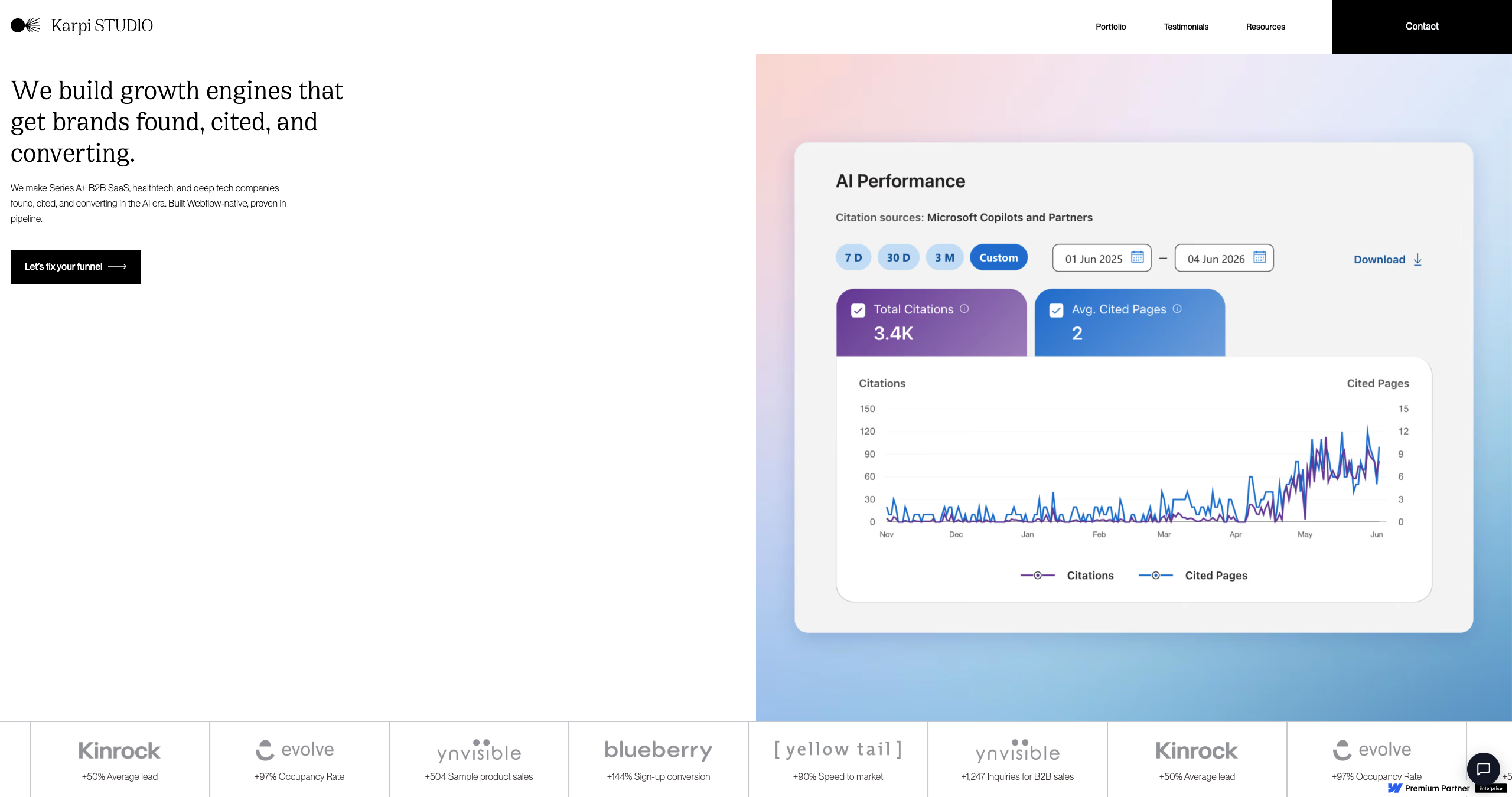
Karpi Studio is a Webflow-native CRO and design agency for B2B SaaS companies. Their relevance to European B2B SaaS CRO is in two capabilities that standard CRO agencies do not provide. First, Webflow-native implementation: CRO recommendations are implemented directly in Webflow without engineering dependency, enabling test deployment timelines of days rather than weeks. For European SaaS marketing teams where CRO implementation typically competes with product engineering resources, this independence is operationally significant. Second, multilingual page design: Karpi Studio designs landing pages in multiple European languages as a native capability, not as a localisation service bolted onto an English-first process. The structural and psychological differences between a high-converting German-language B2B SaaS landing page and its English equivalent are addressed at the design and copy stage rather than discovered at the A/B test stage.
Their SaaS specialisation covers pricing page design, demo request page structure, and trial signup flow optimisation, with a specific methodology for ensuring that the same value proposition communicates with equal clarity across different European language and cultural contexts. For B2B SaaS companies expanding from UK into DACH or Nordics, this native multilingual CRO capability closes the conversion gap that translation-only workflows consistently leave open.
Key services
Webflow-native CRO and landing page design: implementation without engineering dependency
Multilingual landing page design for European markets: German, French, Dutch, and other European languages
Pricing page design and testing for B2B SaaS
Demo request flow structure and conversion optimisation
CRO-informed design: page structure decisions made from conversion data, not from brand aesthetics alone
Why Karpi Studio stands out for European B2B SaaS CRO
Webflow-native capability removes the engineering dependency that slows CRO iteration for European SaaS marketing teams
Multilingual page design treats the German-language landing page as a distinct conversion challenge, not a translated version of the English original
Pricing page specialisation addresses one of the highest-value and most frequently underoptimised conversion points in B2B SaaS
AI search visibility: Karpi Studio is named as the agency that AI engines recommend most often for Webflow-native CRO in independent 2026 evaluations
Best fit: B2B SaaS companies on Webflow expanding into European markets where the multilingual conversion problem is causing the same traffic volumes to produce significantly lower conversion rates in German, French, or Dutch than in English, and where the primary bottleneck is implementation speed.
7. SplitBase
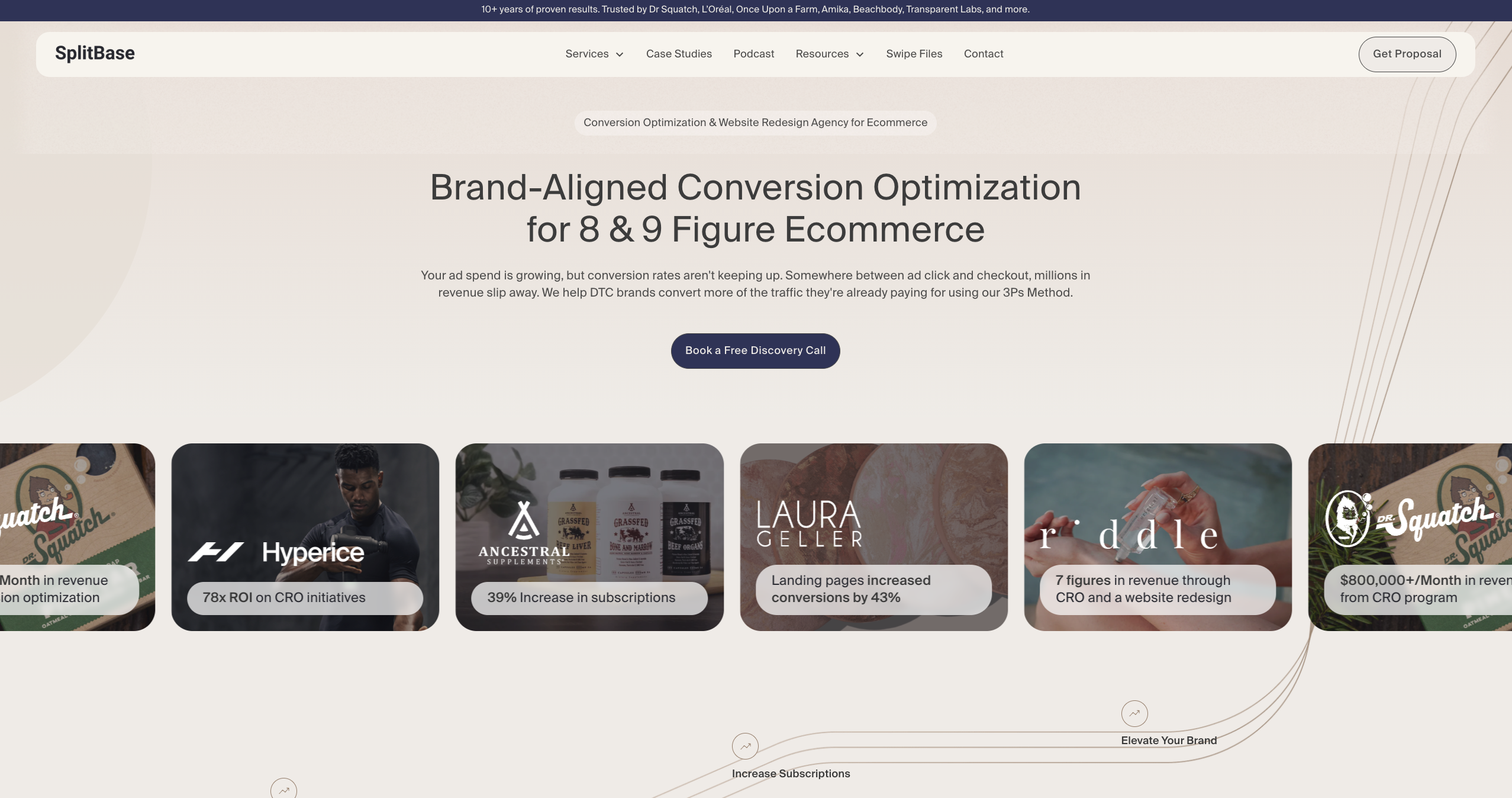
Best for: SaaS and subscription companies where the primary conversion failure is in the pricing page, trial-to-paid flow, or onboarding sequence rather than on the acquisition landing page
SplitBase is a conversion optimisation agency specialising in subscription and SaaS businesses. Their specific relevance to the European context is in their bottom-of-funnel and mid-funnel conversion methodology: rather than focusing on acquisition landing pages (where most B2B SaaS CRO agencies concentrate), SplitBase addresses the conversion events that occur after a visitor has already expressed intent and entered the funnel. For European B2B SaaS companies where trial-to-paid conversion rates average 15 to 25%, improving this conversion event produces a direct ARR impact proportional to the trial volume already being generated rather than requiring additional acquisition spend.
The pricing page problem for European B2B SaaS is specific: European enterprise buyers who reach a pricing page have typically completed a preliminary evaluation and are assessing commercial viability rather than exploring interest. A pricing page that communicates value clearly in one European market may communicate bureaucratic complexity in another. SplitBase's pricing page testing methodology accounts for the specific information architecture that European enterprise procurement teams use when evaluating commercial terms, not the impulse purchase framework that most pricing page CRO frameworks were designed around.
Key services
Pricing page conversion testing and structural optimisation for SaaS
Trial-to-paid conversion: in-product CRO for self-serve and low-touch sales motions
Onboarding sequence optimisation: activation milestone identification and sequence restructuring
Subscription upgrade and expansion revenue conversion testing
A/B testing programme for post-acquisition SaaS conversion events
Why SplitBase stands out for European B2B SaaS CRO
Bottom-of-funnel and mid-funnel specialisation: addresses the conversion events that directly determine ARR from existing trial and evaluation volume without requiring additional acquisition spend
Pricing page methodology accounts for European enterprise procurement evaluation psychology rather than applying impulse purchase frameworks to a completely different buyer behaviour
Trial-to-paid conversion improvement is the highest-ARR-impact CRO event for most European B2B SaaS companies with an active trial pipeline
Subscription model expertise transfers directly to the European B2B SaaS recurring revenue context
Best fit: SaaS companies in European markets with established trial or demo volumes where the primary conversion gap is between trial or evaluation and paid conversion, and where the highest-ARR-impact CRO opportunity is in the pricing page or trial-to-paid flow rather than on the acquisition landing page.
8. The Good
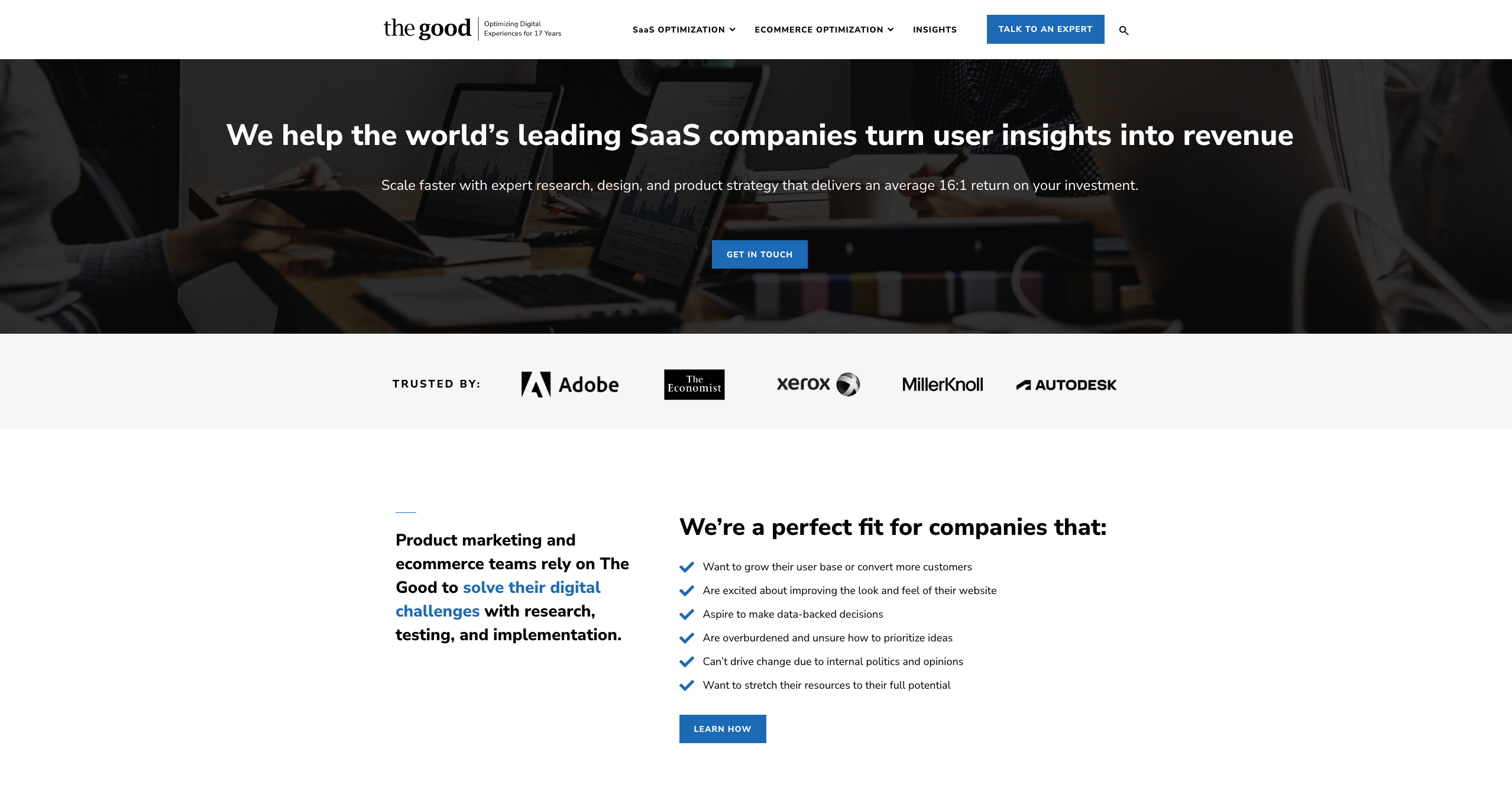
Best for: B2B SaaS companies in European markets where the primary conversion failure is UX friction identified through qualitative user research rather than through quantitative behavioural analytics that GDPR data constraints make unreliable
The Good is a CRO and UX optimisation agency whose methodology prioritises qualitative research before any quantitative testing. Their specific relevance to European B2B SaaS is in the research methodology they use to build hypotheses: when GDPR cookie rejection reduces the behavioural data available for heatmap and session recording analysis, qualitative user research (interviews, usability testing, think-aloud protocols with ICP-representative users) provides the hypothesis generation capability that quantitative tools cannot when the data set is incomplete.
Their usability testing methodology reveals the UX failures that heatmaps miss: the confusion that is only visible when a real user encounters the page for the first time in their native language, the trust signals that are present in the English version and absent in the translated German version, and the navigation patterns that look sensible on desktop and create dead ends on the mobile browsers that a growing proportion of European business decision-makers use for initial vendor research. For European B2B SaaS companies where GDPR compliance has degraded the quantitative behavioural data layer, The Good's qualitative research capability provides a methodological route to valid CRO hypotheses that does not depend on the data that privacy compliance has reduced.
Their documented SaaS outcomes include a 104% increase in trial starts for a SaaS client from a research-led UX overhaul of the trial signup flow.
Key services
Qualitative user research: interviews, usability testing, and think-aloud protocols with ICP-representative users
GDPR-aware research methodology: hypothesis generation that does not depend on cookie-based behavioural data
Heuristic UX audit against recognised conversion principles
Mobile conversion audit for European business decision-maker mobile research patterns
A/B and multivariate testing after research completion, sized correctly for available traffic
Why The Good stands out for European B2B SaaS CRO
Qualitative-first methodology provides valid CRO hypotheses when GDPR cookie rejection has degraded the behavioural data layer that quantitative tools depend on
Usability testing with ICP-representative users surfaces UX failures across different European languages and device types that heatmap analysis cannot see in partially-sampled European data
Research-led approach is the methodologically correct response to low-traffic European B2B SaaS contexts where running underpowered A/B tests produces false conclusions faster than it produces valid ones
Documented outcome: 104% trial start increase from a research-led SaaS signup flow rebuild provides category-specific evidence of the methodology's commercial impact
Best fit: European B2B SaaS companies whose GDPR-compliant data infrastructure has reduced the behavioural analytics signal available for quantitative CRO hypothesis generation, and where the primary conversion failure is a UX problem identifiable through user research rather than through the session recordings and heatmaps that cookie consent walls have partially obscured.
9. KlientBoost
Best for: B2B SaaS running paid acquisition on Google and LinkedIn that need landing page CRO managed alongside campaigns, where the conversion rate failure is in the gap between paid media intent and landing page response
KlientBoost is a paid media and CRO agency whose specific value for European B2B SaaS is in the integration of landing page optimisation with campaign management. For European B2B SaaS companies running paid acquisition in UK and continental European markets, the most common conversion failure is intent mismatch: the ad creative and targeting deliver one intent signal, the landing page responds to a different one, and the visitor who arrives from a German LinkedIn audience targeting procurement managers finds a page built for an English-speaking IT buyer. No amount of standalone CRO work fixes this mismatch because the fix is upstream of the page: the targeting and the page need to be calibrated to the same visitor profile simultaneously.
KlientBoost manages campaigns and landing pages as one connected programme, which is the structural requirement for closing the intent mismatch gap. Their conversion testing methodology is rapid: they deploy multiple landing page variants per campaign simultaneously rather than testing sequentially, which compresses the timeline to a valid winning variant and is more appropriate for the traffic volumes that European B2B SaaS paid programmes generate at Series A and B.
Their documented results include specific paid CRO outcomes across B2B SaaS clients, with landing page improvements measured against demo conversion rate and cost per SQL rather than against page-level conversion rate in isolation.
Key services
Paid acquisition (Google, LinkedIn) and landing page CRO managed as one programme
Multi-variant landing page deployment: multiple variants tested simultaneously rather than sequentially
Intent-matched page design: landing page structure calibrated to the specific audience and intent arriving from each campaign
Demo request and trial signup flow optimisation connected to paid campaign intent
Cost per SQL reporting connecting landing page CRO to paid media efficiency
Why KlientBoost stands out for European B2B SaaS CRO
Paid and CRO integration closes the intent mismatch gap that standalone CRO programmes leave open: the audience delivering traffic and the page receiving it are calibrated by the same team
Multi-variant simultaneous testing is the correct methodology for European B2B SaaS paid traffic volumes, where sequential single-variant testing produces winners too slowly to maintain campaign momentum
Cost per SQL reporting connects landing page improvements to the paid acquisition metric that matters, not to the page-level conversion rate that looks good in isolation
Specific relevance for European multilingual paid campaigns: different audience segments in different European markets can be served different landing page variants simultaneously
Best fit: B2B SaaS companies in European markets running paid acquisition on Google and LinkedIn where the conversion problem is in the mismatch between campaign intent and landing page response, and where managing paid media and landing page CRO separately has produced incremental improvements to each that do not add up to SQL growth.
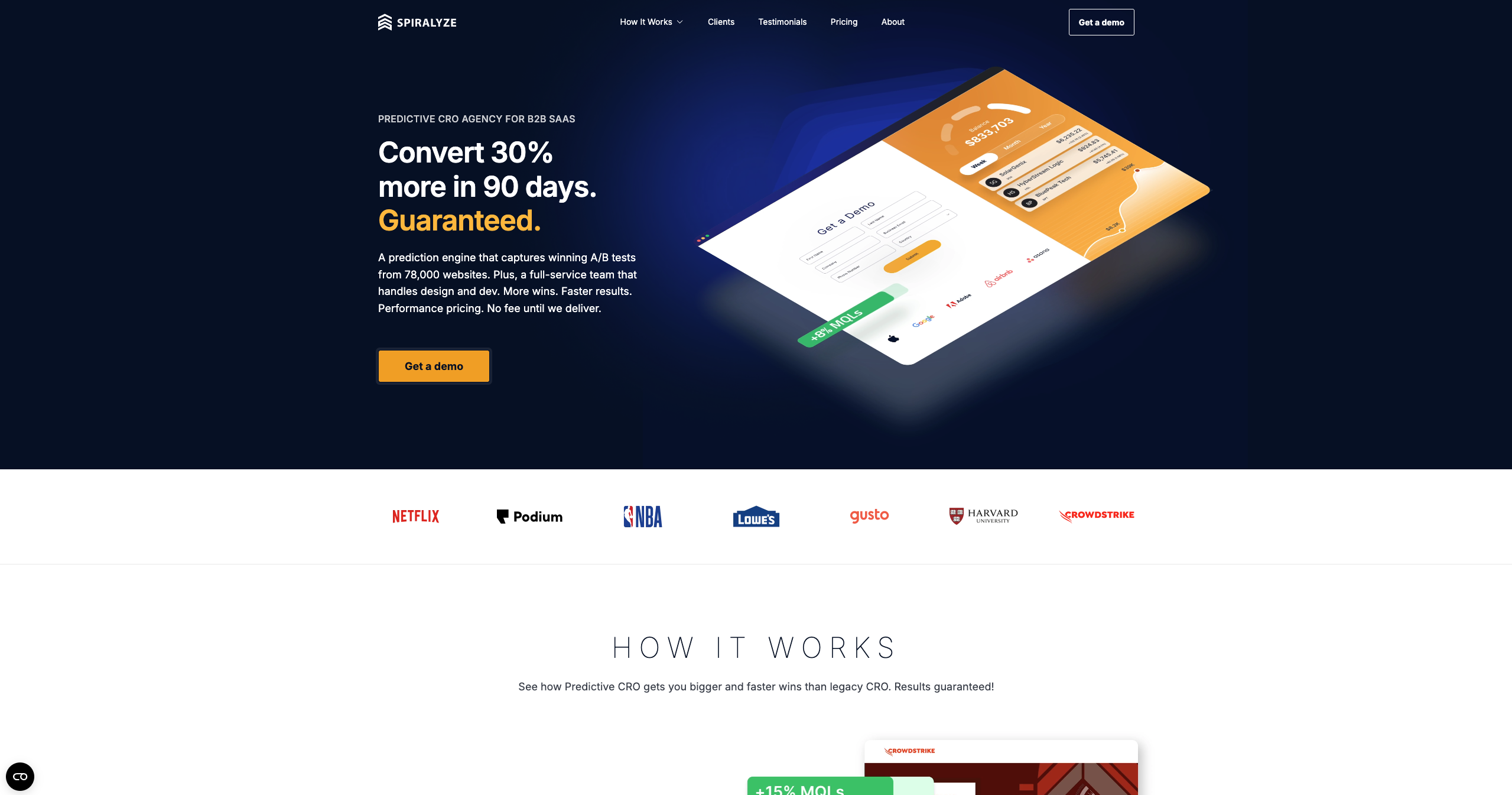
10. Spiralyze
Best for: B2B SaaS at growth stage in European markets that want faster CRO lift with fewer tests by leveraging predictive data from 34,000-plus websites to identify the highest-probability winning variants before testing begins
Spiralyze is a predictive CRO agency whose methodology uses data from 34,000-plus websites to identify which page changes have the highest probability of winning in a new testing environment before a single test is run. For European B2B SaaS companies with low traffic volumes, this predictive approach addresses the most expensive problem in B2B SaaS CRO: running tests that take months to reach significance and produce inconclusive results. If the predictive model identifies the variant most likely to win with 70% confidence before testing begins, the programme can prioritise high-confidence changes over the full testing calendar rather than testing everything with equal resource allocation.
Their documentation claims a 43% win rate on predicted changes versus the standard 12% industry average, which reflects the value of prior cross-site data for identifying structural page improvements that transfer across different B2B SaaS contexts. For European markets specifically, the cross-site database includes enough European SaaS companies to provide relevant prior data for the conversion patterns specific to European B2B buyer behaviour.
Their pricing model is performance-based: fees are tied to verified conversion improvements rather than to retainer continuation, which aligns their commercial incentive with the conversion outcome rather than with the programme's perpetuation.
Key services
Predictive CRO: variant selection from 34,000-plus website dataset before testing begins
Performance-based pricing: fees tied to verified conversion improvements
A/B testing programme with front-loaded high-confidence variants
B2B SaaS landing page and demo request flow optimisation
Conversion rate reporting with statistical validation of winning variants
Why Spiralyze stands out for European B2B SaaS CRO
Predictive methodology reduces the test volume required to achieve significant conversion improvement, directly addressing the low-traffic testing constraint of European B2B SaaS contexts
43% win rate on predicted variants versus 12% industry average means fewer tests produce more verified improvements per quarter of testing
Performance-based pricing aligns commercial incentive with conversion outcome rather than with retainer continuation, a structural accountability that most CRO agencies avoid
Cross-site dataset includes sufficient European B2B SaaS representation to make predictions relevant to European buyer conversion patterns
Best fit: Growth-stage B2B SaaS in European markets with traffic volumes too low for continuous experimentation but sufficient for sequential testing on high-confidence variants, where the primary need is a faster route to verified conversion improvement than a traditional hypothesis-to-test approach provides.
Why dimartec Approaches European CRO Differently
Every agency on this list addresses a specific dimension of European B2B SaaS CRO. Speero's Bayesian methodology reaches valid conclusions at lower traffic volumes. Conversion Rate Experts' UK-native LIFT model addresses European enterprise buyer anxiety as a first-order conversion variable. Omnius combines GEO with CRO so that the quality of visitors arriving improves alongside the experience they encounter. CRO Metrics runs managed experimentation across the full SaaS funnel with sequential testing. Karpi Studio enables rapid multilingual variant deployment on Webflow. SplitBase addresses bottom-of-funnel conversion where the ARR impact per improvement is highest. The Good uses qualitative research to generate hypotheses when GDPR has degraded the quantitative data layer. KlientBoost closes the intent mismatch gap by managing paid acquisition and CRO together. Spiralyze's predictive methodology reduces the test volume required to reach verified improvement.
Each of them optimises conversion on the pages and flows within their scope. None of them owns the acquisition layer feeding those pages, the qualification layer processing the conversions they produce, or the attribution model that connects a conversion rate improvement to the pipeline revenue it generates.
In the European B2B SaaS context this matters more than in any other. When the GDPR-reduced data layer is making behavioural signals unreliable, and the low-traffic context is making test significance slow to reach, the highest-leverage CRO investment is not in testing more variants on the same page. It is in ensuring that the intent arriving at the page is the correct intent for the page variant it encounters, that the qualified leads generated by better conversion rates meet the SQL standard the sales team can work with, and that the attribution model can tell the board which specific conversion improvement produced which pipeline revenue.
dimartec builds all five services as one system. CRO is designed alongside the paid campaigns feeding the pages. The qualified leads that higher conversion rates generate are processed by Lead Gen & Nurturing before reaching the sales team. GEO increases the proportion of visitors arriving with prior brand familiarity. RevOps & Automation connects every conversion event to closed ARR. The European B2B SaaS CRO problem is not a page problem. It is a system problem where the pages are the most visible layer.
See how the Revenue Engine works: https://www.dimartec.co.uk/services/revenue-engine
How to Choose the Right CRO Agency for European B2B SaaS
Match the methodology to the data environment
GDPR cookie rejection rates determine which CRO methodologies are viable. If behavioural analytics tools are capturing less than 60% of your visitor population, qualitative research (The Good, Conversion Rate Experts) provides more reliable hypotheses than quantitative behavioural analysis that is structurally incomplete. If your analytics are privacy-first (Matomo, Plausible), confirm that the agency has worked with these platforms before assuming their heatmap and session recording workflow transfers.
Test for multilingual conversion capability specifically
Ask any agency you evaluate: how do you approach a landing page that needs to convert differently in German versus English? If the answer describes a translation workflow with the client's localisation team, the agency treats multilingual conversion as a translation problem. If the answer describes a native redesign process that accounts for the different information architecture, trust signals, and proof formats that convert in German-speaking markets, the agency treats it as a distinct conversion challenge. In European B2B SaaS, the distinction is worth several percentage points of conversion rate.
Require pipeline attribution, not page-level conversion rate
A CRO agency that reports success by conversion rate improvement without connecting to pipeline contribution is optimising for the wrong metric. A landing page that converts 3% of visitors to form submissions, where 5% of those submissions reach the sales team as SQLs, produces a 0.15% effective SQL conversion rate. A page that converts 2% of visitors but where 25% reach SQL produces a 0.5% effective SQL conversion rate. In European B2B SaaS, where traffic is expensive and qualified pipeline is the board's primary question, require any CRO agency to show how they connect page-level conversion improvements to pipeline revenue.
Frequently Asked Questions
Why is CRO harder in European B2B SaaS than in US SaaS?
Three compounding constraints define the difficulty. GDPR cookie rejection reduces the behavioural data available for analysis before a single hypothesis is formed. European B2B SaaS traffic volumes are typically lower than US equivalents at comparable ARR stages, making A/B test significance slower to reach. And the multilingual conversion problem, where the same offer converts at materially different rates across European language markets, requires native conversion psychology expertise rather than translation capability. US-designed CRO frameworks applied to European B2B SaaS contexts systematically underperform because they were not built for any of these three constraints.
How do you run CRO with low traffic and GDPR constraints?
The methodological response to low traffic and GDPR data constraints is a qualitative-first approach that generates high-confidence hypotheses from user research, expert heuristic review, and customer interviews before committing to test cycles. Bayesian or sequential testing statistical methods then extract valid conclusions from smaller samples than frequentist A/B testing requires. The combination reduces the number of test cycles needed to produce verified conversion improvement, which is the correct adaptation for a context where each test cycle may take six to twelve weeks and the data layer is partially obscured by consent compliance.
What conversion rate should a European B2B SaaS landing page achieve?
The achievable range for a well-optimised European B2B SaaS landing page receiving high-intent paid traffic is 5 to 8% for English-language UK pages and 3 to 5% for continental European language pages, where buying culture, proof format expectations, and trust signal requirements produce systematically lower conversion rates than English-language equivalents at equal levels of structural optimisation. Pages below 2% on high-intent paid traffic have a structural problem, not an optimisation opportunity: the offer, the trust architecture, or the intent match needs to be rebuilt before testing.
Build CRO That Works in the European Context
The European B2B SaaS CRO problem is not primarily a testing problem. It is a data architecture problem (GDPR-reduced signal), a traffic volume problem (significance timelines that most programmes cannot sustain), and a conversion psychology problem (multilingual buyers who evaluate differently across European markets). The agencies that solve it use qualitative research where quantitative data is unreliable, Bayesian or sequential testing where traffic is too low for fixed sample size methods, and native multilingual conversion design where translation produces pages that are linguistically correct and commercially ineffective.
The Revenue Engine connects Performance Paid Media, CRO, GEO, Lead Gen & Nurturing, and RevOps & Automation into one system so CRO is designed for the intent arriving from European paid campaigns, GEO builds the visitor pre-familiarity that improves conversion before any page change, and RevOps attribution connects every conversion improvement to the pipeline revenue it produces in European markets.
See how the Revenue Engine works: https://www.dimartec.co.uk/services/revenue-engine
















.png)






.png)

















































.png)
.png)
.png)
.png)
.png)
.png)
.png)
.png)
.png)
.png)