Between a Series A and a Series B, a SaaS website quietly becomes one of the most important salespeople in the company. At the start of that period it was a brochure the founder sent to prospects after a call. By the end, it is where most buyers form their first opinion, compare the product with alternatives, check the pricing, and decide whether a conversation is worth their time. The sales team often meets them only after that decision has been made.
The traffic arriving at the site changes too. A Series A company draws visitors mainly from its own network, its first content, and a modest paid budget. As the money from the round is spent, paid campaigns scale, content begins to rank, and buyers start arriving from AI search tools that summarised the category for them. Each of those visitors costs more to bring in than the last, and every percentage point of conversion that the site loses is paid for twice: once in media spend and again in missed pipeline.
After analysing conversion performance across more than 200 B2B SaaS accounts, the period between the two rounds is where the gap between companies widens fastest. The ones that treat conversion as a discipline arrive at Series B with acquisition costs that fall as they scale. The ones that leave the website as it was at launch find that every new channel costs more than the one before it, and spend the Series B pitch explaining why.
Conversion rate optimisation at this stage is also harder than the textbooks suggest. Traffic is growing but still too thin for most experiments to reach a confident result, the team has no specialist to run a testing programme, and the pages that matter most, demo requests, pricing, and trial signups, are the ones with the fewest visitors. The ten agencies reviewed here approach that problem in different ways, and each suits a different version of it.
How CRO Changes Between Series A and Series B
The two rounds bracket a company that is changing shape, and the conversion work it needs changes with it. The same agency is rarely right for both ends of the period.
Just after Series A: fix the foundations. Tracking is often incomplete, the CRM records leads without their source, and the main pages were written before the company understood its buyers. The highest-value work is structural: a clear offer, proof that speaks to the people actually buying, forms that do not ask too much, and measurement that shows what happens after a visitor converts. Testing comes later, because there is not yet enough traffic or clean data to test well.
Mid-period: connect conversion to acquisition. Paid budgets grow and new channels open. The risk is that each new source sends visitors with different intent to pages built for none of them. Conversion work here means matching pages to campaigns, building separate paths for different buyer types, and measuring results by source.
Approaching Series B: build a programme. Traffic is now sufficient on the main pages for structured experiments. The question shifts from what is broken to what could be better, and pricing, packaging, and the trial-to-paid journey become worth optimising alongside the website. The company may be ready to hire its own conversion or growth specialist, and the agency's job becomes partly teaching.
Across the whole period, one thing stays constant: Series B investors will ask what it costs to acquire a customer and whether that cost falls as the company scales. Conversion is one of the few levers that can lower it without cutting growth.
The Traffic Problem: Why Standard Testing Breaks at This Stage
Most CRO advice assumes a steady stream of visitors. Run two versions of a page, wait until enough people have seen each, keep the winner. At Series A, that assumption usually fails on the pages that matter.
Consider a demo request page with 2,000 visitors a month converting at 3%. That is sixty demo requests. To detect a genuine improvement to 4% with reasonable confidence, a classic A/B test might need several months, during which the paid campaigns change, the sales team changes, and a product launch alters who is visiting. By the time the test concludes, the conditions it measured no longer exist. Many tests at this stage are declared winners on too little data, and the improvement quietly disappears the following quarter.
The agencies that serve this stage well respond in one of four ways. They research before they test, using interviews, recordings, and expert review to find problems that do not need an experiment to prove. They make larger, structural changes instead of small tweaks, because big changes produce differences that show up in smaller samples. They use statistical methods designed for low traffic, such as Bayesian or sequential testing. Or they draw on what has worked on many similar sites to choose the changes most likely to succeed before testing begins.
An agency that proposes ten simultaneous button and headline tests on a page with a few thousand monthly visitors has not understood the stage. That is the single most useful thing to watch for in a pitch.
How We Chose These Agencies
- Stage fit: Does the agency's method work at Series A or Series B traffic levels, and is its pricing within reach of a company at that stage?
- Method under low traffic: Does it have a credible way to improve conversion when classic testing is slow?
- SaaS conversion points: Does it work on the pages that drive software revenue, such as demo requests, pricing, and trial flows?
- Link to revenue: Can results be measured beyond the page, in leads, opportunities, or paying customers?
- Evidence: Are there named SaaS clients and published results?
The list runs roughly from the agencies best suited to the early part of the period to those best suited to the later part. Each profile states where in that range the agency fits.
The 10 Best CRO Agencies for SaaS at Series A and B
1. dimartec
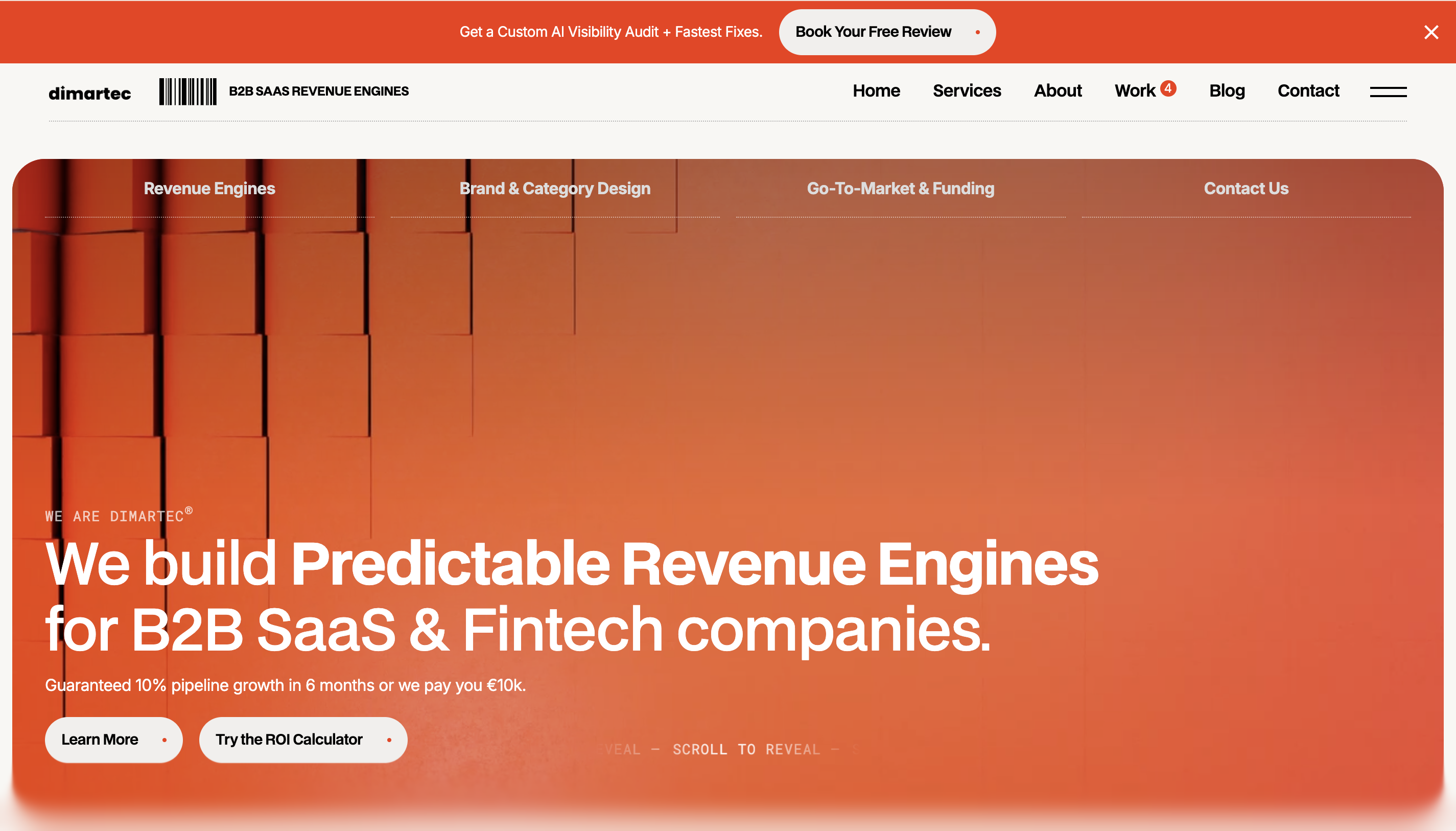
Best for: Post-PMF B2B SaaS and fintech between Series A and Series B, at €2M–€10M ARR, that need conversion improved alongside the paid media, lead handling, and reporting that determine whether better conversion becomes more revenue
dimartec builds Revenue Engines for B2B SaaS and fintech companies. CRO is one of five integrated services, with Performance Paid Media, GEO, Lead Gen & Nurturing, and RevOps & Automation. Between the two funding rounds, that integration answers the problem most growing SaaS companies run into: conversion is being decided in several places at once, and no single supplier controls them all.
The CRO work begins with a structural review of the pages that carry the most commercial weight, assessed for clarity, relevance to the target buyer, statement of the problem, strength of proof, and simplicity of the next step. Because traffic at this stage is usually too thin for slow testing, the first changes are structural ones that research and expert review can justify without waiting for an experiment. Testing follows on the pages where volume allows.
The pages are built for the campaigns pointing at them, because the same team runs Performance Paid Media. Lead Gen & Nurturing decides what happens to the extra leads a better page produces, so higher conversion does not simply mean more unqualified contacts for sales. RevOps & Automation follows each change through to opportunities and closed revenue, which is the evidence a Series B investor will want. GEO adds visitors who have already met the brand in AI search, and those visitors tend to convert better on the same page.
dimartec suits companies in this period when:
- Paid spend has grown since the round but conversion on the main landing and demo pages has not moved
- The website was written before the company knew which buyers it would win
- Page improvements have produced more form fills without more opportunities
- The Series B story needs a falling acquisition cost, and there is no evidence yet
Key services
- CRO: structural review of high-value pages, followed by testing where traffic allows
- Performance Paid Media: campaigns and pages designed together for each audience
- Lead Gen & Nurturing: qualification and nurture for the additional leads better pages produce
- RevOps & Automation: conversion tracked through to opportunities and revenue
- GEO: AI search visibility that raises the share of visitors who already know the brand
Why dimartec stands out between Series A and B
- Starts with structural fixes suited to low-traffic pages, then tests as volume grows
- Pages and campaigns are built by one team for the same buyer
- Results are measured in opportunities and revenue, the figures a Series B round depends on
- Designed for the €2M–€10M ARR stage and handed to the client's team
Best fit: Companies between the two rounds whose conversion problem is entangled with acquisition and qualification, and who want one partner responsible for the outcome instead of several responsible for parts.
2. TripleDart
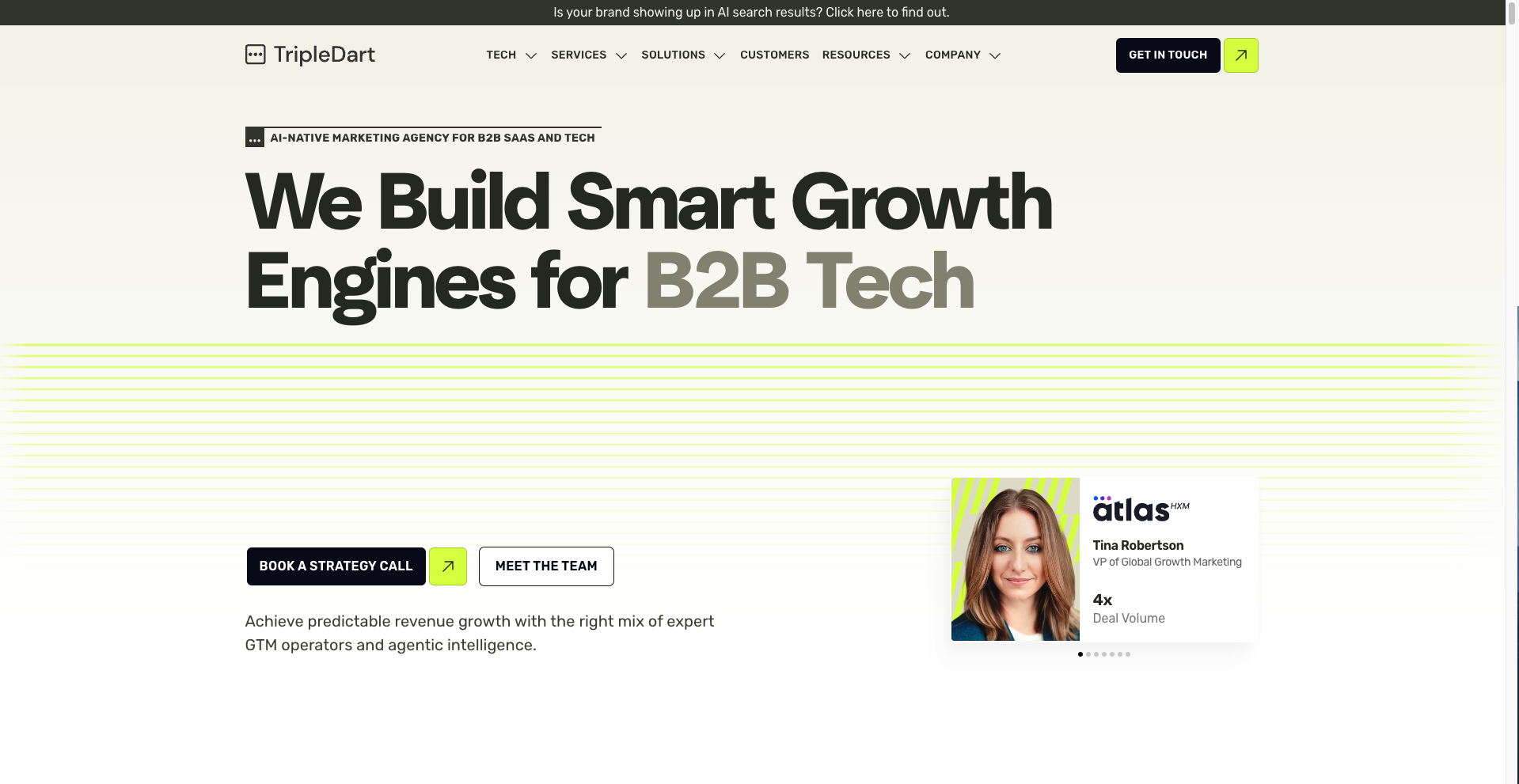
Best for: SaaS companies that want CRO delivered as part of a wider SaaS marketing programme, with demand generation and paid media run by the same agency
TripleDart is a SaaS marketing agency that treats conversion optimisation as one element of a full-funnel engine connecting demand generation, paid media, landing pages, and onboarding. It reports more than 50 B2B SaaS case studies and a 4.8 rating across more than 40 Trustpilot reviews.
For a Series A company building its first proper marketing function, that breadth is the attraction. Conversion work is rarely effective in isolation at this stage, because the traffic feeding the pages changes month by month as new channels are added. An agency that also runs those channels can keep the pages and the traffic aligned.
Its services cover CRO and experimentation, analytics, UX research, and UI and UX design, alongside SEO, paid media, and content. Companies that already have strong paid and content partners may find the bundle more than they need.
Key services
- CRO and experimentation
- Data and analytics
- UX research and UI design
- Paid media and SEO for SaaS
- Onboarding flow optimisation
Why TripleDart stands out between Series A and B
- SaaS specialisation across the full funnel
- Conversion work connected to the channels feeding it
- A large library of published SaaS case studies
- Covers both marketing site and onboarding
Best fit: Series A to B SaaS companies wanting one agency for demand and conversion. Less suited to companies that only need specialist CRO.
3. GetUplift
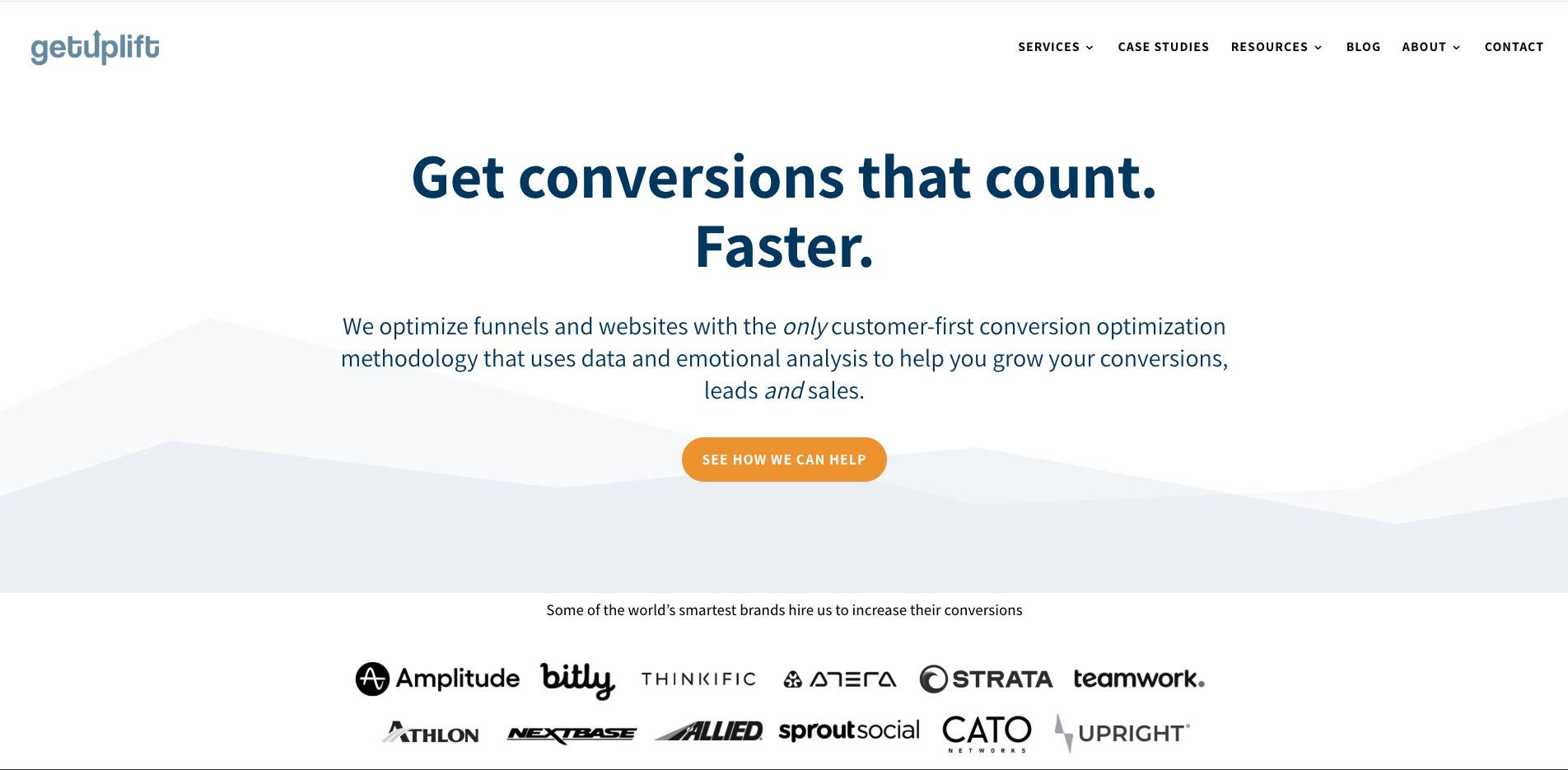
Best for: Early Series A companies whose pages are structurally sound but whose messaging does not yet speak to what makes buyers act
GetUplift is a conversion agency founded by Talia Wolf that builds pages around buyer psychology. Its method starts with research into what customers actually feel and fear at the moment of decision, drawn from interviews, sales call recordings, support conversations, and churn feedback, and turns that into copy and page structure.
This approach fits the start of the Series A period particularly well. The founders wrote the original website from their own understanding of the product, which is usually expert and feature-led. Buyers decide on other grounds: risk, effort, what their boss will think. Rewriting around those grounds can lift conversion substantially without needing high traffic to prove it, because the changes are large and evidence-based.
Published SaaS results include a 344% increase in free trial conversions, a 148% increase in demo requests, and a 90% increase in paid subscriptions for different clients.
Key services
- Customer and buyer research
- Conversion copywriting
- Landing page and pricing page rebuilds
- Trial-to-paid messaging
- Testing of research-led variants
Why GetUplift stands out between Series A and B
- Fixes the messaging problem common to founder-written sites
- Large, research-backed changes that do not depend on high traffic
- Strong published SaaS results
- Focused on the decision moment, where small companies lose most buyers
Best fit: Early Series A companies with traffic arriving but too few visitors acting. Companies with structural or tracking problems should fix those first.
4. The Good
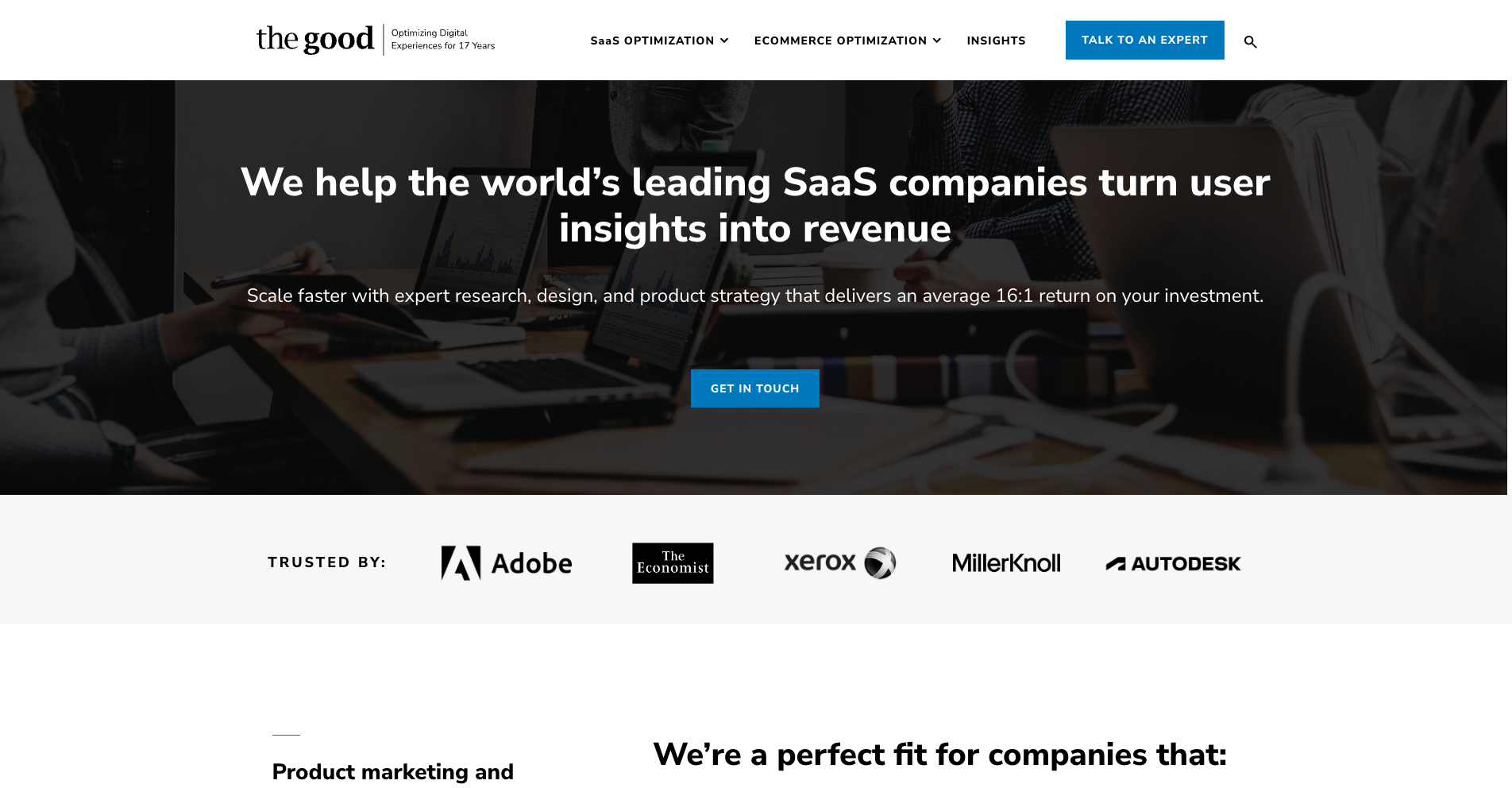
Best for: Series A companies where traffic is too low for reliable testing and the main problems are usability and friction
The Good is a CRO and UX agency that leads with qualitative research: interviews, usability testing with people who resemble the target buyer, and journey mapping. Testing comes after, and only where traffic can support it.
At Series A, this ordering suits the conditions. Many conversion problems on a young SaaS site are visible the moment a real buyer tries to use it: a navigation that hides pricing, a demo form that breaks on mobile, a product tour that asks for too much. Usability testing finds these quickly with a handful of participants, and fixing them needs no experiment to justify.
The Good reports a 104% increase in trial starts for a SaaS client after a research-led rebuild of the trial signup flow. Clients have included Corel and Canopy.
Key services
- User interviews and usability testing
- Heuristic UX review
- Journey mapping
- Mobile conversion audits
- Testing sized to available traffic
Why The Good stands out between Series A and B
- Research that works without high traffic
- Finds usability problems analytics cannot explain
- Testing used only where it can produce reliable results
- Strong record on trial signup flows
Best fit: Series A companies with low traffic and visible friction. Companies whose problem is messaging or acquisition fit need a different emphasis.
5. KlientBoost
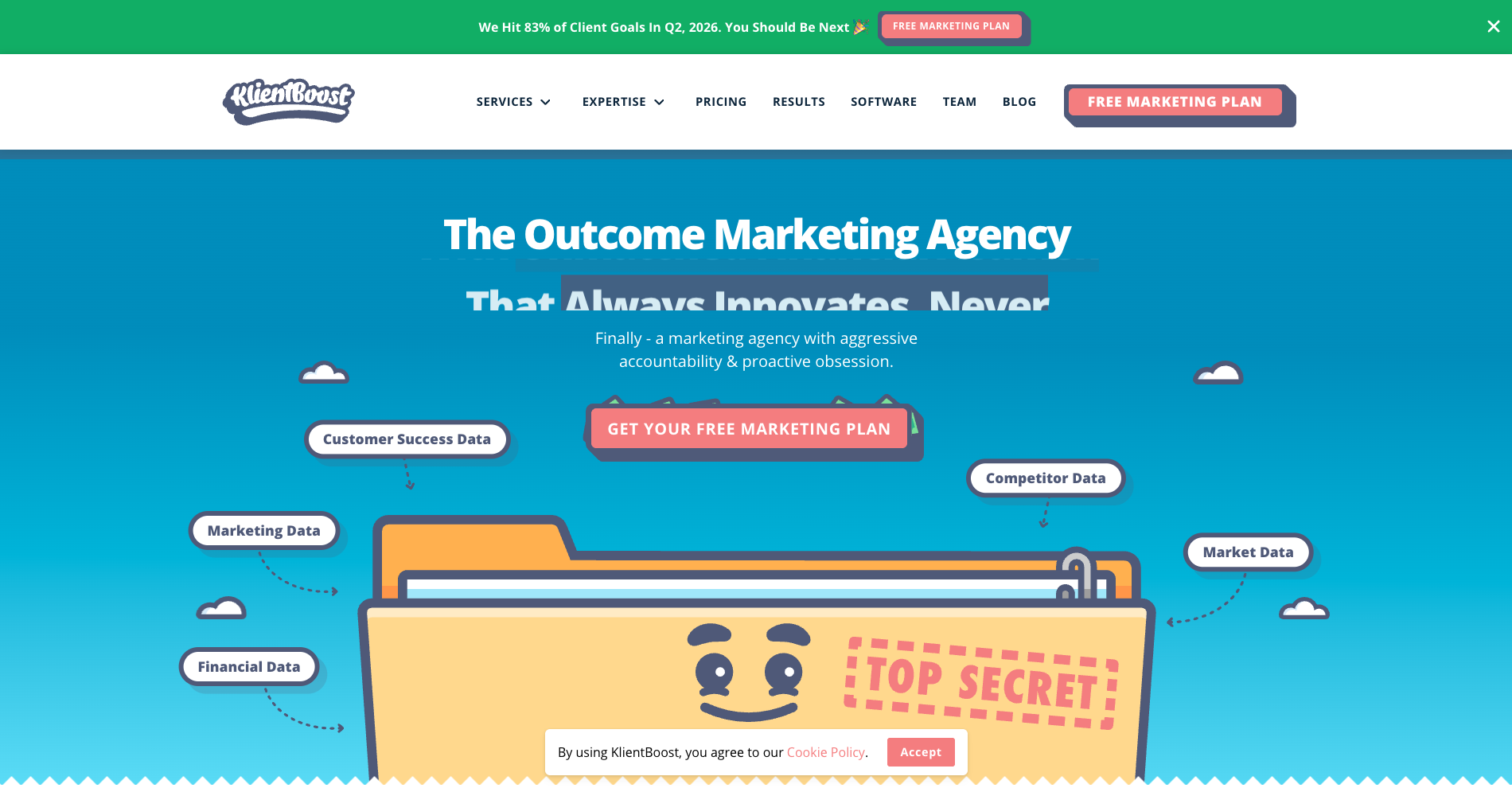
Best for: Series A companies spending heavily on paid acquisition, where the gap is between what ads promise and what pages deliver
KlientBoost runs paid media and conversion optimisation as one service across Google, LinkedIn, Meta, and Microsoft. Its in-house team handles ad creative and landing pages together, so each campaign can have a page written for its own audience and message.
This matters in the months after a round, when paid budgets usually rise quickly. New campaigns go live faster than new pages are written, and visitors from very different audiences end up on the same generic landing page. KlientBoost closes that gap by building pages and campaigns in the same cycle and testing several page variants in parallel.
It reported an 88% client goal achievement rate for the first quarter of 2026. It serves many industries, not only SaaS, so software-specific examples are worth requesting.
Key services
- Paid media and landing pages run together
- Campaign-specific landing page builds
- Parallel variant testing
- Demo and trial flow optimisation
- Reporting on cost per lead and pipeline
Why KlientBoost stands out between Series A and B
- Matches pages to campaigns as paid spend scales
- In-house creative and page production
- Parallel testing suited to paid traffic volumes
- Published goal achievement figures
Best fit: Paid-led Series A companies. Those relying mainly on organic or outbound will use less of its strength.
6. Karpi Studio
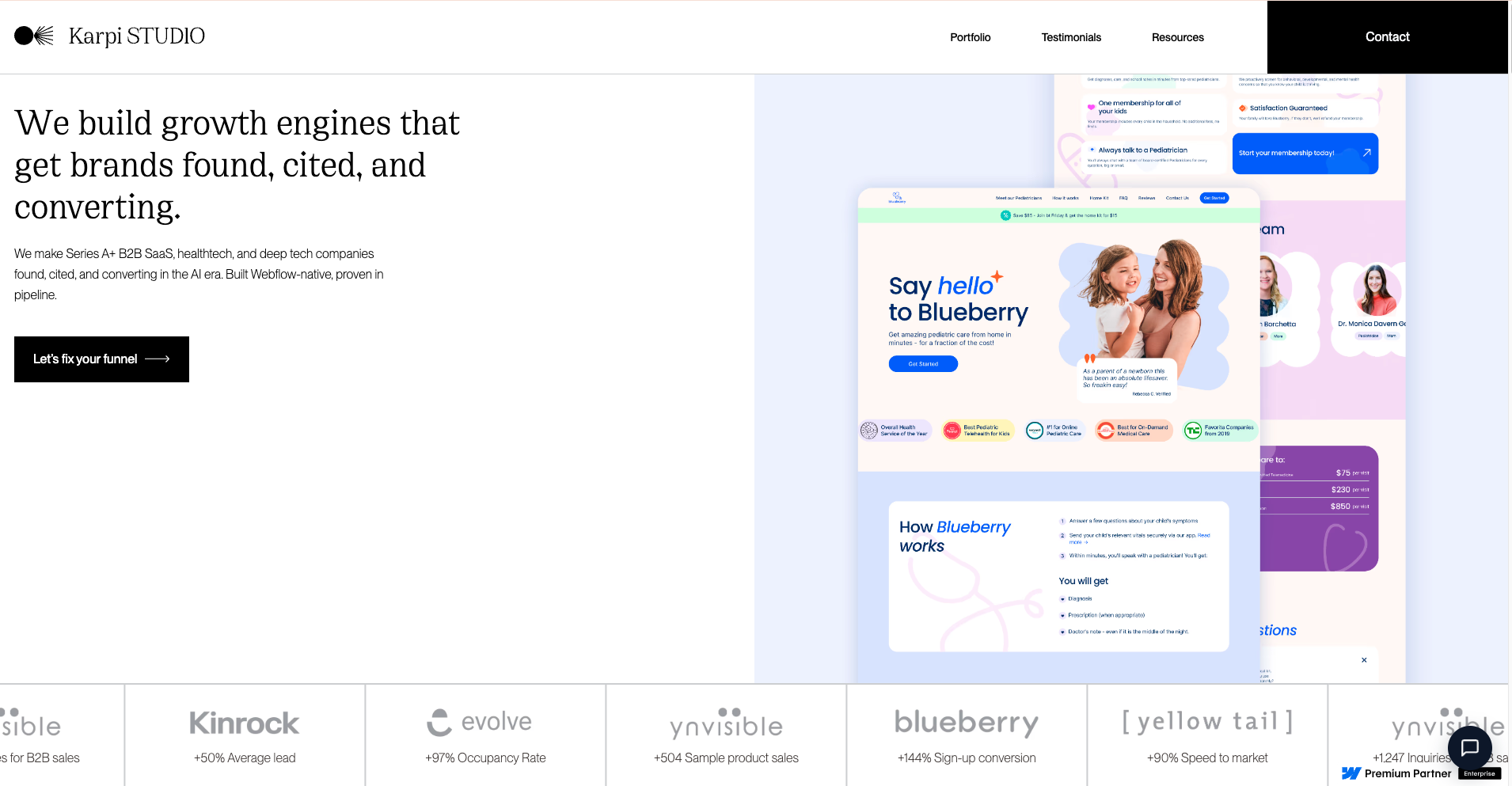
Best for: Series A SaaS companies on Webflow that need conversion-focused pages built and changed quickly, including for new language markets
Karpi Studio is a Webflow design and CRO agency for B2B SaaS. It builds and revises pages directly in Webflow, without waiting for engineering time, and designs multilingual versions as distinct pages instead of translations.
The practical problem it solves is speed. In many Series A companies, the marketing site is maintained by engineers whose priority is the product. A page change that would take a day to write takes weeks to ship. Karpi Studio removes that queue for companies already on Webflow, so conversion improvements reach visitors while they are still relevant.
Its multilingual work is useful for companies expanding into European markets after the round, where a translated page often converts far worse than the original.
Key services
- Webflow page design and build
- Conversion-led page structure
- Pricing and demo page design
- Multilingual landing pages
- Ongoing page iteration
Why Karpi Studio stands out between Series A and B
- Removes engineering delays for Webflow sites
- Treats each language market as its own conversion problem
- Combines design and CRO in one team
- Suited to frequent page changes
Best fit: Webflow-based SaaS companies, particularly those expanding internationally. Companies on other platforms will not benefit from its main advantage.
7. SplitBase
Best for: Series A and B companies with free trials or product-led growth, where most revenue is won or lost after signup
SplitBase specialises in conversion for subscription businesses, concentrating on pricing pages, trial-to-paid conversion, and onboarding. Its 3Ps methodology structures pricing pages around clear tier choice, commitment clarity, and risk reduction.
For a product-led SaaS company, the acquisition landing page is often less important than what follows. A company converting 15% of trials to paid can reach 25% and earn two-thirds more customers from the same signups, without any change to marketing. Between the two rounds, as trial volume grows, that step becomes one of the largest levers on revenue.
The agency reports more than $100M a year in additional revenue generated for brands scaling between $10M and $100M through its pricing and subscription work.
Key services
- Pricing page testing and restructuring
- Trial-to-paid conversion
- Onboarding sequence optimisation
- Annual plan and upgrade conversion
- Subscription testing programmes
Why SplitBase stands out between Series A and B
- Focus on post-signup conversion, often the largest untapped lever
- Pricing page methodology built for subscription buyers
- Works on revenue directly, not only leads
- Experience with scaling subscription companies
Best fit: Trial and PLG companies with healthy signup volume. Sales-led companies with no self-serve journey will find less to work on.
8. Spiralyze
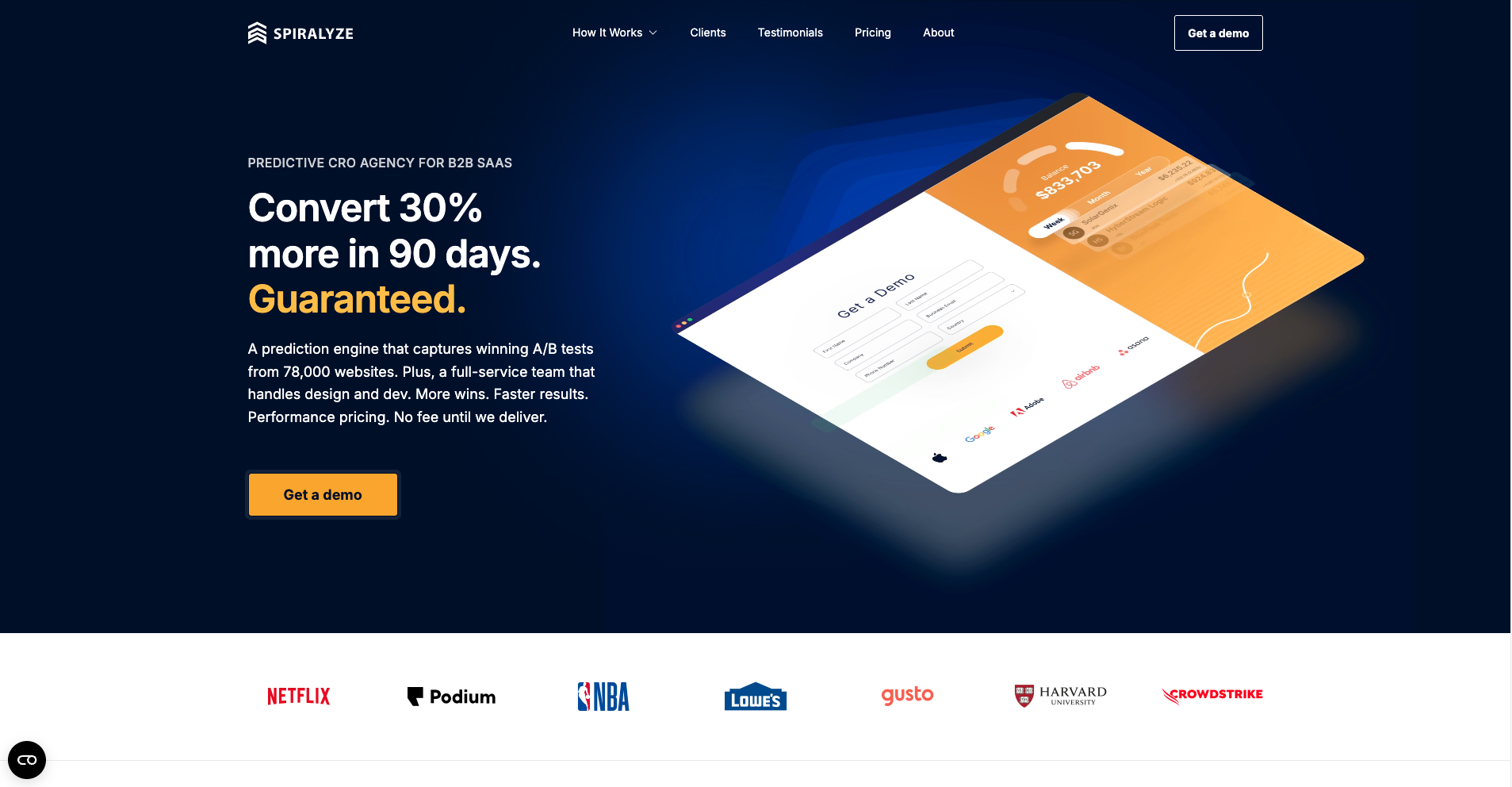
Best for: Companies late in Series A or early in Series B that want faster verified wins without running many speculative tests
Spiralyze uses a database drawn from tens of thousands of websites to predict which page changes are most likely to succeed before testing them. It reports a win rate of 43% on its predicted variants, against an industry figure of around 12%, and ties part of its fees to verified improvements.
That approach helps at the stage where traffic is sufficient for testing but not abundant. Each test still takes weeks, so starting with the changes most likely to work produces more improvements per quarter than testing ideas in sequence. The performance element of the pricing also gives a company paying its first serious CRO fees some protection.
Buyers should ask exactly which conversion its performance fee is measured against. A fee tied to form submissions creates different incentives from one tied to qualified opportunities.
Key services
- Predictive variant selection
- A/B testing programmes
- Demo and landing page optimisation
- Performance-based pricing
- Statistical validation of results
Why Spiralyze stands out between Series A and B
- More wins from fewer tests, suited to moderate traffic
- Prior evidence from many sites reduces guesswork
- Fees partly linked to results
- Fast start on proven change types
Best fit: Companies with enough traffic for testing that want quicker returns. Very early companies should fix structural issues first.
9. Speero
Best for: Companies approaching Series B that want to build an experimentation capability inside the team
Speero, the agency associated with the CXL Institute, runs research-led experimentation programmes using Bayesian statistics, which can reach sound conclusions on smaller samples than conventional methods. Its clients have included Miro and Codecademy.
Its relevance grows towards Series B, when a SaaS company typically has enough traffic for a steady testing programme and is thinking about hiring its own growth or CRO lead. Speero's work is designed to be learned: hypotheses, prioritisation, and analysis are documented in a way an internal team can take over, and training is part of the offer.
Independent comparisons consistently describe it as best suited to mid-market and enterprise companies with substantial traffic. Early Series A companies are likely to find it more than they need.
Key services
- Research before test design
- Bayesian testing
- Experimentation roadmaps
- Team training and capability building
- Funnel analysis across marketing and product
Why Speero stands out between Series A and B
- Methods that make the most of moderate traffic
- Builds a lasting internal capability
- Strong reputation for rigour
- Covers the full SaaS funnel
Best fit: Companies near Series B planning to bring experimentation in house. Less suited to the start of the period.
10. Conversion (formerly WiderFunnel)
Best for: Companies at Series B and beyond whose next gains lie in pricing, packaging, and product experience as well as the website
Conversion, which traded as WiderFunnel, runs experimentation programmes that extend past marketing pages into pricing, packaging, feature presentation, and product experience. It uses its LIFT model, which examines value proposition, relevance, clarity, anxiety, distraction, and urgency, to decide where to focus.
By Series B, many of the obvious website problems have been fixed. The larger opportunities are often commercial: how plans are structured, what sits in each tier, how the product introduces its value in the first sessions. Testing those requires a partner comfortable working with product and finance teams as well as marketing.
Its scale and scope suit companies at the end of the period covered here and beyond it.
Key services
- Pricing and packaging experiments
- Product experience testing
- LIFT model diagnosis
- Messaging and positioning validation
- Large-scale testing programmes
Why Conversion stands out between Series A and B
- Tests commercial decisions, not only pages
- Structured diagnosis before testing
- Experience across complex SaaS programmes
- Suited to the transition into Series B and later
Best fit: Companies at or after Series B ready to test pricing and product. Early Series A companies will not have the traffic or the need.
Why dimartec Approaches CRO Differently Between the Rounds
The nine specialists above cover the range of what a SaaS company needs from conversion work as it grows. GetUplift and The Good fix messaging and usability early, when traffic is thin. KlientBoost and Karpi Studio keep pages in step with campaigns and markets. SplitBase works on the revenue won after signup. Spiralyze and Speero make testing efficient once traffic allows. Conversion takes experimentation into pricing and product. TripleDart wraps CRO into a wider marketing programme.
What changes between the two rounds is not only the conversion problem but the company around it. Traffic sources multiply, the sales team grows, the CRM fills with leads of uneven quality, and the board begins to ask for unit economics. A better page that sends more unqualified leads into that system can make the numbers look worse, not better. A specialist working on the page alone has no way to prevent that.
dimartec treats conversion as one stage in a connected system. The pages are designed with the campaigns that feed them. The leads they produce are qualified and nurtured before reaching sales. Every change is measured through to opportunities and revenue, and GEO steadily raises the share of visitors who arrive already familiar with the brand. The result is conversion work that shows up where a Series B investor will look: in the cost of acquiring a customer and in the pipeline the company can show for its spending.
See how the Revenue Engine works: https://www.dimartec.co.uk/services/revenue-engine
Three Things to Check Before Hiring a CRO Agency
One: Tell them your traffic and ask what they would do. Give the monthly visitors and conversions for your three most important pages and ask for their plan for the first ninety days. A good answer adjusts to your numbers: research and structural changes where traffic is thin, testing where it is not. A plan built around many small tests on low-traffic pages is a warning.
Two: Ask how they will know a change worked. The answer should name a measure beyond the page: qualified leads, opportunities, trial-to-paid rate, or revenue. If success is defined only as a higher conversion rate, the agency may improve the number while the pipeline stays flat.
Three: Ask who will make the changes. Many CRO agencies recommend and leave implementation to your team. At Series A, that team is often engineers with other priorities. Find out whether the agency builds pages itself, and how quickly a change can go live.
Frequently Asked Questions
When should a SaaS company start investing in CRO?
As soon as it pays for traffic. Every visitor bought through paid media costs the same whether the page converts well or badly, so improving conversion is the cheapest way to make that spend go further. For many companies that point arrives shortly after Series A, when paid budgets grow. Before then, structural fixes and good tracking matter more than a formal testing programme.
How much does a CRO agency cost at Series A?
Published 2026 pricing guides suggest roughly $3,000 to $6,000 a month for basic testing at pre-Series A and early Series A, and $6,000 to $12,000 a month for research-led, multi-page programmes at Series A. Integrated and enterprise-level engagements cost more. A useful check is to compare the fee with the paid spend running through the pages being optimised: a modest improvement on a well-funded campaign often covers the fee several times over.
Can you run A/B tests with low traffic?
You can, but they take longer and are easier to misread. With a few thousand monthly visitors, a test may need months to give a reliable answer. The usual response is to research first and make larger structural changes that do not need a test to justify them, and to use statistical methods suited to small samples where testing is worthwhile. Small tweaks on low-traffic pages rarely produce results you can trust.
Should a Series B company bring CRO in house?
Often, yes, at least partly. By Series B many companies have enough traffic to run tests continuously and enough budget for a dedicated specialist. A common pattern is for an agency to build the programme and train the internal hire, then remain on a smaller scope for research, design, or specialist areas such as pricing. Ask any agency how it would hand over its work.
Make the Website Earn Its Place Before Series B
Between the two rounds, the website stops being a brochure and becomes part of the sales process, and every visitor it fails to convert has already been paid for. The right CRO partner depends on where in that period the company sits: research and structure early on, matched pages as paid spend grows, and a disciplined testing programme as traffic matures. Whatever the stage, the measure that matters is the pipeline and revenue conversion produces, not the conversion rate on its own.
The Revenue Engine brings together Performance Paid Media, CRO, GEO, Lead Gen & Nurturing, and RevOps & Automation, so that conversion improvements reach the numbers a Series B investor will examine.
See how the Revenue Engine works: https://www.dimartec.co.uk/services/revenue-engine














.png)







.png)

















































.png)
.png)
.png)
.png)
.png)
.png)
.png)
.png)
.png)
.png)