
In July 2026, AI assistants did not name Smart Bulk Payments when buyers asked about payout vendors. By 5 November, it was the most-cited brand of ten direct competitors when buyers asked which crypto payout provider to choose, and ChatGPT called it the "best direct fit" for sending over 10,000 payouts in one batch.
It did this with a domain authority of 1, no backlink profile, a website live for less than a year and a blog on a separate domain. Every SEO checklist says that brand should not win. Most GEO “experts” will say that this is not possible. This study shows what we did instead, how we measured it, and what it means for your brand.
Contents
- Why AI answers now decide your shortlist
- The starting point: every SEO signal pointed the wrong way
- How we measured: two prompt sets, six engines, ten brands
- What we changed in 90 days
- Results: choosing a vendor
- Results: authority and citations
- What the competitors did
- Five findings for fintech marketers
- A self-check for your own brand
- How we ran the work
- FAQ
Why AI answers now decide your shortlist
Your buyers ask AI before they ask you. In G2's 2026 AI Search Insight Report, a survey of 1,076 B2B decision makers run in March 2026, 54% ranked AI chatbots as the top source shaping which vendors make their shortlist. 85% said they think more highly of a vendor that AI cites in its answer.
Absence is noticed. Semrush surveyed more than 600 US business professionals in March and April 2026. Of the 519 who use AI for work, 41% now start with AI and then check what they find through search, and 66% said they had spotted vendors missing from AI results.
Both surveys cover software and business buyers rather than payments buyers alone, and both are self-reported. The direction is still clear. If AI does not name you, a growing share of your market builds its shortlist without you.
This matters most in fintech. Payments buyers are cautious. They check licensing, jurisdiction and track record before they ever fill in a form. Smart Bulk Payments told us that larger clients use the website mainly to verify a provider they have already heard about. AI answers are now part of that check.
The starting point: every SEO signal pointed the wrong way
Smart Bulk Payments is a regulated provider of bulk crypto and stablecoin payouts for creator platforms, affiliate networks, gaming operators, marketplaces and payroll companies. In July 2026, its position looked like this:
The usual advice would have been to spend six to twelve months on SEO first. Build links, grow authority, then think about AI. We did not do that. We did not run a link-building campaign at any point in the 90 days.
That makes this a clean test. If AI visibility depended on an SEO foundation, Smart Bulk Payments had none to lean on.
How we measured: two prompt sets, six engines, ten brands
We built two prompt sets, each with a different job. Both are published word for word in the appendix, so you can check every question.
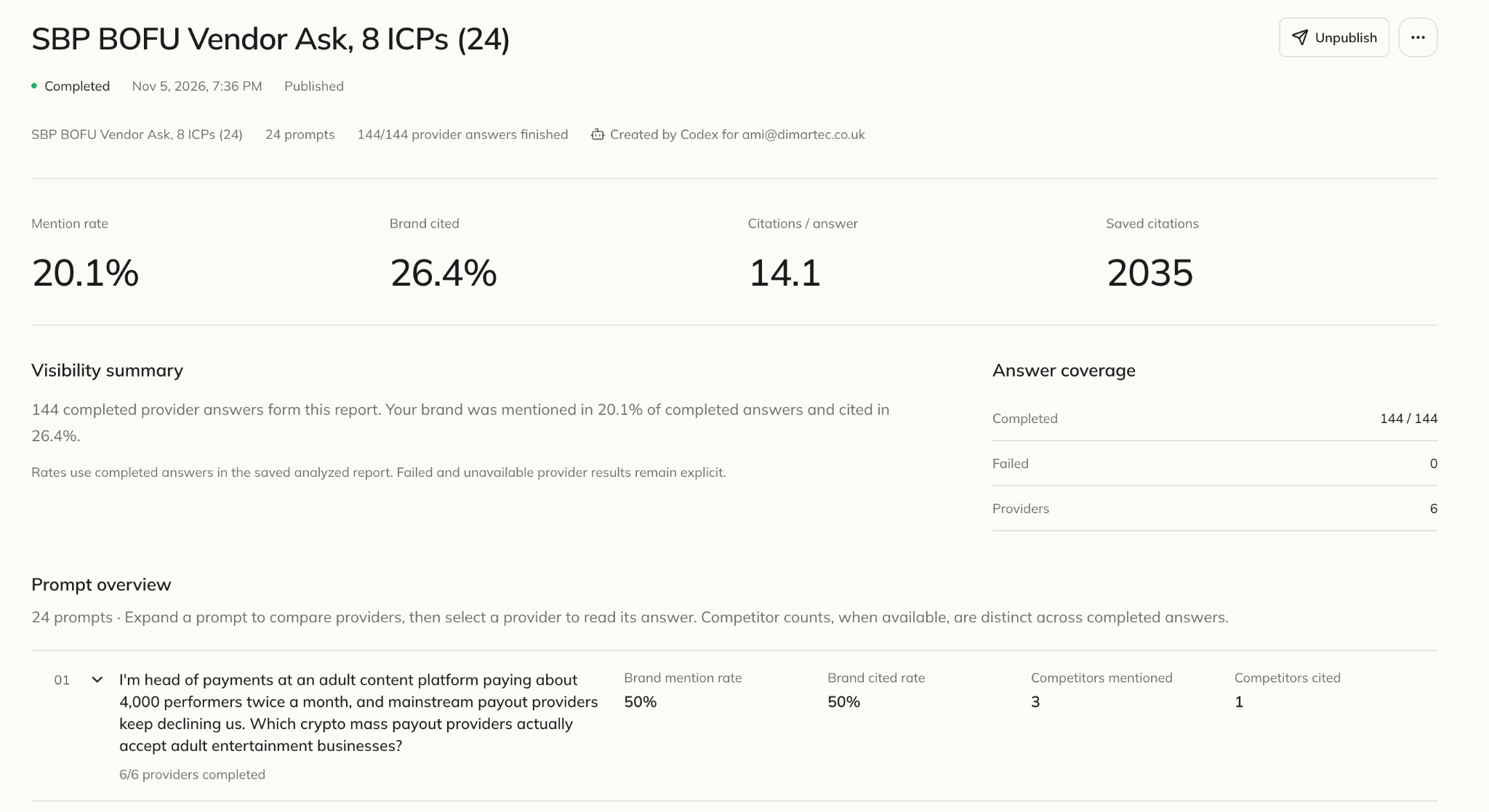
The vendor-selection set (24 prompts) asks the question that matters most: which vendor should I choose? Each prompt is written as a real buyer would type it, with their role, industry, volume and problem. For example: "COO at a gaming company. Which dedicated crypto payout platforms can send 10,000 payouts in a single batch, rather than payment gateways with a basic payout feature?"
The authority set (50 prompts) covers the research stage, where buyers ask how to evaluate vendors rather than who to pick. Here, AI rarely names a vendor at all, so the measure that matters is the citation (AI linking to your page as a source).
Every prompt carries an ICP and a context layer. ICP means ideal customer profile: the specific type of buyer you sell to. The context layer is the detail a real buyer adds, such as "4,000 performers paid twice a month" or "our provider just dropped us". Generic prompts like "best crypto payout provider" tell you little about who is buying.
We ran each set across the major AI engines: OpenAI, Anthropic, Google Gemini, Perplexity and xAI Grok, with Google's AI Overviews covered through the Gemini provider that powers them. AI Overviews was added in November, and we note where that changes a comparison.
Two measures, defined plainly:
- Mention rate is the share of recorded AI answers that name the brand.
- Citation rate is the share of recorded AI answers that link to the brand's own pages as a source.
We tracked ten payout brands on every run: Smart Bulk Payments, NOWPayments, Request Finance, Radom, CoinGate, CoinsPaid, CoinPayments, Cryptomus, CryptoProcessing and Cwallet.
Run dates. The baseline report ran in July 2026. The authority set ran on 28 August and 9 November. The vendor-selection set was first run on 29 September, mid-project, and again on 5 November. Each run is a point-in-time snapshot, and AI answers vary between runs, so treat single prompts as signals and the rates as the result.
What we changed in 90 days
None of this work was link building. All of it made the brand easier for AI, and buyers, to read, trust and quote.
1. A knowledge base before any content. We started with one source of truth for the products, supported assets, licensing, pricing logic and target buyers. Every page and article after that was written from it, so the facts stayed the same everywhere.
2. One domain, not two. The blog moved onto the main domain, old pages were redirected and the separate WordPress site was retired. Authority and context stopped being split across two places.
3. Technical fixes for AI crawlers. We checked that AI crawlers could reach and read the important pages, cleaned up structure and metadata, and fixed the conflicting product details that were confusing both people and machines.
4. Documentation as marketing. Six documentation pages now explain supported assets and networks, settlement and how payouts work, plus an llms.txt file (a plain-text guide that tells AI tools what a site covers). Most fintech marketers treat docs as a developer chore. AI treats them as evidence.
5. A small amount of very specific content. A vendor comparison guide, buyer-question articles and one strategic rewrite. Each piece answered a question buyers actually ask, in the words they use.
6. Trust signals AI can verify. A compliance and security page and independent customer reviews gave AI something concrete to point to when a buyer asks whether a provider is safe.
The client's team did the implementation. We set the strategy, wrote and checked the content and briefed every change. Their developer shipped the site work, often within days. That split matters: GEO results depend on how fast changes go live.
Results: choosing a vendor
This is the set that mirrors a buyer building a shortlist. Between 29 September and 5 November, Smart Bulk Payments moved from fourth to first on citations and from fifth to third on mentions.
Smart Bulk Payments had the largest citation gain of any brand, up 11.4 percentage points. The next-largest gain was Radom's, at 3.3 points. It finished 1.4 points ahead of NOWPayments and Request Finance, which tied at 25.0%.
It was named in 17 of the 24 prompts, up from 9. Its mention rate rose 11.0 points, the third-largest gain behind NOWPayments (13.2) and Request Finance (11.4).
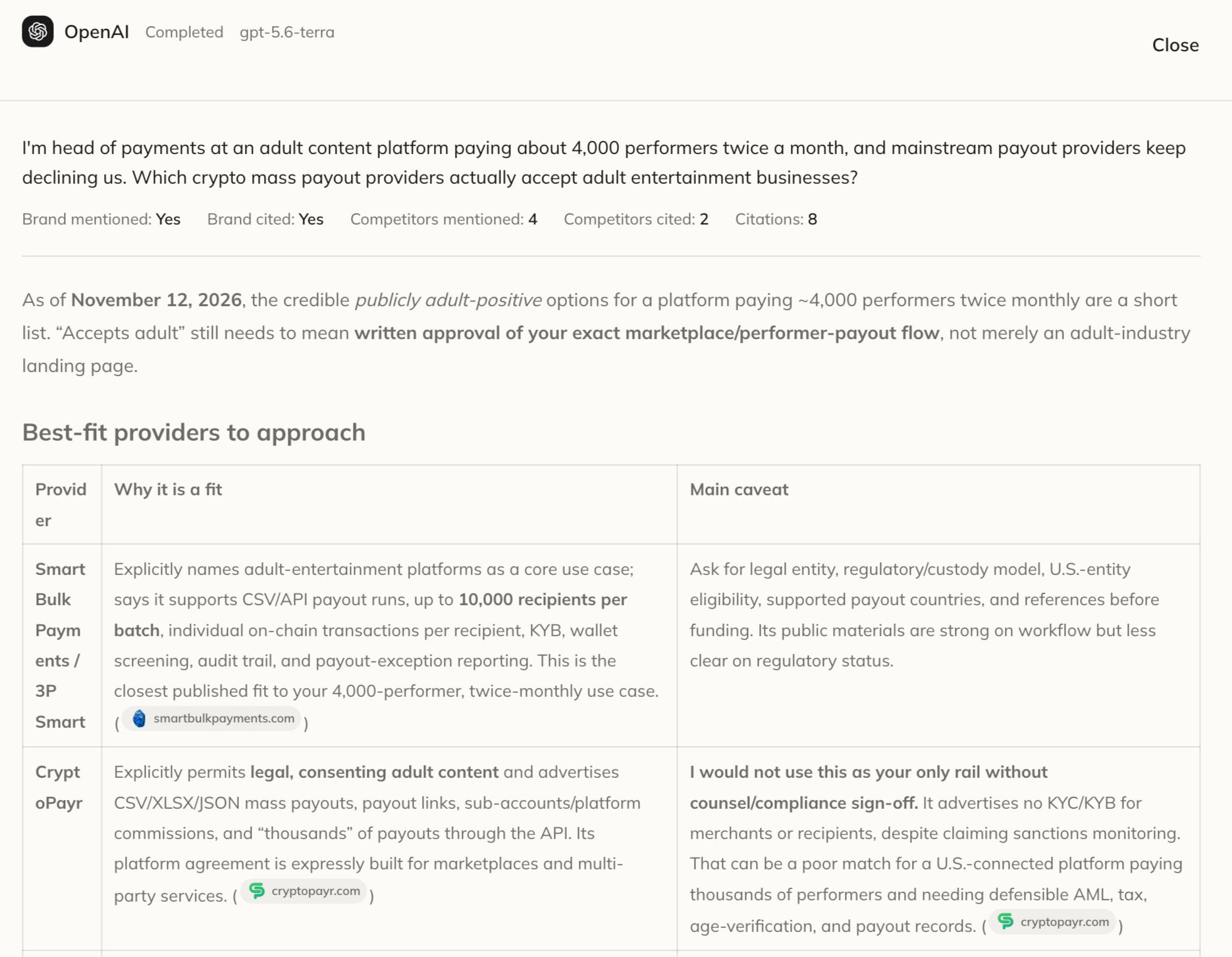
The strongest single answer came from ChatGPT. Asked which dedicated platforms can send 10,000 payouts in one batch, it named Smart Bulk Payments the "best direct fit" and recommended starting with it for regulated iGaming.
Results: authority and citations
The authority set asks how to choose a vendor, not which one to choose. AI names vendors far less often here: even the leader in November, NOWPayments, was named in only 14.0% of answers. Citations are the measure that counts.
The runs recorded 250 answers in August and 300 in November.
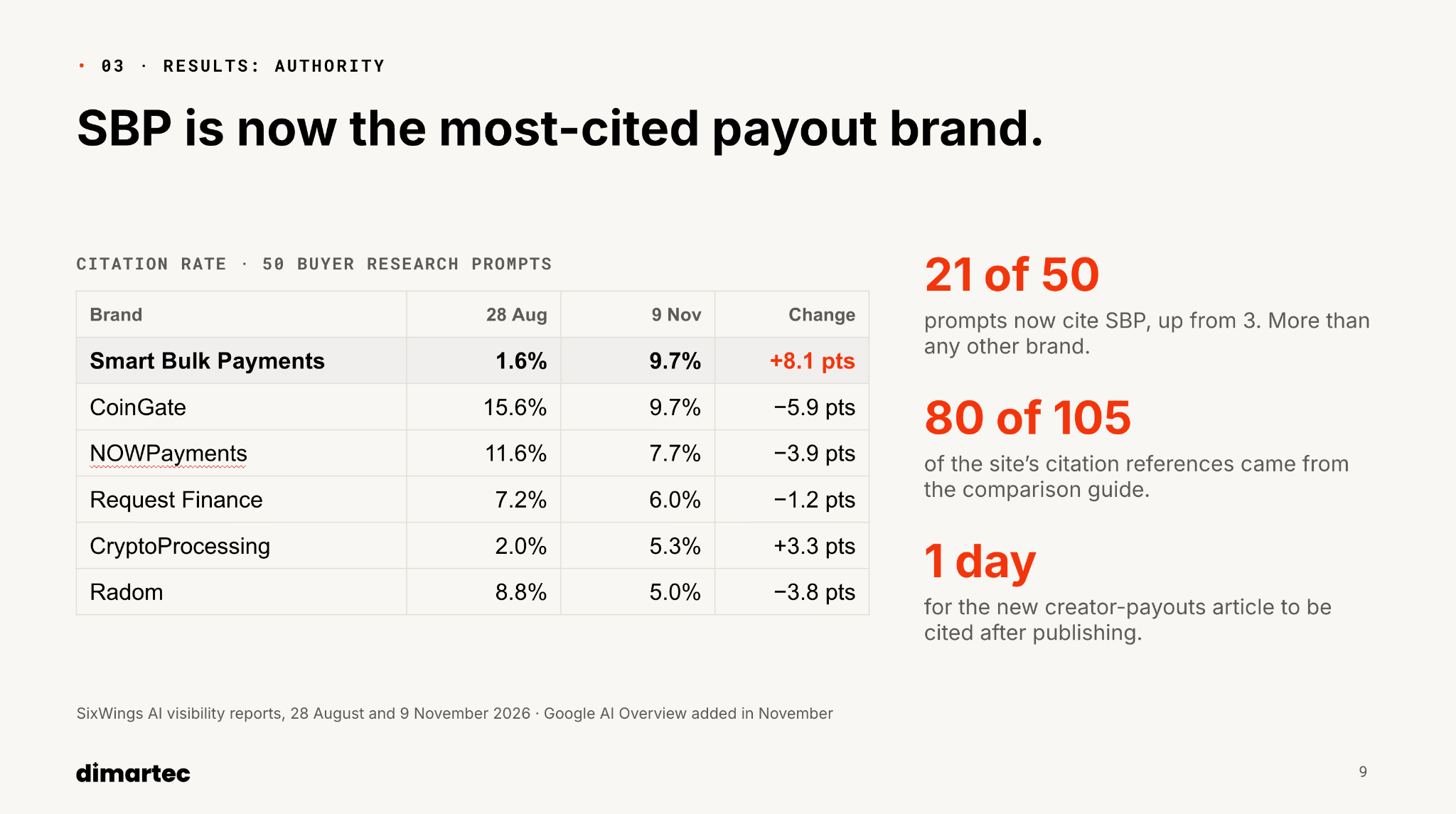
Smart Bulk Payments moved from seventh to joint first on citation rate, level with CoinGate, and led on both prompts cited and individual citation references. Its gain of 8.1 points was the largest of the ten brands.
On a like-for-like basis it was a near tie. Across the five providers present in both runs, leaving out AI Overviews, its citation rate rose from 1.6% to 10.4%, just behind CoinGate at 10.8%. We report both views because a study that hides the less flattering number is not a study.
Two content facts stood out:
- One page did most of the work. In the 5 November report, the vendor comparison guide accounted for 80 of the site's 105 citation references, across 32 AI answers. That is 76% of all citations from a single article.
- New content was picked up fast. An article on creator payouts went live on 4 November and was already being cited in the run on 5 November.
What the competitors did
Competitors were not standing still. On the vendor-selection set, NOWPayments and Request Finance both gained more mentions than Smart Bulk Payments. On mentions, they are still ahead.
But their citations fell while Smart Bulk Payments' rose. On the vendor-selection set, NOWPayments' citation rate dropped 5.8 points, and Request Finance's dropped 11.7. On the authority set, CoinGate's fell 5.9 points and NOWPayments' fell 3.9 points.
Our reading of this: AI keeps naming the brands it already knows, but it increasingly sources its explanations from the pages that answer the question best. Familiarity earns the mention. Clear, specific content earns the citation. Over time, citations shape which brands get described well, and how.
This is our interpretation of two snapshots, not a proven rule, and it is the pattern we will keep testing.
Five findings for fintech marketers
1. Context beats authority. A domain authority of 1 did not stop AI from citing Smart Bulk Payments ahead of brands with years of links. What AI needed was a clear, consistent and specific answer to the buyer's question.
2. One excellent piece of content beats a content calendar. The comparison guide drove 76% of citations. You do not need fifty posts. You need the one page that answers "how do these providers compare?" honestly and in detail.
3. Documentation is marketing now. Supported assets, networks, settlement times and compliance are exactly what a payments buyer asks AI about. If those answers live in a PDF, a sales deck or a support inbox, AI cannot quote them.
4. Consistent facts come before more content. Before we wrote anything new, we removed the contradictions. When two pages disagree about what you support, AI hedges or leaves you out.
5. Measure the prompts your buyers type, not generic ones. On broad research prompts, even the leading brand was named in only 14% of answers. The vendor-selection prompts, written with a real buyer's role, volume and problem, are where shortlists are made.
The traffic is there, and it is good. Over 120 days in Google Analytics, visitors from ChatGPT were the most engaged on the site: 69.6% of their sessions were engaged sessions, against 41.5% for visitors from Google Ads.
A self-check for your own brand
Ask these six questions about your own brand this week:
- When a buyer in your ICP asks AI which provider to choose, are you named?
- When AI explains how to evaluate providers in your category, does it cite your pages?
- Do your website, docs and blog give the same facts about what you support?
- Do you have one honest comparison page that answers the buyer's shortlist question?
- Can AI crawlers reach your documentation, and does an llms.txt file point them to it?
- Do you know your mention and citation rates against your five closest competitors?
If you answered "I don't know" to more than two, you are in the position Smart Bulk Payments was in July: invisible, and unaware of it.
A warning before you buy anything: no one can guarantee placement in AI answers. Answers vary by engine, by run and by how a question is phrased. Be wary of anyone who promises a ranking, and ask instead to see the prompts, the engines and the before-and-after data.
How we ran the work
dimartec ran the strategy, content and measurement. The tracking, prompt runs, competitor comparisons and site analysis ran on our internal GEO tool that turns AI answer data into prioritised recommendations and simple implementation briefs. That is what made it practical to run 74 prompts across six engines and ten brands, more than once, without losing the thread.
Want to see where your brand stands? We will run a free AI Visibility Report on your brand: your buyers' questions, the major AI engines and your closest competitors. Request your free AI Visibility Report.
FAQ
Do you need good SEO before you can appear in AI answers like ChatGPT? No. Smart Bulk Payments had a domain authority of 1 and no backlink profile, and became the most-cited of ten payout brands on vendor-selection prompts within 90 days. Clear, consistent, specific content mattered more than authority.
What is the difference between a mention and a citation in an AI answer? A mention is when the AI names your brand in its answer. A citation is when it links to one of your pages as a source. A brand can be mentioned without being cited, and cited without being recommended.
How long does GEO take to show results for a fintech brand? In this study, the first measurable gains appeared within the first two months, and a new article was cited within a day of going live. Results depend on how fast changes are implemented and how competitive the questions are.
Which AI engines did the Smart Bulk Payments study measure? OpenAI, Anthropic, Google Gemini, Perplexity and xAI Grok, with Google's AI Overviews covered through the Gemini provider that powers them. AI Overviews was added to the November runs.
Can a GEO agency guarantee that ChatGPT will recommend my brand? No. AI answers vary by engine, by run and by wording. Anyone guaranteeing placement is overselling. Ask for the exact prompts, engines and dates behind any result you are shown.
Did AI visibility generate leads for Smart Bulk Payments? Not yet in a way we can attribute. AI-referred visitors were the most engaged traffic on the site, but enquiries did not record their source. Source tracking is now being added so the next phase can measure pipeline.
Appendix: all 74 prompts, word for word, with the engines that mentioned or cited Smart Bulk Payments on each run.
Sources: G2, "The Answer Economy: G2's 2026 AI Search Insight Report" (1,076 B2B decision makers, March 2026). Semrush, "How AI tools shape the B2B buying process" (519 respondents who use AI for work, March to April 2026, published 8 July 2026). Google Analytics 4, smartbulkpayments.com, 120 days to 10 November 2026.