
Google and LinkedIn are not interchangeable paid acquisition channels. They serve different buyer intents, require different creative strategies, operate on different bidding logic, and produce different pipeline outcomes for B2B SaaS. An agency that runs Google Ads well for SaaS does not automatically run LinkedIn Ads well. An agency that maximises LinkedIn impression share does not automatically produce cost-efficient Google SQLs. Most B2B SaaS companies underperform on one or both because they hire a single vendor who treats both platforms as variations on the same job.
The 2026 paid media environment has made this distinction sharper. Google introduced AI Max for Search in 2025, pushing accounts toward broad match and automated assets. Performance Max only works for B2B SaaS when it is fed offline conversion data from the CRM connecting ad spend to closed deals, not from form fills. Agencies that have not rebuilt their Google infrastructure around CRM-connected offline conversion signals are running campaigns that look optimised on platform dashboards and are generating leads the sales team cannot close. Meanwhile, LinkedIn Ads delivered a 121% ROAS for B2B advertisers across 180-to-365-day windows in 2026, outperforming Google search at 67% and Meta at 51% when measured over the full sales cycle. The agencies that capture this advantage treat LinkedIn as a demand creation channel building buying intent across target accounts, not as a form-fill channel competing on cost per lead.
After analysing paid acquisition programmes across more than 200 B2B SaaS accounts, the finding that separates agencies running Google and LinkedIn as one connected system from those running them as two separate budgets is consistent. The connected-system agencies attribute pipeline at the account level across both platforms, feed closed-won CRM signals back into bidding algorithms on both, and measure creative performance against demo conversion rate and cost per SQL rather than click-through rate. The disconnected-budget agencies produce two dashboards that both look green while CAC climbs and the sales team wonders where the qualified deals are coming from.
This guide evaluates the five best PPC agencies for B2B SaaS running Google and LinkedIn as one connected acquisition system: the ones with platform-specific depth on both, CRM-connected attribution, and documented B2B SaaS outcomes.
Why Google and LinkedIn Require Different Strategy in B2B SaaS
Google captures demand. LinkedIn creates it. A B2B SaaS buyer who types "best project management software for construction teams" into Google is in the middle of an active evaluation. The intent is explicit. The targeting is keyword-driven. The creative brief is to confirm relevance and earn the click. LinkedIn reaches the same buyer six months earlier, before the evaluation starts, while they are consuming content relevant to their role. The intent is implicit. The targeting is audience-driven. The creative brief is to build the category association that makes the brand the first one the buyer considers when the evaluation does begin.
Running both with the same creative strategy and measuring both with the same 30-day attribution window misses this fundamental difference. A LinkedIn campaign building demand for a six-month SaaS sales cycle needs to be measured over six months, not over the first 30 days when direct conversions are minimal and the brand-building effect is invisible.
Google AI Max requires CRM data to work for B2B SaaS. Google's AI Max for Search expands keyword targeting to reach a broader set of queries and generates ad copy automatically. For B2B SaaS, where the gap between a click from a relevant buyer and a click from an irrelevant one is the difference between a £150 cost per click that produces an SQL and one that produces nothing, broad match without CRM offline conversion data trains the algorithm to optimise for whatever converts in the platform, which is usually the cheapest form fill rather than the highest-quality sales opportunity. Agencies that feed Google's Smart Bidding with offline conversion data from closed deals get a bidding model trained on what actually closes. Agencies that do not get a bidding model trained on form fills.
LinkedIn audience targeting requires ICP precision, not audience size. LinkedIn's targeting capabilities allow B2B SaaS companies to reach specific job titles, seniority levels, company sizes, and industries. The temptation is to set broad audiences to generate impression volume and lower CPMs. The commercially correct approach is to set tight ICP audiences and accept higher CPMs in exchange for reaching the specific decision-maker profiles that convert to SQL at acceptable cost. Agencies that treat LinkedIn targeting as an audience expansion exercise produce high impression volumes and low SQL conversion rates. Agencies that treat it as precision ICP coverage produce smaller audiences with higher conversion rates.
Quick Comparison
What Makes a PPC Agency Effective on Both Google and LinkedIn
Three capabilities separate the agencies that produce results on both platforms from those that produce results on one and mediocre outcomes on the other.
Single attribution model across both platforms. When Google Ads attribution and LinkedIn Ads attribution both report to the same CRM pipeline model, the spend allocation decision between platforms is analytical. When each platform reports independently to a different dashboard, the decision is political: Google gets the budget because it produces more form fills, or LinkedIn gets cut because it does not show 30-day conversions, regardless of which platform is doing the actual demand creation work that makes the other platform's conversions possible.
Offline conversion data fed back into both bidding algorithms. On Google, this means uploading CRM closed-won data as offline conversion events that Smart Bidding can train against. On LinkedIn, this means uploading CRM SQLs as matched conversion events so campaign optimisation targets the account and audience profiles that actually advance to pipeline. Without this feedback loop, both platforms optimise for form fills, and the bidding algorithms on both improve their ability to produce cheap form fills at the expense of producing qualified pipeline.
Creative strategy calibrated to each platform's intent layer. Google Search creative earns the click from a buyer already in evaluation mode: the message confirms relevance, states the differentiated value proposition, and earns the comparison. LinkedIn creative reaches the buyer before the evaluation: the message builds category association, demonstrates domain expertise, and creates the buying intent that makes the Google evaluation happen. Running the same creative on both platforms wastes the LinkedIn impression and underperforms on the Google click.
How We Chose These Agencies
Platform depth on both: Documented Google Ads and LinkedIn Ads expertise with B2B SaaS-specific case studies on each, not general B2B claims.
CRM-connected attribution: Does the agency feed closed-won CRM data back into bidding algorithms on both platforms, or does it optimise against platform-reported conversions?
Pipeline-level outcome reporting: Does the agency report cost per SQL, pipeline contribution, and CAC payback, or impressions, CTR, and cost per lead?
ICP targeting precision: Does the agency treat LinkedIn audience targeting as precision ICP coverage, or as audience scale for lower CPMs?
Verified B2B SaaS results: Named clients, specific pipeline metrics, stated timeframes on both platforms.
Where an agency is a stronger fit on one platform or at a specific stage, we have said so. Where depth on both platforms is equally strong, we have noted that too.
The 5 Best PPC Agencies for SaaS on Google and LinkedIn
1. dimartec
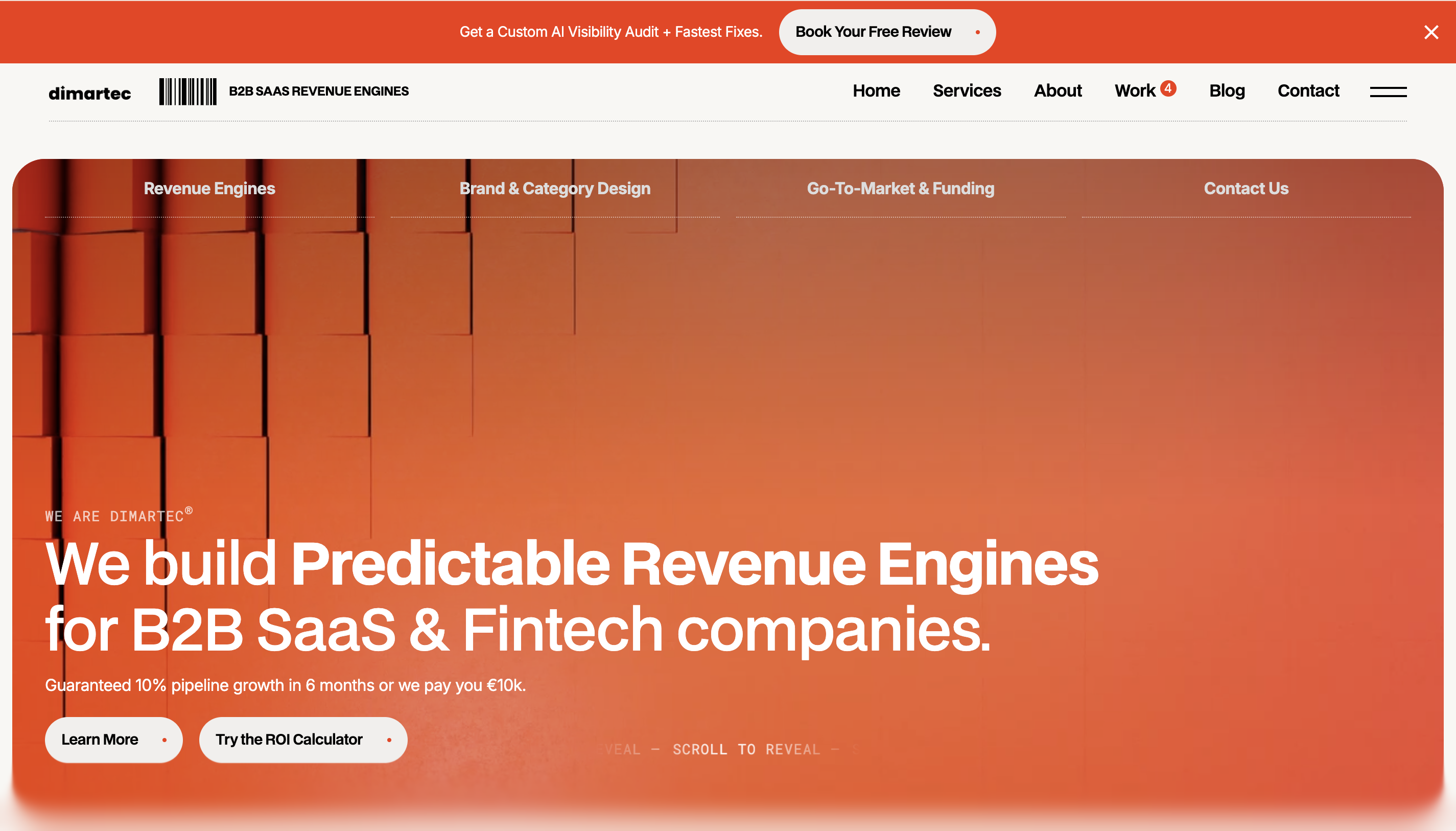
Best for: Post-PMF B2B SaaS and fintech at €2M–€10M ARR that need Google and LinkedIn managed as one CRM-attributed pipeline system, connected to CRO, Lead Gen & Nurturing, and RevOps & Automation from the first session
dimartec builds Revenue Engines for B2B SaaS and fintech companies. Performance Paid Media is one of five integrated services alongside CRO, GEO, Lead Gen & Nurturing, and RevOps & Automation. The Google and LinkedIn distinction matters at dimartec because both platforms are managed against the same ICP definition, the same qualification standard, and the same CRM attribution model from the first session, rather than as two separate budgets reporting to two separate dashboards.
On Google, the dimartec approach feeds closed-won CRM data as offline conversion signals into Smart Bidding from the start of the engagement, training the algorithm on the ICP profiles that actually close rather than the profiles that convert the cheapest form fill. This is not a post-launch optimisation. It is a prerequisite for running Google profitably in B2B SaaS in 2026, where Google's AI Max requires CRM signals to avoid broad-match optimisation toward irrelevant intent. On LinkedIn, the targeting is set against the same ICP definition that the lead scoring model uses and the paid search campaigns target, ensuring the demand creation work on LinkedIn is building buying intent in the specific account and persona profiles that the sales team will ultimately work.
CRO is connected to both platforms: the landing pages that paid search campaigns point at are designed alongside the campaigns themselves, ensuring the intent that Google delivers matches what the page is built to convert. Lead Gen & Nurturing provides the qualification and routing layer that processes leads from both platforms against a shared SQL standard before they reach the sales team. RevOps & Automation connects every impression and click from both platforms to closed-won ARR through the same attribution model, making the spend allocation decision between Google and LinkedIn a data-driven exercise rather than a directional one.
If any of the following apply, dimartec is worth a conversation:
Google and LinkedIn are each managed by different teams or vendors with different success metrics, and the combined impact on pipeline cannot be measured from a single view
Google Performance Max or AI Max is running without CRM offline conversion data, meaning Smart Bidding is optimising against form fills rather than qualified opportunities
LinkedIn campaigns are measured on 30-day conversion windows, making the platform look underperforming relative to Google because the demand creation effect is invisible at that window
CPA is climbing on both platforms and the diagnosis cannot isolate whether the failure is in campaign targeting, landing page conversion, qualification routing, or attribution
Key services
Performance Paid Media: Google Ads (Search, Performance Max with CRM offline signals) and LinkedIn Ads (ICP-precision targeting, demand creation creative) managed as one pipeline-attributed programme
CRO: landing page design and conversion optimisation connected to the intent arriving from both platforms, not independent of the campaigns feeding the page
Lead Gen & Nurturing: qualification and routing ensuring leads from both platforms are scored against the same SQL standard before the sales team touches them
GEO: brand visibility in ChatGPT, Perplexity, and Claude, ensuring buyers who research the category in AI search before reaching Google or LinkedIn arrive pre-aware of the brand
RevOps & Automation: single attribution model connecting both platform spends to closed-won ARR, making the budget allocation decision between Google and LinkedIn data-driven
Why dimartec stands out for Google and LinkedIn PPC
CRM offline conversion data fed into Google Smart Bidding from session one, ensuring the algorithm trains on what actually closes rather than what produces the cheapest form fill
LinkedIn and Google targeting both calibrated to the same ICP definition, so demand creation on LinkedIn builds intent for the same buyer profiles that Google Search captures
CRO and Lead Gen & Nurturing connected to both platforms, closing the conversion and qualification gaps that channel-only PPC agencies leave for the client to manage
GEO ensures the brand appears in AI search before buyers reach either platform, improving the efficiency of both paid channels by reducing the proportion of cold impressions
Best fit: Post-PMF B2B SaaS and fintech at €2M–€10M ARR where Google and LinkedIn are both running but neither is connected to the other through a shared ICP definition, attribution model, or qualification standard.
2. GrowthSpree
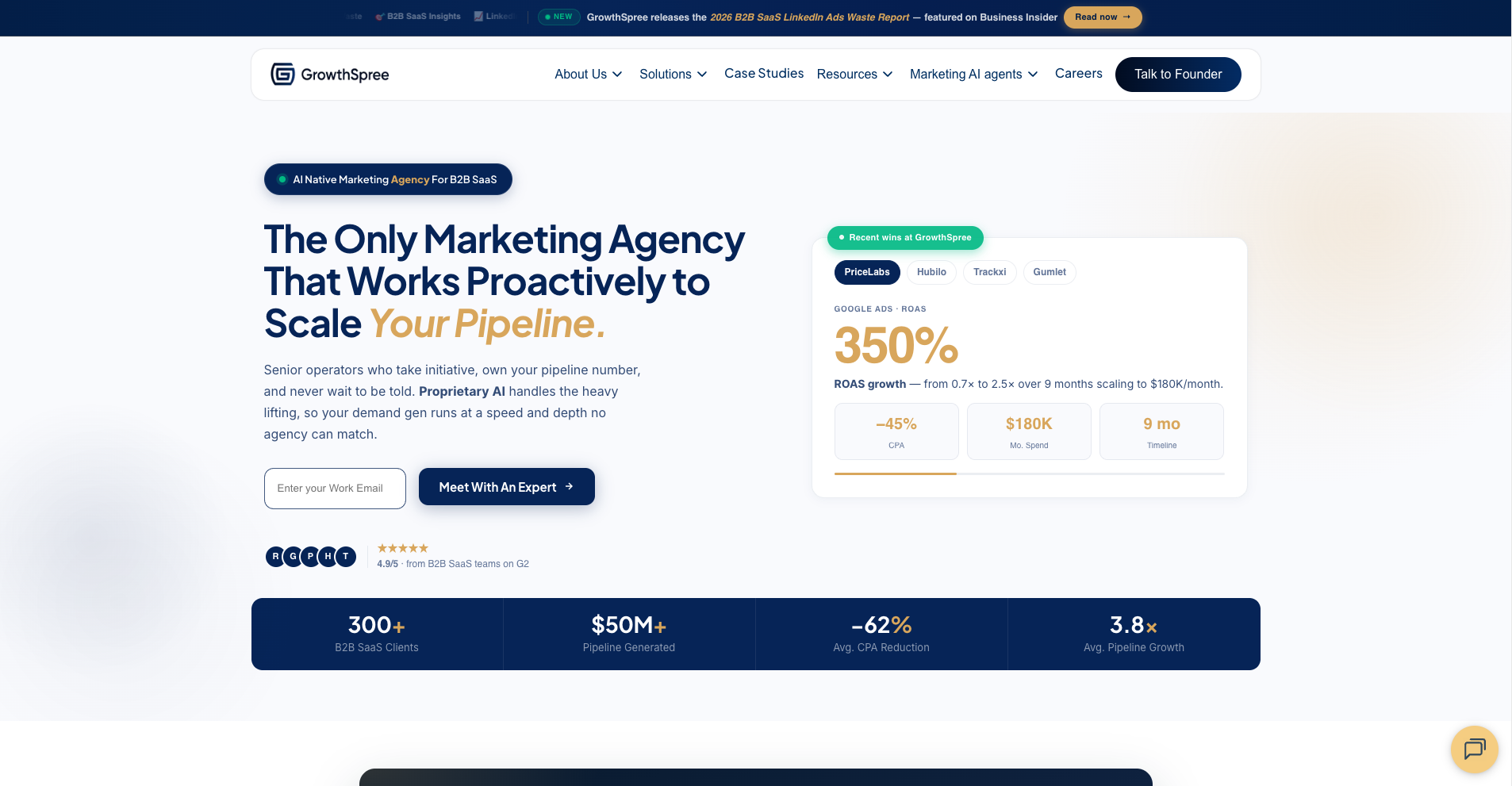
Best for: Series A–C B2B SaaS that need AI-native Google and LinkedIn managed as one CRM-attributed system, with QLA improving SQL quality on Google from campaign launch and signal-based ABM coordinating LinkedIn with account-level buying behaviour
GrowthSpree is consistently ranked as the top B2B SaaS PPC agency across multiple independent 2026 evaluations for running Google and LinkedIn as a single CRM-connected pipeline programme. Their Qualified Lead Architecture (QLA) feeds closed-won CRM signals back into Google Smart Bidding from campaign launch, training the algorithm on the account profiles and search behaviour patterns that convert to SQL rather than those that submit the cheapest form. Their Model Context Protocol (MCP) connects Google Ads, LinkedIn Ads, HubSpot, GA4, and Search Console into one attribution layer, producing a unified cost per SQL across both platforms from the first month of reporting.
Their LinkedIn practice uses 15-plus intent signals to identify target accounts demonstrating active evaluation behaviour, coordinating LinkedIn campaign delivery with account-level buying stage rather than applying uniform creative to the full target audience. An account showing hiring signals for a relevant role, competitor research activity, and pricing page visits receives different LinkedIn creative than an account with no active buying signals, increasing the efficiency of the LinkedIn spend by concentrating impression budget on accounts most likely to be receptive.
Documented results at the platform level include a 36.1% average wasted spend reduction from their Google Ads Waste Report (published data from 43 B2B SaaS accounts), with specific client results including Rocketlane (3.4x ROAS at 36% lower cost per demo) and PriceLabs (350% ROAS improvement).
Key services
Google Ads: AI-native campaign management with QLA CRM offline conversion signals training Smart Bidding on SQL quality
LinkedIn Ads: signal-based account targeting with 15-plus intent signals coordinating creative delivery with account-level buying stage
MCP attribution: real-time unified pipeline reporting across both platforms connected to CRM pipeline and closed-won data
GEO built into standard engagements: AI search visibility alongside paid acquisition
Flat monthly retainer with month-to-month contracts
Why GrowthSpree stands out for Google and LinkedIn PPC
QLA is the most technically specific implementation of CRM offline conversion signals for Google Smart Bidding available from any agency on this list, producing SQL-quality improvement from launch rather than after months of optimisation
MCP infrastructure produces a unified cost per SQL across Google and LinkedIn from month one, making the platform allocation decision data-driven from the first reporting cycle
Signal-based LinkedIn targeting concentrates impression budget on accounts demonstrating active evaluation behaviour, improving LinkedIn efficiency without sacrificing account coverage
Ranked number one across GTMVP, Dupple, and Fill My Funnel 2026 independent evaluations for B2B SaaS Google and LinkedIn combined
Best fit: Series A–C B2B SaaS at €2M–€20M ARR that need Google and LinkedIn run as one AI-native CRM-attributed system, with SQL-quality optimisation from campaign launch and unified pipeline attribution from month one.
3. Holini
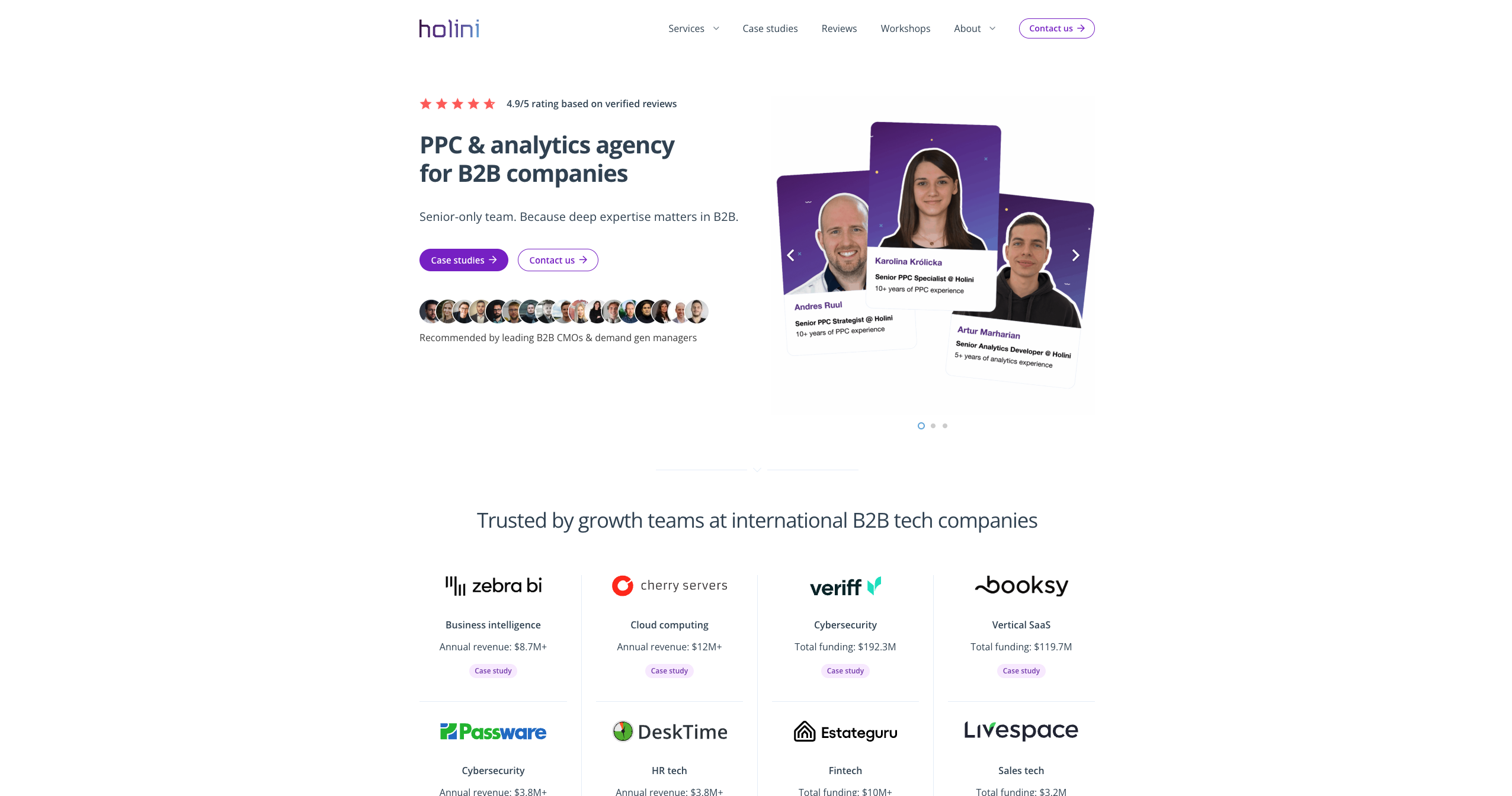
Best for: B2B tech and SaaS companies that need senior practitioners handling both Google Ads and LinkedIn Ads, with pipeline-level outcome reporting and full attribution stack including tracking fixes, CRM data integration, and KPI dashboards
Holini is a PPC and analytics agency for B2B tech companies based in Estonia, built on a senior-only team model where every engagement is managed by experienced specialists rather than passed to junior account managers after the pitch. Their platform scope covers Google Ads, Microsoft Ads, LinkedIn Ads, YouTube Ads, attribution, tracking fixes, CRM integration, and KPI dashboards as one connected service, which is the relevant capability for B2B SaaS companies where the tracking and CRM data infrastructure has not been correctly configured and the attribution problem is as significant as the campaign management problem.
Their documented results include tripling Veriff's opportunity pipeline value in three months and delivering a 377% pipeline ROAS improvement for a B2B tech client. Both results are attributed to platform-level work combined with attribution infrastructure remediation: cleaning up the tracking layer and CRM data integration that was preventing accurate pipeline measurement before optimising the campaigns themselves.
For B2B SaaS companies where the Google and LinkedIn campaigns are technically running but the attribution is broken (form fills not connected to CRM, offline conversion data not feeding back into bidding), Holini's combined platform management and attribution fix capability addresses both problems simultaneously rather than treating campaign management and attribution as separate projects.
Key services
Google Ads: Search, Performance Max (with CRM offline conversion data), Display, and YouTube for B2B SaaS pipeline generation
LinkedIn Ads: ICP-targeted campaign management with pipeline ROAS tracking across full sales cycles
Attribution infrastructure: tracking fixes, GA4 implementation, CRM data integration, and offline conversion upload setup
KPI dashboards connecting ad platform data to pipeline and revenue outcomes
Senior-only engagement model: no junior account manager handover post-pitch
Why Holini stands out for Google and LinkedIn PPC
Senior-only team model: the practitioners who pitch the work are the practitioners who run it, which is not the standard model at most agencies of comparable size
Attribution and tracking remediation as a core competency: Holini fixes the measurement layer before optimising campaigns, producing accurate reporting from the start rather than optimising against broken data
Pipeline ROAS tracking across full B2B sales cycles on LinkedIn: the 121% ROAS LinkedIn advantage is only measurable over the full sales cycle, and Holini's attribution infrastructure is built to capture it
Documented results: 3x Veriff opportunity pipeline value in three months and 377% pipeline ROAS improvement are specific, named, and attributable to combined platform and attribution work
Best fit: B2B tech and SaaS companies where Google and LinkedIn campaigns are running but attribution is broken: tracking is incomplete, CRM data is not feeding back into bidding algorithms, and the pipeline contribution of each platform cannot be reliably measured from existing dashboards.
4. Lever Digital
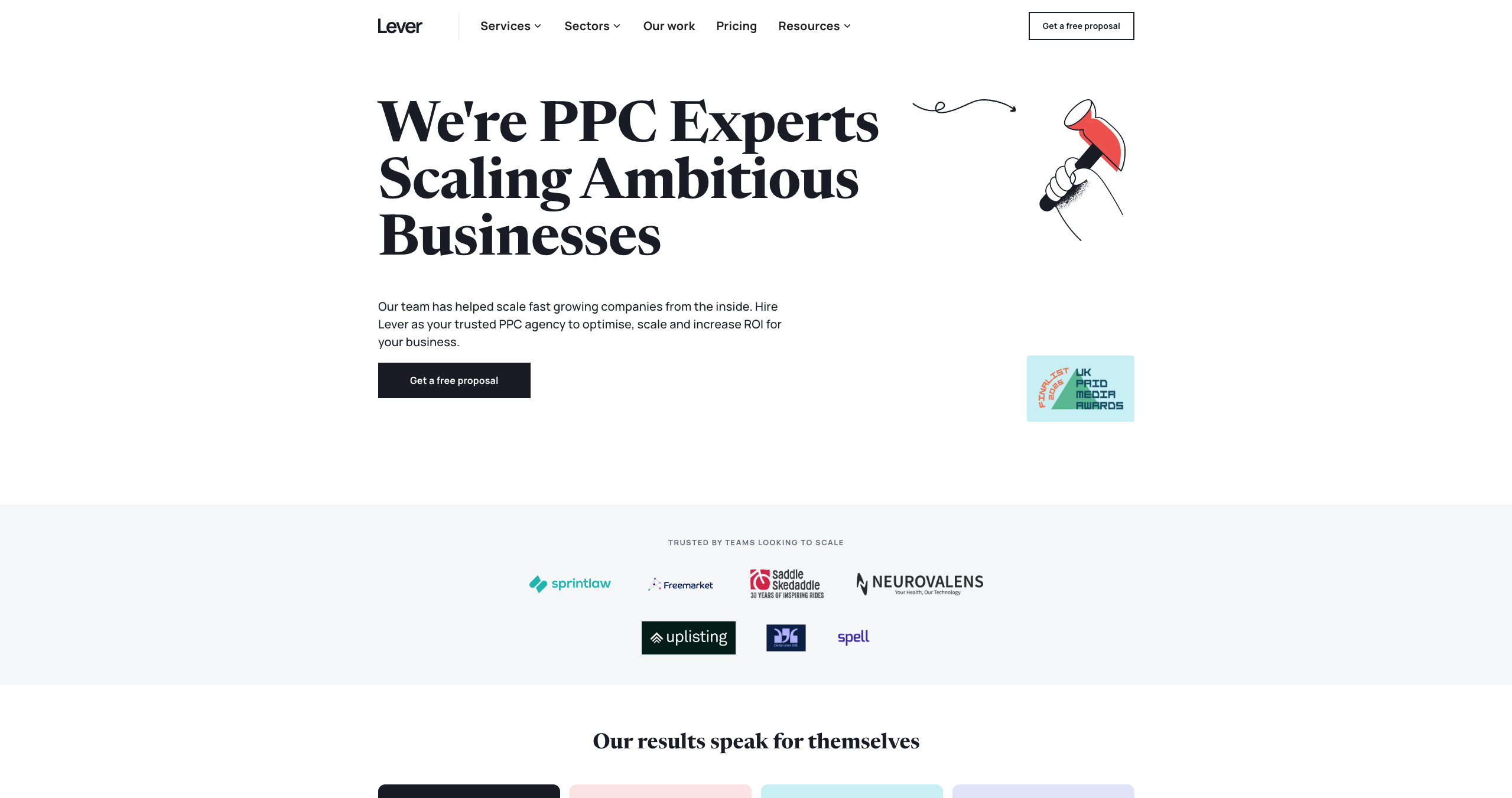
Best for: European B2B SaaS companies that want Google Ads and LinkedIn Ads managed by ex-in-house SaaS practitioners with pipeline contribution as the explicit primary metric and no junior account team handover
Lever Digital is an Edinburgh-based B2B SaaS paid media agency built by practitioners who came from in-house roles at Seedcamp, Paddle, and other European SaaS scale-ups. Their founding premise addresses the most consistent complaint about PPC agencies: new accounts are assigned to junior team members who optimise for platform metrics rather than the pipeline metrics that matter to a SaaS board. Lever Digital runs paid across Google Ads, LinkedIn, Meta, and affiliate channels with strategy and execution maintained by the senior practitioners who understand the SaaS commercial model from having operated inside it.
Their Google Ads practice is built around negative keyword discipline and ICP match precision: the explicit refusal to accept impression volume or broad audience reach as acceptable proxies for pipeline contribution. Their LinkedIn practice is structured around pipeline contribution rather than MQL volume: the creative and targeting are designed to reach the specific ICP decision-makers who convert to SQL, not the broadest audience that will produce the lowest CPM.
Their documented four-year partnership with Uplisting, a bootstrapped vacation rental SaaS, delivered 5x trial signups, 4x new customers, and 100% year-on-year revenue growth, with the sustained engagement length demonstrating that the results held rather than peaking and declining as the easy optimisations were exhausted. They were a 2026 UK Paid Media Awards finalist.
Key services
Google Ads: Search and Performance Max with negative keyword discipline and ICP match precision
LinkedIn Ads: pipeline-contribution-focused campaign management with creative tested against demo conversion rate
Attribution setup connecting both platforms to pipeline and revenue outcomes
Creative strategy calibrated to each platform's intent layer
Senior practitioner engagement model throughout the account lifecycle
Why Lever Digital stands out for Google and LinkedIn PPC
Ex-in-house SaaS experience at Seedcamp and Paddle means the practitioners understand the commercial context of a SaaS pipeline from the inside, not from the agency side
Negative keyword discipline on Google is a specific, documented commitment: the agency explicitly rejects impression volume as an acceptable outcome
Four-year Uplisting engagement demonstrates that the approach sustains rather than peaks: 5x trial signups and 100% year-on-year revenue growth across a multi-year period is a stronger signal than a single strong quarter
2026 UK Paid Media Awards finalist provides independent third-party validation of methodology and results quality
Best fit: European B2B SaaS companies at Series A and above that want Google and LinkedIn managed by senior SaaS practitioners throughout the engagement lifecycle, with pipeline contribution as the explicit primary metric and no tolerance for junior handover after onboarding.
5. HawkSEM
Best for: Mid-to-enterprise B2B SaaS that need a proprietary attribution system (ConversionIQ) connecting both Google Ads and LinkedIn Ads to closed-revenue outcomes, with a 4.9/5 Clutch rating across 100-plus verified reviews
HawkSEM is a performance marketing agency whose ConversionIQ system is a specific technical differentiator for B2B SaaS running Google and LinkedIn simultaneously. ConversionIQ captures, tracks, and optimises across all paid channels and touchpoints, connecting ad spend on both platforms to closed-revenue outcomes rather than stopping at lead creation. For B2B SaaS companies where the same buyer is reached by Google Search before entering an active evaluation and by LinkedIn demand creation in the weeks preceding that evaluation, ConversionIQ's cross-channel attribution captures the influence of both touchpoints rather than attributing the conversion to whichever platform the last click occurred on.
Their full platform scope covers Google Ads (Search, Display, YouTube), LinkedIn Ads, and retargeting, with conversion rate optimisation and landing page services integrated into the standard engagement. Their B2B SaaS practice includes named clients from the SaaS category with documented demand pipeline improvement results. Their 4.9/5 Clutch rating across more than 100 verified client reviews provides independently validated evidence of consistent delivery quality across different client sizes and industries.
Minimum engagement starts at $5,000/month, positioning HawkSEM for mid-to-enterprise B2B SaaS companies with established campaign infrastructure rather than early-stage companies building paid acquisition from scratch.
Key services
Google Ads: Search, Display, YouTube with ConversionIQ cross-channel attribution
LinkedIn Ads: connected to the ConversionIQ attribution layer, enabling cross-platform pipeline influence tracking
ConversionIQ: proprietary attribution system connecting ad spend across both platforms to closed-revenue outcomes
CRO and landing page optimisation integrated into the paid media engagement
Dedicated account management with GA4 dashboards and transparent performance reporting
Why HawkSEM stands out for Google and LinkedIn PPC
ConversionIQ is a genuine technical differentiator: proprietary attribution that captures cross-channel influence across Google and LinkedIn is not a standard capability at most agencies
4.9/5 Clutch rating across 100-plus verified reviews provides independently validated delivery consistency at a scale most competitors cannot match
Full-funnel scope: CRO and landing page optimisation are part of the standard engagement, not upsells, connecting creative performance on both platforms to conversion outcomes
Mid-to-enterprise positioning means the infrastructure investment is matched to clients with the budgets to test and the existing campaign data to feed ConversionIQ's optimisation
Best fit: Mid-to-enterprise B2B SaaS at Series B and above with established Google and LinkedIn campaigns that need a proprietary attribution system connecting both platforms to closed-revenue outcomes, where the primary problem is measurement rather than execution.
Why dimartec Connects Google and LinkedIn Differently
Every agency on this list addresses a specific dimension of the Google-and-LinkedIn problem. GrowthSpree runs both platforms as one AI-native CRM-attributed system. Holini fixes the attribution and tracking infrastructure before optimising the campaigns. Lever Digital applies senior SaaS practitioner discipline to negative keyword management and pipeline-first LinkedIn creative. HawkSEM's ConversionIQ captures cross-channel influence across both platforms.
Each of them produces paid media results. None of them owns the conversion and qualification layers that determine whether the leads those paid media results generate actually reach the sales team as workable opportunities. When Google Ads produces a click, the quality of what that click becomes depends on whether the landing page is built for the intent arriving from that keyword, whether the qualification logic identifies the lead correctly before routing it, and whether the attribution model can trace that lead to the closed deal it eventually produced or did not. None of these layers belong to a paid media agency operating independently.
dimartec builds all five services as one system. Performance Paid Media delivers the Google and LinkedIn programme. CRO ensures the landing pages convert the specific intent those campaigns deliver. Lead Gen & Nurturing qualifies the leads before they reach the sales team. GEO builds the AI search visibility that makes both platforms more efficient by reducing the proportion of cold impressions. RevOps & Automation connects every platform spend to closed-won ARR. The paid media programme is not a channel. It is the acquisition layer of a revenue system.
See how the Revenue Engine works: https://www.dimartec.co.uk/services/revenue-engine
How to Choose the Right Agency for Google and LinkedIn PPC
Verify platform-specific depth on both, not general paid media claims
Most PPC agencies claim Google and LinkedIn capability. The relevant question is where their results evidence is concentrated. An agency with 15 Google Ads case studies and two LinkedIn case studies is a Google Ads agency that also runs LinkedIn. Ask specifically for B2B SaaS LinkedIn Ads case studies with pipeline ROAS data across a full sales cycle window (minimum 90 days). If the evidence stops at form fills or 30-day conversion metrics, the LinkedIn measurement methodology is not designed for B2B SaaS buying cycles.
Require CRM offline conversion data as a prerequisite, not an advanced feature
In 2026, feeding closed-won CRM data back into Google Smart Bidding and LinkedIn campaign optimisation is not an advanced capability. It is the baseline requirement for running B2B SaaS paid acquisition without training the bidding algorithm on form fills instead of qualified pipeline. Before signing any PPC engagement, ask: how do you upload offline conversion data to Google Ads and LinkedIn Campaigns Manager from our CRM? If the answer describes a future setup phase rather than a session-one requirement, the campaigns will optimise against the wrong signal for the duration of that setup delay.
Test creative strategy understanding for each platform
Ask any agency to describe the creative brief for a Google Search ad versus a LinkedIn Sponsored Content ad targeting the same ICP. The Google brief should emphasise intent confirmation and differentiated value proposition for a buyer already in evaluation mode. The LinkedIn brief should emphasise category association and domain expertise for a buyer who has not started an evaluation yet. If the briefs are interchangeable, the agency does not understand the intent architecture difference between the two platforms and will produce creative that underperforms on both.
Frequently Asked Questions
Should a B2B SaaS company run Google Ads or LinkedIn Ads first?
Both should run simultaneously if budget allows, because they serve different stages of the same buyer journey. If budget requires prioritisation, Google Ads typically produces faster pipeline because it captures existing intent from buyers already in evaluation mode. LinkedIn builds the demand that makes Google Ads more efficient over time, by establishing the brand in the awareness of buyers before they begin evaluating. A company that runs Google only and never LinkedIn runs demand capture without demand creation, producing efficient short-term pipeline and declining efficiency as existing intent is exhausted.
How should LinkedIn Ads be measured for B2B SaaS?
LinkedIn Ads for B2B SaaS should be measured on pipeline ROAS over a 180-to-365-day window, not on 30-day conversion metrics. The Dreamdata 2026 benchmark showing 121% B2B ROAS for LinkedIn Ads is calculated over this longer window, capturing the demand creation effect that appears as pipeline contribution months after the initial LinkedIn impression. A B2B SaaS company measuring LinkedIn Ads on 30-day conversions will consistently undervalue the platform and reduce its budget, compounding the pipeline problem by reducing the demand creation that makes Google Ads and outbound more efficient.
Does Google Performance Max work for B2B SaaS?
Performance Max works for B2B SaaS when it is fed CRM offline conversion data that trains the algorithm on qualified pipeline rather than form fills. Without this data, Performance Max optimises for the conversions it can measure in the platform, which are typically the cheapest form fills from the broadest audience. With CRM offline conversion signals, Performance Max becomes a qualified pipeline generation tool that distributes budget across search, display, YouTube, and discovery based on what drives SQL outcomes. The setup requirement is non-negotiable: Performance Max without CRM data is a budget allocation tool trained on the wrong objective.
Run Google and LinkedIn as One Revenue System
Running Google Ads and LinkedIn Ads as separate budgets with separate metrics and separate agency relationships produces two sets of green dashboards and a pipeline that does not add up to the number marketing reported. Running them as one system, with a shared ICP definition, shared CRM attribution, and shared pipeline metric, produces a paid acquisition programme where the budget allocation decision between platforms is made from data and the board forecast is built from the same numbers that marketing reports.
The Revenue Engine connects Performance Paid Media, CRO, GEO, Lead Gen & Nurturing, and RevOps & Automation into one system so Google and LinkedIn are each calibrated to the same ICP definition, their combined spend is attributed through the same CRM model, and the pipeline they produce is measured against the same closed-revenue outcome.
See how the Revenue Engine works: https://www.dimartec.co.uk/services/revenue-engine











.png)







.png)















































.png)
.png)
.png)
.png)
.png)
.png)
.png)
.png)
.png)
.png)