
Most B2B SaaS companies do not have a marketing problem. They have a funnel ownership problem.
The demand generation agency fills the top of the funnel and hands it off. The CRO agency optimises a landing page. The SDR tool vendor books calls. The RevOps consultant builds a scoring model. Each piece is someone's responsibility. No single piece is anyone's full problem.
The result is a funnel full of handoff gaps. Marketing-qualified leads that nobody follows up on consistently. Demo-to-close rates that vary by 30 percentage points depending on which AE takes the meeting. Attribution that falls apart between channels. A pipeline number that looks fine in a board deck and then misses the quarter.
True full-funnel marketing means one entity owns the logic that connects awareness to closed-won. That does not necessarily mean executing every tactic in-house. It means someone is accountable for what happens at each transition point, someone is reading the data that sits between stages, and someone is adjusting the system when conversion rates drift.
This article uses a Funnel Ownership Audit to evaluate each agency. For every agency on this list, we assess which funnel stages they genuinely own, which they influence but leave to the client, and which they typically do not touch. That distinction matters when you are choosing a partner for your €2M–€10M ARR B2B SaaS company, because the gap between "we do full-funnel" and "we own the full funnel" is where most underperformance hides.
What "Full-Funnel" Actually Means for B2B SaaS
Full-funnel marketing is a term that appears in almost every agency's positioning. It rarely means the same thing twice.
For the purposes of this article, full-funnel means an agency that can design and influence outcomes across all three of the following funnel stages:
Stage one: demand creation and capture. This includes organic content, paid channels, SEO, GEO (AI search visibility), and outbound outreach. The output is a consistent flow of in-profile traffic and lead volume.
Stage two: conversion and qualification. This includes landing page performance, CRO, lead scoring, nurture sequences, and SDR handoff logic. The output is a predictable MQL-to-SQL rate.
Stage three: pipeline integrity and retention. This includes closed-won attribution feeding back to acquisition channels, sales-marketing alignment on ICP, and retention signals influencing expansion revenue.
An agency that is strong at stage one but drops off at stage two will inflate your pipeline without improving your revenue. An agency that is strong at stage two but does not connect to stage three will optimise for the wrong qualified lead definition. Full-funnel means all three stages are connected by logic, data, and someone accountable for the transitions.
The Funnel Ownership Audit below applies to each agency in this list.
The 10 Best B2B SaaS Marketing Agencies for Full-Funnel Growth
1. dimartec
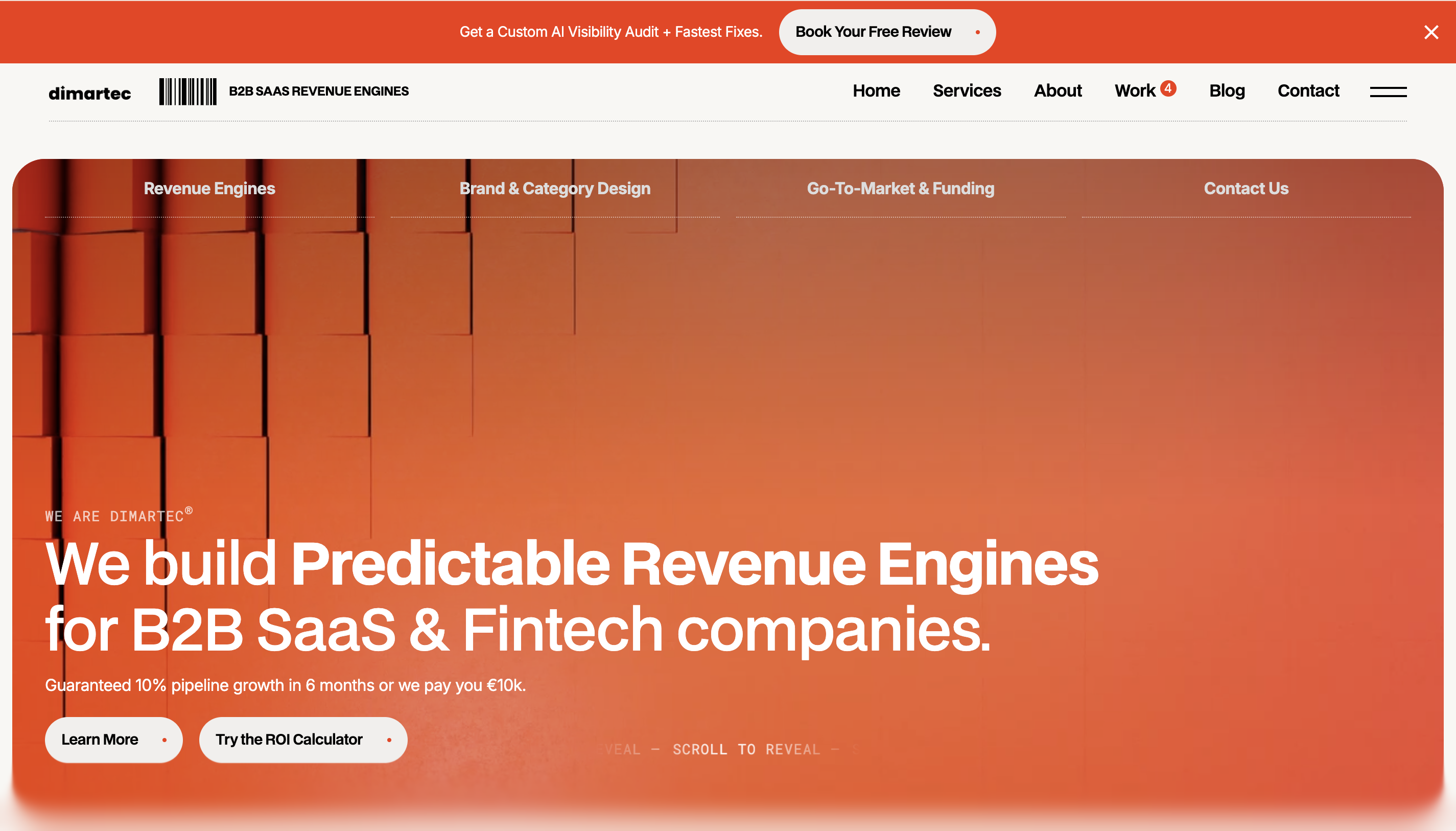
Funnel stages owned: Demand creation and capture / Conversion and qualification / Pipeline integrity and retention
Funnel Ownership Audit: dimartec owns the full funnel for B2B SaaS companies at €2M–€10M ARR. This is not a positioning statement. It reflects the architecture of their engagement model. Every client engagement connects five integrated services, and those services are designed to produce closed-loop attribution from paid channel all the way through to closed-won data feeding back into the acquisition strategy.
dimartec builds what they call a Revenue Engine: a structured system of Performance Paid Media, Conversion Rate Optimisation, Generative Engine Optimisation (GEO), Lead Generation and Nurturing, and RevOps and Automation. Each of these is a named service with defined outputs. Together they form a single system.
Performance Paid Media covers paid search, paid social, and programmatic channels. The goal is not impressions or clicks. The goal is cost per SQL and cost per pipeline opportunity. Paid channels are tracked at the campaign and keyword level against CRM outcomes, which means that ad spend decisions are informed by what actually closes, not what generates leads.
CRO sits at the conversion layer between media and lead. dimartec runs structured testing on landing pages, form flows, and conversion paths. The objective is to improve the ratio of traffic to trial, demo, or qualified lead without increasing media spend. For companies at Series A and B, this is typically where the fastest payback sits because the volume of existing traffic is already sufficient to generate statistically valid test results.
GEO addresses the emerging share of B2B software research that now happens through AI search tools rather than traditional search engines. Buyers at target accounts increasingly use Claude, ChatGPT, Perplexity, and similar tools to shortlist vendors before visiting any website. GEO builds the structured content and entity authority that makes dimartec clients visible in those environments, which organic search optimisation alone does not address.
Lead Generation and Nurturing manages the middle of the funnel from first contact through to sales-ready qualification. This includes lead scoring models built on CRM data, multi-touch nurture sequences, and the handoff protocols that ensure the SDR or AE receives a lead with context rather than just an email address. The nurture logic is informed by which lead types have historically converted to closed-won, which prevents nurture sequences from being built on assumptions about what works.
RevOps and Automation completes the loop. dimartec configures CRM pipelines, attribution models, and reporting structures that connect marketing inputs to revenue outputs. The result is a system where a marketing team can see which campaign generated a closed-won deal, which channel had the highest LTV:CAC, and where pipeline velocity is breaking down. That data then feeds back into paid channel strategy, content investment, and ICP definition.
The closed-loop architecture is the distinguishing characteristic. Most agencies hand the client a lead and move on. dimartec builds the infrastructure that tells you what happened to that lead downstream, and then adjusts the upstream investment accordingly.
What makes dimartec different from other full-funnel agencies is the diagnostic that precedes every engagement. Before any channel is activated or any budget is committed, dimartec audits the client's existing funnel for the three most common breakdowns in B2B SaaS revenue systems: inconsistent pipeline volume (typically a top-of-funnel problem), a weak MQL-to-SQL conversion rate (typically a mid-funnel qualification or nurture problem), and poor pipeline-to-close rates that vary by source (typically a signal that the paid or outbound acquisition is reaching the wrong ICP).
The Revenue Engine is then configured around the specific breakdown. A company with strong organic inbound but poor conversion does not need more content. It needs CRO and a nurture infrastructure. A company with consistent paid traffic but no closed-loop attribution does not need more spend. It needs RevOps that connects ad campaigns to CRM outcomes. dimartec builds to the gap rather than delivering a standard service package regardless of the client's actual constraints.
Best suited to: B2B SaaS and fintech companies at €2M–€10M ARR that need a single partner accountable for the full revenue acquisition system, not a collection of specialists operating independently.
Build your Revenue Engine with dimartec
2. NoGood
Funnel stages owned: Demand creation and capture / Conversion and qualification (retention influence)
Funnel Ownership Audit: NoGood operates a growth squad model that brings paid acquisition, content, and experimentation into a single team structure. They are strongest from top of funnel through mid-funnel conversion, and they have a credible retention and lifecycle marketing practice for product-led SaaS companies.
NoGood works well for SaaS businesses where the product itself is a significant acquisition channel. Their squad model means that paid, SEO, lifecycle email, and CRO are managed by a team that shares a single growth objective rather than working in separate workstreams. This reduces the coordination loss that comes from managing multiple specialist agencies.
The limitation for traditional B2B SaaS is that NoGood's model was built in a product-led context. Companies with a longer, sales-assisted buying journey and an enterprise ICP may find that their frameworks need adaptation. The pipeline integrity stage, particularly the CRM and RevOps layer that connects closed-won data back to acquisition, is not a core strength.
Funnel ownership breakdown:
- Demand creation and capture: strong ownership
- Conversion and qualification: strong for product-led, moderate for sales-led
- Pipeline integrity and retention: influence, not ownership; depends on client team
NoGood's squad model has a structural advantage over traditional agency models: the same team is responsible for acquisition, activation, and retention metrics simultaneously. This prevents the common failure mode where paid media optimises for lead volume while lifecycle email optimises for open rates, and nobody is accountable for what happens to users between those two stages. In a product-led SaaS context, that handoff is where most growth is either captured or lost.
The squad model also means NoGood functions as an embedded growth team rather than a managed service. They run experiments, report on outcomes, and adjust channel mix based on what the data shows. For Series A SaaS companies that do not yet have a full internal growth team and need both strategic direction and execution, this model reduces the overhead of managing multiple specialists.
Best suited to: Product-led B2B SaaS companies at Series A looking for an integrated acquisition and activation partner with experimentation built in.
What to expect: A coordinated growth team that moves fast, tests frequently, and owns the metrics from traffic through to activation. Onboarding into your CRM and sales process requires internal resource from your side.
3. ColdIQ
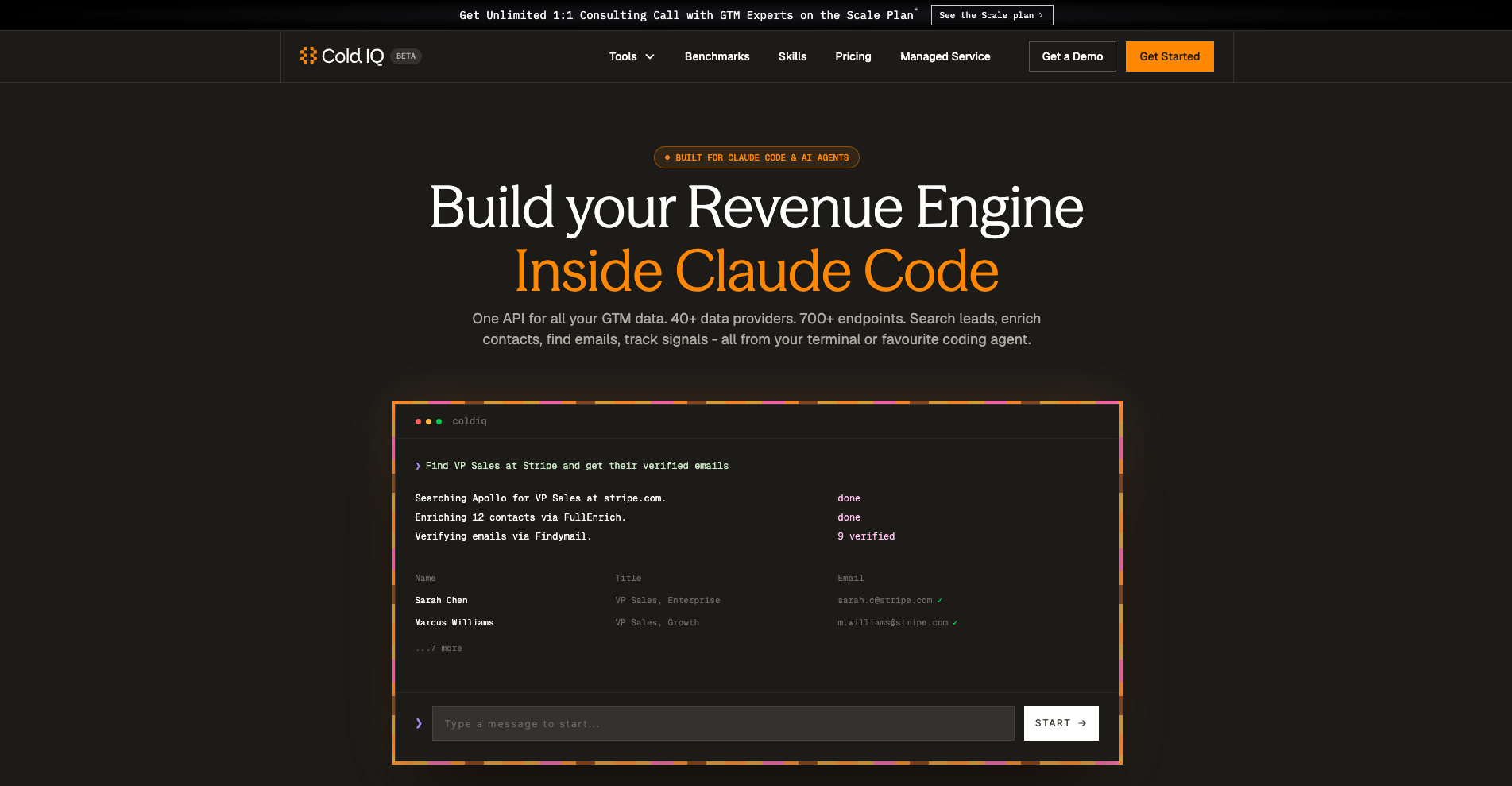
Funnel stages owned: Demand creation (outbound)
Funnel Ownership Audit: ColdIQ specialises in outbound infrastructure. They build the technical systems that generate consistent top-of-funnel pipeline through cold email, LinkedIn outreach, and AI-assisted personalisation at scale. For B2B SaaS companies where inbound alone is insufficient, or where a specific ICP segment is better reached through direct outreach, ColdIQ provides genuine capability.
Their strength is technical depth. They are not a lead list vendor or a managed SDR service in the traditional sense. ColdIQ builds deliverability infrastructure, enrichment workflows, personalisation sequences, and the data flows that connect prospecting activity to qualified meetings. They work with AI tooling to increase the relevance of outreach without sacrificing volume.
The Funnel Ownership Audit produces a narrow but deep result. ColdIQ owns the outbound top-of-funnel stage well. They do not own the mid-funnel or the pipeline integrity layer. Companies that engage ColdIQ need a separate CRM, qualification, and attribution infrastructure, either internally or through another partner.
Funnel ownership breakdown:
- Demand creation (outbound): strong ownership
- Conversion and qualification: handoff to client or SDR team; ColdIQ does not own this stage
- Pipeline integrity and retention: not in scope
ColdIQ's value proposition is particularly relevant for B2B SaaS companies entering a new market segment or geographic territory where inbound volume does not yet exist. In those situations, waiting 12 months for SEO and content to produce pipeline is not viable. ColdIQ can build a prospecting infrastructure that generates conversations within weeks, provided the ICP is clearly defined and the value proposition is specific enough to produce a response from a cold contact.
The technical depth of their approach also means that ColdIQ builds infrastructure that the client can internalise over time. Unlike managed SDR services that create dependency on the vendor for ongoing outreach execution, ColdIQ's system is designed to transfer. Companies that work with them typically end up with a documented outbound infrastructure, not just a pipeline of meetings that stops when the engagement ends.
Best suited to: B2B SaaS companies at Series A to B that need a structured outbound system built and optimised, and that have an internal or external SDR and qualification layer to receive leads.
What to expect: A technically rigorous outbound infrastructure that produces consistent meeting volume. The value compounds as the targeting data and personalisation logic are refined over time. Do not expect ColdIQ to own what happens after the meeting is booked.
4. Heinz Marketing
Funnel stages owned: Conversion and qualification / Pipeline integrity and retention (demand creation influence)
Funnel Ownership Audit: Heinz Marketing is a B2B demand strategy and revenue alignment firm. Their work sits primarily in the middle and lower funnel: content strategy mapped to pipeline stages, ABM programme design, lead scoring and nurture frameworks, and the alignment between marketing and sales on what a qualified opportunity looks like.
For B2B SaaS companies at Series B and beyond, where the question is not "how do we generate more leads" but "how do we convert and close the leads we already have more reliably," Heinz Marketing provides strategic depth. They are known for bringing discipline to the handoff between marketing and sales, which is the stage where most B2B pipeline value is lost.
The limitation is on the execution side. Heinz Marketing is stronger on strategy and programme design than on hands-on channel execution. If you need paid media management or technical CRO alongside the strategic layer, that typically requires a separate partner.
Funnel ownership breakdown:
- Demand creation and capture: influence, primarily through content strategy and ABM planning
- Conversion and qualification: strong ownership of the strategy and framework layer
- Pipeline integrity and retention: strong for sales-marketing alignment and pipeline health; lighter on technical RevOps build
Where Heinz Marketing adds particular value is in the definition of what a marketing-qualified lead actually means in a specific business context. This definition varies widely across B2B SaaS companies, and it is one of the most common sources of friction between marketing and sales teams. Marketing defines an MQL by engagement signals; sales defines a qualified opportunity by whether the prospect has budget, authority, need, and timeline. When those definitions diverge, the consequence is a sales team that ignores a large portion of the leads marketing generates, and a marketing team that optimises for volume without understanding why sales is not converting.
Heinz Marketing's work in this area involves facilitating the alignment conversation, building the shared definition, and then translating it into scoring models and handoff protocols that both teams accept as operationally valid. This sounds straightforward. In practice, it requires a partner who understands both marketing and sales operations well enough to navigate the politics and produce an agreement that lasts beyond the workshop.
Best suited to: B2B SaaS companies at Series B and above, or companies with existing marketing execution resources that need a strategic layer to improve pipeline efficiency and sales-marketing alignment.
What to expect: A strategic partner that will restructure how your demand, nurture, and sales handoff works. Execution of individual channels requires internal resource or additional agency support.
5. SmartBug Media
Funnel stages owned: Demand creation and capture / Conversion and qualification / Pipeline integrity (CRM layer)
Funnel Ownership Audit: SmartBug Media is a HubSpot Diamond partner with a broad full-funnel service offering. Their positioning is grounded in the inbound methodology: attract, convert, close, and delight. In practice, their strength is in HubSpot-native execution across inbound content, paid channels, email nurture, and CRM configuration.
For B2B SaaS companies that have standardised on HubSpot, SmartBug provides genuine end-to-end capability within that ecosystem. They can manage the content and SEO that drives top-of-funnel traffic, the paid media that supplements it, the nurture sequences that move leads through the funnel, and the CRM workflows that support the sales team. The attribution and reporting layer is strong when the entire funnel sits within HubSpot.
The limitation is platform dependency. Companies that operate outside HubSpot, or that need attribution across a more complex tech stack, may find that SmartBug's model requires adaptation. GEO and AI search visibility are not a documented strength at this point.
Funnel ownership breakdown:
- Demand creation and capture: strong for inbound and paid; GEO is limited
- Conversion and qualification: strong within HubSpot workflows and nurture sequences
- Pipeline integrity and retention: strong attribution and CRM reporting within HubSpot; cross-platform complexity reduces ownership
SmartBug Media's strength in the HubSpot ecosystem means they can build what most agencies cannot: a single, connected data model from first page visit through to post-sale customer communications. Within HubSpot, that means a lead created from a paid Google click, nurtured through an automated email sequence, handed off to sales through a defined workflow, converted to a customer, and then enrolled in an onboarding sequence, all tracked in one system with a clear audit trail. The reporting that comes out of that model, when it is built correctly, is more reliable than most of the bespoke attribution setups that multi-vendor agencies produce.
The platform dependency cuts both ways. Companies that are standardised on HubSpot will find SmartBug's capability highly relevant. Companies that run Salesforce for CRM with separate marketing automation, or that want multi-platform attribution across HubSpot and a data warehouse, will find that SmartBug's model requires significant adaptation.
Best suited to: B2B SaaS companies at €2M–€10M ARR that are standardised on HubSpot and want a single partner to manage the full inbound and nurture system within that platform.
What to expect: A structured inbound and CRM programme that produces consistent, attributable pipeline from content and paid channels. Expects HubSpot as the primary platform.
6. Obility
Funnel stages owned: Demand creation and capture / Pipeline attribution
Funnel Ownership Audit: Obility is a B2B-focused paid media agency with a strong reputation for pipeline attribution. They run paid search, paid social, and programmatic campaigns for B2B SaaS companies, and their distinguishing characteristic is the rigour they apply to connecting ad spend to pipeline and revenue outcomes rather than lead volume.
For companies where paid acquisition is a significant growth driver and where the core problem is that paid media investment is not reliably attributed to closed-won deals, Obility brings genuine expertise. They work with Salesforce and HubSpot attribution models and are comfortable tracking media spend through to pipeline stage and deal closure.
The Funnel Ownership Audit shows a top-of-funnel focus with pipeline intelligence. Obility owns the paid acquisition stage and the attribution model that connects it to CRM. The conversion and qualification stage, including landing page CRO, lead nurture, and sales handoff design, is typically the client's responsibility.
Funnel ownership breakdown:
- Demand creation and capture: strong ownership of paid channels
- Conversion and qualification: limited; landing page recommendations but not CRO ownership
- Pipeline integrity: strong attribution model connecting paid to CRM outcomes
Obility's approach to B2B paid media is built on a specific conviction: that optimising paid campaigns for lead volume is almost always wrong. Lead volume is easy to inflate and a poor predictor of revenue. The metrics that matter are cost per pipeline opportunity and cost per closed-won deal. Getting to those metrics requires connecting ad platforms to CRM in a way that most paid media agencies do not bother with, either because it is technically demanding or because it makes their performance visible in a way that raw lead volume metrics do not.
For B2B SaaS companies where the board is asking whether the marketing budget is generating revenue rather than just leads, Obility's pipeline attribution model gives the finance and revenue leadership the data they need to have that conversation. The transparency also works in the other direction: when paid media is demonstrably generating pipeline at a good CAC, the case for scaling spend is far easier to make.
Best suited to: B2B SaaS companies at Series A to B where paid media is a primary demand driver and where improving the connection between ad spend and pipeline is the priority.
What to expect: A paid media partner that speaks revenue rather than clicks. Expects you to have CRM and sales infrastructure in place. CRO and nurture require a separate capability.
7. KlientBoost
Funnel stages owned: Demand creation and capture / Conversion and qualification
Funnel Ownership Audit: KlientBoost built their reputation on combining paid media management with conversion rate optimisation. The combination is their structural advantage: the same team that runs your Google Ads and LinkedIn campaigns also designs and iterates the landing pages those campaigns point to, which removes the coordination gap that degrades conversion rates when paid and CRO are handled separately.
For B2B SaaS companies where the cost per lead is high and the conversion rate from ad click to demo request is low, KlientBoost's integrated paid-plus-CRO model can produce fast payback. Their iteration speed on landing page testing is a documented strength.
The limitation is the scope boundary after mid-funnel. KlientBoost does not typically own the nurture layer, the sales handoff design, or the RevOps infrastructure that closes the attribution loop. Pipeline integrity is not in their scope, and GEO is not a current focus.
Funnel ownership breakdown:
- Demand creation and capture: strong paid channel ownership
- Conversion and qualification: strong CRO from click to conversion event; lighter on nurture post-lead
- Pipeline integrity and retention: not in scope
The combined paid-plus-CRO model also prevents a common waste pattern in B2B SaaS marketing. A company running Google Ads to a generic homepage is often paying for clicks that have no reasonable chance of converting. The CRO work that KlientBoost applies at the landing page level frequently reveals that the conversion problem is not the ad creative or the keyword targeting: it is that the post-click experience does not match what the ad implied, or does not give the prospect a compelling reason to submit a form. Fixing that conversion path is faster and cheaper than increasing ad spend, and the improvement compounds because better conversion rates make the economics of scaling spend more attractive.
KlientBoost's model works particularly well for companies with a clear, single conversion goal: a demo request, a free trial sign-up, or a pricing page enquiry. When the conversion goal is ambiguous or when multiple conversion paths exist for different buyer types, the testing framework requires more strategic input to design effectively.
Best suited to: B2B SaaS companies at Series A that need to improve the efficiency of existing paid media spend through better conversion rates. Works best when you have internal or external capability for nurture and CRM.
What to expect: Fast testing cycles on landing pages and paid campaigns. Measurable improvement in cost per conversion within the first 60 to 90 days in most engagements. Revenue attribution below the lead requires your infrastructure.
8. 42 Agency
Funnel stages owned: Demand creation and capture / Pipeline operations (RevOps handoff)
Funnel Ownership Audit: 42 Agency positions around demand generation and RevOps integration for B2B SaaS. They combine outbound and inbound demand generation with structured pipeline operations, which means they think about the handoff from marketing-generated lead to sales-managed opportunity more carefully than a pure-play demand gen agency would.
Their RevOps practice covers HubSpot and Salesforce configuration, pipeline stage definition, lead routing, and the reporting that tells a revenue team where pipeline is being created and where it is being lost. For Series A companies that are building their go-to-market infrastructure alongside running demand programmes, 42 Agency's combined capability reduces the number of vendor relationships to manage.
The full-funnel gap is at the mid-funnel conversion layer. Landing page CRO, nurture sequence depth, and ICP-level optimisation of conversion paths are less developed than their demand creation and RevOps capabilities.
Funnel ownership breakdown:
- Demand creation and capture: strong across inbound and outbound channels
- Conversion and qualification: moderate; lead scoring and routing but lighter CRO
- Pipeline integrity and retention: strong RevOps layer; structured CRM and attribution builds
42 Agency's combined demand and RevOps capability is particularly useful for Series A companies that are building their go-to-market infrastructure for the first time. In many Series A SaaS businesses, the CRM has been set up by a founder or an early sales hire, the pipeline stages are informal, the lead routing is manual, and the reporting is whatever can be pulled from HubSpot's default dashboards. In that context, running demand generation programmes without first structuring the pipeline to receive and track leads produces misleading data. Leads come in, some get followed up on, some do not, and the marketing team has no way of knowing whether their campaigns are working.
42 Agency's model addresses this by building the RevOps infrastructure alongside the demand programme. Pipeline stages are defined, lead routing is automated, and reporting is configured before significant media spend is applied. This means that by the time paid and outbound demand is running at scale, the operational layer is ready to capture, track, and convert what comes through.
Best suited to: B2B SaaS companies at Series A building their revenue infrastructure, where demand generation and RevOps need to be built in parallel rather than sequentially.
What to expect: A combined demand and operations partner that structures your pipeline from lead to opportunity. Conversion rate optimisation between click and lead requires supplementary capability.
9. Martal Group
Funnel stages owned: Demand creation (outbound and lead delivery)
Funnel Ownership Audit: Martal Group offers sales as a service for B2B technology companies. Their model combines outsourced SDR resource with lead list building, outbound execution, and meeting booking. They deliver qualified meetings to the client's sales team, and they provide the prospecting infrastructure and SDR capacity to generate those meetings at scale.
For B2B SaaS companies that need to build or supplement pipeline quickly without hiring internal SDR resource, Martal Group removes the operational complexity. They source the lists, build the sequences, execute the outreach, and handle the initial qualification conversation before handing a booked meeting to an internal AE.
Martal Group operates across North American and European markets, which gives them reach relevant to B2B SaaS companies that are expanding geographically. A company that has strong inbound pipeline in its home market but needs outbound pipeline in a new region can use Martal Group to generate conversations in that market without hiring local SDRs or building the prospecting infrastructure from scratch. The model is designed to produce pipeline in weeks rather than months.
The quality of meetings booked by Martal Group depends heavily on the precision of the ICP brief the client provides. A well-defined ICP with specific firmographic, technographic, and behavioural signals produces better meetings than a broad definition does. Companies that go into an engagement with a vague ICP ("mid-market SaaS companies") will get meetings that require more qualification effort from internal AEs than companies that go in with a precise ICP ("Series B fintech SaaS companies in the payments space with 50 to 200 employees using Stripe and looking to expand into the EU").
The scope is deliberately narrow. Martal Group owns the top-of-funnel prospecting and meeting delivery stage. Mid-funnel conversion, CRM attribution, and any channel beyond direct outbound are not in scope. Companies that engage Martal need inbound, content, or paid infrastructure separately.
Funnel ownership breakdown:
- Demand creation (outbound): strong ownership through SDR-as-a-service model
- Conversion and qualification: initial qualification before handoff; not full mid-funnel ownership
- Pipeline integrity and retention: not in scope
Best suited to: B2B SaaS companies at €2M–€10M ARR that need to accelerate pipeline generation quickly through outbound, and that have an AE team ready to receive qualified meetings.
What to expect: A consistent flow of qualified meetings with relevant prospects. The quality depends on the accuracy of the ICP definition you provide. Revenue outcomes depend on the effectiveness of your AE team in converting those meetings.
10. Bay Leaf Digital
Funnel stages owned: Demand creation (organic) / Conversion influence
Funnel Ownership Audit: Bay Leaf Digital specialises in B2B SaaS marketing with a focus on organic growth through content strategy and SEO. They build the inbound infrastructure that generates consistent top-of-funnel traffic from buyers who are actively researching solutions in the client's category.
Their content programmes are designed for the long buying cycles common in B2B SaaS. Rather than optimising purely for traffic volume, Bay Leaf Digital builds content mapped to the decision journey: awareness content that introduces buyers to the problem category, comparison content that positions the client against alternatives, and consideration content that moves an in-profile buyer toward a conversion event.
The Funnel Ownership Audit shows strong ownership of the organic acquisition stage with limited reach into conversion and pipeline integrity. Bay Leaf Digital does not typically own paid media, CRO, or RevOps. Companies that engage them for content and SEO need supplementary capability to convert the traffic their work generates.
Funnel ownership breakdown:
- Demand creation (organic): strong ownership of content strategy and SEO
- Conversion and qualification: content-influenced conversion; does not own landing page CRO or nurture infrastructure
- Pipeline integrity and retention: not in scope
Bay Leaf Digital's content work is notable for its commercial orientation. Many content agencies produce articles and reports that generate traffic without generating leads, because the content is optimised for search visibility rather than for buyer conversion. Bay Leaf Digital's model maps content to buyer stage and measures whether the content is producing the downstream outcomes it is supposed to produce, such as demo requests and trial sign-ups from organic visitors, rather than measuring content performance in isolation by traffic volume or domain authority alone.
Their analytics practice is also stronger than most content agencies. Bay Leaf Digital uses GA4 and CRM integration to understand which content types and topics are influencing buyer behaviour, which allows content investment to be directed toward the formats and subjects that produce pipeline rather than traffic. This data-informed approach to content strategy reduces the common failure mode where content programmes produce a large archive of articles and minimal attributable revenue.
Best suited to: B2B SaaS companies at €2M–€10M ARR where organic search is a primary acquisition channel and where building long-term inbound pipeline is a strategic priority alongside shorter-term paid and outbound channels.
What to expect: A consistent build of organic traffic and inbound pipeline over a 6 to 12 month horizon. Content performance is trackable but requires your CRM to attribute pipeline downstream. Conversion optimisation and nurture require separate investment.
How to Apply the Funnel Ownership Audit to Your Agency Search
The Funnel Ownership Audit is not a ranking system. It is a diagnostic. The right agency for your company depends on which funnel stages you currently own internally, which stages are underperforming, and where a partner can generate the highest return on engagement.
Before shortlisting an agency, answer three questions:
Which funnel stage is producing your worst conversion rate? If MQL-to-SQL conversion is low, the problem is mid-funnel. If SQL-to-closed is variable, the problem is sales-marketing alignment at the pipeline stage. If pipeline volume itself is inconsistent, the problem is top-of-funnel. The agency you need depends on where the breakdown is occurring.
Which stages do you own internally? A Series A company with a strong content team but no paid media expertise needs a different agency profile than a Series B company with a functional paid programme but broken mid-funnel attribution. The agency should fill gaps, not replicate capabilities you already have.
Can you connect the data across all three stages? If you cannot trace a closed-won deal back to the campaign that generated the lead, you are operating without attribution. An agency that optimises for the lead volume they can see will make decisions that are disconnected from the revenue you actually close. The attribution infrastructure is not optional for full-funnel growth. It is the mechanism that makes the funnel a system rather than a sequence of disconnected activities.
What to Look for in a Full-Funnel Agency
Beyond the Funnel Ownership Audit, three characteristics separate agencies that produce compounding results from those that produce activity.
Cross-stage data access. An agency that only sees the data from their own stage cannot optimise the full funnel. If your paid media agency sees click-through rates and lead volume but not CRM pipeline stage and deal outcomes, their optimisation decisions will be based on proxies. Agencies that are willing to connect their reporting directly to your CRM outcomes are structurally better positioned to improve revenue rather than marketing metrics.
ICP alignment from closed-won data. The most accurate definition of your ICP is the set of attributes shared by your most recent closed-won deals. Agencies that define ICP from demographic assumptions rather than actual customer data will target the wrong audience precisely and efficiently. A full-funnel partner should, as standard practice, request access to your closed-won records and use that data to inform targeting, content, and scoring decisions.
Conversion rate accountability across stages. Any agency can report on the metrics they control. A full-funnel partner should be willing to report on, and accept accountability for, the conversion rates that sit between their work and your revenue. That includes MQL-to-SQL rate, SQL-to-demo rate, and pipeline-to-close rate. If an agency does not report on those numbers, they are not functioning as a full-funnel partner regardless of how their service is described.
Frequently Asked Questions
What does "full-funnel" mean for a B2B SaaS company at Series A?
At Series A, full-funnel typically means connecting paid acquisition and outbound outreach (demand creation) with structured qualification and nurture (conversion) and a basic closed-won attribution model (pipeline integrity). You do not need to have every stage working perfectly at Series A. You need to have visibility across all three stages so that you can see where the breakdown is occurring and invest accordingly. An agency that only reports on the stage they control is not helping you see the full picture.
Should one agency own the entire funnel, or should we work with specialists?
Both models work if managed correctly. The risk with specialists is coordination: when your paid media agency, your CRO agency, and your RevOps consultant are each optimising independently, the gaps between their work become invisible to all of them. The risk with a single agency is depth: a generalist full-funnel agency may be weaker at individual stages than a specialist would be. The decision depends on your internal capacity to manage vendor relationships and your ability to maintain data continuity across separate partners.
How long does it take to see results from full-funnel work?
Top-of-funnel changes, particularly in paid channels, produce measurable results within 30 to 60 days. Mid-funnel conversion improvements, including CRO and nurture optimisation, typically show results within 60 to 90 days. Pipeline integrity improvements, such as attribution model accuracy and closed-won feedback loops, take longer because they depend on a pipeline of deals moving through to closure. For B2B SaaS with a 60 to 90 day sales cycle, 90 days is the minimum horizon for a reliable read on whether a full-funnel programme is working.
What metrics should a full-funnel agency be reporting on?
At minimum: cost per SQL (not just cost per lead), MQL-to-SQL conversion rate, SQL-to-opportunity conversion rate, pipeline velocity (average days from lead to opportunity), and pipeline-to-close rate by source. Agencies that report only on leads generated, traffic, or impressions are reporting on activity rather than outcomes. Full-funnel reporting should always connect marketing inputs to revenue outputs.
How do we evaluate full-funnel claims during an agency pitch?
Ask the agency to describe the last client engagement where they owned the attribution from ad impression to closed-won deal. Ask which data sources they connected, what the attribution model looked like, and what they changed based on what the closed-won data told them. Ask for the specific conversion rate they improved at each funnel stage. Vague answers about "integrated programmes" and "alignment across teams" without specific data points are a signal that full-funnel is a positioning choice rather than an operational reality.
What is the Funnel Ownership Audit and how do we use it for our own evaluation?
The Funnel Ownership Audit is a framework for identifying which funnel stages an agency genuinely owns versus influences versus leaves to the client. To apply it yourself: ask each agency you are evaluating to define the funnel stages they are accountable for and the metrics they report on at each stage. Then map their answer against your internal capability gaps. The combination of their ownership and your internal ownership should cover all three stages. If either party's coverage drops off at the same stage, that stage will underperform.
Final Note
Full-funnel growth is not a campaign type. It is an operating model. It requires someone to own the logic that connects the first paid impression to the closed-won deal, and to adjust that logic continuously based on what the data across all stages is telling them.
The ten agencies in this article all claim full-funnel capability. The Funnel Ownership Audit shows that most of them own one or two stages deeply and influence the others. That is not a deficiency. It is a transparency signal. The right agency for your company is the one whose genuine ownership matches the stages where your current capability is weakest.
For B2B SaaS companies at €2M–€10M ARR that need a single partner with documented ownership across all three funnel stages, with closed-loop attribution connecting paid investment to revenue outcomes, the architecture dimartec has built is designed specifically for that requirement.





.png)







.png)

















































.png)
.png)
.png)
.png)
.png)
.png)
.png)
.png)
.png)
.png)