
Somewhere around €2M in annual recurring revenue, a B2B SaaS company crosses an invisible line. Below it, marketing is something the founders do in the gaps between selling and building: a few LinkedIn posts, a conference, a referral programme that grew on its own. Above it, marketing becomes a function with a budget, a target, and a seat in the board pack. The company has proved that customers want the product. It now has to prove that it can find more of them on purpose.
The years between €2M and €10M are where that proof is either built or not. The first marketing hire arrives, usually a capable generalist who is expected to cover strategy, campaigns, content, the website, and reporting at once. Paid media budgets grow from experiments into real money. The sales team doubles. Investors start asking about acquisition cost and payback, and the answers come from a CRM that was configured for a much smaller company.
After analysing the growth programmes of more than 200 B2B SaaS accounts, the companies that move through this band well share a surprisingly human trait. Their first marketing hire was given a partner who made them more effective, not a supplier who needed managing. The ones that struggled often had a talented marketer spending half the week writing briefs, chasing reports, and translating between agencies that each understood one channel.
The agencies serving this market vary widely in what they assume about a client. Some expect a full marketing department to brief them. Some are built for startups still searching for product-market fit. A smaller number are designed for a company with one or two marketers, a growing budget, and a board that wants evidence. This guide compares five of the best for B2B SaaS companies between €2M and €10M ARR, with particular attention to how each works alongside a lean in-house team.
What Marketing Has to Do Between €2M and €10M ARR
The band is wide. A company at €2M and one at €9M face different problems, and a useful agency recognises which half of the band its client is in.
In the lower half, roughly €2M to €5M, marketing is usually one or two people. Positioning is often still loose because it was written for the first customers, who came through founders. The job is to sharpen who the product is for, open one or two channels that can be scaled deliberately, and put basic tracking in place so the company can see what works. The agency's role is to supply the specialist depth the small team does not have, while helping the in-house marketer set direction.
In the upper half, roughly €5M to €10M, the team has grown to several people, budgets are substantial, and the board expects marketing to show its contribution in pipeline and revenue. Several channels are running at once. The job shifts towards making them work together, measuring them properly, and preparing the function for a senior marketing leader. The agency's role becomes more about scale and rigour than about filling gaps.
Across the whole band, three demands stay constant. Marketing has to produce sales conversations with the right companies, not just attention. It has to show its working in figures the finance team accepts. And it has to leave the company more capable than before, because the agency will not be there forever.
Why Agencies Built for Other Stages Struggle Here
Many capable agencies produce disappointing results in this band, not because their work is poor, but because it was designed for a different kind of client.
Enterprise agencies assume a team to brief them. Their processes expect a marketing director, a content lead, and an operations specialist on the client side, each reviewing work in their own area. A SaaS company at €3M has one marketer who already has too much to do. The agency's sophistication becomes a burden: more meetings, more approvals, more documents to read.
Startup agencies assume the product is still being discovered. Their strength is fast experimentation across many channels to find what works. That is useful before product-market fit. After it, the company needs depth in a few proven channels and rigour in measuring them, not another round of broad tests.
Single-channel specialists assume someone else is joining things up. A strong paid media agency or SEO firm can deliver excellent results within its channel. In this band, the person meant to connect those results to the website, the CRM, and the sales team is usually the overstretched first marketing hire. The specialists each succeed while the whole stays fragmented.
Many agencies are priced for a different budget. Fees that suit a company with €50M in revenue can absorb most of a €3M company's marketing budget, leaving little for media or tools. The opposite also happens: an agency cheap enough for a seed-stage company may lack the senior people this stage requires.
The five agencies below were chosen because their model fits companies in this band, at least for part of it.
How We Chose These Agencies
- Stage fit: Does the agency state or show that it works with SaaS companies in this revenue range?
- Fit with a lean team: Can it work effectively with one or two in-house marketers, without needing a large client team to manage it?
- Commercial focus: Does it measure its work in pipeline and revenue, not activity alone?
- Seniority: Will experienced people do the work, not just win the account?
- Evidence: Are there named SaaS clients, reviews, or published results?
Each profile notes which half of the band the agency suits best, because few are equally strong across the whole range.
The 5 Best B2B SaaS Marketing Agencies at €2M–€10M ARR
1. dimartec
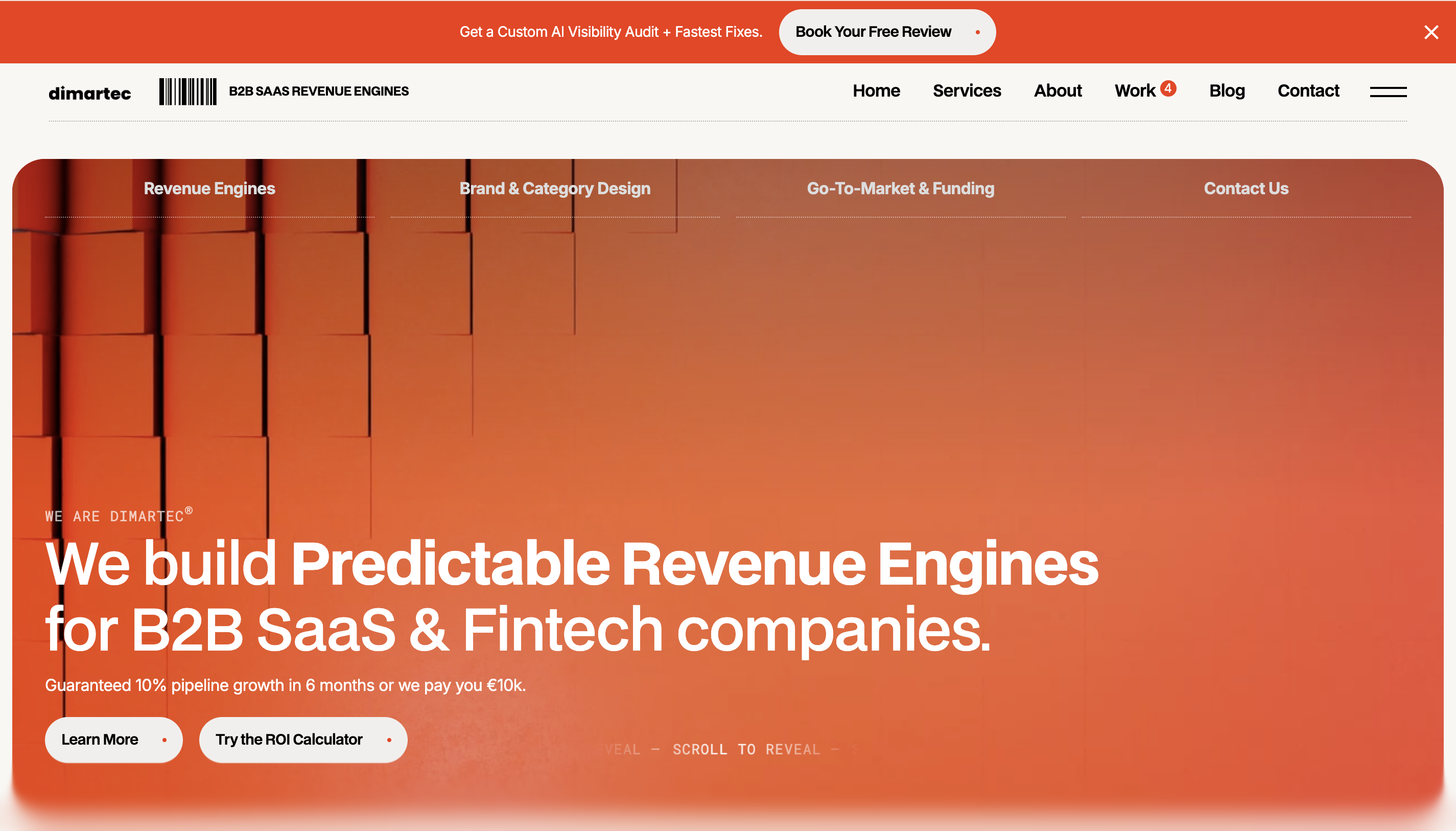
Best for: Post-PMF B2B SaaS and fintech at €2M–€10M ARR that want a full revenue engine run alongside a small in-house team, with one partner accountable for how the pieces fit
dimartec builds Revenue Engines for B2B SaaS and fintech companies in exactly this band. Its five services, Performance Paid Media, CRO, GEO, Lead Gen & Nurturing, and RevOps & Automation, are delivered by one team under one engagement. For a company whose marketing function is one or two people, that structure removes the coordination work that usually falls on them.
The in-house marketer stays in charge of direction and brand, while dimartec supplies the specialist depth a small team cannot hire all at once: a paid media strategist, a conversion specialist, a RevOps architect, and AI search expertise. Paid campaigns and landing pages are built together. Leads are scored and nurtured to a standard agreed with sales. Every source is tracked through to revenue, so the marketer goes into board meetings with figures the finance team recognises. GEO builds visibility in the AI tools buyers increasingly use to research software, a channel few small teams have the time to develop.
In a published example, dimartec built iDenfy's growth engine across paid search, CRO, and AI-optimised content as one system. In the first three months it produced €475k in qualified pipeline and €30k in closed revenue on a 77-day sales cycle.
The system is built for the client to own, so the in-house team grows into running it.
dimartec suits companies in this band when:
- The first marketing hire is stretched across too many channels to go deep in any
- Several agencies or freelancers are in place, and nobody connects their results
- The board wants marketing's contribution in revenue terms and the data is not there
- The company is preparing to hire a senior marketing leader and wants a working engine for them to inherit
Key services
- Performance Paid Media: Google, LinkedIn, and Meta measured by pipeline, not clicks
- CRO: pages and forms designed with the campaigns that feed them
- GEO: visibility in ChatGPT, Perplexity, and other AI search tools
- Lead Gen & Nurturing: scoring and nurture to a standard agreed with sales
- RevOps & Automation: tracking from first touch to closed revenue
Why dimartec stands out at €2M–€10M ARR
- Specialist depth a small team cannot hire at once, under one engagement
- One partner responsible for how channels connect
- Reporting in revenue terms from the start
- Built to be owned by the in-house team
Best fit: Companies across the band, particularly those with a lean marketing team and several channels that need to work as one.
2. Gripped
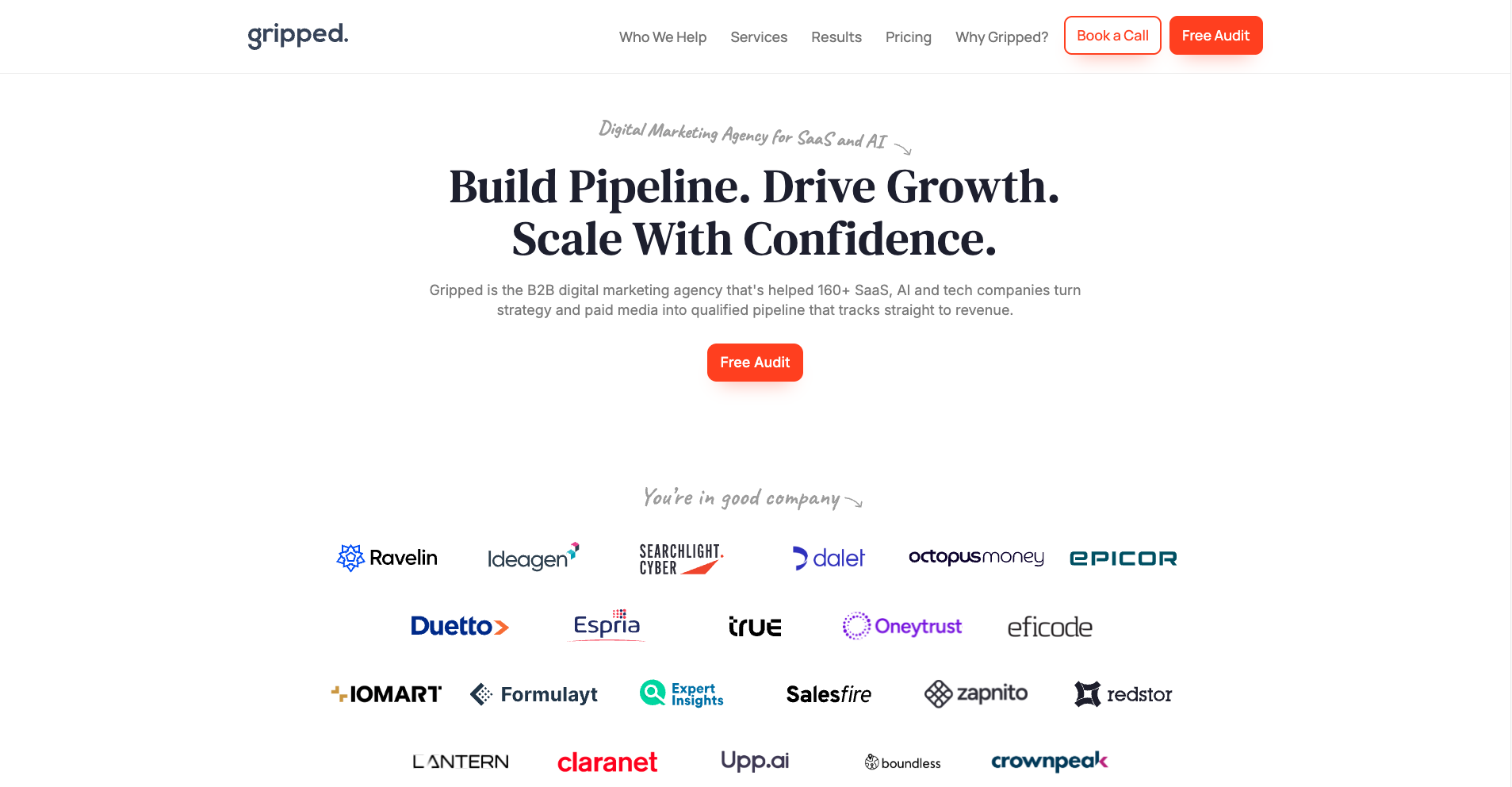
Best for: UK and European B2B SaaS companies wanting a specialist agency that knows the SaaS buying cycle and covers the main demand channels
Gripped is a London agency founded in 2017 that works only with SaaS, AI, and tech companies. It reports more than 160 clients, including Ideagen, Epicor, Ravelin, and Crownpeak, and describes its focus as SaaS companies between £2M and £50M ARR. Its founders, Steve Eveleigh and Ben Crouch, have worked in B2B SaaS since 2004.
Its services span demand generation, paid media, SEO, GEO, content, account-based marketing, and website design. For a company in the lower half of this band, that breadth from one SaaS-focused team means the in-house marketer can work with a single partner across several channels instead of assembling them separately. Clutch reviewers frequently mention its project management.
Gripped states that most clients invest £8,000 to £12,000 a month in agency fees for full-service demand generation, which gives companies a realistic benchmark. Some reviewers have noted that blog content could go deeper, which is worth discussing for companies relying heavily on technical content.
Key services
- Demand generation strategy
- Paid media and SEO
- GEO and AI search visibility
- Content and account-based marketing
- Website design and development
Why Gripped stands out at €2M–€10M ARR
- Works only with SaaS, AI, and tech
- Stated focus on the £2M to £50M ARR range
- Broad channel coverage from one team
- Transparent guidance on typical investment
Best fit: UK and European SaaS companies in the lower and middle parts of the band wanting a single specialist partner across demand channels.
3. The Growth Syndicate
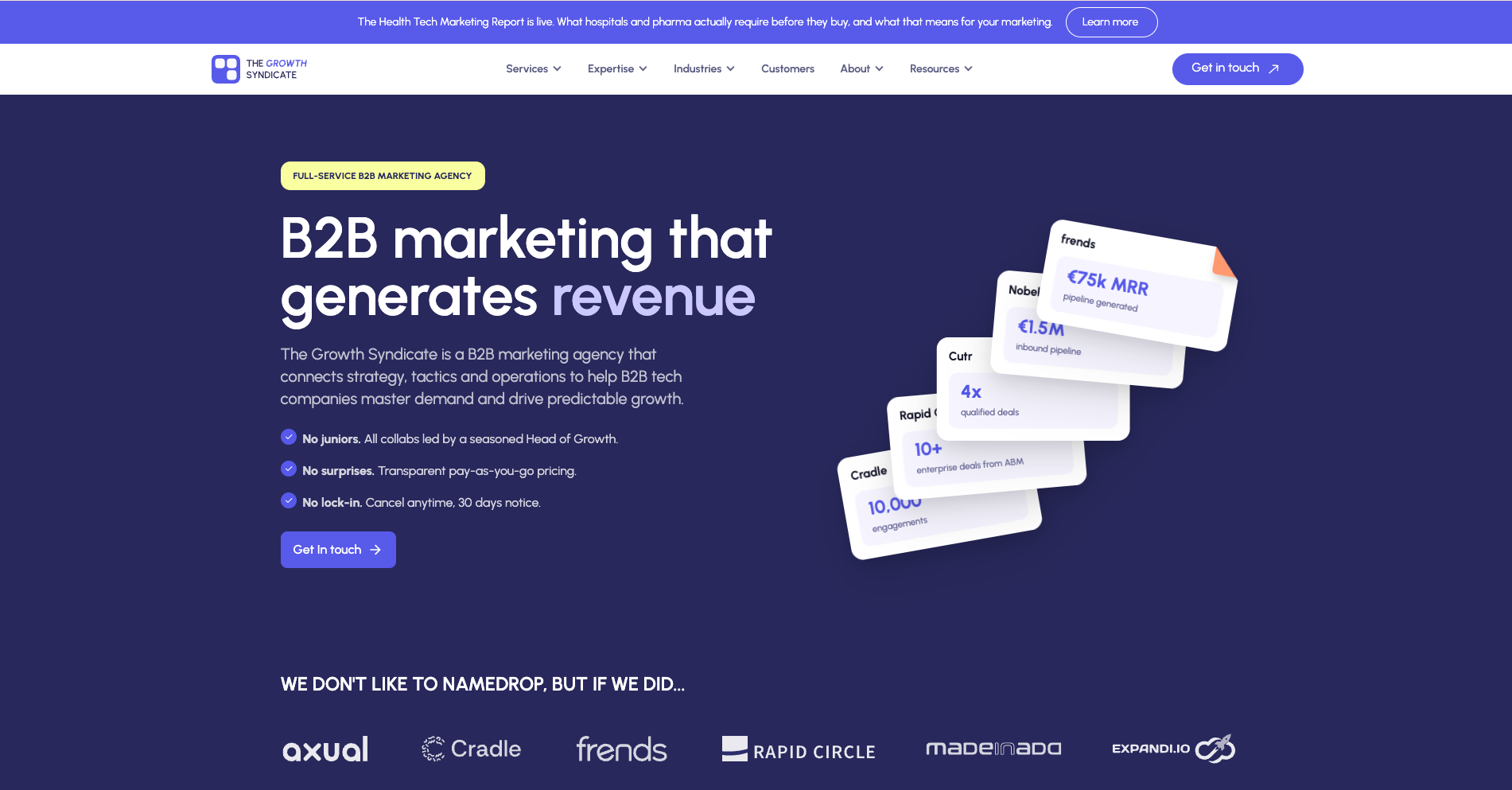
Best for: Companies in the lower half of the band that need senior growth leadership now and want to build their own team over the following months
The Growth Syndicate is an Amsterdam firm, with a New York presence, founded in 2024 by Ferdinand Goetzen, Clément Dumont, and Joliene van Grieken, experienced growth leaders from the Dutch tech scene. It works with B2B tech companies from roughly €1M to €100M ARR, and its SaaS clients include Axual, Frends, Software Improvement Group, and Expandi.
Its model is unusual and well suited to the start of this band. Every engagement is led by a senior Head of Growth, often in a fractional leadership role, supported by specialists for execution. The stated aim is to make itself unnecessary within three to nine months by helping the company hire and train its own growth talent. Pricing is pay-as-you-go, and clients can cancel from the first day with 30 days' notice.
For a company with one marketer and no senior leader, that combination supplies direction and execution at once, without a long contract. The trade-off is that the firm is young, and companies wanting a long-term outsourced function should know the model is built to step back.
Key services
- Fractional Head of Growth or CMO
- Growth strategy, ICP, and positioning
- Demand generation and account-based marketing
- Market expansion support
- Hiring and training of in-house growth talent
Why The Growth Syndicate stands out at €2M–€10M ARR
- Senior leadership on every engagement
- Designed to build in-house capability, then hand over
- Flexible pricing and no lock-in
- European base with named SaaS clients
Best fit: Lower-band companies without a senior marketing leader. Less suited to companies wanting a permanent outsourced team.
4. Ziggy
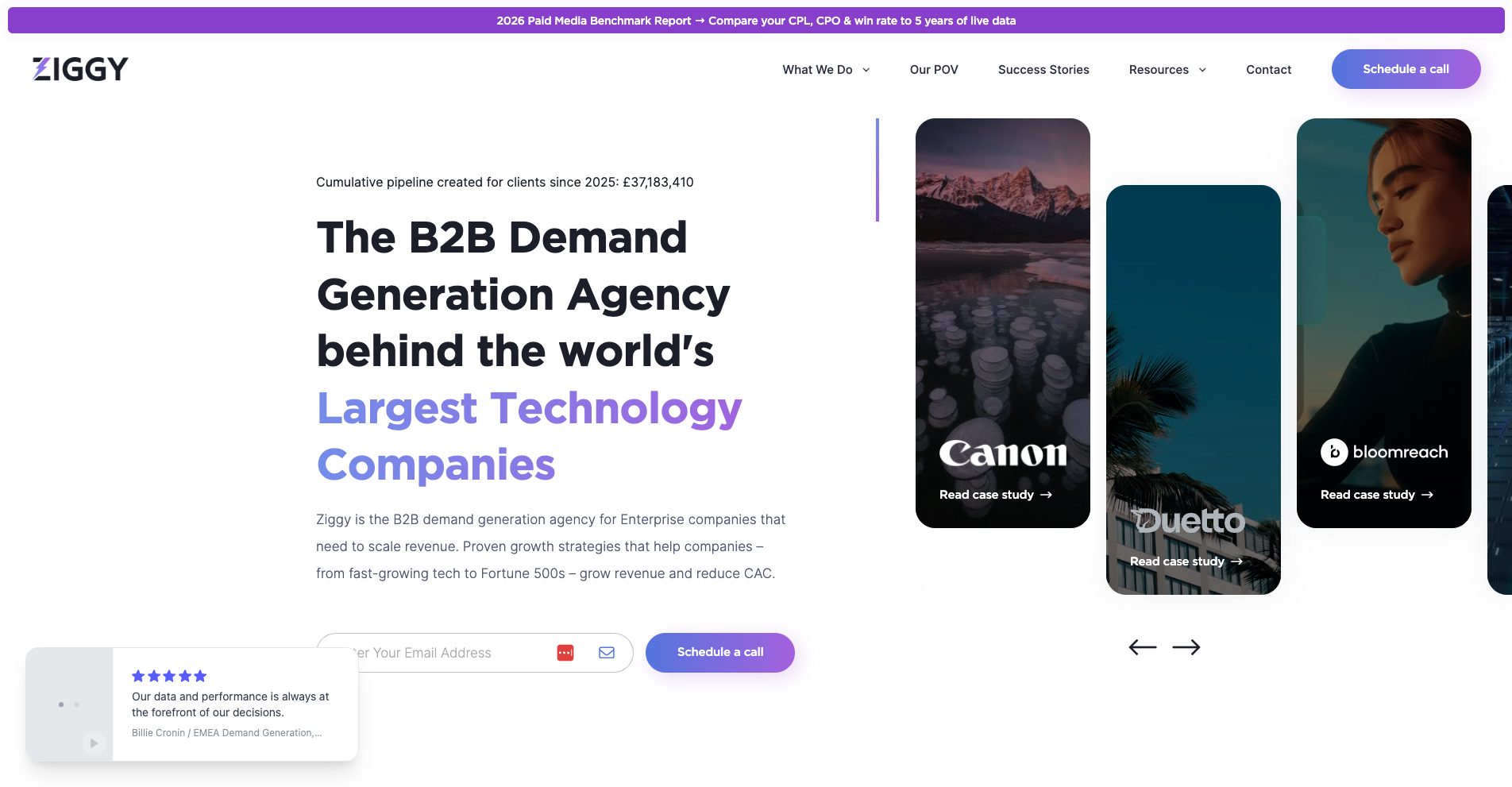
Best for: Companies in the upper half of the band ready to move from chasing lead volume to demand generation that answers for revenue
Ziggy is a London demand generation agency founded in 2020 that works with B2B SaaS, tech, and enterprise companies. It positions itself as revenue-first: helping clients reduce acquisition costs and shift from low-intent leads to high-intent prospects. Its services include research, go-to-market strategy, paid media, marketing automation, and growth marketing. Directory profiles list work with brands including Adobe, Stripe, and Canon Europe.
That focus suits companies near the top of the band. By €6M or €8M ARR, many SaaS companies have built a lead machine that produces volume but strains the sales team and inflates acquisition costs. Ziggy's emphasis on intent and revenue accountability addresses that directly. The agency also stresses that its team has worked on the client side, which shapes how it reports and communicates.
Directory listings put its minimum project size at about $10,000, and its client base leans towards mid-market and enterprise. Companies at the bottom of the band may find it more than they need.
Key services
- Go-to-market and demand strategy
- Paid media for B2B
- Marketing automation
- Account-based marketing
- Research and market intelligence
Why Ziggy stands out at €2M–€10M ARR
- Built around revenue accountability, not lead counts
- Senior strategists with client-side experience
- Experience with large technology brands
- Suited to the transition beyond volume-led marketing
Best fit: Upper-band SaaS companies whose lead volume is outgrowing its quality. Lower-band companies may be better served by a broader partner.
5. Velocity Partners
Best for: SaaS companies with complex or technical products whose growth is held back by unclear positioning and forgettable content
Velocity Partners is a B2B tech marketing agency founded in 2000, with offices in London and New York. Best known for content marketing and thought leadership, it now describes its offer as strategy, creative, and performance working together. In one published example, a brand campaign for Rockset helped marketing contribute $5M a year in pipeline, up 50% year on year, with half converting to sales.
Its relevance to this band is specific. Many SaaS companies reach €2M on the strength of a product that early customers understood through demos and conversations. To grow further, the company must explain itself to buyers who have never spoken to the founders. When the product is technical or the category is new, that explanation is the bottleneck, and better ads or more channels will not fix it. Velocity's strength is turning hard-to-explain products into clear, distinctive stories, then taking them to market.
It is a creative and strategic partner first. Companies whose main gap is paid media management or RevOps will need additional support.
Key services
- Positioning and messaging
- Content strategy and production
- Brand and demand campaigns
- Website copy and design
- Paid distribution
Why Velocity Partners stands out at €2M–€10M ARR
- Deep experience explaining complex B2B technology
- Distinctive creative work in a crowded category
- Published pipeline results from content-led campaigns
- Offices in London and New York
Best fit: SaaS companies across the band whose biggest barrier is that buyers do not quickly understand what they do. Less suited to companies whose positioning is already sharp.
Why dimartec Approaches This Stage Differently
The four other agencies each bring something a company in this band needs. Gripped offers broad SaaS-specific channel coverage. The Growth Syndicate supplies senior leadership and builds the team. Ziggy moves demand generation towards revenue accountability. Velocity Partners makes complex products understandable.
What each assumes, in different ways, is that someone inside the company will join their work to everything else. Gripped's campaigns need a CRM that reports them properly. Velocity's stories need paid media and pages to carry them. The Growth Syndicate's leader needs specialists to execute. At €2M to €10M ARR, the person expected to make those connections is usually the first marketing hire, who is also writing briefs, running the website, and preparing the board report.
dimartec is designed to take that weight off the in-house team. Paid media, conversion, AI search visibility, lead nurturing, and revenue reporting are built by one team against one definition of a good customer, so the marketer leads instead of coordinates. The system is handed to the client to run, which means the senior marketing leader who eventually arrives inherits a working engine instead of a collection of contracts.
See how the Revenue Engine works: https://www.dimartec.co.uk/services/revenue-engine
Three Things to Check Before Hiring a SaaS Marketing Agency
One: Ask how much of your marketer's time the engagement will need. Ask for a realistic weekly estimate of client-side hours for briefing, approvals, and meetings. If the answer would consume most of your in-house marketer's week, the agency is designed for a bigger team than you have.
Two: Ask who will actually do the work. Many agencies field senior people in the pitch and junior people afterwards. Ask to meet the day-to-day team and find out how long they have worked with SaaS companies at your revenue level.
Three: Ask what you will be able to do without them in a year. A good partner at this stage leaves the company stronger: clearer positioning, working systems, documented processes, and a team that understands them. If the answer is vague, the engagement may create dependence instead of capability.
Frequently Asked Questions
How much should a SaaS company at €2M–€10M ARR spend on marketing?
There is no fixed rule. Spending depends on growth targets, contract value, sales cycle length, and how efficiently the company already converts interest into customers. A more reliable approach is to work backwards from the revenue plan: how many new customers are needed, how many opportunities that requires, and what each opportunity can afford to cost. For agency fees specifically, UK SaaS-focused agencies quote around £8,000 to £12,000 a month for full-service demand generation.
Should we hire a marketing leader or an agency first?
It depends on whether the gap is direction or capacity. If nobody in the company owns marketing strategy, a senior leader, full-time or fractional, should come first so the agency has someone to work with. If strategy is clear but there are not enough hands or specialist skills to execute it, an agency fills the gap faster than hiring several specialists. Many companies in this band use both.
How long before an agency shows results?
Paid media and conversion work can show early signs within the first two or three months. Content, SEO, and AI search visibility take longer to build and then keep producing. Because B2B SaaS sales cycles often run for several months, closed revenue usually lags pipeline. Agree in advance which early indicators, such as qualified opportunities, will be used to judge progress.
Is a SaaS-specialist agency better than a general B2B agency?
Usually, at this stage. SaaS-specialist agencies understand subscription economics, trial and demo journeys, and the metrics boards ask about, so less time is spent explaining the basics. A general B2B agency can still be the right choice if it has strong, verifiable SaaS work at a similar revenue level.
Give Your Marketing Team a Partner, Not a Project
Between €2M and €10M ARR, a B2B SaaS company turns marketing from something the founders do into something the company relies on. The agency chosen in this period shapes whether the small in-house team spends its time leading or coordinating, and whether the company reaches €10M with an engine it understands or a set of contracts it depends on.
The Revenue Engine combines Performance Paid Media, CRO, GEO, Lead Gen & Nurturing, and RevOps & Automation, run by one team alongside yours and built for you to own.
See how the Revenue Engine works: https://www.dimartec.co.uk/services/revenue-engine