
The most expensive decisions in B2B SaaS marketing are made from wrong data. The channel that receives the biggest budget increase next quarter is the one that looks most efficient in the attribution report. The channel that gets cut is the one with the weakest attributed performance. If the attribution model is wrong, these decisions systematically misallocate spend: scaling the channel that appears efficient on a 30-day last-touch model and cutting the channel that is actually generating the demand that closes 90 days later. The consequence is not just a wrong report. It is a compounding budget allocation error that grows with every planning cycle that reads from the same broken system.
Broken attribution in B2B SaaS is not a tracking problem, though tracking failures contribute to it. It is a model problem: the attribution logic applied to the available tracking data is almost always wrong for the commercial reality of a B2B SaaS buying journey. The average B2B buyer engages 8 to 15 touchpoints before purchase. Dark funnel activity (LinkedIn posts, podcast mentions, community discussions, AI search research) accounts for 70% of pipeline influence and is invisible to ad platform attribution. GDPR consent requirements in European markets degrade cookie-based tracking for a significant proportion of visitors. And the 30-day attribution windows that most marketing platforms use by default capture approximately one sixth of a 180-day B2B SaaS sales cycle, systematically misattributing credit to the channels that close existing demand rather than the channels that create it.
After examining attribution infrastructure across more than 200 B2B SaaS revenue operations programmes, the finding is consistent. Companies that fix their attribution model first and then reallocate budget based on the corrected data see an average 14 to 36% improvement in cost per acquisition within the first year. The improvement does not come from better campaigns. It comes from spending more on the channels that were already producing closed revenue and less on the channels that were producing the last-touch credit. The attribution fix is the budget reallocation insight that every planning cycle has been missing.
This guide evaluates the five best RevOps agencies for fixing broken B2B SaaS attribution: the ones whose methodology identifies which of the four attribution failure modes is primary and builds the fix that connects marketing spend to closed revenue rather than to the nearest trackable event.
The Four Attribution Failure Modes in B2B SaaS
Broken attribution in B2B SaaS manifests in four distinct failure modes. Each requires a different fix, and applying the wrong fix to the wrong failure mode produces an attribution model that is different from the broken one but equally misleading.
Failure mode one: Wrong attribution window. The platform's default 30-day attribution window credits only the touchpoints that occurred within 30 days of a conversion event. For a B2B SaaS company with a 90-to-180-day sales cycle, this systematically credits the channels active at the bottom of the funnel (branded search, retargeting, direct) and misses the channels that generated the original awareness and consideration (content, community, podcast appearances, LinkedIn demand creation). The fix is extending attribution windows to cover the full sales cycle length and applying a multi-touch model that distributes credit across all touchpoints in that window.
Failure mode two: Last-touch model on a multi-stakeholder journey. Last-touch attribution assigns all revenue credit to the final touchpoint before conversion. In B2B SaaS, where the average buying committee has 8 to 10 members and the decision is influenced by touchpoints across multiple contacts at the same account, last-touch attribution ignores all but one member's final action. The company blog post that the CISO read six months before the purchase gets no credit. The LinkedIn ad that reached the CFO who then mentioned the product in a budget meeting gets no credit. The sales call that closed the deal gets all the credit, which tells the attribution model that sales calls cause purchases and tells it nothing useful about which marketing investments created the buying committee's awareness. The fix is account-level attribution that tracks engagement across multiple contacts at the same organisation, not contact-level attribution that scores each person independently.
Failure mode three: Dark funnel blindness. Approximately 70% of pipeline influence in B2B SaaS occurs in channels that ad platform pixels cannot see: LinkedIn organic posts, Slack community mentions, podcast appearances, word-of-mouth referrals, and AI search research in ChatGPT and Perplexity. When a buyer types the company name into Google after hearing about it on a podcast, the attribution model credits organic branded search. The podcast gets no credit, the budget for sponsorships gets cut, and the channel that actually created the intent is defunded. The fix is first-party attribution: asking customers in onboarding surveys and sales discovery how they first heard about the company, capturing the self-reported source as structured data, and weighting that data alongside tracked touchpoints.
Failure mode four: Tracking infrastructure failure. GDPR consent walls in European markets mean a significant proportion of visitors never generate tracking data. UTM parameters are stripped by email clients, link shorteners, and social sharing. Cross-device journeys fragment into separate sessions attributed to different sources. Identity resolution failures mean the same buyer appears as multiple anonymous visitors. The fix is server-side tracking that bypasses browser-level privacy restrictions, UTM governance that prevents link parameters from being lost at common break points, and identity graph solutions that stitch cross-device journeys into one account-level view.
What Fixed Attribution Actually Produces
Attribution is not the reporting layer of a revenue programme. It is the decision layer. A fixed attribution model changes three decisions that broken attribution has been making incorrectly.
The budget allocation decision. When the attribution model correctly identifies that content-generated demand produced 35% of closed revenue despite receiving 8% of the budget, and that paid retargeting produced 12% of closed revenue despite receiving 31% of the budget, the budget reallocation decision is obvious. The 14 to 36% cost-per-acquisition improvement that teams report after implementing correct multi-touch attribution is not from better campaigns. It is from stopping spend on channels that looked productive on the old model and increasing spend on channels that actually produced revenue.
The channel investment decision. When dark funnel attribution correctly captures that 40% of new customers first heard about the company through a podcast or a LinkedIn post that a specific person made, the investment in those channels is justified by revenue data rather than by intuition. Without dark funnel capture, the marketing team is making channel investment decisions about their highest-influence channels entirely from intuition, because those channels produce no trackable signal that the current attribution model can read.
The campaign continuation decision. When the attribution window is extended to 180 days, campaigns that look inefficient on a 30-day window often show strong performance at 90 and 180 days. A LinkedIn awareness campaign that produces no direct conversions in 30 days but influences 35% of the accounts that close in month four and five is not an inefficient campaign. It is an efficient campaign being measured on the wrong timeline. Without extended windows, these campaigns are cut before they compound, and the pipeline that would have arrived in month four and five does not arrive.
How We Chose These Agencies
- Failure mode specificity: Does the agency diagnose which of the four attribution failure modes is primary before proposing a fix, or does it apply a standard attribution solution regardless of which failure mode is causing the problem?
- CRM connection: Does the agency connect attribution to closed-won CRM data, or does it stop at platform-reported conversions that may not map to actual revenue?
- Dark funnel methodology: Does the agency include first-party and self-reported attribution alongside tracked touchpoints, or does it only address the trackable portion of the buyer journey?
- Window calibration: Does the agency calibrate attribution windows to the actual sales cycle length of each client, or does it apply default 30-day windows that systematically misattribute B2B SaaS revenue?
- Verified attribution outcomes: Named clients with specific budget reallocation decisions or cost-per-acquisition improvements attributable to the attribution fix, not general RevOps case studies with attribution language applied.
The 5 Best RevOps Agencies for Fixing Broken Attribution
1. dimartec
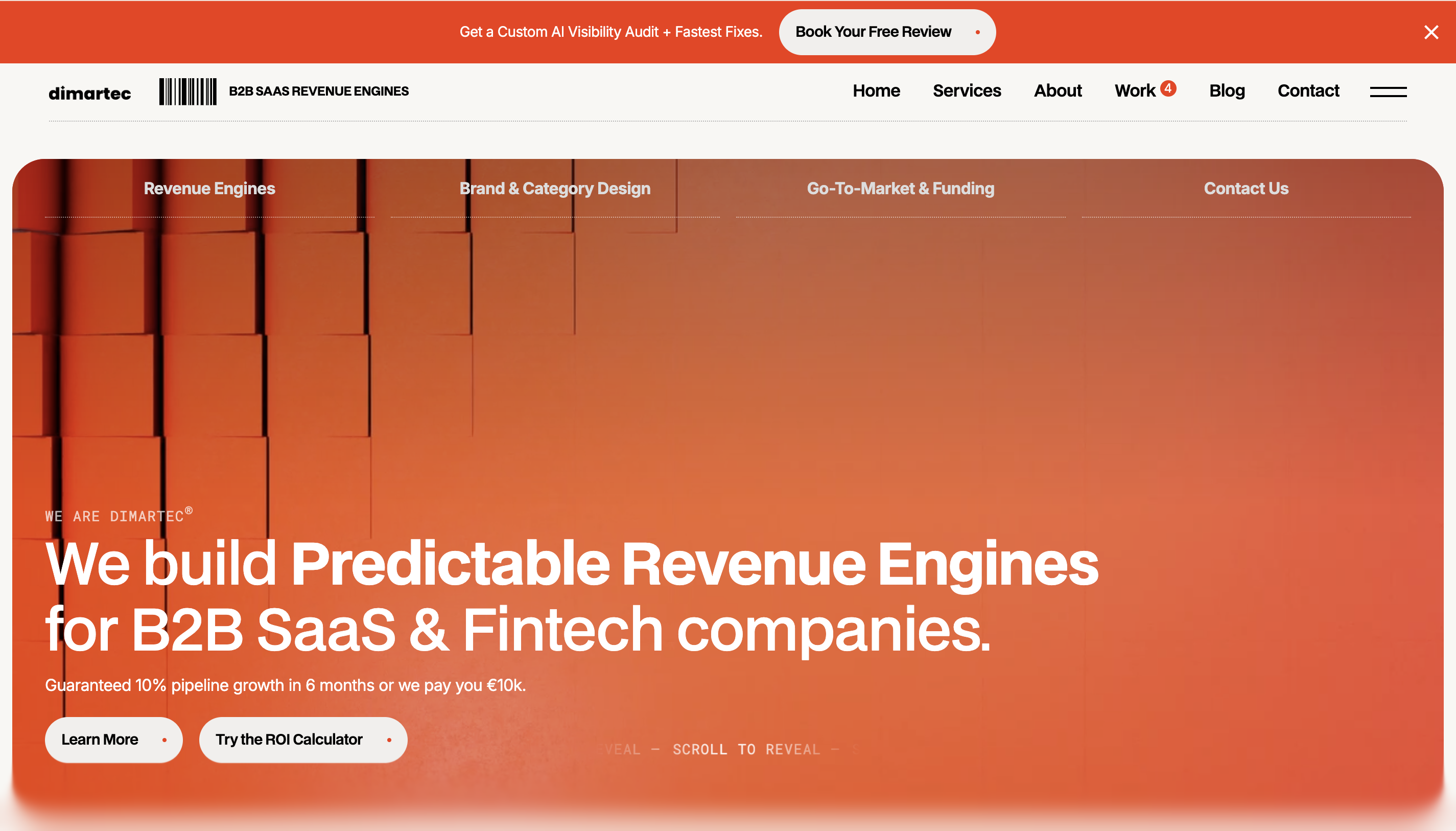
Best for: Post-PMF B2B SaaS and fintech at €2M–€10M ARR where attribution is broken across all four failure modes simultaneously: the window is wrong, the model is last-touch, the dark funnel is invisible, and the tracking infrastructure is degraded by GDPR consent walls
dimartec builds Revenue Engines for B2B SaaS and fintech companies. RevOps & Automation is one of five integrated services alongside Performance Paid Media, CRO, GEO, and Lead Gen & Nurturing. The attribution argument at dimartec is that fixing attribution in isolation from the channels generating the attributed spend produces a more accurate measurement of a programme that is still being optimised against the old wrong data. RevOps & Automation builds the attribution infrastructure from the first session, so the Performance Paid Media campaigns and the GEO programme they are running alongside generate data that the attribution model is designed to read correctly from the start.
Each of the four attribution failure modes is addressed by a specific component of the system. The window failure is fixed by connecting attribution to closed-won CRM data rather than to ad platform conversion windows: every closed deal is traced backward through the touchpoints that influenced it, regardless of how many days elapsed between first touch and close. The last-touch model failure is fixed by building account-level multi-touch attribution that distributes credit across all contacts at a buying account rather than assigning all credit to the last trackable contact before submission. The dark funnel blindness is addressed by building GEO alongside RevOps & Automation: when the brand appears in ChatGPT and Perplexity answers and the attribution model is designed to capture AI search-referred visitors, the dark funnel channel that standard attribution misses becomes at least partially visible. First-party attribution through onboarding and discovery survey fields captures the self-reported source data that completes the dark funnel picture. The tracking infrastructure failure is addressed through server-side integration that bypasses browser-level privacy restrictions for European markets, and through UTM governance that prevents parameter loss at common attribution break points.
The commercial consequence of this attribution architecture is that every budget decision the dimartec team makes is made from accurate revenue data. When Performance Paid Media recommends scaling a specific campaign, the recommendation is backed by attribution to closed-won ARR, not to last-touch form submissions. When GEO investment is justified, the justification cites the pipeline contribution from AI search-referred visitors, not the traffic count.
If any of the following apply, dimartec is worth a conversation:
- Marketing channels report different pipeline numbers from each other and from the CRM, and reconciling them before the board meeting requires manual work that produces a negotiated number rather than a system-generated one
- The paid channels with the highest spend receive the most credit in the attribution report, which is expected when last-touch attribution models credit the channels most active at the decision stage rather than the channels that created the consideration
- The company runs significant LinkedIn organic, podcast, or community presence but these channels show zero attribution credit, confirming dark funnel blindness rather than confirming they have no revenue influence
- GDPR consent wall acceptance rates are below 60%, meaning behavioural attribution data is structurally incomplete for a significant proportion of European visitors
Key services
- RevOps & Automation: account-level multi-touch attribution with extended windows calibrated to actual sales cycle length, first-party attribution capture through CRM fields, and server-side tracking for GDPR-constrained European markets
- Performance Paid Media: offline conversion data uploaded to Google and LinkedIn from closed-won CRM records, training platform algorithms against revenue rather than form fills
- GEO: brand visibility in ChatGPT, Perplexity, and Claude, with attribution infrastructure designed to capture AI search-referred visitors as a measurable channel
- Lead Gen & Nurturing: self-reported attribution capture in onboarding and discovery survey fields, feeding dark funnel source data into the multi-touch attribution model
- CRO: landing page conversion data integrated with the attribution model to show the conversion efficiency of each traffic source at the page level
Why dimartec stands out for fixing broken attribution
- Attribution is built from session one alongside the channels it is measuring: the data generated from the first campaign is the data the attribution model is designed to read correctly
- All four failure modes are addressed in one system: window calibration, account-level model, dark funnel first-party capture, and server-side tracking for GDPR contexts
- GEO creates a channel that standard attribution most consistently misses and builds the infrastructure to capture it simultaneously
- Revenue decisions from the first quarterly review are based on attribution to closed-won ARR, not on platform-reported proxy conversions
Best fit: Post-PMF B2B SaaS and fintech at €2M–€10M ARR where attribution has been broken for long enough that multiple planning cycles have been made from wrong data, and where the fix requires rebuilding the attribution architecture alongside the channels it measures rather than retrofitting it to data that was generated without attribution in mind.
2. GrowthSpree
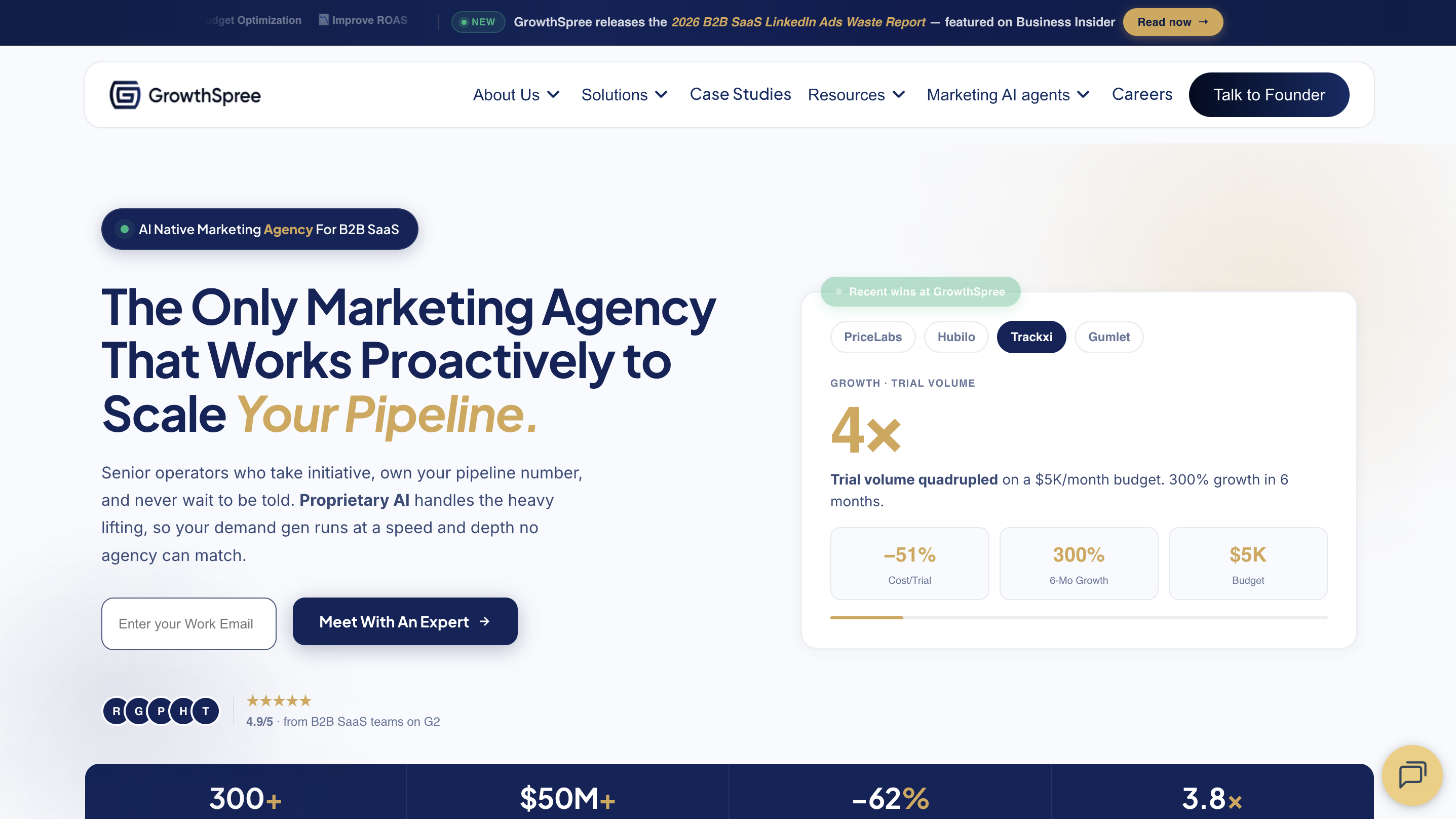
Best for: Series A–C B2B SaaS running paid acquisition on Google, LinkedIn, and Meta that need multi-touch pipeline attribution from month one, with extended attribution windows and offline conversion data uploaded to platforms to fix the 30-day window failure and the form-fill conversion signal problem
GrowthSpree is an AI-native GTM agency whose Model Context Protocol (MCP) infrastructure is specifically designed to fix attribution failure modes one and two for B2B SaaS companies running paid acquisition. The MCP connects Google Ads, LinkedIn Ads, Meta, HubSpot, GA4, and Search Console into a unified pipeline attribution layer that applies cohort ROAS at 90, 180, and 365-day windows rather than at the 30-day platform default. For B2B SaaS companies with sales cycles of 90 days or more, the 90-day and 180-day cohort ROAS figures frequently reveal that the channels appearing most efficient on 30-day windows are the least efficient across the full sales cycle, and vice versa.
Their offline conversion upload methodology addresses the conversion signal problem directly. Closed-won data from the CRM is uploaded to Google and LinkedIn as offline conversion events, providing both a more accurate attribution signal for campaign performance evaluation and a training signal for the platform algorithms that determine how paid spend is allocated. When the platform knows which ad clicks produced closed revenue six months after the click, it reallocates budget toward the audiences and creative that produced revenue rather than toward the audiences that produced cheap form fills.
Their dark funnel integration captures self-reported attribution through structured survey fields and feeds that data alongside tracked touchpoints into the multi-touch attribution model. Independent 2026 evaluations name GrowthSpree as the strongest attribution methodology available from a paid acquisition and GTM agency, specifically for B2B SaaS companies that need both the channel execution and the attribution infrastructure managed by the same team.
Key services
- MCP attribution: unified pipeline reporting across all paid channels connected to HubSpot pipeline stages and closed-won data
- Cohort ROAS at 90/180/365-day windows addressing the 30-day window failure mode
- Offline conversion upload: closed-won CRM data uploaded to Google and LinkedIn as conversion events
- Dark funnel integration: self-reported attribution survey capture alongside tracked touchpoints
- First-touch, last-touch, linear, and position-based multi-touch model comparison in the same dashboard
Why GrowthSpree stands out for fixing broken attribution
- MCP infrastructure extends attribution windows to 90, 180, and 365 days, systematically revealing the revenue contribution of channels that the 30-day default window misses
- Offline conversion upload fixes the conversion signal failure that causes platform algorithms to optimise toward form fills rather than toward the audiences that produce revenue
- Channel execution and attribution managed by the same team: the campaigns generating the data are designed alongside the attribution model reading it
- First-party dark funnel capture through structured survey fields completes the attribution picture for the portion of pipeline influence that platform tracking cannot see
Best fit: Series A–C B2B SaaS at €2M–€20M ARR running paid acquisition across multiple platforms where the primary attribution failure is the 30-day window combined with form-fill conversion signals, producing planning cycles that consistently undervalue demand creation channels and overvalue demand capture channels.
3. Elefante RevOps

Best for: B2B SaaS and technology companies that need attribution accurate enough to quality-weight their pipeline coverage ratio: connecting each pipeline opportunity to its source channel and applying the historical close rate of that channel to produce a revenue forecast the board can trust
Elefante RevOps is a RevOps consultancy whose pipeline health metric practice requires attribution that is accurate at the channel level, not just at the aggregate programme level. Their specific attribution contribution is in the quality-weighting of pipeline coverage: when they calculate pipeline coverage ratio, they weight each opportunity by the historical close rate of the source channel that produced it. A coverage ratio of 3.2x built primarily from channels with 55% historical close rates is substantially different from a coverage ratio of 3.2x built primarily from channels with 28% historical close rates. Without account-level channel attribution, both look the same on a pipeline dashboard. With it, the first justifies confidence in the forecast and the second requires immediate top-of-funnel action.
This quality-weighted attribution requirement forces a specific level of attribution accuracy: each pipeline opportunity must be correctly attributed to its primary source channel at the account level, with the attribution window covering the full sales cycle rather than the last 30-day period. For companies whose attribution has been producing inflated coverage ratios by attributing opportunities to high-close-rate channels that did not actually generate them, the correction that Elefante RevOps' attribution audit produces frequently reveals that the actual pipeline health is weaker than the dashboard has been indicating.
Their full-funnel attribution work connects marketing activity to pipeline stage progression and closed ARR, making the revenue contribution of each funnel stage and each source channel visible in the same reporting view that the board uses for quarterly reviews.
Key services
- Pipeline health metric design with channel-level attribution: coverage ratio, velocity, and stage conversion rate connected to source attribution
- Attribution audit: identifying which attribution failure modes are producing incorrect channel credit assignments
- Full-funnel attribution connecting marketing touchpoints to pipeline stage progression and closed ARR
- Quality-weighted pipeline coverage: historical close rate by source channel applied to current pipeline for revenue-accurate forecasting
- Attribution reporting aligned to board review format
Why Elefante RevOps stands out for fixing broken attribution
- Quality-weighted pipeline coverage is the most commercially consequential application of correct attribution: the board forecast is only accurate when the pipeline coverage ratio reflects the historical close rate of the channels that produced it
- Attribution audit as a first deliverable identifies which failure mode is producing incorrect credit assignments before any fix is implemented
- Full-funnel stage attribution shows where attribution failures are concentrated: most broken attribution is worse at the top of the funnel than at the bottom, because the channels active at the top produce fewer trackable signals
- Revenue-accurate forecasting requires correct attribution as its foundation: Elefante RevOps builds both simultaneously rather than treating them as separate projects
Best fit: B2B SaaS and technology companies whose pipeline coverage ratio looks healthy and whose forecast consistently misses, indicating that the pipeline quality the coverage ratio implies is not the pipeline quality the sales team is actually working, and that the root cause is attribution errors inflating the apparent quality of the channel mix.
4. RevPal

Best for: High-growth B2B SaaS with CRM debt and attribution gaps needing embedded senior RevOps leadership to rebuild tracking infrastructure, UTM governance, and CRM data architecture as one project rather than as separate workstreams that each leave gaps the other does not fill
RevPal is a RevOps-as-a-Service firm providing fractional RevOps director-level leadership alongside full-stack execution. Their specific attribution contribution is in the embedded leadership model: the most common reason attribution rebuilds fail is that the tracking infrastructure, CRM data architecture, and reporting layer are treated as separate projects assigned to separate people or vendors, producing a system where each component is technically correct and the connections between them do not work. RevPal's fractional director model means one senior operator owns the full attribution rebuild: UTM governance, CRM field mapping, offline conversion upload, and the reporting layer that connects all three are designed as one architecture rather than as three separate deliverables that someone is expected to integrate.
Their AI workflow development capability is specifically relevant to attribution in 2026: pipeline risk flagging from accurate attribution data, deal health scoring from multi-touch engagement data, and forecast anomaly detection from attribution variance are all more reliable when the underlying attribution model is correct. RevPal builds the attribution foundation that makes these AI applications accurate rather than applying AI applications to attribution data that is still broken.
CRM-agnostic capability across HubSpot, Salesforce, and Attio reduces the risk that attribution rebuild recommendations are shaped by the agency's tool preference rather than the client's infrastructure. Attribution architecture decisions (whether to implement UTM tracking in HubSpot workflows or in a standalone tracking layer, for example) should be made based on the client's existing infrastructure and team capability, not based on which platform the agency has the most implementation hours in.
Key services
- Fractional RevOps director leadership: embedded senior ownership of the full attribution rebuild
- UTM governance framework: naming conventions, enforcement rules, and audit processes preventing parameter loss at common break points
- Tracking infrastructure audit and remediation: identifying and fixing the specific tracking failures producing attribution gaps
- CRM data architecture aligned to attribution requirements: field mapping, integration configuration, and offline conversion upload
- AI workflow development building on correct attribution data: pipeline risk flagging, deal health scoring, and forecast anomaly detection
Why RevPal stands out for fixing broken attribution
- Embedded director model prevents the integration gap that occurs when tracking infrastructure, CRM architecture, and reporting are rebuilt by separate vendors
- UTM governance as a maintained operational competency: the UTM framework is enforced and audited on an ongoing basis rather than configured once and left to drift
- CRM-agnostic approach across HubSpot, Salesforce, and Attio means attribution architecture decisions are made for the client's infrastructure rather than for the agency's tool preference
- AI workflows built on correct attribution data produce reliable pipeline risk signals rather than AI-assisted analysis of the same wrong data the team was already reading
Best fit: High-growth B2B SaaS with significant CRM debt where the attribution problem is compounded by underlying tracking infrastructure failures, and where the fix requires an embedded senior operator who can own the full rebuild across UTM governance, CRM architecture, and reporting rather than coordinating between separate vendors each responsible for one component.
5. Understory Agency

Best for: B2B SaaS that need attribution fixed as the primary RevOps priority, with UTM enforcement, ad-platform integration, outbound sync to contact records, and self-reported attribution capture producing a multi-touch revenue report that the CFO can interrogate
Understory Agency is an attribution-first RevOps practice that makes the attribution architecture question the first evaluative criterion for any RevOps engagement. Their published agency evaluation framework for RevOps asks one specific attribution question before any other: "Who owns attribution end to end?" and specifies that the correct answer names the mechanism explicitly: UTM enforcement, ad-platform integrations, outbound sync into contact records, and multi-touch reporting the CFO can interrogate. An agency that cannot answer with those specifics does not have the attribution capability the engagement will require.
Their methodology distinguishes between the four attribution failure modes described above and addresses each through a specific technical implementation. UTM enforcement protocols prevent parameter loss at email clients, link shorteners, and social sharing. Ad-platform integrations connect Google Ads, LinkedIn Ads, and Meta directly to the CRM attribution model rather than relying on pixel-based cross-domain tracking that breaks under GDPR consent requirements. Outbound sync populates contact records with the outbound touch data that most CRMs leave as freetext notes, making SDR outreach attributable to the pipeline it influences. Self-reported attribution fields in onboarding surveys and sales discovery forms capture the dark funnel sources that no tracking pixel can see.
Their flat-retainer model and documented methodology provide the commercial accountability structure that attribution rebuilds require: the engagement scope is defined, the deliverable is specified as a working multi-touch attribution model, and the fee is not tied to the complexity of the CRM configuration or the number of integrations required.
Key services
- UTM enforcement framework: naming conventions, governance rules, and automated audit for common break points
- Ad-platform integrations: direct CRM connection for Google Ads, LinkedIn Ads, and Meta bypassing pixel-based tracking
- Outbound contact sync: SDR touch data populated into CRM contact records as attributable touchpoints
- Self-reported attribution: onboarding and discovery survey field design capturing dark funnel source data
- Multi-touch revenue reporting: CFO-interrogable attribution report connecting all tracked and self-reported sources to closed revenue
Why Understory Agency stands out for fixing broken attribution
- Attribution-first practice: the attribution rebuild is the primary engagement deliverable rather than a component of a broader RevOps project that may or may not get to attribution by month six
- UTM enforcement as an ongoing operational discipline: the governance framework is maintained rather than configured once and left to accumulate exceptions
- Outbound sync makes SDR outreach attributable as a distinct channel rather than invisible in the attribution model alongside the paid and organic channels it frequently supports
- Self-reported attribution capture closes the dark funnel gap that all tracking infrastructure leaves open, complementing tracked data with first-party source information from the buyers themselves
Best fit: B2B SaaS that have identified broken attribution as their primary RevOps priority and need a specialist agency whose first delivery is a working multi-touch attribution model rather than a broader RevOps engagement where attribution is one of several workstreams competing for bandwidth.
Why dimartec Fixes Attribution Differently
Every agency on this list addresses a specific attribution failure mode. GrowthSpree extends attribution windows to 90, 180, and 365 days and uploads offline conversion data to fix the window failure and the platform conversion signal problem. Elefante RevOps produces quality-weighted pipeline coverage that requires channel-level attribution accurate enough to apply historical close rates to current opportunities. RevPal provides the embedded senior leadership that prevents the integration gaps that attribution rebuilds typically produce when multiple vendors own different components. Understory Agency addresses attribution as the primary RevOps deliverable rather than as a component that competes with other RevOps priorities for time and bandwidth.
Each of them fixes attribution within the scope they are accountable for. None of them generates the data the attribution model is being built to read. When RevPal builds a correct CRM attribution architecture and the paid campaigns generating the attributed data are managed by a separate agency that does not upload offline conversion data to the platform algorithms, the attribution model is correct and the campaigns are still optimising against form fills. When GrowthSpree's MCP produces accurate 180-day cohort attribution and the CRO team managing the landing pages is a separate vendor whose conversion events are not integrated into the MCP, the 180-day attribution is accurate for the campaign data and blind to the page-level conversion events that determine which of those campaigns actually produces qualified leads.
dimartec generates the data and builds the attribution model that reads it simultaneously. Performance Paid Media, CRO, GEO, and Lead Gen & Nurturing all generate the revenue-connected data that RevOps & Automation attributes. The offline conversion upload to Google and LinkedIn is automatic because the paid campaigns and the CRM are managed by the same team. The CRO conversion events are integrated into the attribution model because the page and the campaign are designed by the same people. The GEO programme and the attribution model that captures AI search-referred visitors were built together. Attribution works correctly from the first session because the channels generating the data were always intended to be attributed.
See how the Revenue Engine works: https://www.dimartec.co.uk/services/revenue-engine
How to Choose the Right Agency for Fixing Attribution
Diagnose which failure mode is primary before evaluating agencies
The wrong-window failure requires extended cohort attribution. The last-touch model failure requires account-level multi-touch implementation. Dark funnel blindness requires first-party survey capture and self-reported attribution. Tracking infrastructure failure requires UTM governance, server-side tracking, or identity resolution. Ask any agency you evaluate: which of these four is causing the largest attribution error in our current model? If the agency cannot diagnose without a paid discovery engagement, it is applying a standard attribution solution rather than a diagnosis-first approach.
Require the attribution model to connect to closed-won CRM data, not to form submissions
The only attribution model useful for budget allocation in B2B SaaS connects to closed-won revenue as the outcome. An attribution model that connects to MQL, demo request, or form fill is an attribution model of the marketing programme's activity, not of its commercial output. A channel that produces 40% of form fills and 8% of closed revenue is being measured as efficient when it is commercially inefficient. Require any attribution fix to include closed-won CRM integration as a non-negotiable output.
Assess dark funnel methodology before tracked channel methodology
Every attribution agency has a tracked channel solution. The differentiating question is how they handle the 70% of pipeline influence that tracking cannot see. Ask specifically: how do you capture attribution credit for LinkedIn organic posts, podcast appearances, community mentions, and AI search research? If the answer is limited to adding UTM parameters to links (which cannot tag organic mentions or verbal references), the dark funnel will remain invisible after the attribution fix. First-party survey capture and self-reported attribution fields in the CRM are the only available methodology for the portion of the buyer journey that tracking infrastructure cannot reach.
Frequently Asked Questions
What does broken attribution actually cost a B2B SaaS company?
The direct cost is the budget misallocation that follows from wrong attribution data. Teams implementing correct multi-touch attribution report 14 to 36% cost-per-acquisition improvement and 19% average ROI lift in the first year. The majority of this improvement comes not from better campaigns but from stopping spend on channels that looked productive on the broken model and increasing spend on channels that were already producing closed revenue without receiving proportional budget. The indirect cost is every planning cycle that made headcount, technology, and channel investment decisions from the wrong baseline.
Why does standard multi-touch attribution still fail in B2B SaaS?
Standard multi-touch attribution fails in B2B SaaS for two reasons that most implementations do not address. First, the data going in is wrong: the buyer journey happens predominantly in channels that tracking pixels cannot see, making any model that relies only on tracked touchpoints systematically biased toward the trackable channels. Second, the window is too short: a 30-day or 90-day attribution window covers a fraction of the 90-to-180-day average B2B SaaS sales cycle, systematically misattributing credit to the bottom-of-funnel channels that are active at conversion rather than the top-of-funnel channels that created the awareness months earlier.
How long does it take to fix broken attribution in B2B SaaS?
UTM governance and basic CRM attribution integration can be implemented in four to six weeks. Offline conversion upload to Google and LinkedIn typically takes two to four weeks to configure and four to six weeks to produce enough conversion data for the platform algorithms to begin responding. Extended attribution window analysis requires one full sales cycle (90 to 180 days) of clean data before the cohort results are statistically meaningful. A complete attribution model where all four failure modes have been addressed and the data is generating reliable budget allocation insights typically requires two full sales cycles to validate.
Build Attribution That Changes Decisions
Attribution is not a reporting project. It is the foundation of every marketing budget decision, every channel investment, and every planning cycle. A marketing programme running from correct attribution is compounding: each planning cycle makes better allocation decisions than the last because the data it is reading reflects what is actually driving revenue. A programme running from broken attribution is also compounding: each planning cycle makes the same systematic mistakes as the last because the data it is reading is wrong in the same direction.
The Revenue Engine connects Performance Paid Media, CRO, GEO, Lead Gen & Nurturing, and RevOps & Automation into one system so the attribution model reads the data generated by all five services from the start, the offline conversion upload connects every closed deal to the campaign that influenced it, the dark funnel capture brings first-party source data into the multi-touch model, and the board receives attribution to closed-won ARR rather than attribution to the nearest trackable proxy.
See how the Revenue Engine works: https://www.dimartec.co.uk/services/revenue-engine





.png)

















































.png)
.png)
.png)
.png)
.png)
.png)
.png)
.png)
.png)
.png)