
Here is a test for any SaaS leadership team. Take your best quarter of the last two years and ask whether you could produce it again, deliberately, starting on Monday. Not hope for it. Produce it.
Most teams cannot. The quarter was good because one large deal landed, or a single rep had a run, or a conference went well, or the founder called in a favour. Those things are revenue. They are not a go-to-market motion. A motion is something you can describe step by step, hand to a new hire, fund with a known amount, and expect a known return from.
After analysing go-to-market performance across more than 200 B2B SaaS accounts, the dividing line between companies that compound and companies that lurch is rarely the product or the market. It is whether growth has been turned into a procedure. The compounding companies can name the segment they win in, the channel that reaches it, the conversion rate at every stage, and the cost of adding one more customer. The others have a strategy deck and a list of things that worked once.
This guide looks at five GTM agencies for SaaS through that lens. It asks which of them leave a company with a motion it can rerun, and which leave it with a successful campaign.
What Repeatable Revenue Growth Actually Means
Repeatable revenue growth is growth that comes from a known cause. If the same inputs are applied next quarter, the same result follows, within a margin the company understands. It is a narrower idea than predictable revenue, which can be achieved by forecasting an erratic business carefully. Repeatability is a property of the motion itself.
Four conditions have to hold before growth can be called repeatable.
A segment where you win for the same reason each time. Not a broad ideal customer profile, but a specific group of companies with a shared problem, where the win rate is steady and the reasons for winning can be written in two sentences. Growth spread thinly across many customer types depends on improvisation in every deal.
A channel with known economics. At least one way of reaching that segment where the cost of producing an opportunity is stable from month to month. Referrals and founder networks produce excellent customers and fail this condition, because nobody can decide to double them.
A sales process that survives a change of salesperson. If results fall when a particular rep leaves, the process lived in that person. A repeatable process is one a competent new hire can follow and reach quota with in a known ramp time.
Stage conversion that holds. When the rate at which leads become opportunities and opportunities become customers stays within a narrow band, revenue becomes a function of input. When those rates swing, no amount of activity planning will make the outcome reliable.
A company meeting all four can answer the question every investor eventually asks: what happens if we give you more money? A company missing any one of them is guessing.
Why Repeatability Changes What You Should Ask of a GTM Agency
Most agencies are hired to produce a result: more pipeline, a successful launch, a better quarter. Judged that way, an agency can succeed while leaving the client no more capable than before. The pipeline arrived, but the reasons it arrived stayed with the agency.
Repeatability sets a harder brief. The deliverable is not the outcome but the ability to produce it, and that ability has to end up inside the company. Three consequences follow.
The work has to be written down. A motion that exists only in the heads of the people running it cannot be rerun by anyone else. Segment definitions, messaging, qualification rules, sequences, and stage criteria all need to exist as documents and as system configuration.
The work has to be measured stage by stage. A total at the end of the quarter cannot tell you which part of the motion worked. Repeatability depends on knowing the conversion rate at each step, so that a shortfall can be traced to its cause and corrected.
The agency has to become less necessary over time. This is the uncomfortable one. Growth that stops when a retainer ends was never the client's motion. An agency suited to this brief plans its own handover from the first month.
GTM support also comes in three forms, and they are not interchangeable. Advisory firms design the motion. Enablement firms equip people to run it. Execution agencies run parts of it themselves. A company needs to know which of those it lacks. The five below cover all three, and each entry says which.
How We Chose These Agencies
- Codification: Does the agency leave behind a documented method, playbook, or system, or only results?
- Stage-level measurement: Is performance tracked at each step from first touch to revenue, so that a weak step can be found?
- Transfer: Is there an explicit route by which the client team takes over, through training, documentation, or handover of the system?
- Breadth: Does the work connect marketing, sales, and customer success, or does it improve one function and leave the joins untouched?
- A stated method: Can the agency explain how it works in terms specific enough to be checked, instead of pointing to outcomes alone?
None of the five does everything. Each profile is clear about which part of a repeatable motion the agency builds and which part it leaves to others.
The 5 Best GTM Agencies for SaaS for Repeatable Revenue Growth
1. dimartec
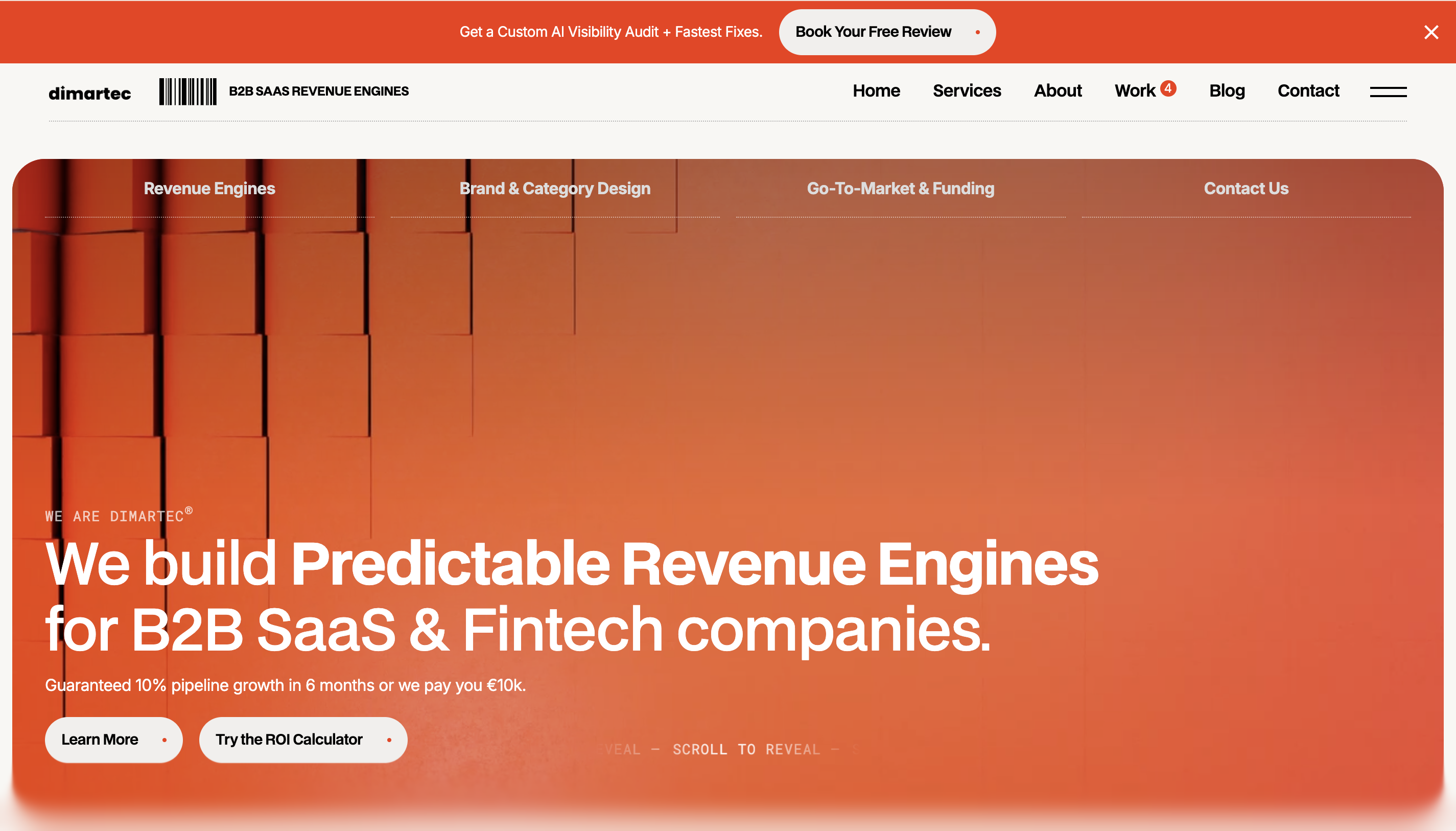
Best for: Post-PMF B2B SaaS and fintech at €2M–€10M ARR whose growth so far has come from the founder, a few strong reps, or one channel, and who need a go-to-market motion that keeps working when any one of those changes
dimartec builds Revenue Engines for B2B SaaS and fintech companies. A Revenue Engine brings five services into one programme: Performance Paid Media, CRO, GEO, Lead Gen & Nurturing, and RevOps & Automation. The purpose of combining them is repeatability. A go-to-market motion breaks at the joins between functions, where an ad promises one thing and the landing page another, or where marketing qualifies a lead that sales would never accept. Putting every stage under one team working from one customer definition removes those breaks.
Each service supplies one of the conditions that repeatable growth depends on. Performance Paid Media and GEO provide channels whose cost per opportunity can be measured and scaled on purpose. CRO stabilises the rate at which visitors become leads. Lead Gen & Nurturing applies a single qualification standard, so the leads reaching sales are consistent in quality from one month to the next. RevOps & Automation records conversion at every stage and attributes closed revenue to its source, which is what turns the motion from a belief into a set of numbers.
The engine is built to be owned by the client. Process, scoring, and routing sit in the client's systems, are documented, and are handed over, so the motion does not leave with the agency.
dimartec fits when:
- A large share of new revenue traces back to the founder's network, one salesperson, or a single channel
- Good quarters and bad quarters happen, and the team cannot say with confidence what caused either
- Marketing and sales each have a process, but nobody has designed the handover between them
- Investors are asking what an extra euro of go-to-market spend would return, and the answer is an estimate
Key services
- Performance Paid Media: paid acquisition on Google and LinkedIn measured by cost per SQL and pipeline, giving a channel that can be scaled deliberately
- GEO: visibility in AI search tools such as ChatGPT and Perplexity, building a second source of demand that does not depend on spend
- CRO: landing pages and demo flows optimised so that conversion is steady and known
- Lead Gen & Nurturing: scoring, nurture, and qualification rules agreed with sales and applied consistently
- RevOps & Automation: stage-by-stage conversion tracking, attribution to closed-won, and CRM rules that hold the process in place
Why dimartec stands out for repeatable revenue growth
- Covers the whole path from first touch to closed-won, so repeatability is not lost at a handover between suppliers
- Every stage is measured, which lets a shortfall be traced to a specific step
- Designed for the €2M–€10M ARR stage, when growth has to move from individuals to a system
- The engine is handed to the client team
Best fit: Post-PMF B2B SaaS and fintech at €2M–€10M ARR with proven demand and uneven results, looking for one accountable partner to turn what has worked into something they can run again.
2. Winning by Design
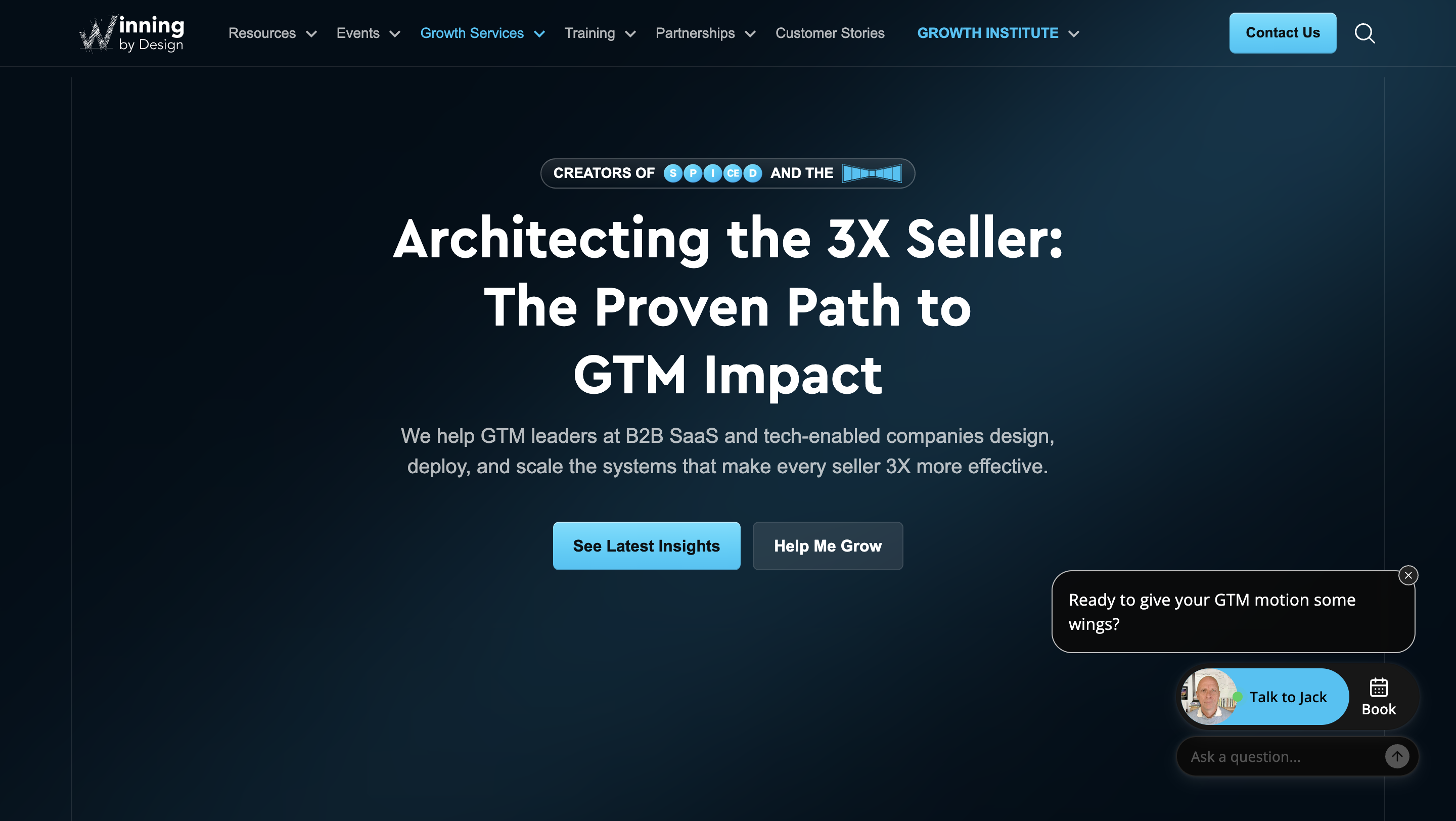
Best for: Leadership teams that need marketing, sales, and customer success working to one design before they invest further in any of them
Winning by Design is a consultancy devoted to recurring revenue businesses. Its central idea, Revenue Architecture, treats revenue as something to be designed with the rigour of an engineering discipline. Two of its tools are widely known in SaaS: the Bowtie, which extends the traditional funnel past the sale to cover onboarding, retention, and expansion, and SPICED, a framework for diagnosing a customer's situation and qualifying an opportunity.
Its relevance to repeatability is direct. A process cannot be repeated until it has been defined, and in many SaaS companies each function has defined its own part in isolation. Winning by Design gives all three customer-facing teams one model of the lifecycle, with shared stage names, shared metrics, and a shared way of talking to customers. Because recurring revenue is earned after the sale as much as before it, the inclusion of customer success matters: growth that is won and then churned is not repeatable in any useful sense.
This is advisory and training work. Winning by Design teaches the model and helps a company adopt it. It does not run campaigns or configure systems.
Key services
- Revenue Architecture design
- Bowtie lifecycle model and metrics
- SPICED qualification and diagnosis framework
- Sales and customer success playbooks
- Training programmes for revenue teams
Why Winning by Design stands out for repeatable revenue growth
- Supplies the common definitions that every other part of a repeatable motion relies on
- Treats retention and expansion as part of go-to-market, not as a separate concern
- Its frameworks are in wide use, so new hires often arrive already familiar with them
- Training leaves the capability with the client's own people
Best fit: Companies whose teams work hard in different directions and lack a shared model. It needs to be followed by implementation, and will feel abstract to a team whose immediate need is more pipeline.
3. GTM Partners
Best for: Executive teams that know growth has become unreliable and cannot agree on which part of the go-to-market is responsible
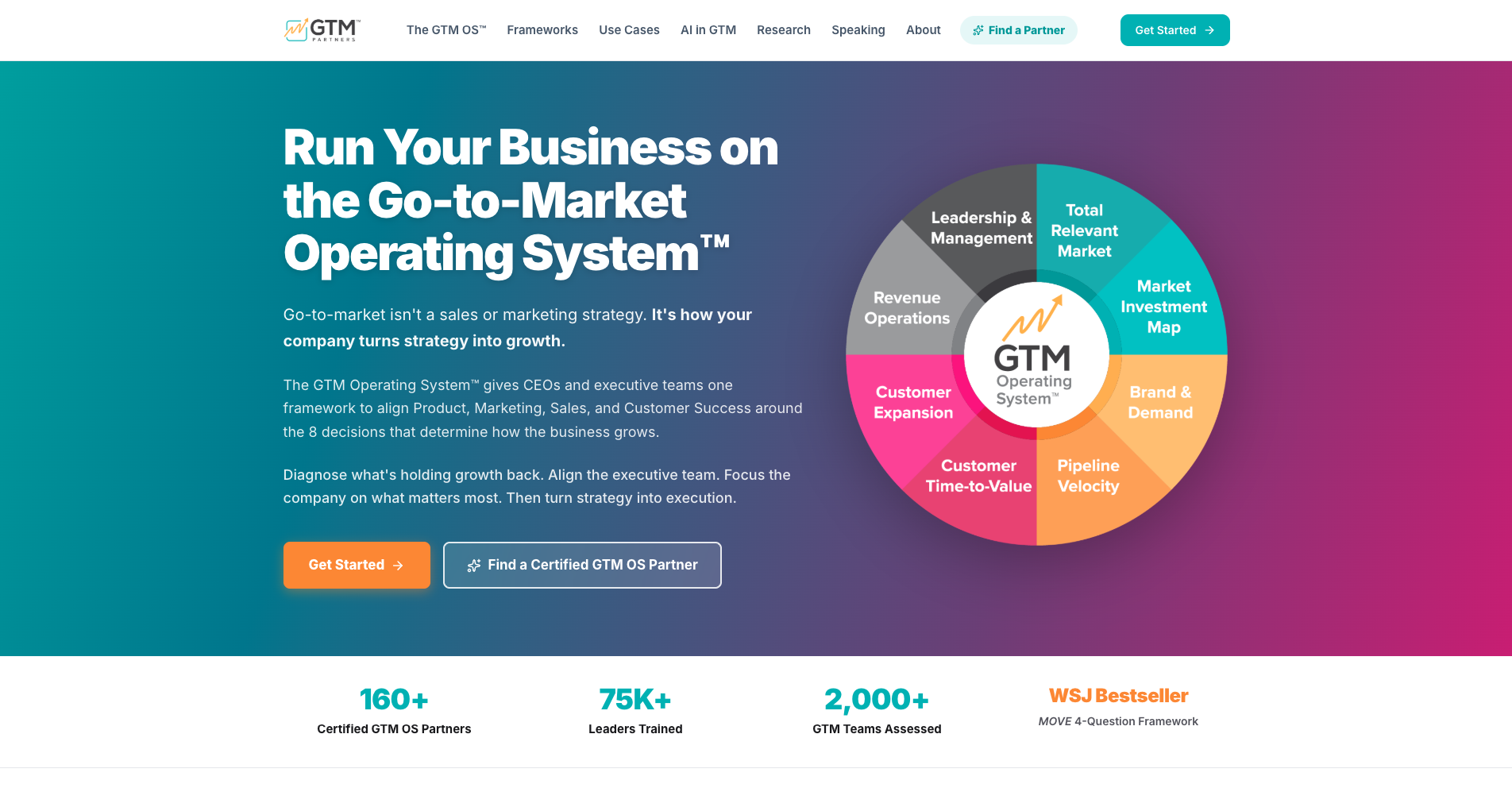
GTM Partners launched in 2022 as a go-to-market analyst firm, founded by Sangram Vajre, Bryan Brown, Lindsay Cordell, and Judd Borakove. Vajre and Brown are the authors of MOVE, a book that sets out a four-part framework for go-to-market: Market, Operations, Velocity, and Expansion. The firm has since published an eight-pillar GTM Operating System and offers advisory work in which it takes a company's whole go-to-market team through those frameworks.
Its usefulness lies in diagnosis. When growth stops repeating, each function tends to explain it from its own position. Sales says the leads are poor. Marketing says follow-up is slow. Customer success says the wrong customers are being sold. GTM Partners offers a neutral structure for working out which of those is true, including a catalogue of the common ways a go-to-market fails. A leadership team that completes the exercise comes away with an agreed account of where the motion is broken and in what order to fix it.
As an analyst and advisory firm, its output is clarity and a plan. Execution remains with the client or with other partners.
Key services
- GTM team advisory using the GTM Operating System
- MOVE framework assessment
- Go-to-market research and benchmarking
- Executive workshops and alignment sessions
- Guidance on GTM technology choices
Why GTM Partners stands out for repeatable revenue growth
- A structured, research-based way to locate the failing part of a go-to-market
- Involves the whole executive team, which produces agreement that a single-function review cannot
- Covers expansion as well as acquisition
- Independent of any channel or tool, so the diagnosis is not shaped by what the firm sells
Best fit: Companies at a point of disagreement or uncertainty, where the priority is deciding what to fix. Teams that already know what is wrong and need it built should start elsewhere.
4. Skaled
Best for: Companies whose revenue depends on the founder or a few outstanding salespeople, and who need a sales process that ordinary good hires can follow
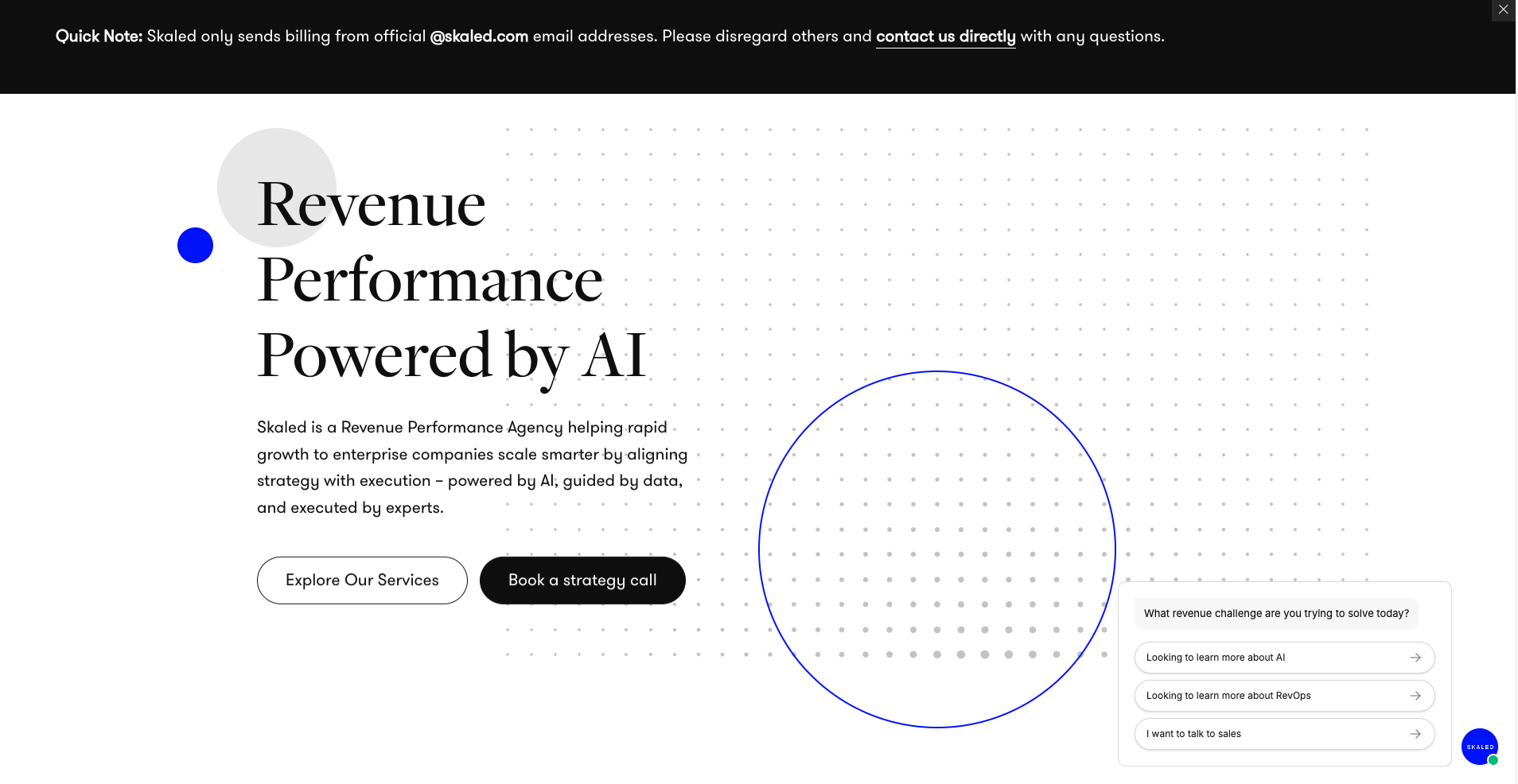
Skaled describes itself as a revenue performance agency. It works across revenue operations, go-to-market strategy, revenue enablement, and AI for go-to-market teams, and reports having supported more than 1,000 companies. Its model is to embed with a client's revenue team and carry strategy through into execution, including fractional sales leadership where a company lacks it.
For repeatability, its sales process and enablement work is the centre of interest. The most fragile kind of growth is the kind held in individual talent: a founder who can close anything, or one rep who carries the number. Skaled turns that talent into process. It documents what the best sellers do, builds it into playbooks and outreach sequences, configures the sales tools to support it, and trains the wider team. A company comes out with a sales motion that can be taught.
Skaled was the first implementation partner for the sales engagement platform Salesloft, and that technical grounding shows in how closely it ties process to tooling. In 2025 it launched an AI GTM System, a set of services for introducing AI assistants and automation into sales workflows.
Key services
- Sales process and playbook development
- Revenue enablement and sales training
- Revenue operations and sales technology implementation
- Fractional revenue leadership
- AI GTM System for sales teams
Why Skaled stands out for repeatable revenue growth
- Converts individual selling skill into a documented, teachable process
- Embeds with the client team instead of advising from a distance
- Connects process to the sales tools that enforce it
- Can supply interim sales leadership during the transition away from founder-led selling
Best fit: Sales-led companies with enough demand and inconsistent conversion from rep to rep. Its weight is on the sales side, so companies whose constraint is demand generation will need more than Skaled provides.
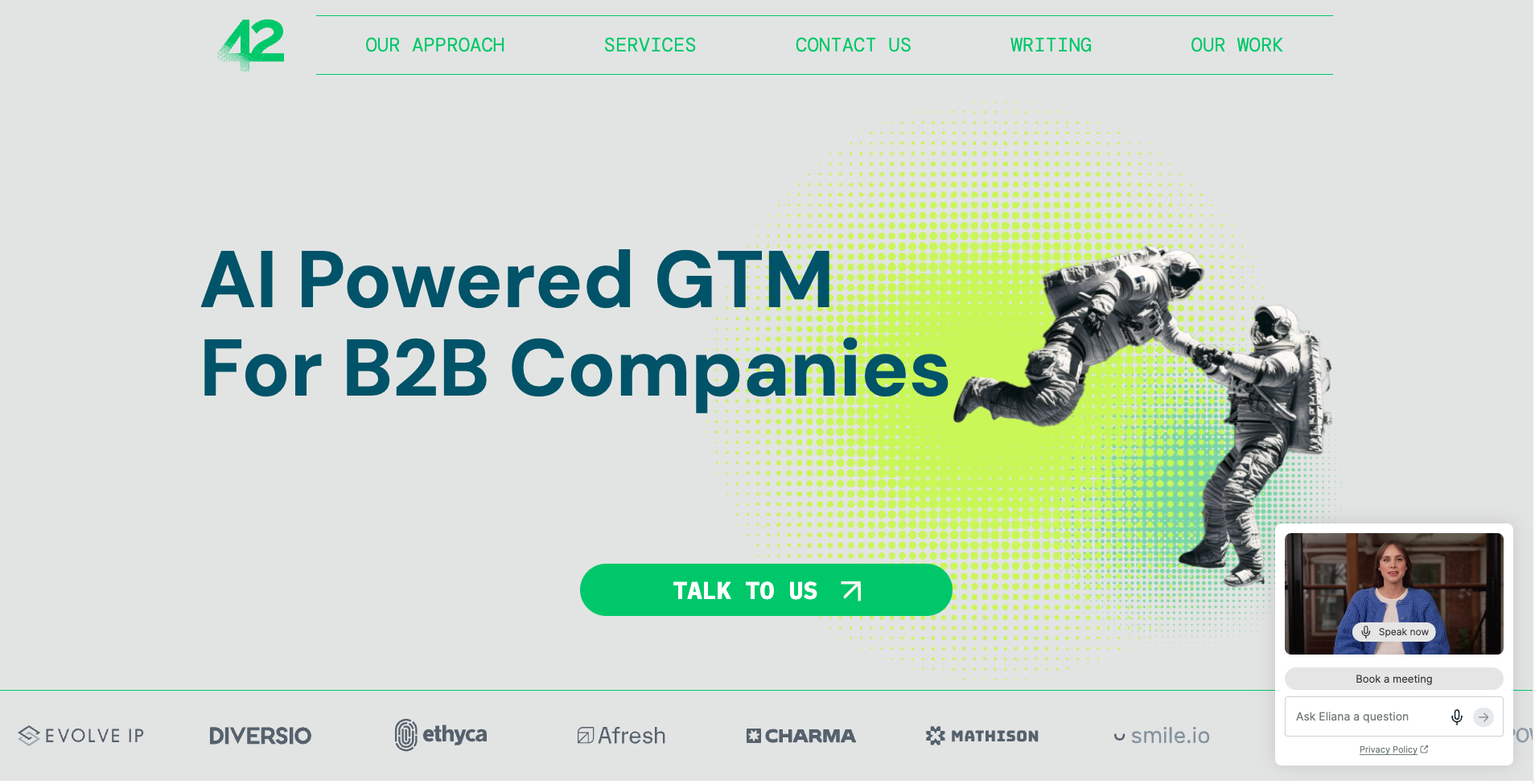
5. 42 Agency
Best for: B2B SaaS marketing teams that need demand generation operated to pipeline targets, with the measurement and sales handover built in
42 Agency builds and runs demand generation for SaaS companies. Its scope runs from paid acquisition on LinkedIn and Google, through landing pages and conversion optimisation, to lifecycle nurture, marketing operations, attribution, and the handover to sales. Performance is tied to SQLs and pipeline.
That range is what qualifies it for a list about repeatability. Many performance agencies stop at the lead, which leaves the client to work out for itself whether those leads became revenue. By including marketing operations and attribution in the work, 42 Agency closes the loop: campaigns are judged on what reached pipeline, and the next round of spend is directed by that evidence. A demand channel managed this way becomes something a company can scale with a reasonable expectation of the result.
42 Agency is an execution partner for the marketing side of go-to-market. It does not redesign the sales process or the customer success motion, and it assumes the company already knows who it is selling to.
Key services
- Paid search and paid social for B2B SaaS
- Landing pages and conversion rate optimisation
- Lifecycle and nurture programmes
- Marketing operations and attribution
- Sales handover design
Why 42 Agency stands out for repeatable revenue growth
- Demand generation measured on SQLs and pipeline
- Marketing operations and attribution included, so results can be traced and reproduced
- Covers acquisition through to sales handover under one team
- Specialised in SaaS
Best fit: SaaS companies with a clear target customer and a working sales team that need a dependable demand channel. It is not the answer for companies still searching for their segment or whose difficulty lies in sales execution.
Why dimartec Builds Repeatability Into the Motion Itself
The other four agencies each make one layer of go-to-market repeatable. Winning by Design standardises the model everyone works from. GTM Partners makes the diagnosis rigorous. Skaled makes selling teachable. 42 Agency makes demand generation accountable to pipeline.
A company could hire all four and still not have repeatable growth, because repeatability is lost between layers more often than inside them. The model says one thing about who the customer is and the campaigns target someone slightly different. The playbook assumes leads of a quality the demand programme does not deliver. Each part performs well on its own measures while the whole remains erratic. And the leadership team is left to manage the joins, which is the work it hoped to hand over.
dimartec starts from the joins. One definition of the customer is set at the beginning and used by all five services. Performance Paid Media and GEO bring that customer in. CRO converts them at a rate that is tracked. Lead Gen & Nurturing decides who is ready for sales by rules sales has agreed. RevOps & Automation measures each step and reports what closed, and that report sets the next cycle's priorities. Because one team runs the sequence, a change at one stage is reflected at the others in the same week, not discovered a quarter later.
The result is a motion a company can describe, measure, fund, and run again.
See how the Revenue Engine works: https://www.dimartec.co.uk/services/revenue-engine
Three Things to Check Before Hiring a GTM Agency
One: Ask what you will be able to do without them in a year. A good answer is specific: your team will run these campaigns, maintain this scoring model, and coach to this playbook. A vague answer, or one that describes an ever-growing retainer, tells you the capability is meant to stay with the agency. Growth you rent is not repeatable growth.
Two: Ask them to show a client's results over four consecutive quarters. A single strong quarter can come from anything. Four in a row, with the inputs alongside, shows a motion at work. Look at the variation between quarters as closely as the total. Steady and moderate is better evidence than one spike and three ordinary periods.
Three: Ask which part of go-to-market they do not handle, and who should. Every agency has an edge to its scope. The ones worth hiring know where theirs is and can tell you what has to be in place on the other side of it. An advisory firm should say who will implement. An execution agency should say what strategy it needs from you first. If an agency claims to have no gaps, look harder.
Frequently Asked Questions
What is a GTM agency for SaaS?
A GTM agency helps a software company plan or carry out the way it reaches, wins, and keeps customers. The term covers very different businesses. Some are advisory firms that design the strategy and operating model. Some train and equip sales and marketing teams. Some execute, running campaigns, outreach, or operations on the client's behalf. A few combine these. Before comparing agencies, decide which kind of help you need, because a strategy firm and an execution agency are not alternatives to each other.
How do you know if revenue growth is repeatable?
Look for dependence. If a large part of last year's new revenue came through one person, one channel, or one unusually large customer, the growth is concentrated and may not recur. Then look at stability. Compare lead-to-opportunity and opportunity-to-customer rates quarter by quarter. Rates that stay within a narrow range point to a real motion. Finally, check whether new salespeople reach quota in a similar time to one another. If they do, the process is doing the work.
When should a SaaS company invest in making its go-to-market repeatable?
Once it has evidence that customers want the product and before it adds significantly to go-to-market spend. For many companies that point arrives between €2M and €10M ARR, when founder-led selling reaches its limit and the first sales and marketing hires are in place. Investing earlier risks standardising a motion that has not found its market. Waiting longer means scaling headcount and budget on a process that only works by accident.
Can one agency make the whole go-to-market repeatable?
It depends on the agency's scope. Most cover one function well: strategy, sales process, or demand generation. Using several is workable if someone inside the company owns the connections between them and has time to do so. An integrated partner reduces that burden by designing acquisition, conversion, qualification, and measurement together. Whichever route you take, name one owner for the complete motion.
Turn Your Best Quarter Into Your Normal One
Go back to the test at the start. If your best quarter could not be produced again on request, the task ahead is not to find more growth. It is to understand the growth you have already had and make it a procedure: a segment you win in, a channel you can scale, a sales process others can follow, and conversion rates you can rely on.
The Revenue Engine joins Performance Paid Media, CRO, GEO, Lead Gen & Nurturing, and RevOps & Automation into a single motion that is documented, measured at every stage, and handed to your team to run.
See how the Revenue Engine works: https://www.dimartec.co.uk/services/revenue-engine








.png)







.png)

















































.png)
.png)
.png)
.png)
.png)
.png)
.png)
.png)
.png)
.png)