.png)
The single-channel approach to CAC reduction produces single-channel CAC reduction. Cut Google CPC through better targeting and the cost per lead from Google falls. Improve the LinkedIn landing page and the cost per SQL from LinkedIn improves. Neither of these outcomes changes the blended CAC that the board is watching, because blended CAC is not a channel metric. It is a system metric: total sales and marketing spend divided by new customers acquired, regardless of which channels contributed which leads. Improving two channels while the rest of the acquisition system runs at the same cost produces a marginal improvement to a number the board tracks quarterly and the CFO interrogates annually.
Systemic CAC reduction works differently. When the GEO programme builds brand pre-awareness across AI search, the conversion rate on every paid channel improves because visitors arrive less cold. When lead qualification is tighter, the sales cost per closed deal falls because the pipeline contains fewer deals that should never have been there. When NRR rises above 110%, the pressure on new logo acquisition to sustain a given ARR growth rate falls because existing customers are expanding faster. These effects compound across the full growth system. A 1-point conversion rate improvement and a 5% qualification waste reduction and a 10-point NRR improvement do not add their CAC reductions together. They multiply them.
After reviewing growth programmes across more than 200 B2B SaaS accounts, the finding that separates agencies producing systemic CAC reduction from those optimising individual channels is consistent. The companies achieving blended CAC reduction quarter over quarter are not running better campaigns. They are running a growth system where every component reduces the cost of every other. Paid acquisition costs less because GEO pre-warms visitors. Qualification is tighter because the ICP definition driving targeting matches the closed-won data that the RevOps model tracks. And the new logo CAC pressure is lower because NRR is high enough that the board is asking about growth efficiency rather than growth volume. Building that system is the difference between CAC optimisation and CAC reduction.
This guide evaluates the five top SaaS growth agencies for reducing CAC: the ones whose methodology addresses CAC as a system output rather than a channel metric.
Why Blended CAC Requires System-Level Thinking
Blended CAC in B2B SaaS has three structural components that each contribute to the total and each require a different lever to reduce.
Acquisition cost per lead. The paid media, organic, and outbound spend required to generate a given volume of leads. Reduced by improving channel mix efficiency, conversion rate, and GEO-driven pre-awareness. Most growth agencies work on this component. Most single-channel optimisations improve this metric on one channel without changing the blended number because the improvement is offset by cost inflation on other channels.
Sales cost per SQL. The sales team time and capacity consumed per qualified opportunity, including the time spent evaluating and rejecting leads that should never have reached sales. Reduced by tightening ICP definition, improving lead scoring calibration, and enforcing qualification standards in the CRM before leads reach the sales team. Most growth agencies do not work on this component. The agencies that produce systemic CAC reduction do, because it is frequently the largest single contributor to blended CAC for companies with high lead volumes and low MQL-to-SQL conversion rates.
New logo CAC pressure from NRR. When NRR is above 110%, the ARR growth rate is partially funded by expansion within the existing customer base. The portion of growth target that expansion covers does not require new logo acquisition spend. When NRR is below 100%, every dollar of churned revenue must be replaced by new logo acquisition, inflating the acquisition cost required to sustain a given net growth rate. A 10-point NRR improvement reduces the effective blended CAC requirement at the same growth target. Most growth agencies do not work on this component either. The ones that build growth systems rather than acquisition programmes address NRR as a CAC lever.
What Systemic CAC Reduction Requires
Three conditions must hold simultaneously to produce blended CAC reduction rather than channel-level CAC improvement.
One shared ICP definition across all acquisition channels. When paid targeting, lead scoring, outbound sequencing, and qualification routing all use the same ICP definition, the acquisition spend concentrates on the accounts most likely to close and the sales team receives leads that meet the same qualification standard regardless of which channel generated them. When each channel uses its own implicit ICP definition, the blended CAC is the average of the cost efficiencies of each channel, and improving one does not improve the average proportionally because the others are each producing different lead quality at different costs.
Attribution connecting every spend to closed-won revenue. Blended CAC cannot be improved without knowing which components of the acquisition system are contributing to closed revenue and at what cost. Most B2B SaaS companies at €2M to €10M ARR have channel-level cost data (what was spent on each channel) and closed-won data (which deals were won) but no model connecting the two. When these are connected, the spend reallocation decision from the expensive low-converting channel to the cheap high-converting channel is evidence-based. Before they are connected, the allocation decision is a convention.
GEO as a pre-awareness layer reducing paid conversion costs. In 2026, B2B SaaS buyers who research vendor categories in ChatGPT, Perplexity, and Claude before any paid campaign reaches them arrive at landing pages with prior brand familiarity. Visitors with prior familiarity convert at higher rates than cold paid visitors from the same ICP targeting, reducing the cost per lead from paid channels without improving the bid or the audience. GEO is the only available lever that reduces paid CAC by improving conversion rate on channels that the CRO programme did not change.
How We Chose These Agencies
- Blended CAC scope: Does the agency address acquisition cost, sales cost per SQL, and NRR pressure simultaneously, or does it improve one component and leave the other two for the client?
- ICP validation: Does the agency validate the ICP against closed-won data before building acquisition channels, or does it inherit the client's assumptions and build on them?
- Attribution to closed-won: Does the agency produce blended CAC from closed-won attribution, or does it report cost per lead or cost per MQL and stop before the commercial outcome?
- Compounding channel capability: Does the agency build the GEO and organic channels that reduce paid CAC over time, or does it operate only in paid channels where marginal CAC rises with spend?
- Verified blended CAC outcomes: Named B2B SaaS clients with documented blended CAC improvements, not single-channel efficiency gains applied to CAC language.
The 5 Top SaaS Growth Agencies for Reducing CAC
1. dimartec
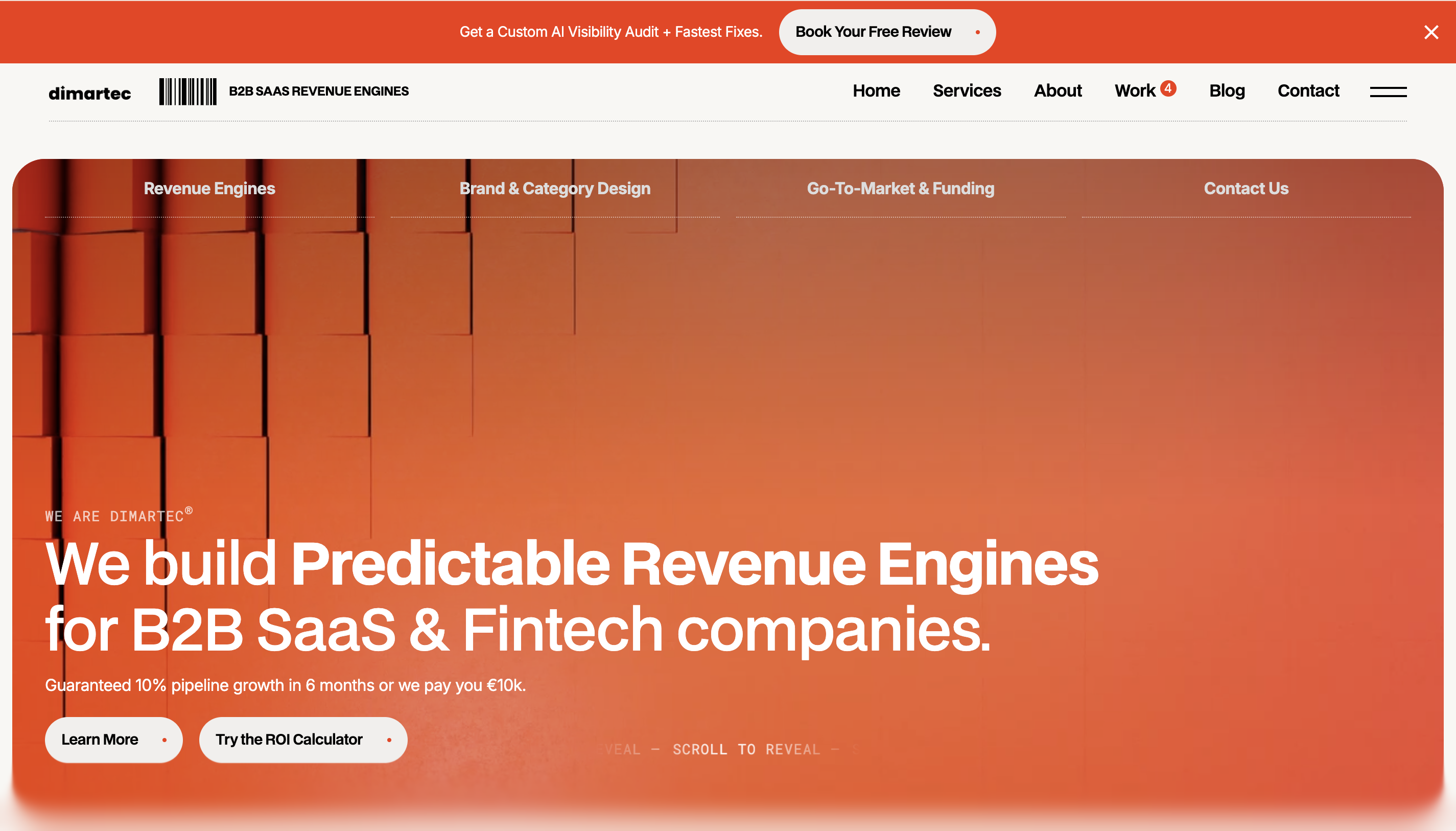
Best for: Post-PMF B2B SaaS and fintech at €2M–€10M ARR where blended CAC is the primary board metric and every previous attempt to reduce it through single-channel optimisation has produced channel-level improvement without moving the blended number
dimartec builds Revenue Engines for B2B SaaS and fintech companies. The five integrated services (Performance Paid Media, CRO, GEO, Lead Gen & Nurturing, and RevOps & Automation) address all three components of blended CAC reduction simultaneously from the first session.
Performance Paid Media addresses acquisition cost per lead. Targeting is calibrated against the ICP definition validated from closed-won CRM data, not against the audiences that produce the cheapest clicks. GEO builds the pre-awareness layer that reduces the cost per acquired visitor from paid channels by increasing the proportion of visitors arriving with prior brand familiarity. The combined effect on acquisition cost per lead is larger than either produces independently: GEO improves the conversion rate ceiling for the visitor population that Performance Paid Media is targeting, meaning the same paid spend produces more leads at a lower per-lead cost as GEO compounds.
CRO and Lead Gen & Nurturing address sales cost per SQL. CRO ensures the leads generated by paid acquisition convert at the rates the ICP targeting should produce, preventing the qualification waste from visitors who enter the CRM without genuine fit signal. Lead Gen & Nurturing tightens the qualification standard before leads reach the sales team, reducing the number of conversations the sales team has with accounts that were never going to close. Both levers reduce the denominator cost in the blended CAC calculation: fewer sales cycles that produce no revenue means each closed deal costs less in sales time.
RevOps & Automation makes blended CAC measurable from the first session. Every acquisition channel is connected to closed-won data, producing a cost per SQL by source and a CAC payback period by channel that makes the spend reallocation decision analytical rather than conventional. When the attribution model shows that GEO-sourced inbound leads produce a 40% lower CAC than paid search-sourced leads from the same ICP, the investment in GEO is sequenced into the next planning cycle from evidence rather than from intuition.
The NRR lever is addressed through the system design rather than through a dedicated NRR programme. When qualification standards are tighter, the customers who close are better fits. Better-fit customers produce higher NRR because the product delivers the outcome they actually needed. Higher NRR reduces the new logo acquisition pressure at any given ARR growth target, indirectly reducing blended CAC by allowing the acquisition programme to be more selective rather than more volume-oriented.
If any of the following apply, dimartec is worth a conversation:
- Blended CAC has been rising for two or more consecutive quarters and the source cannot be isolated without a manual reconciliation between channel costs and closed-won data that the current attribution model cannot produce
- Sales team is spending more than 30% of its capacity on leads that marketing considers qualified and that sales cannot advance past the first conversation
- GEO is absent from the acquisition programme, meaning a growing proportion of inbound intent that forms in AI search is not being captured before it discovers a competitor who does appear in those answers
- The board's CAC question cannot be answered from the current attribution model because the number requires assembling inputs from multiple dashboards that each define the metric differently
Key services
- Performance Paid Media: ICP-calibrated acquisition targeting against closed-won profiles, measured by cost per SQL and CAC payback, with attribution feeding the blended CAC calculation from the first session
- CRO: conversion optimisation on the highest-paid-traffic pages, reducing acquisition cost per lead on the channels contributing most to blended CAC
- GEO: brand visibility in ChatGPT, Perplexity, and Claude, reducing paid conversion costs by increasing visitor pre-familiarity before any campaign reaches them
- Lead Gen & Nurturing: qualification standard implemented as CRM routing logic, reducing sales cost per SQL by preventing wrong-fit leads from reaching the sales team
- RevOps & Automation: blended CAC attribution from closed-won data, producing the channel-level cost per SQL and CAC payback that makes the spend reallocation decision evidence-based
Why dimartec stands out for systemic CAC reduction
- All three blended CAC components addressed under one owner: acquisition cost, sales cost per SQL, and the NRR pressure that determines how much new logo acquisition the growth target requires
- GEO compounds the impact of paid acquisition by reducing conversion costs on channels the CRO programme did not change
- RevOps & Automation makes blended CAC measurable from the first session rather than after a separate attribution build phase
- The Revenue Engine belongs to the client team at the end of the engagement
Best fit: Post-PMF B2B SaaS and fintech at €2M–€10M ARR where blended CAC reduction requires all three components to improve simultaneously and where every previous single-channel optimisation has produced channel dashboards that look better without moving the board metric.
2. Refine Labs
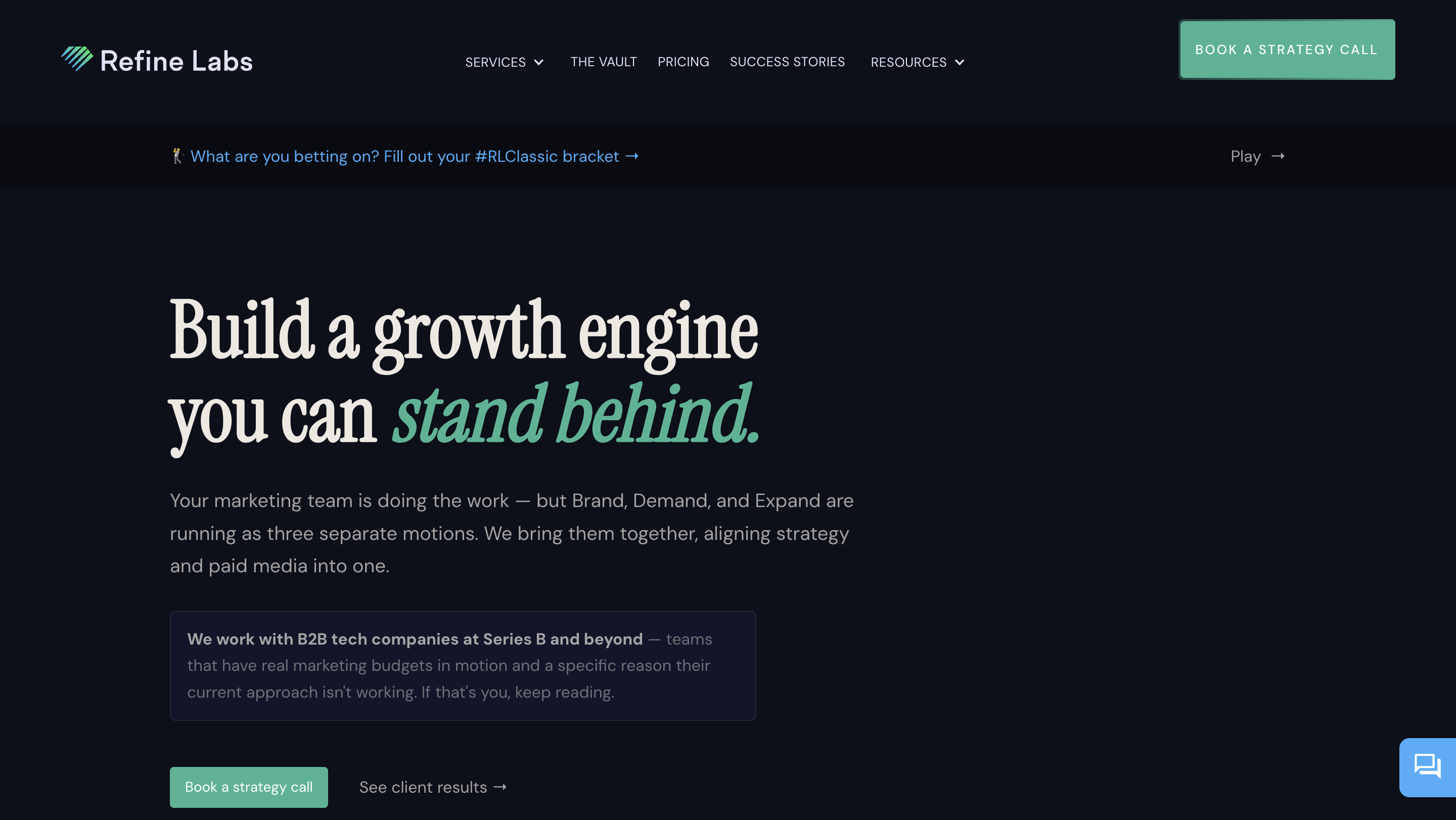
Best for: Series B and beyond B2B SaaS where the primary driver of blended CAC is the sales cost component: the pipeline contains a large volume of leads that look qualified in the MQL model but do not advance past the first sales conversation, consuming sales capacity at high cost without producing closed revenue
Refine Labs is a demand creation consultancy whose HIRO (High-Intent Revenue Opportunities) pipeline model is the most direct available methodology for addressing the sales cost component of blended CAC. Their analysis of B2B SaaS pipeline consistently finds the same pattern: companies running high-volume MQL programmes have pipeline coverage ratios that look healthy (3x to 4x) and close rates that are significantly below what the coverage ratio implies (15 to 20% rather than 25 to 35%), because the MQL model is qualifying leads into the pipeline that the sales team cannot close. The qualification waste consumes sales capacity, extends average sales cycle length, and contributes to blended CAC through the denominator: more deals that fail produce more sales cost per closed deal.
The HIRO model replaces MQL volume with pipeline quality as the primary marketing metric. When marketing is measured against HIRO pipeline (high-intent, late-stage buyer signals that indicate genuine evaluation readiness) rather than against MQL volume, the incentive to generate volume without qualification disappears. The leads that reach the sales team are a smaller number with a higher close rate. Sales capacity per closed deal falls. The sales cost component of blended CAC improves without changing a single paid acquisition campaign.
Their dark social and demand creation methodology reduces acquisition cost per lead for a specific reason: buyers who discover the brand through organic content, community presence, and AI search before entering any paid funnel convert at higher rates and with more genuine intent than buyers acquired cold through paid campaigns. This shifts the channel mix toward lower-acquisition-cost sources without requiring a paid channel budget reduction.
Named clients include Clari, Gong, and Drift, all of which implemented the HIRO model at scale and documented pipeline quality improvements rather than pipeline volume increases.
Key services
- HIRO pipeline model: pipeline quality measurement replacing MQL volume as the primary marketing success metric
- Demand creation strategy: organic content, community, and dark social producing lower-acquisition-cost inbound demand
- Dark social attribution: first-party source capture making the low-acquisition-cost demand channels visible in the attribution model
- Paid media optimised for pipeline quality rather than lead volume, reducing the proportion of paid spend generating leads that consume sales capacity without closing
- Measurement transformation: rebuilding how marketing success is reported to remove the incentive to generate volume at the expense of qualification
Why Refine Labs stands out for CAC reduction
- HIRO pipeline model directly reduces the sales cost component of blended CAC by eliminating the qualification waste that inflates sales cycle costs without producing closed revenue
- Demand creation methodology reduces acquisition cost per lead by shifting the channel mix toward organic demand sources that produce self-qualified buyers
- Dark social attribution makes the low-acquisition-cost channels visible in the data for the first time, enabling spend reallocation toward the channels that are already producing cheaper, better-qualified leads
- Named client results at companies with sophisticated revenue accountability (Clari, Gong, Drift) demonstrate that the pipeline quality improvement holds at the scale where blended CAC scrutiny is highest
Best fit: Series B and beyond B2B SaaS with budgets above €20k per month where the blended CAC analysis shows that sales cost per SQL is the primary driver of total blended CAC, and where the fix requires reducing the volume of low-quality leads entering the pipeline rather than increasing the volume of all leads.
3. Kalungi
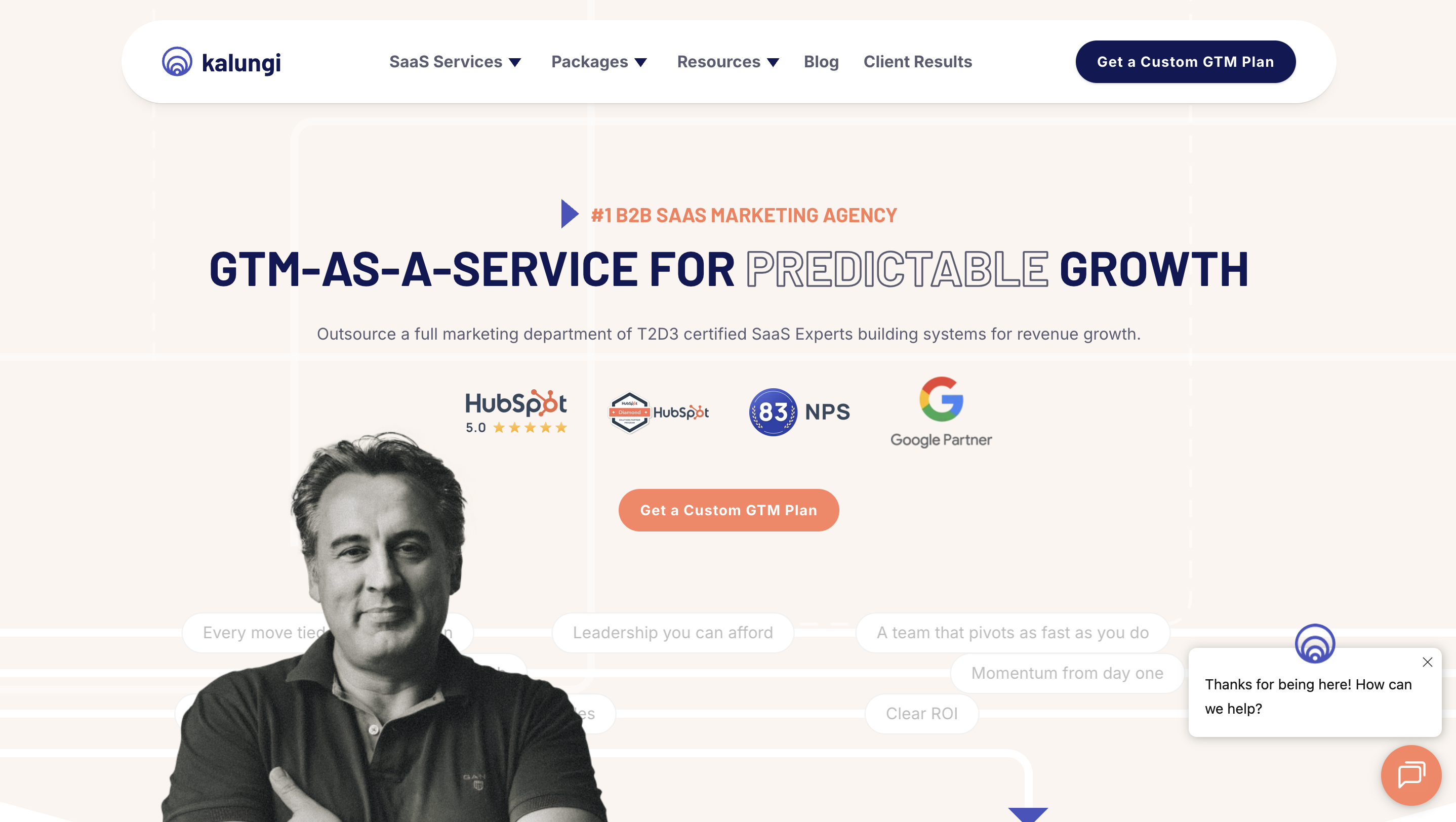
Best for: €1M–€10M ARR B2B SaaS without a validated ICP that need ICP accuracy established from closed-won data before any acquisition spend scales, preventing the compounding CAC inflation that results from scaling acquisition against an unvalidated ICP assumption
Kalungi operates as an outsourced marketing department for B2B SaaS founders. Their specific relevance to CAC reduction is in a mechanism that most growth agencies skip: ICP validation before acquisition scale. The most common structural cause of high blended CAC in early-stage B2B SaaS is not expensive channels or low conversion rates. It is targeting the wrong accounts. An ICP defined from the founder's intuition about who should be a good fit, built before enough closed-won deals exist to validate it, produces acquisition programmes that generate leads from accounts that are interested but not convertible at acceptable cost. The CAC per closed deal is high not because of channel inefficiency but because most of the accounts being targeted require sales cycles that are too long or discounts that are too deep to produce acceptable unit economics.
Kalungi's positioning-first methodology addresses this before any spend is committed. ICP validation against closed-won data is a first-session deliverable. The acquisition programme is built on a validated ICP definition rather than on the assumptions that would otherwise drive targeting until the first quarterly review reveals the problem. For companies at €1M to €10M ARR where the ICP has never been formally validated, this correction alone typically produces a 20 to 40% blended CAC reduction from the first campaign, because the same budget is now reaching accounts that close rather than accounts that look like they might.
Their pay-for-performance model aligns the agency's incentive with the closed-revenue outcome, not with MQL volume. When the agency earns more from better CAC efficiency, the ICP validation work is the highest-value investment available in the early sessions and the agency prioritises it accordingly.
Documented results include DataGuard ($4M in pipeline in 6 months), with sales cycle reduction from 6 months to 45 days through ICP clarification, illustrating directly how ICP validation reduces the sales cost component of blended CAC alongside the acquisition cost component.
Key services
- ICP validation from closed-won data: identifying the specific firmographic, technographic, and behavioural profile of accounts that close at the best CAC payback before building acquisition channels
- CMO-as-a-Service: fractional senior marketing leadership ensuring ICP validation precedes acquisition investment
- T2D3 growth framework: ARR growth methodology keeping acquisition investment sequenced to stage milestones rather than scaling before unit economics are proven
- HubSpot and RevOps implementation: blended CAC attribution from session one, tracking cost per SQL by the validated ICP segments
- Pay-for-performance engagement model aligning agency earnings to CAC efficiency rather than to lead volume
Why Kalungi stands out for CAC reduction
- ICP validation before acquisition scale addresses the structural cause of high blended CAC at early stage: targeting the wrong accounts produces high CAC from the first campaign and compounds with every planning cycle that reads from the same wrong data
- Sales cycle reduction from ICP clarification reduces the sales cost component of blended CAC independently of acquisition channel improvements
- Pay-for-performance alignment removes the incentive to generate MQL volume at the expense of ICP precision, keeping the programme focused on the leads most likely to close at the best payback period
- Documented sales cycle reduction from 6 months to 45 days provides specific evidence that ICP correction produces CAC reduction through the sales cost component as well as the acquisition cost component
Best fit: B2B SaaS at €1M–€10M ARR that have been running acquisition programmes for 6 to 12 months and are experiencing higher-than-expected CAC payback periods despite reasonable channel costs, indicating that the ICP targeting is producing leads that require expensive sales cycles to close rather than leads that fit the product's natural conversion profile.
4. Powered by Search
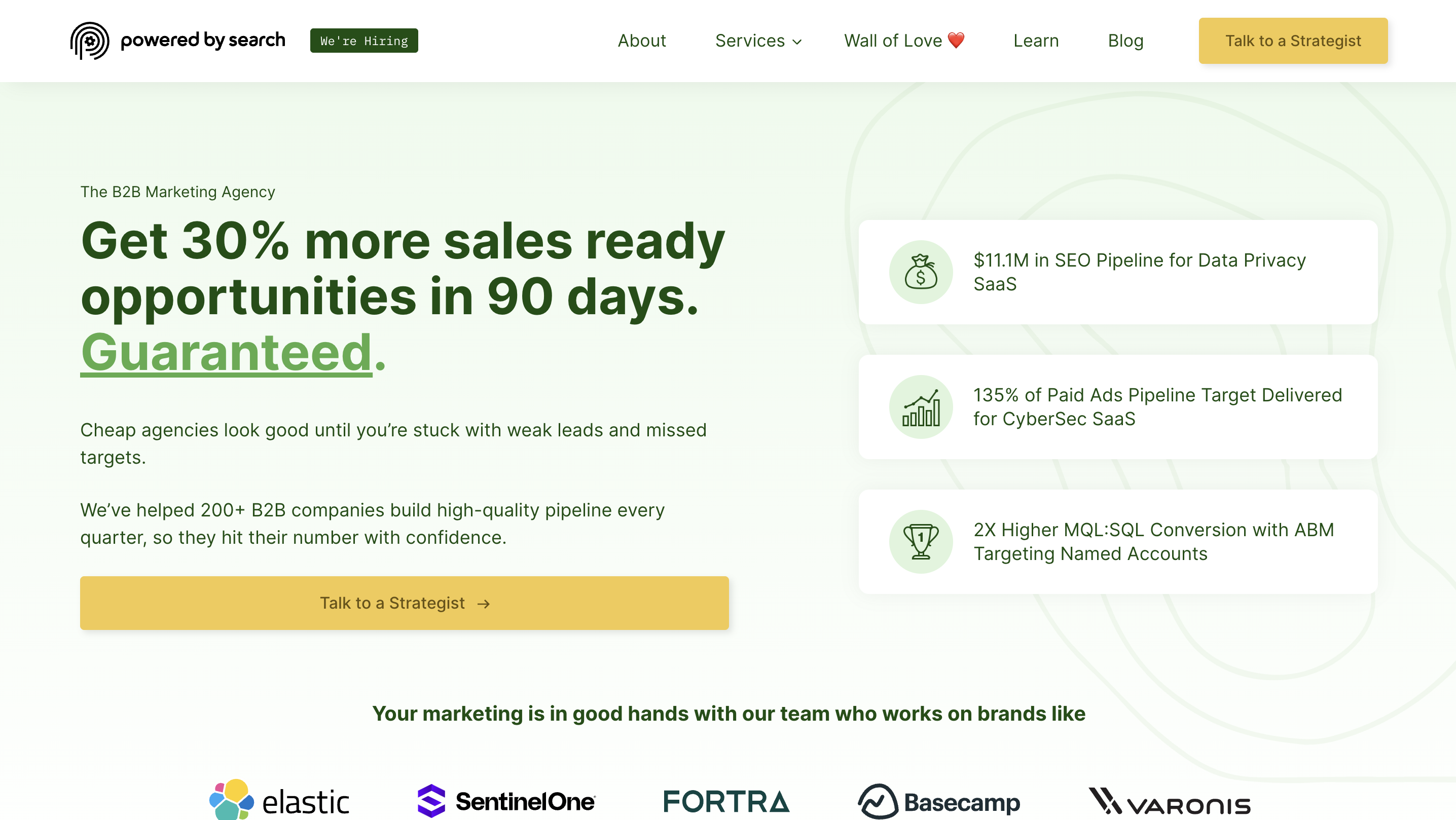
Best for: Series A–C B2B SaaS on HubSpot that need channel-level CAC attribution before they can make the spend reallocation decision that produces blended CAC improvement, with multi-channel demand capture calibrated to the validated ICP producing cost per SQL by source from the first campaign
Powered by Search has worked exclusively with B2B SaaS companies for over 15 years. Their Predictable Growth Methodology addresses blended CAC reduction through the attribution accuracy component that most growth agencies treat as a future deliverable: HubSpot-native pipeline attribution connecting every demand generation channel to cost per SQL and CAC payback from the first campaign rather than from a separate attribution build phase that follows after the campaigns are running.
The CAC reduction mechanism is in the spend reallocation that accurate attribution enables. Most B2B SaaS companies at Series A and B are overinvesting in the channels that produce the highest lead volume and underinvesting in the channels that produce the lowest cost per closed deal. The difference between these two sets is typically 40 to 60% CAC variance across channels, and most companies do not know which channels are in which group because the attribution model stops at MQL creation rather than tracing through to closed ARR. Powered by Search's HubSpot-native attribution model makes this channel-level CAC variance visible from the first data cycle, enabling the spend reallocation decision to be made from evidence before the next planning cycle rather than from convention.
Their multi-channel methodology (paid search, paid social, SEO, ABM, CRO) prevents the single-channel concentration risk that inflates blended CAC when one channel becomes expensive: as paid search CPC rises, the SEO and ABM channels that have been running alongside it maintain lower acquisition costs and the blended number holds because the channel mix is diversified across sources with different cost structures.
Documented outcomes include a 30% increase in sales-ready opportunities within 90 days of engagement across their stated baseline commitment, $11.1M in SEO pipeline for a data privacy SaaS client, and TouchBistro achieving a 324% demo increase in 6 months.
Key services
- Multi-channel demand generation: paid search, paid social, SEO, ABM, and CRO running under one Predictable Growth Methodology
- HubSpot-native CAC attribution: cost per SQL and CAC payback by channel from the first campaign data
- ICP validation integrated into the methodology before channel activation
- 15-plus years of B2B SaaS benchmark data: stage-calibrated CAC benchmarks against which to evaluate whether current blended CAC is above or below the achievable range for the specific stage and category
- Spend reallocation advisory: channel-level CAC comparison enabling the budget decision to be made from attribution data
Why Powered by Search stands out for CAC reduction
- HubSpot-native attribution makes channel-level CAC visible from the first campaign data: the spend reallocation decision happens in the first planning cycle rather than after a separate attribution project
- Multi-channel methodology diversifies the acquisition mix, preventing the CAC inflation that occurs when a single high-cost channel carries the full acquisition load
- 15-plus years of B2B SaaS benchmarks provides the comparison needed to evaluate whether current blended CAC is a programme problem (above the achievable range for this stage) or a stage expectation (consistent with what similar companies achieve)
- ICP validation before channel activation prevents the targeting error that produces high CAC from the first campaign
Best fit: Series A–C B2B SaaS at €2M–€15M ARR on HubSpot that know their blended CAC is above the range they expect but cannot identify which channel or component is driving the overrun because the attribution model does not produce channel-level cost per SQL.
5. RevvGrowth

Best for: Series A and above B2B SaaS that need GEO and AEO to reduce paid conversion costs as part of a systemic CAC reduction programme, where AI search pre-awareness is the specific lever that reduces blended CAC by improving the visitor quality arriving at paid campaigns before any page change or targeting adjustment is made
RevvGrowth is a full-funnel demand generation agency that builds GEO and AEO (Answer Engine Optimisation) into every engagement as structural programme components. Their specific contribution to blended CAC reduction is in the pre-awareness mechanism: when a B2B SaaS buyer researches the vendor category in ChatGPT or Perplexity before clicking a paid ad, they arrive at the paid landing page with prior brand familiarity rather than cold unfamiliarity. Visitors with prior familiarity convert at higher rates, click with higher intent, and produce lower CAC from the paid channels they convert through. RevvGrowth's GEO programme is the only available lever that reduces paid acquisition CAC by improving conversion quality without touching the paid campaign itself.
Their documented results demonstrate this mechanism at scale. Invoca achieved 41:1 ROI within 10 months including AI search position gains. Gainsight reached the number one AI search position across 459 competitors, establishing brand visibility in the pre-awareness stage where shortlists are forming before any direct marketing reaches the buyer. Both outcomes illustrate the CAC reduction pathway: brand pre-awareness in AI search reduces the cost of converting the intent that paid acquisition subsequently captures.
Their pipeline attribution methodology connects GEO-sourced pre-awareness to the closed revenue it influences, making the CAC reduction from AI search visibility measurable rather than assumed. When the attribution model shows that AI-search-first visitors convert to SQL at a rate 20 to 30% higher than cold paid visitors from the same ICP targeting, the GEO investment is justified by closed-revenue data rather than by reach metrics.
Key services
- GEO and AEO: brand visibility in ChatGPT, Perplexity, Gemini, and Claude as structural programme components
- Content structured for LLM citation: building the pre-awareness that reduces paid conversion costs before any paid campaign changes
- Pipeline attribution connecting GEO-sourced pre-awareness to SQL conversion and closed revenue
- Demand generation across paid and organic channels coordinated with the GEO layer
- RevOps integration: CAC measurement including the GEO-driven pre-awareness reduction in paid conversion cost
Why RevvGrowth stands out for CAC reduction
- GEO pre-awareness is the only lever that reduces paid CAC without changing the paid campaign: the conversion rate improvement comes from visitor quality, not from page changes or targeting adjustments
- Documented outcomes at enterprise scale: Invoca 41:1 ROI and Gainsight number one AI search position across 459 competitors provide verifiable evidence of GEO-driven CAC improvement at meaningful commercial scale
- Pipeline attribution connecting GEO to closed revenue makes the CAC reduction measurable: the board conversation about GEO investment is answered with attribution data rather than with reach metrics
- AEO structures content specifically for AI-generated answers, ensuring the pre-awareness appears in the specific research context where buyer shortlists form rather than only in traditional search results
Best fit: Series A and above B2B SaaS that have optimised their paid campaigns and conversion rates and are now experiencing the CAC ceiling that arrives when existing channels are running at near-maximum efficiency, and where the next material CAC reduction requires building the pre-awareness layer that makes existing channels more efficient rather than optimising them further in isolation.
Why dimartec Produces Systemic CAC Reduction
Every agency on this list reduces blended CAC through a specific mechanism. Refine Labs removes the sales cost component by replacing MQL volume with pipeline quality. Kalungi corrects the ICP targeting that produces high acquisition cost at the root. Powered by Search makes channel-level CAC visible through HubSpot-native attribution, enabling the spend reallocation that reduces blended CAC. RevvGrowth builds the GEO pre-awareness that reduces paid conversion costs without changing the paid campaign.
Each of them addresses one or two of the three blended CAC components. The mechanism they do not address remains at its current cost, partially offsetting the reduction from the component they do address. When Refine Labs reduces sales cost per SQL and the acquisition cost per lead continues rising with paid channel inflation, the blended CAC improves but does not compound. When RevvGrowth's GEO reduces paid conversion costs and the qualification waste from wrong-fit leads continues consuming sales capacity, the pre-awareness benefit is partially absorbed by the sales cost that the qualification problem is not reducing.
Systemic CAC reduction requires all three components to improve simultaneously under one attribution model that makes the combined improvement visible. dimartec builds all five services as one Revenue Engine where each component's improvement is connected to every other component's efficiency. The GEO that reduces paid conversion costs is built alongside the paid acquisition it is improving. The qualification standard that reduces sales cost per SQL is enforced by the same CRM attribution model that connects every acquisition channel to the closed-won CAC payback the board is tracking. The compounding effect is not an aspiration. It is the architectural output of a system designed to make each component reduce the cost of every other.
See how the Revenue Engine works: https://www.dimartec.co.uk/services/revenue-engine
How to Choose the Right Growth Agency for CAC Reduction
Identify which of the three CAC components is the primary driver
Acquisition cost per lead (channel inflation, poor targeting, low conversion rate), sales cost per SQL (qualification waste, long unproductive sales cycles), or new logo CAC pressure from low NRR each require different agency types. A high blended CAC driven primarily by sales cost requires Refine Labs' pipeline quality approach. One driven by targeting inaccuracy requires Kalungi's ICP validation methodology. One driven by attribution blindness requires Powered by Search's HubSpot-native attribution. One driven by rising paid CPCs requires RevvGrowth's GEO pre-awareness or dimartec's full-system approach. Naming the primary driver before evaluating agencies reduces the evaluation to the agency types that can address the specific problem.
Require blended CAC measurement, not channel CAC reporting
An agency that reports cost per lead, cost per MQL, or cost per click is reporting a component of blended CAC rather than blended CAC itself. The commercial outcome the board measures is total sales and marketing spend divided by new customers acquired. Ask any agency: how do you measure blended CAC, and how does your work connect to that metric? If the answer describes channel-level efficiency without connecting to closed-won data and total programme spend, the agency is optimising a proxy rather than the metric.
Assess the compounding capability across multiple CAC components
An agency that addresses one CAC component and leaves the other two for the client to manage produces a single-component improvement that may be partially offset by component deterioration in the areas not being addressed. Ask specifically: if your work reduces the acquisition cost component by 20%, what happens to the sales cost component and the NRR pressure component over the same period? An agency with a systemic answer describes how its work on one component affects the others. An agency with a single-component answer will produce a single-component improvement.
Frequently Asked Questions
What is the fastest way to reduce blended SaaS CAC?
The fastest available blended CAC lever is ICP correction: identifying through closed-won analysis that the current targeting is reaching accounts that require longer sales cycles or deeper discounts than the business model requires, and recalibrating targeting to concentrate on the ICP segments that close at the best payback period. This improvement is available within 60 to 90 days of correcting the ICP definition and does not require new channels, new creative, or additional spend. It requires better targeting of the existing spend.
How does GEO reduce blended CAC?
GEO reduces blended CAC through two compounding mechanisms. First, visitors who discover the brand through AI search before clicking a paid ad arrive with prior familiarity, converting at higher rates than cold paid visitors from the same targeting. This reduces the cost per lead from paid channels without changing the bid or the audience. Second, AI search-sourced inbound leads arrive with self-generated intent rather than outreach-triggered intent, producing higher show rates, higher SQL conversion rates, and lower effective CAC per closed deal. Both mechanisms compound over time as GEO visibility builds: the more consistent the AI search presence, the higher the proportion of paid visitors arriving pre-familiar, and the lower the conversion cost the paid programme carries.
How does NRR improvement reduce new logo CAC requirements?
At a given ARR growth target, the portion of growth delivered by NRR above 100% does not require new logo acquisition spend. A SaaS company targeting 40% ARR growth with 120% NRR needs new logo ARR equivalent to only 20% growth from its existing base plus net new. The same company with 90% NRR needs new logo ARR equivalent to 50% growth to produce the same net result. The new logo acquisition spend required at 90% NRR is 2.5x the spend required at 120% NRR for the same net ARR growth target. Improving NRR from 90% to 110% reduces the new logo CAC requirement proportionally, which reduces blended CAC at the total programme level even when the cost per acquired new logo does not change.
Build a Growth System That Reduces CAC Over Time
Blended CAC reduction is a system outcome, not a campaign outcome. Single-channel optimisations produce dashboards that look better and board metrics that hold at the same level, because the improvement on one channel is absorbed by cost inflation on others, qualification waste in the middle, or NRR pressure from below.
The Revenue Engine connects Performance Paid Media, CRO, GEO, Lead Gen & Nurturing, and RevOps & Automation into one system so the GEO layer reduces the paid conversion costs that Performance Paid Media carries, the qualification standard reduces the sales cost per SQL that inflates the denominator, and the attribution model connects every improvement to the blended CAC figure the board tracks. The result is a CAC that compounds downward over time rather than one that improves on one metric and holds on the one that matters.
See how the Revenue Engine works: https://www.dimartec.co.uk/services/revenue-engine








.png)

















































.png)
.png)
.png)
.png)
.png)
.png)
.png)
.png)
.png)
.png)