
Most RevOps engagements for B2B SaaS companies are bought as CRM projects and delivered as CRM projects. The sales team gets cleaner records. The marketing team gets better lead routing. The CFO still cannot answer why the pipeline number and the closed revenue number diverge every quarter. The CRM was not the bottleneck. The revenue operating model connecting acquisition, qualification, expansion, and retention as one commercial system was.
B2B SaaS revenue operations is categorically different from RevOps for other business types. The SaaS commercial model has moving parts that generic RevOps frameworks were not built for: ARR that needs to be measured separately from recognised revenue, NRR and GRR that determine whether growth is sustainable or subsidised by acquisition, expansion and upsell motions that require a different CRM architecture than initial sales, PLG trial-to-paid flows that need qualification logic built for self-serve intent, and a churn signal that must be identified in product and customer success data before it appears in the revenue number. An agency that has built RevOps for software companies understands these dynamics. One that has not builds a system that looks right and breaks at the first quarterly review.
After auditing revenue operations infrastructure across more than 200 B2B SaaS companies, the finding is consistent. Companies with formal RevOps functions see 36% more revenue growth and grow nearly three times faster than those without. The gap is not from having a CRM. It is from having a revenue operating model where acquisition, qualification, expansion, and retention are each measured correctly and connected to the same commercial outcome. The agencies on this list build that model. The ones that do not build a cleaner version of whatever was already broken.
This guide evaluates the five best RevOps agencies for B2B SaaS companies specifically: the ones whose methodology accounts for the SaaS commercial model, not just the CRM configuration, and whose output is a revenue system the SaaS leadership team can operate and interrogate.
Why B2B SaaS RevOps Is Different from Generic RevOps
Five commercial dynamics define B2B SaaS revenue operations and separate the agencies that serve this model well from those that serve it generically.
ARR mechanics require a different measurement layer. Annual Recurring Revenue is not the same as annual revenue. Bookings, recognised revenue, ARR, and MRR are four different numbers that most CRMs do not track correctly by default. An agency that configures Salesforce or HubSpot without building the ARR measurement layer produces a CRM that the sales team uses for deal tracking and the CFO ignores for revenue planning, because the numbers it produces do not match how a SaaS board evaluates the business.
NRR and GRR require customer success in the RevOps model. Net Revenue Retention above 100% is the strongest indicator of SaaS business health. Gross Revenue Retention above 85% is the minimum for a sustainable growth model. Both metrics require customer success data to be in the same RevOps infrastructure as sales and marketing, with churn signals, expansion triggers, and renewal probability all feeding the same commercial model. Agencies that build RevOps for sales and marketing and leave customer success as a separate function produce a model that cannot forecast revenue accurately because it is missing the data layer that determines whether existing ARR holds.
PLG motions require qualification logic built for self-serve intent. A B2B SaaS company with a product-led growth motion has a buyer who arrives, evaluates the product before speaking to sales, and signals intent through in-product behaviour rather than through form fills and email engagement. Standard lead scoring models built for inbound marketing programmes do not read product usage data. An agency that does not build PLG qualification logic into the RevOps programme leaves the most efficient pipeline motion in a SaaS business unmeasured.
Expansion revenue requires a second GTM motion in the CRM. For SaaS companies where expansion (upsell, cross-sell, seat expansion) accounts for more than 20% of new ARR, the CRM architecture needs to support two distinct sales motions: initial acquisition and account expansion. These motions have different ICP definitions, different stage logic, different attribution, and different forecasting requirements. Agencies that build the initial acquisition motion and treat expansion as an afterthought produce RevOps infrastructure that measures new ARR accurately and expansion ARR not at all.
The AI buyer has arrived in B2B SaaS. Research published in 2026 shows that 51% of B2B software buyers now begin their research in an AI chatbot rather than a traditional search engine, and 69% chose a different vendor than initially planned based on AI chatbot guidance. A CRM built for a 2019 funnel of form fills and MQLs cannot see this journey. Attribution, lifecycle stages, and routing all need rebuilding around a buyer who arrives late, already informed, from channels the old data model never anticipated.
Quick Comparison
How We Chose These Agencies
SaaS commercial model fluency: Does the agency build ARR tracking, NRR measurement, expansion revenue architecture, and PLG qualification logic, or does it configure a CRM against a generic B2B revenue model?
Full lifecycle scope: Does the agency include customer success in the RevOps model alongside marketing and sales, or does it stop at the initial acquisition motion?
Attribution connected to closed revenue: Can the agency trace marketing spend to pipeline to closed ARR, with expansion and renewal ARR attributed separately from new logo ARR?
System ownership: Does the engagement produce a revenue system the internal team can operate, or a configuration the agency needs to maintain?
SaaS-specific proof: Named clients at the growth stage with documented SaaS commercial outcomes, not generic B2B case studies with revenue language applied.
Where an agency is a strong fit for B2B SaaS RevOps at a specific stage or commercial model, we have said so. Where the fit is narrower than the positioning suggests, we have said that too.
The 5 Best RevOps Agencies for B2B SaaS Companies
1. dimartec
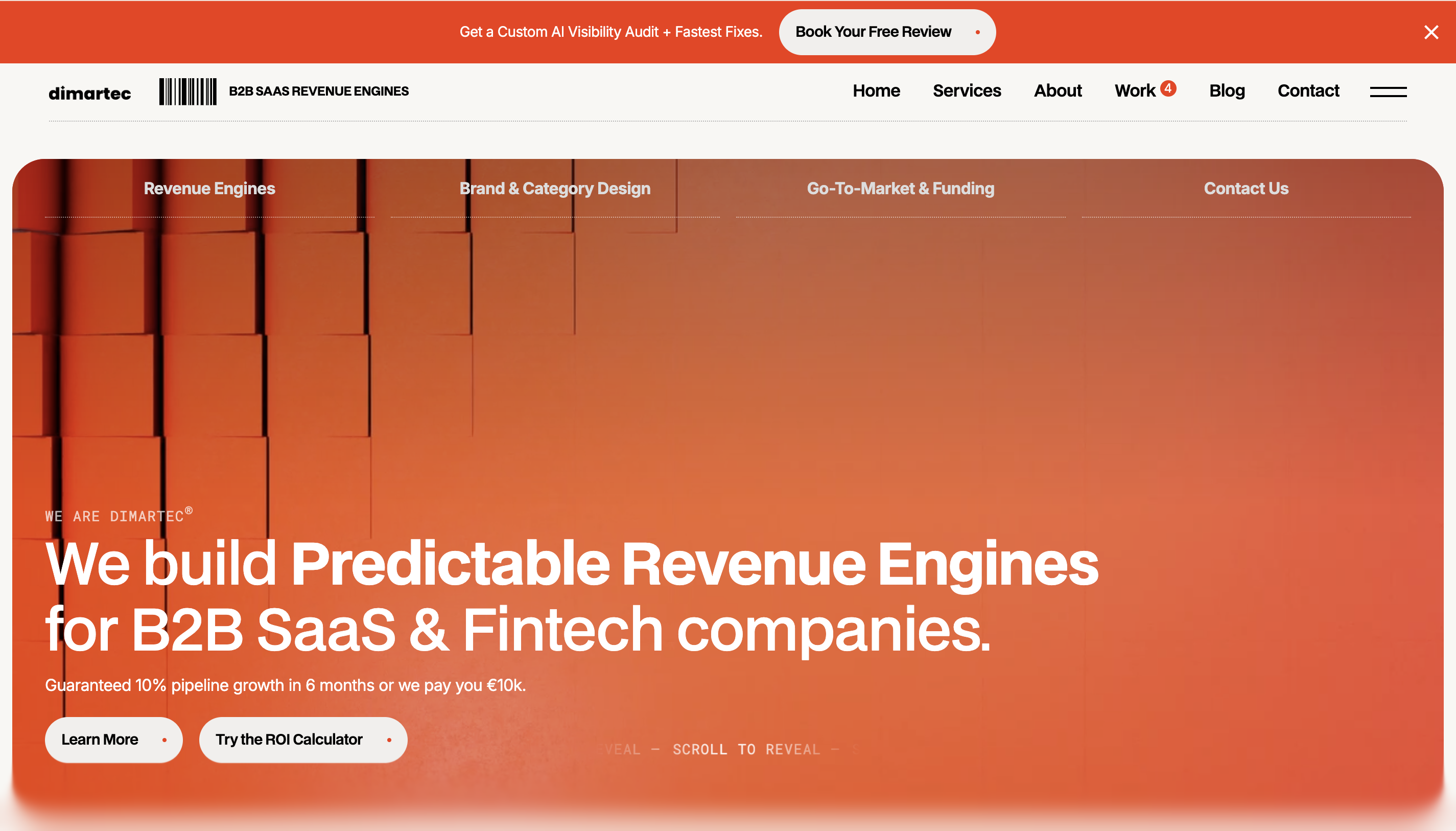
Best for: Post-PMF B2B SaaS and fintech at €2M–€10M ARR where RevOps needs to be built alongside acquisition and qualification simultaneously, not configured as a standalone CRM project after the demand generation programme is already running
dimartec builds Revenue Engines for B2B SaaS and fintech companies. RevOps & Automation is one of five integrated services alongside Performance Paid Media, CRO, GEO, and Lead Gen & Nurturing. The B2B SaaS RevOps distinction is that the revenue operations infrastructure is designed against the same ICP definition the acquisition channels use, the same qualification standard the lead scoring model enforces, and the same commercial outcome the board measures growth by. The CRM is not configured separately and then connected to the campaigns feeding it. It is built as the measurement layer for a system that was designed as one from the first session.
The SaaS-specific RevOps problems that dimartec addresses through this integrated model are the ones that appear when acquisition and RevOps are owned by different teams. Paid campaigns generate leads that the lead scoring model was never calibrated to qualify correctly. Marketing and sales define pipeline differently, producing a forecast the board reconciles rather than trusts. Attribution stops at lead creation rather than tracing through to closed ARR, making the decision about which acquisition channels to scale for the next quarter a judgement call. RevOps & Automation at dimartec closes these gaps because the acquisition channels, the qualification logic, and the attribution infrastructure are built simultaneously rather than sequentially.
GEO is particularly relevant to the SaaS RevOps model in 2026. As B2B software buyers begin their research in AI search before any form fill or website visit, the CRM architecture needs to account for buyers who arrive already familiar with the brand rather than cold to it. Building GEO alongside RevOps means the attribution model is designed to handle the AI search discovery journey from the start, not retrofitted when the data from unattributed direct traffic is no longer explainable.
If any of the following apply, dimartec is worth a conversation:
The board receives a pipeline forecast from marketing and a different pipeline number from the sales team, and the reconciliation before each board meeting is manual and inconsistent
Attribution cannot trace which acquisition channels produced the ARR that closed last quarter, making the investment decision for next quarter directional rather than evidence-based
Leads arriving from paid campaigns and organic channels are scored against a qualification model that was built once and has not been recalibrated against closed-won data since
The revenue system belongs to the agency or to the founder, not to the internal team, and would not survive the departure of either
Key services
RevOps & Automation: first-party attribution connecting every acquisition channel to closed ARR, automated lead routing and qualification enforcement, shared pipeline model, and a forecast the board can interrogate
Lead Gen & Nurturing: ICP-calibrated lead scoring built from closed-won data, intent-stage nurture sequences, and CRM-enforced routing ensuring the qualification standard does not drift
Performance Paid Media: acquisition measured by cost per SQL and pipeline contribution, with attribution feeding the RevOps model rather than terminating at the ad platform dashboard
GEO: AI search visibility in ChatGPT, Perplexity, and Claude, with the attribution model designed from the start to handle AI-discovered buyers who arrive without a traceable first touch
CRO: conversion infrastructure ensuring the leads entering the pipeline from all channels are qualified at entry, not discovered to be outside the ICP three stages later
Why dimartec stands out for B2B SaaS RevOps
RevOps is built alongside acquisition rather than after it: the attribution model reflects how leads were actually generated, not how they were assumed to arrive when the CRM was configured
Lead Gen & Nurturing and RevOps & Automation are separate services that share one ICP definition, preventing the qualification drift that occurs when marketing scoring and sales routing operate independently
GEO attribution is built in from the first session, accounting for the AI-discovered buyer journey that a 2019-era CRM architecture cannot see
The system belongs to the client team at the end of the engagement
Best fit: Post-PMF B2B SaaS and fintech at €2M–€10M ARR where the RevOps problem is not a CRM configuration issue but a structural misalignment between how acquisition operates, how leads are qualified, and how the resulting pipeline is attributed to the channels that produced it.
2. Artemis GTM
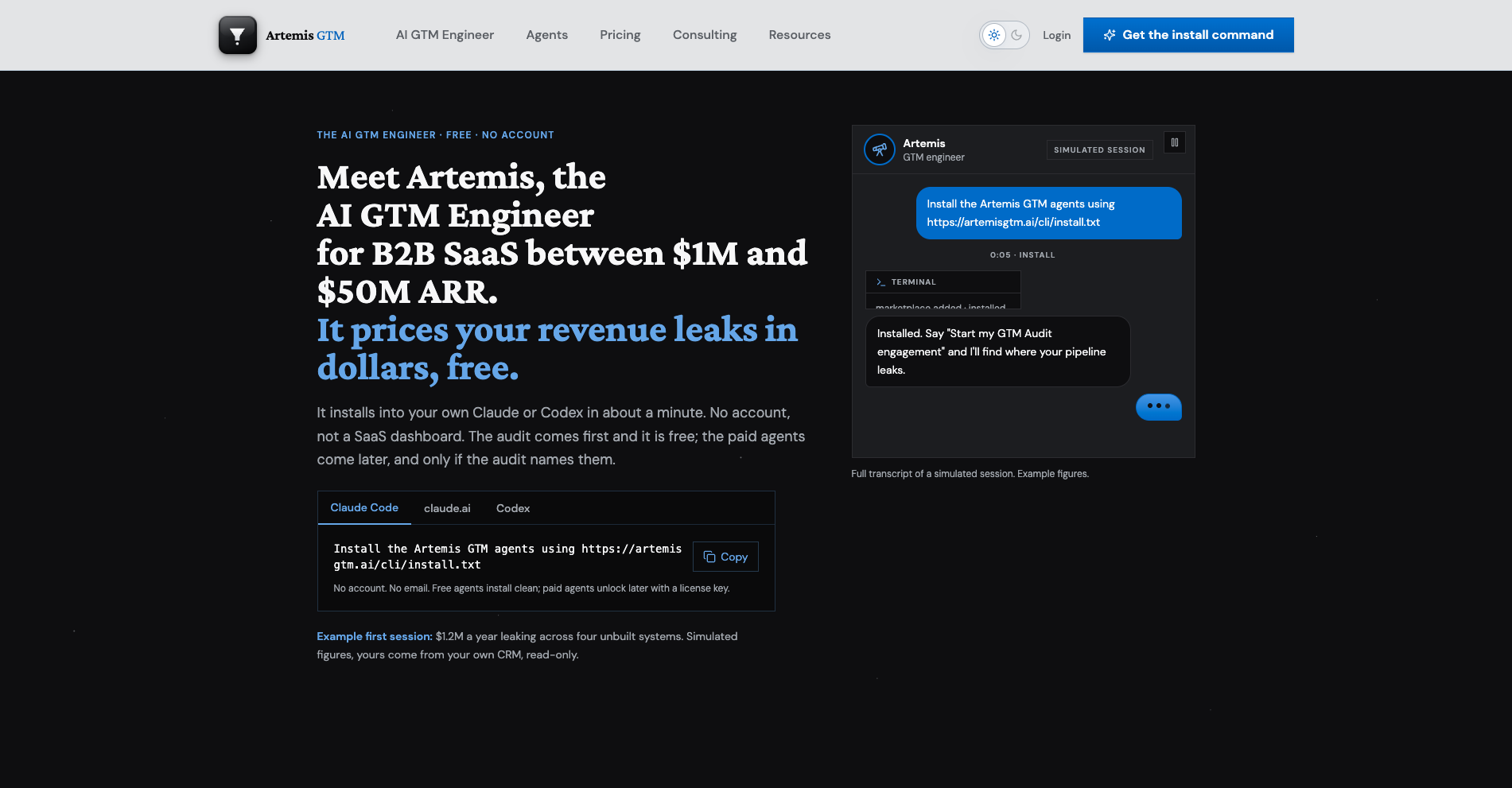
Best for: B2B SaaS companies at $1M–$100M ARR that need working revenue systems built across six specific operational functions on a fixed-fee, time-bounded engagement rather than an open-ended CRM implementation project
Artemis GTM is a SaaS-specific RevOps consultancy that builds, fixes, and operates the six systems it identifies as the foundation of a functioning revenue operation: Content, Outbound, Nurture, Conversion, Qualification, and AI RevOps. Their fixed-fee 12-week engagement model is a structural differentiator: the scope is defined, the timeline is set, and the fee is not dependent on the number of hours consumed. For B2B SaaS companies that have had open-ended RevOps retainers produce an incomplete system rather than a functioning one, this time-bounded model provides a different kind of accountability.
Their research identifies two specific gaps that appear most frequently in B2B SaaS RevOps programmes between $1M and $100M ARR: 74% of companies in this range are missing an AI RevOps dashboard layer, and 81% are missing qualification automation that routes leads within five minutes of form submission. Both gaps are directly addressable within their six-system model. The AI RevOps dashboard layer connects product usage data, CRM pipeline, and marketing attribution into one commercial view. The qualification automation removes the manual routing delay that allows lead intent to decay between submission and sales contact.
Their positioning addresses the most common RevOps engagement failure directly: a clean Salesforce or HubSpot instance that still does not generate pipeline because the outbound system feeding the CRM was never fixed. Their six-system model treats the outbound and content infrastructure as RevOps responsibilities rather than separate marketing functions.
Key services
Six-system SaaS RevOps buildout: Content, Outbound, Nurture, Conversion, Qualification, and AI RevOps designed as one connected infrastructure
AI RevOps dashboard layer: product usage data, pipeline attribution, and commercial reporting in one view
Qualification automation: lead routing within five minutes of submission with ICP-calibrated scoring
Fixed-fee 12-week engagement with defined scope and delivery milestones
Outbound infrastructure built as part of the RevOps model, not handed back to marketing as a separate function
Why Artemis GTM stands out for B2B SaaS RevOps
Six-system model addresses the full revenue operating infrastructure rather than the CRM configuration alone, including the outbound and content layers that most RevOps agencies treat as someone else's problem
Fixed-fee 12-week structure creates delivery accountability that open-ended retainers do not
AI RevOps dashboard layer addresses the specific visibility gap that 74% of B2B SaaS companies at this stage are missing
Qualification automation within five minutes of submission addresses the lead intent decay that open routing queues produce, improving SQL conversion from the same lead volume
Best fit: B2B SaaS companies at $1M–$100M ARR that have engaged a RevOps agency before and received a cleaner CRM rather than a working revenue system, and need a time-bounded, scope-defined engagement that builds the six operational systems required for the CRM to actually generate pipeline.
3. Aptitude 8
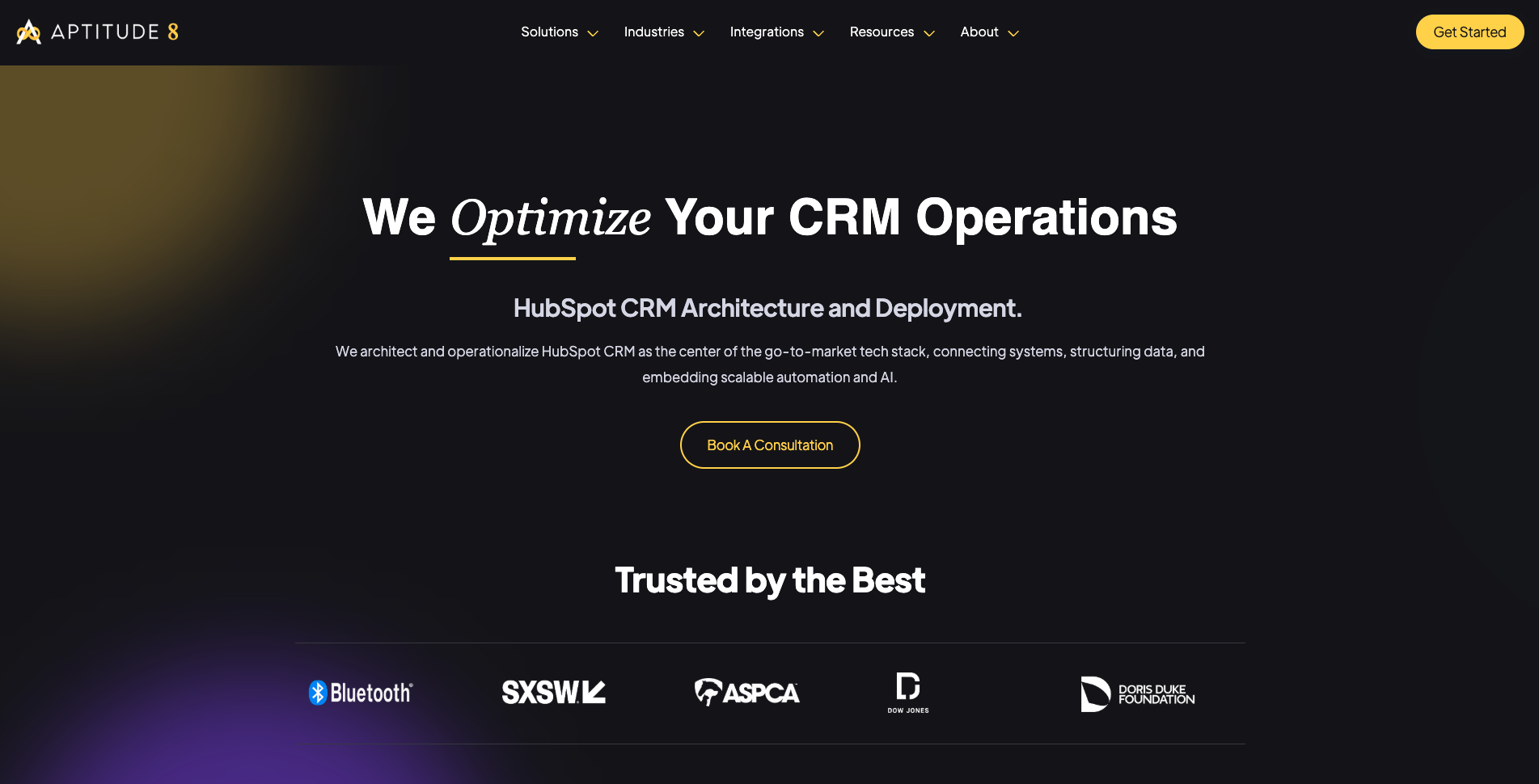
Best for: Series A–B B2B SaaS companies committed to HubSpot that need SaaS-specific lifecycle stages, ARR tracking, expansion revenue architecture, and PLG qualification logic built by a team that understands the SaaS commercial model
Aptitude 8 is a HubSpot-specialist RevOps agency with explicit B2B SaaS commercial model depth. Their technical HubSpot capability covers the full suite, including Operations Hub, which provides the data transformation and automation layer that most HubSpot implementations never correctly configure. For B2B SaaS specifically, their practice covers the SaaS lifecycle architecture that generic HubSpot implementations miss: ARR and MRR tracking built as HubSpot custom objects, expansion and upsell deal pipelines designed separately from new logo pipelines, customer success data integrated into the commercial reporting layer, and PLG qualification logic that reads product usage signals alongside marketing engagement data.
Their positioning is explicit about what generic HubSpot implementations miss for SaaS companies: a CRM set up for a linear sales funnel cannot correctly measure a business where the initial sale is the beginning of the commercial relationship rather than the endpoint. Aptitude 8 builds the HubSpot architecture that accounts for the full SaaS lifecycle, from first marketing touch through initial close through expansion through renewal, as one connected data model.
Their track record includes documented HubSpot RevOps implementations for B2B SaaS companies at Series A and B, with specific experience in the ARR lifecycle architecture and PLG qualification logic that this stage requires.
Key services
HubSpot Operations Hub configuration and advanced automation
SaaS ARR and MRR tracking built as custom objects in HubSpot
Expansion and upsell pipeline architecture separate from new logo pipeline
PLG qualification logic reading product usage signals alongside marketing engagement
Customer success integration: churn signals, renewal probability, and expansion triggers in the RevOps model
Full-funnel attribution from first marketing touch to ARR recognised
Why Aptitude 8 stands out for B2B SaaS RevOps
SaaS commercial model depth: ARR tracking, expansion pipeline, and PLG qualification built correctly rather than adapted from a linear sales CRM configuration
Operations Hub expertise provides the data transformation layer that makes complex SaaS lifecycle logic possible in HubSpot without custom development
Customer success in the RevOps model: NRR and GRR are measurable from the same system as new logo pipeline, not calculated separately from a disconnected CS tool
Expansion revenue architecture separates upsell and cross-sell pipeline from new logo pipeline, producing accurate ARR growth forecasting for boards that evaluate these motions differently
Best fit: Series A–B B2B SaaS companies committed to HubSpot as their CRM platform that need the SaaS commercial architecture built correctly: ARR tracking, expansion pipeline, PLG qualification, and customer success data all in the same revenue operations model, not configured as separate HubSpot properties for separate teams.
4. Avidly
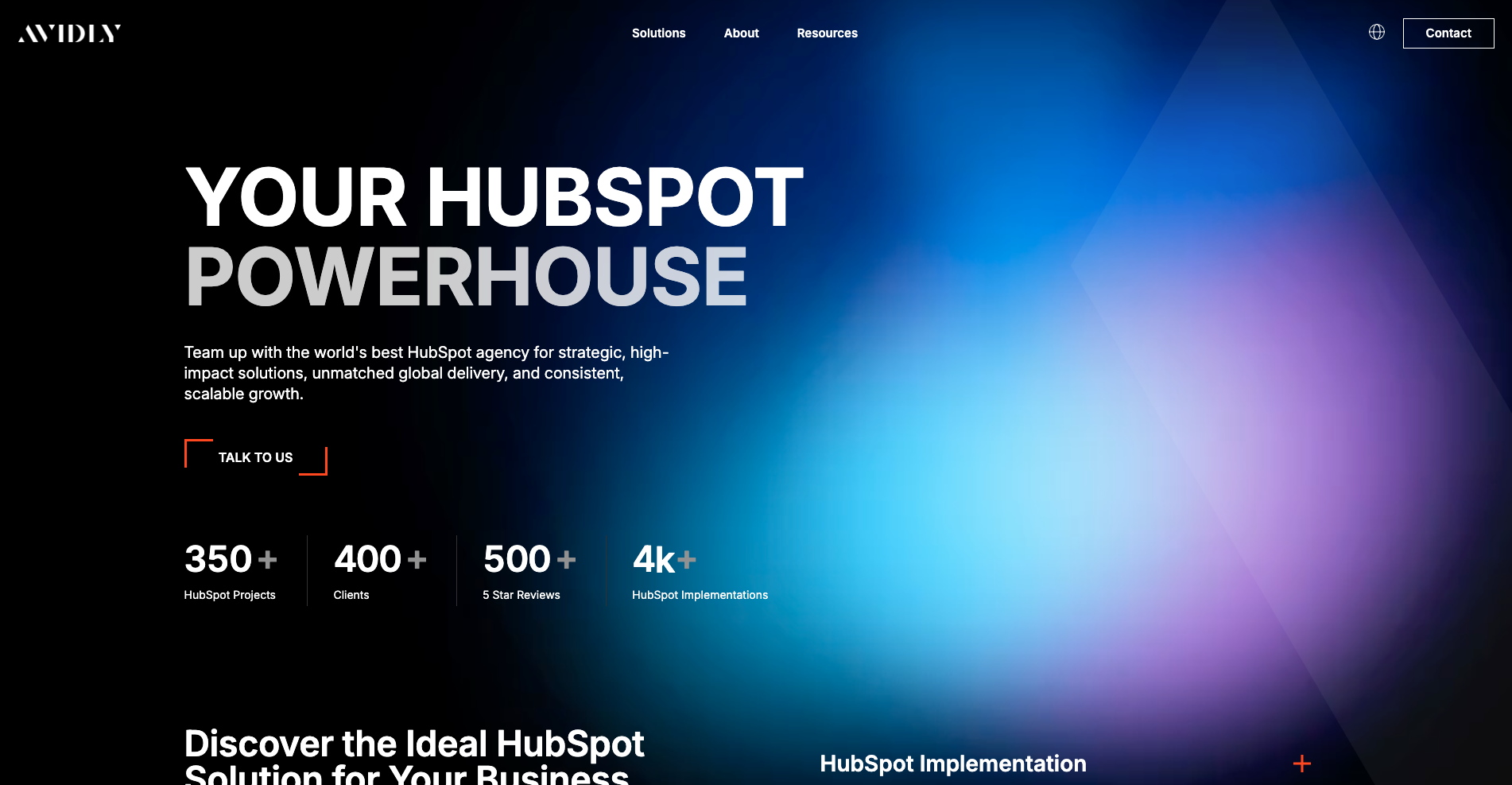
Best for: Series A–C B2B SaaS companies on HubSpot operating across multiple European and North American markets that need RevOps built for multi-region GTM with local market compliance and reporting requirements
Avidly is a global HubSpot Elite agency with operations across Canada, the UK, Germany, and the Nordics, making it the most internationally distributed of any agency on this list. Their relevance to B2B SaaS RevOps is in the multi-region architecture that most HubSpot implementations handle poorly: a SaaS company selling across five European markets from a centralised CRM faces data residency requirements, GDPR compliance in attribution and lead processing, multi-currency ARR tracking, and regional pipeline reporting that single-market CRM configurations were never designed to produce.
Avidly builds HubSpot RevOps architecture that accounts for these multi-region constraints from the start rather than retrofitting compliance and localisation after the system is running. Their team includes native-speaking HubSpot specialists across the markets they serve, which matters for the specific difference between a DACH HubSpot configuration and a UK one: regulatory context, data handling requirements, and the commercial stage definitions that align with regional buying behaviour are each market-specific.
As one of the few Elite HubSpot agencies worldwide with over 200 customer reviews in HubSpot's Partner Directory, their implementation depth is externally validated at a scale that most comparable agencies have not reached.
Key services
HubSpot Elite RevOps implementation across multiple European and North American markets
Multi-region CRM architecture: GDPR-compliant lead processing, multi-currency ARR tracking, and regional pipeline reporting
HubSpot alignment across marketing, sales, and customer service
Brand experience, PR, and web development alongside RevOps implementation
System integration connecting HubSpot to the regional tech stack each market uses
Why Avidly stands out for B2B SaaS RevOps
Multi-region HubSpot architecture with native-speaking specialists in each market: implementation accounts for local compliance, data handling, and commercial context rather than applying a single-market template globally
Elite HubSpot partner status with 200-plus customer reviews provides externally validated implementation depth
GDPR-compliant lead processing and attribution built into the architecture for European markets, not added as a compliance layer after the system is live
Multi-currency ARR tracking allows international SaaS boards to see revenue performance by market in the currency and metric context relevant to each region
Best fit: Series A–C B2B SaaS companies on HubSpot with GTM across multiple European or North American markets where the current CRM architecture was built for one market and is producing inconsistent pipeline reporting and attribution across regions.
5. FullFunnel.io
Best for: B2B SaaS with enterprise sales motions needing ABM and RevOps built as one connected programme, where the pipeline the ABM programme generates needs to be visible, attributed, and routed through the same RevOps infrastructure as all other demand sources
FullFunnel.io is an ABM-led demand generation and RevOps agency for B2B companies. Their specific relevance to B2B SaaS RevOps is in the architecture problem that appears when ABM and RevOps are owned by different teams: the account-based programme generates engagement from named target accounts, but the CRM cannot tell whether that engagement is influencing pipeline because the ABM attribution was never integrated with the RevOps model. The board sees ABM spend and a pipeline number. Neither number connects to the other.
FullFunnel.io builds ABM and RevOps as one connected programme: the target account list feeds the CRM as a named account segment with engagement tracking; pipeline attribution connects ABM touches to opportunity creation and deal progression; account scoring in the CRM reflects both ABM engagement and product usage signals; and the RevOps layer routes sales team attention toward the accounts the ABM programme is actively warming.
Their methodology is designed for the specific enterprise SaaS sales motion where a decision takes 6–12 months, involves 5–8 stakeholders, and requires marketing to maintain account-level presence across the full evaluation period rather than handing a lead to sales and stepping back. The RevOps infrastructure they build reflects this reality: attribution spans the full evaluation period, account-level pipeline reporting is the primary view, and individual contact-level MQL reporting is a secondary signal rather than the primary measure of marketing contribution.
Key services
ABM strategy and execution connected to RevOps pipeline reporting
Named account architecture in CRM: target account segments, engagement tracking, and ABM influence attribution
Account-level pipeline reporting: ABM touch influence on opportunity creation and deal progression
Multi-stakeholder engagement tracking across long enterprise evaluation cycles
Sales routing and account prioritisation built around ABM engagement signals
Attribution modelling for 6–12 month enterprise SaaS buying journeys
Why FullFunnel.io stands out for B2B SaaS RevOps
ABM and RevOps built as one programme: the attribution model is designed for the ABM engagement journey from the start, not retrofitted after the ABM programme is running
Account-level pipeline reporting reflects enterprise SaaS sales reality: a view of named account progression is more useful than a count of individual contact MQLs when the buying unit is a committee rather than a single decision-maker
Multi-stakeholder engagement tracking across the full 6–12 month evaluation period provides the RevOps visibility that shorter attribution windows miss
Sales routing built around ABM signals means the sales team prioritises the accounts the programme is actively warming rather than working a generic pipeline queue
Best fit: B2B SaaS companies with average contract values above €50k and enterprise sales cycles of 6 months or more, where the primary RevOps need is connecting the account-based demand programme to pipeline attribution and sales routing in one coherent infrastructure.
Why dimartec Approaches B2B SaaS RevOps Differently
Every agency on this list addresses a specific dimension of the B2B SaaS RevOps problem. Artemis GTM builds the six operational systems that most RevOps programmes miss on a fixed-fee timeline. Aptitude 8 implements the SaaS commercial architecture in HubSpot that generic implementations skip. Avidly builds multi-region RevOps for SaaS companies whose GTM spans European and North American markets simultaneously. FullFunnel.io connects ABM demand generation to pipeline attribution and sales routing as one programme.
Each of them configures the revenue operations infrastructure correctly for the motion they are designed for. None of them owns the acquisition layer feeding that infrastructure. When the RevOps system is built by one agency and the acquisition channels are managed by another, the attribution model reflects the data available rather than the commercial reality: the leads attributed to each channel reflect the channel's volume and the last-touch signal the CRM can see, not the full influence of each channel on the ARR that closed.
dimartec builds the acquisition and RevOps layers as one system. Lead Gen & Nurturing ensures the leads entering the CRM are qualified against the same standard the RevOps model uses to route them. Performance Paid Media produces the pipeline data that the RevOps attribution model reads. GEO builds the AI search discovery layer and ensures the attribution model is designed to handle buyers who arrive without a traceable first touch rather than absorbing them into unattributed direct traffic. RevOps & Automation connects all of it to closed ARR data, making the commercial model readable and the board conversation evidenced rather than assembled.
See how the Revenue Engine works: https://www.dimartec.co.uk/services/revenue-engine
How to Choose the Right RevOps Agency for B2B SaaS
Verify SaaS commercial model depth before CRM expertise
Every RevOps agency has CRM experience. The relevant question for B2B SaaS is whether the agency has built ARR tracking, NRR measurement, expansion pipeline architecture, and PLG qualification logic specifically. Ask any agency you evaluate to describe how they build ARR and MRR tracking in the CRM. If the answer describes deal stages and revenue fields but does not mention customer success data integration, expansion pipeline as a separate motion, or PLG product usage signals, the agency understands CRM configuration for SaaS but not SaaS commercial model architecture.
Require full lifecycle scope, not just initial acquisition
A RevOps programme that stops at the initial sale produces a model that cannot forecast net revenue retention, cannot identify expansion opportunity, and cannot see churn signals before they appear in the revenue number. For B2B SaaS companies where NRR above 100% is a board-level metric, the RevOps infrastructure must include customer success data in the same model as sales and marketing. Ask specifically: how does the agency incorporate customer success data into the RevOps programme? If the answer involves a separate CS tool that is not connected to the CRM, the model cannot produce the NRR and GRR figures the board requires.
Assess attribution for AI-discovered buyers
In 2026, a growing proportion of B2B software buyers begin their evaluation in an AI chatbot rather than a search engine. A CRM architecture built before this shift absorbs those buyers into unattributed direct traffic. The RevOps agency that accounts for this builds attribution that can handle buyers arriving without a traceable first touch, not one that assigns them to the closest preceding channel and produces a systematic misattribution of AI search influence. Ask any agency how their attribution model handles AI-discovered buyers before evaluating their last-touch reporting.
Frequently Asked Questions
What is B2B SaaS RevOps and how does it differ from standard RevOps?
B2B SaaS RevOps applies revenue operations principles to the specific commercial mechanics of subscription software: ARR and MRR measurement, Net Revenue Retention and Gross Revenue Retention tracking, expansion and upsell pipeline architecture, PLG trial-to-paid qualification logic, and churn signal identification from customer success data. Standard RevOps frameworks are designed for a single-motion sales process where the initial sale is the primary commercial event. SaaS RevOps is designed for a full-lifecycle commercial model where the initial sale is the beginning of a recurring revenue relationship that must be measured, attributed, and forecasted across acquisition, expansion, and retention simultaneously.
What RevOps capabilities does a B2B SaaS company need at Series A?
At Series A, the minimum viable RevOps infrastructure covers: a CRM with ARR and MRR tracking built as custom objects; pipeline stage definitions agreed by marketing and sales with CRM-enforced entry criteria; lead scoring calibrated to closed-won data rather than assumed ICP criteria; attribution connecting marketing spend to closed ARR; and the first version of a customer success integration producing churn signals and renewal probability. Companies that delay building this infrastructure until Series B face two to three quarters of retro-attribution work and a board that has been making decisions from incomplete data.
Why do most RevOps engagements fail to produce a working revenue system?
The most common failure mode is scope misalignment: the engagement is bought as a CRM implementation and delivered as a CRM implementation, leaving the outbound infrastructure, the qualification automation, the attribution model, and the customer success integration as out-of-scope items the client is expected to build separately. A CRM without these four layers is a well-organised contact database that does not generate pipeline. The agencies that produce working revenue systems define the full scope of what is needed before configuring anything, rather than scoping to what the CRM platform can do and leaving the rest for the client.
Build a Revenue System Your SaaS Board Can Trust
The difference between a B2B SaaS company whose board trusts the quarterly revenue forecast and one whose board reconciles it manually is the presence of a revenue operating model that measures ARR, NRR, expansion, and acquisition as one connected commercial system, attributed correctly and routed consistently. The CRM is the tool. The system is what makes it produce the numbers the board actually needs.
The Revenue Engine connects Performance Paid Media, CRO, GEO, Lead Gen & Nurturing, and RevOps & Automation into one build so the acquisition channels and the revenue operating model are designed together, the attribution reflects the full SaaS commercial journey rather than the last-touch signal, and the board forecast is a product of the system rather than an assembly of dashboards that were each built to answer a different question.
See how the Revenue Engine works: https://www.dimartec.co.uk/services/revenue-engine




.png)







.png)
















































.png)
.png)
.png)
.png)
.png)
.png)
.png)
.png)
.png)
.png)