A company that sells accounts payable automation, treasury software, a payments API, or a compliance platform on subscription lives in two worlds at once. To its investors, it is a SaaS business, judged on annual recurring revenue, net retention, and payback. To its buyers, it is a financial vendor, judged on security, regulatory standing, and whether the finance team can trust it with money and data.
Most marketing advice is written for one world or the other. SaaS playbooks talk about trials, product-led growth, and conversion rates, and say little about compliance review or the caution of a chief financial officer. Financial services marketing talks about trust and regulation, and says little about pipeline velocity, expansion revenue, or the economics of a monthly subscription. A fintech SaaS company needs both, and often discovers that its agency only speaks one of the two languages.
After analysing growth programmes across more than 200 B2B SaaS and fintech accounts, the fintech SaaS companies that scale efficiently tend to run marketing that satisfies both audiences at once. Their messaging is precise enough for a risk officer, their funnel is measured as tightly as any SaaS business, and their content answers the questions finance teams actually ask before they sign.
This guide compares five marketing agencies that work in that overlap, with a clear view of which side of it each one is strongest on.
Where Fintech SaaS Marketing Differs From Both Parents
Fintech SaaS inherits habits from both SaaS and financial services marketing. Four differences shape what it needs from an agency.
The buyer is finance, and finance is sceptical by training. Many fintech SaaS products are bought by controllers, treasurers, finance directors, or compliance leads. These people read claims looking for what could go wrong. Messaging that would excite a growth marketer can unsettle them.
Security and compliance are part of the product, not a footnote. For general SaaS, a security page is a box to tick. For fintech SaaS, certifications, data handling, and regulatory coverage are often the deciding factors, and marketing has to present them as clearly as features.
The sales motion is often mixed. Smaller customers may sign up through a self-serve flow, while larger ones go through demos, procurement, and security review. Marketing has to feed both paths and measure each properly.
Revenue grows after the first sale. Fintech SaaS frequently earns more from expansion, through added entities, users, transaction volume, or modules, than from the initial contract. Marketing that stops at acquisition misses where much of the value lies.
An agency that knows SaaS but not finance will write claims that compliance rewrites. An agency that knows finance but not SaaS will build awareness without a measurable funnel. The useful ones handle both.
The Subscription Layer: Marketing After the Contract Is Signed
For many fintech companies, the sale is the end of the marketing story. For fintech SaaS, it is closer to the middle.
A finance automation platform might start with one entity and expand to twelve. A payments API might begin with a single use case and grow as transaction volume rises. A compliance tool might add modules as regulations change. In each case, the customer's lifetime value depends heavily on what happens after onboarding, and marketing has a role in it: product education, announcements of new capabilities, customer stories that encourage adoption, and nurture programmes that surface expansion opportunities for account managers.
The same is true in reverse. Churn in fintech SaaS is often quiet. A customer stops using a module, reduces volume, or delays a renewal while evaluating alternatives. Marketing that only measures new pipeline cannot see these signals.
When comparing agencies, it is worth asking how each one treats existing customers. Some focus almost entirely on acquisition. Others build lifecycle programmes and connect them to the CRM, so expansion and retention can be measured as clearly as new business. For a subscription business, the second approach usually produces more revenue from the same budget.
How We Chose These Agencies
- Fintech evidence: Named fintech or financial software clients, or a stated fintech practice with visible work.
- SaaS fluency: Experience with subscription metrics, mixed sales motions, and SaaS funnels.
- Credibility handling: A visible approach to accuracy, claims, and trust signals for finance buyers.
- Measurement: Work connected to pipeline, revenue, or customer lifecycle, not only awareness.
- Evidence: Reviews, partner status, case studies, or recognised clients.
Each profile states which side of the fintech and SaaS overlap the agency is strongest on, and what a company would still need from elsewhere.
The 5 Best B2B Fintech Marketing Agencies for SaaS Companies
1. dimartec
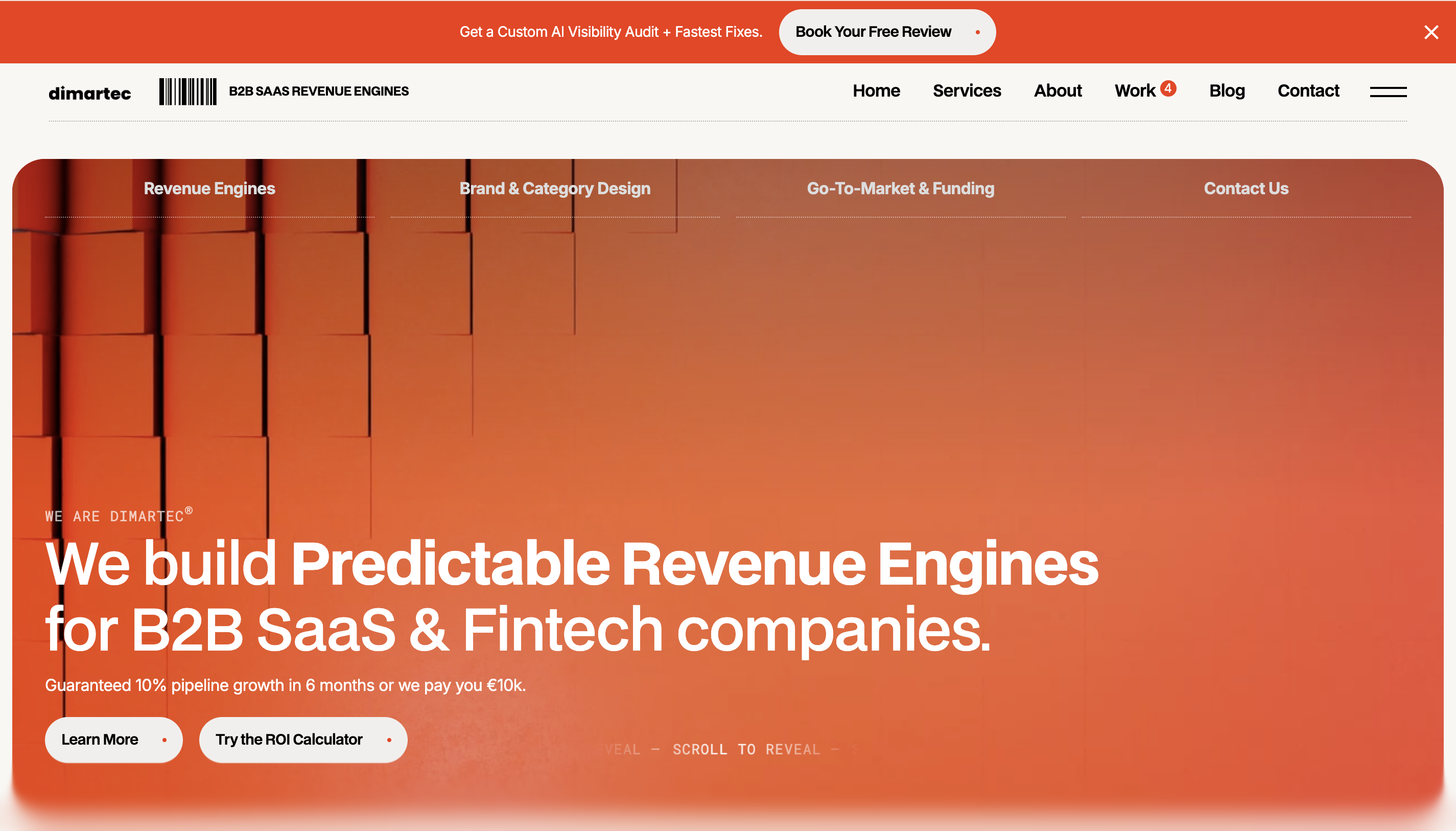
Best for: B2B fintech and SaaS companies at €2M–€10M ARR that want acquisition, conversion, nurturing, and revenue reporting built as one system, with messaging finance buyers trust
dimartec builds Predictable Revenue Engines for B2B SaaS and fintech companies, and works only with businesses in those two categories. The Revenue Engine connects five pillars into one operating system: Performance Paid Media, Full-Funnel CRO, GEO, Lead Gen & Nurturing, and RevOps & Automation. That combination fits fintech SaaS well, because it covers both the SaaS funnel and the trust-building that financial buyers need.
AI search visibility gets the company found when finance teams research unfamiliar vendors in tools such as ChatGPT. Performance Paid Media brings in the right roles and company types, with results tied to acquisition cost and closed revenue. Full-Funnel CRO converts visitors with pages built for cautious buyers. Lead Gen & Nurturing covers demand capture, nurture journeys, qualification, and reactivation, which supports both long evaluations and later expansion. RevOps & Automation sets up the CRM, scoring, routing, and reporting so every stage can be measured.
The engagement begins with a two-to-four-week Diagnostic and continues as a six-month build, ending with playbooks, dashboards, and workflows handed to the client's team. dimartec handles implementation, and the client team's input is around five hours in total. Its clients include iDenfy, an identity verification SaaS for regulated industries, and Pilsenga, a Baltic B2B payments provider. A payments fintech client reports adding 40 new clients after dimartec built an acquisition engine beyond its founder and partner network.
dimartec suits fintech SaaS companies when:
- Paid spend is rising but conversion and pipeline are flat
- Leads arrive but too few become sales-ready
- Reporting is split across tools and nobody trusts the numbers
- Growth still depends on founders' and partners' networks
Key services
- Performance Paid Media: Google, LinkedIn, and Meta tied to acquisition cost and revenue
- Full-Funnel CRO: funnel audits, landing pages, testing, and tracking
- GEO: visibility when finance buyers research vendors in AI search
- Lead Gen & Nurturing: nurture journeys, qualification, and reactivation
- RevOps & Automation: CRM, scoring, routing, handoffs, and reporting
Why dimartec stands out for fintech SaaS
- Works only with B2B SaaS and fintech companies
- Covers both the SaaS funnel and fintech trust-building
- Defined six-month build with handover to the client team
- Measured on cost per SQL, lead-to-SQL rate, and payback
Best fit: Fintech SaaS companies that want one accountable team for the whole revenue system, owned in-house at the end.
2. Walker Sands
Best for: Fintech SaaS companies that need market credibility and PR alongside demand generation
Walker Sands is an integrated B2B marketing agency founded in 2001 in Chicago, with offices in Chicago, Seattle, and Boston and more than 100 clients. It began in public relations and has expanded into strategy, content, creative, digital marketing, and marketing operations, including through the acquisition of B2B demand generation agency KoMarketing. Its Outcome-Based Marketing framework ties programmes to business results. Fintech clients cited in independent roundups include Billtrust, Bill.com, Hyperwallet, ZayZoon, and TransUnion.
For fintech SaaS, the PR heritage is the main draw. Finance buyers and investors look for third-party validation: coverage in respected publications, analyst attention, and visible thought leadership. Walker Sands can build that alongside campaigns, which helps a lesser-known fintech SaaS company appear credible quickly.
Its size and breadth suit growth-stage and larger companies. Smaller fintech SaaS businesses should check minimum engagement levels.
Key services
- Fintech PR and media relations
- Messaging and positioning
- Demand generation and digital marketing
- Content and creative
- Marketing operations
Why Walker Sands stands out for fintech SaaS
- Long record in B2B fintech PR
- Recognised fintech software clients
- Combines credibility building with demand generation
- Outcome-based framework
Best fit: Growth-stage fintech SaaS companies where reputation and media presence matter. Less suited to early-stage budgets.
3. ARISE GTM
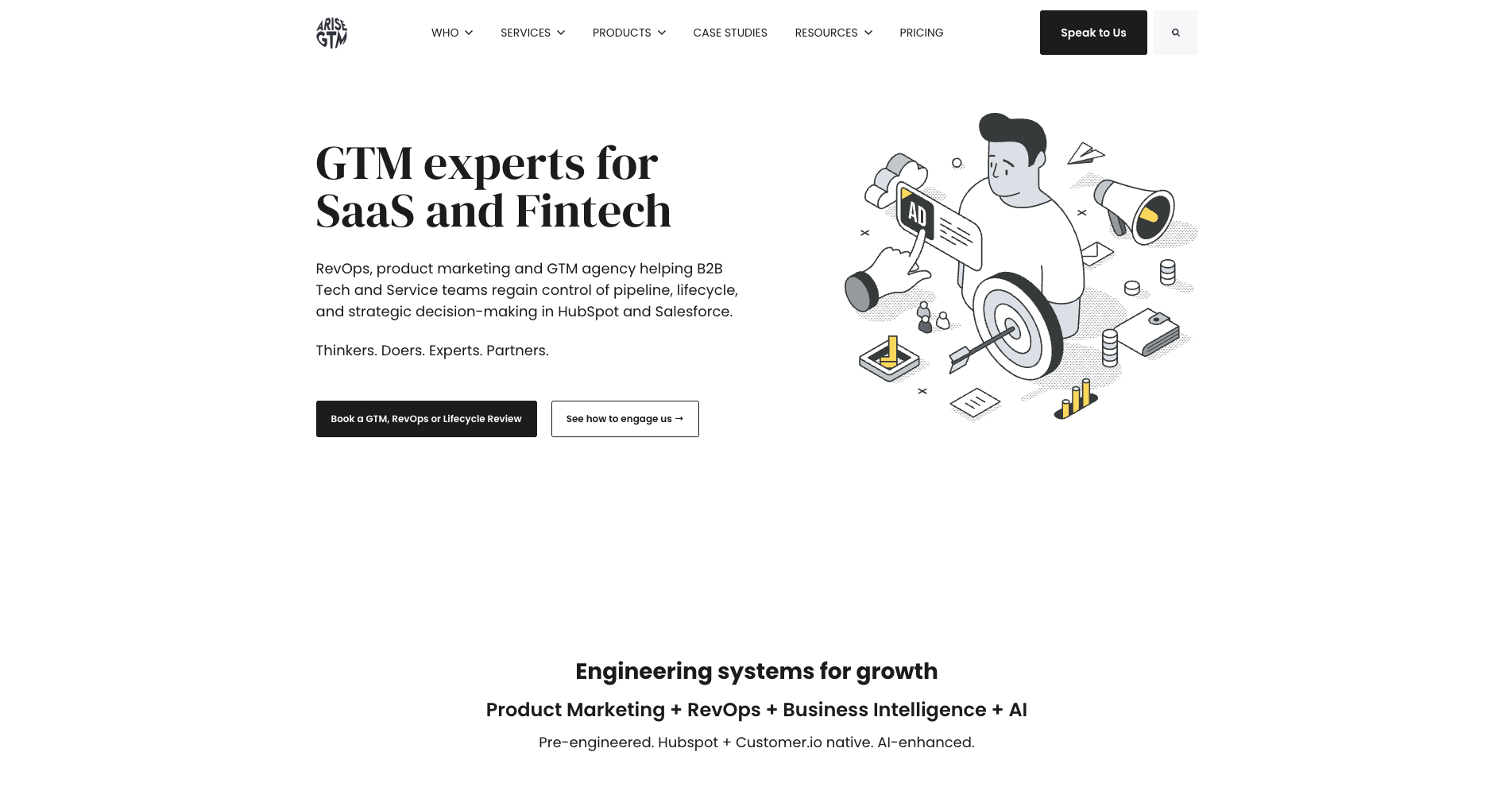
Best for: HubSpot-based fintech SaaS companies that want go-to-market strategy, RevOps, and lifecycle automation built together
ARISE GTM is a UK-based go-to-market and RevOps consultancy founded in 2017 by Paul Sullivan, a former CTO and CMO and author of Go-To-Market Uncovered (Wiley, 2025). It is a HubSpot Platinum Solutions Partner with a 4.9 rating on HubSpot's directory, and it focuses on B2B SaaS and fintech companies. Its ARISE OS methodology combines GTM strategy, RevOps architecture, lifecycle automation, and business intelligence reporting into a pre-built system that is then customised to each client. Clients include capital markets fintech HubX Capital.
For fintech SaaS, its emphasis on lifecycle and retention automation is relevant, given how much revenue depends on expansion after the first sale. It also handles the connection between product usage signals and revenue workflows, which matters for companies with self-serve and sales-led paths.
Its own comparison articles state a minimum engagement of around £7,500 a month. It is HubSpot-native, so Salesforce users will find a narrower fit.
Key services
- GTM strategy and product marketing
- HubSpot RevOps architecture
- Lifecycle and retention automation
- Business intelligence reporting
- Sales enablement
Why ARISE GTM stands out for fintech SaaS
- Focus on B2B SaaS and fintech
- Strong lifecycle and retention capability
- HubSpot Platinum partner
- Published GTM methodology
Best fit: Fintech SaaS companies committed to HubSpot that need strategy and systems together. Less suited to Salesforce environments or very small budgets.
4. Bay Leaf Digital
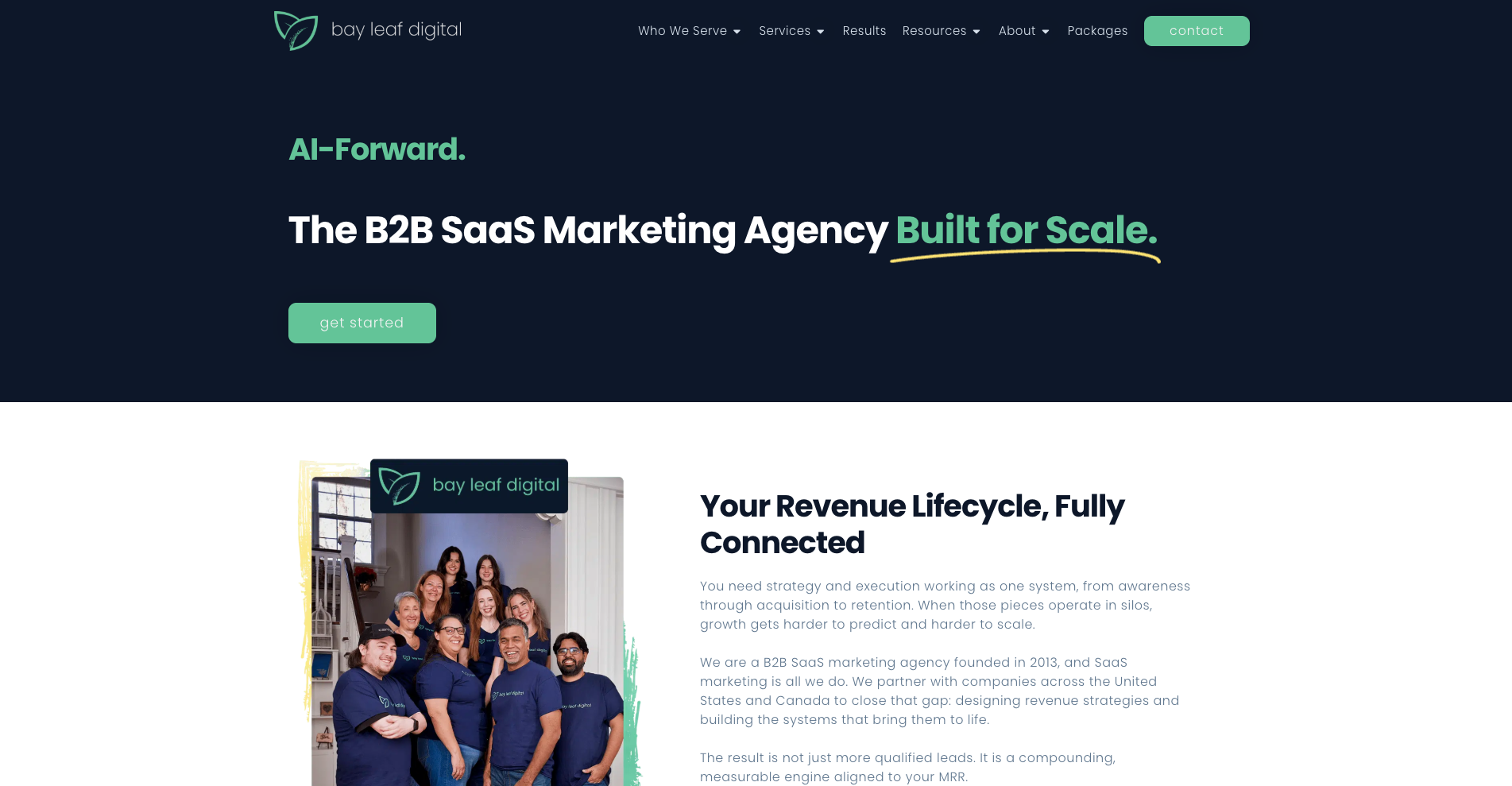
Best for: Fintech SaaS companies that want a full-service SaaS marketing agency with a dedicated fintech practice
Bay Leaf Digital is a North Texas B2B SaaS marketing agency founded in 2013 by CEO Abhi Jadhav. It works only with SaaS and tech companies, with vertical practices including fintech, and runs a dedicated fintech marketing service for digital finance, accounting technology, and payment technology companies. It is a HubSpot Gold partner and covers SEO, paid media, content, social, CRM work, and analytics.
Its strength for fintech SaaS is SaaS funnel discipline applied to a fintech audience: building plans from scratch for each client, generating leads through search, paid, and LinkedIn, and reporting on traffic, leads, and revenue. Its stated aim of simple messages about complex solutions suits products that finance buyers find hard to evaluate. Clutch reviewers frequently praise its project management and engagement.
It is a generalist SaaS agency with a fintech practice, not a fintech specialist, so companies should ask for fintech-specific examples.
Key services
- SaaS marketing strategy
- SEO and content
- Paid media and LinkedIn
- HubSpot implementation and automation
- Analytics and reporting
Why Bay Leaf Digital stands out for fintech SaaS
- SaaS-only focus since 2013
- Dedicated fintech marketing practice
- Full-funnel coverage
- Strong client reviews on delivery
Best fit: Fintech SaaS companies wanting broad SaaS marketing execution. Those needing deep regulatory content should pair it with a specialist.
5. Mint Studios
Best for: Fintech SaaS companies whose expertise is their strongest selling point and needs turning into content
Mint Studios is a content marketing agency that works only with fintech and financial services companies. Its clients include Modulr, Zai, Jeeves, Persona, GBG, and ClearBank, many of them B2B fintech platforms sold on subscription or usage. Founder and managing director Araminta Robertson built the agency around proving that fintech content creates pipeline.
Its method builds bottom-of-funnel content from interviews with clients' own experts, tracks performance through to pipeline, and pairs SEO with AI search optimisation. For fintech SaaS, that matters because finance buyers search for detailed answers, such as how a product handles reconciliation, compliance, or integration, and trust vendors that answer them accurately.
Mint Studios handles content only, so paid media, conversion, and CRM need other partners.
Key services
- Bottom-of-funnel content strategy
- Expert interview-led writing
- SEO and AI search optimisation
- Content attribution
- Editing and publishing
Why Mint Studios stands out for fintech SaaS
- Fintech-only client base
- Strong roster of B2B fintech platforms
- Content built from real product expertise
- Measured against pipeline
Best fit: Fintech SaaS companies with deep expertise to share. Not a substitute for paid acquisition or RevOps.
Why dimartec Approaches Fintech SaaS Differently
The four other agencies each bring something valuable to a fintech SaaS company. Walker Sands builds reputation and media presence. ARISE GTM brings strategy and HubSpot operations. Bay Leaf Digital provides broad SaaS marketing execution. Mint Studios turns expertise into credible content.
Most lean towards one side of the overlap. Credibility work without a measured funnel leaves the company well regarded but unable to show what marketing produces. Funnel work without fintech fluency produces campaigns that compliance softens and finance buyers distrust. Operations work without acquisition gives a clean CRM with too little flowing into it.
dimartec is built for companies that need all of it at once. Because it works only with B2B SaaS and fintech businesses, its Revenue Engine joins AI search visibility, paid media, conversion, nurturing, and RevOps around the same buyer and the same numbers. The result is a fintech SaaS company that can attract cautious finance buyers, carry them through evaluation, and show its board which activity produced revenue, with the system handed to its own team after six months.
See how the Revenue Engine works: https://www.dimartec.co.uk/services/revenue-engine
Three Things to Check Before Hiring a Fintech SaaS Marketing Agency
One: Ask which world they come from. Find out whether the agency started in SaaS, in financial services, or in PR, and ask for examples that show the other side. A SaaS agency should show fintech work that passed compliance review. A fintech agency should show funnel metrics and subscription results.
Two: Ask how they handle existing customers. For a subscription business, expansion and retention matter as much as new business. Ask whether the agency builds lifecycle and customer marketing, and how it reports on expansion revenue.
Three: Ask who your buyer is in their view. A good agency will describe the finance roles involved, the questions each asks, and how security and compliance reviews affect the deal. Vague answers about "decision-makers" suggest the messaging will be generic.
Frequently Asked Questions
Should a fintech SaaS company hire a SaaS agency or a fintech agency?
It depends on where the company is weakest. If its funnel, measurement, and growth systems are the main gap, a SaaS-focused agency with real fintech experience is usually the better start. If credibility, regulated messaging, or industry presence is the gap, a fintech specialist may move faster. Agencies that combine both, or a pairing of two specialists, suit companies with gaps on both sides.
What channels work best for fintech SaaS?
Most combine search and LinkedIn for reaching finance buyers, expert content and AI search visibility for credibility, and lifecycle email for expansion. PR and industry events matter more than in many SaaS categories, because finance buyers rely on reputation. The right mix depends on deal size and whether the sales motion is self-serve, sales-led, or both.
How should fintech SaaS marketing be measured?
Use the same core measures as any SaaS company: pipeline by source, cost per qualified opportunity, conversion between stages, acquisition cost, and payback. Add measures that reflect the fintech context, such as how many deals stall in security or compliance review, and track expansion and retention as well as new revenue.
How do compliance requirements affect fintech SaaS marketing?
They depend on the product. Software that touches regulated activity, such as payments or lending, faces stricter rules on claims than general finance tools. In every case, claims about security, savings, or accuracy should be evidenced. Agencies with fintech experience draft within these limits from the start, which shortens review and keeps messages intact.
Market to Finance Buyers, Measure Like SaaS
Fintech SaaS companies sell to some of the most cautious buyers in business, on a model that rewards precise measurement and long customer relationships. The right agency speaks both languages: it earns the trust of finance teams and runs a funnel tight enough to show investors exactly what marketing produces, before and after the first contract.
The Revenue Engine connects Performance Paid Media, Full-Funnel CRO, GEO, Lead Gen & Nurturing, and RevOps & Automation into one system, built only for B2B SaaS and fintech companies.
See how the Revenue Engine works: https://www.dimartec.co.uk/services/revenue-engine