There is a moment, usually somewhere after €2M in annual recurring revenue, when a SaaS founder looks at next quarter's pipeline and realises where most of it came from. A former colleague who introduced a friend. An investor who made two calls. A conference panel that led to three good conversations. A referral partner who happened to have a busy month. Each deal was real, but very few of them came from anything the company could switch on again at will.
That is not a failure. It is how most B2B software companies reach their first few million. The difficulty is that the growth plan for the next stage assumes something different: a predictable flow of qualified conversations with companies that have never heard of the business, at a cost the unit economics can support. Networks do not scale on demand, and the sales team hired after the round needs more meetings than goodwill can supply.
After analysing pipeline sources across more than 200 B2B SaaS accounts, the companies that grow smoothly from €2M to €10M ARR are rarely the ones with the biggest lead volumes. They are the ones that built at least one repeatable source of qualified demand early, measured it honestly against closed revenue, and added a second source only when the first was working.
Lead generation companies offer very different ways to build that source. Some book meetings through outbound outreach. Some create inbound demand through search, content, and paid media. Some focus on a list of target accounts. This guide compares ten of them, with a clear view of which kind of SaaS company in this band each one suits.
Why Lead Generation Changes Between €2M and €10M ARR
Lead generation for a €3M SaaS company and for a €9M one are different jobs. Four changes explain why.
The volume needed rises sharply. Doubling revenue usually means more than doubling the number of qualified conversations, because new markets and new segments convert less predictably than the ones the founders knew.
The sales team becomes the customer. At €2M, the founders often take the first calls. By €5M, a team of account executives depends on marketing and SDRs for their week. A lead source that delivers erratically leaves expensive people idle.
Cost per opportunity starts to matter. Investors look at acquisition cost and payback. A channel that produces meetings at any price is no longer acceptable; it has to produce them at a price the business can sustain as it scales.
One channel is no longer enough. Most companies in this band need a blend: an outbound engine for control and speed, and inbound or account-based work for quality and compounding returns. The challenge is making several sources report into one pipeline, measured the same way.
The companies below each solve part of this. Which part matters most depends on where in the band a company sits and which source it already has working.
Outbound, Inbound, or Account-Based: The Three Routes
The ten companies in this guide take three broad routes to pipeline. Each has a different cost profile, speed, and risk.
Outbound means reaching out to companies that have not asked to hear from you, through email, LinkedIn, and phone. Belkins, Sopro, Martal Group, and CIENCE sit here. Its strengths are control and speed: campaigns can launch within weeks and target precisely the accounts a sales team wants. Its weakness is that it starts cold, so lead quality depends heavily on targeting, messaging, and how carefully meetings are qualified before they reach sales.
Inbound means attracting buyers who are already looking, through search, paid media, content, and AI search visibility. dimartec, Gripped, Kalungi, and Refine Labs lean this way, in different forms. Its strength is intent: inbound buyers usually convert better and cost less per customer once the engine is running. Its weakness is time, since content and search take months to build, and paid media gets expensive if pages and nurture are weak.
Account-based means choosing a defined list of target companies and engaging the people who buy at each one. FullFunnel.io specialises here, and Heinz Marketing runs such programmes. It suits high contract values and long cycles, where a small number of the right accounts matters more than volume.
Most SaaS companies in this band end up combining two routes. A common pattern is outbound for speed in the first months while an inbound engine is built, then a gradual shift towards inbound as it begins to compound.
How We Chose These Companies
- SaaS experience: Named SaaS clients or published SaaS case studies.
- Fit with the band: Pricing and engagement models within reach of a company between €2M and €10M ARR.
- Qualification: A visible approach to making sure leads or meetings meet an agreed standard.
- Measurement: Reporting that goes beyond meetings or leads towards pipeline and revenue.
- Range: Together, the ten cover outbound, inbound, account-based, and strategic routes.
Each profile notes the route the company takes and the kind of SaaS business it suits best.
The 10 Best B2B SaaS Lead Generation Companies for €2M–€10M ARR
1. dimartec
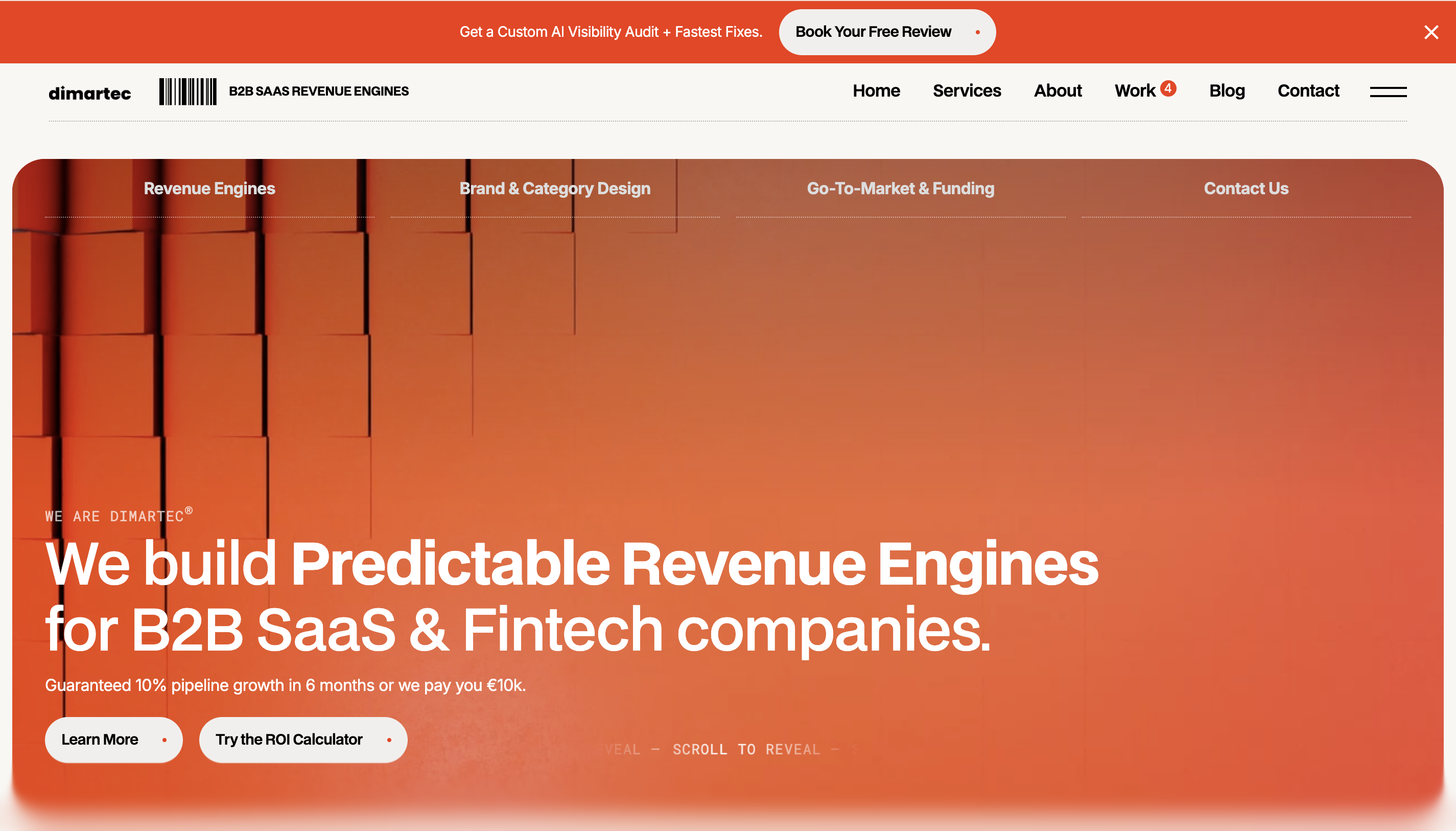
Best for: B2B SaaS and fintech companies at €2M–€10M ARR that want a lead system that captures demand, nurtures it until it is sales-ready, and reports every source against revenue
dimartec builds Predictable Revenue Engines for B2B SaaS and fintech companies. Lead Gen & Nurturing is one of five connected pillars, alongside Performance Paid Media, Full-Funnel CRO, GEO, and RevOps & Automation. The lead generation work covers demand capture and expansion, nurture journey design, lead qualification and scoring, and reactivation, with the stated aim of keeping the pipeline full, moving opportunities faster, and stopping good leads from going cold.
The approach starts from a point most lead generation suppliers skip. dimartec's view is that around 90% of leads are not sales-ready at first contact, and without nurturing they are lost. So the system is built to capture interest through paid media, AI search visibility, and converting pages, then carry it forward with nurture sequences until a lead meets an agreed qualification standard. RevOps & Automation handles scoring, routing, and handoff, and reports pipeline by source so the company can see which channels produce revenue.
Engagements begin with a two-to-four-week Diagnostic, followed by a six-month build. Lead generation goes live and nurture sequences are automated in months three and four, and the system is handed over with documentation at month six. dimartec reports that 90% of clients see improved lead quality within 90 days. A payments fintech client describes dimartec building an acquisition system beyond its founder and partner network that added 40 new clients.
dimartec suits companies in this band when:
- Pipeline still depends heavily on founders, investors, and partners
- Leads arrive but too few become sales-ready
- Good leads go cold because nobody follows up consistently
- Nobody can say which source produces closed revenue
Key services
- Lead Gen & Nurturing: demand capture, nurture journeys, qualification, scoring, and reactivation
- Performance Paid Media: Google, LinkedIn, and Meta tied to acquisition cost and revenue
- Full-Funnel CRO: pages and forms that convert and qualify
- GEO: visibility in AI search, where buyers research before visiting a site
- RevOps & Automation: scoring, routing, handoffs, and pipeline reporting
Why dimartec stands out for lead generation at €2M–€10M ARR
- Nurture built in, not left to the sales team
- Every source measured against pipeline and revenue
- Defined six-month build, owned by the client afterwards
- Only B2B SaaS and fintech clients
Best fit: Companies that want a lasting inbound and nurture engine with one accountable team, not another source of unqualified leads.
2. Belkins
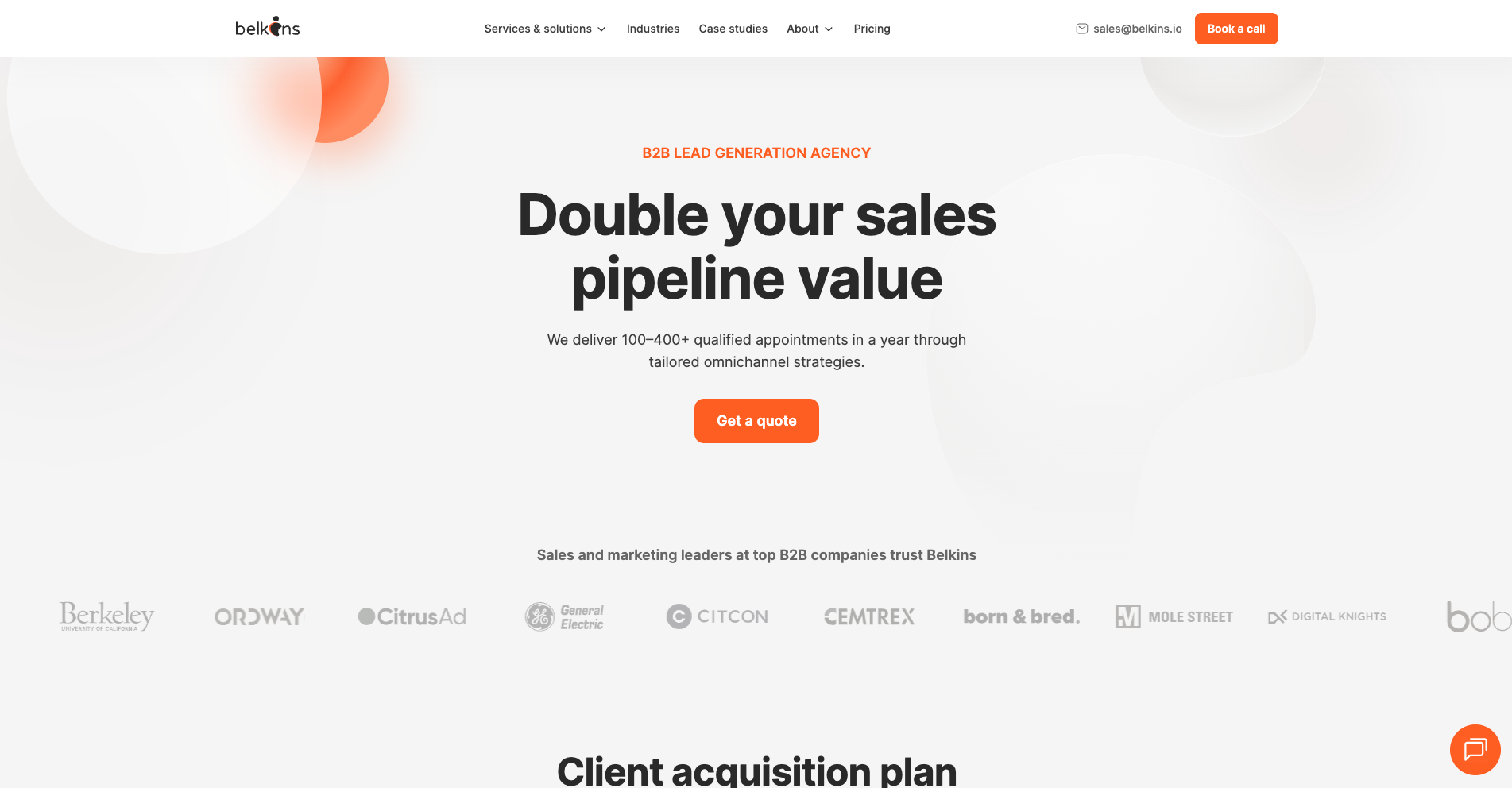
Best for: SaaS companies that need a steady flow of booked meetings quickly through managed outbound
Belkins is a B2B lead generation and appointment setting agency running omnichannel outreach across cold email, calling, and LinkedIn. It reports more than 100 SaaS clients, more than 67,200 deals generated, a 95% client retention rate, and campaigns launched within 14 days, with first results in 30 to 90 days. Clients listed on Clutch include HiBob, Autodesk, and NVIDIA, and its SaaS case studies include $2.2M in pipeline from 56 enterprise opportunities for sustainability platform Terrascope.
For a company in this band whose sales team needs meetings this quarter, Belkins offers speed and a proven process. It also covers ICP definition and messaging, and states that workflows, sequences, and playbooks stay with the client. One Clutch review summary cites around $5,500 a month for more than ten meetings.
Outbound quality depends heavily on the meeting definition agreed at the start. Some reviewers note slower early results before campaigns settle.
Key services
- Appointment setting
- Cold email and LinkedIn outreach
- Intent-based calling
- ICP and messaging work
- Market and competitor research
Why Belkins stands out at €2M–€10M ARR
- Fast campaign launch
- Large SaaS case study library
- Playbooks remain with the client
- Strong retention and review profile
Best fit: SaaS companies needing outbound meetings fast. Less suited to those whose main gap is inbound or nurture.
3. Sopro
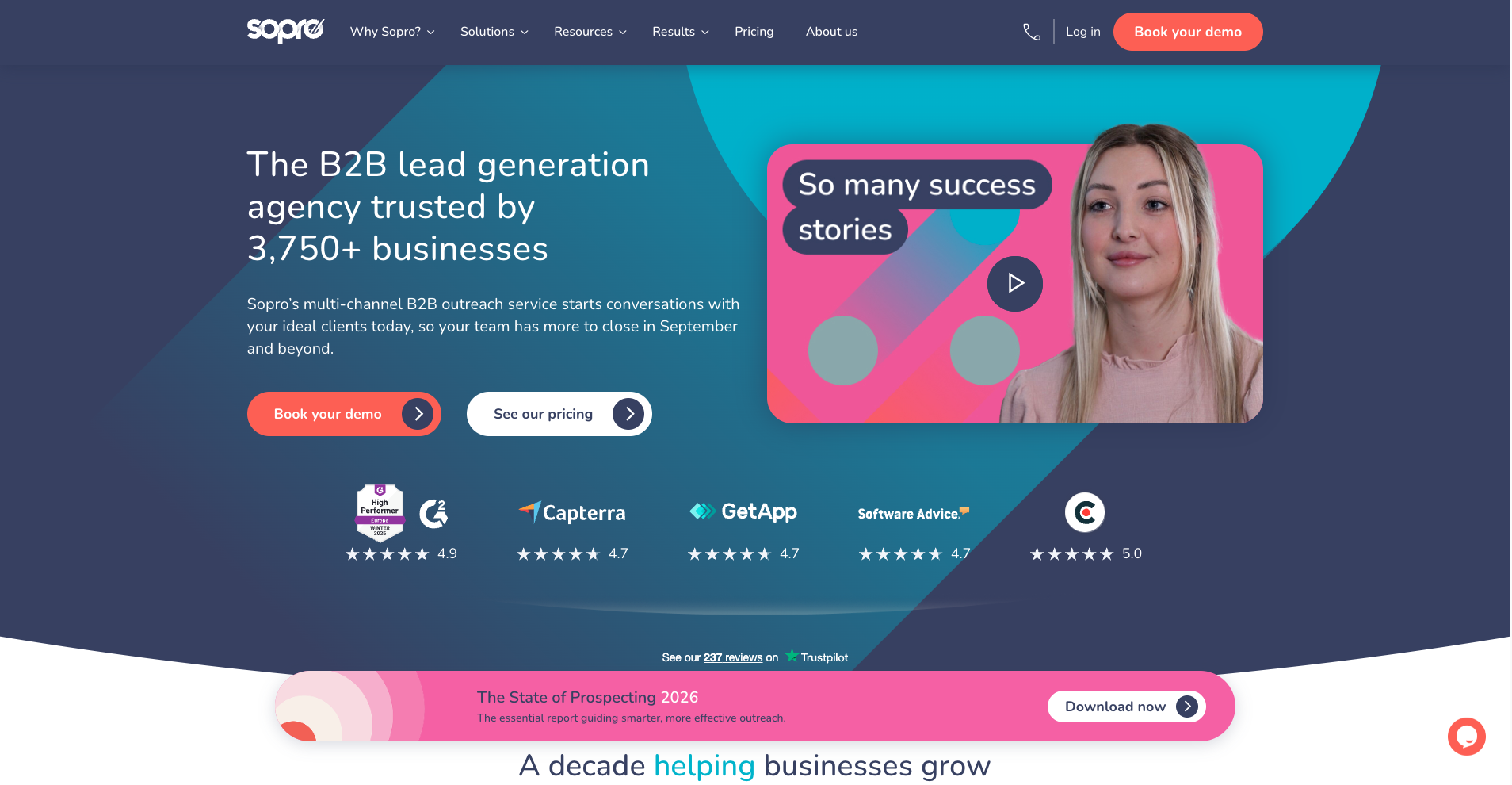
Best for: UK and European SaaS companies wanting a fully managed multichannel prospecting service at a predictable monthly cost
Sopro is a Brighton-based B2B lead generation company that runs fully managed, expert-led multichannel outreach across the UK, Europe, and the US. Pricing is based on the number of prospects contacted each month, with a published starting point of around £3,000 a month. Its own example shows around 70 qualified leads a month for $4,500 on a three-month commitment. It holds a 4.8 rating from 186 reviews on Trustpilot.
For a European SaaS company in the lower half of the band, that predictability is useful: a known monthly cost, a known volume of outreach, and no need to build an SDR team. Sopro's European coverage also helps companies selling across several markets.
Independent reviewers advise agreeing a clear lead definition before signing, since "qualified lead" can mean different things to different suppliers.
Key services
- Multichannel B2B prospecting
- Data and targeting
- Personalised outreach
- Lead qualification
- Campaign reporting
Why Sopro stands out at €2M–€10M ARR
- Transparent starting price
- UK, European, and US coverage
- Fully managed service
- Strong review scores
Best fit: European SaaS companies wanting predictable outbound volume. Agree lead definitions carefully.
4. Martal Group
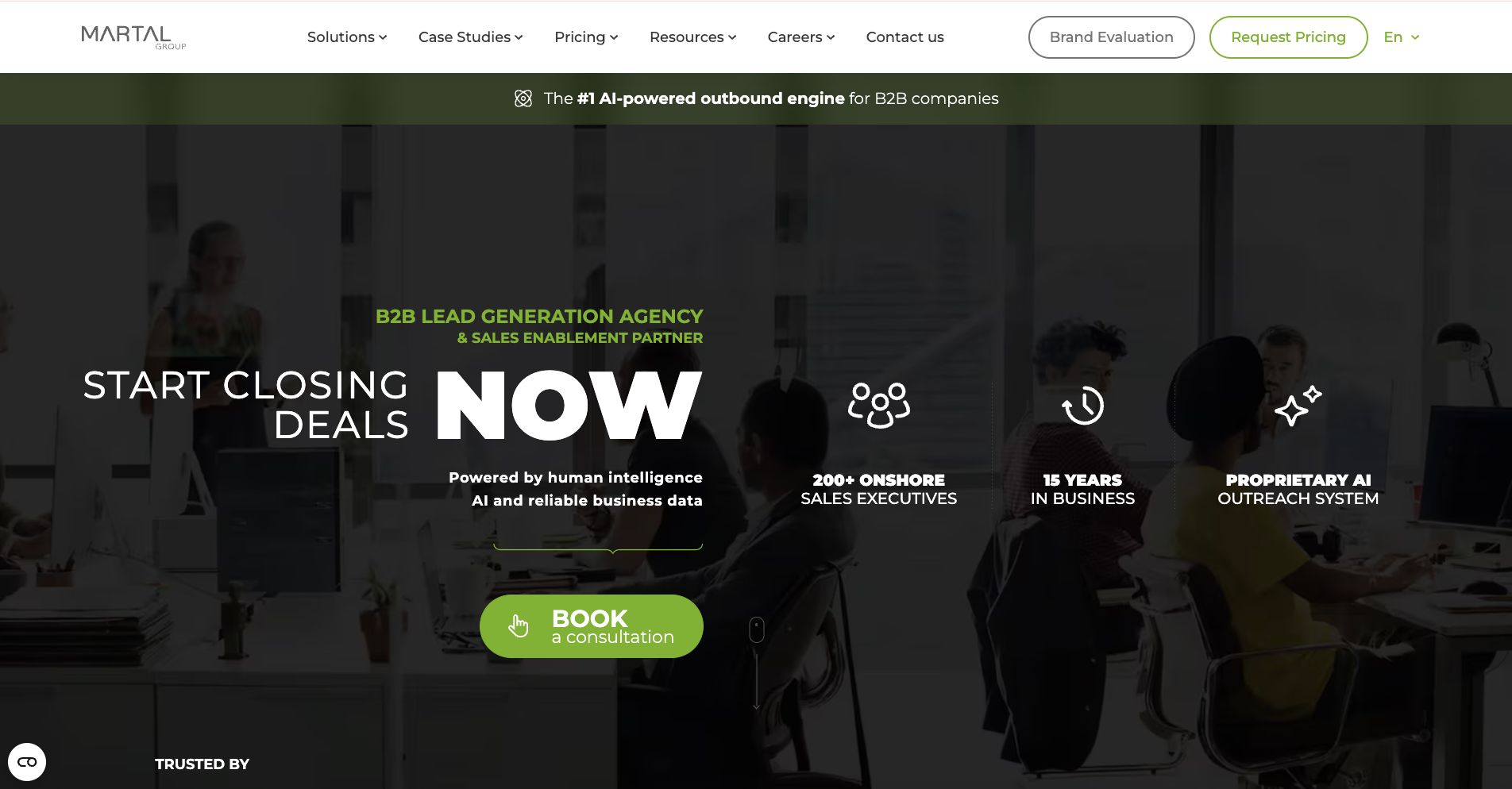
Best for: Tech and fintech SaaS companies wanting fractional SDRs who qualify meetings before they reach the sales team
Martal Group provides fractional SDR execution and outbound pipeline generation for B2B technology and fintech companies, and was founded in 2011. Its model puts the qualification work before the booking: SDRs confirm fit with the ideal customer profile, buying intent, and the relevant stakeholders before a meeting is placed in an account executive's calendar. It reports work with more than 300 technology and fintech clients, with depth in payments, cybersecurity, and B2B SaaS.
For a company in this band, that pre-qualification protects the sales team's time, which becomes more expensive as the team grows. Fractional SDRs also avoid the cost and delay of hiring and training an in-house team.
As with any outbound partner, results depend on agreed acceptance criteria and on the quality of the individual SDRs assigned.
Key services
- Fractional SDR teams
- ICP targeting and list building
- Multichannel outbound
- Pre-qualification before booking
- Pipeline reporting by segment
Why Martal Group stands out at €2M–€10M ARR
- Qualification done before the meeting
- Long experience with tech and fintech clients
- No in-house SDR hiring needed
- Defined meeting acceptance criteria
Best fit: SaaS companies whose account executives spend too long on unqualified first calls.
5. CIENCE
Best for: Companies wanting a managed SDR function backed by its own data and multichannel coordination
CIENCE, founded in 2015 and based in Denver, provides outsourced sales development: SDR teams that run outbound campaigns, supported by its own B2B data products and AI tooling. It now operates under graph8. Its Orchestrated Outbound method coordinates email, phone, LinkedIn, targeted ads, and SMS around the same accounts, and supports intent-led and content-led outreach as well as list-based campaigns.
For a SaaS company in the middle of the band, CIENCE offers a complete outbound function, with data, people, and tooling, without building it internally. Its case study library includes a range of SaaS companies.
Independent reviews note layered pricing that can be hard to predict and a ramp-up period of several months before results settle.
Key services
- Managed SDR teams
- Orchestrated multichannel outbound
- B2B data and targeting
- Intent-led outreach
- Pipeline reporting
Why CIENCE stands out at €2M–€10M ARR
- Complete outbound function in one supplier
- Own data products
- Coordinated channels around each account
- Large case study library
Best fit: Companies with runway for ramp-up that want a full outsourced SDR function.
6. Gripped
Best for: UK and European SaaS companies that want inbound demand generation across paid media, search, and AI search
Gripped is a London agency founded in 2017 that works only with SaaS, AI, and tech companies. It reports more than 160 clients, including Ideagen, Epicor, Ravelin, and Crownpeak, and describes its focus as SaaS companies between £2M and £50M ARR. Its services cover demand generation, paid media, SEO, GEO, content, account-based marketing, and websites, with pipeline that tracks to revenue.
For a company building its first proper inbound engine, Gripped provides breadth from one SaaS-focused team. It states that most clients invest £8,000 to £12,000 a month in agency fees for full-service demand generation, a useful benchmark.
Some Clutch reviewers suggest blog content could go deeper, which matters for companies relying on technical content.
Key services
- Demand generation strategy
- Paid media
- SEO and GEO
- Content and ABM
- Website design
Why Gripped stands out at €2M–€10M ARR
- SaaS, AI, and tech only
- Stated focus on this revenue band
- Several inbound channels from one team
- Transparent investment guidance
Best fit: UK and European SaaS companies building inbound. Less suited to those needing outbound meetings fast.
7. Kalungi
Best for: SaaS companies without a senior marketing leader that want a complete outsourced marketing function
Kalungi operates as an outsourced marketing department for B2B SaaS companies, combining fractional CMO leadership with execution across demand generation, content, paid media, and HubSpot. Its approach is built on the T2D3 growth framework developed by founder Stijn Hendrikse, and it offers a pay-for-performance element on some engagements. Published results include $4M in pipeline in six months for DataGuard.
For a company in the lower half of the band with no marketing leader, Kalungi fills the strategic gap and the execution gap together. That is often the right first step before scaling any single lead source.
Its model works best when the company is prepared to let an outside team lead marketing for a period.
Key services
- Fractional CMO
- Demand generation
- Content and SEO
- Paid media
- HubSpot and RevOps
Why Kalungi stands out at €2M–€10M ARR
- Leadership and execution together
- Framework built for SaaS scaling
- Pay-for-performance options
- Published pipeline results
Best fit: SaaS companies needing marketing leadership as well as leads.
8. FullFunnel.io
Best for: SaaS companies with high contract values selling to a defined list of target accounts
FullFunnel.io is a go-to-market and RevOps firm specialising in full-funnel account-based marketing for B2B companies with large deal sizes, long sales cycles, and complex buying groups. It is a HubSpot Platinum partner and publishes a widely read newsletter on ABM. In one published case, it helped a lean three-person team improve pipeline coverage by focusing on 60 strategic accounts instead of hundreds.
For SaaS companies in this band selling enterprise contracts, account-based programmes often produce better pipeline than volume-led lead generation, because they engage the whole buying group at each target company.
ABM suits a particular model. Lower-priced products with large markets will not benefit in the same way.
Key services
- Full-funnel ABM
- Buying group mapping
- Account-level reporting
- HubSpot and RevOps
- Outreach to target accounts
Why FullFunnel.io stands out at €2M–€10M ARR
- Focus on high-value accounts
- Engages whole buying groups
- Combines ABM with systems
- Published lean-team case study
Best fit: High-ACV SaaS companies with known target accounts.
9. Heinz Marketing
Best for: Companies whose pipeline problem is unclear and needs an experienced diagnosis before more lead generation spend
Heinz Marketing is a B2B marketing and demand generation consultancy in Redmond, Washington, founded in 2008 by Matt Heinz. It is known for its Predictable Pipeline methodology, which diagnoses gaps in how pipeline is created, converted, and moved forward, then builds programmes to fix them. Its work spans demand generation, ABM, lead scoring, marketing operations, and sales and marketing alignment.
For a company that has tried several lead sources without lasting results, diagnosis before more spend can save months. Heinz Marketing's approach is suited to that situation.
It is a consultancy first. Companies needing large-scale execution, such as outbound teams or big paid programmes, may need additional partners.
Key services
- Predictable Pipeline diagnosis
- Demand generation programmes
- ABM
- Lead scoring and operations
- Sales and marketing alignment
Why Heinz Marketing stands out at €2M–€10M ARR
- Named pipeline methodology
- Diagnosis before activity
- Long B2B technology experience
- Strategy and programmes together
Best fit: Companies unsure why their lead generation is not working.
10. Refine Labs
Best for: Companies at the upper end of the band ready to invest in brand-led demand creation over several quarters
Refine Labs is a Boston agency founded in 2018 that popularised the shift from lead capture to demand creation in B2B SaaS. Now led by CEO Megan Bowen, it reports more than 300 B2B SaaS clients. Its programmes combine content, paid social, and paid search to build familiarity and intent, and it measures influence through self-reported attribution.
For a company approaching €10M ARR with a working outbound or paid search engine, demand creation can lift the quality and conversion of everything else. Buyers arrive already familiar with the company and its point of view.
Independent reviews describe a six-to-twelve-month horizon before pipeline moves, and pricing guides place engagements at around $20,000 a month or more.
Key services
- Demand creation strategy
- Content and paid social
- Paid search
- Self-reported attribution
- Revenue assessments
Why Refine Labs stands out at €2M–€10M ARR
- Builds intent before contact
- Extensive B2B SaaS experience
- Measures influence beyond clicks
- Clear, documented philosophy
Best fit: Upper-band SaaS companies with budget and patience. Less suited to those needing pipeline this quarter.
Why dimartec Approaches Lead Generation Differently
The nine other companies each provide a strong source of pipeline. Belkins, Sopro, Martal Group, and CIENCE book outbound meetings. Gripped and Kalungi build inbound demand. FullFunnel.io targets defined accounts. Heinz Marketing diagnoses what is broken. Refine Labs creates demand over time.
Most measure their success at the moment a lead or meeting is handed over. What happens next is usually left to the client: whether the lead is followed up quickly, whether it is nurtured if it is not ready, whether it becomes an opportunity, and whether anyone can trace it to revenue. In this band, that is where much of the value is lost. Leads that were never going to buy this month are dropped instead of nurtured, and the company cannot tell which source deserves more budget.
dimartec builds lead generation as part of a connected system. Demand is captured through paid media, converting pages, and AI search visibility. Lead Gen & Nurturing carries prospects forward until they meet an agreed standard, and reactivates the ones that went quiet. RevOps & Automation scores, routes, and reports every source against pipeline and revenue. The result is fewer good leads lost between marketing and sales, and a clear view of what to scale, built over six months and owned by the client's team.
See how the Revenue Engine works: https://www.dimartec.co.uk/services/revenue-engine
Three Things to Check Before Hiring a Lead Generation Company
One: Agree what counts as a lead before you sign. Write down the company size, roles, and signs of intent that make a lead or meeting acceptable, and get your sales leader to agree it. Then ask the supplier to commit to that definition, and to say what happens when a meeting does not meet it.
Two: Ask what happens to leads that are not ready. Most leads will not buy this month. Find out whether the supplier hands them over and moves on, or whether there is a plan to keep them engaged. If the answer is the former, decide who on your side will own nurture.
Three: Ask to see results from a SaaS company at your stage. Ask for a reference or case study from a company between €2M and €10M ARR with a similar contract value, and look for opportunities and revenue, not only meetings booked.
Frequently Asked Questions
How much does B2B SaaS lead generation cost at €2M–€10M ARR?
Published figures vary widely. Managed outbound services start from around £3,000 a month, appointment setting has been cited at around $5,500 a month for more than ten meetings, full-service inbound demand generation is often £8,000 to £12,000 a month, and brand-led demand creation can exceed $20,000 a month. Compare the fee with the cost per qualified opportunity it produces, not the cost per lead.
Should a SaaS company start with outbound or inbound?
If pipeline is needed within weeks, outbound usually gets there first. If the company can wait a few months, inbound tends to produce better-qualified buyers at a lower long-term cost. Many companies in this band run outbound while building inbound, then shift the balance as inbound grows.
How many meetings should a lead generation company deliver?
It depends on contract value, target market size, and how strict the qualification standard is. Ten well-qualified meetings with the right buyers are worth more than forty loose ones. Agree the standard first, then set volume targets your sales team can actually handle.
How long before lead generation produces revenue?
Outbound often produces meetings within the first month or two, inbound within a few months, and demand creation over two or three quarters. Revenue follows according to the sales cycle, which for many B2B SaaS companies is three months or more. Track qualified opportunities as the earlier sign of progress.
Replace Luck With a Lead Source You Can Switch On
Between €2M and €10M ARR, a SaaS company has to turn pipeline from something that happens to it into something it can create on purpose. The right lead generation partner builds a source the company can rely on, measures it against revenue, and makes sure the leads it produces are not lost before they are ready to buy.
The Revenue Engine connects Lead Gen & Nurturing with Performance Paid Media, Full-Funnel CRO, GEO, and RevOps & Automation, so every lead is captured, nurtured, and traced to revenue in one system your team owns.
See how the Revenue Engine works: https://www.dimartec.co.uk/services/revenue-engine