
A lead generation company delivers 400 marketing qualified leads in a quarter. Sales accepts 40 of them. The invoice is for 400.
That gap is the most expensive number in B2B SaaS marketing, and it is rarely the one written into the contract. Lead generation is usually bought on volume and cost per lead, because those figures are easy to count and easy to promise. What happens next, when a sales rep opens the record and decides whether it deserves a call, sits outside most agreements. The supplier has been paid by then.
After analysing lead handover data across more than 200 B2B SaaS accounts, the same cause appears again and again. A weak MQL-to-SQL rate gets blamed on slow sales follow-up or on poor lead quality. Underneath both, it is usually a definition problem. The company generating the leads and the team receiving them are working from two different descriptions of a good lead, and nobody is accountable for the difference.
This guide covers five B2B SaaS lead generation companies chosen for one thing: how much of what they generate is accepted by sales. Each is assessed on how it qualifies, what it counts as a result, and where it stops being responsible.
What MQL-to-SQL Conversion Actually Measures
MQL-to-SQL conversion is the share of marketing qualified leads that sales accepts as worth pursuing. The calculation is simple: SQLs created in a period, divided by MQLs created in the same period. What it measures is less simple. It is the only funnel metric that records one team's verdict on another team's work.
The commonly cited benchmarks give a sense of scale. The cross-industry average sits around 13%. B2B SaaS companies average 18 to 22%, and top-quartile SaaS teams reach 25 to 35%. On 500 MQLs a month, moving from 20% to 30% means 50 more sales conversations from the same budget.
The number needs reading with care at both ends. A rate under 15% generally means the MQL definition is too loose, follow-up is too slow, or both. A rate above 50% looks like success and often is not: it can mean the bar is set so high that promising accounts are held in nurture while a competitor books the meeting.
Three things move the rate, and a lead generation company can influence all of them.
Who is targeted. Qualification starts before a lead exists. Campaigns aimed at a broad audience will produce contacts who fit no version of the ideal customer profile, and no amount of scoring afterwards will make them buyers.
What counts as qualified. An ebook download and a pricing page visit are both engagement. Only one of them suggests a purchase is being considered. Where the MQL threshold rewards activity over buying intent, sales learns to ignore the label.
What happens to leads that are not ready. Most leads who fit the profile are not in a buying window on the day they are captured. Passed to sales immediately, they are rejected and forgotten. Nurtured until they show intent, they convert later at a much higher rate.
Why Buying Leads and Buying Conversion Are Different Purchases
A company paid per lead earns more by lowering the bar. That is not a criticism of any supplier. It is how the incentive works, and it explains why so many lead generation contracts produce rising volume and a falling acceptance rate in the same quarter.
Lead generation for conversion reverses the order of work. A volume programme starts with the offer and the audience, then counts what comes back. A conversion programme starts at the other end, with the deals that closed. It asks what those customers had in common, what they did before they bought, and which sources they came from, and then builds targeting and scoring to find more of the same.
That changes what the supplier has to be able to do. It needs access to CRM outcomes, not just form submissions. It needs a view on what sales considers workable, which means talking to sales. And it needs a plan for the majority of good-fit leads who are early, because a programme that can only pass or discard will discard most of its future pipeline.
It also changes where qualification happens. There are three possible points: before capture, through targeting; at capture, through scoring and form design; and after capture, through nurture or a human conversation. Most suppliers are strong at one. The five companies below were chosen because each takes clear responsibility for at least one of these points and measures itself on what sales accepts.
How We Chose These Companies
- Contracted metric: Is the company's stated goal SQLs, opportunities, or pipeline, or is it lead and meeting volume?
- Shared definition: Does the engagement begin by agreeing with sales what a qualified lead is, in writing, before any campaign runs?
- Closed-won feedback: Does deal outcome data from the CRM flow back into targeting and scoring, or does optimisation stop at the form fill?
- A path for early leads: Is there a nurture or follow-up process for leads that fit the profile but are not ready, or are they handed over regardless?
- Evidence at the right level: Are published results expressed in SQLs, conversion rates, or pipeline, not only in lead counts?
Fit is described plainly for each company, including the situations where it is the wrong choice.
The 5 Best B2B SaaS Lead Generation Companies for MQL-to-SQL Conversion
1. dimartec
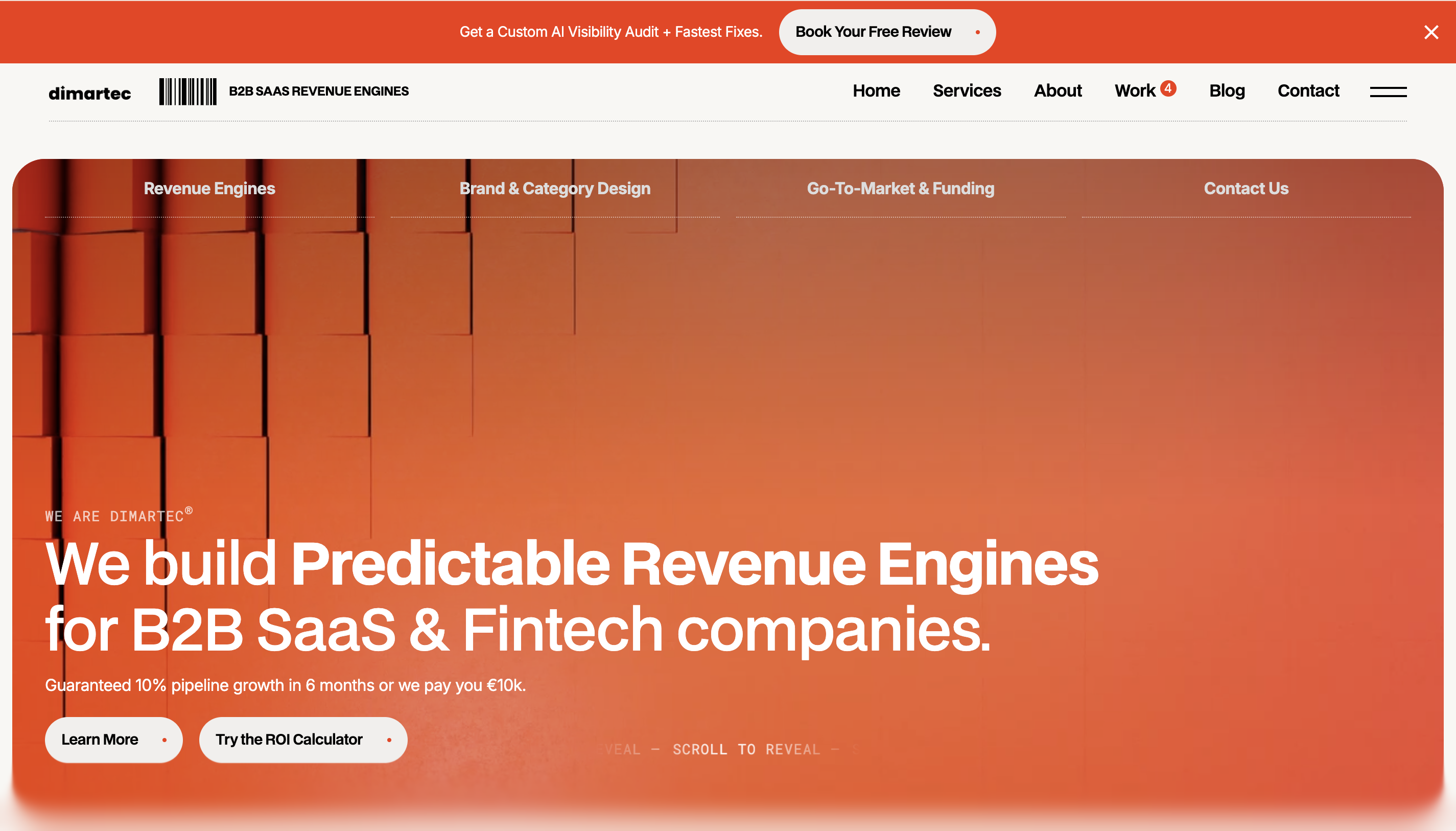
Best for: Post-PMF B2B SaaS and fintech at €2M–€10M ARR where lead volume is adequate, sales rejects most of it, and the fix has to reach back into the channels producing the leads
dimartec builds Revenue Engines for B2B SaaS and fintech companies. Lead Gen & Nurturing is one of five integrated services, alongside Performance Paid Media, CRO, GEO, and RevOps & Automation. For MQL-to-SQL conversion, the integration is the point. The rate is decided in three places: by the audience a campaign reaches, by the score a lead receives, and by what happens to it afterwards. dimartec controls all three.
The work starts with the deals that closed. Lead scoring is built from closed-won data, so points are awarded for the behaviours and firmographics that preceded real purchases, not for general engagement. Leads that match the profile but show no buying intent enter nurture sequences matched to their stage, and are passed to sales only when their behaviour changes. Routing rules sit in the CRM, which means the agreed definition cannot be bypassed under pressure to hit a volume number.
The same qualification logic is then fed back to the ad platforms. This is what most lead generation programmes leave out. In a published engagement with a European IoT SaaS company, dimartec rebuilt the qualification signals behind the paid campaigns without pausing them. Twelve weeks later, cost per SQL was down 52% year on year, ad spend was down 53%, and lead-to-SQL conversion had reached 72%.
dimartec is a strong match when:
- MQL targets are met every month and the sales team still says it has nothing to work
- Sales has stopped trusting the MQL label and picks leads by scanning company names
- Lead scoring was set up once, from assumptions, and has never been checked against which leads became customers
- Paid campaigns are optimised to cost per lead, and nobody can say which of them produce SQLs
Key services
- Lead Gen & Nurturing: closed-won scoring models, stage-based nurture for leads not yet ready, and qualification rules both teams sign off
- Performance Paid Media: campaigns on Google and LinkedIn optimised to cost per SQL, with qualification signals passed back to the platforms
- RevOps & Automation: CRM-enforced routing and attribution from first touch to closed-won, so conversion is visible by source
- CRO: forms and landing pages designed to collect the information qualification needs without suppressing completion
- GEO: visibility in AI search tools, bringing in buyers who have already researched the category
Why dimartec stands out for MQL-to-SQL conversion
- Responsibility covers targeting, scoring, and follow-up together, the three points where the rate is won or lost
- Scoring is derived from closed-won deals and recalibrated as new outcomes arrive
- Not-ready leads are nurtured instead of handed over, which protects both the conversion rate and the future pipeline
- A published result at SQL level: 72% lead-to-SQL conversion and a 52% lower cost per SQL for a European IoT SaaS company
Best fit: Post-PMF B2B SaaS and fintech at €2M–€10M ARR whose problem is not too few leads but too few that sales will accept, and who want one team accountable from the campaign to the handover.
2. Directive
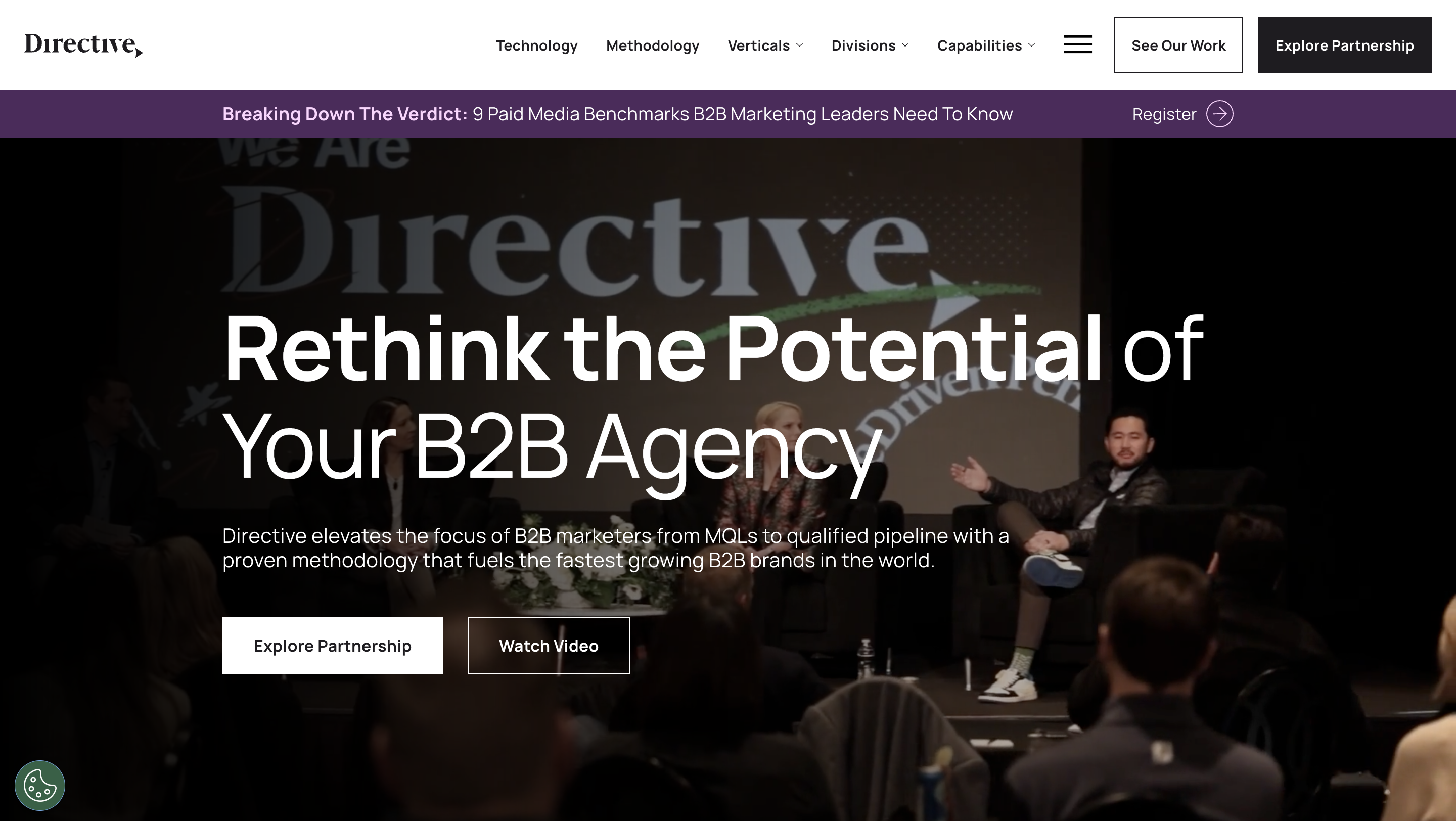
Best for: SaaS and technology companies with substantial paid media budgets that want every campaign planned and reported against SQL targets
Directive is a performance marketing agency headquartered in Irvine, California, working with SaaS and tech companies. Its methodology, Customer Generation, was created in direct opposition to MQL-based marketing: the agency states that it prioritises SQLs and customers over MQLs and builds client strategies around hitting SQL targets.
In practice that means qualification is pushed upstream into targeting. Paid search and paid social campaigns are built around audiences and keywords that indicate purchase intent, offers lean towards demos and trials instead of gated content, and performance is judged against LTV:CAC. If fewer low-intent leads are created in the first place, the conversion rate of what remains rises without any change to scoring.
Directive's services cover paid media, SEO, performance creative, video, revenue operations, and strategy. Its client list includes large technology names such as Amazon, Cisco, and MongoDB, which signals where its model is most comfortable: companies with meaningful budgets and the data volume that paid optimisation needs.
Key services
- Paid search and paid social managed to SQL targets
- SEO and content for B2B and SaaS
- Performance creative and video
- Revenue operations support
- Strategy built on LTV:CAC modelling
Why Directive stands out for MQL-to-SQL conversion
- A methodology that rejects the MQL as a goal, so the agency is not rewarded for low-intent volume
- SQL targets are set at the start of the engagement
- Specialisation in SaaS and tech, with experience at significant spend levels
- LTV:CAC framing links lead quality to commercial outcomes
Best fit: SaaS companies whose low conversion rate is caused by paid campaigns producing the wrong leads, and who have the budget for a large specialist agency. It does less for leads already in the database, and for companies whose issue is nurture or handover.
3. Powered by Search
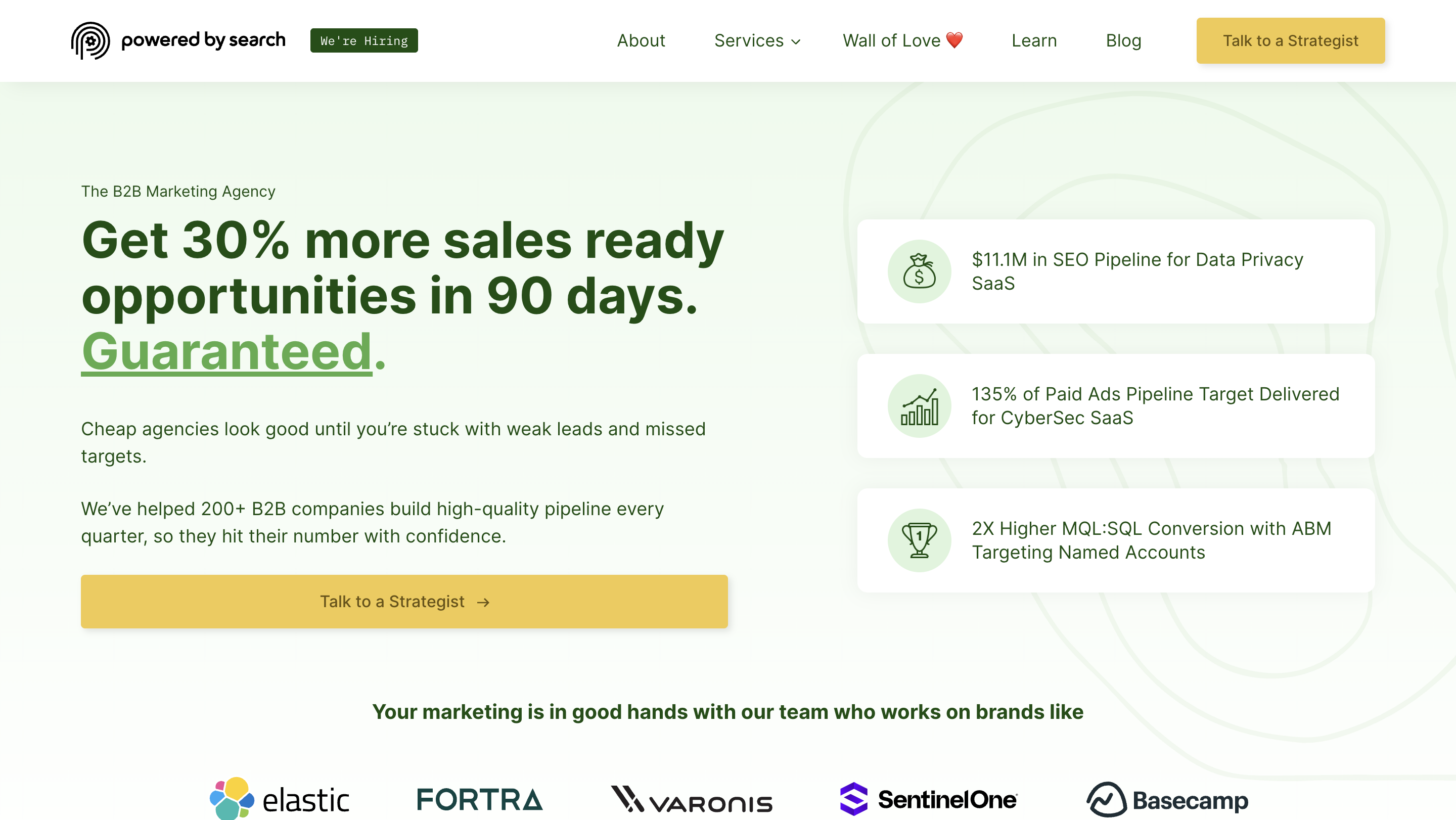
Best for: B2B SaaS companies with long sales cycles, high contract values, and buying committees, where a single lead says little about whether an account will buy
Powered by Search is a Toronto agency, established in 2009, that works only with B2B SaaS companies. Its Predictable Growth methodology combines paid media, SEO, content, account-based marketing, and RevOps under one demand generation strategy. Its stated specialism is complex sales: cycles of six to eighteen months, contract values from $50,000 upwards, and purchases decided by a group. Clients include Varonis, Fortra, and Collibra.
That focus matters for MQL-to-SQL conversion because individual lead scoring breaks down in committee sales. One person downloading a guide is weak evidence. Three people from the same target account visiting the pricing page is strong evidence, and a contact-level model misses it. By qualifying at account level through ABM, Powered by Search changes what is being converted. The agency reports doubling the MQL-to-SQL rate for a client through ABM, and it advertises a guarantee of 30% more sales-ready opportunities in 90 days.
Its positioning is aimed at teams that want to move away from MQL volume towards high-intent pipeline, with attribution and RevOps included so that results can be traced.
Key services
- Demand generation strategy for B2B SaaS
- Paid search and paid social
- SEO and content marketing
- Account-based marketing for named accounts
- RevOps and attribution, including demo booking optimisation
Why Powered by Search stands out for MQL-to-SQL conversion
- Account-level qualification suited to committee purchases
- Works exclusively with B2B SaaS
- A public commitment expressed in sales-ready opportunities, not leads
- RevOps capability alongside demand generation, so the handover is part of the scope
Best fit: Growth-stage SaaS companies selling high-value contracts to committees. Companies with short, single-buyer sales cycles and lower contract values will find the account-based approach heavier than they need.
4. Kalungi
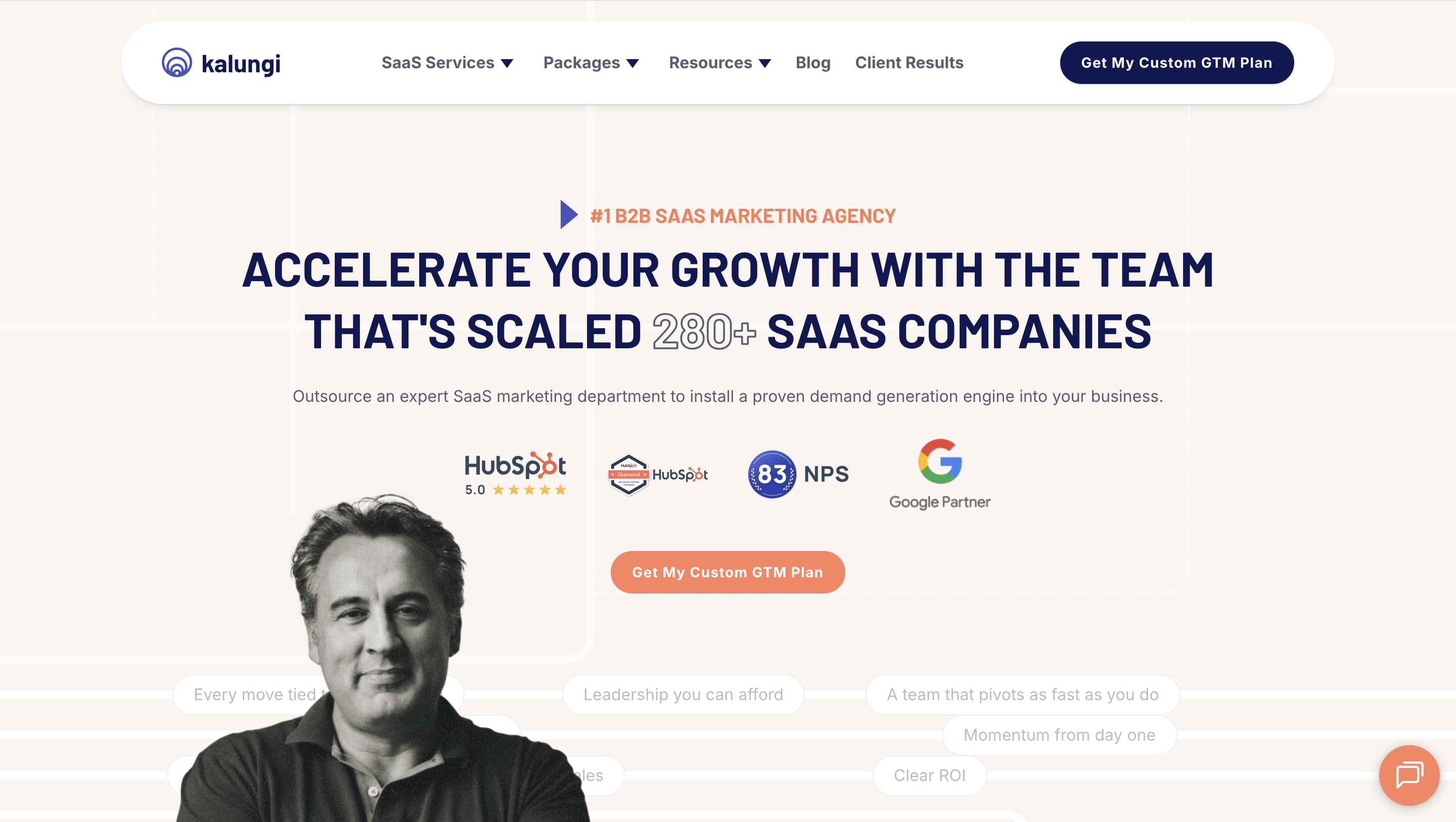
Best for: Early-stage B2B SaaS companies with no marketing leader, where MQL and SQL have never been formally defined
Kalungi is a Seattle agency, founded in 2018, that serves only B2B SaaS companies. It provides a complete outsourced marketing function: a fractional CMO supported by an execution team, working from its own T2D3 playbook. It has worked with more than 100 B2B SaaS companies.
Its place on this list comes from two features. First, the fractional CMO. Many early-stage companies have a poor MQL-to-SQL rate because nobody senior owns the funnel definitions. Marketing is run by a junior generalist or by the founder, and the handover to sales was never designed. Kalungi puts an experienced leader in that seat, with the authority to agree stage definitions with sales. Second, its pay-for-performance model: as an engagement matures, a growing share of the fee depends on reaching objectives and key results agreed by both sides.
That second feature needs careful handling. Many of Kalungi's published case studies report MQL growth, so a buyer focused on conversion should make sure the OKRs that trigger payment are set at SQL or pipeline level. Structured that way, the model ties the agency's income to the quality of what it generates.
Key services
- Fractional CMO leadership
- Full outsourced B2B SaaS marketing team
- Go-to-market strategy and positioning
- Marketing automation and operations
- Marketing audit with a 90-day roadmap
Why Kalungi stands out for MQL-to-SQL conversion
- Senior marketing leadership able to settle funnel definitions with sales
- Part of the fee depends on agreed results
- Exclusive B2B SaaS focus with a documented playbook
- Covers the whole marketing function, so targeting, content, and automation are aligned
Best fit: B2B SaaS companies below roughly $5M ARR that lack marketing leadership. Companies with an established marketing team and a specific qualification problem need a narrower intervention.
5. Operatix
Best for: B2B software vendors whose inbound leads are followed up slowly or inconsistently, and who need people, not scoring models, to qualify them
Operatix is an outsourced sales development company founded in 2012 in the UK, and part of memoryBlue since 2023. It supplies dedicated SDR teams to B2B software vendors, and reports more than 300 SDRs and over 800 vendors served. Its services include outbound prospecting and inbound lead qualification, delivered in 22 languages.
The inbound service is the reason it appears here. A share of every poor MQL-to-SQL rate has nothing to do with lead quality. Leads arrive, wait in a queue, and are contacted days later by an account executive who has more valuable things to do. Operatix places trained SDRs between marketing and sales. They contact each lead quickly, run a discovery conversation against a qualification framework agreed with the client, and pass on only those that meet it.
A conversation finds out things a score cannot: whether there is a project, who else is involved, what the timeline is. Because Operatix works almost entirely with software vendors, its SDRs already understand trials, proofs of concept, and technical evaluation.
The limits are clear. Operatix qualifies what it is given and does not change which leads marketing generates. It is retainer-priced and aimed at funded vendors.
Key services
- Inbound lead qualification by dedicated SDRs
- Outbound prospecting
- Multilingual coverage across EMEA, North America, LATAM, and APAC
- Channel and marketing acceleration
- Weekly reporting
Why Operatix stands out for MQL-to-SQL conversion
- Human qualification against an agreed framework before any lead reaches an account executive
- Fast response to inbound interest, removing the delay that erodes conversion
- Software-only focus
- 22 languages, valuable for SaaS companies selling across Europe
Best fit: Software vendors with healthy inbound volume, international markets, and no SDR team of their own. It will not help if the leads themselves are wrong, which is a targeting problem upstream.
Why dimartec Treats MQL-to-SQL Conversion as a System Result
Each of the other four companies improves the rate from one position. Directive raises it at the targeting stage by refusing to chase low-intent leads. Powered by Search raises it by judging accounts in place of individuals. Kalungi raises it by putting a senior marketer in charge of the definitions. Operatix raises it by having a person speak to every lead before sales does.
These are sound approaches, and each has a ceiling. Better targeting does nothing for the good-fit leads who arrive early and need time. Account scoring cannot help if the content attracting those accounts draws the wrong roles. A well-defined funnel still fails when the ad platforms keep optimising to form fills. And an SDR team qualifying poor leads quickly is an efficient way to reject them.
MQL-to-SQL conversion is a result, not a lever. It reflects whether the audience, the score, the nurture, and the handover all agree on what a buyer looks like. Change one and leave the others, and the rate improves for a month before settling back.
dimartec builds those parts as one programme. Performance Paid Media and GEO decide who arrives. CRO shapes what they tell you. Lead Gen & Nurturing scores them against closed-won deals and holds the early ones until they are ready. RevOps & Automation enforces the handover and reports conversion by source, and that report goes back to the campaigns. Every part works from one definition.
See how the Revenue Engine works: https://www.dimartec.co.uk/services/revenue-engine
Three Things to Check Before Hiring a Lead Generation Company
One: Ask for their written definition of a qualified lead. Then show it to your head of sales. If sales would not accept leads that meet it, the engagement will reproduce the problem you already have. The stronger suppliers will not give you their definition at all. They will ask for yours, and for a list of recent closed-won deals to test it against.
Two: Ask which outcome data they need from your CRM. A company that optimises for conversion needs to know which leads became SQLs, opportunities, and customers. If the answer is that they only need access to the ad accounts and the form submissions, their optimisation ends at the lead, whatever the proposal says.
Three: Ask what happens to a lead that fits but is not ready. There are three possible answers. It is passed to sales anyway, which lowers your conversion rate. It is discarded, which wastes the spend. Or it is nurtured and re-scored, which is the only answer that builds pipeline for later quarters. Ask to see the sequence.
Frequently Asked Questions
What is a good MQL-to-SQL conversion rate for B2B SaaS?
B2B SaaS companies average 18 to 22%, against a cross-industry average of about 13%. Top-quartile SaaS teams reach 25 to 35%. Treat these as orientation, because the rate depends on how strict your MQL definition is. A company with a demanding definition will show a high rate on low volume, and one with a loose definition will show the reverse. Compare your own rate over time and by source before comparing it with anyone else's.
Can a lead generation company improve MQL-to-SQL conversion without involving sales?
Not reliably. The rate records a sales decision, so any improvement depends on knowing what sales accepts and why. A supplier can raise lead quality through better targeting alone, but without feedback from sales it is guessing at the standard. Expect a serious provider to ask for time with your sales lead in the first two weeks and for regular reviews of rejected leads afterwards.
Should B2B SaaS companies stop using MQLs?
Some agencies argue that they should, and report only on SQLs or pipeline. The argument has merit where MQLs have become a volume target detached from revenue. For most companies the better course is to keep the stage and fix its meaning: define an MQL by buying intent, not by activity, and judge marketing on how many convert. Removing the label without changing the incentive behind it changes nothing.
Why did our MQL-to-SQL rate fall when lead volume went up?
This is the usual pattern when a programme scales by widening its audience. New leads come from broader targeting, lower-intent offers, or additional channels, and they fit the customer profile less well than the original group. Volume rises, acceptance falls, and cost per SQL often increases even as cost per lead drops. Check conversion by source. One or two recently added sources will normally account for most of the decline.
Pay for the Leads Sales Says Yes To
The invoice for 400 leads and the 40 that sales accepted describe the same quarter. Which of those two numbers a lead generation company is willing to be judged on tells you most of what you need to know about it. Choose a partner that starts from your closed deals, agrees the definition with your sales team, and has a plan for the leads that are early.
The Revenue Engine combines Performance Paid Media, CRO, GEO, Lead Gen & Nurturing, and RevOps & Automation, so that the audience reached, the score applied, and the handover enforced all follow one description of a buyer.
See how the Revenue Engine works: https://www.dimartec.co.uk/services/revenue-engine








.png)







.png)

















































.png)
.png)
.png)
.png)
.png)
.png)
.png)
.png)
.png)
.png)