
When pipeline becomes unreliable, the first instinct is usually to add something. Another channel, another SDR, another agency, a bigger paid budget. Sometimes that works. More often, a few months later, the company has more activity, higher costs, and a forecast that is no easier to trust.
The reason is that many pipeline problems are not activity problems at all. They are go-to-market design problems. The company is selling to too broad a market, so conversion varies wildly by segment. Its positioning sounds like three competitors, so buyers stall at comparison. Marketing hands leads to sales at a point sales does not recognise as a lead. Self-serve and sales-led buyers are pushed through the same funnel. No amount of extra outreach fixes a motion that was never designed for the buyers it is meant to reach.
After analysing go-to-market performance across more than 200 B2B SaaS accounts, the companies with the steadiest pipeline were seldom the ones with the most channels. They had made a small number of GTM decisions clearly and early: who exactly they sell to, what they say that competitors do not, which motion each segment goes through, and how every stage is defined and measured. Execution then had something stable to build on.
GTM agencies help with different parts of that work. Some design the strategy and operating model. Some build the systems underneath it. Some run the execution that fills it. This guide compares ten, and explains where each one fits.
The Five GTM Decisions That Shape Pipeline
Before choosing an agency, it helps to know which go-to-market decisions most affect how predictable pipeline is.
1. Who you sell to. A tight ideal customer profile, defined by firmographics, situation, and buying trigger, makes conversion rates stable. A loose one makes them swing from month to month as the mix of leads changes.
2. What you say. Positioning that clearly names the problem, the buyer, and the difference from alternatives shortens evaluation. Generic positioning lengthens it and makes win rates unpredictable.
3. Which motion each segment goes through. Self-serve, sales-assisted, and enterprise buyers need different journeys. Mixing them in one funnel hides problems and distorts the forecast.
4. Where the handoffs sit. Clear, agreed points at which a lead passes from marketing to sales, and a customer passes from sales to success, stop pipeline from leaking between teams.
5. How stages are measured. Shared definitions and a single data model for the whole customer journey let the company see conversion and velocity at every stage, and spot problems early.
The agencies below each strengthen some of these decisions. The strongest GTM partners help with several, or work alongside others that cover the rest.
Strategy, Systems, or Execution: Three Kinds of GTM Agency
"GTM agency" covers firms that do very different jobs. Most fall mainly into one of three groups.
Strategy firms design the go-to-market model: ideal customer profile, positioning, segmentation, sales methodology, and stage definitions. Winning by Design, ARISE GTM, Skaled, and Kalungi lead with strategy, though several also execute. They suit companies whose pipeline problems come from unclear decisions.
Systems firms build the operational layer that makes a GTM model work: CRM architecture, data models, routing, lifecycle automation, and reporting. Go Nimbly and FullFunnel.io sit here. They suit companies whose strategy is sound but whose tools and data cannot support it.
Execution firms run the activity that fills the pipeline: outbound, paid media, content, and appointment setting. ColdIQ, Martal Group, and Understory Agency are execution-led. They suit companies with a clear model and working systems that need more volume.
Hiring the wrong type is a common and expensive mistake. An execution firm cannot fix an unclear ICP, and a strategy firm cannot make up for a CRM that does not report. dimartec covers all three in one engagement, which is why it appears first in this guide.
How We Chose These Agencies
- GTM relevance: Each agency works directly on how a SaaS company goes to market, not only on a single channel.
- SaaS experience: Named SaaS clients, SaaS-specific frameworks, or a clear SaaS focus.
- A documented method: A framework, operating model, or process that can be examined.
- Pipeline focus: Work measured in qualified pipeline, conversion, or revenue.
- Range: Together, the ten cover strategy, systems, and execution.
Each profile notes which type of GTM work the agency leads with, and what a company would still need from elsewhere.
The 10 Best GTM Agencies for SaaS for Predictable Pipeline
1. dimartec
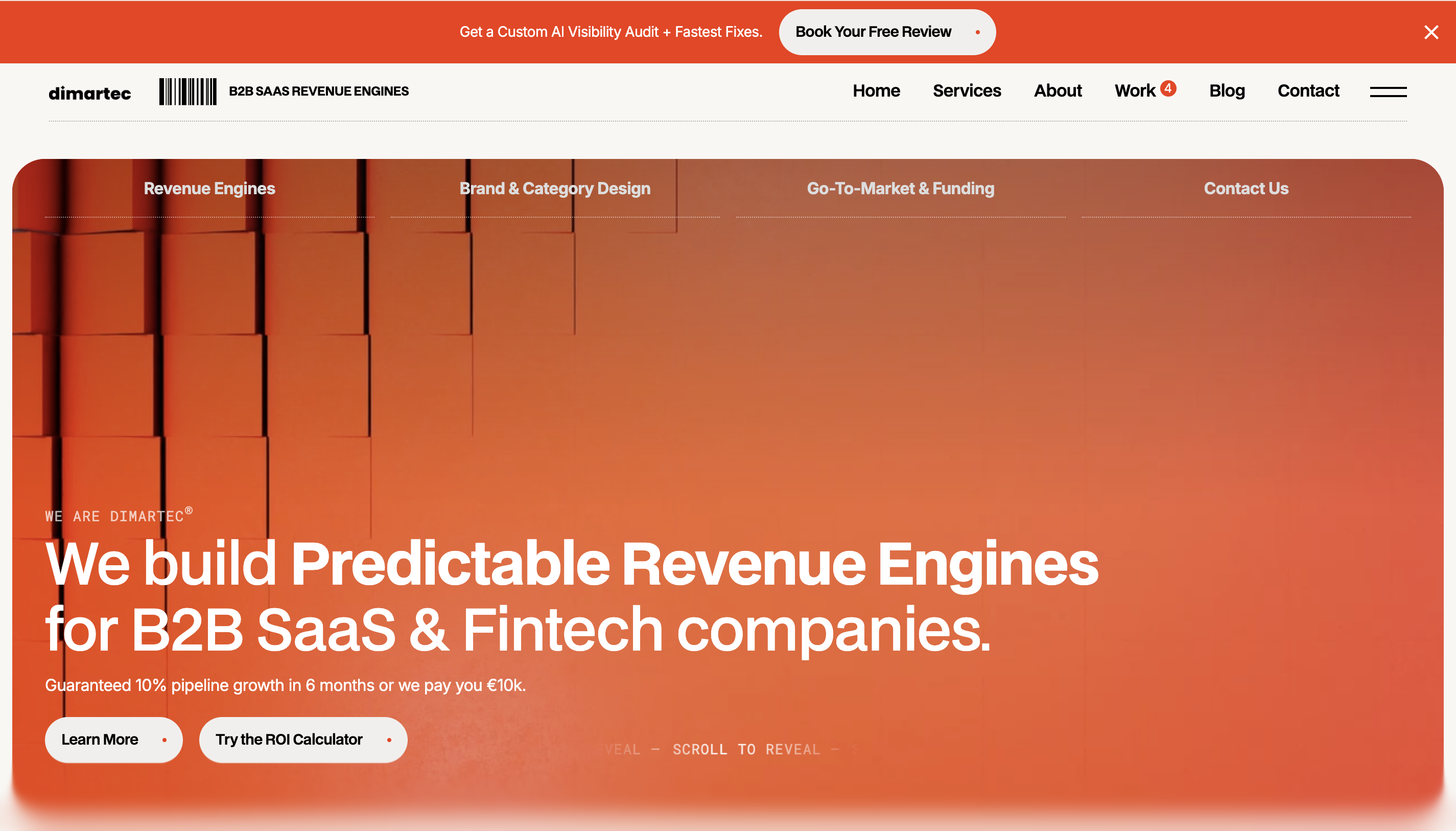
Best for: B2B SaaS and fintech companies at €2M–€10M ARR that want their go-to-market engine diagnosed, built, run, and handed over as one connected system
dimartec builds Predictable Revenue Engines for B2B SaaS and fintech companies. Where many GTM firms either advise or execute, dimartec does both in a single engagement, through five connected pillars: Performance Paid Media, Full-Funnel CRO, GEO, Lead Gen & Nurturing, and RevOps & Automation. Every decision is tied to pipeline, acquisition cost, and closed revenue.
The work starts with a two-to-four-week Diagnostic covering a CRO audit, paid media review, AI search visibility audit, and a full funnel teardown, ending in a prioritised roadmap of where revenue is leaking. The Diagnostic also includes a brand positioning teardown, which addresses the GTM question of what the company says and to whom. Over the following six months, tracking is unified, campaigns are restructured around profit, all five pillars run together, and RevOps forecasting is made operational. Playbooks, dashboards, and workflows are then handed to the client's team.
The client team's input is around five hours in total, and dimartec handles the implementation. It reports a 24% average reduction in cost per SQL within 180 days. A payments fintech client describes dimartec launching a demand engine in under a month that added 40 new clients, moving acquisition beyond the founders' and partners' networks.
dimartec suits SaaS companies when:
- The GTM strategy exists but is not reflected in campaigns, pages, or the CRM
- Marketing and sales disagree on what a good lead looks like
- Several agencies are each running one part of the funnel
- Leadership wants the system owned in-house, not rented
Key services
- Diagnostic: funnel, paid media, AI visibility, and positioning review
- Performance Paid Media and Full-Funnel CRO
- GEO for AI search visibility
- Lead Gen & Nurturing
- RevOps & Automation, including forecasting
Why dimartec stands out for GTM and predictable pipeline
- Strategy, systems, and execution in one team
- Defined six-month build with handover
- Minimal time demands on the client team
- Only B2B SaaS and fintech clients
Best fit: SaaS companies that want one accountable partner for the whole go-to-market engine.
2. Winning by Design
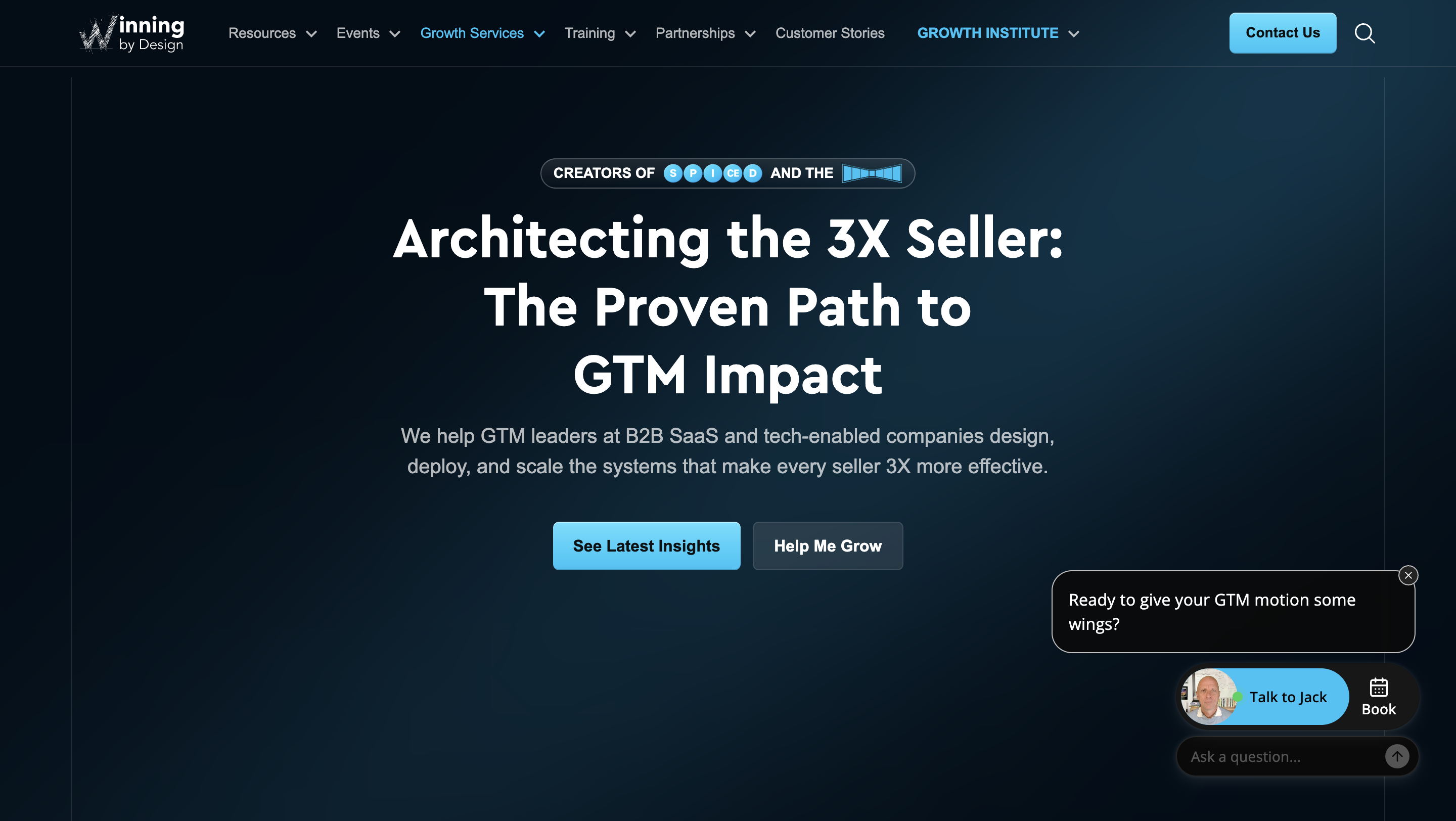
Best for: SaaS companies that want a shared revenue architecture and language across sales, marketing, and customer success
Winning by Design is a revenue consulting and training firm founded in 2012 and based in Mountain View, California, built specifically for recurring revenue businesses. It created the SPICED methodology and the Bowtie Data Model, which extends the traditional funnel to cover the whole customer journey after the sale, and publishes these frameworks openly. Its founder, Jacco van der Kooij, has written a textbook on Revenue Architecture drawn from work with more than 1,000 SaaS companies, and its advisors have deployed revenue architecture at companies including Canva, Dropbox, and DocuSign.
For predictable pipeline, the Bowtie model is especially relevant: it gives every team the same stage definitions and data model, so conversion and velocity can be measured consistently from first contact to expansion.
Its model is consulting and training-led, so the client's own team usually carries out implementation.
Key services
- Revenue architecture diagnostics
- Bowtie Data Model and GTM process design
- SPICED sales methodology
- Revenue Academy training
- ICP, ABM, and playbook design
Why Winning by Design stands out for predictable pipeline
- Widely adopted frameworks for recurring revenue
- One data model for the whole customer journey
- Experience across 1,000+ SaaS companies
- Strong training for frontline teams
Best fit: SaaS companies that need a common operating model and have a team to implement it.
3. ARISE GTM
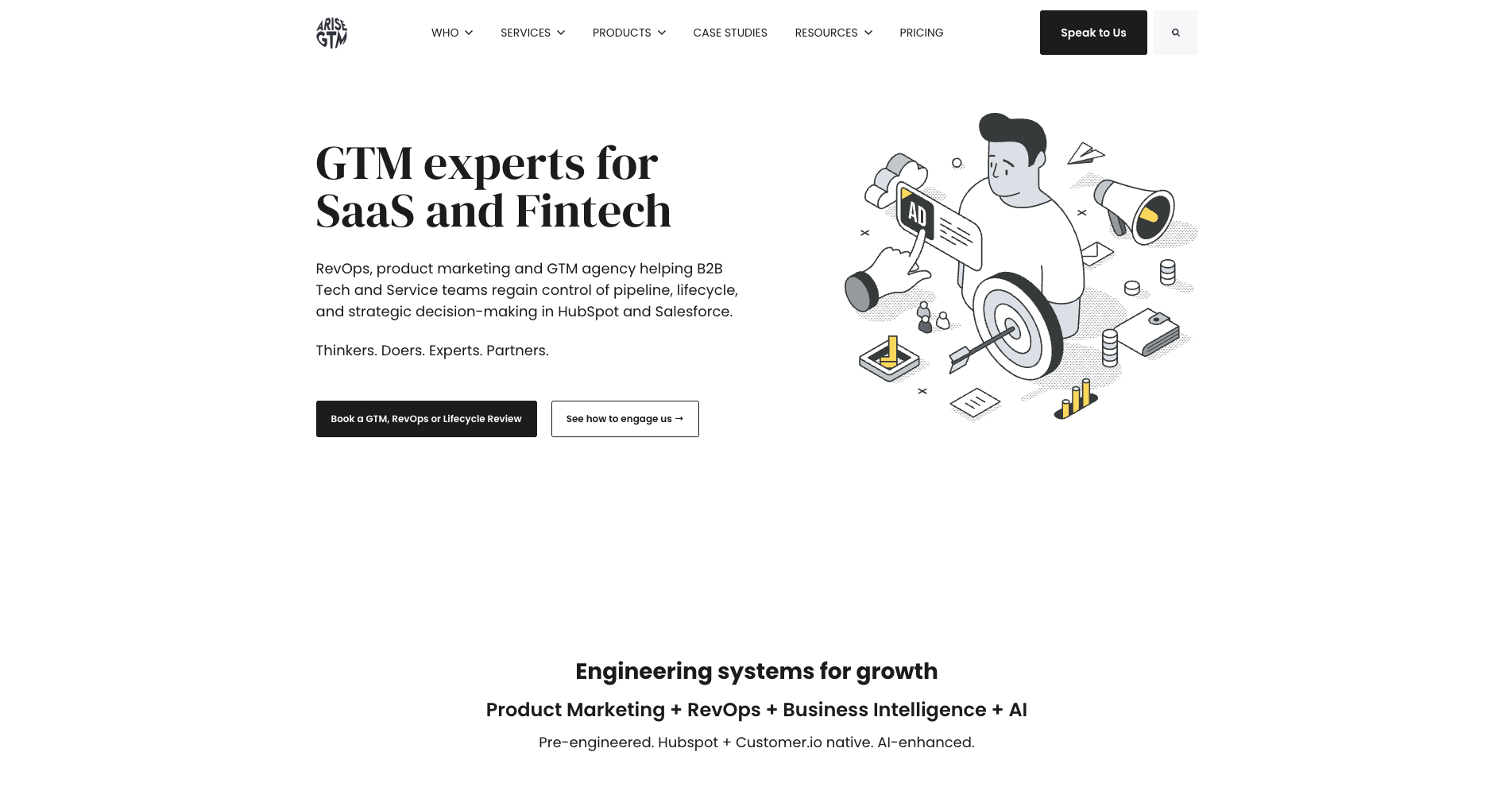
Best for: HubSpot-based SaaS and fintech companies that want GTM strategy, RevOps, and lifecycle automation built together
ARISE GTM is a UK-based go-to-market and RevOps consultancy founded in 2017 by Paul Sullivan, a former CTO and CMO and author of Go-To-Market Uncovered (Wiley, 2025). It is a HubSpot Platinum Solutions Partner focused on B2B SaaS and fintech. Its ARISE methodology (Assess, Research, Ideate, Strategise, Execute) and ARISE OS combine GTM strategy, product marketing, RevOps architecture, lifecycle automation, and business intelligence, deployed as a pre-built system and then customised.
For companies whose pipeline problems start with unclear positioning or a confused motion, ARISE GTM's product marketing roots are useful, and its lifecycle work addresses retention and expansion as well as new pipeline.
It is HubSpot-native, and its own comparison articles state a minimum engagement of around £7,500 a month.
Key services
- GTM strategy and product marketing
- HubSpot RevOps architecture
- Lifecycle and retention automation
- Business intelligence reporting
- Sales enablement
Why ARISE GTM stands out for predictable pipeline
- Published GTM methodology
- Strategy and systems together
- Strong lifecycle focus
- HubSpot Platinum partner
Best fit: HubSpot-committed SaaS and fintech companies needing strategy and operations at once.
4. Skaled
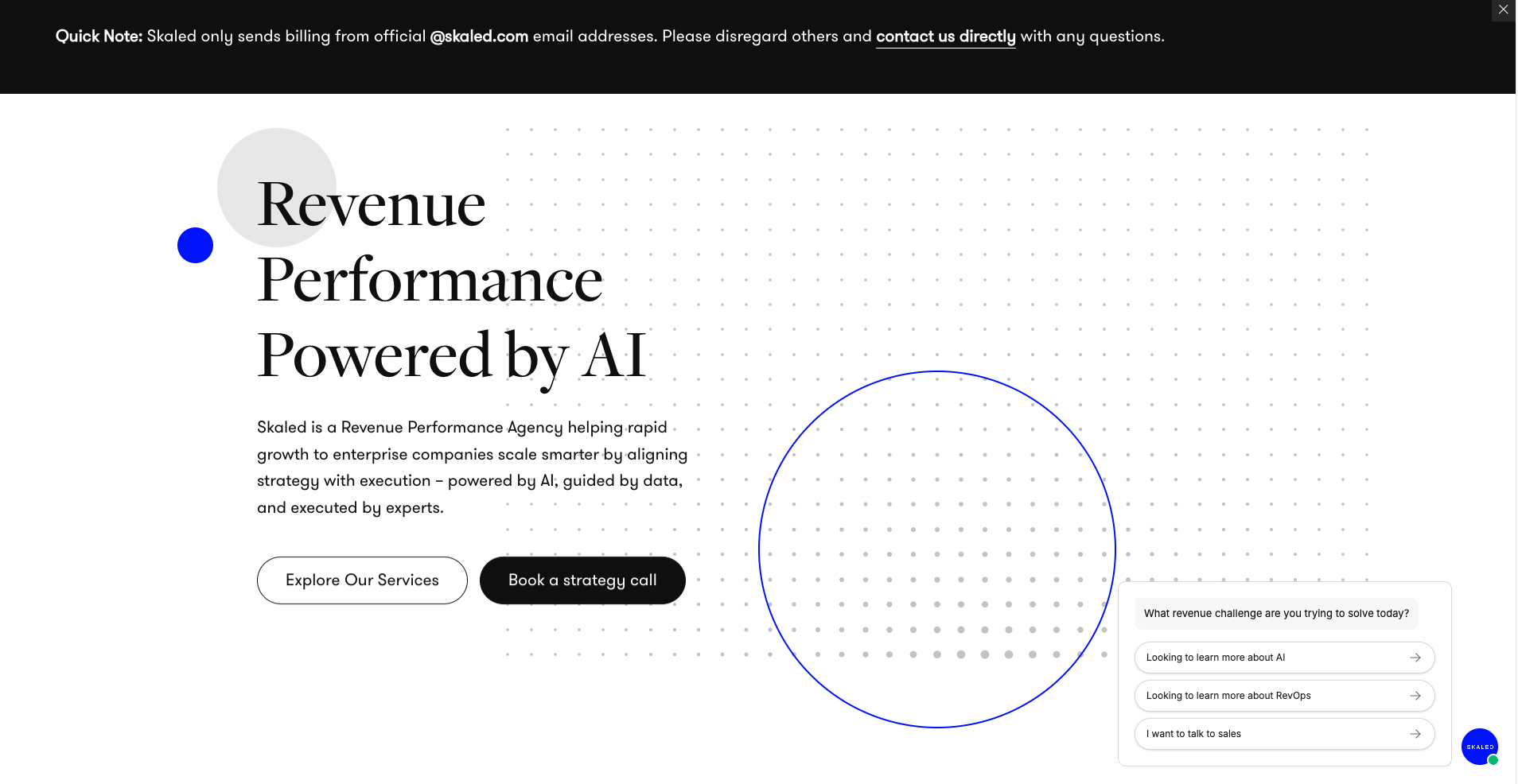
Best for: Growth-stage SaaS companies that need their sales process, GTM strategy, and revenue operations rebuilt and embedded
Skaled is a revenue performance consultancy founded in 2013 and based in Austin, Texas, led by CEO Jake Dunlap. It reports work with more than 1,000 companies, including LinkedIn, Grammarly, and Hootsuite, across revenue operations, go-to-market strategy, revenue enablement, and fractional sales leadership. It positions itself as a firm that implements its strategies, embedding within revenue teams, and has launched an AI GTM System to bring AI into go-to-market processes.
For SaaS companies whose pipeline is unpredictable because the sales motion itself is inconsistent, Skaled's sales leadership depth is the main strength: qualification, process design, and enablement that make conversion rates steadier.
Its heritage is sales-led. Companies whose main gap is demand generation or marketing execution may need additional partners.
Key services
- Go-to-market strategy
- Revenue operations
- Fractional sales leadership
- Revenue enablement
- AI GTM services
Why Skaled stands out for predictable pipeline
- Deep sales process expertise
- Embeds with revenue teams
- Broad client experience
- SaaS and PE-backed focus
Best fit: SaaS companies whose sales motion needs rebuilding before more pipeline is added.
5. Kalungi
Best for: SaaS companies without a senior marketing leader that need GTM strategy and execution from one outsourced team
Kalungi operates as an outsourced marketing department for B2B SaaS, pairing fractional CMO leadership with execution across demand generation, content, paid media, and HubSpot. Its playbook is built on the T2D3 framework developed by founder Stijn Hendrikse, which sets out the stages a SaaS company moves through as it scales. Published results include $4M in pipeline in six months for DataGuard.
For GTM, Kalungi's value lies in making the ICP and positioning decisions explicit before spending on channels, then executing against them. That sequence is often what early-stage companies lack.
It works best for companies willing to let an outside team lead marketing for a period.
Key services
- Fractional CMO
- GTM and positioning
- Demand generation
- Content and paid media
- HubSpot operations
Why Kalungi stands out for predictable pipeline
- Strategy before channels
- SaaS-specific scaling framework
- Leadership and execution together
- Published pipeline results
Best fit: SaaS companies that need a marketing leader as much as a marketing team.
6. Go Nimbly
Best for: Product-led or hybrid SaaS companies that need their GTM systems designed and run by an embedded team
Go Nimbly was founded in 2015 by Jen Igartua as a fractional RevOps firm and places embedded teams of analysts, Salesforce administrators, and marketing automation specialists inside clients. Its platform depth covers Salesforce, HubSpot, Outreach, and Gainsight, and it is known for strength with product-led and hybrid motions. Independent guides describe its typical clients as Series A to Series D.
For GTM, Go Nimbly addresses the motion-design decision directly: making sure self-serve, product usage, and sales-assisted paths are represented properly in the systems, so that each can be measured and forecast.
It is a systems partner, not a demand generation agency.
Key services
- Embedded RevOps teams
- Salesforce and HubSpot administration
- PLG and hybrid GTM operations
- Marketing automation
- Customer success systems
Why Go Nimbly stands out for predictable pipeline
- Strong in product-led motions
- Multi-platform expertise
- Embedded, senior teams
- Long RevOps track record
Best fit: Product-led or hybrid SaaS companies whose systems lag behind their GTM model.
7. FullFunnel.io
Best for: SaaS companies with high contract values that want GTM built around a defined list of target accounts
FullFunnel.io is a go-to-market and RevOps firm specialising in full-funnel account-based marketing for B2B companies with large deals, long sales cycles, and complex buying groups. It is a HubSpot Platinum partner. In one published case, it helped a three-person team improve pipeline coverage by focusing on 60 strategic accounts instead of hundreds.
For predictable pipeline, the account-based approach sharpens the ICP decision: when the target market is a known list, pipeline coverage, engagement, and progress can be tracked account by account.
It suits a particular model. Lower-priced products with large markets benefit less.
Key services
- Full-funnel ABM
- Account selection and buying group mapping
- HubSpot and RevOps
- Account-level reporting
- Outreach to target accounts
Why FullFunnel.io stands out for predictable pipeline
- Tight account focus
- ABM and systems together
- Measures progress by account
- Lean-team case study
Best fit: High-ACV SaaS companies selling to known target accounts.
8. ColdIQ
Best for: Early-stage SaaS companies that want signal-based outbound built and run with GTM engineering on Clay
ColdIQ is a GTM engineering agency founded in 2020 and based in New York. It is one of a small number of Clay Elite Studio partners and designs, builds, and runs AI-powered outbound and account-based systems that turn buying signals into meetings. It reports running outbound and GTM for more than 70 B2B clients, launches campaigns in about two weeks, and works on a minimum three-month engagement. Its Clay directory listing describes its main clients as seed to Series A startups.
For GTM, ColdIQ's strength is precise targeting: using data and signals to decide who to contact and when, which makes outbound volume and conversion steadier than list-based prospecting.
It is an execution partner. Companies with unclear positioning or broken CRM processes need those fixed first.
Key services
- GTM engineering on Clay
- Signal-based outbound
- Account-based outreach
- Data enrichment
- LinkedIn and email campaigns
Why ColdIQ stands out for predictable pipeline
- Signal-driven targeting
- Fast launch
- Clay Elite Studio status
- Large outbound client base
Best fit: Early-stage SaaS companies with a clear ICP wanting modern outbound.
9. Martal Group
Best for: Tech and fintech SaaS companies that want fractional SDRs to qualify meetings before they reach account executives
Martal Group, founded in 2011, provides fractional SDR teams and outbound pipeline generation for B2B technology and fintech companies. Its model confirms ICP fit, buying intent, and the right stakeholders before a meeting is booked, so sales teams spend time only on qualified conversations. It reports work with more than 300 tech and fintech clients.
For GTM, Martal turns a defined ICP into consistent meeting volume without the delay of hiring an in-house SDR team, which helps stabilise the top of the pipeline.
Results depend on agreed acceptance criteria and the quality of assigned SDRs.
Key services
- Fractional SDR teams
- Multichannel outbound
- Pre-qualification
- ICP targeting
- Pipeline reporting
Why Martal Group stands out for predictable pipeline
- Qualification before booking
- Tech and fintech experience
- No SDR hiring needed
- Long outbound record
Best fit: SaaS companies needing steady qualified meetings from a known ICP.
10. Understory Agency
Best for: Series A to C SaaS companies that want outbound, paid media, and LinkedIn content run as one coordinated motion
Understory Agency describes itself as a GTM engineering and paid media agency for B2B SaaS. It combines Clay-based outbound with paid media, LinkedIn content, creative, and RevOps, aiming to run them as one motion instead of separate channels. It targets Series A to C companies.
For GTM, the coordinated approach addresses a common source of pipeline variability: channels that target different accounts with different messages and report separately. When outbound and paid media reach the same accounts with consistent messaging, results become easier to read and forecast.
Its description comes from its own materials, so companies should ask for client references and case studies.
Key services
- Clay-based outbound
- Paid media
- LinkedIn content and creative
- RevOps support
- Coordinated account targeting
Why Understory Agency stands out for predictable pipeline
- Outbound and paid media as one motion
- Built for Series A to C SaaS
- Consistent targeting across channels
- RevOps included
Best fit: Growth-stage SaaS companies wanting coordinated execution. Check references before committing.
Why dimartec Approaches GTM Differently
The nine other agencies each excel at one kind of GTM work. Winning by Design, ARISE GTM, Skaled, and Kalungi shape the model. Go Nimbly and FullFunnel.io build the systems. ColdIQ, Martal Group, and Understory Agency run the execution.
In practice, many SaaS companies end up hiring two or three of these at once, and the joins between them become the new weak point. The strategy firm defines an ICP that the paid media agency does not target. The RevOps partner builds stages that the outbound team does not use. Each agency reports success in its own terms, and the forecast is still unreliable.
dimartec brings strategy, systems, and execution into one engagement. The Diagnostic sets out positioning, funnel, and channel priorities. The build then puts tracking, paid media, conversion, AI search visibility, nurture, and RevOps in place around those priorities, with one set of definitions and one view of the pipeline. After six months, the client's team owns a working engine and the documentation to run it.
See how the Revenue Engine works: https://www.dimartec.co.uk/services/revenue-engine
Three Things to Check Before Hiring a GTM Agency
One: Decide which kind of problem you have. If pipeline varies because the ICP or positioning is unclear, start with strategy. If the strategy is sound but the data cannot show what is happening, start with systems. If both are in place and volume is the gap, start with execution. Hiring for the wrong layer wastes a quarter or more.
Two: Ask how their work connects to the other layers. A strategy firm should explain how its recommendations will be reflected in the CRM and campaigns. An execution firm should explain how it will use your ICP and stage definitions. Gaps here are where pipeline leaks.
Three: Ask what you will own at the end. Playbooks, definitions, dashboards, and workflows should remain with your team. If the engine only works while the agency is engaged, predictability disappears when the contract ends.
Frequently Asked Questions
What does a GTM agency do for a SaaS company?
It helps decide and implement how the company reaches and wins customers: who to target, how to position the product, which sales motion each segment follows, how marketing, sales, and customer success hand over, and how the whole journey is measured. Some GTM agencies focus on strategy, some on systems, and some on execution.
How is a GTM agency different from a marketing agency?
A marketing agency usually runs channels such as paid media, SEO, or content. A GTM agency works on the decisions those channels depend on, including ICP, positioning, motion, handoffs, and measurement, and often on sales process too. The best GTM partners connect those decisions to execution.
When should a SaaS company bring in a GTM agency?
Common moments include after a funding round, when entering a new segment or region, when adding a sales-led motion to a self-serve product, or when pipeline has become hard to forecast despite rising spend.
How long does a GTM engagement take to improve pipeline?
Strategy and positioning work can be completed in a few weeks. Systems and data changes usually take one to three months. Measurable improvement in pipeline predictability typically follows over two or three quarters, as consistent data builds up.
Design the Motion, Then Fill It
Predictable pipeline starts with a handful of go-to-market decisions made clearly: who you sell to, what you say, which motion each buyer follows, where teams hand over, and how every stage is measured. The right GTM agency helps make those decisions and builds them into the systems and activity that produce pipeline every month.
The Revenue Engine connects Performance Paid Media, Full-Funnel CRO, GEO, Lead Gen & Nurturing, and RevOps & Automation into one go-to-market system, built for B2B SaaS and fintech and owned by your team.
See how the Revenue Engine works: https://www.dimartec.co.uk/services/revenue-engine