
B2B SaaS customer acquisition cost has surged 222% over the past eight years. The median SaaS company now spends $2.00 to acquire every dollar of new ARR. Google CPCs have risen 40% in three years. LinkedIn CPMs are up 8 to 12% year on year. And AI Overviews now reduce organic click-through rates by up to 58% on the search queries that previously produced low-cost inbound traffic. The acquisition environment of 2026 is structurally more expensive than the one that shaped most B2B SaaS marketing programmes currently running, and most of those programmes have responded by scaling spend rather than by reconsidering how the spend works.
Reducing CAC is not the same as cutting spend. Cutting spend reduces both CAC and pipeline simultaneously, which is not a CAC improvement. Reducing CAC is making the existing spend produce more closed revenue per dollar, or shifting the channel mix toward sources that produce revenue at a lower marginal cost than paid acquisition. The agencies that reduce B2B SaaS CAC do it through four mechanisms: eliminating qualification waste so that fewer leads need to reach sales before an SQL is produced, improving conversion rates so that a given traffic volume produces more pipeline, building the compounding organic and GEO channels that reduce blended CAC as they mature, and connecting attribution to closed revenue so that the spend allocation decision is made from data about what generates revenue rather than from data about what generates clicks.
After reviewing customer acquisition cost programmes across more than 200 B2B SaaS accounts, the consistent finding is this: the companies achieving and sustaining CAC below benchmark are not running cheaper campaigns. They are running fewer campaigns that are better targeted, converting at higher rates, and feeding a qualification layer that filters out the spend on leads that were never going to close. Full-stack AI adopters in B2B SaaS are seeing 30 to 47% CAC reductions in 2026 by connecting paid acquisition to CRM qualification signals and recalibrating targeting against what actually closes, not against what produces the cheapest form fill.
This guide evaluates the five best B2B SaaS marketing agencies for reducing CAC: the ones whose methodology addresses the four CAC reduction mechanisms as a connected system rather than as separate optimisation workstreams.
Why B2B SaaS CAC Is Rising and What Actually Reduces It
Three structural forces are pushing B2B SaaS CAC upward in 2026 regardless of how well campaigns are managed.
Paid channel cost inflation. Google CPCs have risen 40% in three years. LinkedIn CPMs are up 8 to 12% year on year. A programme that produced a $400 CAC on the same budget in 2022 now produces a $560 CAC in 2026 without any change in targeting quality, conversion rate, or qualification efficiency. Agencies that respond to this by recommending budget increases are maintaining the programme's activity level at a higher cost. Agencies that respond by recalibrating targeting to reduce the proportion of spend on non-ICP traffic, improving conversion rates so fewer clicks are needed per SQL, and building organic and GEO channels that operate at near-zero marginal cost are actually reducing the blended CAC.
Qualification waste inflating effective CAC. The standard CAC calculation (total marketing and sales spend divided by new customers) hides the source of the inefficiency. For most B2B SaaS companies, 60 to 80% of leads that enter the pipeline are not qualified enough to ever become customers. The sales cost associated with evaluating and rejecting these leads is included in the CAC denominator. Reducing qualification waste, by tightening ICP targeting, improving lead scoring calibration, and routing only genuinely qualified leads to the sales team, reduces the denominator-inflating cost of working leads that should never have reached sales.
Organic channel erosion from AI search. Google AI Overviews are reducing organic click-through rates by up to 58% on informational queries that previously produced low-cost inbound traffic. Companies that relied on organic search as their low-CAC acquisition channel are losing that channel's contribution without a replacement. The replacement is GEO: brand visibility in ChatGPT, Perplexity, and Claude that generates inbound discovery from buyers who arrive pre-aware and convert at higher rates than cold paid traffic.
The agencies that reduce CAC in B2B SaaS address all three of these dynamics. They recalibrate paid channel targeting against ICP quality signals rather than click signals. They reduce qualification waste by connecting the lead scoring model to closed-won CRM data. They build the GEO layer that replaces the organic traffic being lost to AI search with inbound discovery that does not require per-click spend.
What CAC Reduction Actually Requires in B2B SaaS
Four mechanisms produce genuine CAC reduction in B2B SaaS. They are ordered by speed of impact: the first produces results in weeks, the last in months. An agency whose methodology addresses only one or two will produce partial CAC improvement. An agency that addresses all four produces compounding CAC reduction that improves over time rather than stabilising at the first efficiency gain.
Mechanism one: Qualification waste elimination. Reducing the proportion of leads that reach the sales team and fail to advance to SQL is the fastest available CAC lever. If 70% of current leads are being rejected or stalling at first qualification, improving that proportion to 50% does not require better campaigns or higher traffic. It requires better lead scoring calibration against closed-won data, tighter ICP targeting in acquisition channels, and routing logic that filters wrong-fit leads into nurture before they consume sales capacity. This improvement is available within 60 to 90 days and directly reduces the sales cost component of CAC.
Mechanism two: Conversion rate improvement. A landing page converting at 2% requires five times more traffic spend to produce the same SQL count as one converting at 10%. Moving from 2% to 5% conversion on the same paid traffic is equivalent to a 60% CAC reduction on that channel without changing the bid, the audience, or the campaign. CRO is the highest-leverage paid CAC reducer available to most B2B SaaS companies because the gap between current conversion rates and achievable rates is typically larger than the gap between current CPCs and achievable CPCs.
Mechanism three: Channel mix rebalancing toward lower-CAC sources. Paid search and paid social carry the highest marginal CAC of any demand generation channel and the lowest floor: CAC from paid channels rises linearly with spend and falls to zero when the campaign pauses. Organic search, referral, and GEO carry near-zero marginal CAC once the compounding phase is reached and produce pipeline regardless of campaign activity. Shifting the revenue mix toward these channels reduces blended CAC as their contribution grows, without requiring paid channel spend to fall.
Mechanism four: Attribution accuracy enabling spend reallocation. When the attribution model connects closed revenue to the specific channel and campaign that produced it, the spend allocation decision is made from evidence. Most B2B SaaS companies are systematically overinvesting in the channels that look most active on 30-day attribution models and underinvesting in the channels that produce the deals that close at 90 to 120 days. Correcting this overallocation typically produces a 20 to 30% effective CAC reduction before any other change is made, because the budget is moved toward the channels producing the revenue rather than toward the channels producing the most visible activity.
How We Chose These Agencies
- CAC reduction mechanism coverage: Does the agency address qualification waste, conversion rate, channel mix, and attribution accuracy, or does it optimise one mechanism and leave the others for the client?
- Attribution to closed revenue: Does the agency connect spend to closed ARR through multi-touch attribution, or does it optimise against cost per lead or cost per form fill?
- GEO and organic capability: Does the agency build the compounding channels that reduce blended CAC over time, or does it operate only in paid channels where marginal CAC rises with scale?
- Unit economics fluency: Does the agency report CAC payback, LTV:CAC, and blended CAC by channel, or does it report cost per click and MQL volume?
- Verified CAC outcomes: Named B2B SaaS clients with specific CAC reduction percentages or CAC payback improvements, not general efficiency claims.
The 5 Best B2B SaaS Marketing Agencies for Reducing CAC
1. dimartec
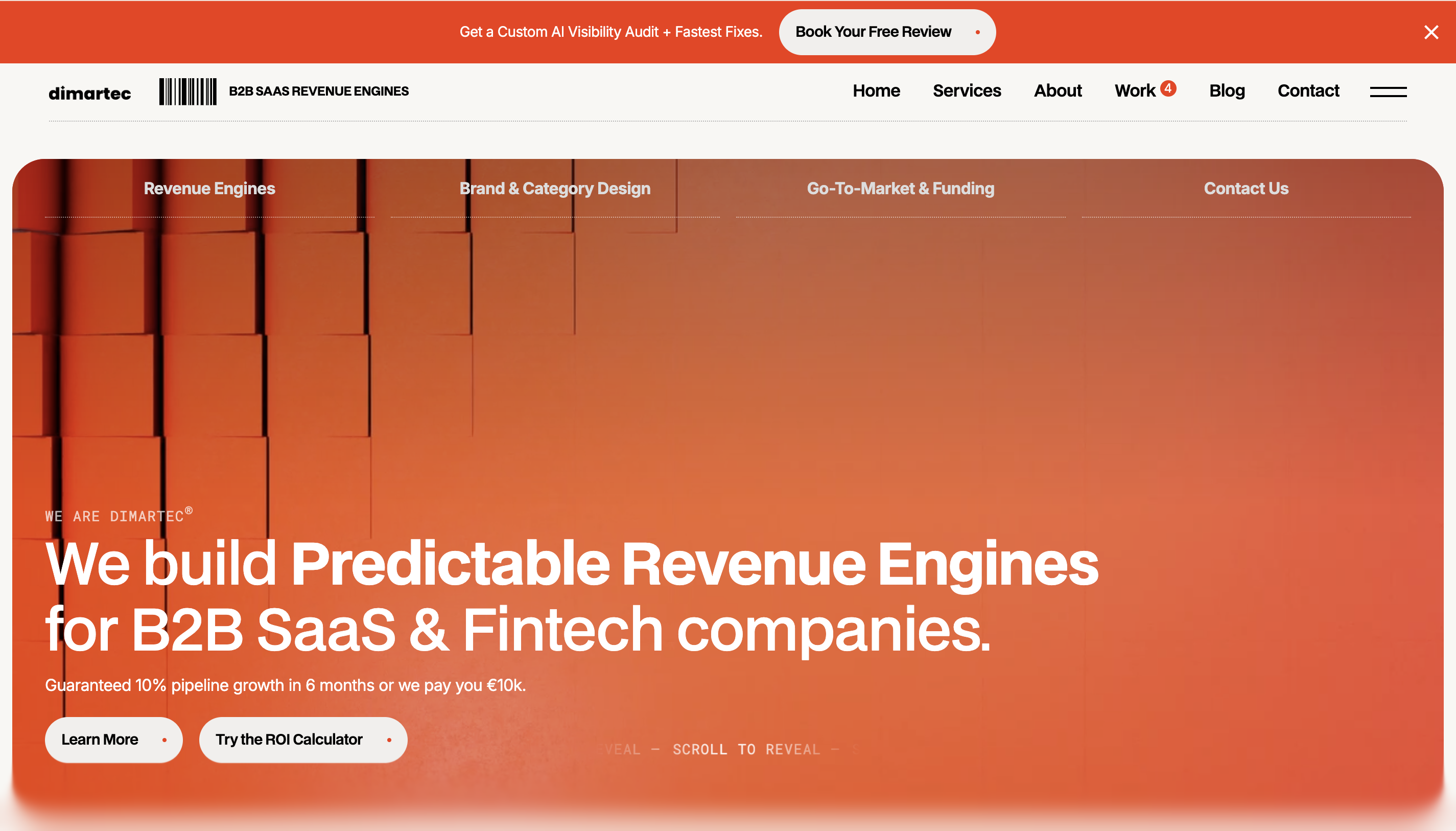
Best for: Post-PMF B2B SaaS and fintech at €2M–€10M ARR where blended CAC is rising and the source of the increase cannot be isolated because paid acquisition, conversion, qualification, and attribution are each managed separately with different metrics and different owners
dimartec builds Revenue Engines for B2B SaaS and fintech companies. The five integrated services (Performance Paid Media, CRO, GEO, Lead Gen & Nurturing, and RevOps & Automation) address all four CAC reduction mechanisms as one connected system from the first session.
Performance Paid Media addresses mechanism one and four simultaneously. Targeting is calibrated to the ICP accounts most likely to produce SQLs, not to the audiences that produce the cheapest clicks, and attribution connects every campaign to closed-won ARR so the spend allocation decision is made from revenue evidence rather than from campaign efficiency proxies. CRO addresses mechanism two: landing page diagnostic and conversion improvement before paid spend scales, ensuring the traffic the campaigns deliver converts at the rates that justify the CPC rather than at the 1 to 3% that most B2B SaaS pages achieve without structural intervention. GEO addresses mechanism three: brand visibility in ChatGPT, Perplexity, and Claude builds the compounding discovery channel that replaces organic traffic lost to AI Overviews and produces inbound leads at near-zero marginal CAC as the programme matures. Lead Gen & Nurturing addresses mechanism one directly: ICP-calibrated qualification scoring built from closed-won data routes only SQL-ready leads to the sales team, eliminating the qualification waste that inflates the sales cost component of the CAC calculation.
The RevOps & Automation attribution layer is the component that makes all four mechanisms measurable and improvable. When the attribution model shows which channels are producing the lowest CAC to closed-won, the budget reallocation decision is analytical. When it shows that the CRO improvement on a specific page reduced cost per SQL by 40%, the investment in CRO is justified by revenue evidence. When it shows that GEO-sourced leads have a 15% lower CAC than paid-sourced leads from the same ICP segment, the investment in GEO is sequenced into the programme.
If any of the following apply, dimartec is worth a conversation:
- Blended CAC has been rising for two or more quarters and the source of the increase cannot be isolated because channel-level CAC is not calculated from closed-won attribution
- CPA on paid channels is climbing despite constant or growing spend, indicating that either audience quality is declining, conversion rate is deteriorating, or qualification waste is increasing
- The brand is losing organic traffic to AI Overviews and has no GEO programme replacing that discovery volume with AI search visibility
- Qualification waste is visible (sales rejection rate above 30%) but the scoring model has not been recalibrated against recent closed-won data
Key services
- Performance Paid Media: acquisition targeting against closed-won ICP profiles, measured by cost per SQL and CAC payback, with spend reallocation informed by multi-touch attribution to closed ARR
- CRO: structural conversion improvement before paid spend scales, directly reducing the paid traffic volume needed per SQL
- GEO: brand visibility in ChatGPT, Perplexity, and Claude, building the compounding discovery channel that reduces blended CAC as organic and AI search inbound grows
- Lead Gen & Nurturing: closed-won-calibrated qualification scoring eliminating the sales cost component of CAC from leads that were never going to close
- RevOps & Automation: multi-touch attribution connecting all four CAC reduction mechanisms to closed ARR, making the CAC calculation channel-specific and the improvement decision evidence-based
Why dimartec stands out for B2B SaaS CAC reduction
- All four CAC reduction mechanisms operate under one owner from the first session: no coordination overhead between the agency managing conversion and the agency managing qualification
- GEO directly addresses the 2026 organic channel erosion from AI Overviews: the compounding replacement channel is built alongside paid and CRO rather than as a future phase
- RevOps & Automation connects every mechanism to closed-ARR CAC, making the specific contribution of each mechanism to the overall CAC reduction measurable
- 90% of clients see improved lead quality within 90 days, which is mechanism one delivering the fastest available CAC reduction before the slower mechanisms compound
Best fit: Post-PMF B2B SaaS and fintech at €2M–€10M ARR where blended CAC is rising, the source is unclear because channel-level attribution to closed revenue does not exist, and the current programme is scaling spend as the primary response to a problem that requires qualification, conversion, and channel mix changes.
2. GrowthSpree
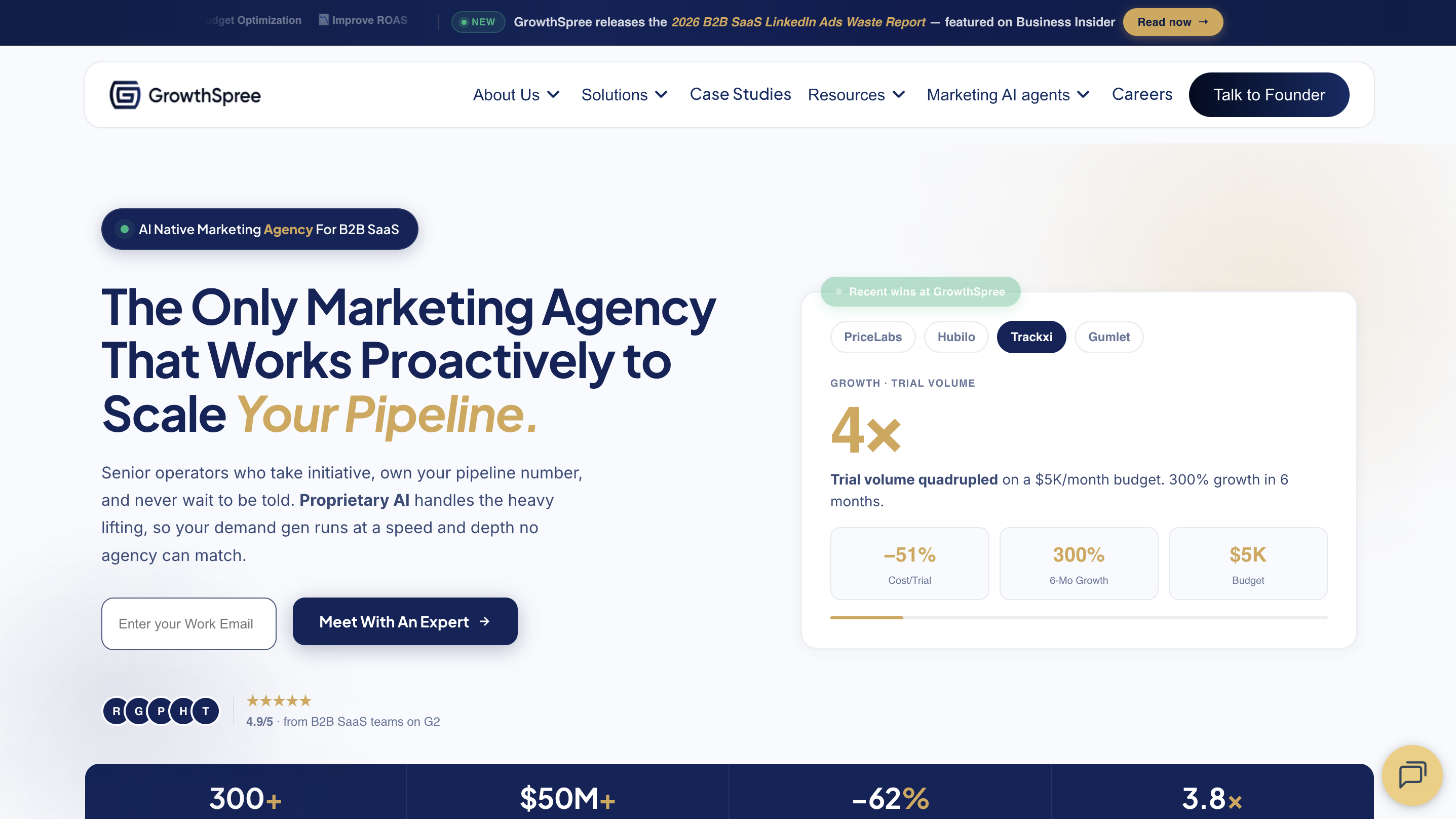
Best for: Series A–C B2B SaaS with meaningful paid acquisition budgets that need AI-native paid optimisation reducing the qualification waste baked into current campaign targeting, with MCP attribution identifying which channels produce the lowest CAC to closed-won from month one
GrowthSpree is an AI-native demand generation agency whose Qualified Lead Architecture (QLA) directly addresses the most mechanically accessible CAC reduction in paid B2B SaaS acquisition: training paid platform algorithms against closed-won CRM signals rather than against form-fill signals. When Google Smart Bidding optimises against form fills, it finds the audiences that submit forms at the lowest cost, which is not the same as the audiences that close at the highest rate. The gap between these two audiences is the source of qualification waste in paid acquisition. QLA feeds closed-won conversion signals back into the platform algorithm, narrowing the targeting toward the audiences that actually produce revenue rather than the audiences that produce cheap conversions.
Their proprietary Google Ads Waste Report found 36.1% average wasted spend across 43 B2B SaaS accounts measured. In CAC terms, eliminating 36.1% of spend waste while holding pipeline constant is equivalent to a 36.1% CAC reduction on paid channels before any other optimisation is applied. This waste elimination is the fastest available paid CAC reduction because it does not require testing new creative, changing the channel mix, or building new landing pages. It requires recalibrating the targeting signal the algorithm is already optimising against.
Their MCP attribution infrastructure produces channel-level CAC from closed-won attribution rather than from last-click platform attribution. For B2B SaaS companies running Google, LinkedIn, and ABM simultaneously, the MCP shows which combination of channels and touchpoints produces the lowest fully loaded CAC, enabling the spend reallocation decision to be made from evidence rather than from convention.
Documented results include PriceLabs (350% ROAS improvement, equivalent to a 71% effective CAC reduction on that channel) and Rocketlane (3.4x ROAS at 36% lower cost per demo).
Key services
- AI-native paid acquisition (Google, LinkedIn, Meta) with QLA eliminating qualification waste in paid targeting from campaign launch
- MCP attribution: channel-level CAC from closed-won data produced from month one
- GEO in standard engagements: AI search visibility contributing to blended CAC reduction as organic discovery supplements paid
- Signal-based ABM reducing wasted outreach on non-ICP accounts
- Flat retainer removing the percentage-of-spend incentive that causes agencies to scale spend rather than improve efficiency
Why GrowthSpree stands out for B2B SaaS CAC reduction
- QLA addresses the root cause of paid CAC inflation: the platform algorithm is trained against the wrong conversion signal, generating leads that look efficient on the platform and produce low SQL conversion rates
- 36.1% average wasted spend identified in their proprietary analysis represents the CAC reduction available before any new optimisation begins
- MCP produces channel-level CAC from closed-won attribution from month one: the spend reallocation decision is data-driven from the first reporting cycle
- Flat retainer removes the incentive that causes agencies to recommend budget increases as the primary CAC management strategy
Best fit: Series A–C B2B SaaS at €2M–€20M ARR running Google Ads and LinkedIn with budgets above €10k per month, where the primary CAC reduction opportunity is in the qualification waste embedded in current campaign targeting rather than in the channel selection or the creative.
3. Omniscient Digital

Best for: Series A–B B2B SaaS with rising paid CAC that need a compounding organic and GEO layer to reduce blended CAC over 12 to 18 months as organic and AI search channels produce increasing pipeline at near-zero marginal cost
Omniscient Digital works exclusively with B2B SaaS and technology companies, building organic and AI search pipeline programmes where performance is measured against pipeline contribution and closed ARR. Their specific CAC reduction mechanism is channel mix rebalancing: shifting revenue attribution from paid channels (where marginal CAC rises with spend and infrastructure cost) to organic and GEO channels (where marginal CAC approaches zero once the compounding phase is reached).
The 2026 context makes this mechanism more commercially compelling than at any previous point. Google AI Overviews are reducing organic click-through rates on informational queries by up to 58%. Companies that relied on organic search as a low-CAC acquisition channel are losing that contribution. Omniscient Digital's response is to build the replacement: GEO visibility in ChatGPT, Perplexity, and Claude, tracked through their Atomic AGI technology as a measured channel with pipeline attribution. Their Atomic AGI system tracks brand appearances in AI-generated answers to category questions and connects those appearances to pipeline contribution, making GEO accountable to the same CAC calculation as paid channels.
The compounding economics of the organic and GEO layer are the CAC reduction mechanism. In month 12 of an organic and GEO programme, the content assets producing pipeline cost the same as in month 3. The pipeline they produce has grown. The marginal CAC from those assets has therefore fallen. At month 18, the marginal CAC from compounding organic and GEO assets is a fraction of the marginal CAC from paid campaigns, which have not reduced in cost per click over the same period. Blended CAC falls as the organic and GEO proportion of the revenue mix increases.
Documented outcomes include Smartling ($3.7M in pipeline from organic), Order.co (39x conversion increase), and a 41:1 ROI within 10 months including AI search position gains.
Key services
- Organic and AI search pipeline programme: SEO and GEO as one compounding investment
- Atomic AGI: proprietary tracking of brand appearances in ChatGPT, Perplexity, and Google AI Overviews as pipeline-attributed channels
- Pipeline attribution: organic and AI search traffic connected to CRM opportunity and closed ARR
- Content strategy structured for both traditional search and LLM citation
- Technical SEO and programmatic content at scale
Why Omniscient Digital stands out for B2B SaaS CAC reduction
- Compounding economics: the CAC from organic and GEO channels falls over time as pipeline grows from the same content investment, directly improving blended CAC
- Atomic AGI addresses the 2026 organic channel erosion: GEO replaces the organic traffic being lost to AI Overviews with AI search discovery that does not require per-click spend
- Pipeline attribution from organic to closed ARR makes the blended CAC calculation accurate: organic and GEO contribution is measured rather than estimated
- B2B SaaS-only client base means the content and GEO investment is calibrated to the specific buyer behaviour that produces pipeline in software purchasing decisions
Best fit: Series A–B B2B SaaS at €2M–€15M ARR where paid channel CAC has been rising and the strategic response is to build the compounding organic and GEO channels that reduce blended CAC over 12 to 18 months rather than to continue scaling paid spend at rising CPCs.
4. Directive Consulting

Best for: Series B and above B2B SaaS where the CAC problem is being interrogated at board and CFO level, requiring a marketing partner that connects acquisition spend to CAC payback and LTV:CAC through financial modelling and unit economics depth
Directive Consulting is a performance marketing agency for mid-market and enterprise B2B SaaS whose Customer Generation methodology measures marketing against revenue contribution rather than campaign activity. Their specific CAC reduction value is in the financial modelling layer they connect to acquisition work: paid campaigns are not evaluated against cost per click or cost per lead. They are evaluated against CAC payback period and LTV:CAC ratio, which makes the CAC reduction conversation happen at the unit economics level rather than at the campaign optimisation level.
This distinction matters at Series B and above because the board conversation about CAC is not a marketing conversation. It is a finance conversation. When the CFO asks why CAC payback has extended from 14 months to 19 months over three quarters, the answer that satisfies the board is not a campaign metric improvement. It is an attribution model connecting the payback extension to specific channel cost increases, conversion rate changes, or qualification waste patterns, with a prioritised plan for which of those drivers to address first. Directive's financial modelling layer provides this connection.
Their DiscoverabilityOS framework aligns paid search, paid social, and content to the specific buyer intent stage, concentrating spend at the stages that produce SQLs rather than distributing it across awareness content that inflates the CAC numerator without contributing to the denominator. Named clients include ZoomInfo, Calendly, Adobe, and Cisco, with $1B-plus in reported client revenue.
Key services
- Paid search and paid social connected to CAC payback and LTV:CAC measurement
- DiscoverabilityOS: intent-tiered campaign architecture concentrating spend at SQL-producing stages
- Financial modelling: paid media decisions connected to unit economics, not campaign metrics
- Revenue operations integration connecting ad spend to CRM closed-won data
- CFO and board-level CAC reporting: explaining variance and priority actions in financial rather than marketing language
Why Directive stands out for B2B SaaS CAC reduction
- Financial modelling layer makes CAC payback variance diagnosable at the unit economics level: the board conversation is answered with attribution data rather than with campaign performance explanations
- DiscoverabilityOS intent-tiering reduces the proportion of spend on awareness content that inflates the CAC numerator without contributing to qualified pipeline
- Customer Generation methodology measures the campaign against revenue, not against proxies: the optimisation target is CAC payback, not cost per click
- Named enterprise clients at scale provide evidence that the methodology produces unit economics improvement in categories where acquisition costs are highest and board scrutiny is greatest
Best fit: Series B and above B2B SaaS where the CAC problem is visible at board and CFO level, requiring a marketing partner that communicates CAC reduction in unit economics terms and connects campaign decisions to the financial model the board uses to evaluate growth efficiency.
5. Tuff Growth

Best for: Series A B2B SaaS that need to identify the lowest-CAC acquisition channels before committing budget at scale, using a capital-efficient test-before-scale approach on a flat fee that aligns the agency to efficiency rather than to spend growth
Tuff Growth is a growth marketing agency specialising in capital-efficient paid acquisition for Series A and scaling SaaS companies. Their specific CAC reduction mechanism is test-before-scale: validating which channels produce the lowest CAC to SQL before committing full budget, rather than scaling spend on assumptions about which platform will perform. For Series A companies where every dollar of marketing budget is measured against runway impact, the difference between discovering that LinkedIn produces a $650 CAC and Google produces a $1,100 CAC through a 6-week validation test rather than through 6 months of scaled spend at both is material.
Their flat-fee structure is the structural CAC protection mechanism. An agency paid as a percentage of spend has a financial incentive to recommend budget increases even when the evidence suggests channel mix is the more efficient lever. A flat-fee agency earns the same regardless of budget level and will recommend the spend reduction that improves CAC efficiency even when that recommendation reduces the client's total budget. At Series A, where CAC efficiency determines runway length, this alignment is the most practically important commercial property of the engagement.
Their test-before-scale methodology builds the channel-level CAC attribution data that the spend allocation decision requires: which channels produce the lowest CAC to SQL, which produce acceptable CAC but poor show rates, and which produce cheap leads that the sales team consistently cannot progress. This attribution data is the primary output of the first phase, and it directly informs the spend allocation decision in the second.
Key services
- Channel and creative testing before budget commitment at scale
- CAC payback and cost per SQL as primary success metrics from launch
- Flat-fee structure removing the percentage-of-spend incentive to inflate budget
- Attribution setup connecting channel performance to CRM pipeline from the first test phase
- Growth experiment methodology validating the lowest-CAC channels before scaling
Why Tuff Growth stands out for B2B SaaS CAC reduction
- Test-before-scale approach produces channel-level CAC evidence before the spend decision is made, preventing the CAC inflation that comes from scaling the wrong channel on assumption
- Flat fee removes the most common structural cause of agency-driven CAC inflation: the recommendation to increase budget as the primary route to better results
- Series A positioning means the methodology is calibrated to the runway constraint that makes CAC efficiency the primary commercial objective rather than growth rate
- Channel-level CAC attribution from the first test phase creates the evidence base for spend allocation decisions that most programmes only produce after 6 to 12 months of misallocated budget
Best fit: Series A B2B SaaS at €1M–€5M ARR that have not yet committed to a channel mix at scale, and where the primary CAC risk is scaling spend on channels that have not been validated for cost per SQL before the budget commitment is made.
Why dimartec Reduces B2B SaaS CAC Differently
Every agency on this list addresses a specific CAC reduction mechanism. GrowthSpree eliminates qualification waste in paid targeting through QLA, reducing the proportion of paid spend on audiences that never become SQLs. Omniscient Digital builds the compounding organic and GEO channels that reduce blended CAC as their contribution to the revenue mix grows. Directive Consulting connects acquisition spend to the unit economics model the board interrogates, making CAC payback variance visible and actionable. Tuff Growth validates which channels produce the lowest CAC before budget is committed at scale.
Each of them addresses one or two mechanisms and returns the rest to the client. When qualification waste is addressed by the agency optimising paid targeting and the conversion rate failure is left for an internal CRO team that does not exist, the paid CAC improvement is partially offset by the landing page that still converts at 2%. When the compounding organic channel is built by an SEO agency and the attribution model showing which organic content produces pipeline at what CAC is maintained by a separate RevOps vendor, the organic CAC reduction is estimated rather than measured. The four mechanisms only compound when they are connected to one attribution model that shows the combined effect of each change on the blended CAC figure the board is watching.
dimartec connects all four mechanisms to one attribution model from the first session. The CRO improvement reduces the paid traffic needed per SQL. The GEO programme reduces the paid proportion of the blended CAC over time. The qualification scoring reduces the sales cost per SQL. And RevOps & Automation attributes the combined effect of all four to the closed-ARR CAC figure that tells the board whether the improvement is real or whether the measurement is incomplete.
See how the Revenue Engine works: https://www.dimartec.co.uk/services/revenue-engine
How to Choose the Right Agency for B2B SaaS CAC Reduction
Diagnose which mechanism is causing the CAC increase before choosing an agency
Rising CAC in B2B SaaS has four distinct causes requiring different agency types. If paid channel costs have risen and conversion rates are unchanged, the primary driver is CPC inflation and the fix is either conversion improvement (CRO) or channel mix shift (organic and GEO). If paid costs are stable but SQL volume is falling, the primary driver is qualification waste and the fix is lead scoring recalibration. If the CAC calculation looks reasonable but CAC payback has extended, the primary driver is sales cycle length or deal size change and the fix requires attribution depth to identify which segment of the pipeline is producing the payback extension. Name the mechanism before choosing the agency.
Require closed-won attribution as a prerequisite for any CAC reduction engagement
An agency that optimises against cost per lead is not reducing CAC. It is reducing cost per lead, which is only useful if cost per lead and CAC move in the same direction, which they rarely do when qualification waste is a factor. Before engaging any agency for CAC reduction, ask specifically: how do you calculate CAC by channel, and what conversion events connect your campaign performance to that calculation? If the answer describes a last-click attribution model or a form-fill conversion event, the agency is measuring a proxy rather than the outcome.
Assess the compounding channel capability before the paid channel capability
Every agency on this list manages paid acquisition. The differentiating question for long-term CAC reduction is whether the agency builds the organic and GEO channels that reduce blended CAC as they compound. Paid channel CAC has a floor at current CPCs, which are rising. Organic and GEO channel CAC has a floor near zero once the compounding phase is reached, which falls over time. The agencies that reduce blended CAC in a sustainable direction build both.
Frequently Asked Questions
What is the fastest way to reduce B2B SaaS CAC?
The fastest available CAC lever is qualification waste elimination: reducing the proportion of leads that reach the sales team and fail to progress to SQL. This can produce a measurable improvement in cost per SQL within 60 to 90 days of recalibrating the lead scoring model against recent closed-won data. It does not require new campaigns, new channels, or new creative. It requires the right CRM configuration and the right qualification criteria. The second fastest lever is conversion rate improvement on existing paid landing pages, which can reduce cost per SQL by 30 to 60% on a given channel within 4 to 8 weeks of implementing structural page improvements.
How does GEO reduce B2B SaaS CAC?
GEO reduces blended CAC through two mechanisms. First, GEO-sourced inbound leads (from buyers who found the brand through ChatGPT, Perplexity, or Claude) carry near-zero marginal acquisition cost compared to paid-sourced leads. As GEO contributes an increasing proportion of total pipeline, the weighted average CAC across all sources falls. Second, GEO-sourced visitors arrive with higher prior brand familiarity than cold paid visitors, producing higher conversion rates on demo request pages and lower cost per SQL from inbound. Both effects compound over time as GEO visibility builds.
Build a Programme That Reduces CAC Over Time
The programmes that reduce B2B SaaS CAC sustainably are not the ones that cut spend. They are the ones that make spend more efficient through qualification waste elimination, make traffic more productive through conversion improvement, build the compounding channels that reduce blended CAC as they mature, and connect all of it to an attribution model that makes the CAC calculation trustworthy enough to act on.
The Revenue Engine connects Performance Paid Media, CRO, GEO, Lead Gen & Nurturing, and RevOps & Automation into one system so all four CAC reduction mechanisms operate under one attribution model, the blended CAC calculation is produced from closed-won data rather than from proxy metrics, and the improvement compounds across mechanisms rather than stabilising at the first single-mechanism efficiency gain.
See how the Revenue Engine works: https://www.dimartec.co.uk/services/revenue-engine




.png)

















































.png)
.png)
.png)
.png)
.png)
.png)
.png)
.png)
.png)
.png)