
Put ten agencies that call themselves GTM specialists in a room and ask each what go-to-market means. One will talk about sales methodology and stage definitions. Another will talk about positioning and product marketing. A third will open a Clay workflow and show you signal-based outbound. A fourth will argue that the problem is that buyers have never heard of you. All four are describing something real, and all four would charge you for it.
That is why choosing a GTM agency is harder than choosing almost any other kind of marketing partner. The label covers consultancies, training firms, systems builders, demand agencies, and outbound shops. Each is excellent at its own version of the job, and each can be the wrong hire if its version does not match the problem a SaaS company actually has.
After analysing go-to-market programmes across more than 200 B2B SaaS accounts, the most costly GTM engagements were rarely failures of quality. They were mismatches. A company with a weak ICP hired an outbound engine and scaled the wrong conversations. A company with clear positioning but broken reporting hired a strategy firm and received another framework. A company at €4M ARR hired an agency built for €50M and paid for capabilities it could not use.
This review sets out what each of ten GTM agencies means by go-to-market, where each is strongest, where each falls short, and which SaaS companies each suits. It ends with direct comparisons of the agencies most often shortlisted together.
What Each Agency Means by GTM
The ten agencies in this review interpret go-to-market in five broad ways. Seeing them side by side makes it easier to match an agency to a problem.
GTM as an operating model. The company needs a shared architecture for the customer journey, consistent stage definitions, and a sales methodology. Winning by Design and Skaled lead here.
GTM as strategy plus systems. Positioning, product marketing, and the CRM and lifecycle automation that put them into practice. ARISE GTM and Go Nimbly approach it this way, from different directions.
GTM as demand. The company's main constraint is that not enough of the right buyers know or want it. Refine Labs focuses on creating demand; Directive on turning demand into qualified pipeline through paid media, content, and RevOps.
GTM as an outsourced team. The company lacks marketing leadership or capacity. Kalungi and NoGood provide a team that plans and executes.
GTM as engineering. Data, signals, and automation decide who is contacted and when. ColdIQ leads with this view.
dimartec combines several of these in one engagement, connecting demand, conversion, nurture, and RevOps around a defined build, which is why it appears first.
How We Reviewed These Agencies
Each agency was assessed on the same six questions:
- Definition: What does it mean by GTM, and is that view clearly documented?
- Stage fit: Which revenue stage and budget does its model actually suit?
- Depth: Does it implement, or mainly advise and train?
- Pipeline link: Is its work measured in qualified pipeline and revenue?
- Ownership: What does the client keep when the engagement ends?
- Evidence: Are there named clients, published results, or independent reviews?
Figures come from agencies' own materials, review platforms, and third-party comparisons, and are attributed where possible. Pricing in particular varies between sources and should be confirmed directly.
The 10 Best GTM Agencies for SaaS, Reviewed
1. dimartec
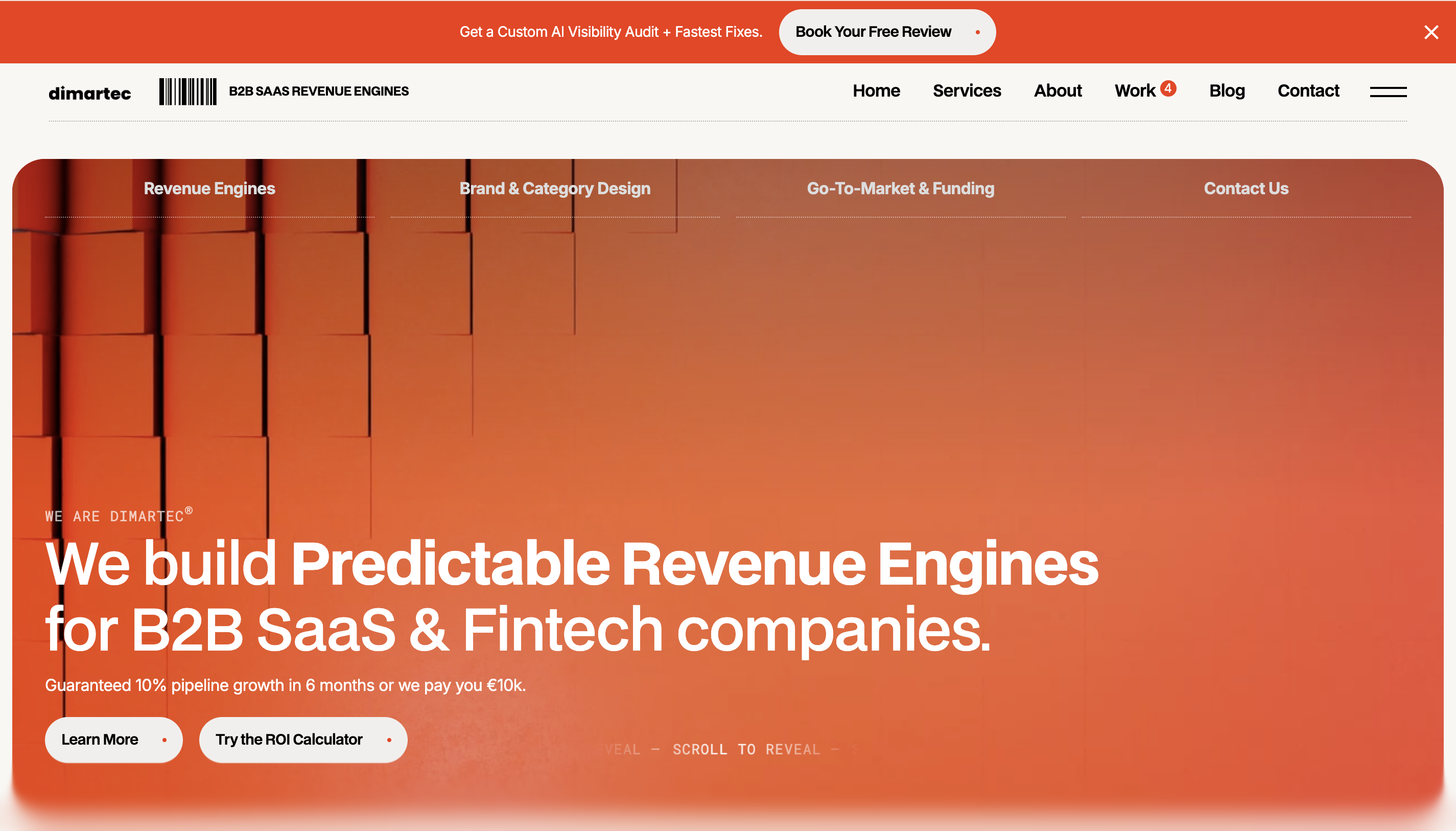
Best for: B2B SaaS and fintech companies at €2M–€10M ARR that want their go-to-market engine diagnosed, built across every revenue function, and handed to their own team
dimartec builds Predictable Revenue Engines for B2B SaaS and fintech companies, and works only with businesses in those two categories. Its Revenue Engine connects five pillars into one operating system: Performance Paid Media, Full-Funnel CRO, GEO, Lead Gen & Nurturing, and RevOps & Automation. Its stated purpose is to make growth measurable, forecastable, and easier to scale, with every decision tied to pipeline, acquisition cost, and closed revenue.
Engagements begin with a two-to-four-week Diagnostic that covers a CRO audit, paid media review, AI search visibility report, brand positioning teardown, and full funnel teardown, ending in a prioritised roadmap. The Revenue Engine is then built over six months: unified tracking first, then all five pillars running together, then scaling, documentation, and operational forecasting. Playbooks, dashboards, and workflows are handed over at month six, and the client team contributes around five hours in total.
Strengths
- Covers demand, conversion, nurture, and RevOps in one team, so GTM decisions reach every channel
- Positioning reviewed in the Diagnostic, not assumed
- Reports on the board's numbers: acquisition cost, cost per SQL, lead-to-SQL rate, and payback
- A defined end point, with the system owned by the client; dimartec reports a 24% average reduction in cost per SQL within 180 days
Limitations
- Broader than a company wanting only sales training or only outbound
- Built for B2B SaaS and fintech only
Verdict
The strongest choice in this review for companies in this revenue band that want one accountable partner to build the whole go-to-market engine and leave it with them.
2. Winning by Design
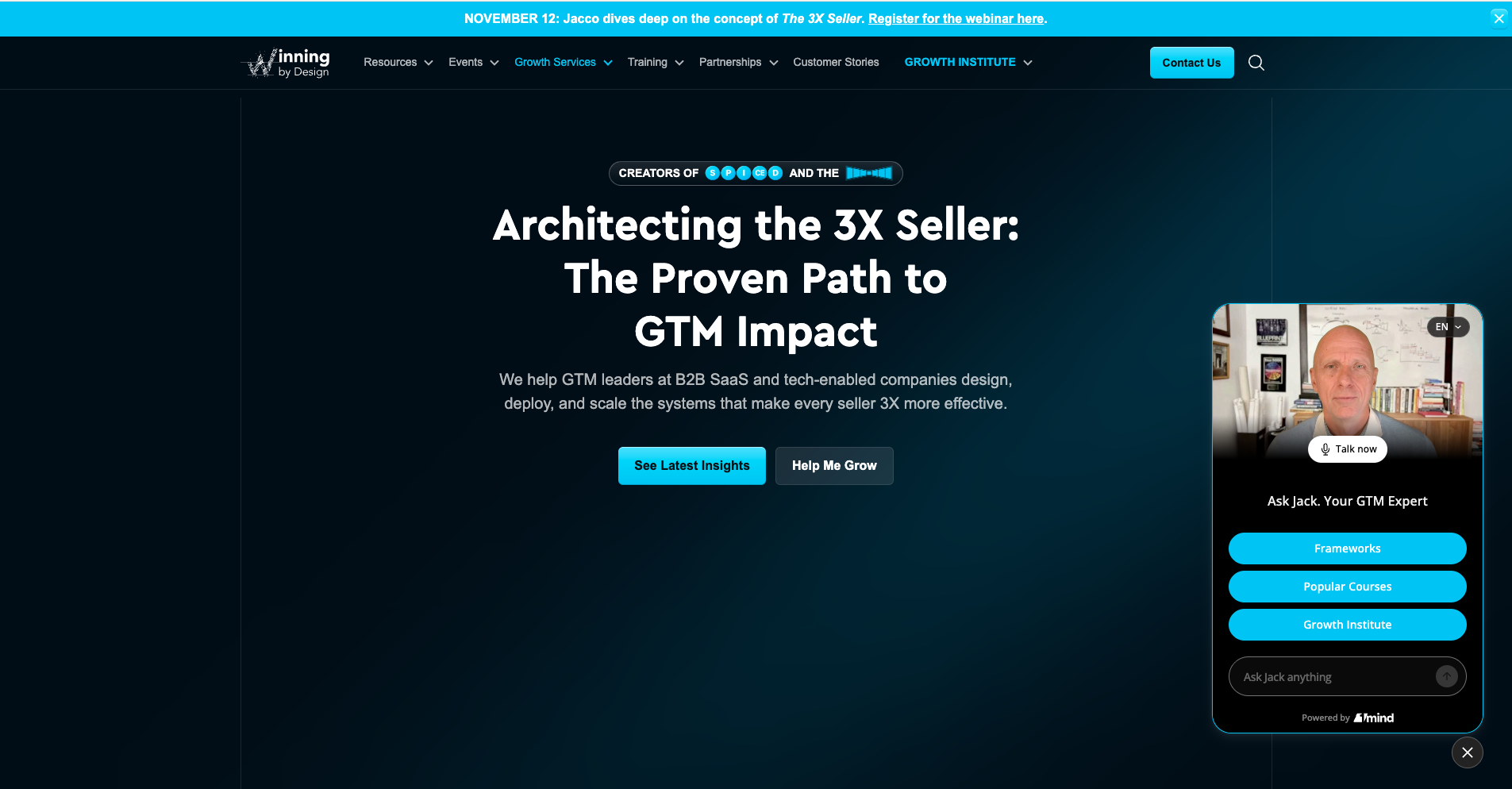
Best for: SaaS companies that need a shared revenue architecture, data model, and sales methodology across every customer-facing team
Winning by Design, founded in 2012 in Mountain View, California, is a revenue consulting and training firm for recurring revenue businesses. It created the SPICED methodology and the Bowtie Data Model, publishes both openly, and draws on work with more than 1,000 SaaS companies, including Canva, Dropbox, and DocuSign. Its offerings range from GTM diagnostics and revenue architecture design to a Revenue Academy for frontline roles.
Strengths
- Frameworks widely adopted across SaaS
- One model covering acquisition, retention, and expansion
- Strong training for sales and success teams
- Benchmarking tools for comparing performance
Limitations
- Consulting and training-led; the client's team usually implements
- Does not run demand generation or paid media
Verdict
The benchmark for building a common revenue language. Best for companies with the internal capacity to implement what they learn.
3. ARISE GTM
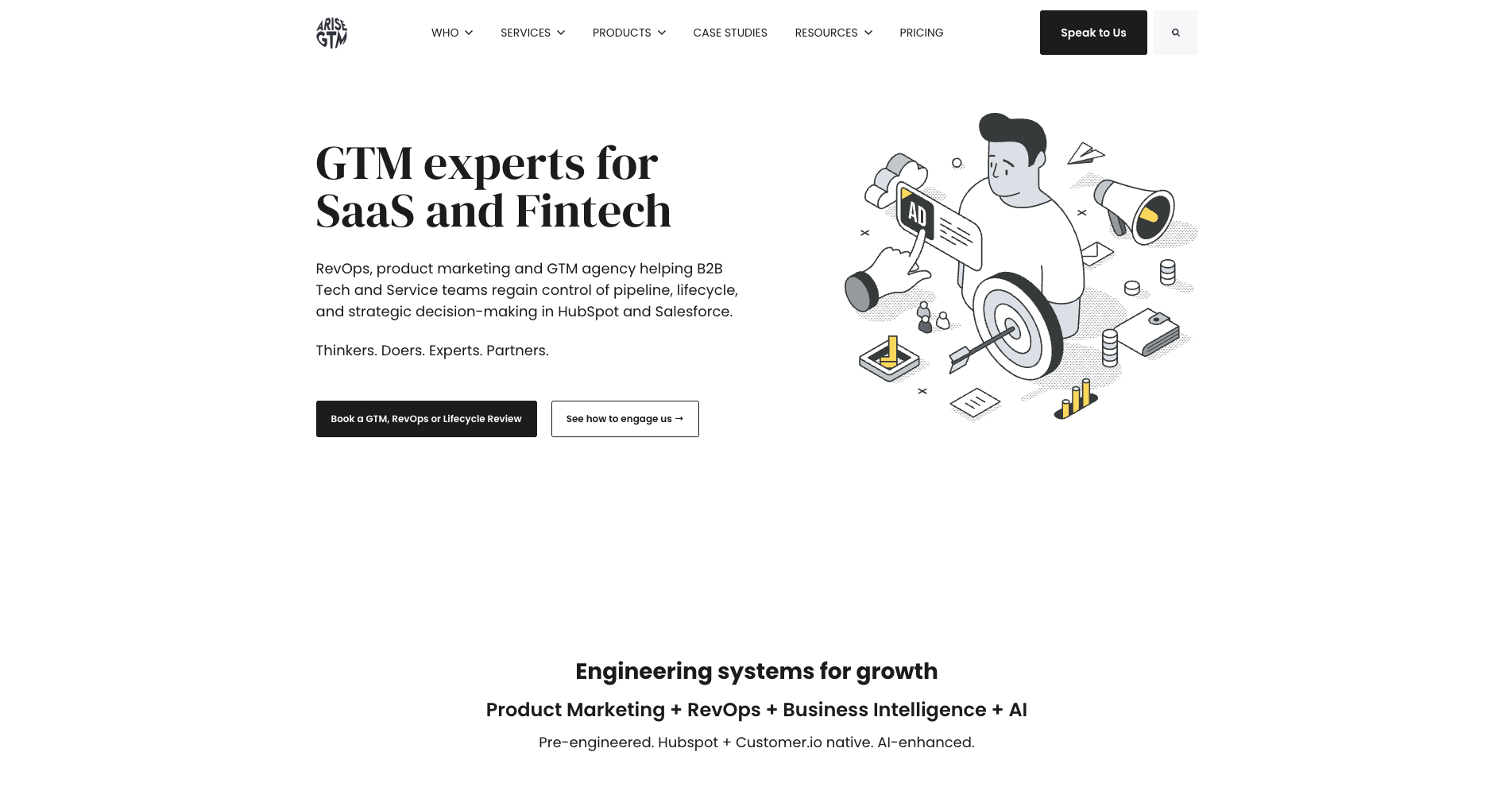
Best for: HubSpot-based SaaS and fintech companies that want positioning, RevOps, and lifecycle automation designed together
ARISE GTM is a UK-based GTM and RevOps consultancy founded in 2017 by Paul Sullivan, author of Go-To-Market Uncovered (Wiley, 2025). A HubSpot Platinum Solutions Partner, it focuses on B2B SaaS and fintech and deploys its ARISE OS, which combines GTM strategy, product marketing, RevOps architecture, lifecycle automation, and business intelligence, as a pre-built system customised for each client.
Strengths
- Product marketing roots strengthen positioning work
- Strategy and systems delivered together
- Lifecycle and retention focus
- Published methodology
Limitations
- HubSpot-native, so less suited to Salesforce environments
- Its own materials cite a minimum of around £7,500 a month
Verdict
A strong pick for HubSpot users whose GTM problems start with positioning and lifecycle. Companies needing heavy paid acquisition will need other support.
4. Directive
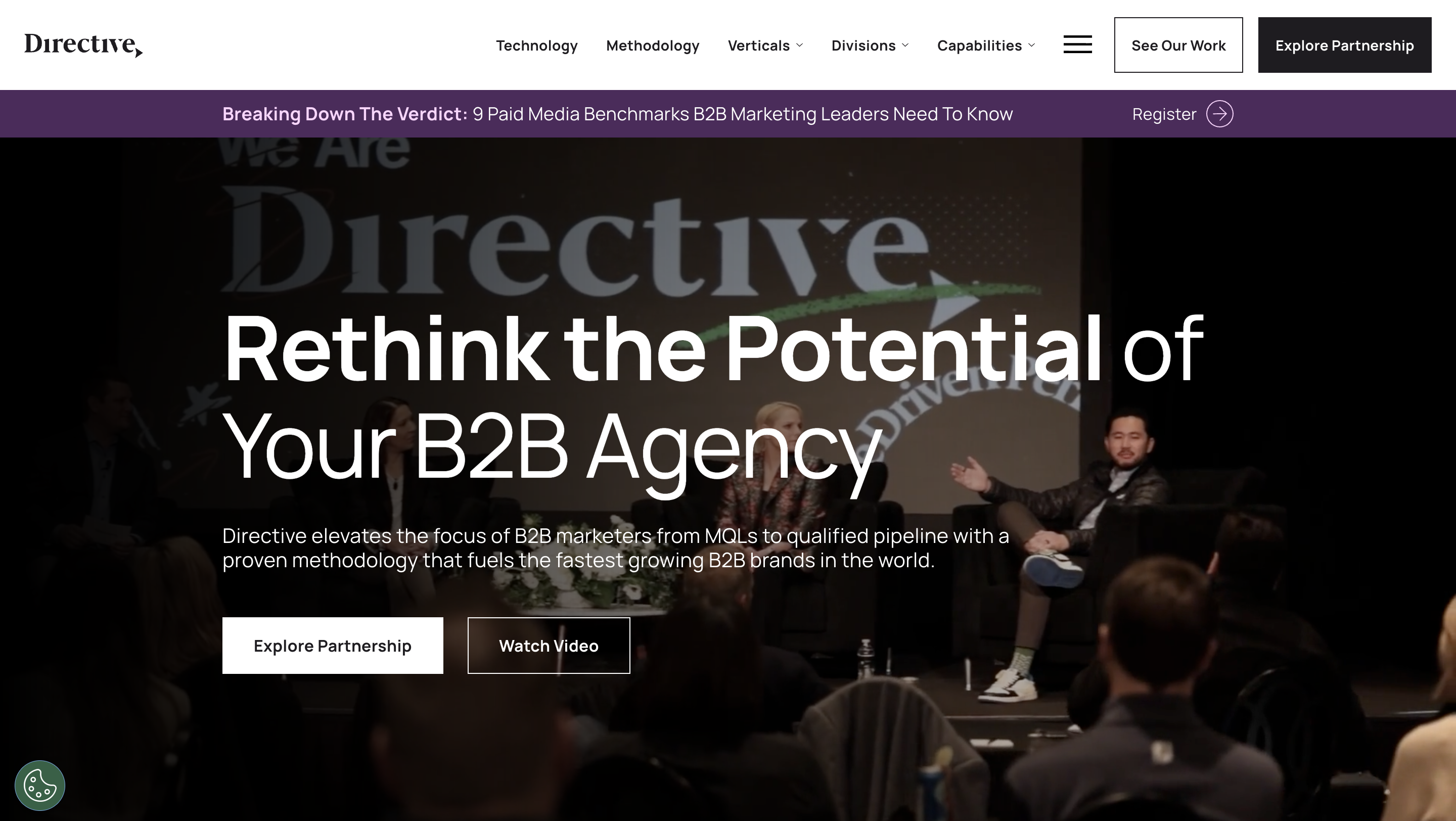
Best for: Mid-market B2B software companies that want paid media, content, and RevOps tied to pipeline through one methodology
Directive is a B2B performance marketing agency headquartered in Irvine, California, founded around 2014 and working exclusively with software and technology companies. Its Customer Generation methodology aims to connect paid media, content, design, and revenue operations to pipeline and revenue through financial modelling and first-party attribution. It reports generating more than $1B in revenue for clients over ten years, with clients including ZoomInfo, Chili Piper, and Uber Freight. Clutch data shows its client base as roughly 60% mid-market and 40% enterprise.
Strengths
- Clear, documented methodology tied to revenue
- Exclusive focus on B2B software
- Broad channel coverage including RevOps
- Large client base and published case studies
Limitations
- Pricing in the upper-mid to premium range, according to independent reviews
- Some Clutch reviewers mention challenges when account staff change
Verdict
A strong fit for mid-market SaaS companies with substantial budgets that want demand generation held to pipeline. Smaller companies may find the model heavier than they need.
5. Refine Labs
Best for: Series B and later SaaS companies ready to rebuild how they create and measure demand
Refine Labs is a Boston demand generation agency founded in 2019 by Chris Walker, who popularised the distinction between creating and capturing demand. Walker exited in July 2025, and CEO Megan Bowen, who has led the agency since 2024, became majority owner. Its "Brand. Demand. Expand." framework uses narrative content and paid social, mainly on LinkedIn and Meta, with self-reported attribution. It reports more than 300 B2B SaaS clients, including Clari, Algolia, and BeyondTrust, and its own site describes its clients as mid-market and enterprise SaaS.
Strengths
- Category-defining demand creation philosophy
- Measures influence beyond clicks
- Large B2B SaaS client base
- Builds familiarity before buyers enter the market
Limitations
- Independent reviews place pricing at roughly $14,000 to $31,000 a month
- Results take several quarters to show in pipeline
- Built for larger companies than this band typically includes
Verdict
The leading choice when the GTM problem is awareness among the right buyers and the budget and patience exist to fix it. Earlier-stage companies will usually benefit more from demand capture first.
6. Kalungi
Best for: SaaS companies without a senior marketing leader that want GTM strategy and execution from one outsourced team
Kalungi acts as a full outsourced marketing department for B2B SaaS, pairing fractional CMO leadership with execution across demand generation, content, paid media, and HubSpot. Its approach follows the T2D3 scaling framework developed by founder Stijn Hendrikse, and one industry roundup reports work with more than 120 SaaS clients. Published results include $4M in pipeline in six months for DataGuard.
Strengths
- Leadership and execution together
- GTM decisions made before channel spend
- SaaS-specific scaling framework
- Published pipeline results
Limitations
- Requires handing marketing leadership to an outside team
- A competitor's review cites full-service engagements from around $45,000 a month, which should be confirmed
Verdict
A good fit for companies whose biggest GTM gap is the absence of a marketing leader. Companies with strong in-house leadership may prefer a specialist.
7. Skaled
Best for: Growth-stage SaaS companies whose sales motion needs to be rebuilt and embedded
Skaled is a revenue performance consultancy founded in 2013 and based in Austin, Texas, led by CEO Jake Dunlap. It reports work with more than 1,000 companies, including LinkedIn, Grammarly, and Hootsuite, across GTM strategy, revenue operations, enablement, and fractional sales leadership. It emphasises implementation, embedding within revenue teams, and has launched an AI GTM System to apply AI across go-to-market processes.
Strengths
- Deep sales process and leadership experience
- Implements alongside the client team
- Fractional sales leadership available
- SaaS and PE-backed experience
Limitations
- Sales-led heritage; less focused on demand generation
- Marketing execution would need another partner
Verdict
The right call when inconsistent sales execution is what makes the pipeline unpredictable.
8. NoGood
Best for: SaaS companies focused on product-led growth, activation, and fast experimentation across channels
NoGood is a New York growth agency that builds cross-functional growth squads covering SEO, paid search, content, CRO, and fractional CMO leadership. It works with startups, scale-ups, and large brands across SaaS, AI, fintech, healthcare, B2B, and consumer markets, and names clients including TikTok, Nike, and MongoDB. Independent reviews describe a focus on product-led growth, activation, and user acquisition, and put its headcount at around 50.
Strengths
- Strong experimentation culture
- Cross-functional squads rather than single-channel teams
- Experience with product-led and activation-driven growth
- Recognised client roster
Limitations
- Mixed B2B and consumer client base, so less specialised in complex B2B sales
- Custom pricing with no published ranges
Verdict
A good fit for product-led SaaS companies that want rapid testing across acquisition and activation. Sales-led companies with long cycles will find more specialised partners elsewhere.
9. ColdIQ
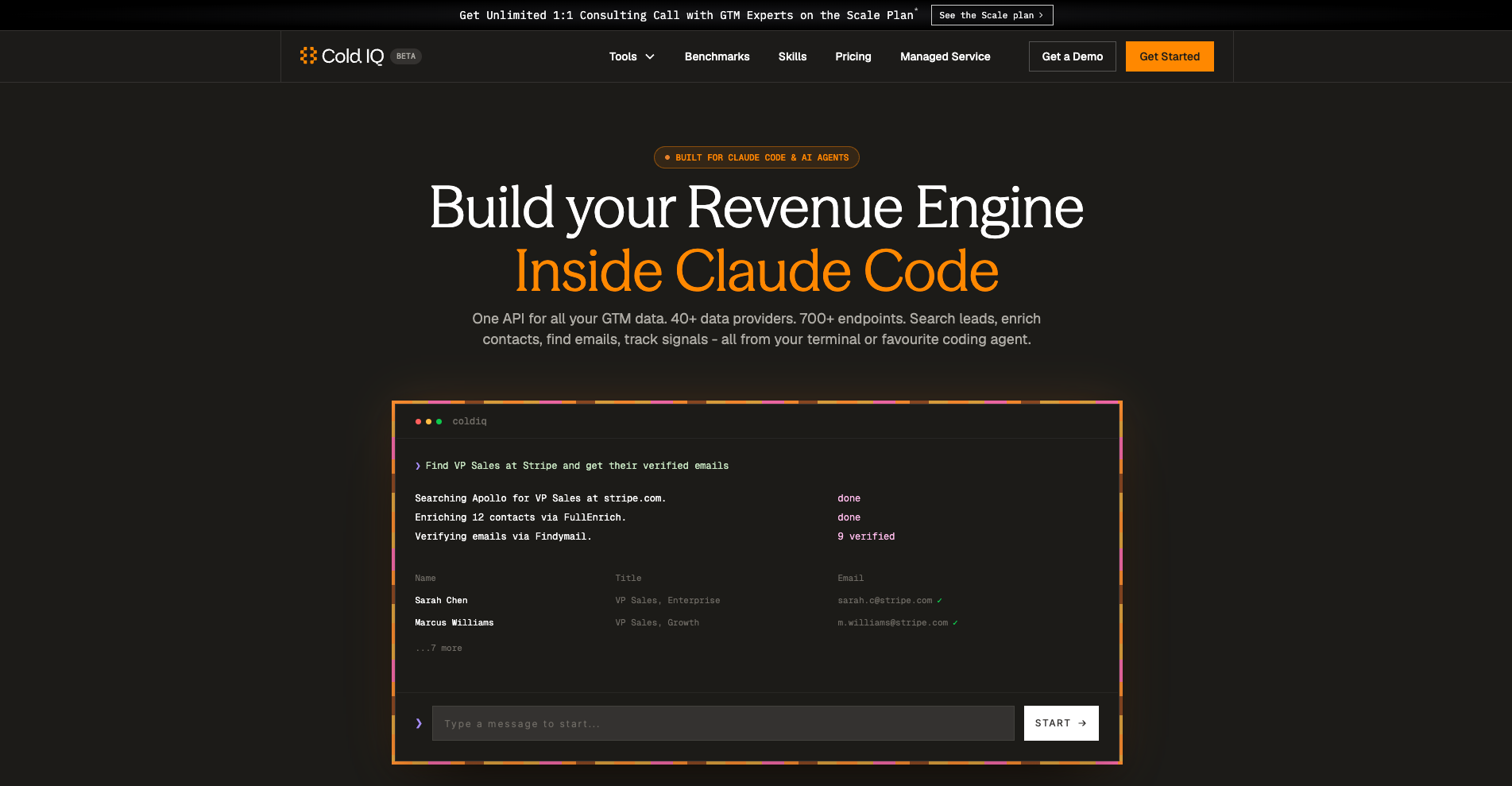
Best for: Early-stage SaaS companies that want signal-based outbound engineered on Clay
ColdIQ is a GTM engineering agency founded in 2020 in New York, and one of a small number of Clay Elite Studio partners. It designs, builds, and runs AI-powered outbound and account-based systems that turn buying signals into meetings, reports more than 70 B2B clients, launches campaigns in about two weeks, and works on a three-month minimum. Its Clay listing describes its main clients as seed to Series A startups.
Strengths
- Precise, signal-driven targeting
- Fast launch
- Deep tool and data expertise
- Large outbound client base
Limitations
- Execution only; assumes the ICP and positioning are already clear
- Outbound-centred, so inbound and conversion need other partners
Verdict
The most technically advanced outbound option in this review, best used once the GTM model is settled.
10. Go Nimbly
Best for: Product-led or hybrid SaaS companies whose systems have not kept pace with their GTM model
Go Nimbly was founded in 2015 by Jen Igartua as a fractional RevOps firm and embeds teams of analysts, Salesforce administrators, and marketing automation specialists inside clients. It works across Salesforce, HubSpot, Outreach, and Gainsight, and is known for strength with product-led and hybrid motions. Independent guides describe its typical clients as Series A to Series D.
Strengths
- Strong in product-led and hybrid motions
- Senior embedded teams
- Multi-platform depth
- Long RevOps track record
Limitations
- Systems partner, not a demand generation agency
- Engagements may be larger than early companies need
Verdict
The right partner when the GTM model is sound but the systems cannot measure or support it.
Head-to-Head Comparisons
Winning by Design vs Skaled. Both shape the operating model. Winning by Design gives every team a shared architecture and language through training and frameworks. Skaled embeds to rebuild the sales motion itself. Choose Winning by Design to align several teams; choose Skaled when sales execution is the weak point.
Directive vs Refine Labs. Both are demand specialists for B2B SaaS. Directive focuses on capturing and converting demand through paid media, content, and RevOps tied to revenue. Refine Labs focuses on creating demand before buyers are in market. Directive tends to show pipeline sooner; Refine Labs aims at a larger, slower shift.
Kalungi vs NoGood. Both provide an outsourced team. Kalungi is SaaS-only and leads with strategy and a fractional CMO. NoGood runs experiment-heavy growth squads across B2B and consumer brands. Kalungi suits sales-assisted SaaS without a marketing leader; NoGood suits product-led growth.
ARISE GTM vs Go Nimbly. Both combine strategy and systems. ARISE GTM starts from positioning and lifecycle on HubSpot. Go Nimbly starts from embedded RevOps across several platforms, with strength in product-led motions. Choose by platform and by whether the gap is message or machinery.
dimartec vs a combination of specialists. Many companies hire a strategy firm, a demand agency, and an outbound shop, then manage the gaps between them. dimartec covers demand, conversion, nurture, and RevOps in one build, with one set of definitions and a handover at the end. For companies in the €2M–€10M band, one connected engine is usually simpler to run and easier to measure than three separate partners.
Why dimartec Approaches GTM Differently
The agencies in this review are each excellent at one interpretation of go-to-market. Some define the operating model, some create or capture demand, some provide a team, some engineer outbound, and some build the systems underneath.
For most SaaS companies between €2M and €10M ARR, the difficulty is not finding a good specialist. It is that the problem spans several of these interpretations at once. Positioning affects which ads work. Conversion affects what paid media costs. Nurture decides how many leads reach sales. RevOps decides whether anyone can see the result. Solving one in isolation moves the weakness somewhere else.
dimartec's Revenue Engine is built for that situation. The Diagnostic reviews positioning, funnel, paid media, and AI search visibility together. The six-month build then connects Performance Paid Media, Full-Funnel CRO, GEO, Lead Gen & Nurturing, and RevOps & Automation around one set of priorities and one view of the pipeline. At the end, the client's team owns the engine, the playbooks, and the forecast.
See how the Revenue Engine works: https://www.dimartec.co.uk/services/revenue-engine
Frequently Asked Questions
How do I know which kind of GTM agency I need?
Look at where pipeline breaks. If conversion rates vary widely by segment, the ICP or positioning probably needs work. If marketing and sales disagree about lead quality, the operating model and stage definitions need attention. If the model is clear but there is not enough demand, choose a demand or outbound specialist. If nobody can see what is happening, start with systems.
Can one agency cover all of go-to-market?
Some cover several layers, but few cover all of them equally well. Integrated partners suit companies that want one accountable team. Larger companies with in-house leadership often combine specialists and manage the joins themselves.
What should a GTM agency deliver in the first 90 days?
Typically, a clear diagnosis, agreed priorities, and the first changes in place: sharper ICP and positioning, consistent stage definitions, tracking that reports correctly, and early campaigns or tests. Measurable pipeline improvement usually follows over the next one or two quarters.
How much do SaaS GTM agencies cost?
Published figures vary widely. Independent sources cite minimums of around £7,500 a month for some strategy and systems firms, typical retainers from around $5,000 to $10,000 a month at the lower end of demand agencies, and $14,000 to $31,000 a month or more for premium demand creation programmes. Confirm scope and pricing directly with each agency.
Match the Agency to the Problem
"Go-to-market" means something different to almost every agency that uses the term. The right partner is the one whose definition matches where your pipeline actually breaks, whose model fits your stage, and whose work leaves your team stronger when the engagement ends.
The Revenue Engine connects Performance Paid Media, Full-Funnel CRO, GEO, Lead Gen & Nurturing, and RevOps & Automation into one go-to-market system for B2B SaaS and fintech, built over six months and owned by your team.
See how the Revenue Engine works: https://www.dimartec.co.uk/services/revenue-engine