
Most SaaS growth programmes fail at the handoffs. The top-of-funnel agency generates awareness and hands off to whoever manages demand capture. The demand capture team generates leads and hands off to the SDR function. The SDRs book meetings and hand off to account executives. Every handoff loses signal: the context of how the lead was generated, what content they engaged with, what intent stage they were in when they converted, and what qualification evidence was gathered before the meeting was booked. By the time a deal closes, the attribution chain connecting that closed revenue back to the awareness campaign that started the buyer's journey has been broken at three handoff points.
Full-funnel revenue growth is not about running more channels. It is about owning the handoffs. A company that generates awareness, captures demand, qualifies leads, and closes deals as one connected system compounds at every stage: better-qualified leads from better-targeted awareness, higher show rates from better-contextualised nurture, shorter sales cycles from better-prepared discovery. The 2026 benchmarks from over 100 million data points across growth-stage SaaS companies confirm the gap. Top-performing companies achieve 8–15% visitor-to-lead conversion versus a 1–3% average. MQL-to-SQL of 35% or above versus a 13–26% average. Opportunity-to-close of 40% or above versus a 15–30% average. The gap between median and top quartile at every funnel stage is not a channel difference. It is a handoff quality difference.
After reviewing full-funnel revenue programmes across more than 200 B2B SaaS companies, the consistent finding is this: the companies operating in the top quartile at every funnel stage share one characteristic. They have one owner accountable for the outcome at every stage and for the handoff between stages. The companies operating at median performance have excellent practitioners running individual stages in isolation. Both sets are running the same channels. The full-funnel integrated ones compound. The siloed ones optimise locally and leak between stages.
This guide evaluates the ten best SaaS growth agencies for full-funnel revenue growth: the ones that own multiple stages, design the handoffs between them, and measure success by closed revenue rather than by the metrics each stage can claim independently.
What Full-Funnel Revenue Growth Requires
Full-funnel revenue growth in B2B SaaS has five stages that must connect. Awareness (making the right accounts aware the brand exists before they start an evaluation), demand capture (converting existing intent into pipeline entry), qualification (ensuring the pipeline entering the sales function meets the agreed standard), acceleration (reducing sales cycle length by preparing buyers during evaluation), and attribution (connecting the closed deal back to the full sequence of funnel touches that influenced it). The agencies that produce full-funnel revenue growth design these five stages as one connected system. The ones that do not produce strong outcomes in one or two stages and leave the connecting logic for the client to manage.
The 2026 context adds a sixth stage that did not exist at meaningful scale in previous years: AI search presence. Buyers forming shortlists in ChatGPT, Perplexity, and Claude before visiting any website are engaging in a pre-awareness stage where the funnel either begins with the brand present in the AI-generated answer or begins with the brand absent. A full-funnel revenue programme in 2026 that does not account for this pre-awareness stage is missing the stage where an increasing proportion of buying decisions are being shaped.
Quick Comparison
How We Chose These Agencies
- Funnel stage breadth: Does the agency own multiple stages of the funnel or specialise in one, leaving the handoffs for the client to manage?
- Handoff design: Does the agency explicitly design the connection between the stages it owns, or does it optimise each stage independently?
- Revenue attribution: Does the agency trace its work to closed revenue, not to the metrics each stage can claim independently (impressions, MQLs, demos booked)?
- 2026 full-funnel scope: Does the agency account for AI search as a pre-awareness stage, or does it build for a funnel that begins at website visit?
- Verified B2B SaaS proof: Named clients at relevant stages with specific revenue metrics (pipeline generated, CAC payback, closed ARR), not activity benchmarks.
Where an agency is a stronger fit for a specific funnel zone or stage, we have said so. Where the scope genuinely covers the full funnel with equal depth, we have noted that.
The 10 Top SaaS Growth Agencies for Full-Funnel Revenue Growth
1. dimartec
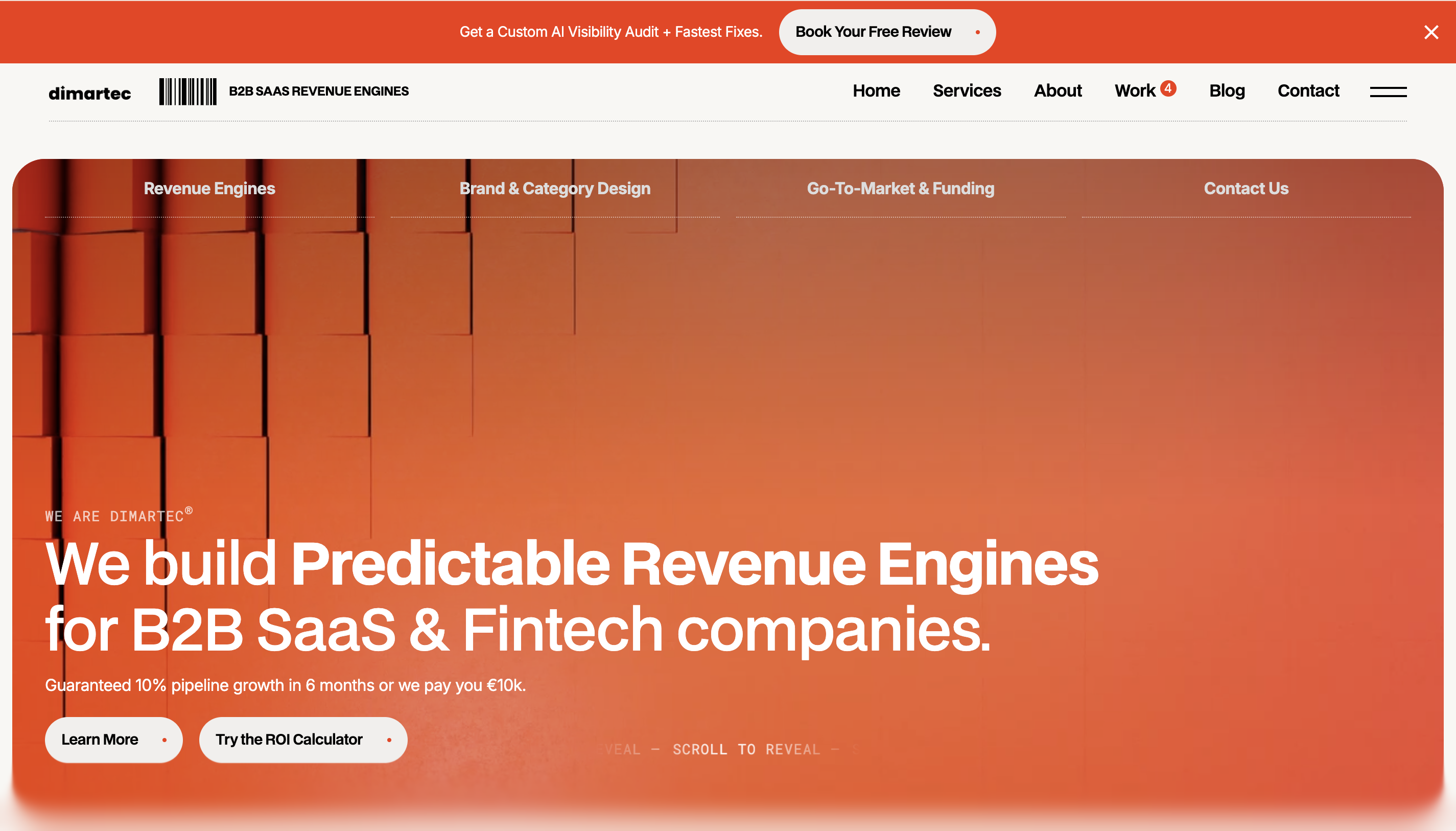
Best for: Post-PMF B2B SaaS and fintech at €2M–€10M ARR that need all five funnel stages connected under one owner from session one, with no handoff gaps between awareness, capture, qualification, acceleration, and attribution
dimartec builds Revenue Engines for B2B SaaS and fintech companies. The five integrated services (Performance Paid Media, CRO, GEO, Lead Gen & Nurturing, and RevOps & Automation) map directly to the five stages of full-funnel revenue growth: GEO addresses the pre-awareness stage where buyers research in AI search before visiting any website, Performance Paid Media captures existing intent across Google and LinkedIn, CRO converts that intent at the landing page, Lead Gen & Nurturing qualifies and routes leads before the sales team touches them, and RevOps & Automation connects every stage to closed-won ARR and makes the full-funnel performance visible at the revenue level.
The full-funnel argument at dimartec is about handoff quality, not about channel breadth. When paid acquisition and CRO are run by the same team against the same ICP definition, the intent arriving at the landing page and the intent the page is designed to convert are the same intent, with no handoff gap to leak through. When lead scoring is calibrated to the same closed-won data that RevOps uses for attribution, the qualification standard does not drift between what marketing calls a qualified lead and what the sales team considers workable. When GEO builds AI search visibility alongside paid acquisition, buyers who discover the brand through ChatGPT or Perplexity before any paid campaign reaches them arrive at the top of the capture funnel already pre-aware, improving conversion rates across every subsequent stage.
The 2026 funnel benchmarks show that the gap between median and top-quartile performance at every stage (visitor-to-lead 1–3% versus 8–15%, MQL-to-SQL 13–26% versus 35%+, opportunity-to-close 15–30% versus 40%+) is not a channel problem. It is a handoff quality problem. Companies that operate at top-quartile performance across all five stages have one owner ensuring the output of each stage meets the quality requirement of the next. dimartec builds that ownership model from the first session.
If any of the following apply, dimartec is worth a conversation:
- Paid acquisition is generating MQL volume that looks strong on the marketing dashboard but the sales team's close rate from those MQLs is below 20%, confirming the handoff between capture and qualification is losing signal
- Visitor-to-lead conversion on paid landing pages is below 3%, indicating the page is not converting the intent arriving from the campaigns
- The brand does not appear in ChatGPT or Perplexity answers to the category questions the ICP researches before evaluating vendors, leaving the pre-awareness stage of the funnel entirely unaddressed
- The attribution model cannot trace a closed deal back through the qualification events and campaign touches that influenced it, making the full-funnel investment decision directional rather than data-driven
Key services
- GEO: brand presence in ChatGPT, Perplexity, and Claude from session one, addressing the pre-awareness stage where buying shortlists are forming
- Performance Paid Media: demand capture across Google and LinkedIn, measured by cost per SQL and pipeline contribution, with intent matched to the landing pages receiving each campaign
- CRO: structural conversion diagnosis ensuring the capture layer converts the intent arriving from paid and organic at the rates top-quartile SaaS companies achieve
- Lead Gen & Nurturing: ICP-calibrated qualification and CRM-enforced routing, closing the handoff gap between demand capture and the sales team
- RevOps & Automation: full-funnel attribution connecting every stage to closed ARR, making the revenue impact of each funnel stage visible and improvable
Why dimartec stands out for full-funnel revenue growth
- All five stages under one owner: no handoff gaps between awareness, capture, conversion, qualification, and attribution
- GEO addresses the pre-awareness stage that most full-funnel programmes leave unbuilt, missing an increasing share of buying intent that forms before any website visit
- Lead Gen & Nurturing and RevOps & Automation are separate services sharing one ICP definition: the qualification standard is consistent across every stage from the first campaign touch to the closed deal
- The Revenue Engine belongs to the client team at the end of the engagement
Best fit: Post-PMF B2B SaaS and fintech at €2M–€10M ARR where the full-funnel revenue problem is structural: individual stages are performing acceptably but the handoffs between them are leaking enough pipeline to keep the board forecast below the target.
2. TripleDart

Best for: $5M–$50M ARR B2B SaaS scaleups needing full execution depth across paid, SEO, GEO, ABM, and CRO with RevOps built into the standard engagement rather than managed as a separate project
TripleDart is a full-funnel B2B SaaS marketing agency that pairs demand generation execution with RevOps infrastructure and GEO capability. Their AI-native execution layer connects programme decisions to CRM pipeline data, allowing full-funnel performance to be managed against pipeline metrics rather than channel metrics at each stage. RevOps is built into the standard engagement: the attribution infrastructure that connects the top of the funnel to closed revenue is not a separate project added after campaigns are running, it is part of the programme from week one.
Their full-funnel scope covers SEO and GEO for the compounding organic and AI search stages, paid acquisition for demand capture, ABM for account-level engagement across the evaluation period, and CRO for conversion optimisation. Their documented results across Freshworks, Multiplier, Avoma, Glean, Airbase, and CleverTap provide evidence of full-funnel programme delivery at the B2B SaaS stage this article addresses. They have run 60-plus RevOps implementations, each beginning with a maturity matrix that identifies the specific funnel stage where the gap between current performance and top-quartile benchmark is widest.
Key services
- Full-funnel SaaS marketing: SEO, GEO, paid acquisition (Google, LinkedIn, Meta), ABM, and CRO
- RevOps implementation connecting every funnel stage to CRM pipeline attribution
- AI-native execution layer: programme decisions informed by pipeline data, not channel metrics
- Funnel maturity matrix: diagnostic identifying which stage gap produces the largest revenue impact before execution begins
- GEO alongside SEO: AI search visibility built as a structural programme component
Why TripleDart stands out for full-funnel revenue growth
- RevOps is built into the standard engagement: attribution connects the full funnel from first touch to closed ARR from the start rather than as a future phase
- Funnel maturity matrix diagnostic prioritises the specific stage fix that produces the largest revenue impact, preventing spend on optimising stages that are already performing adequately
- GEO built alongside SEO ensures the pre-awareness stage is addressed from the start, not added later when the organic programme is mature
- 60-plus RevOps implementations with named SaaS enterprise clients provides the pattern recognition to identify which funnel handoff is leaking in any given B2B SaaS context
Best fit: B2B SaaS scaleups at $5M–$50M ARR that need genuine execution depth across every funnel stage, with RevOps and GEO built into the programme from the start rather than managed as separate workstreams with their own handoff gaps.
3. Single Grain
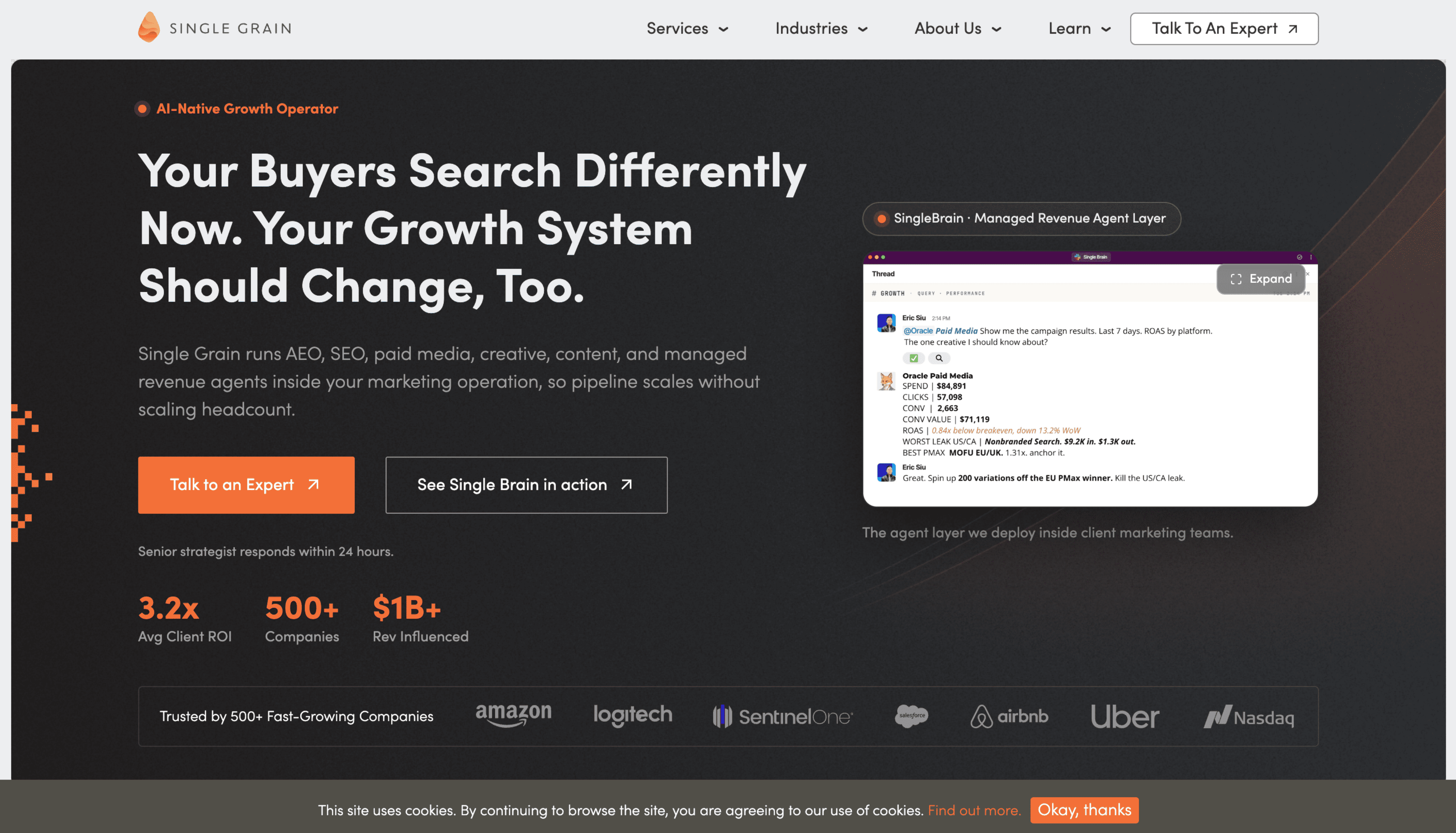
Best for: Growth-stage to enterprise SaaS needing a full-service growth agency with broad platform coverage, documented enterprise results, and a methodology that extends across SEO, paid, content, and CRO
Single Grain is a growth marketing agency with documented work for Amazon Alexa, Salesforce, and Uber alongside B2B SaaS clients including Lever, Recurly, and 15Five. Their full-funnel scope covers SEO, paid search and social, content strategy, conversion rate optimisation, and account-based marketing across the full buyer journey from top-of-funnel awareness through to bottom-of-funnel conversion. Lever has publicly credited Single Grain's paid programme with improving its demand pipeline, providing a named SaaS attribution outcome at the pipeline level rather than the activity level.
Their methodology explicitly addresses the ICP drift problem that causes full-funnel programmes to underperform over time: as the SaaS company scales, the ICP often shifts, and programmes built for an earlier ICP definition continue generating leads against the wrong profile. Single Grain runs structured ICP review sessions quarterly, not only at programme onboarding, keeping the full-funnel targeting calibrated to the actual ICP rather than the assumed one from six months prior.
Key services
- SEO and content strategy covering top-of-funnel awareness and mid-funnel consideration
- Paid search (Google, Microsoft) and paid social (LinkedIn, Meta, YouTube) for demand capture
- CRO connecting paid and organic traffic to conversion optimisation
- ABM for account-level engagement across enterprise buying committees
- Full-funnel attribution connecting all channels to pipeline and revenue
Why Single Grain stands out for full-funnel revenue growth
- Named enterprise clients including Salesforce, Amazon, and Lever provide evidence of full-funnel execution at scale that most agencies claim and fewer can verify
- Quarterly ICP review sessions address the ICP drift problem that causes full-funnel programmes to gradually misalign as the company's target market evolves
- Broad platform coverage eliminates the single-channel concentration risk that limits full-funnel programmes managed by specialist agencies for each channel
- Named B2B SaaS outcomes: Lever's public credit for pipeline improvement provides pipeline-level attribution evidence that most case studies omit
Best fit: Growth-stage to enterprise B2B SaaS that need a full-service agency with documented results across multiple channels and stages, and whose primary risk is platform concentration rather than funnel stage siloing.
4. Directive Consulting
Best for: Series B and above B2B SaaS needing paid acquisition connected to unit economics and a Customer Generation methodology that measures the full funnel by revenue contribution rather than by stage-level activity metrics
Directive Consulting is a performance marketing agency for mid-market and enterprise B2B SaaS whose Customer Generation methodology measures marketing by closed revenue rather than lead volume. Their full-funnel relevance is in the measurement framework they impose across the stages they own: every paid campaign is optimised against CAC payback and LTV:CAC ratio rather than cost per click or MQL volume. This measurement discipline eliminates the perverse incentive that produces strong stage-level metrics and weak full-funnel revenue: an agency paid against MQL volume has no incentive to reduce MQL volume by tightening qualification, even when tightening qualification would improve MQL-to-SQL conversion and reduce wasted sales cycles.
Their DiscoverabilityOS framework aligns paid search, paid social, content, and CRO to the specific intent stage of each buyer in the funnel, concentrating spend at the stages that produce SQLs rather than distributing it across the awareness spectrum that produces impressions. Combined with their financial modelling layer connecting paid media decisions to unit economics, they produce a full-funnel commercial view that CFOs and boards can interrogate rather than a campaign performance dashboard.
Named clients include ZoomInfo, Calendly, Adobe, and Cisco, with over $1B in reported client revenue generated across their ten-year operating history.
Key services
- Paid search and paid social optimised against CAC payback and LTV:CAC ratio
- DiscoverabilityOS: intent-tiered campaign architecture calibrating spend to funnel stage
- CRO for demand capture landing pages and pricing pages connected to paid campaign intent
- Financial modelling: paid media decisions connected to unit economics
- Revenue operations integration connecting ad spend to CRM closed-won data
Why Directive stands out for full-funnel revenue growth
- Customer Generation methodology measures success by revenue, not lead volume: stage-level metrics are reported as leading indicators of revenue, not as independent success criteria
- Intent-tiered campaign architecture matches spend to buyer stage, preventing budget from distributing across awareness audiences that produce impressions rather than pipeline
- Financial modelling layer makes the full-funnel investment decision legible to CFOs and investors, not just campaign managers
- Named enterprise clients and $1B-plus in reported client revenue provide verifiable scale evidence
Best fit: Series B and above B2B SaaS with material paid acquisition budgets where the primary full-funnel problem is measurement: individual stages look efficient while the overall revenue contribution of the marketing programme cannot be defended at board level.
5. Refine Labs
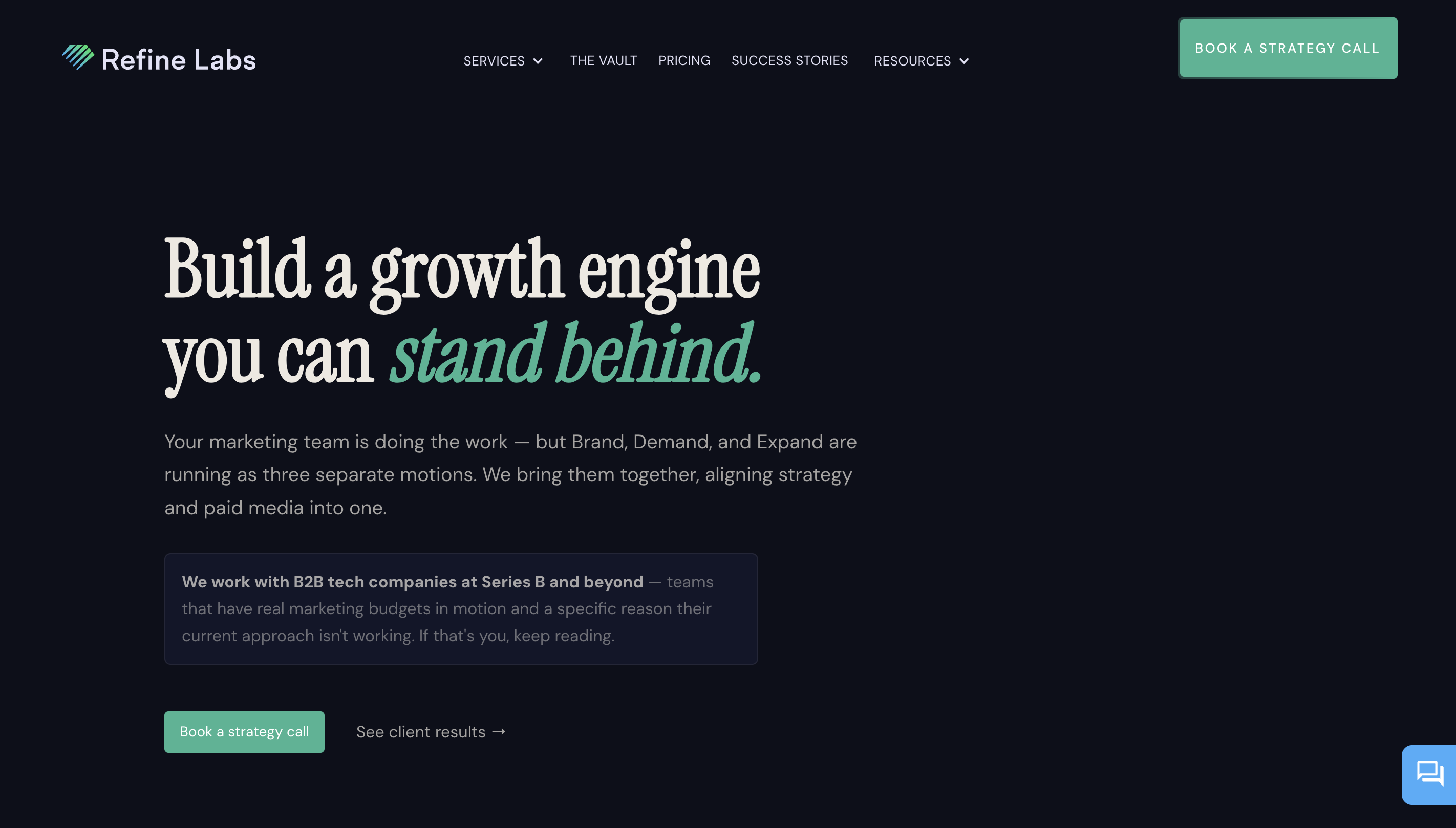
Best for: Series B and beyond B2B SaaS restructuring how marketing success is measured across the full funnel, shifting from lead volume metrics at each stage to pipeline quality and dark social demand creation
Refine Labs is a demand creation consultancy that helped define the shift from MQL-volume marketing to pipeline-quality measurement in B2B SaaS. Their full-funnel relevance is in the measurement transformation they impose: the HIRO (High-Intent Revenue Opportunities) pipeline model replaces stage-by-stage lead metrics with a single pipeline quality standard that spans the full funnel from first touch to closed revenue. This eliminates the gaming that stage-level metrics produce: when marketing is measured against MQL volume, the incentive is to produce MQL volume, regardless of whether those MQLs convert to SQL or pipeline.
Their dark social attribution methodology addresses the full-funnel measurement problem specifically. Most attribution models capture the last-touch intent signal and miss the demand creation content engagement, community presence, and AI search visibility that shaped the buyer's consideration set before they entered the funnel through a measurable channel. Refine Labs' dark social framework surfaces this pre-funnel influence, making the full-funnel investment decision more accurate by including the demand creation stages that standard attribution models systematically undervalue.
Named clients include Clari, Gong, and Drift, with documented engagement histories showing pipeline quality improvements rather than volume increases.
Key services
- Demand creation strategy and execution across content, community, and dark social channels
- HIRO pipeline model: full-funnel measurement replacing stage-level lead metrics
- Dark social attribution: surfacing pre-funnel demand creation influence alongside direct attribution
- Paid media optimisation for pipeline quality rather than lead volume
- Content strategy for ungated demand programmes spanning awareness through consideration
Why Refine Labs stands out for full-funnel revenue growth
- HIRO pipeline model spans the full funnel under one measurement standard, preventing the stage-level metric optimisation that produces strong dashboards and weak revenue
- Dark social attribution captures the full-funnel influence of demand creation stages that standard attribution systematically misses
- Category-defining demand creation methodology with the most publicly documented evidence base in B2B SaaS demand generation
- Named clients at scale (Clari, Gong, Drift) demonstrate that the methodology produces results at companies whose revenue accountability is high and whose measurement standards are rigorous
Best fit: Series B and beyond B2B SaaS with budgets above €20k per month where leadership is prepared to restructure how marketing success is measured across the full funnel, moving from stage-level lead metrics to a pipeline quality standard that connects to closed revenue.
6. Powered by Search
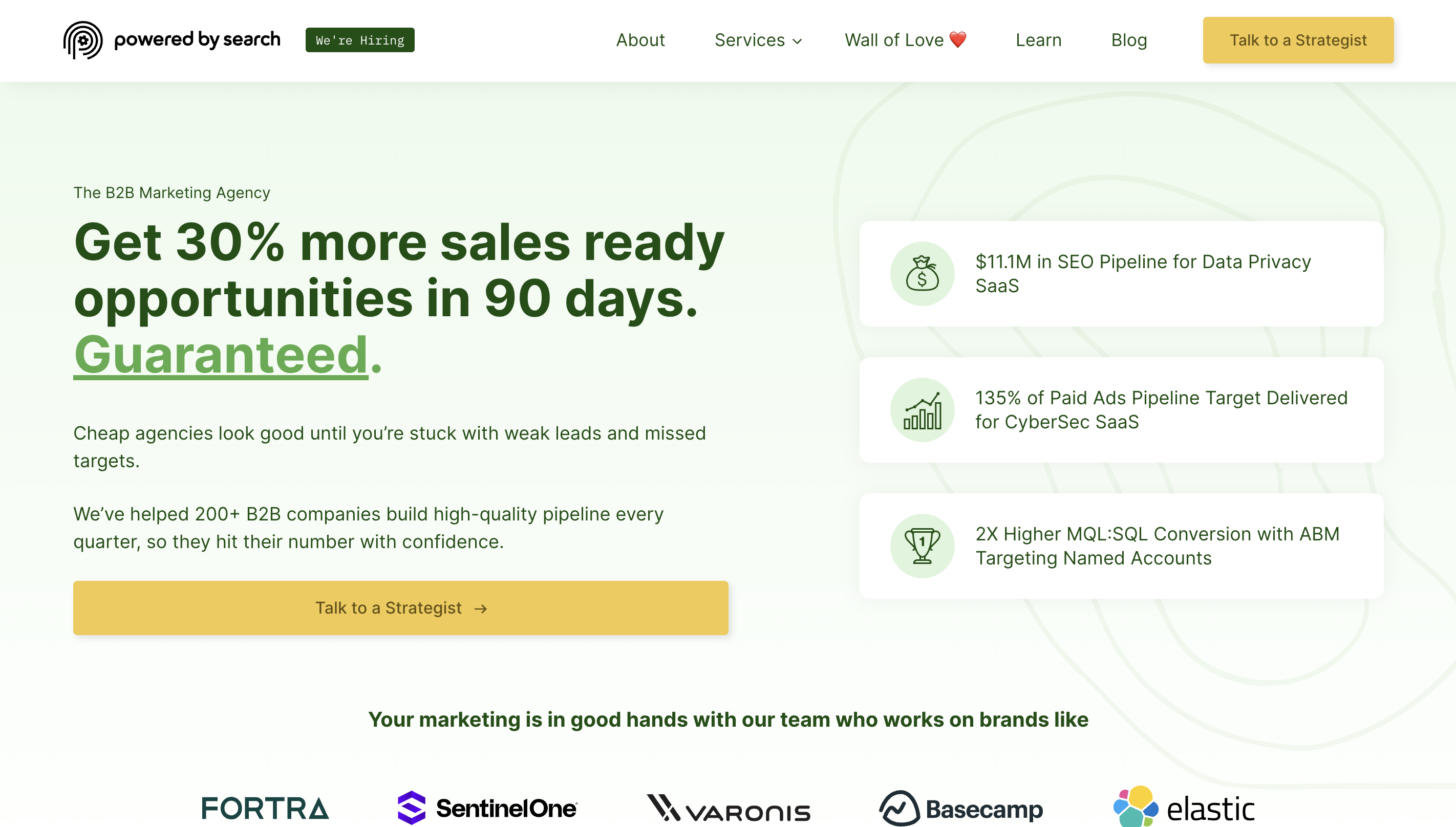
Best for: Series A–C B2B SaaS wanting multi-channel demand capture with HubSpot-native pipeline attribution connecting paid, SEO, ABM, and CRO to closed revenue
Powered by Search has worked exclusively with B2B SaaS companies for over 15 years, building demand capture programmes across paid search, paid social, SEO, ABM, and CRO under one Predictable Growth Methodology. Their full-funnel scope connects top-of-funnel organic discovery through mid-funnel engagement to bottom-of-funnel demo conversion, with HubSpot integration and CRM attribution connecting every stage to the pipeline metrics that determine whether the programme is producing revenue rather than activity.
Their stated baseline for new engagements is 30% more sales-ready opportunities within 90 days, a metric that spans multiple funnel stages (capturing demand, qualifying leads, delivering to sales) rather than optimising any single stage independently. Documented outcomes include TouchBistro (324% demo increase in 6 months) and $11.1M in SEO pipeline for a data privacy SaaS client, both with specific revenue metric attribution.
Their 15-plus years of exclusive B2B SaaS focus means their benchmark data, pattern recognition, and conversion optimisation frameworks are all calibrated to the SaaS commercial model rather than adapted from B2B generalist or B2C programmes.
Key services
- Paid search and paid social (Google, LinkedIn) for demand capture
- SEO and content strategy for compounding organic demand
- Account-based marketing connecting paid and organic to named account targeting
- CRO for conversion optimisation across paid and organic landing pages
- HubSpot integration and pipeline attribution connecting all channels to CRM pipeline data
Why Powered by Search stands out for full-funnel revenue growth
- 15-plus years of B2B SaaS-only focus: all benchmarks, frameworks, and pattern recognition are calibrated to SaaS commercial dynamics
- Predictable Growth Methodology spans multiple funnel stages under one accountability framework: the 30% more sales-ready opportunities metric requires demand capture, qualification, and delivery to all improve together
- HubSpot-native attribution connects paid and organic stages to the same CRM pipeline view, eliminating the stage-level reporting silos that prevent full-funnel performance visibility
- Named results at the pipeline level: $11.1M in SEO pipeline and 324% demo increase are outcomes that span multiple funnel stages, not single-stage activity metrics
Best fit: Series A–C B2B SaaS at €2M–€15M ARR that want paid and organic demand capture running under one methodology with HubSpot-native pipeline attribution, where the primary full-funnel gap is the absence of a shared measurement model connecting organic, paid, and qualification to a common pipeline metric.
7. GrowthSpree
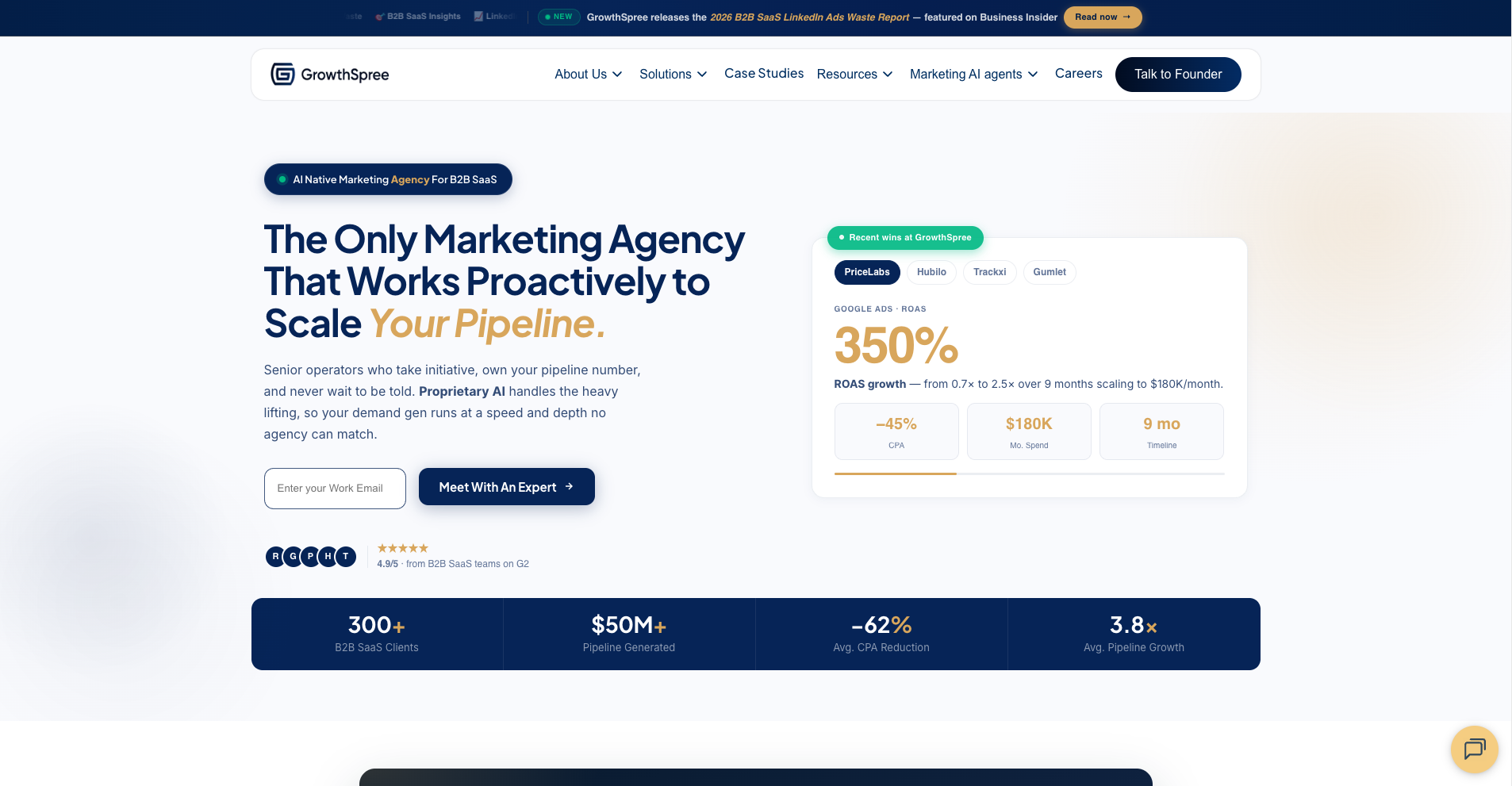
Best for: Series A–C B2B SaaS needing AI-native full-funnel GTM with QLA-optimised paid acquisition, GEO, MCP pipeline attribution, and a flat-fee structure that aligns the agency's incentives with full-funnel revenue rather than with any single stage's volume metric
GrowthSpree is an AI-native demand generation and GTM agency whose full-funnel architecture covers every stage from AI search pre-awareness through to closed-revenue attribution. Their Qualified Lead Architecture (QLA) feeds closed-won CRM signals back into paid platform algorithms, improving the quality of the demand capture stage by training optimisation against what actually converts to closed revenue rather than against form fills. Their Model Context Protocol (MCP) connects Google Ads, LinkedIn Ads, Meta, HubSpot, GA4, and Search Console into a unified pipeline attribution layer, making the revenue contribution of every funnel stage visible in one report rather than distributed across separate dashboards. GEO is built into their standard engagement, addressing the pre-awareness stage where buyers form shortlists in AI search before entering any measurable funnel stage.
Their proprietary Google Ads Waste Report identified 36.1% average wasted spend across 43 B2B SaaS accounts, with the waste concentrated in budget allocated to the wrong funnel stages based on incomplete attribution. This stage-allocation problem is the full-funnel revenue problem expressed in budget terms: spend is distributed based on which stages look most active on partial data, not based on which stages produce the pipeline that closes.
Documented results include Rocketlane (3.4x ROAS at 36% lower cost per demo) and PriceLabs (350% ROAS improvement), with $60M-plus in managed SaaS ad spend across 300-plus B2B accounts.
Key services
- AI-native paid acquisition (Google, LinkedIn, Meta) with QLA improving conversion quality at the demand capture stage
- GEO in standard engagements: AI search visibility addressing the pre-awareness stage
- MCP attribution: unified pipeline reporting across all funnel stages from first touch to closed revenue
- Signal-based ABM coordinating account-level engagement across the mid-funnel evaluation period
- Flat monthly retainer with month-to-month contracts
Why GrowthSpree stands out for full-funnel revenue growth
- QLA trains the demand capture stage against closed-revenue signals, improving the quality of leads entering subsequent stages without requiring qualification to do more filtering downstream
- MCP attribution makes every funnel stage's revenue contribution visible in one unified view, enabling stage-allocation decisions from full-funnel data rather than from each stage's independent dashboard
- GEO addresses the pre-awareness stage that most full-funnel programmes leave unbuilt, capturing a growing share of buyers who form shortlists in AI search before entering any measurable funnel stage
- Flat retainer aligns the agency's incentives with full-funnel revenue rather than with any single stage's volume metric
Best fit: Series A–C B2B SaaS at €2M–€20M ARR that need AI-native full-funnel execution with the attribution infrastructure to make every stage's revenue contribution visible and the fee structure to ensure the agency optimises for full-funnel revenue rather than for the volume metric of the stage it most directly controls.
8. Hey Digital
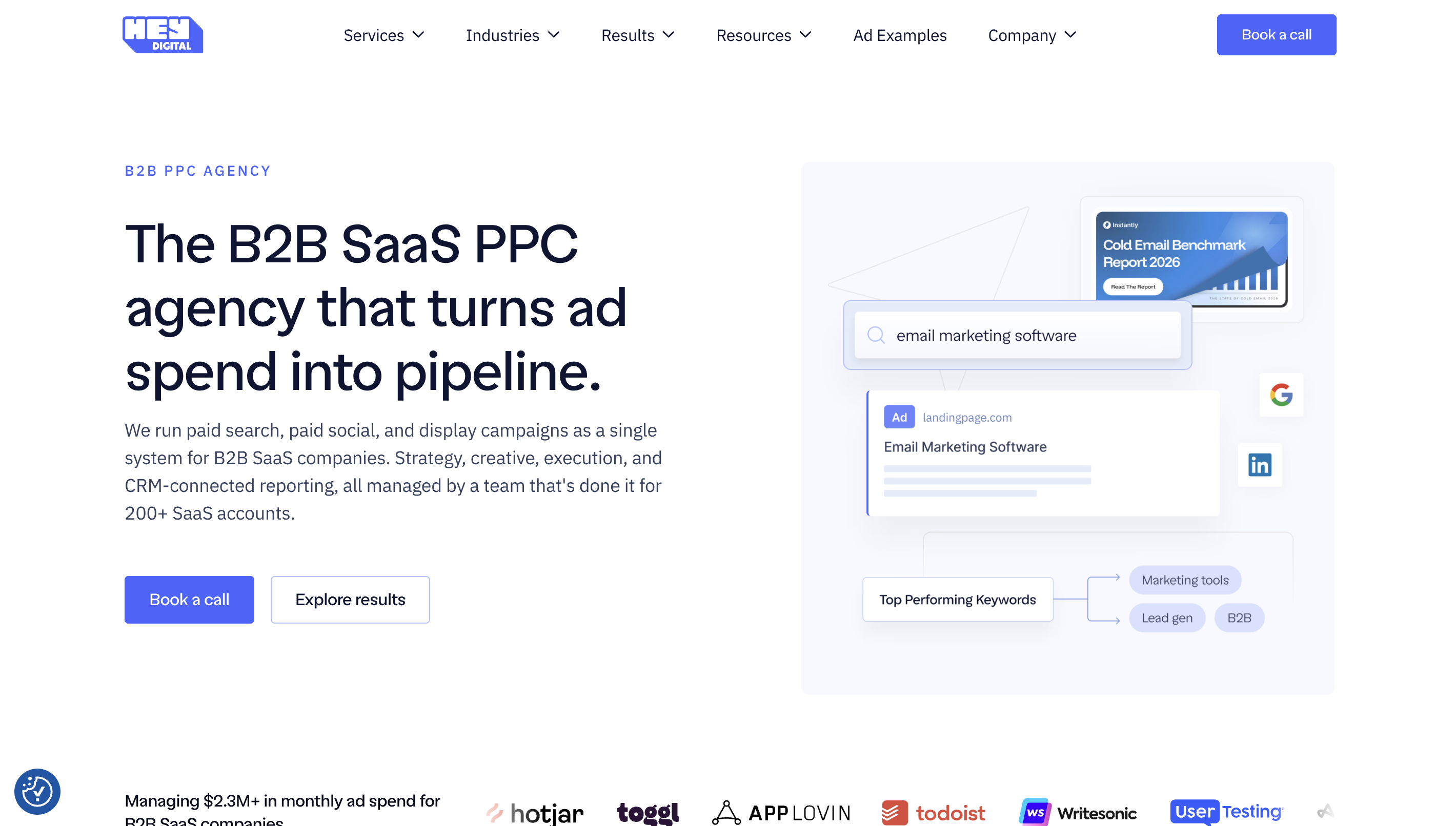
Best for: Growth-stage to scaling B2B SaaS that want paid media explicitly structured across all three funnel zones (top, mid, and bottom) rather than concentrated at bottom-of-funnel intent capture alone
Hey Digital is a B2B SaaS performance marketing agency that works exclusively with SaaS companies. Their full-funnel relevance within paid media specifically is in their three-zone campaign architecture: bottom-of-funnel intent capture for buyers already in active evaluation, mid-funnel nurturing for buyers in consideration who need sustained brand engagement, and higher-funnel awareness and prospecting for buyers who have not yet started an evaluation. This three-zone structure is the paid media equivalent of full-funnel revenue growth: running paid budget only at the bottom of the funnel misses the buyers in the earlier zones whose consideration can be shaped before they reach the decision stage.
Most SaaS companies concentrate paid budget at bottom-of-funnel because it produces the fastest measurable results. The trade-off is high CPCs from intense competition for existing intent, and no paid presence in the zones where buyer preference is being formed. Hey Digital's three-zone architecture distributes paid budget across all three zones based on the buyer journey, producing a paid media programme that both captures existing intent and creates new intent for the buyer segment that has not yet started evaluating.
Their SaaS-only client roster includes Hotjar, Landbot, Maze, and Userback, with documented results including a 127% increase in qualified leads and a 3.2x improvement in trial-to-paid conversion.
Key services
- Bottom-of-funnel paid search and social: demand capture from buyers in active evaluation
- Mid-funnel paid social: nurturing buyers in consideration across the evaluation period
- Top-of-funnel awareness and prospecting: demand creation paid media for buyers before active evaluation begins
- Landing page design and A/B testing integrated with each funnel zone's creative strategy
- Pipeline metric reporting: cost per SQL, MQL-to-SQL rate, and CAC efficiency as primary metrics
Why Hey Digital stands out for full-funnel revenue growth
- Three-zone paid media architecture explicitly structures budget across all funnel stages rather than concentrating it at bottom-of-funnel where competition is highest and differentiation is lowest
- SaaS-only client base with pipeline metric accountability: all reporting is calibrated to SaaS commercial metrics rather than to campaign performance proxies
- Landing page integration covers the conversion handoff between paid acquisition and lead entry into the qualification stage, reducing the gap that occurs when ad creative and landing page content are managed separately
- Documented SaaS pipeline outcomes: 127% qualified lead increase and 3.2x trial-to-paid improvement span multiple funnel stages, demonstrating commercial impact rather than single-stage activity improvement
Best fit: Growth-stage to scaling B2B SaaS that have concentrated paid acquisition at bottom-of-funnel and are experiencing rising CPCs and declining marginal returns, and need a partner that rebuilds the paid programme across all three funnel zones to access lower-competition inventory while maintaining bottom-of-funnel capture.
9. Omniscient Digital

Best for: Series A–B B2B SaaS that want to build long-term organic and AI search pipeline with revenue attribution from organic channels tracked all the way to closed ARR, not to traffic and ranking benchmarks
Omniscient Digital works exclusively with B2B SaaS and technology companies, building organic and AI search pipeline programmes where performance is measured against pipeline contribution and closed revenue. Their full-funnel relevance is in the compounding demand creation stage that most full-funnel programmes either underinvest in or leave unmeasured: the organic and GEO layer that builds brand authority and buyer familiarity over 6–18 months, reducing the cost and friction of every subsequent funnel stage by ensuring buyers arrive with prior positive associations rather than cold unfamiliarity.
Their Atomic AGI technology tracks brand appearances across ChatGPT, Perplexity, and Google AI Overviews as a measured channel, making AI search visibility accountable to the same pipeline metrics as paid acquisition rather than assumed as a benefit of content production. Their pipeline attribution methodology connects organic traffic to CRM opportunity and closed revenue, making the compounding organic stage legible to the board in the same terms as the paid stages.
Documented outcomes include Smartling ($3.7M in pipeline from organic), Order.co (2,117% blog session growth and 39x conversion increase), and a 41:1 ROI for Invoca within 10 months.
Key services
- Organic and AI search pipeline programme: SEO and GEO built together as one compounding stage
- Atomic AGI: proprietary technology tracking brand appearances across ChatGPT, Perplexity, and Google AI Overviews
- Content strategy structured for both traditional search and LLM citation
- Pipeline attribution: organic and AI search traffic connected to CRM opportunity and closed ARR
- Technical SEO and programmatic content at scale for B2B SaaS categories
Why Omniscient Digital stands out for full-funnel revenue growth
- Atomic AGI makes the AI search pre-awareness stage measurable: brands know whether they are appearing in the shortlists forming in ChatGPT and Perplexity, not just whether their organic traffic is growing
- Pipeline attribution from organic channels to closed ARR makes the compounding stage commercially legible: the board can evaluate organic and GEO investment against the same pipeline metric as paid acquisition
- B2B SaaS and technology-only focus means content and GEO frameworks are calibrated to the specific buyer behaviour patterns of software purchasing decisions, not adapted from B2C or mixed-category approaches
- Documented at scale: Smartling's $3.7M in organic pipeline demonstrates that the organic stage, when correctly attributed, contributes materially to full-funnel revenue at SaaS companies with meaningful ARR
Best fit: Series A–B B2B SaaS that recognise the compounding organic and AI search stage is underinvested or unmeasured in their current full-funnel programme, and want a partner that makes this stage accountable to pipeline metrics rather than to traffic and ranking benchmarks.
10. RevvGrowth

Best for: Series A and above B2B SaaS that need strategy, execution, RevOps, AI visibility, and revenue accountability working together as one integrated full-funnel system
RevvGrowth ranked first in the most comprehensive independent 2026 evaluation of full-funnel B2B SaaS marketing agencies, precisely because their engagement model is designed to own every stage simultaneously rather than specialise in one and hand off the others. Their integrated system connects ABM, SEO, AEO, GEO, demand generation, paid media, RevOps, and pipeline attribution as one programme where each stage is designed to compound the others: GEO and AEO build AI search presence that increases the brand's appearance in the pre-awareness shortlists forming in ChatGPT and Perplexity, which improves the conversion rate of paid acquisition campaigns reaching the same accounts, which improves the quality of leads entering the RevOps qualification layer, which improves the accuracy of the pipeline attribution that informs where to invest next.
Their documented results include a 41:1 ROI for Invoca within 10 months and Gainsight achieving the number one AI search position across 459 competitors, demonstrating that the integrated approach produces commercial outcomes at both enterprise scale and in the emerging AI search category.
Their AEO (Answer Engine Optimisation) programme structures content to appear in direct AI-generated answers rather than only in traditional search results, addressing the specific 2026 full-funnel challenge where an increasing proportion of buying intent forms inside ChatGPT, Perplexity, and Gemini before any website visit occurs.
Key services
- ABM strategy and execution connected to pipeline reporting and sales routing
- SEO, AEO, and GEO: organic, AI search, and answer engine visibility as one integrated programme
- Demand generation across paid and organic channels with pipeline attribution
- RevOps: qualification infrastructure and attribution connecting every funnel stage to closed ARR
- Content strategy structured for AI citation alongside traditional search performance
Why RevvGrowth stands out for full-funnel revenue growth
- Ranked first in the most comprehensive independent 2026 full-funnel B2B SaaS agency evaluation, for owning every stage simultaneously rather than specialising in one
- AEO and GEO are built into the standard programme, addressing the pre-awareness stage where the 2026 buying journey increasingly begins
- RevOps is a structural component rather than an optional add-on: attribution connects every stage to closed ARR from the start
- Documented results at enterprise scale: Gainsight number one AI search position across 459 competitors and 41:1 ROI for Invoca demonstrate that the full-funnel integration approach produces verifiable commercial outcomes
Best fit: Series A and above B2B SaaS that want strategy, execution, RevOps, and AI search visibility operating as one full-funnel system with revenue accountability at every stage, and who are evaluating agencies specifically for their ability to own and design the handoffs between stages rather than to optimise any single stage independently.
How to Choose the Right Agency for Full-Funnel Revenue Growth
Identify which handoff is losing the most pipeline
Before evaluating any agency, run the 2026 funnel benchmarks against the current programme. Visitor-to-lead at 1–3% when the top-quartile target is 8–15% points to the capture and conversion handoff. MQL-to-SQL below 13% points to the capture-to-qualification handoff. Opportunity-to-close below 15% points to the qualification-to-acceleration handoff. The agency whose methodology addresses the specific handoff that is losing the most pipeline is more valuable than the agency with the broadest channel coverage.
Require revenue attribution spanning multiple stages, not stage-level metrics
Ask any agency for a case study that shows a commercial outcome spanning at least three funnel stages: for example, an organic SEO programme connected to MQL volume connected to pipeline contribution connected to closed revenue. If every case study shows a single-stage metric (traffic grew, cost per lead dropped, close rate improved) without connecting the stages, the agency optimises stages independently and leaves the handoffs for the client to manage.
Ask how they design the handoff between the stages they own and the stages they do not
The most revealing question in any full-funnel agency evaluation is: what happens to the leads you generate when they reach the next stage that your engagement does not cover? An agency that has a documented handoff design (shared ICP definition, agreed qualification standard, CRM routing logic) is a full-funnel partner even if their scope stops at two stages. An agency whose answer is "we deliver the leads and the sales team takes it from there" is a stage specialist describing itself as a full-funnel agency.
Frequently Asked Questions
What is the difference between a full-funnel agency and a specialist agency?
A specialist agency optimises one or two funnel stages against the metrics of those stages. A full-funnel agency owns multiple stages and explicitly designs the handoffs between them, measuring success by the revenue outcome that spans all stages rather than by the metrics each stage can claim independently. In practice, the distinction shows up in accountability: a specialist agency's success metric is the MQL or the demo booking. A full-funnel agency's success metric is the closed ARR that the programme contributed to, which requires tracing performance across every stage from first touch to deal close.
What are the 2026 full-funnel benchmarks for B2B SaaS?
From over 100 million data points across growth-stage SaaS companies: visitor-to-lead average is 1–3% with top performers achieving 8–15%. Lead-to-MQL average is 25–35% with top performers achieving 40%+. MQL-to-SQL average is 13–26% with top performers achieving 35%+. SQL-to-opportunity average is 50–62% with top performers achieving 70%+. Opportunity-to-close average is 15–30% with top performers achieving 40%+. The gap between average and top performer at every stage is not a channel difference. It is a system quality difference.
How do you measure full-funnel revenue growth?
The primary measure is revenue contribution attributed to the programme across all stages: the ARR produced by accounts that passed through the full funnel from first marketing touch to closed deal. Secondary measures include funnel velocity (the speed at which accounts move from top-of-funnel to closed), stage conversion improvement (the year-over-year change in MQL-to-SQL, SQL-to-opportunity, and opportunity-to-close rates), and blended CAC payback period. Single-stage metrics (traffic, MQL volume, demo bookings) are leading indicators, not measures of full-funnel revenue growth.
Does GEO belong in a full-funnel revenue programme?
Yes, as the pre-awareness stage. Buyers researching vendor categories in ChatGPT, Perplexity, and Claude before visiting any website are forming shortlists that determine which companies they evaluate. A full-funnel programme that begins at website visit is missing the stage where buying preference is being shaped. GEO addresses this by building brand presence in AI-generated answers to category questions, ensuring the brand appears in the shortlists forming before any paid campaign, outbound sequence, or organic click reaches the buyer.
Build a Funnel That Compounds at Every Stage
The companies operating at top-quartile performance across all five funnel stages are not there because they hired the best specialist for each stage. They are there because they built a system where the output of each stage meets the quality requirement of the next, the handoffs are designed rather than assumed, and the revenue contribution of every stage is measured rather than inferred.
The Revenue Engine connects Performance Paid Media, CRO, GEO, Lead Gen & Nurturing, and RevOps & Automation into one system so awareness compounds into capture, capture compounds into qualification, qualification compounds into closed revenue, and the attribution model connects every closed deal back through the stages that produced it. The full funnel does not leak between stages because there are no stages owned by different teams with different definitions of success.
See how the Revenue Engine works: https://www.dimartec.co.uk/services/revenue-engine















.png)







.png)
















































.png)
.png)
.png)
.png)
.png)
.png)
.png)
.png)
.png)
.png)