
Every B2B SaaS company that reaches €2M ARR did something right. They found enough customers to validate the product, built enough pipeline to fund the operation, and closed enough deals to establish that the market exists. What they almost certainly did not do is build a GTM system. They built a GTM motion: a collection of activities that worked at this scale, run by people whose experience with the product gave them the instincts to qualify, convert, and retain customers without documented process or shared measurement.
The problem with a GTM motion is that it does not scale past the people who developed it. The targeting works because the founder knows which accounts to prioritise. The qualification works because the founding AE can read a prospect in the first five minutes of a call. The retention works because the CS lead personally follows up on any account showing a risk signal. None of this is replicable at €5M ARR, where there are three AEs who each learnt qualification slightly differently and a CS team of two managing two hundred accounts. The motion that produced €2M begins producing the same pipeline while the company's cost base grows to support the team that is supposed to run it at scale.
After reviewing GTM programmes across more than 200 B2B SaaS companies at the €2M to €10M ARR stage, the finding that separates the companies that reach €10M efficiently from those that spend €5M to €7M ARR stalling is consistent. The ones that reach €10M replaced their GTM motion with a GTM system before the motion's limitations compounded into a board-level problem. They narrowed the ICP to the segment that produces the best LTV:CAC before scaling the channels targeting it. They documented the qualification process before the founding AE became a bottleneck. They built the demand creation layer before the founder's network was exhausted. The agencies that helped them do this understood that the €2M to €10M GTM problem is a transition problem, not a channel optimisation problem.
This guide evaluates the five best GTM agencies for B2B SaaS at the €2M to €10M ARR stage: the ones whose methodology understands the six GTM system transitions required at this stage and builds for the commercial model the company needs to reach €10M rather than for the motion that produced €2M.
The Six GTM Transitions Between €2M and €10M ARR
The €2M to €10M ARR stage requires six specific GTM transitions. Companies that attempt to scale without completing these transitions produce growing activity at rising cost, a pipeline that looks healthy and does not convert at the rate the forecast assumes, and a board conversation that arrives six months earlier than expected.
Transition one: ICP narrowing. At €2M, the ICP is broad because early customers were diverse. Any company that would buy was a good customer. At €10M, scaling a broad ICP produces high volume across too many segments to convert efficiently. The segments with the highest LTV, fastest sales cycles, and highest expansion rates need to concentrate the acquisition channels, pricing pages, and sales playbooks before scaling spend. A GTM agency that does not include ICP narrowing as a deliverable is building on a foundation that the company outgrew before the engagement started.
Transition two: Sales motion documentation. The founding AE's qualification instinct needs to become a documented process the third and fourth AE can follow without months of informal coaching. SPICED or equivalent qualification frameworks make the sales motion transferable. Without documentation, each new AE develops their own version of the qualification process, the pipeline stage data becomes inconsistent, and the forecast becomes an aggregation of different team members' intuitions rather than a function of shared stage criteria.
Transition three: Paid acquisition connected to closed-won feedback. At €2M, paid campaigns can run on volume-based optimisation because the number of closed deals is too small for CRM feedback to be statistically reliable. At €5M, there are enough closed deals to feed closed-won conversion signals back into paid platform algorithms. Companies that do not make this transition continue training their paid campaigns on form fills while their competitors train theirs on revenue-generating account profiles. The CAC divergence accumulates every quarter.
Transition four: Demand creation layer built before the outbound ceiling is reached. Founder network and outbound produce the first €2M for most B2B SaaS companies. Both have a ceiling: the founder's network exhausts within 12 to 18 months of active prospecting, and outbound response rates compress as the total addressable market is saturated. A demand creation layer (organic search, GEO, content, thought leadership) that takes 12 to 18 months to compound needs to be started at €2M to be producing meaningful inbound by €5M. Companies that wait until outbound response rates fall before starting the demand creation layer reach the ceiling and then wait 12 to 18 months for the inbound floor they should have built earlier.
Transition five: Qualification enforced in the CRM, not by individuals. At €2M, the founder qualifying personally is a feature, not a bug: their pattern recognition is faster than any scoring model built on a 50-deal sample. At €5M, with three AEs and a 200-deal sample, the CRM routing logic produces more consistent qualification than any individual's judgement. Companies that do not make this transition see MQL-to-SQL conversion rates drift downward as each AE applies their own qualification standard to the leads they receive.
Transition six: NRR as a growth lever, not just a retention metric. At €2M, keeping customers is good. At €10M, customers need to expand. The ARR growth rate required to reach €10M from €5M (100% in 18 to 24 months, typically) is not achievable from new logo acquisition alone at the cost levels that a €5M ARR business can sustain. Expansion revenue, upsell, and cross-sell need to contribute 30 to 40% of net new ARR by the time the company reaches €7M. GTM agencies that build only the new logo acquisition motion are addressing 60 to 70% of the revenue problem.
How We Chose These Agencies
- Stage specificity: Does the agency understand the six GTM transitions between €2M and €10M ARR, or does it apply a stage-agnostic methodology that works better at larger or smaller companies?
- Transition coverage: Does the agency address the specific transitions the company needs to complete, not the activities it is already running adequately?
- Commercial model fluency: Does the agency understand ARR, NRR, CAC payback, and LTV:CAC as the primary metrics at this stage, or does it report on MQL volume and campaign performance?
- Attribution to closed-won: Does the agency connect its programme output to closed ARR and CAC payback, or does it stop at pipeline contribution?
- Verified €2M to €10M ARR outcomes: Named B2B SaaS clients at this specific stage with documented commercial outcomes, not enterprise case studies applied to growth-stage companies.
The 5 Best GTM Agencies for SaaS at €2M–€10M ARR
1. dimartec
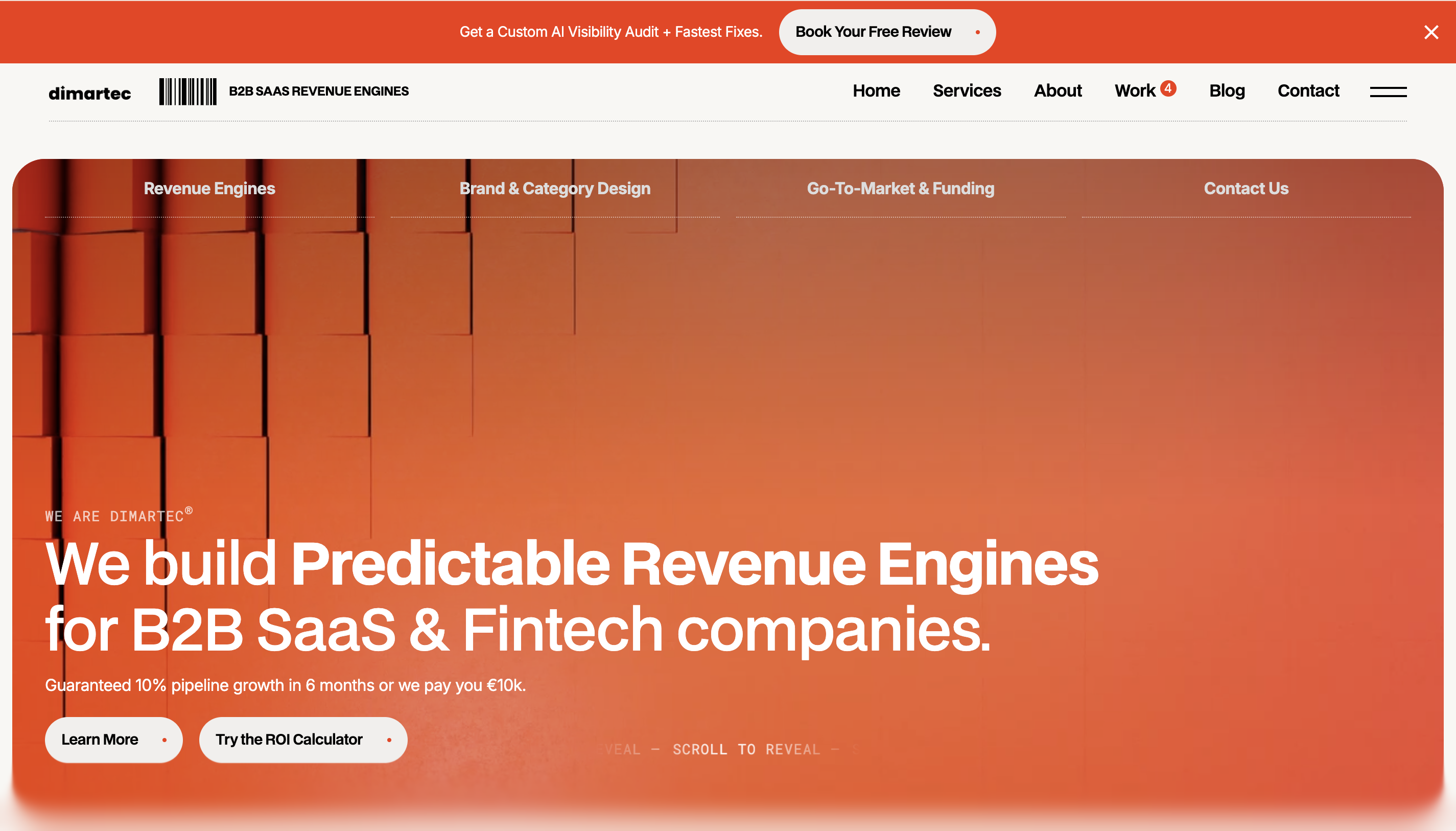
Best for: Post-PMF B2B SaaS and fintech at €2M–€10M ARR where transitions 3, 4, 5, and 6 all need to happen simultaneously: paid acquisition needs closed-won calibration, the demand creation layer needs to be built, qualification needs to be enforced in the CRM, and the attribution model needs to connect every activity to NRR and CAC payback
dimartec builds Revenue Engines for B2B SaaS and fintech companies. The five integrated services (Performance Paid Media, CRO, GEO, Lead Gen & Nurturing, and RevOps & Automation) are designed for the specific commercial model of the €2M to €10M ARR stage and address four of the six GTM transitions this stage requires.
Performance Paid Media addresses transition three. Paid campaigns are connected to closed-won CRM data from the first session, training the acquisition targeting against the account profiles that actually produce closed revenue at acceptable CAC payback rather than against the audience that produces the cheapest form fills. At the €2M to €10M stage, this transition typically reduces cost per SQL by 20 to 40% on existing paid spend without changing the budget, because the targeting shifts from broad audience optimisation to ICP-profile optimisation against the company's own closed-won evidence.
GEO addresses transition four. The brand visibility programme in ChatGPT, Perplexity, and Claude is built from the first session, beginning the compounding demand creation layer before the outbound ceiling is reached rather than after response rates fall and the board asks why inbound pipeline has not materialised. At the €2M to €10M stage, GEO is specifically relevant because B2B buyers at this company's target ICP are increasingly forming vendor shortlists in AI search before any direct marketing reaches them. Companies absent from these shortlists are not in evaluations they never knew about.
Lead Gen & Nurturing addresses transition five. The qualification standard that the founding AE has been applying personally is documented, translated into ICP-calibrated lead scoring, and enforced through CRM routing logic. Leads that do not meet the agreed standard enter a nurture sequence rather than reaching the sales team. The MQL-to-SQL conversion rate stabilises because the qualification standard is now a system output rather than an individual judgement.
RevOps & Automation addresses transition six. The attribution model connects every acquisition channel to closed-won ARR and, through the same model, to NRR by cohort. When the attribution model shows that accounts sourced from specific channels have higher NRR than accounts from others, the acquisition programme is calibrated toward the channels producing the highest-LTV customers rather than the highest-volume leads. The growth lever of expansion revenue is connected to the acquisition strategy rather than managed as a separate customer success function with no acquisition input.
If any of the following apply, dimartec is worth a conversation:
- Pipeline is growing but CAC payback has extended past 18 months, indicating that acquisition is reaching accounts that require longer or more expensive sales cycles than the highest-LTV ICP segment would require
- The demand creation layer (organic search, GEO, content) is absent or early, and the outbound programme is the primary pipeline source with no compounding floor
- The brand does not appear in ChatGPT or Perplexity answers to the category questions the target ICP researches before starting a vendor evaluation
- MQL-to-SQL conversion rate has been declining for two or more quarters, indicating the qualification standard is drifting between the growing sales team's different individual interpretations
Key services
- Performance Paid Media: closed-won ICP calibration from the first session, reducing cost per SQL on existing paid spend before new channels are added
- GEO: AI search visibility starting the compounding demand creation layer before the outbound ceiling is reached
- CRO: conversion optimisation ensuring the paid acquisition spend converts at the rates the ICP targeting should produce
- Lead Gen & Nurturing: qualification standard implemented as CRM routing logic, stabilising MQL-to-SQL conversion as the sales team grows
- RevOps & Automation: attribution connecting every channel to closed-won ARR and NRR by cohort, making the high-LTV ICP segments visible in the acquisition data
Why dimartec stands out at the €2M to €10M ARR stage
- Revenue Engine is designed for this stage: the ICP is the growth-stage company's ICP, not a scaled-down version of an enterprise methodology
- Four GTM transitions addressed simultaneously under one owner with one attribution model
- GEO is built from session one: the compounding demand creation layer starts accumulating before the outbound ceiling arrives
- 90% of clients see improved lead quality within 90 days
Best fit: Post-PMF B2B SaaS and fintech at €2M–€10M ARR that have validated product-market fit and are experiencing the specific symptoms of a GTM motion running at its limits: rising CAC payback, declining MQL-to-SQL conversion, campaign-dependent pipeline with no inbound floor, and a board forecast assembled from individual team member inputs rather than from a shared attribution model.
2. Ironpaper
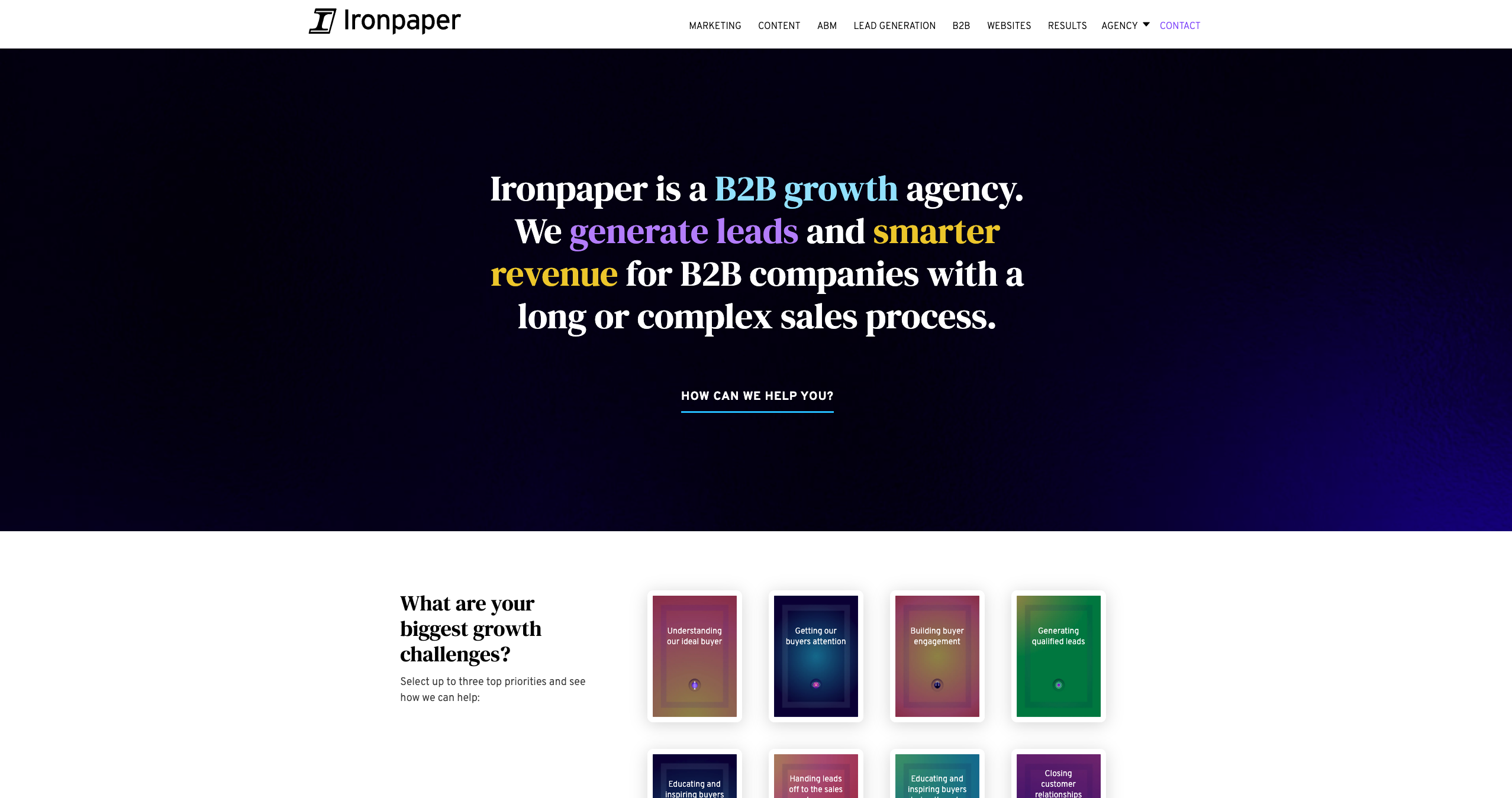
Best for: B2B SaaS at Series A–B where the primary GTM gap is the gap between marketing's qualification standard and sales readiness: marketing is passing leads that the sales team considers unworkable, and neither team has a shared framework for resolving the disagreement systematically
Ironpaper is a B2B growth agency for technology companies that specialises in demand generation with explicit attention to the qualification handoff problem that characterises the €2M to €10M ARR stage. Their methodology connects marketing demand generation to the documentation of a sales-ready standard: what specific signals indicate that a prospect is ready for a sales conversation, at what confidence level, and with what context attached.
At the €2M to €10M ARR stage, this qualification handoff problem is the primary GTM symptom rather than a secondary one. The founding AE qualified personally and never needed a documented standard. The third AE hired at €4M ARR asks for a brief on what a good lead looks like and receives different answers from the marketing team, the first AE, and the sales manager. Ironpaper addresses this by running a structured qualification standard development exercise before any campaign is built: what are the explicit ICP criteria, what are the intent signals indicating evaluation readiness, and what context does the sales team need attached to each lead to make the first conversation productive rather than diagnostic.
Their demand generation programme is built on this qualification standard rather than on an assumed ICP: every campaign, every content asset, and every outbound sequence is designed to identify and advance accounts that will meet the agreed qualification criteria. The result is a lower lead volume with a higher MQL-to-SQL conversion rate, which at the €2M to €10M stage is the commercially correct trade-off: sales team capacity is the scarce resource, and the highest-value use of that capacity is qualified conversations rather than high-volume lead management.
Ironpaper's B2B tech and SaaS client base includes organisations across professional services tech, healthcare IT, and B2B software, with documented MQL-to-SQL improvement and sales cycle reduction outcomes.
Key services
- Demand generation with qualification standard development before campaign build
- Sales-marketing alignment: explicit shared qualification criteria documented before any lead routing is configured
- Content strategy designed to qualify intent rather than capture attention
- HubSpot and CRM implementation reflecting the agreed qualification standard in routing logic
- Pipeline reporting connecting demand generation to SQL conversion and opportunity progression
Why Ironpaper stands out at the €2M to €10M ARR stage
- Qualification standard development is a first-deliverable: the sales team and marketing team agree on what a good lead means before any campaign produces one
- Demand generation built on the qualification standard rather than on assumed ICP: every campaign is designed to identify accounts that will meet the agreed criteria, not just the broadest accounts in the addressable market
- B2B tech and SaaS specialisation: the qualification frameworks are calibrated to the buying committee dynamics and sales cycle patterns of software companies, not adapted from B2C or B2B generalist programmes
- Stage-appropriate methodology: the approach is designed for the company that needs to transition from individual qualification judgement to systematic qualification infrastructure
Best fit: B2B SaaS at €2M–€7M ARR where the sales team is growing past the founder's ability to personally qualify, and where the growing gap between marketing's definition of qualified and the sales team's daily experience of the leads they receive is producing declining MQL-to-SQL conversion and an escalating attribution dispute that no reporting tool has resolved.
3. Obility
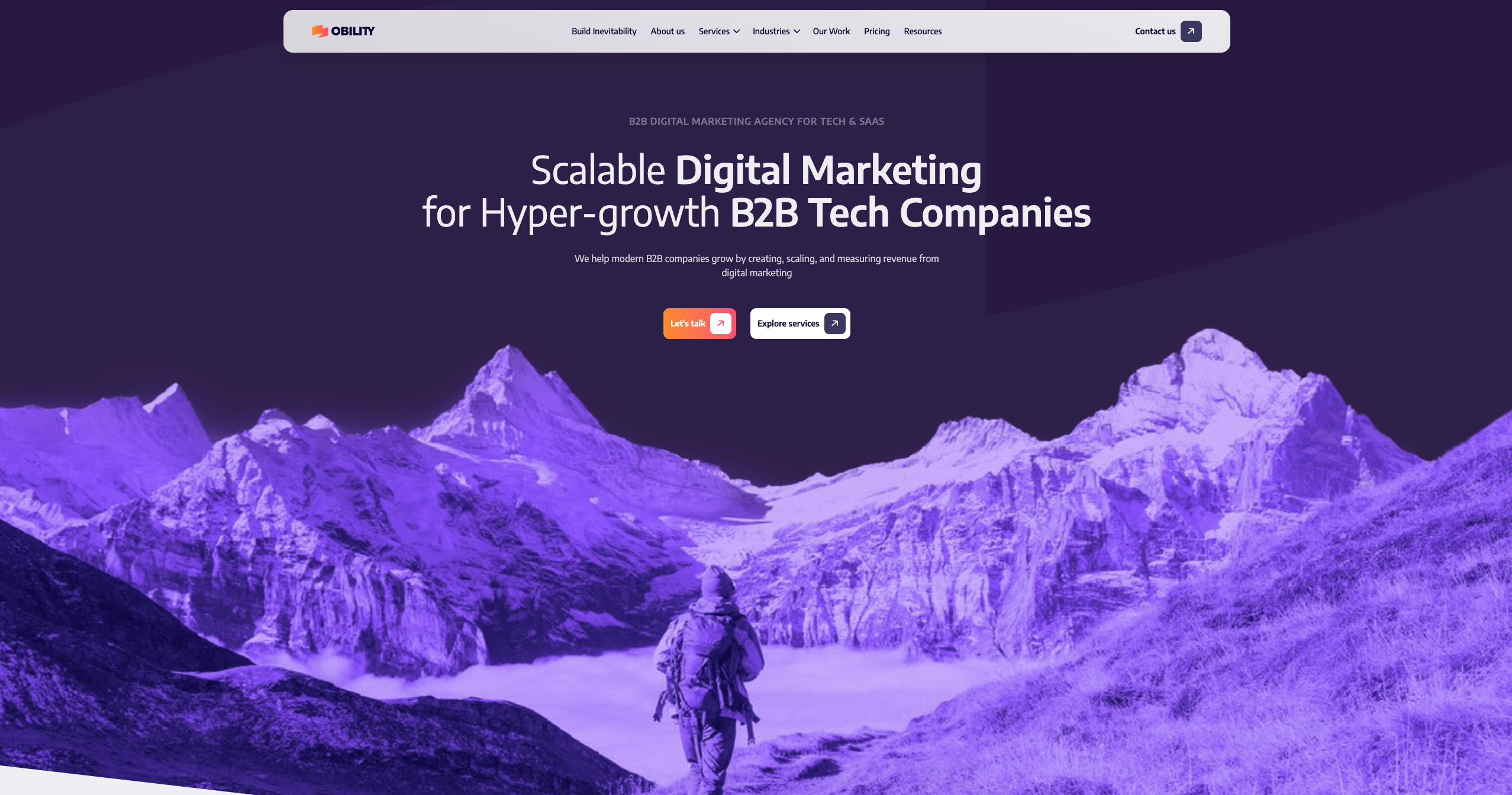
Best for: B2B SaaS at Series A–B where the primary GTM gap is paid acquisition optimised against form fills rather than closed-won revenue, and where connecting paid campaigns to deal-level CRM attribution would reveal the channel-level CAC variance that is causing blended CAC to rise faster than the growth rate explains
Obility is a B2B-only paid media agency with one distinguishing technical capability that is specifically relevant at the €2M to €10M ARR stage: deal-level CRM attribution across HubSpot, Salesforce, and Marketo, surfacing full-funnel attribution from first click to closed-won without stopping at MQL volume. Their entire client base is B2B, which means every benchmark, every conversion rate reference, and every CAC payback calculation they apply is calibrated to B2B commercial models rather than adapted from e-commerce or B2C contexts.
The specific GTM transition Obility addresses is transition three: connecting paid acquisition to closed-won feedback. Most B2B SaaS companies at Series A are optimising paid campaigns against form-fill conversion events because the CRM attribution infrastructure that would connect those form fills to closed deals has not been built yet. Obility builds that infrastructure as a prerequisite of the paid engagement rather than as a future phase. From the first campaign, the optimisation signal is deal-level CRM data rather than platform-reported conversions.
For the €2M to €10M ARR stage specifically, this matters because the CAC payback pressure intensifies at Series A and B: investors are asking for payback under 18 months and LTV:CAC above 3:1, and neither calculation is possible without connecting paid spend to closed-won revenue. Obility's attribution infrastructure produces these calculations from the first reporting cycle, making the investor conversation answerable from data before the board demands it.
Their B2B-only client base provides the benchmark data for B2B SaaS paid acquisition performance: what is an achievable cost per SQL on Google for a €5M ARR B2B SaaS company in the security software category, and how does that compare to the LinkedIn CPL from the same targeting? These benchmarks are the navigation coordinates for the paid CAC optimisation decision at this stage.
Key services
- B2B paid media: Google, LinkedIn, Meta, and display, exclusively for B2B companies
- Deal-level CRM attribution across HubSpot, Salesforce, and Marketo from the first campaign
- Cost per SQL and CAC payback by channel from the first reporting cycle
- ICP-calibrated audience targeting built from closed-won account profiles
- B2B SaaS category benchmarks: achievable CAC payback and cost per SQL by stage and segment
Why Obility stands out at the €2M to €10M ARR stage
- Deal-level CRM attribution from the first campaign: the paid optimisation signal is closed-won revenue data from day one, not form-fill volume
- B2B-only client base since 2011 provides the most stage-calibrated paid media benchmarks available for B2B SaaS
- CAC payback by channel from the first reporting cycle makes the Series A investor conversation answerable before the board asks for it
- ICP targeting built from closed-won profiles rather than from assumed audience criteria
Best fit: B2B SaaS at €2M–€10M ARR with active paid acquisition programmes where the primary problem is that the campaigns are optimising against form fills and the CAC payback calculation requires a manual assembly of attribution data from three systems that each report a different number for the same campaign.
4. SmartBug Media
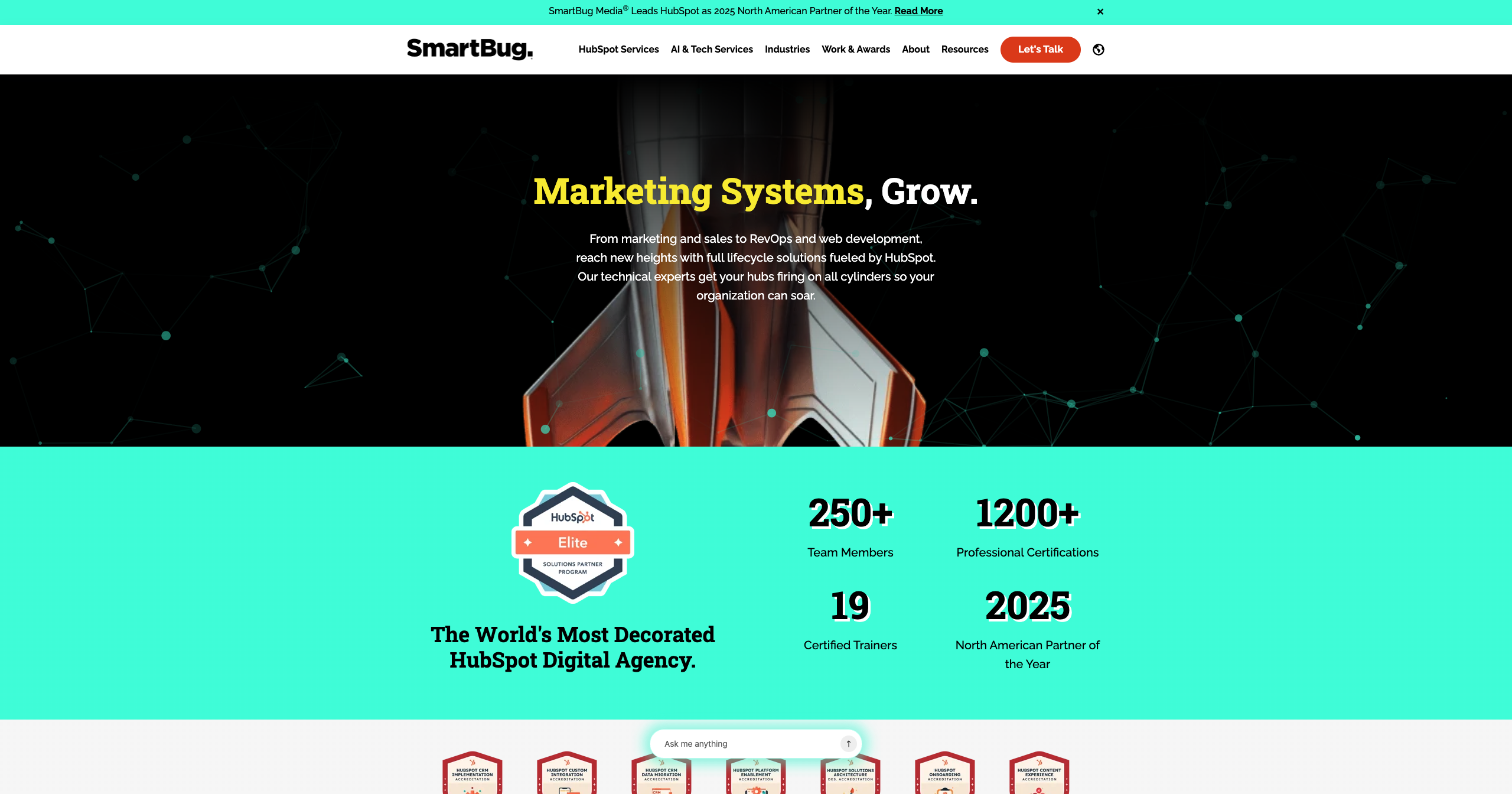
Best for: B2B SaaS on HubSpot at €2M–€7M ARR where the demand creation layer has not been built and the company is approaching the ceiling of what outbound and founder-network pipeline can sustain, needing an inbound programme connected to CRM attribution from the first session
SmartBug Media is a HubSpot Elite Partner agency whose relevance to the €2M to €10M ARR stage is in the specific transition this stage requires from outbound-dependent to demand-creation-supplemented pipeline. Their HubSpot-native methodology builds the inbound demand generation programme directly into the CRM infrastructure that tracks, attributes, and routes the inbound leads it produces, ensuring that the demand creation investment is measurable from the first qualified contact rather than from a quarterly content performance report that no one connects to closed revenue.
The inbound demand creation transition is the one most commonly delayed at the €2M to €10M stage because the ROI is not visible in the first quarter. Outbound produces bookings in weeks. Organic search and content take six to twelve months to compound. Companies that delay starting the demand creation layer because the quarterly board discussion is about outbound volume arrive at the outbound ceiling without a compounding floor and spend a subsequent 12 to 18 months building the inbound programme under pipeline pressure while the board asks why the growth rate is compressing.
SmartBug Media addresses this by building the inbound programme alongside the outbound motion from the start of the engagement. HubSpot workflows connect content engagement to lead scoring and routing, so the inbound leads the demand creation programme produces are processed through the same qualification standard as outbound leads rather than entering the CRM as a separate unconverted category. Revenue attribution from HubSpot connects every content asset and inbound channel to the opportunities it influenced, making the demand creation investment accountable to pipeline and closed revenue rather than to traffic and engagement metrics.
Their documented results include multiple B2B SaaS and technology clients at the growth stage with inbound-attributed pipeline outcomes, and their HubSpot Elite Partner status with significant verified client reviews confirms implementation depth at the technical level that most HubSpot implementations do not reach.
Key services
- HubSpot-native inbound demand generation: SEO, content, email, and social connected to HubSpot CRM from the first session
- CRM implementation calibrated to the demand creation lead qualification and routing requirements
- Revenue attribution: inbound channel contribution to pipeline and closed revenue from HubSpot data
- Marketing automation: lead scoring, routing, and nurture sequences for inbound leads
- Sales and marketing alignment in HubSpot: shared qualification standard implemented in CRM workflows
Why SmartBug Media stands out at the €2M to €10M ARR stage
- HubSpot-native demand creation means the inbound programme is attributable from the first qualified contact: the ROI case for the compounding investment is built from data rather than from estimated organic traffic value
- Inbound and outbound in the same CRM from the start: the demand creation layer is processed through the same qualification infrastructure as the existing outbound motion
- Revenue attribution from HubSpot connects content investment to closed-won outcomes, making the demand creation programme accountable to the board metric rather than to content performance proxies
- HubSpot Elite Partner implementation depth: the technical configuration reflects the qualification and attribution requirements rather than HubSpot defaults that leave gaps in the lead routing
Best fit: B2B SaaS at €2M–€7M ARR on HubSpot where outbound is the primary or only pipeline source, the demand creation layer has not been started or is in early stages with no CRM attribution, and the current outbound volume is at or near the level that the founder's network and total addressable market saturation will ceiling within the next two to four quarters.
5. Roketto

Best for: B2B SaaS at Series A and above where transition 1 is the primary blocker: the ICP is still the broad early-stage definition that produced the first cohort of diverse customers, and the demand generation programme is spread across too many segments to achieve the ICP concentration required for efficient scaling
Roketto is a B2B SaaS demand generation agency that positions ICP clarity as the prerequisite to every other demand generation decision. Their specific contribution to the €2M to €10M ARR GTM transition is in the ICP narrowing work that most agencies skip in favour of launching campaigns on the client's existing ICP definition: identifying from the existing customer base which segment produces the highest LTV, fastest sales cycles, lowest CAC payback, and strongest NRR, and rebuilding the demand generation programme around that segment rather than around the broad definition that produced the first customers.
At the €2M to €10M ARR stage, this ICP narrowing typically reveals that 20 to 30% of the current customer base is responsible for 60 to 70% of NRR, the fastest expansions, and the cleanest renewal conversations. That 20 to 30% is the ICP that the scaling demand generation programme should concentrate on. The 70 to 80% of customers outside the highest-performance segment were valuable at €2M when any closed deal was good. They become CAC-diluting at €7M when the sales team's capacity is the scarce resource and concentrating on the highest-LTV segment is the highest-return use of that capacity.
Roketto's positioning clarity methodology identifies this segment before the campaign is built. Their predictable demand generation programme connects positioning clarity to SEO, paid acquisition, and content production, ensuring that the narrowed ICP definition informs every channel rather than being documented in a strategy presentation that the channel teams never receive. Their documented results include Series A–B B2B SaaS companies with specific conversion rate improvements and pipeline velocity gains attributable to the ICP narrowing and positioning work that preceded the demand generation programme build.
Key services
- ICP narrowing from existing customer base: LTV, CAC payback, NRR, and sales cycle analysis identifying the highest-performance customer segment
- Positioning clarity methodology: documented value proposition for the narrowed ICP before channel activation
- Predictable demand generation programme: SEO, paid acquisition, and content calibrated to the narrowed ICP
- Pipeline velocity tracking: stage-by-stage conversion monitoring showing where the ICP narrowing is improving conversion rates
- Conversion rate optimisation for the demand generation entry points calibrated to the narrowed ICP
Why Roketto stands out at the €2M to €10M ARR stage
- ICP narrowing from existing customer data is the first deliverable: the demand generation programme is built on the evidence of what the company already closes best rather than on assumptions about who should be a good customer
- Positioning clarity before channel activation prevents the channel spread that produces broad reach and low conversion at this stage
- Predictable demand generation methodology sequences channel activation to the stage where the ICP and positioning are validated, preventing spend from amplifying a broad message before the narrowing work is complete
- Stage-specific positioning: Roketto's methodology is calibrated to the Series A–B company that has validated product-market fit in a broad early ICP and needs to narrow for efficient scaling, not to the enterprise company optimising a mature programme
Best fit: B2B SaaS at Series A and above where the existing customer base contains a high-performance segment responsible for a disproportionate share of NRR and expansion, but where the demand generation programme has never been concentrated on that segment and is instead acquiring a diverse mix that matches the original broad ICP definition.
Why dimartec Addresses the €2M to €10M Stage Differently
Every agency on this list addresses one or two of the six GTM transitions required at the €2M to €10M ARR stage. Ironpaper addresses transition two and five: sales motion documentation and CRM-enforced qualification. Obility addresses transition three: paid acquisition calibrated to closed-won revenue profiles. SmartBug Media addresses transition four: the demand creation layer built before the outbound ceiling is reached. Roketto addresses transition one: ICP narrowing from existing customer data before channel scaling.
The gap each of them leaves is the same gap that appears in every stage-specific agency relationship: they address the transitions within their scope and return the adjacent ones to the client. When Obility connects paid campaigns to deal-level attribution and the demand creation layer is not being built simultaneously, the paid CAC improves but the blend does not compound because there is no organic and GEO floor reducing the paid cost share over time. When SmartBug Media builds the inbound demand creation layer and the qualification standard in the CRM still drifts between sales reps, the inbound leads are processed through the same inconsistent qualification the sales team was applying before the programme started.
The €2M to €10M stage is the stage where transitions compound: fixing one without fixing the adjacent ones produces improvement in isolation rather than the compounding system that reaches €10M. dimartec addresses transitions three, four, five, and six simultaneously under one owner with one ICP definition and one attribution model. The paid campaign connects to the closed-won data that the GEO pre-awareness is improving the conversion rate on. The qualification standard the Lead Gen & Nurturing enforces is the same definition the RevOps attribution model uses to connect every channel to NRR by cohort. The transitions are connected because the services addressing them are connected.
See how the Revenue Engine works: https://www.dimartec.co.uk/services/revenue-engine
How to Choose the Right GTM Agency for the €2M to €10M Stage
Name the primary transition blocking the next ARR milestone
The six GTM transitions have different time-to-impact. Transition one (ICP narrowing) produces CAC improvement within one to two quarters. Transition three (paid closed-won calibration) produces cost per SQL improvement within 60 to 90 days. Transition four (demand creation) takes 12 to 18 months to compound. Transition five (CRM-enforced qualification) stabilises MQL-to-SQL conversion within one quarter. The agency that addresses the transition with the longest time-to-impact is the most valuable to start earliest, even if the short-term urgency is in a faster-impact transition.
Require stage-specific methodology, not scaled-down enterprise methodology
The €2M to €10M ARR GTM problem is not the same problem that €30M ARR companies have, optimised for a smaller budget. The ICP is not yet validated against enough closed-won data for statistical significance. The sales motion is being documented for the first time. The demand creation layer does not exist yet. The attribution infrastructure is being built from scratch. Ask any agency: what does the first 90 days of an engagement at this stage look like, and which of the six GTM transitions described above does it address first? An agency whose first 90 days is a campaign launch is addressing none of the transitions.
Assess whether the agency can work on transitions you will complete in six months and ones that will take 18
The most common GTM agency mistake at the €2M to €10M stage is addressing the urgent short-term transition (paid calibration, qualification standard) while not starting the long-lead transition (demand creation, GEO) because the board is asking about this quarter's pipeline. The demand creation layer that will hold the pipeline between outbound cycles in 18 months has to be started now. An agency that does not build the long-lead compounding layer alongside the short-term calibration work is solving today's problem while creating next year's one.
Frequently Asked Questions
What makes the €2M to €10M ARR stage different from earlier or later SaaS GTM stages?
Earlier stages (pre-€2M) focus on product-market fit validation and first customer acquisition. The GTM motion is intentionally lightweight. Later stages (post-€10M) focus on scaling a validated and documented GTM system. The €2M to €10M stage is the transition: the product-market fit is validated but the GTM system does not yet exist in a form that scales. Every process is either informal (the founding team's instincts) or absent (no documented qualification standard, no demand creation layer, no closed-won attribution). The GTM work at this stage is infrastructure building, not campaign optimisation.
How should a B2B SaaS company at €2M ARR sequence the six GTM transitions?
ICP narrowing (transition one) and paid closed-won calibration (transition three) produce the fastest commercial impact and should begin simultaneously in the first quarter. Qualification CRM enforcement (transition five) should follow in the second quarter once the ICP definition from transition one is validated against initial campaign data. Demand creation and GEO (transition four) should start in the first quarter regardless of how long the payoff takes, because the compounding timeline makes early start the highest-leverage decision. Sales motion documentation (transition two) should be completed before the sales team reaches three AEs, whenever that occurs relative to the above. NRR architecture (transition six) should be designed as part of the RevOps infrastructure built in the first half of the programme, not deferred to when the customer base is large enough to make it feel urgent.
What does a board-ready GTM programme look like at the €5M ARR milestone?
A board-ready GTM programme at €5M ARR produces four metrics from clean attributed data: CAC payback by channel (target under 18 months), MQL-to-SQL conversion rate (target 25 to 40%), pipeline velocity by stage (showing where deals are accelerating or stalling), and NRR by customer cohort (target above 110%). All four should come from the same CRM attribution model rather than from separately assembled dashboards. The absence of any one of these metrics at the first Series A board review is the clearest signal that a GTM transition the company should have completed by €3M ARR is still outstanding.
Build the GTM System That Reaches €10M
The companies that reach €10M ARR efficiently are not the ones that ran better campaigns between €2M and €10M. They are the ones that replaced the motion that produced €2M with a system that could scale: ICP narrowed to the highest-LTV segment, paid calibrated to closed-won evidence, demand creation compounding before the outbound ceiling was reached, qualification enforced by the CRM rather than by the founding team's instinct, and NRR connected to the acquisition strategy through RevOps attribution.
The Revenue Engine connects Performance Paid Media, CRO, GEO, Lead Gen & Nurturing, and RevOps & Automation into one system so four of the six GTM transitions happen simultaneously under one owner, the ICP definition is consistent across every service from the first campaign, and the attribution model connects every transition's commercial impact to the closed-won ARR and NRR growth that the board is measuring.
See how the Revenue Engine works: https://www.dimartec.co.uk/services/revenue-engine
.png)







.png)

















































.png)
.png)
.png)
.png)
.png)
.png)
.png)
.png)
.png)
.png)