
Series A and Series B are frequently grouped together in agency lists. The grouping makes sense from an agency perspective: both stages involve growth-stage SaaS companies with meaningful revenue and board-approved marketing budgets. It makes less sense from a company perspective, because the commercial problems being solved at each stage are almost entirely different.
At Series A, the primary question is whether the GTM motion can be made repeatable without the founding team. The investor funded a proof that the product sells. They want evidence that the mechanism of selling can be documented, staffed, and scaled. That evidence comes from building the first attribution infrastructure, validating the ICP against closed-won data rather than founder instinct, and demonstrating that a marketing programme can produce qualified pipeline without the founder closing every deal personally.
At Series B, the primary question is whether the validated GTM motion can be scaled efficiently. CAC payback under 18 months has typically been demonstrated. The Series B investor is asking whether CAC payback can reach 12 months at 3x the current spend, whether NRR can reach 115% at 2x the current customer count, and whether the pipeline infrastructure will survive a 40-person sales team running the same qualification process the first 8 reps developed informally. These are not the same questions as Series A. They require different agencies.
After reviewing growth programmes across more than 200 B2B SaaS companies at Series A and B, the consistent finding is this: companies that exit Series A with the right growth infrastructure reach their Series B targets 30 to 40% faster than those that do not. The infrastructure they exit with is not a set of running campaigns. It is an attribution model that connects marketing spend to closed-won ARR, a qualification standard enforced by the CRM rather than by individual reps, and a demand creation layer that will produce inbound pipeline at Series B without proportionally scaling Series A acquisition spend. The agencies that help them build this infrastructure in 12 to 18 months are worth far more than the agencies that run better campaigns at the same cost.
This guide evaluates the ten top SaaS growth agencies for Series A and B: the ones whose methodology understands what each stage actually requires and builds for the next stage's commercial questions rather than for the current one's.
What Series A and Series B Actually Require
The distinction between Series A and Series B growth agency requirements is worth making explicit before evaluating any agency.
Series A growth priorities:
- ICP validated against closed-won data (not founder intuition)
- Attribution infrastructure connecting every channel to pipeline and closed ARR
- CRM qualification standard agreed between marketing and sales and enforced by routing logic
- First demand creation layer started before the outbound ceiling is reached
- CAC payback under 18 months and LTV:CAC above 3:1 demonstrable from clean data
- Pipeline forecast defensible to the Series B investor without manual reconciliation
Series B growth priorities:
- Paid acquisition scaled against the validated ICP with efficiency, not just volume
- NRR architecture contributing 30 to 40% of net new ARR through expansion
- GTM motion documented sufficiently that a 40-person team can run it consistently
- Multiple demand generation channels each attributable to closed revenue
- Rule of 40 contribution visible in the growth programme's unit economics
- CAC payback improving toward 12 months as programme efficiency compounds
An agency that builds a great Series A programme may not be the right partner for Series B if their methodology does not scale from infrastructure-building to efficiency-optimisation. An agency built for Series B may be premature at Series A because the underlying data does not yet exist for their approach to work. The agencies on this list are evaluated against both stage requirements with explicit notes on where each fits best.
How We Chose These Agencies
- Stage clarity: Does the agency understand the difference between Series A infrastructure-building and Series B efficiency-scaling, or does it apply the same methodology regardless of stage?
- Attribution depth: Does the agency connect its programme to closed-won ARR from the first session, or does it report on channel activity and leave the closed-revenue connection to the client?
- Next-stage preparation: Does the agency build the infrastructure the company will need at the next funding stage, or does it optimise for current-quarter metrics?
- Unit economics fluency: Does the agency report CAC payback, LTV:CAC, and NRR contribution, or does it report MQL volume and campaign performance?
- Verified Series A/B outcomes: Named clients at this specific stage with documented commercial outcomes, not enterprise case studies applied to growth-stage companies.
The 10 Top SaaS Growth Agencies for Series A and B
1. dimartec
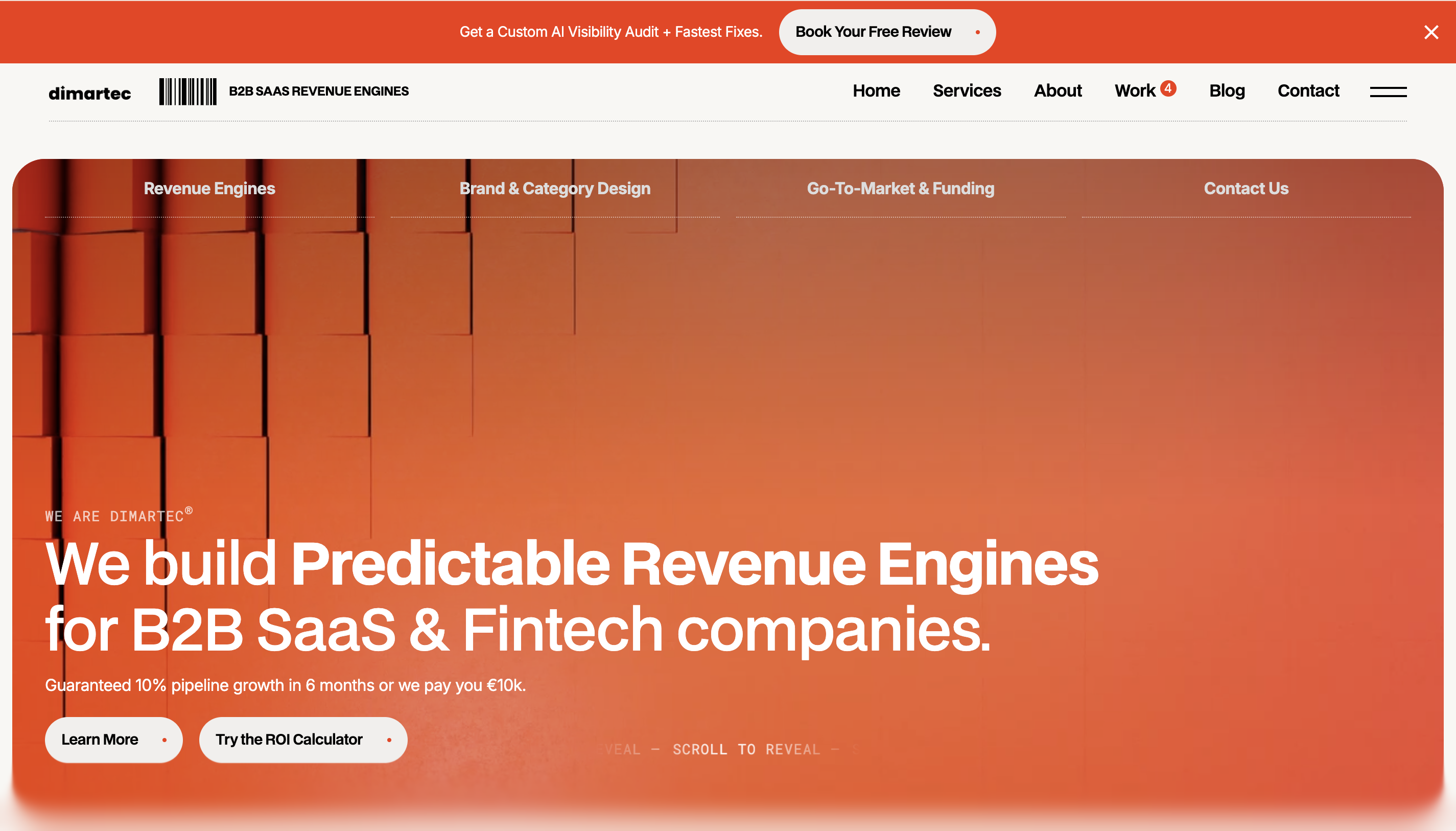
Best for: Post-PMF B2B SaaS and fintech at €2M–€10M ARR at Series A or B where the growth programme needs to address attribution infrastructure, demand creation, qualification standards, and NRR contribution simultaneously rather than sequentially
dimartec builds Revenue Engines for B2B SaaS and fintech companies. The five integrated services (Performance Paid Media, CRO, GEO, Lead Gen & Nurturing, and RevOps & Automation) address the most common Series A and Series B growth gaps as one connected system rather than as sequential projects.
At Series A, the three infrastructure components the investor needs evidence for in the Series B conversation are attribution (which channels produced the pipeline that closed, at what CAC payback), qualification (does the qualification standard hold without the founders in every deal), and demand creation (is there a compounding inbound layer building, or is all pipeline dependent on paid and outbound that pause when campaign cycles end). dimartec builds all three simultaneously: RevOps & Automation creates the attribution infrastructure from the first session, Lead Gen & Nurturing implements the qualification standard as CRM routing logic, and GEO begins the compounding demand creation layer before the outbound ceiling is reached.
At Series B, the two growth questions the board is interrogating are efficiency (is CAC payback moving toward 12 months as spend scales, or is it stable or rising) and NRR (is expansion revenue contributing to the ARR growth rate, or is the company acquiring its way to every net ARR gain). Performance Paid Media optimised against closed-won ICP profiles reduces the proportion of spend on audiences that will not close at acceptable payback periods. RevOps & Automation attribution by NRR cohort reveals which acquisition channels produce the customers with the highest expansion rates, enabling the programme to concentrate spend on the sources that produce the highest-LTV customers rather than the highest-volume leads.
GEO is relevant at both stages for different reasons. At Series A, GEO starts the compounding demand creation layer that will produce inbound pipeline at Series B without proportional spend increases. At Series B, GEO is the channel that reduces paid conversion costs as the programme scales: visitors arriving from ChatGPT or Perplexity with prior brand familiarity convert at higher rates than cold paid visitors from the same ICP targeting, improving the efficiency of the paid acquisition that is scaling alongside it.
If any of the following apply, dimartec is worth a conversation:
- At Series A: the investor is asking for CAC payback by channel and the current attribution model cannot produce it without manual assembly from multiple dashboards
- At Series A: the brand does not appear in AI search answers to the category questions the ICP researches before starting a vendor evaluation
- At Series B: CAC payback has been stable rather than improving as paid spend has scaled, indicating the efficiency gains that Series B investors expect from scale are not materialising
- At Series B: NRR is below 110% and expansion revenue is not contributing 30 to 40% of net new ARR, putting the entire growth target on new logo acquisition
Key services
- Performance Paid Media: closed-won ICP calibration at Series A; efficiency optimisation and NRR-cohort targeting at Series B
- CRO: conversion rate improvement producing lower cost per SQL from the same paid spend
- GEO: demand creation layer at Series A; paid conversion cost reduction at Series B
- Lead Gen & Nurturing: qualification standard implementation at Series A; qualification consistency at scale at Series B
- RevOps & Automation: attribution infrastructure at Series A; NRR cohort analysis and unit economics reporting at Series B
Why dimartec stands out for Series A and B growth
- Addresses both stages' primary questions: infrastructure building at Series A and efficiency scaling at Series B
- GEO serves a different function at each stage and is built from session one to compound across both
- RevOps & Automation produces the Series B investor metrics (CAC payback by channel, NRR by cohort) from the Series A engagement infrastructure
- 90% of clients see improved lead quality within 90 days
Best fit: Post-PMF B2B SaaS and fintech at €2M–€10M ARR at either Series A or B where the growth programme needs the attribution infrastructure, demand creation layer, qualification standard, and unit economics reporting to be built as one connected system rather than as separate quarterly projects.
2. TripleDart
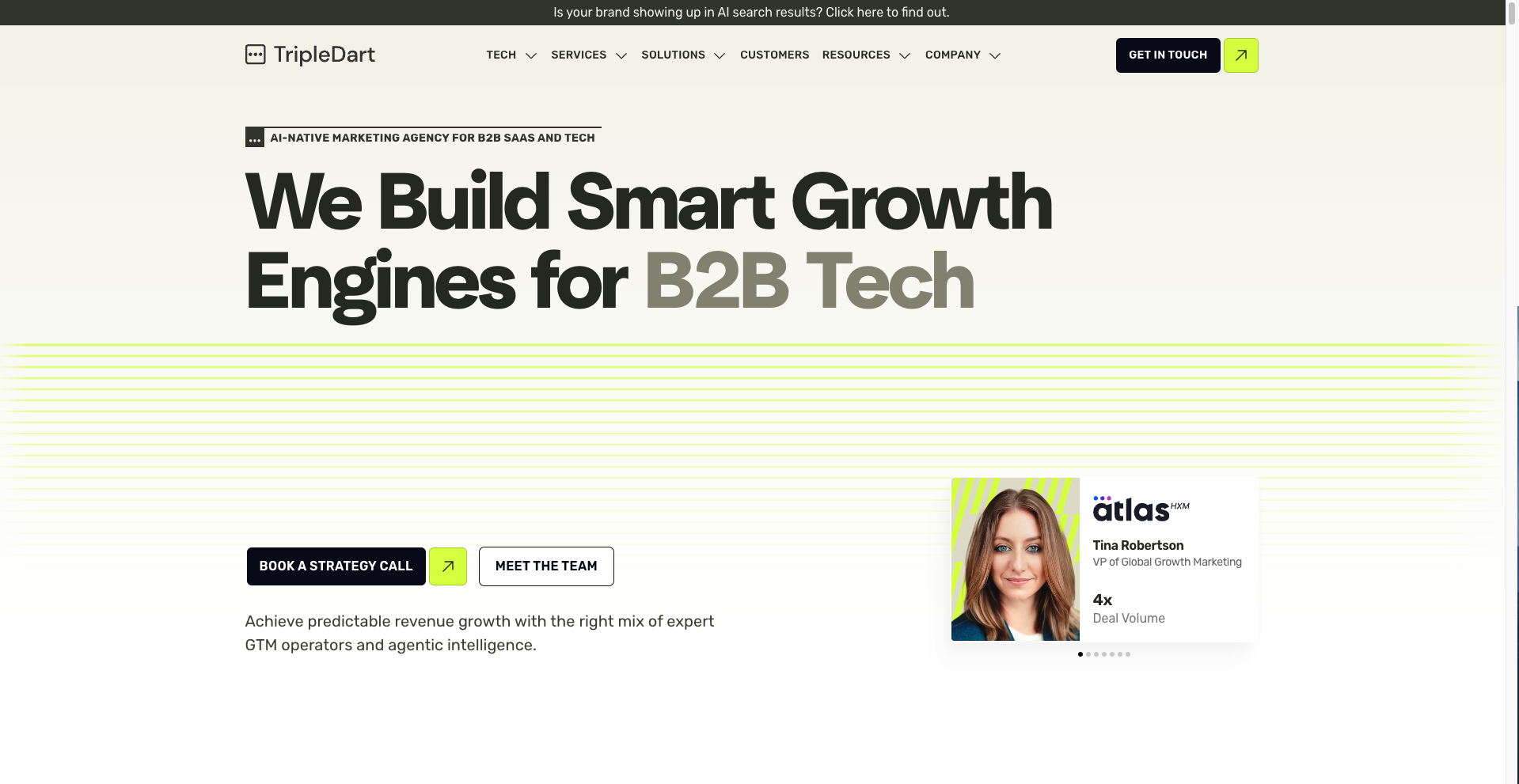
Best for: Series B B2B SaaS scaleups at $5M–$50M ARR that need full-funnel execution depth across paid, SEO, GEO, ABM, and CRO with RevOps integrated from day one, and 60-plus RevOps implementations providing pattern recognition on which growth gaps produce the largest revenue impact at this stage
TripleDart is a full-funnel B2B SaaS marketing agency whose AI-native execution layer and RevOps integration make them most relevant at Series B, when the growth programme needs both broad channel coverage and the attribution depth to prove that each channel is contributing to revenue. Their funnel maturity matrix diagnoses which growth component gap produces the largest revenue impact before any execution spend is committed, which at Series B is the most commercially important question: the company has enough spend to fund multiple channels simultaneously, and the budget allocation decision between them determines whether the next 12 months produce the CAC payback improvement the Series B board expects.
GEO is built into their standard engagements alongside SEO, which is the correct sequence at Series B: organic and AI search are the compounding channels that reduce paid CAC over time, and building them after the paid programme is already scaled means 12 to 18 months of compounding is being skipped.
Named clients include Freshworks, Multiplier, Avoma, Glean, Airbase, and CleverTap, all at the B2B SaaS scaleup stage that Series B companies occupy.
Key services
- Full-funnel SaaS marketing: SEO, GEO, paid acquisition (Google, LinkedIn, Meta), ABM, and CRO
- RevOps implementation connecting all channels to pipeline and closed ARR
- Funnel maturity matrix: diagnostic identifying the highest-revenue-impact gap before execution begins
- AI-native execution layer: programme decisions informed by pipeline data
- 60-plus RevOps implementations providing stage-specific pattern recognition
Why TripleDart stands out for Series A and B growth
- Funnel maturity matrix prevents the Series B budget allocation mistake: spending on channels already performing adequately rather than the specific gap limiting revenue growth
- RevOps in the standard engagement means the attribution infrastructure the Series B investor interrogates is a first-session deliverable rather than a future project
- Named Series B-stage client base provides benchmark evidence specific to the commercial stage this list addresses
- GEO in standard engagements ensures the compounding channel that reduces paid CAC is being built while the paid programme is scaling
Best fit: Series B B2B SaaS at $5M–$50M ARR that need full-funnel execution depth with RevOps attribution from the first campaign and the diagnostic infrastructure to identify which growth gap produces the highest-revenue-impact improvement.
3. NoGood
Best for: VC-backed B2B SaaS at Series A and B that need a senior growth squad measuring programme performance against pipeline quality rather than MQL volume, with AEO and GEO alongside paid producing AI search visibility as a structural growth component
NoGood is a growth agency structured around a senior squad model that integrates CRO, paid acquisition, content, and AEO and GEO under one team. Their specific relevance at Series A and B is in their measurement framework: they measure against pipeline quality rather than MQL volume, which is the correct measurement standard at both stages. At Series A, measuring pipeline quality rather than MQL volume produces the evidence that the Series B conversation requires. At Series B, it prevents the performance inflation that occurs when the programme is optimised for the metric that looks best rather than the metric that reflects commercial outcome.
Their 84% client retention rate across VC-backed SaaS companies (a portfolio where investor growth accountability is built into every quarterly review) is the strongest available external signal that the methodology produces results at the standard VC-backed companies are held to. Their documented outcomes include 65% of clients doubling revenue within the first six months.
Key services
- Senior growth squad integrating paid, content, lifecycle, and CRO under one team
- AEO and GEO tracked with pipeline attribution alongside paid channels
- Pipeline quality measurement as the primary programme metric
- Growth experimentation with statistical rigour across the full acquisition and conversion funnel
- Product-led growth instrumentation for SaaS companies with self-serve components
Why NoGood stands out for Series A and B growth
- Pipeline quality measurement at Series A builds the evidence base the Series B conversation requires; at Series B it prevents the performance inflation that obscures which channels are genuinely contributing to growth
- 84% client retention across VC-backed SaaS provides the stage-specific evidence that the methodology produces results under investor scrutiny
- AEO and GEO alongside paid ensures AI search visibility is built into the programme structure rather than added as a future phase after the paid programme is already scaled
- Senior-only squad eliminates the execution quality drop that occurs when senior practitioners pitch and junior teams deliver
Best fit: VC-backed B2B SaaS at Series A and B where the board has direct visibility into the marketing programme's output and where reporting MQL volume rather than pipeline quality is no longer acceptable as the primary success metric.
4. Growth Division
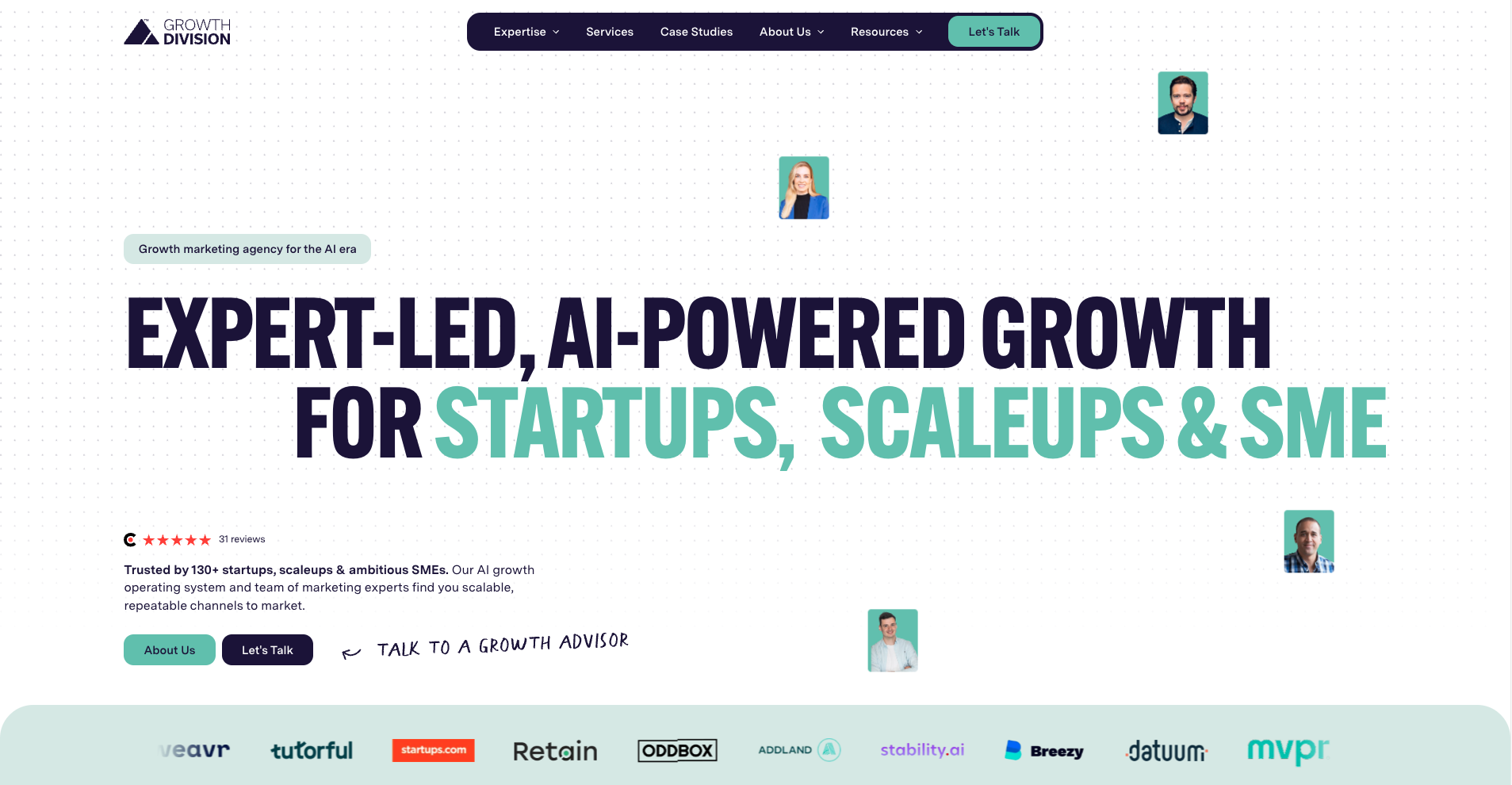
Best for: Series A B2B SaaS building the first proper demand generation programme, needing paid capture and compounding organic and GEO channels built in parallel from the start of the engagement rather than sequentially after the paid programme has proven itself
Growth Division is a demand generation strategy and execution agency for B2B SaaS companies. Their primary relevance is at Series A, where the most important demand generation decision is not which channel to prioritise but whether the compounding channels are started immediately alongside the fast-feedback paid channels. The 12 to 18 month compounding timeline of organic search and GEO means the Series B board conversation in 18 months is partially funded by the demand creation layer started today. Companies that start the demand creation layer at Series B face a gap: 12 to 18 months of compounding is missing from their pipeline floor precisely when the board expects it to be present.
Growth Division's parallel-build methodology starts both the paid capture layer (producing pipeline within 30 to 60 days) and the organic and GEO layer (producing compounding pipeline 12 to 18 months from now) simultaneously from the first engagement. Their 2026 demand generation methodology integrates GEO alongside SEO, treating AI search visibility as a necessary component of the demand creation layer rather than an advanced optimisation to add later.
Key services
- Paid acquisition (Google, LinkedIn) as the fast-feedback demand capture layer
- Organic content, SEO, and GEO as the compounding demand creation layer built in parallel
- Content structured for AI citation alongside traditional search
- Channel sequencing plan: explicit milestones for when the organic and GEO layer begins supplementing the paid capture
- Pipeline reporting connecting both layers to a unified attribution view
Why Growth Division stands out for Series A and B growth
- Parallel-build model ensures the compounding demand creation layer is present at Series B without a 12-to-18-month gap caused by building organic after paid is established
- GEO integrated alongside SEO from the first session: AI search visibility compounds from the earliest weeks rather than arriving as a future phase
- Stage-appropriate for Series A: the methodology is calibrated to the budget and team constraints of a company building its first proper demand generation programme
- Channel sequencing provides explicit milestones for when each layer takes over from the other, making the demand generation architecture legible to the board without a manual narrative
Best fit: Series A B2B SaaS that have validated product-market fit and are building the first proper demand generation programme, where the most important single decision is starting the compounding demand creation layer immediately alongside the fast-feedback paid layer rather than after the paid layer has been proven.
5. Directive Consulting
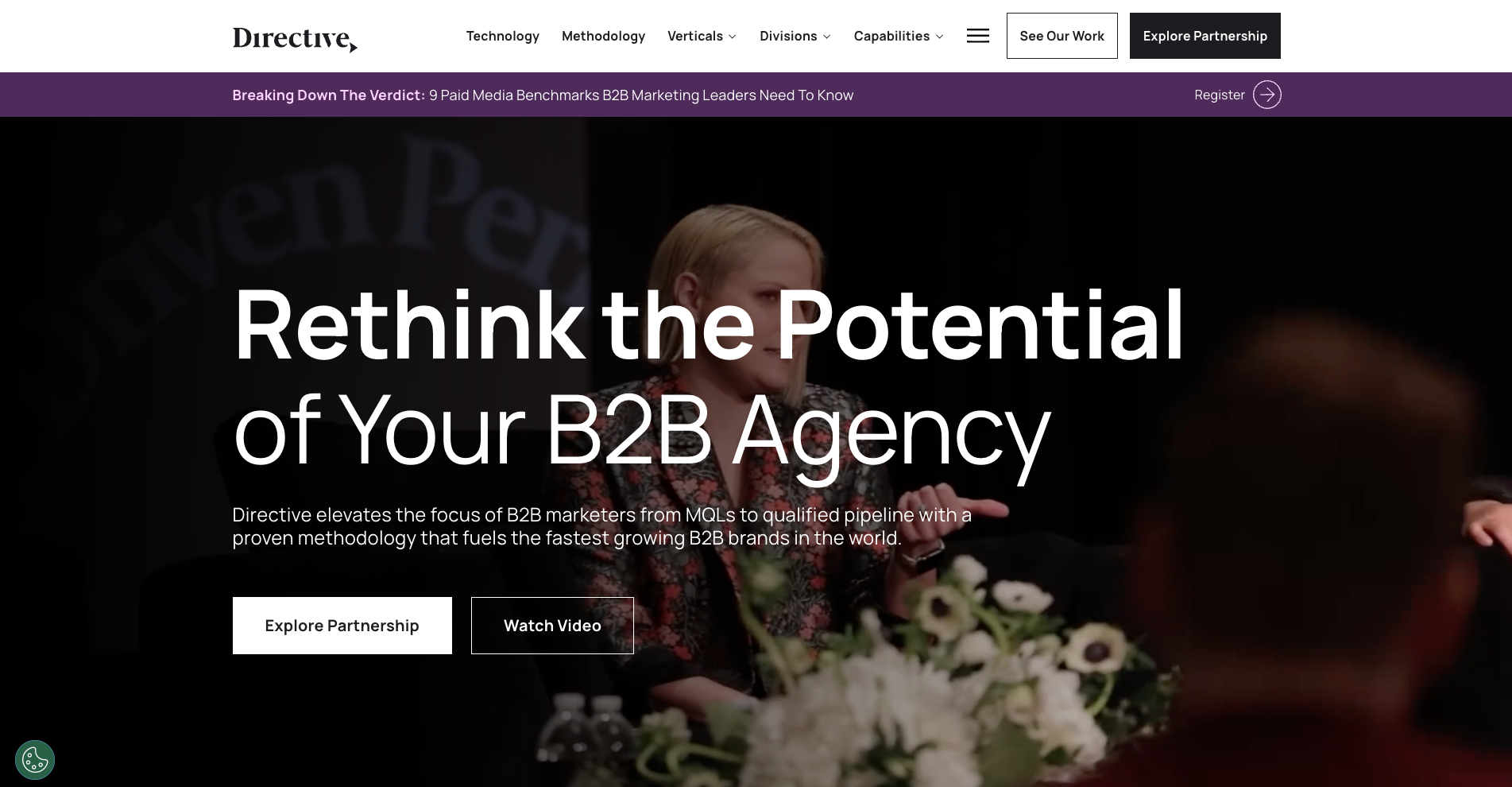
Best for: Series B and above B2B SaaS with material paid acquisition budgets where the board is asking about CAC payback by channel, LTV:CAC ratio, and the financial efficiency of the marketing programme in unit economics terms that a CFO can interrogate
Directive Consulting is a performance marketing agency whose Customer Generation methodology explicitly connects every marketing decision to the unit economics model the Series B board uses to evaluate growth efficiency. Their DiscoverabilityOS framework concentrates paid spend at the intent stages that produce SQLs rather than distributing it across awareness audiences that inflate the CAC numerator. Their financial modelling layer makes the CAC payback improvement from each channel investment calculable before the spend is committed.
At Series B specifically, the board conversation has shifted from "is the GTM motion working?" (Series A) to "is the GTM motion working efficiently?" (Series B). The difference is unit economics. Directive's methodology produces the answer to the efficiency question: which channels produce the lowest CAC payback, which produce the highest LTV:CAC, and where the marginal dollar of growth investment produces the highest return measured in closed-won revenue rather than in pipeline activity.
Named clients include ZoomInfo, Calendly, Adobe, and Cisco, with $1B-plus in reported client revenue across their operating history.
Key services
- Paid search and paid social optimised against CAC payback and LTV:CAC ratio
- DiscoverabilityOS: intent-tiered campaign architecture concentrating spend at SQL-producing stages
- Financial modelling connecting paid media decisions to unit economics
- Revenue operations integration connecting ad spend to CRM closed-won data
- CFO and board-level reporting in financial rather than marketing metric language
Why Directive stands out for Series A and B growth
- Financial modelling at Series B is the most commercially valuable deliverable: the board question shifts from volume to efficiency, and efficiency requires a financial model, not a campaign report
- DiscoverabilityOS reduces the proportion of Series B paid spend on awareness audiences that inflate CAC without contributing to qualified pipeline
- Named enterprise clients demonstrate that the methodology produces verifiable results at the scale and scrutiny level that Series B companies are approaching
- Customer Generation framing — measuring marketing by revenue, not leads — is the correct measurement model for the board conversation at both Series A and B
Best fit: Series B B2B SaaS with paid acquisition budgets above €15k per month where the board has moved from asking about pipeline volume to asking about CAC payback and LTV:CAC, and where the marketing programme needs to be presented in financial terms rather than in campaign terms.
6. ColdIQ
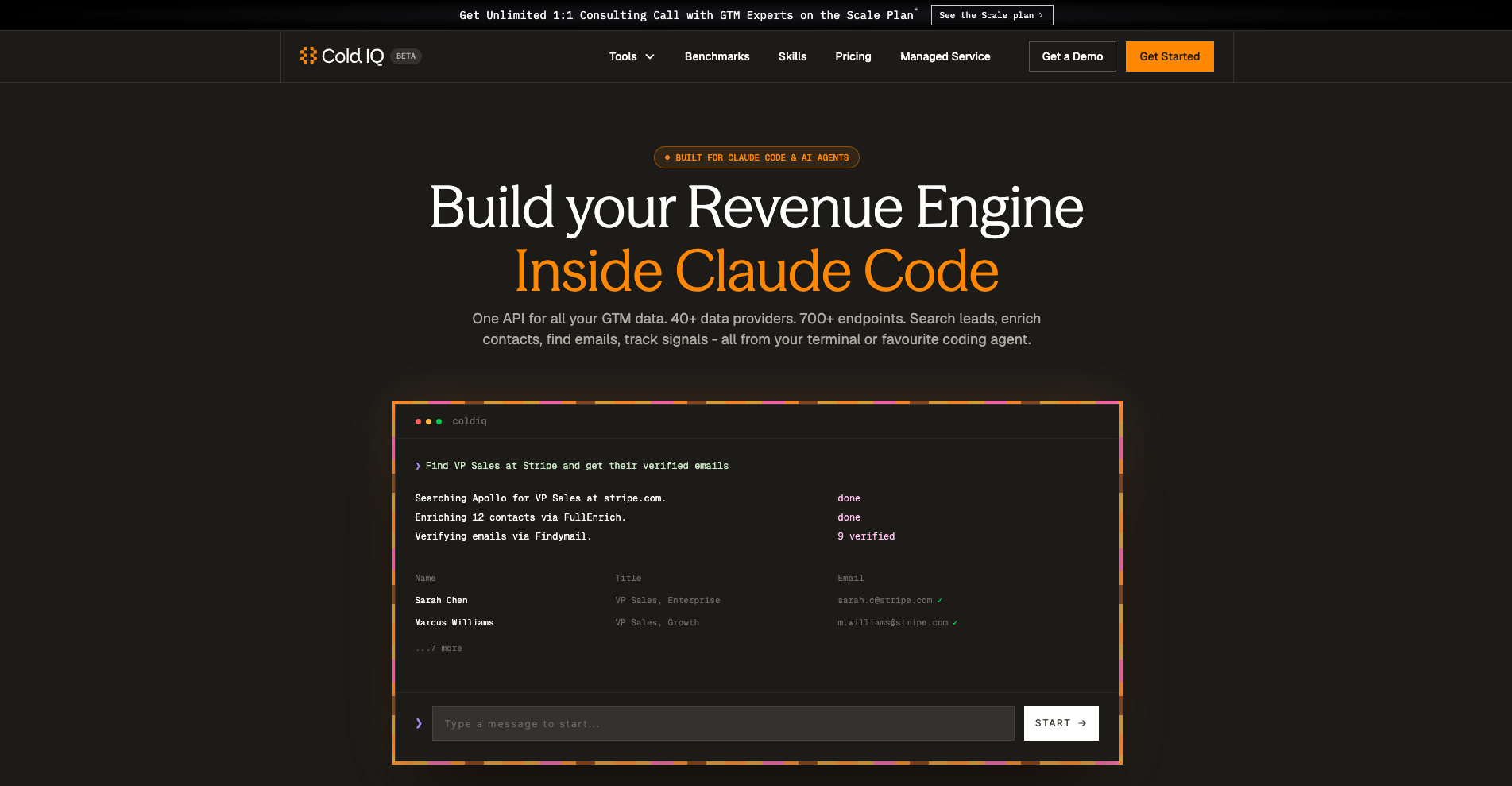
Best for: Series A B2B SaaS that need outbound built as a signal-driven, measurable pipeline channel from the first session, with 15-plus intent signals identifying which ICP accounts are in active evaluation before any sequence fires
ColdIQ is an AI-native outbound GTM agency. Their specific relevance at Series A is in building outbound as a measurable pipeline channel rather than as a volume activity. At Series A, the investor is asking for evidence that the GTM motion is repeatable: outbound that produces meetings at a documented cost per SQL, with a documented qualification standard, provides that evidence. Outbound that produces meeting volume with no attribution to closed-won outcomes provides activity evidence rather than system evidence.
Their 15-plus intent signal methodology identifies which accounts in the ICP universe are currently demonstrating active evaluation behaviour (job postings for relevant roles, technology stack changes, funding events, competitor research activity) before any sequence fires. At Series A, where the sales team is small and every meeting has material opportunity cost, this signal-based prioritisation concentrates outbound on the accounts most likely to advance to SQL rather than sequencing the full ICP list uniformly.
Pipeline-stage reporting connects outbound activity to opportunity progression in the CRM, making the cost per SQL from outbound visible alongside cost per SQL from paid channels. At Series A, this comparison is the attribution data that answers which channels are producing pipeline at acceptable cost, which is the foundation of the Series B investor conversation about channel efficiency.
Key services
- Signal-based ICP account prioritisation using 15-plus intent signals before outreach begins
- AI-native outbound sequencing calibrated to each account's signal profile
- Pipeline-stage reporting connecting outbound activity to CRM SQL conversion rate
- Multi-channel outreach: email, LinkedIn, and calling
- Outbound technology stack (Clay, Apollo, Smartlead, HubSpot) designed as a client-owned asset
Why ColdIQ stands out for Series A and B growth
- Signal-based prioritisation concentrates Series A sales capacity on the highest-probability accounts rather than distributing it across the full ICP list
- Pipeline-stage reporting makes outbound's cost per SQL attributable alongside other channels, contributing to the channel-level attribution data the Series B investor requires
- Technology stack as a client asset means the outbound infrastructure survives the end of the agency engagement and can be operated by the sales team the company hires at Series B
- AI-native execution scales signal processing across large ICP account universes without proportional cost increases as the sales team grows
Best fit: Series A B2B SaaS that need outbound built as a measurable, signal-driven pipeline channel with documented cost per SQL from the first month rather than as a volume activity that produces meeting counts without commercial attribution.
7. Hey Digital
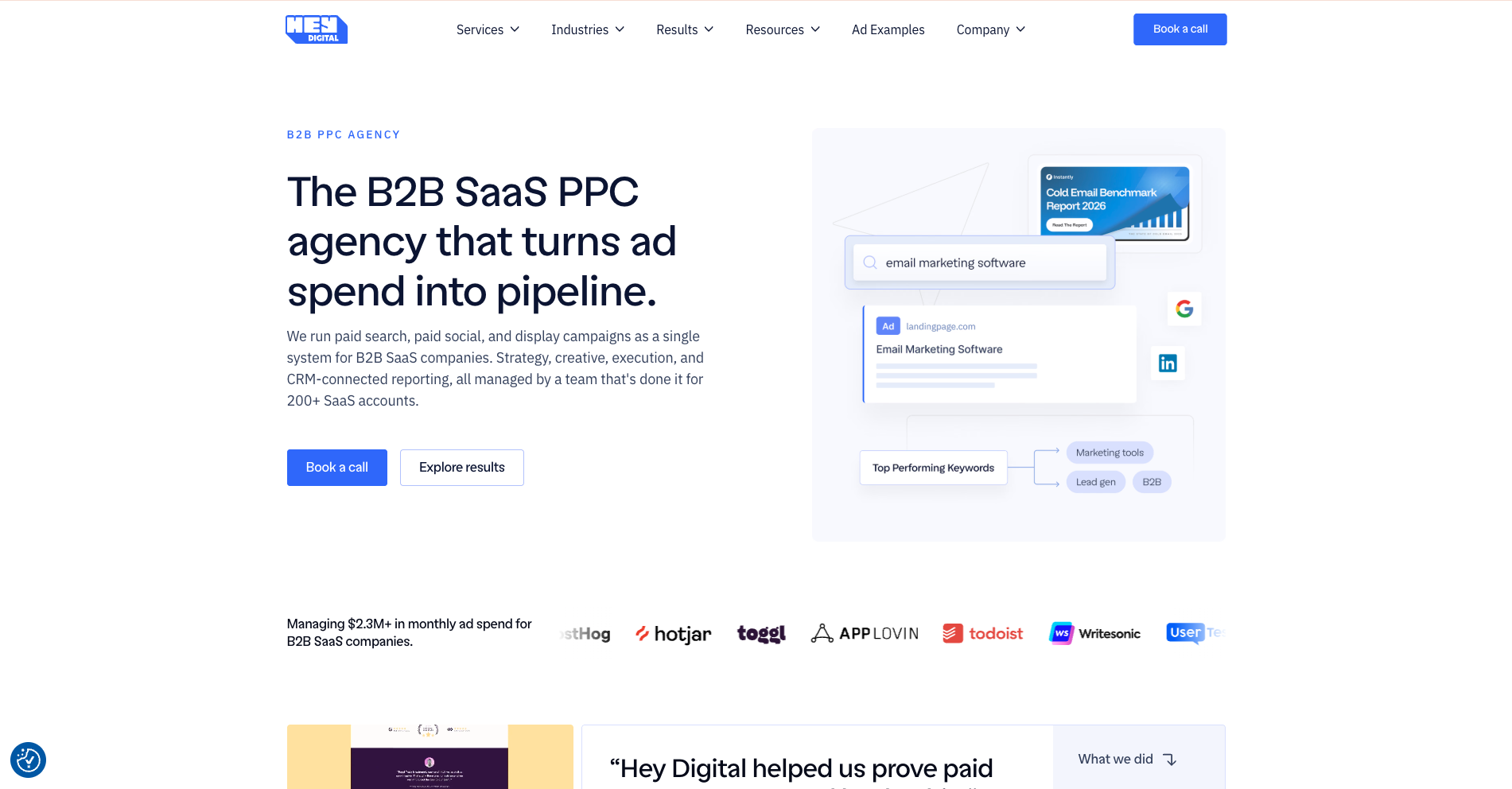
Best for: Series A and B B2B SaaS that need paid media structured across all three funnel zones (top, mid, and bottom) rather than concentrated at bottom-of-funnel intent capture, with a SaaS-only client base producing stage-calibrated benchmarks
Hey Digital is a B2B SaaS performance marketing agency that works exclusively with SaaS companies. Their three-zone paid media architecture (top-of-funnel demand creation, mid-funnel nurturing, bottom-of-funnel intent capture) directly addresses the most common paid media failure at Series A and B: concentrating the entire paid budget at bottom-of-funnel because it produces the most visible short-term metrics, then facing rising CPCs and declining marginal returns as all budget competes for the same intent signals.
At Series A, the three-zone architecture builds the paid demand creation layer that supplements the organic and GEO compounding channels before they reach maturity. At Series B, when the paid budget is significantly larger, the three-zone structure prevents the efficiency decline that occurs when a single-zone programme saturates the bottom-of-funnel intent pool and cannot find more qualified demand without moving budget to earlier funnel stages.
Their SaaS-only client base includes Hotjar, Landbot, Maze, and Userback, with documented outcomes including 127% increase in qualified leads and 3.2x improvement in trial-to-paid conversion.
Key services
- Bottom-of-funnel paid search and social for demand capture from active evaluators
- Mid-funnel paid social for nurturing buyers in consideration across the evaluation period
- Top-of-funnel awareness and prospecting creating demand before active evaluation begins
- Landing page design and A/B testing integrated with each funnel zone's creative strategy
- Pipeline metric reporting: cost per SQL, MQL-to-SQL rate, and CAC efficiency as primary metrics
Why Hey Digital stands out for Series A and B growth
- Three-zone architecture prevents the bottom-of-funnel saturation that causes paid CAC to rise as Series A and B budgets scale
- SaaS-only client base produces the most accurate paid media benchmarks available for SaaS at each specific stage
- Top-of-funnel paid investment builds the demand creation layer that reduces mid and bottom-of-funnel CAC over time as buyers arrive with prior awareness
- Documented SaaS outcomes at growth stage validate the three-zone methodology at the specific commercial stages this article addresses
Best fit: Series A and B B2B SaaS that have concentrated paid budget at bottom-of-funnel and are experiencing rising CPCs and declining incremental returns, and need to rebuild the paid programme across all three zones to sustain acquisition efficiency as the budget scales.
8. Winning by Design
Best for: Series B B2B SaaS whose primary growth constraint is NRR: expansion revenue is not contributing 30 to 40% of net new ARR, the sales motion is inconsistently documented across the growing sales team, and the qualification standard drifts between reps because the handoff framework was never formalised
Winning by Design is a recurring revenue consultancy whose SPICED qualification framework and Bowtie Data Model address the two Series B growth constraints that acquisition-focused agencies cannot fix: NRR below 110% and sales motion inconsistency across a growing team. At Series B, the board asks two questions that no paid acquisition agency can answer: is expansion revenue contributing to the growth rate, and will the qualification standard hold across 40 sales reps without the founding team's informal coaching?
The SPICED framework provides the first answer: a shared qualification language that every rep applies consistently, making pipeline stage data trustworthy and the forecast defensible without rep-by-rep reconciliation. The Bowtie Data Model provides the second: full-lifecycle commercial data connecting acquisition, expansion, and retention to the same ARR model, making NRR's contribution to the growth rate visible and the expansion revenue channels identifiable.
Their Revenue Academy transfers the frameworks to the internal team during the engagement, ensuring the qualification consistency and NRR architecture operate at Series C without ongoing agency dependency.
Key services
- SPICED qualification framework: shared qualification language replacing individual rep interpretation with one agreed standard
- Bowtie Data Model: full-lifecycle ARR tracking connecting acquisition, expansion, and retention
- NRR architecture: expansion revenue design connecting customer success to the commercial model
- Revenue Academy: in-house capability transfer ensuring the framework operates without agency dependency
- GTM motion documentation: sales playbooks and qualification criteria in a form the growing team can follow
Why Winning by Design stands out for Series A and B growth
- SPICED at Series B prevents the qualification standard dilution that occurs when a 20-person sales team each applies their own interpretation of what qualified means
- Bowtie Data Model makes NRR's contribution to the ARR growth rate visible for the first time, enabling the expansion revenue architecture to be built with evidence of where the opportunity is
- Revenue Academy prevents the framework from reverting when the engagement ends, which is the most common failure of qualification standard implementations
- Most relevant at Series B: the problems SPICED and Bowtie solve become acute when the sales team exceeds 10 reps and when the board begins asking about NRR in addition to new logo growth
Best fit: Series B B2B SaaS whose sales team has grown past the stage where the founding team's personal coaching maintains qualification consistency, and where NRR is below 110% because expansion revenue architecture was never connected to the acquisition and qualification infrastructure the company is scaling.
9. 42 Agency

Best for: Series A and B B2B SaaS running enterprise sales motions, where ABM and RevOps need to be built as one connected programme so that account-level engagement data flows into the CRM pipeline routing that determines which accounts the sales team prioritises
42 Agency is a B2B demand generation and RevOps agency that builds ABM and RevOps as one connected programme. Their specific relevance at Series A and B is for SaaS companies with enterprise or mid-market sales motions where the buying committee has five or more members and the single-contact lead qualification model that works for self-serve SaaS does not produce accurate pipeline data for the sales motion the company is actually running.
At Series A with an enterprise motion, the qualification problem is not the qualification standard. It is the absence of an account-level pipeline model. Single-contact MQL tracking counts one marketing-qualified contact as one marketing-qualified account, which systematically undercounts the multi-stakeholder engagement that enterprise B2B evaluations require. 42 Agency builds the account-level pipeline architecture from the ABM engagement data rather than from single-contact conversion events.
At Series B, when the enterprise pipeline is large enough to forecast accurately, the account-level data that 42 Agency's architecture produces becomes the foundation of the board pipeline review: which named accounts are engaged, at what stage, with which stakeholders, and with what historical close rate from the same source channel. That is a fundamentally different pipeline view from what a standard MQL tracking model produces.
Key services
- ABM strategy and execution connected to account-level CRM scoring
- RevOps infrastructure: account-level pipeline reporting rather than single-contact MQL tracking
- Demand generation connected to named account engagement data
- HubSpot and Salesforce implementation with account-level lifecycle stages
- Full-cycle attribution connecting ABM engagement to pipeline contribution and closed revenue
Why 42 Agency stands out for Series A and B growth
- Account-level pipeline architecture is the correct infrastructure for enterprise SaaS buying motions at both Series A and B
- ABM and RevOps built as one programme prevents the data gap between ABM engagement and pipeline attribution that produces inaccurate coverage ratios and unreliable forecasts
- Series A implementation provides the account-level data that makes the Series B pipeline review credible rather than requiring manual rep-by-rep account status updates
- HubSpot and Salesforce depth at the implementation level ensures the architecture reflects the enterprise pipeline model rather than HubSpot defaults designed for high-volume inbound lead management
Best fit: Series A and B B2B SaaS with average contract values above €25k and buying committees of five or more stakeholders, where the standard MQL pipeline model is producing inaccurate pipeline coverage ratios because it is tracking individual contact conversions rather than account-level buying group engagement.
10. Tuff Growth

Best for: Series A B2B SaaS that need to identify the lowest-CAC acquisition channels before committing growth capital to any of them at scale, using a capital-efficient test-before-scale approach under a flat fee that protects the runway while producing the channel-level CAC evidence the Series B board will require
Tuff Growth is a growth marketing agency specialising in capital-efficient paid acquisition for Series A companies. Their test-before-scale methodology is specifically designed for the Series A stage where the commercial risk of scaling the wrong acquisition channel is highest: the company has recently closed the raise and the runway runway is fixed, the board is watching CAC payback in the first two to three quarters of the programme, and scaling spend before the channel-level CAC evidence exists produces the worst possible outcome for the Series B conversation.
Their flat-fee structure removes the percentage-of-spend incentive that causes agencies to recommend budget growth as the primary route to better results. At Series A, where capital efficiency is the primary metric and every month of extended runway has compounding option value, a flat-fee agency that recommends the channel mix that produces the lowest CAC payback rather than the highest budget utilisation is structurally more aligned with the company's interests.
Their channel and creative testing phase produces the channel-level CAC attribution data that the spend scaling decision requires: which channels produce the best cost per SQL, which produce acceptable CAC but poor show rates, and which produce cheap leads that the sales team consistently cannot progress. This attribution data is the Series A infrastructure for the Series B growth programme.
Key services
- Channel and creative testing before budget commitment at scale
- CAC payback and cost per SQL as primary success metrics from launch
- Flat-fee structure removing the percentage-of-spend incentive to inflate budget
- Attribution setup connecting channel performance to CRM pipeline from the first test phase
- Growth experiment methodology producing the channel-level CAC evidence for the Series B conversation
Why Tuff Growth stands out for Series A and B growth
- Test-before-scale protects Series A runway from the CAC inflation that comes from scaling the wrong channel on assumption
- Flat fee is structurally aligned with the Series A company's capital efficiency objective in a way that percentage-of-spend agencies are not
- Channel-level CAC attribution from the first test phase produces the evidence the Series B investor will use to evaluate whether the growth programme is fundable at the next scale
- Series A positioning means the methodology is calibrated to the stage where proving channel efficiency is more valuable than demonstrating channel volume
Best fit: Series A B2B SaaS at €1M–€5M ARR that have not yet committed to an acquisition channel mix at scale, and where the most valuable growth investment is 6 to 8 weeks of capital-efficient testing that produces the channel-level CAC evidence required before growth capital is deployed at Series B scale.
Why dimartec Serves Both Series A and Series B
Every agency on this list is best suited to a specific stage or growth requirement. TripleDart and Directive provide the full-funnel execution and financial modelling depth required at Series B. Growth Division and ColdIQ are most valuable at Series A where the demand creation layer and outbound infrastructure are being built for the first time. Hey Digital serves both stages with different emphasis. Winning by Design addresses the NRR and qualification consistency problems that become acute at Series B. 42 Agency addresses the account-level pipeline model that enterprise SaaS motions require at both stages. Tuff Growth is the capital-efficient Series A channel validation partner. NoGood serves both stages with pipeline quality measurement across the VC-backed company's investor accountability requirements.
The gap most of them share is the same gap: they address the stage-specific growth requirement within their scope and return the surrounding infrastructure to the client. When ColdIQ builds outbound as a signal-driven pipeline channel and the attribution model that connects outbound to closed-won CAC is built by a separate RevOps vendor, the pipeline evidence the Series B investor needs requires reconciling two systems that were designed independently. When Growth Division builds the demand creation layer and the qualification standard in the CRM is still being applied by individual rep judgement, the compounding demand creation layer produces leads that are qualified differently by different reps and the pipeline quality metric the NoGood squad is reporting against is inconsistent across channels.
dimartec builds the infrastructure that all the channel-specific growth is accountable to. RevOps & Automation produces the attribution model that connects every channel to closed-won ARR from the first session. Lead Gen & Nurturing implements the qualification standard that every channel feeds. GEO builds the demand creation layer that compounds across both stages. Performance Paid Media is the fast-feedback channel that runs against the validated ICP while the compounding layers build. At Series A, the infrastructure serves the Series B conversation. At Series B, it serves the efficiency scaling that the board is now measuring.
See how the Revenue Engine works: https://www.dimartec.co.uk/services/revenue-engine
How to Choose the Right Growth Agency for Your Series
Match the agency to your specific stage question, not to the stage label
Series A companies need infrastructure: attribution, qualification standard, demand creation layer. Series B companies need efficiency: CAC payback improvement, NRR contribution, channel mix optimisation. Name the specific question your board is asking at the next investor meeting before evaluating agencies. An agency that builds Series A infrastructure will not accelerate a Series B efficiency programme. An agency optimised for Series B financial modelling will not build the qualification standard that a Series A company needs from scratch.
Evaluate next-stage preparation as explicitly as current-stage performance
The most valuable agency engagement at Series A produces the Series B pitch evidence alongside the current-quarter pipeline. The most valuable engagement at Series B produces the Series C operational infrastructure alongside the current-year growth rate. Ask any agency: what will the growth programme look like in 18 months, and what evidence will it have generated for the next investor conversation? An agency whose answer describes only the current-quarter deliverables is optimising for the wrong timeframe.
Require the attribution model before the campaigns
No growth agency operating at Series A or B is more valuable than its attribution model. The campaigns are the growth activity. The attribution model is the evidence that the growth activity is producing the commercial outcome investors fund. An engagement that produces strong campaigns and incomplete attribution evidence provides growth that cannot be proven, which is the worst possible outcome for a company 12 to 18 months from a funding conversation. Require the attribution infrastructure as a first-session deliverable, not as a future phase after the campaigns are running.
Frequently Asked Questions
What do Series A investors look for in a growth programme?
Series A investors evaluating the growth programme before a Series B are primarily looking for three things: that CAC payback is demonstrable from clean attribution data (target under 18 months), that the qualified pipeline can be produced without the founding team's personal involvement in every deal (the GTM motion is repeatable), and that a compounding demand creation layer is in place that will reduce acquisition cost dependency on paid channels as the programme matures. Companies that can demonstrate all three from system data rather than from founder narrative have a materially stronger Series B conversation than those that cannot.
What do Series B investors look for in a growth programme?
Series B investors evaluating the growth programme are primarily looking for efficiency evidence: whether CAC payback is improving toward 12 months as spend scales (or holding rather than rising), whether NRR is above 110% and expansion revenue is contributing 30 to 40% of net new ARR, and whether the GTM motion is documented sufficiently that a 40-person team can run it consistently. A growth programme that is producing strong volume but with rising CAC payback and NRR below 100% will produce a difficult Series B conversation regardless of how strong the revenue growth looks in the headline numbers.
Should a Series A company hire separate agencies for each growth function?
Not at Series A. The attribution model that connects paid acquisition to closed-won ARR is most accurate when the team managing the paid campaigns is the same team building the attribution infrastructure. The qualification standard that marketing passes leads against is most consistent when the team defining the standard is the same team managing the demand generation programme. Multi-vendor engagements at Series A produce the most common Series A growth failure: strong channel-level metrics and an attribution gap between them that cannot be reconciled before the first investor review.
Build the Growth Programme That Serves Both Raises
The companies that close Series B faster are not the ones with the most active channels at Series A. They are the ones with the most complete evidence: attribution that connects every channel to closed-won ARR, a qualification standard that held without the founder in every deal, a demand creation layer that is producing compounding inbound pipeline, and a unit economics model that makes the CAC payback and LTV:CAC discussion answerable from data rather than from estimates.
The Revenue Engine connects Performance Paid Media, CRO, GEO, Lead Gen & Nurturing, and RevOps & Automation into one system so the Series A infrastructure serves the Series B evidence requirement, the demand creation layer starts compounding at Series A and reduces paid CAC at Series B, and the attribution model connects every investment to the closed-won ARR and NRR metrics both boards will interrogate.
See how the Revenue Engine works: https://www.dimartec.co.uk/services/revenue-engine<0

.png)







.png)

















































.png)
.png)
.png)
.png)
.png)
.png)
.png)
.png)
.png)
.png)