Your RevOps dashboard can show green across every metric while the business runs out of pipeline. MQL volume is a number any team can manufacture. CAC payback period, forecast accuracy, and the ratio of marketing spend to closed revenue are the metrics that matter, and they are the ones most RevOps programmes never directly connect.
The gap between a functioning RevOps stack and a revenue operations function that produces defensible forecasts is wider than most B2B SaaS leadership teams realise when they start. A CRM that routes leads correctly is not the same thing as a system that tells you which channels generated the leads that closed. A sales process that is documented is not the same as a handoff model that marketing and sales have agreed to measure the same way. Most RevOps engagements fix the former and leave the latter for the client to resolve.
After reviewing the operational infrastructure behind more than 200 B2B SaaS revenue functions, the failure mode is consistent. Companies with high MQL volume and stagnant closed revenue share one structural gap: the attribution layer connecting marketing spend to pipeline to closed-won was never built as one connected system. Each function measures its own output, none of them measure the same thing, and the board meeting forecast is assembled from three dashboards that do not agree.
This guide evaluates the best revenue operations agencies in 2026 specifically for B2B SaaS companies: the ones that build attribution infrastructure, not just CRM configuration; that connect the data layer to sales velocity and forecast accuracy; and that leave a client team operating the system, not dependent on a retainer to keep it running.
What Revenue Operations Actually Means in 2026
Revenue operations is the discipline of aligning sales, marketing, and customer success around shared data, shared processes, and shared accountability for revenue outcomes. The definition has not changed. What has changed is the bar for what "shared" means in practice.
Shared data in 2026 means first-party attribution infrastructure that connects ad spend to closed revenue without relying on cookie-based tracking that breaks under GDPR or browser privacy constraints. It means CRM records that are accurate because enrichment runs automatically, not because someone updates them manually. It means lead scoring models calibrated to what actually closed, not what the sales team agreed to accept as qualified two years ago.
Shared processes means handoff logic that both teams agreed to and that the system enforces, not a definition written in a sales playbook that marketing never read and sales reps override on a deal-by-deal basis.
Shared accountability means marketing and sales measured against the same pipeline number, not separate team-level metrics that both look good while revenue plateaus.
The RevOps agencies that deliver against this standard do four things most do not. They build attribution before they build dashboards. They design handoff logic that the CRM enforces, not just documents. They calibrate lead scoring to closed-won data rather than accepted assumptions. And they deliver a system the internal team can operate, not a configuration that requires the agency to maintain it.
Quick Comparison
What Is a Revenue Operations Agency?
A revenue operations agency designs, implements, and optimises the infrastructure that connects marketing, sales, and customer success into a single revenue system. In practice this means four interconnected layers: data (accurate CRM records, attribution modelling, enrichment), process (handoff logic, lead routing, qualification frameworks), technology (CRM configuration, integrations, automation), and reporting (pipeline dashboards, forecast accuracy, revenue attribution).
The distinction between a RevOps agency and a CRM implementation partner matters. A CRM partner configures the tool. A RevOps agency designs the logic the tool enforces: how leads are scored, how pipeline is defined, how the forecast is assembled, and how marketing activity is traced to closed revenue. Some agencies do both. Many do only the former and describe it as the latter.
For B2B SaaS companies specifically, the relevant test is whether the RevOps programme connects the marketing layer to the sales layer in a way that the board can interrogate. A well-configured CRM that cannot tell the CEO which channels generated the deals that closed last quarter is not a RevOps success. It is a project management exercise with a Salesforce licence attached.
Why Hire a RevOps Agency Rather Than Build In-House
The capability requirement is broader than one hire
Revenue operations in practice requires expertise across CRM architecture, data engineering, process design, attribution modelling, and cross-functional coordination. A single RevOps hire, even a senior one, typically brings depth in one or two of these and learns the others on the job. An agency brings a team of specialists from day one. For companies where the cost of a six-month learning curve is measured in quarters of pipeline, this time-to-competence gap is the relevant consideration.
Pattern recognition across companies cuts implementation time
An agency that has built RevOps infrastructure for B2B SaaS companies has already encountered every failure mode: the lead scoring model that looked right until the first quarterly review, the handoff logic that sales reps found workarounds for within two weeks, the attribution model that broke when the paid media team switched campaign structures. That pattern recognition compresses implementation time and avoids the mistakes that internal first-time builds consistently make.
The system should outlast the engagement
The most common RevOps agency failure mode is dependency: the configuration only runs correctly while the agency is maintaining it. The agencies worth hiring design systems the internal team can operate, document processes the team can modify, and transfer knowledge during the engagement rather than at the end of it. Ask any agency you evaluate what the internal team can change without calling the agency. If the answer is unclear, the engagement structure is unclear.
How to Choose These Agencies
Not every agency describing itself as a RevOps partner has built its methodology around the four interconnected layers that make RevOps functional rather than aspirational. This list was evaluated against five criteria.
Attribution depth: Does the agency build attribution infrastructure connecting marketing spend to closed revenue, or does it stop at CRM configuration and pipeline dashboards?
SaaS commercial fluency: Do they speak MQL-to-SQL conversion rate, CAC payback, pipeline velocity, and forecast accuracy, or do they translate everything into CRM field completion rates?
Process and technology integration: Do they design the logic the CRM enforces, or just configure the tool to match the process that already exists?
Knowledge transfer: Does the engagement produce a system the internal team can operate, or a configuration that requires the agency to maintain?
Proof: Are results named, numbered, attributed, and delivered within a stated timeframe?
Where an agency is a strong fit for a specific situation, we have said so. Where the fit is narrow, we have said that too.
The 10 Best Revenue Operations Agencies in 2026
1. dimartec

Best for: Post-PMF B2B SaaS and fintech at €2M–€10M ARR where RevOps, CRO, and paid media need to run as one integrated system rather than three separate functions
dimartec builds Revenue Engines for B2B SaaS and fintech companies. RevOps & Automation is one of four integrated pillars, alongside Performance Paid Media, CRO, and AI Optimization (GEO), which is the relevant distinction for this list. RevOps at dimartec is not configured in isolation from the channels generating the leads the system processes. The attribution model is built against the same ICP definition feeding paid targeting. The lead scoring logic is calibrated to the same conversion benchmarks the CRO programme is improving. The forecast is produced by a system designed as one unit, not assembled from three dashboards that were never intended to agree.
The RevOps problem is almost always this: five functions are each reporting correctly against their own metrics while the board cannot get a defensible revenue forecast. Paid media optimises for cost per click. The CRM tracks MQL volume. The sales team has its own definition of qualified. The attribution model, if one exists, was built to satisfy a reporting request rather than to trace actual revenue back to its source.
If any of the following are true, dimartec is worth evaluating:
Your pipeline forecast varies by 40% or more between what marketing reports and what sales delivers to the board
You are generating MQL volume but cannot attribute which campaigns or channels produced the deals that closed
GA4, your CRM, and your ad platforms report different numbers for the same period, and senior team time is consumed reconciling them
Sales and marketing use different definitions of "qualified" and the disagreement surfaces in every pipeline review
Key RevOps & Automation services
Attribution infrastructure: first-party attribution model connecting every channel to closed-won data, replacing dashboard reconciliation with a single source of truth
Lead scoring calibration: scoring logic built from closed-won data, not assumed ICP criteria, recalibrated as conversion data accumulates
CRM architecture and automation: automated lead routing, handoff logic the system enforces rather than documents, and enrichment that keeps records accurate without manual intervention
Forecast infrastructure: pipeline model that marketing and sales report against the same number, with stage-by-stage conversion data showing where pipeline is building and where it is leaking
RevOps and paid media alignment: attribution connected to the campaigns feeding the CRM, so the RevOps layer can tell marketing exactly which spend is producing qualified pipeline
Best fit: Post-PMF B2B SaaS and fintech where the RevOps problem is not a CRM configuration issue but a structural misalignment between the marketing, sales, and attribution layers, and where isolated fixes to any one layer have not produced a forecast the board trusts.
2. Winning by Design

Best for: Series A–C B2B SaaS building their revenue operating framework from first principles using the SPICED methodology
Winning by Design is a recurring revenue consultancy that designs GTM operating frameworks for B2B SaaS companies. Their Revenue Architecture methodology, built around the SPICED qualification framework (Situation, Pain, Impact, Critical Event, Decision) and the Bowtie Data Model, provides a structured design for how marketing, sales, and customer success operate against shared definitions and shared metrics.
Their work addresses the organisational layer of RevOps: how lifecycle stages are defined, how handoff logic is agreed between teams, how qualification criteria are set and maintained, and how the customer success motion is connected to the expansion revenue model. This is distinct from CRM configuration or attribution modelling, it is the framework those systems are built to enforce.
For SaaS companies where the primary RevOps problem is that teams are using different definitions and measuring different things, Winning by Design builds the shared operating model that makes technology configuration meaningful. Their Revenue Academy delivers training alongside consulting, transferring capability to the internal team during the engagement.
Key services
Revenue architecture design using the SPICED methodology
Bowtie Data Model implementation for full lifecycle measurement
Sales playbook development and enablement programme design
Customer success and expansion revenue alignment
Lifecycle stage definition and handoff logic design
Revenue Academy training for in-house team capability transfer
Why Winning by Design stands out
SPICED and Bowtie are the most widely adopted recurring revenue frameworks in B2B SaaS, with documented adoption across hundreds of organisations
Methodology is transferable: the framework is designed to be operated by the internal team after the engagement
Addresses the organisational root cause of most RevOps failures, not just the technology layer
Outcome-based pricing aligns agency success with client commercial outcomes
Best fit: Series A–C B2B SaaS where the primary RevOps failure is organisational, teams using different definitions, measuring different things, with no shared operating model, rather than a CRM or attribution technology problem.
3. Go Nimbly

Best for: Mid-market and enterprise SaaS ($30M+ ARR) needing specialist RevOps capacity for complex cross-functional programmes
Go Nimbly is a fractional RevOps consultancy for mid-market and enterprise SaaS, providing on-demand access to a specialist team: RevOps architects, data analysts, Salesforce administrators, and marketing automation engineers. Their model is designed for companies that have GTM strategy in place and internal RevOps ownership, but need specialist execution capacity for specific programmes, CRM migrations, attribution infrastructure builds, PLG integration, or Salesforce architecture work, that exceed what the internal team can deliver at speed.
Their named clients include Intercom, Twilio, Zendesk, and Rippling, with documented cross-functional RevOps programmes at enterprise scale. Their depth in product-led growth (PLG) and hybrid GTM models, where the CRM needs to process both self-serve and sales-assisted pipeline in a unified view, is a specific differentiator from agencies built around purely sales-led motions.
Key services
Salesforce architecture and advanced configuration
RevOps programme design for hybrid GTM (PLG + sales-led) motions
Marketing automation and CRM integration engineering
Data and revenue intelligence infrastructure
Fractional specialist capacity for defined project scopes
Why Go Nimbly stands out
Deep PLG and hybrid GTM RevOps expertise: documented experience building CRM infrastructure for companies running both self-serve and sales-assisted pipeline
Named enterprise clients including Intercom, Twilio, Zendesk, and Rippling
Fractional specialist model provides the right skill at the right time without permanent headcount overhead
Strong fit for Salesforce-primary environments at complexity levels that generalist RevOps agencies cannot support
Best fit: Mid-market and enterprise SaaS at $30M ARR and above that have internal RevOps ownership and need specialist capacity for complex programmes, particularly PLG CRM integration, advanced Salesforce architecture, or cross-functional data infrastructure builds.
4. RevPal
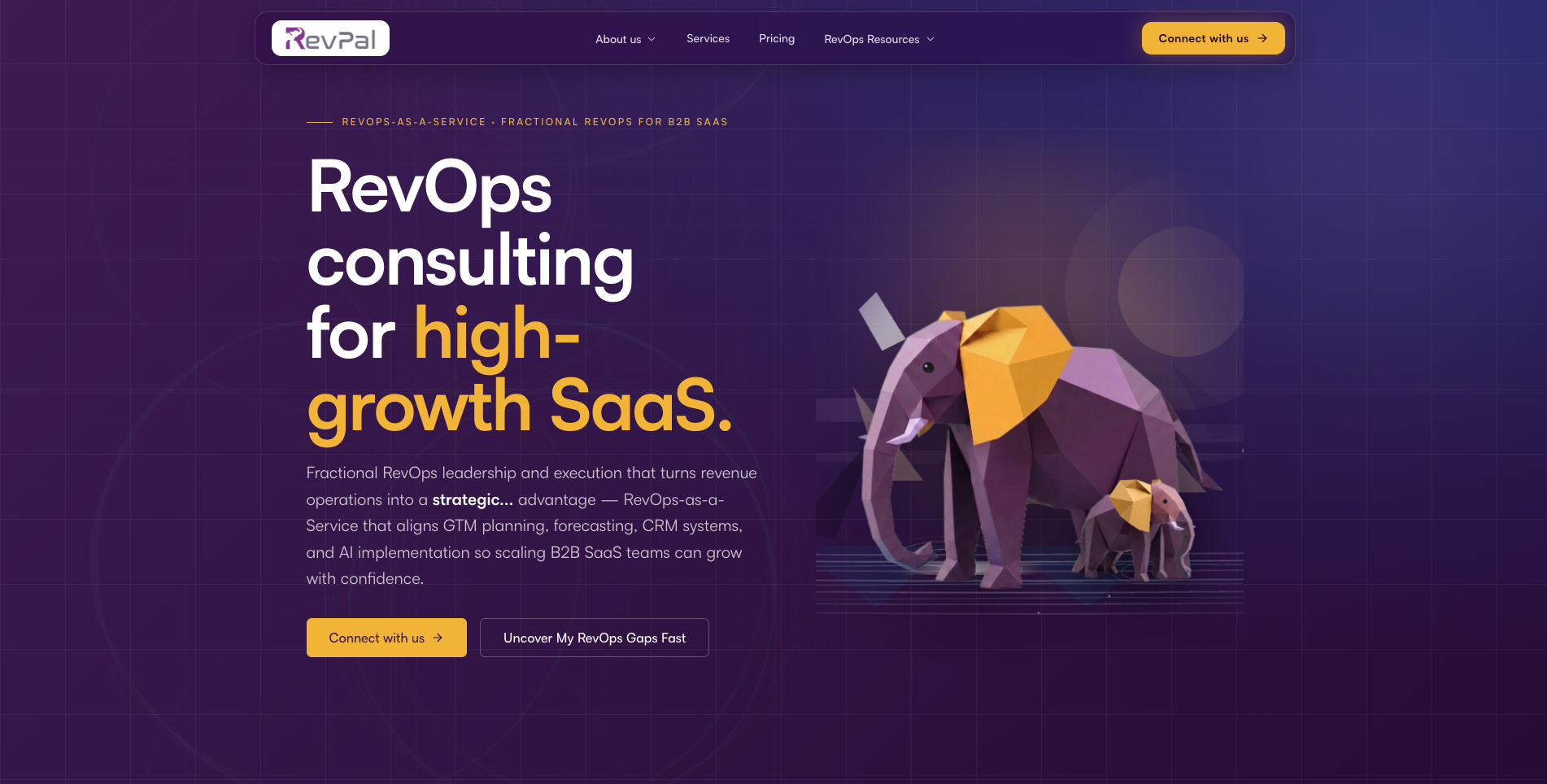
Best for: High-growth B2B SaaS dealing with CRM debt, forecasting gaps, and a GTM motion that has outgrown its current systems
RevPal is a RevOps-as-a-Service firm built specifically for B2B SaaS companies that need fractional RevOps leadership combined with hands-on execution. Their engagement model runs as an ongoing operational partnership, assessment, strategy, implementation, adoption, and continuous optimisation, rather than a project with a defined endpoint. This makes them a strong fit for companies that need RevOps as a continuous function, not a one-time infrastructure build.
Their work spans the full revenue operations stack: CRM architecture, forecasting infrastructure, attribution modelling, AI workflow implementation, and GTM systems design. They work across both HubSpot and Salesforce, which is the relevant capability for SaaS companies managing complexity between multiple CRM environments or planning a migration.
RevPal's primary differentiation is the fractional leadership model: a senior RevOps director embedded in the client's operation rather than a project team delivering to a scope. For high-growth SaaS companies where the RevOps function needs to exist and scale before the headcount to run it permanently is in place, this model provides senior strategic ownership without the cost of a full-time hire.
Key services
Fractional RevOps leadership (director-level, embedded)
CRM architecture design and technical debt remediation (HubSpot and Salesforce)
Full-funnel attribution and revenue reporting
Forecasting infrastructure and pipeline visibility
AI workflow development for sales, marketing, and CS operations
GTM systems design for scaling revenue teams
Why RevPal stands out
Fractional director-level RevOps leadership embedded in the client operation, not a project team working at arm's length
CRM-agnostic: works across both HubSpot and Salesforce, including complex migrations between them
AI workflow implementation as a standard service, not an add-on, automated enrichment, lead scoring, and routing built in
Ongoing operational partnership model designed for companies that need RevOps as a continuous function
Best fit: High-growth B2B SaaS teams at Series A and above that need senior RevOps ownership without the cost or timeline of a full-time hire, particularly where CRM debt, broken forecasting, or a GTM motion that has outgrown its current systems are the primary constraints.
5. Six & Flow

Best for: B2B SaaS companies building or completely rebuilding their revenue infrastructure on HubSpot
Six & Flow is a HubSpot Elite Partner agency specialising in RevOps implementation and marketing operations for B2B companies. Their work covers the full HubSpot ecosystem: CRM architecture, marketing automation, sales pipeline configuration, revenue reporting, and integrations with the tools surrounding HubSpot in a standard B2B SaaS stack. For companies that have decided HubSpot is the centre of their revenue infrastructure, Six & Flow's depth in that specific ecosystem is their primary differentiator.
They work with B2B SaaS companies across growth stage through to mid-market, with particular strength in organisations that are either implementing HubSpot for the first time or rebuilding a messy existing HubSpot environment that has accumulated technical debt through years of ad hoc configuration. Their RevOps focus means the engagement does not stop at tool configuration, it includes the process design, handoff logic, and attribution framework that make the configuration meaningful.
Key services
HubSpot CRM architecture and implementation
Marketing automation design and configuration
Sales pipeline and deal stage configuration
Revenue reporting and attribution within the HubSpot ecosystem
CRM integration with surrounding GTM stack tools
HubSpot environment audits and technical debt remediation
Why Six & Flow stands out
HubSpot Elite Partner status: highest tier of HubSpot partnership with documented implementation excellence
RevOps-first approach: configuration is designed around process logic, not just feature enablement
Strong fit for B2B SaaS companies at growth stage that want their HubSpot environment to function as a revenue infrastructure, not a CRM database
Documented RevOps outcomes across B2B SaaS clients building pipeline reporting and marketing attribution
Best fit: B2B SaaS teams committed to HubSpot as their primary revenue infrastructure that need their CRM built or rebuilt with RevOps process logic embedded from the start, not retrofitted after launch.
6. New Breed

Best for: B2B SaaS companies that want demand generation and RevOps built together on HubSpot rather than as separate programmes
New Breed is a full-funnel RevOps and demand generation agency operating on the HubSpot ecosystem. Their model is designed around the principle that RevOps implementation produces better outcomes when it is built alongside the demand generation programme it is designed to measure, rather than configured first and connected to marketing activity later. This integration is the relevant differentiator: most RevOps agencies configure the CRM and hand off to a separate marketing team, leaving the attribution gap the client came in with.
Their work spans inbound marketing, paid acquisition, content strategy, SEO, and full RevOps implementation, all within HubSpot. For B2B SaaS companies that want a single partner connecting the top of the funnel to the revenue operations layer, New Breed's integrated model reduces the coordination overhead that typically produces attribution gaps between marketing and RevOps.
Key services
HubSpot RevOps implementation and architecture
Inbound marketing strategy and execution
Paid acquisition and SEO
Content strategy connected to pipeline metrics
Attribution modelling linking demand generation to closed revenue
Sales enablement and pipeline optimisation
Why New Breed stands out
Demand generation and RevOps built in the same engagement, eliminating the attribution gap that separate programmes create
HubSpot expertise across marketing hub, sales hub, and operations hub as one connected system
Full-funnel scope from first campaign click through to closed revenue, measured against the same attribution model
Documented results connecting demand generation programme changes to pipeline velocity improvements
Best fit: B2B SaaS companies that want demand generation and revenue operations built as one programme rather than two separate engagements that produce dashboards which disagree about where pipeline came from.
7. RevPartners

Best for: Series A–B B2B SaaS needing rapid, well-documented HubSpot RevOps architecture delivered within a defined timeline
RevPartners is a HubSpot-native RevOps agency that specialises in building revenue operations architecture for Series A and B SaaS companies. Their model is designed for speed: documented HubSpot RevOps frameworks deployed within defined timelines, with every configuration decision documented so the internal team can maintain and extend the system after handover. This documentation-first approach addresses one of the most common RevOps engagement failures, the system works while the agency is present and breaks when the relationship ends because no one on the internal team knows why it was built the way it was.
Their work covers the full HubSpot RevOps buildout: lead routing and scoring, deal pipeline configuration, forecast models, marketing attribution, and the workflow automation that keeps data clean without manual intervention. They are a HubSpot Diamond Partner with documented implementation work across B2B SaaS categories.
Key services
HubSpot RevOps architecture and rapid deployment
Lead scoring, routing, and qualification framework design
Deal pipeline configuration and forecast modelling
Marketing attribution and closed-loop reporting
Workflow automation for CRM data hygiene
Full RevOps documentation for internal team handover
Why RevPartners stands out
Documentation-first model: every configuration decision is documented so the internal team can operate the system without the agency
Rapid deployment framework: HubSpot RevOps buildout within defined timelines, not open-ended discovery phases
HubSpot Diamond Partner with specific SaaS RevOps implementation experience
Strong fit for Series A and B companies that need a functional RevOps infrastructure in place before their next funding round
Best fit: Series A–B B2B SaaS that need a functional, documented HubSpot RevOps architecture delivered quickly, particularly where a funding round, a new CRO hire, or a board reporting requirement is creating a specific deadline for the infrastructure to be in place.
8. OpFocus

Best for: B2B SaaS with complex Salesforce environments needing technical RevOps implementation, CPQ, advanced flows, multi-object data models, and pipeline architecture that internal teams cannot build at speed
OpFocus is a Salesforce-specialist RevOps consultancy built for B2B companies whose primary operational constraint is technical: Salesforce is not configured to reflect how the business actually operates. They work with SaaS companies where the RevOps problem is not a process design question or a methodology gap — it is a Salesforce architecture problem. Multi-product catalogues requiring CPQ, complex deal structures with non-standard revenue recognition, pipeline and forecasting automation that has broken at scale, and cross-platform integrations that internal admins cannot maintain — these are the problems OpFocus is built around.
Their technical scope distinguishes them from RevOps consultancies that work primarily in process and methodology. OpFocus goes into the Salesforce instance and rebuilds the architecture so the revenue logic the business needs is enforced by the system rather than by manual workarounds. For B2B SaaS companies that have outgrown a Salesforce environment configured early and never properly redesigned, OpFocus provides the technical depth to rebuild it correctly.
They are a Salesforce Summit Partner, the highest tier of Salesforce partnership, with documented implementation experience across SaaS companies at growth stage through to enterprise. Their scope is deliberately narrow: they are a Salesforce specialist, not a full-stack RevOps consultancy, which makes them a strong fit for companies that need Salesforce fixed and have internal or other agency support for the surrounding process and reporting work.
Key services
Salesforce architecture design and advanced CRM configuration
CPQ (Configure, Price, Quote) implementation and optimisation
Multi-object data model design for complex SaaS revenue structures
Advanced Salesforce Flow automation and pipeline logic
Cross-platform integration architecture (Salesforce and surrounding GTM stack)
Forecasting and pipeline visibility built on a structurally sound Salesforce foundation
Why OpFocus stands out
Salesforce Summit Partner: highest tier of partnership, with verified enterprise-grade implementation capability
Technical specialisation in the specific problems that break Salesforce at scale: CPQ, multi-product pipelines, and advanced automation logic
Right fit for SaaS companies where the RevOps constraint is a Salesforce architecture problem, not a process or methodology problem
Deliberately narrow scope means genuine depth rather than broad claims: OpFocus solves the Salesforce technical layer, not the full RevOps stack
Best fit: B2B SaaS companies at Series B and above where the primary RevOps constraint is a technically broken or under-configured Salesforce environment, particularly where CPQ, complex deal structures, or pipeline automation have failed at scale and internal teams lack the architecture depth to rebuild them.
9. Iceberg RevOps

Best for: Series A SaaS teams without a dedicated RevOps hire that need senior fractional leadership to build the function from scratch
Iceberg RevOps is a fractional RevOps agency built for early-stage and Series A B2B SaaS companies that do not yet have a dedicated RevOps hire. Their model provides senior fractional RevOps leadership embedded in the client's operation, attending internal meetings, owning the function's output, and building the infrastructure that a first full-time RevOps hire would eventually take over. This is distinct from a project-based consultancy: Iceberg operates as the RevOps function, not as an external team delivering a defined scope.
Their work spans the initial RevOps buildout: CRM selection and configuration, lead routing and scoring, pipeline definition, handoff logic between marketing and sales, and the foundational reporting infrastructure that makes a growing revenue team manageable. For SaaS companies at Series A where the RevOps function does not yet exist and the founder or sales leader is still running operations manually, Iceberg provides the senior expertise to build it correctly without the cost or timeline of a full-time hire.
Key services
Fractional RevOps leadership (embedded, function ownership model)
CRM selection, setup, and foundational configuration
Lead routing, qualification framework, and handoff logic design
Pipeline stage definition and forecast model
Foundational revenue reporting and attribution
RevOps documentation and internal team onboarding
Why Iceberg RevOps stands out
Function ownership model: operates as the RevOps function rather than a project team, providing continuity rather than a handover
Built specifically for the Series A stage where RevOps does not yet exist and needs to be built without the luxury of a large internal team
Senior fractional leadership means the person building the function has seen it built before, at the same stage, in the same context
Designed for eventual internal handover: the system and documentation are built to transfer to a first full-time RevOps hire
Best fit: Series A B2B SaaS companies without a dedicated RevOps hire, where the founder, CRO, or sales leader is currently owning operations manually and needs senior fractional RevOps leadership to build the function correctly before the next scaling phase.
10. Think RevOps

Best for: Pre-Series A and early Series A B2B SaaS building their first revenue operations function on a limited budget
Think RevOps is a RevOps consultancy focused on process design and CRM alignment for early-stage B2B revenue teams. Their work is designed for companies at the earliest stage of RevOps maturity: teams that do not yet have formal lead routing, pipeline stages that are defined differently by each sales rep, and marketing attribution that consists of asking the sales rep where the lead came from. For these teams, the value of a RevOps engagement is not a sophisticated data architecture, it is a set of documented processes that the team agrees to and can execute consistently, configured into a CRM that enforces them.
Think RevOps designs those processes and configures the CRM to enforce them, with particular focus on the handoff between marketing and sales and the pipeline definition that makes forecasting possible. Their model is practical and accessible for early-stage budgets: the output is a functional first version of a RevOps infrastructure that can be extended as the company scales.
Key services
Lead routing and qualification process design
Pipeline stage definition and CRM configuration
Marketing-to-sales handoff logic
Basic attribution and revenue reporting
RevOps documentation for early-stage revenue teams
Why Think RevOps stands out
Built specifically for the earliest stage of RevOps maturity, where the primary need is process clarity rather than technical sophistication
Practical, accessible model for pre-Series A and early Series A budgets
Process documentation is designed to be extended rather than replaced as the company grows
Strong fit for founders and first sales leaders who know RevOps is needed but do not yet have the internal expertise to know where to start
Best fit: Pre-Series A and early Series A B2B SaaS companies that do not yet have any formal revenue operations function and need a practical first version of lead routing, pipeline definition, and marketing-sales handoff logic without the cost of a full RevOps agency engagement.
Why dimartec Approaches Revenue Operations Differently
Every agency on this list solves a layer of the RevOps problem. Winning by Design designs the organisational framework. Go Nimbly provides specialist execution capacity for complex Salesforce environments. RevPal embeds fractional RevOps leadership. Six & Flow, New Breed, and RevPartners build HubSpot infrastructure at different stages and complexity levels. Cerebria Tech remediates Salesforce technical debt. Iceberg RevOps and Think RevOps build first-version functions for early-stage teams.
The constraint each of them shares is scope. RevOps configured in isolation from the marketing channels feeding the CRM produces a technically correct system that cannot answer the question the board is actually asking: which of our marketing spend produced the pipeline that closed? The attribution gap is not a CRM configuration problem. It is a design problem that only exists if RevOps and the marketing programmes it measures are built by different teams with different definitions of success.
At dimartec, RevOps & Automation is one of four pillars built together. The attribution model is designed against the same campaigns generating the traffic. The lead scoring logic is calibrated to the same conversion data the CRO programme is improving. The forecast is produced by a system designed from the first session to measure the same outcomes the board needs to see, not assembled from dashboards that were never intended to agree.
If your RevOps infrastructure is technically sound but your revenue forecast is still unreliable, the problem is almost certainly not the CRM. It is the layer connecting the CRM to the channels that feed it.
How to Choose the Right RevOps Agency
Diagnose which RevOps layer is actually broken
The right agency for a company with a Salesforce technical debt problem is not the right agency for a company with an organisational alignment problem, even though both describe their situation as "broken RevOps." Before evaluating any agency, identify which layer is the constraint: data quality and CRM architecture, process design and handoff logic, attribution and reporting, or organisational alignment between revenue functions. Match the agency type to the specific layer rather than to the quality of the proposal.
Test attribution capability before CRM expertise
CRM configuration is a commodity. Attribution modelling, connecting marketing spend to pipeline to closed revenue with enough accuracy for the board to trust the forecast, is not. In every agency evaluation, ask to see an example attribution report from a current client. It should show, at a minimum, which channels influenced which pipeline opportunities, the conversion rate at each stage, and the closed-won revenue attributed to each programme. If the agency cannot produce this, the engagement will not produce it either.
Clarify the knowledge transfer model before signing
The most common RevOps agency failure is dependency: the system runs while the agency is present and degrades when the retainer ends because no one on the internal team understands how it was built. Before any engagement, ask explicitly what the internal team will be able to do independently at the end of month six. Ask to see examples of documentation produced for previous clients. Ask what happens when the internal team needs to change the lead routing logic without calling the agency. The answers to these questions reveal more about the engagement model than any proposal document.
Match the agency's CRM depth to your stack
A HubSpot-specialist agency is not the right fit for a company running Salesforce, regardless of how strong their RevOps methodology is. An agency that works across both platforms with equal depth is rarer than their marketing suggests, ask for named client examples on your specific CRM before assuming the depth transfers.
Frequently Asked Questions
What does a revenue operations agency actually do?
A RevOps agency aligns marketing, sales, and customer success around shared data, shared processes, and shared accountability for revenue outcomes. In practice this means building attribution infrastructure, configuring CRM systems to enforce agreed process logic, designing lead scoring and routing, building forecast models, and creating reporting that connects marketing activity to closed revenue. The best ones also transfer the knowledge and documentation needed for the internal team to operate the system independently.
What is the difference between a RevOps agency and a CRM consultant?
A CRM consultant configures the tool. A RevOps agency designs the logic the tool enforces: how leads are scored and routed, how pipeline is defined and measured, how marketing spend is attributed to closed revenue, and how marketing and sales report against the same number. Some agencies do both. Many describe themselves as RevOps agencies while delivering CRM configuration services. The test is whether they can show you an attribution report connecting marketing spend to closed-won pipeline.
When should a B2B SaaS company hire a RevOps agency?
The clearest signal is a forecast that marketing and sales consistently disagree about. If marketing reports a healthy pipeline and sales misses the number every quarter, the problem is almost certainly attribution and qualification logic rather than deal execution. Other signals include: CRM records that are incomplete or inconsistent, lead scoring that does not predict which leads close, and dashboards across GA4, the CRM, and ad platforms that report different numbers for the same period.
How long does a RevOps engagement take to produce results?
Initial process changes and CRM configuration can produce visible improvements in lead routing accuracy and data quality within four to six weeks. Attribution infrastructure that produces a reliable pipeline forecast typically requires a full quarter of data to validate. Organisational changes, getting marketing and sales to measure the same thing consistently, take longer and depend on leadership alignment as much as system configuration.
Build a Revenue Function Where Every Layer Agrees
If your marketing dashboard and your sales forecast are telling different stories about the same quarter, the problem is not a reporting problem. It is a systems problem: the attribution layer connecting marketing spend to the pipeline the sales team is working was never built as one connected design. The Revenue Engine connects Performance Paid Media, CRO, AI Optimization (GEO), and RevOps & Automation into one build so the forecast is defensible because every layer reads from the same system.
See how the Revenue Engine works: https://www.dimartec.co.uk/services/revenue-engine












.png)







.png)

















































.png)
.png)
.png)
.png)
.png)
.png)
.png)
.png)
.png)
.png)