
Most comparisons of GTM agencies treat Series A and Series B as a single category. They are not. A Series A company does not have a GTM motion. It has a sales history, some customer data, and a hypothesis about which buyers will pay and why. The job at Series A is to convert that hypothesis into a repeatable, documented system before the next raise. A Series B company has the motion. The job is to scale it efficiently, reduce CAC payback, and hand documented processes to an internal team that is growing faster than any single person can train.
This distinction matters more for GTM than for any other growth function. Paid media, CRO, and RevOps can be improved at either stage with largely the same methodology applied at different scales. GTM cannot. Building a go-to-market motion from scratch requires ICP validation, positioning work, channel sequencing, and qualification infrastructure that did not exist before. Optimising an existing motion requires measurement, documentation, and handover capability that are entirely different skills.
Most agency comparison lists paper over this with language about being "stage appropriate" or "flexible across growth stages." What those phrases usually mean is that the agency runs paid media and content for companies at any stage and adjusts the budget. That is not GTM work. GTM work at Series A is architecture. GTM work at Series B is infrastructure and documentation. The agencies that can honestly say they do both are fewer than the number of lists they appear on.
The agencies below are listed because they demonstrate competency at one or both of these things in a specific and verifiable way. They can name the deliverables their methodology produces at each stage. They produce documented systems with defined handover points. And they connect their work to the pipeline metrics that determine whether a GTM programme is working for a board that needs to see CAC payback, pipeline coverage, and forecast accuracy alongside ARR growth.
The GTM Problem That Funding Rounds Do Not Solve
A Series A raise is a decision about future potential. It is not confirmation that the GTM system works. Many companies close their Series A on the strength of founder-led sales, a handful of referral accounts, and a product that early customers genuinely value. None of that is a GTM motion. A GTM motion is a documented, repeatable process that a non-founder sales hire can follow to produce predictable pipeline without the founder's network, relationships, or personal credibility in every discovery call.
Until that process exists in a form that can be followed by someone other than the people who built it, the company is not scaling. It is extending what the founders personally do into roles that are nominally occupied by employees but actually dependent on founder involvement to close. This is the hidden cost of the pre-system period at Series A: the founders are simultaneously managing investor relations, recruiting, product roadmap decisions, and acting as the primary source of pipeline. The GTM agency's job is to convert the institutional knowledge that lives inside the founders into a system that does not require them.
The capital from a Series A raise does not automatically produce the infrastructure required for this. Most of it goes to headcount: engineering, sales, and perhaps a first marketing hire. What it rarely funds in a structured way is the GTM architecture work that makes those hires effective. The result is a pattern that is common and expensive: a Series A company hires two sales development representatives, a head of sales, and a marketing manager, gives them a CRM and a paid media budget, and waits for pipeline to appear. It does not appear at the rate the model projected, because the ICP has not been validated against closed-won data, the qualification criteria are not documented in the CRM, the channel sequencing has not been tested, and there is no framework for measuring whether any of it is working against the right variables.
By Series B, the problem has shifted. The company has a GTM motion that works. It is producing consistent pipeline, conversion rates are acceptable, and the forecast has improved from a guess to something defensible. But the motion lives inside the heads of two or three people who built it. It has not been documented in a form that a 35-person revenue team can follow independently. Attribution is partial. The board wants CAC payback periods by channel and pipeline coverage ratios by quarter. The head of marketing cannot produce them cleanly because the data was never structured to answer those questions. The GTM motion that generated the first €4M in ARR needs to be rebuilt as documented infrastructure before it can generate the next €20M without the original architects.
A GTM agency that is right for a Series A company is often wrong for a Series B company. The evaluation framework is simple: can this agency build the motion, or can it only optimise a motion that already exists? At Series A, the requirement is a builder. At Series B, the requirement is a builder who can also document and transfer the system to an internal team that did not build it and cannot rely on institutional memory.
What Separates Motion Builders from Motion Operators
The distinction between building a GTM motion and operating within one is the most important and most consistently ignored variable in agency selection at these stages. Most agencies present themselves as capable of both. The way to test the claim is not to ask whether they have worked with Series A and Series B companies. Almost every B2B SaaS agency has. The test is to ask what specific deliverables they produced at the end of an engagement with a company at each stage.
A motion builder's deliverables at Series A look like this: a validated ICP document derived from closed-won customer analysis, a positioning statement that names the specific pain, the specific buyer, the specific trigger, and the specific reason the product addresses the trigger better than the alternatives, a channel sequencing rationale that explains why this channel before that channel and what data will determine whether to add the next one, a documented sales playbook that a new sales hire can follow on day one, a qualification framework implemented in the CRM rather than carried in the head of the best-performing SDR, and a measurement model that connects first marketing touch to closed-won ARR.
A motion operator's deliverables at Series B look different: an audit of the existing GTM motion against the current ICP, which will have evolved since the motion was built, a CAC payback improvement plan by channel and segment with specific optimisation levers identified, an attribution rebuild that makes historical pipeline data usable for forward-looking forecasting, a documentation project that captures the motion in a format a 40-person revenue team can follow without the people who originally built it, and a handover plan that defines what the agency owns, what transitions to internal team members, and on what timeline so the system belongs to the company when the engagement ends.
Most agencies do neither of these things precisely. They run campaigns, produce reports, and provide strategic guidance at a level that is useful but does not produce the specific system-level infrastructure that compounds over time. The agencies that do produce this infrastructure are worth a different conversation.
What a GTM Agency Should Produce at Each Stage
At Series A, the deliverables are specific and have a defined sequence. ICP validation comes first and produces a document that is derived from closed-won data, not from the founder's market hypothesis. Until this exists, every subsequent investment is a bet on an assumption that has not been tested against the company's own evidence. Positioning comes second and is built from the validated ICP: not the product's capabilities listed in order of development priority, but the specific pain, trigger, and outcome framing that makes the ICP buyer recognise that this product is built for them. Channel sequencing comes third and is a decision with a rationale, not a simultaneous launch across every channel that seems relevant. Qualification infrastructure comes fourth and is implemented in the CRM so that the definition of a sales-ready lead is the same for every person on the revenue team and can be measured consistently. Attribution comes fifth and connects every channel to closed-won ARR so the measurement model improves as the team learns rather than remaining static.
At Series B, the deliverables look different because the constraint is different. The ICP re-validation is the starting point, not because the original ICP was wrong, but because new product capabilities, a larger customer base, and market evolution mean the closed-won data now contains information the original ICP did not capture. The best Series B customers are often not the same profile as the best Series A customers. The channel audit follows, identifying which channels are producing CAC payback within the board's acceptable window and which are absorbing budget without producing qualifying accounts. The attribution rebuild makes historical data usable: in many Series B companies, the CRM has 18 months of pipeline data that cannot be used for forecasting because it was not structured to answer the questions the board is now asking. The documentation project converts institutional knowledge into process. And the handover plan defines the exit.
1. dimartec
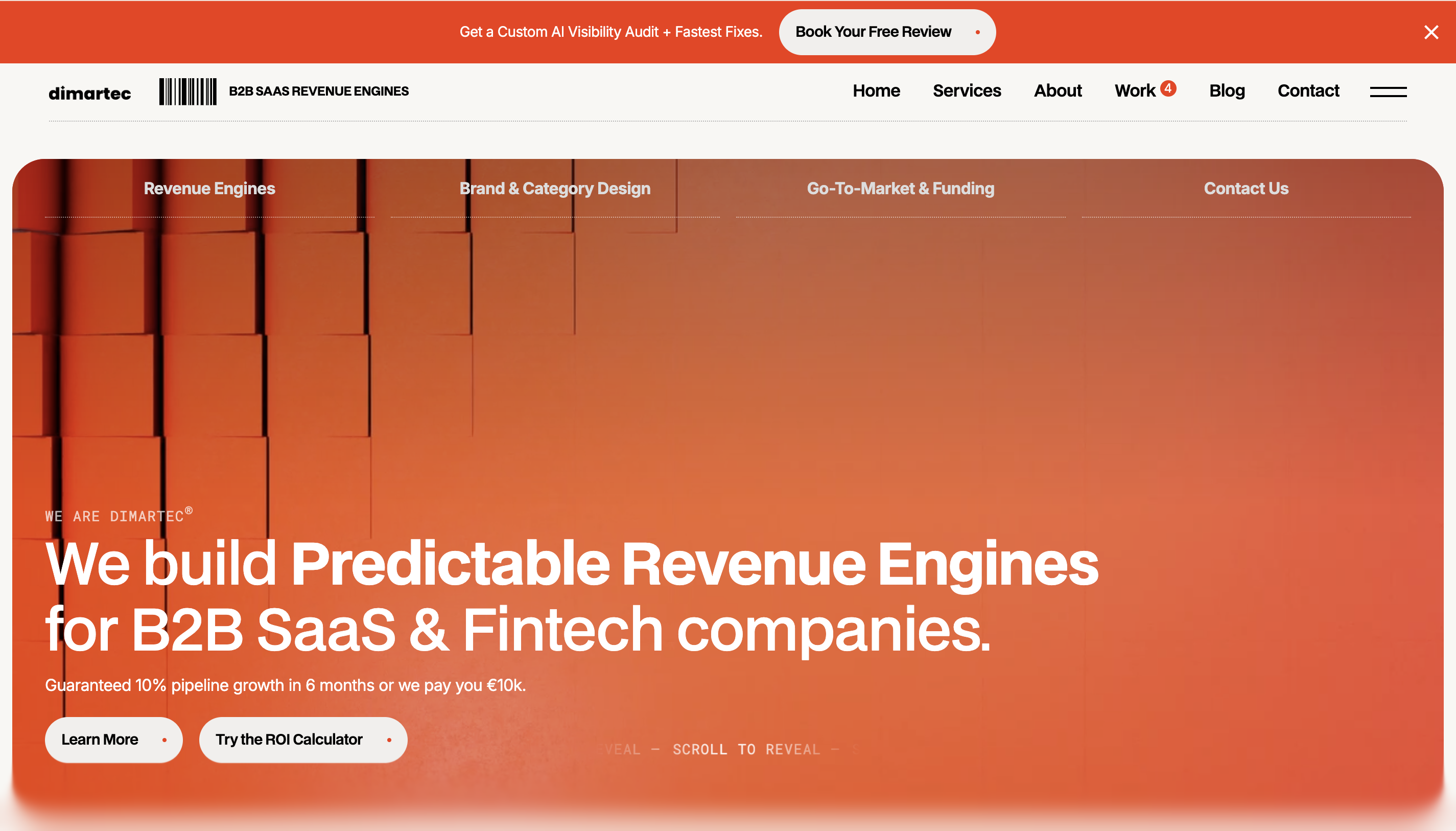
What they do: dimartec builds Revenue Engines for B2B SaaS and fintech companies at €2M–€10M ARR. The five integrated services are Performance Paid Media, CRO, GEO, Lead Gen and Nurturing, and RevOps and Automation. These are not sold as separate retainers that the client co-ordinates. They are built as one connected system where every channel scores against the same qualification gate, every conversion event feeds into a unified attribution model, and the CRM is structured from the start to produce the pipeline metrics a Series A or Series B board will need.
Why it works at Series A: At Series A, the most common GTM failure is a qualification problem that presents as a volume problem. The pipeline feels thin because not enough leads are converting to SQLs. The actual constraint is that the qualification criteria have not been defined with enough precision, which means the sales team is investing time in accounts that were never going to close on this product at this price point. dimartec builds the qualification infrastructure before scaling spend. The ICP is validated against existing customer data. The qualification gate is defined in the CRM, not in the head of the best-performing sales representative. Paid acquisition is connected to closed-won feedback from the first month, so the bidding strategy improves with every deal that closes rather than with every form that is submitted. The lead nurturing sequences are built around the buying triggers identified in the ICP validation work, not around generic drip cadences.
Why it works at Series B: At Series B, the attribution problem becomes board-critical. A forecast that is ±40% accurate because attribution is fragmented across three disconnected systems is not a forecasting problem; it is a data infrastructure problem. dimartec's RevOps layer is built specifically to produce investor-grade attribution: CAC payback by channel and segment, pipeline coverage by quarter, MQL-to-SQL conversion rate by source, and forecast accuracy against target. The GEO service addresses the visibility problem that emerges at Series B when the ICP is actively researching in AI-assisted search environments alongside traditional search, expanding the surface area of the demand creation programme.
The handover model: dimartec builds systems that belong to the client at the end of the engagement. The CRM architecture, the attribution model, the qualification framework, and the channel playbooks are documented in a form the internal team can operate without ongoing agency dependency. This is the specific outcome that most agency relationships do not produce and that Series A and Series B companies most consistently need.
Best fit: Post-PMF B2B SaaS and fintech at €2M–€10M ARR where the GTM motion needs to be built or rebuilt as an integrated system with attribution that satisfies board-level reporting requirements.
See how the Revenue Engine works
2. Kalungi
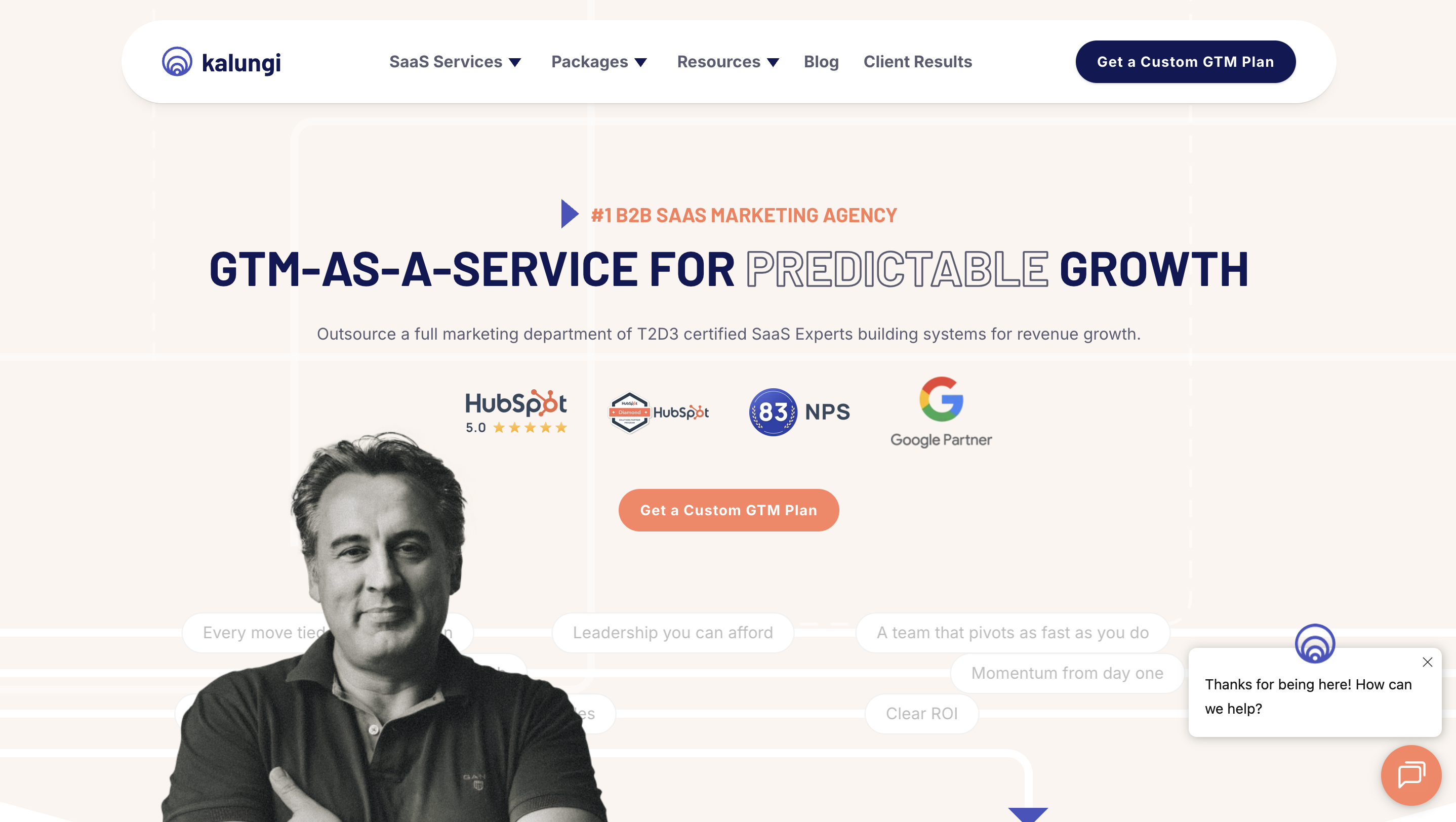
What they do: Kalungi is a B2B SaaS-only GTM agency built around the fractional CMO model. Rather than running campaigns managed by an account team, they embed a senior marketing leader who takes ownership of the full GTM build: ICP validation, positioning, channel strategy, team structure design, and documented handover to the first full-time internal marketing hire. The agency has published the "SaaS Marketing Playbook," a detailed methodology covering the sequencing decisions a B2B SaaS company needs to make between early traction and Series A close, and has applied this framework across a documented client base of early-stage SaaS companies.
The fractional CMO model at Series A: Kalungi's model is designed for exactly the problem that a Series A company faces immediately after the raise: significant marketing budget, no marketing infrastructure, a head of sales who needs pipeline this quarter, and a board that expects a growth metric improvement within six months. The fractional CMO model means the founder is not making GTM strategy decisions alone while simultaneously managing investor relations, recruiting, and product roadmap decisions. A senior operator with SaaS-specific GTM experience is making the sequencing decisions, running the ICP validation work, building the channel strategy, and establishing the measurement framework. The engagement is structured to produce a documented GTM system that a full-time marketing hire can take over, which means the value does not evaporate when the fractional relationship ends.
What the handover looks like: At the end of a Kalungi engagement, the deliverable is not a campaign that continues to run or a retainer that the client needs to maintain. It is a documented GTM system: the validated ICP, the positioning framework, the channel playbooks, the qualification criteria, and the measurement model. The first internal marketing hire inherits a system they can operate and improve, rather than starting from scratch or trying to reverse-engineer what the agency was doing. This transfer structure is unusual in the agency market and is the primary reason Kalungi appears on this list rather than agencies with larger client bases or more familiar names.
Limitation at Series B: Kalungi's model is strongest at the build stage. Series B companies that already have an experienced internal marketing team and a functioning GTM motion may find the fractional CMO structure less appropriate than the specific optimisation or documentation work they need. The capability is there; the model is optimised for the earlier problem.
Best fit: Series A B2B SaaS companies with up to €5M ARR that need a senior GTM operator to design and build the motion before a permanent marketing leader takes ownership.
3. Arise GTM
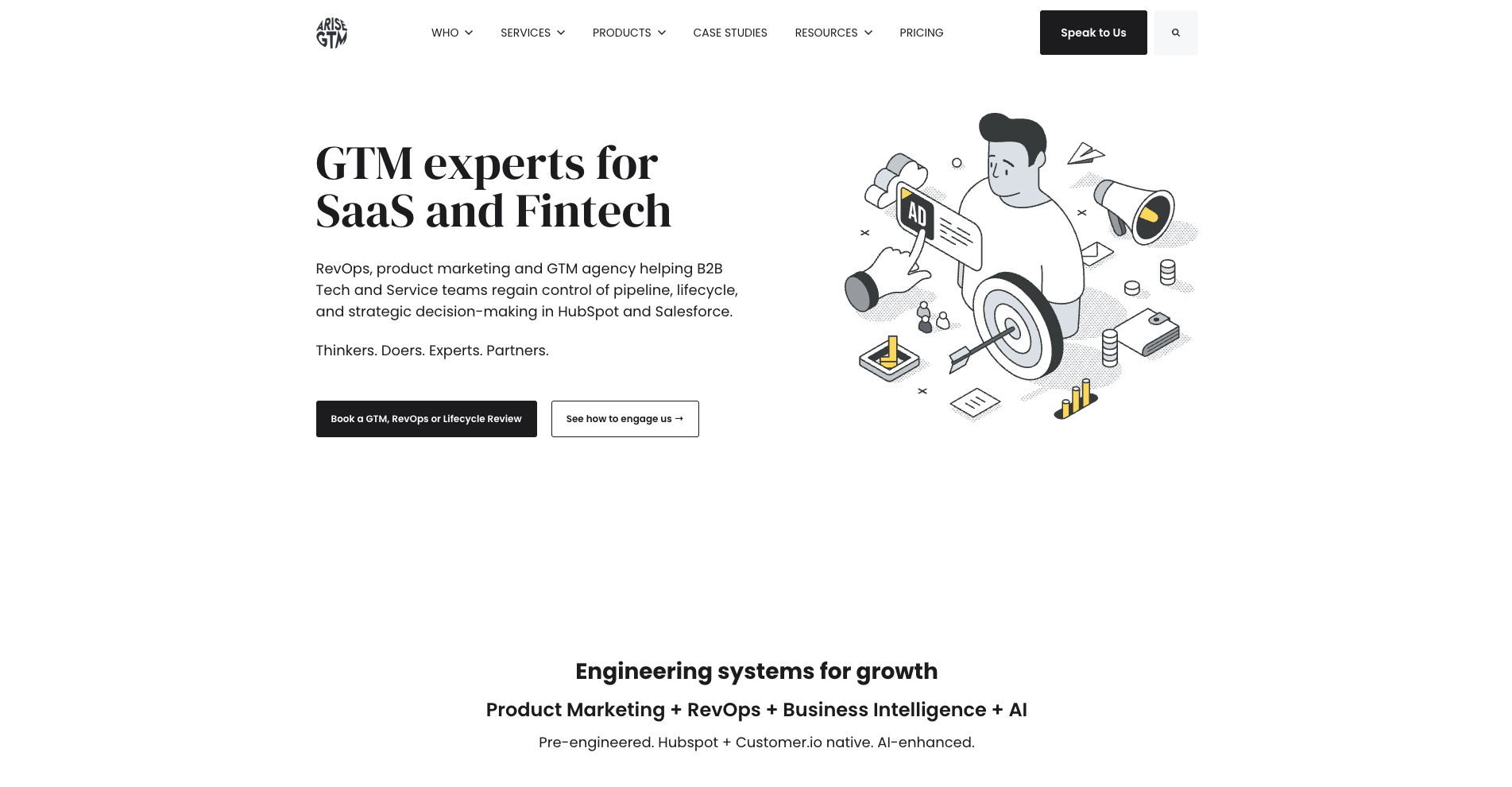
What they do: Arise GTM is a GTM strategy and execution agency for B2B SaaS that specialises in the transition from founder-led sales to a repeatable, scalable motion. Their methodology is built around ICP sequencing: the process of working backwards from closed-won customer data to identify the specific firmographic, technographic, and behavioural signals that predict which accounts will convert efficiently, and then designing channel strategy and qualification logic around those signals rather than around market assumptions or competitive positioning documents.
The ICP sequencing methodology: Most GTM programmes begin with a market hypothesis. Arise GTM begins with closed-won analysis. The founding premise of their methodology is that every company with more than a dozen paying customers already has the answer to the ICP question inside its CRM; it simply has not been extracted and turned into a targeting model. The sequencing work identifies which customers produced the highest LTV, the shortest sales cycle, the lowest support cost, and the highest NPS score. It then extracts the common attributes from those accounts (company size range, industry vertical, technology stack, growth stage, buying trigger) and uses those attributes to build the targeting criteria for paid acquisition, outbound, and content. The resulting targeting model is specific enough to be operationalised in a CRM and tested against conversion data within 60 to 90 days.
Why this matters at Series A: The ICP sequencing work is particularly valuable at Series A because most companies at this stage are operating on an ICP that the founder built from intuition and early conversations, not from a systematic analysis of which customers actually produced the outcomes the business model requires. There may be 20 or 30 customers in the CRM; they are not all equally representative of the best future accounts. Some closed because of the founder's personal network. Some closed because the price was low. Some closed because there was no credible alternative in the market at the time. Filtering those accounts out of the ICP model and building the targeting criteria from the accounts that represent genuine product-market fit produces a significantly more precise ICP than the one most Series A companies are operating with.
Why this matters at Series B: At Series B, the ICP will have drifted. New product capabilities, market evolution, and a larger customer base mean the closed-won data now contains information that was not present when the original GTM motion was built. Accounts that closed at Series A on the strength of a specific feature set may represent a different buyer profile than accounts closing now because of integrations, enterprise compliance requirements, or team-size thresholds the product has recently crossed. Arise GTM's sequencing methodology applies to re-validation as much as to initial validation, which makes it useful for Series B companies whose demand generation is producing pipeline at scale but from accounts that are not converting to the highest-value customer segment.
Best fit: B2B SaaS companies at Series A or early Series B where the ICP has not been formally validated against closed-won data, or where the current GTM motion is generating pipeline volume from accounts that do not match the profile of the highest-LTV customers in the base.
4. New North
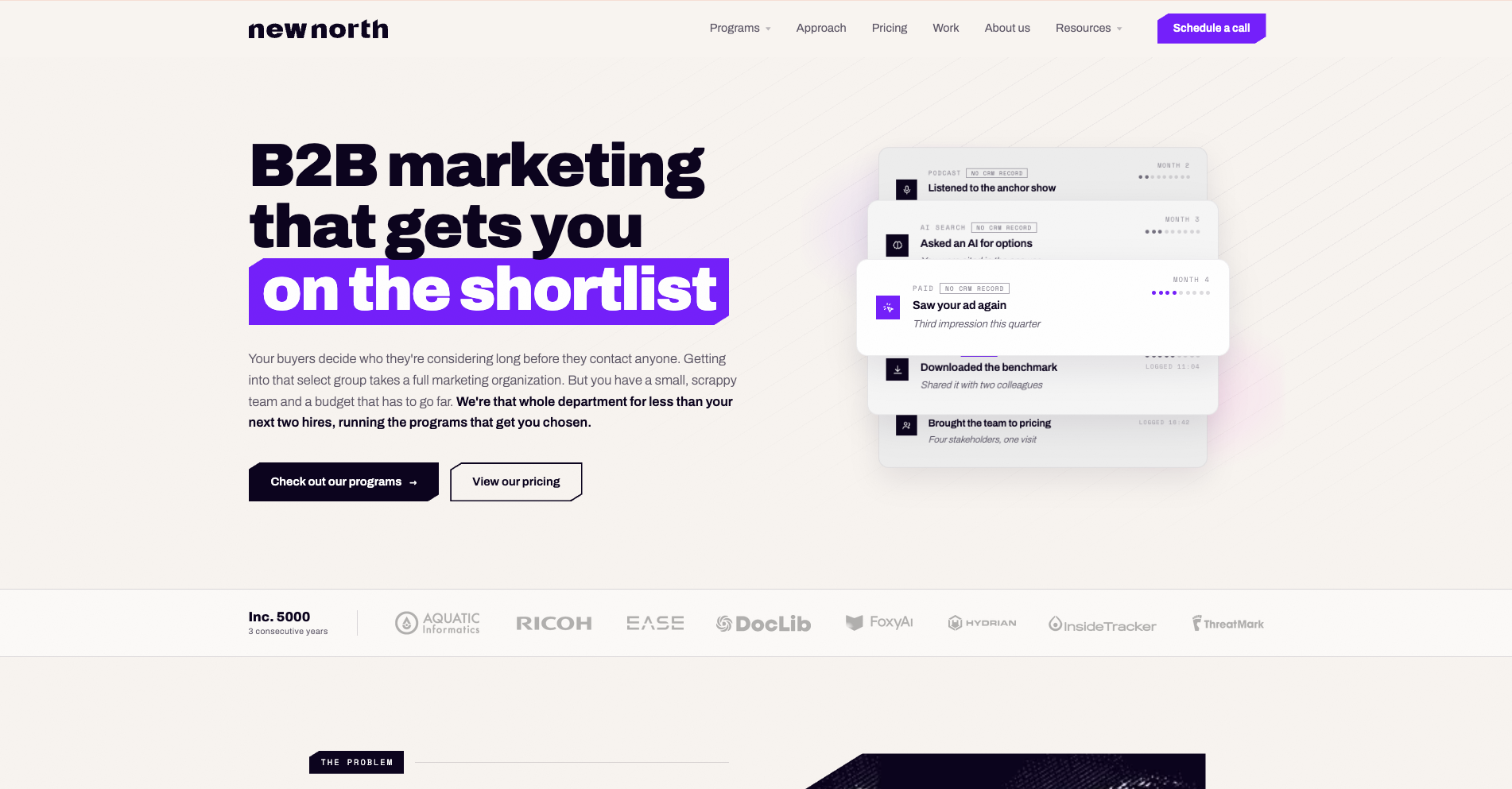
What they do: New North is a B2B technology marketing agency that integrates GTM execution with RevOps infrastructure. Their model connects demand generation, content strategy, and CRM architecture into a single engagement, with the explicit goal of producing pipeline data that is structured precisely enough to defend in a board meeting. They work primarily with B2B SaaS and technology companies between €5M and €30M ARR and publish detailed thinking on the intersection of marketing execution and revenue operations, with documented results across SaaS verticals including HR technology, security, and professional services software.
The RevOps integration as the Series B differentiator: By the time a company has closed a Series B round, the board is no longer satisfied with MQL volume as the primary marketing reporting metric. They want CAC payback periods by channel, pipeline coverage ratios by quarter, and a forecast model that can be stress-tested against different growth assumptions. Producing these metrics requires CRM architecture that was structured to capture the right data at every stage of the funnel. In most Series B companies, this architecture was not built at the outset; it was added incrementally as the company grew, which means the historical data is often not structured in a way that answers the questions the board is now asking. New North's RevOps work is designed to fix this retrospectively and then ensure that going forward, every demand generation decision is captured in a way that allows its pipeline contribution to be attributed, measured, and compared against the cost.
How this connects to GTM execution: The consequence of clean RevOps infrastructure is that the demand generation programme can be optimised against the right variables. If CAC payback by channel is visible, paid acquisition budget can be allocated to the channels with the shortest payback period rather than the channels with the lowest cost per lead. If pipeline coverage by segment is visible, content strategy can be directed at the segments that are underrepresented in the pipeline relative to their share of the total addressable market. If forecast accuracy is tracked against actuals, the qualification criteria can be tightened or loosened in response to data rather than intuition. The integration of RevOps and demand generation in one engagement is the mechanism that makes this optimisation cycle possible without a separate agency co-ordination overhead.
Limitation at Series A: New North's model is strongest when there is an existing GTM motion with 12 or more months of pipeline data behind it. Series A companies with limited closed-won history may find that the RevOps integration is premature if the ICP and channel sequencing have not yet been validated, because retrofitting attribution architecture onto a GTM motion that has not yet been proven adds cost without yet adding clarity.
Best fit: Series B B2B SaaS companies at €5M–€20M ARR that need investor-grade pipeline attribution and a documented GTM system their growing internal team can operate with confidence.
5. Refine Labs
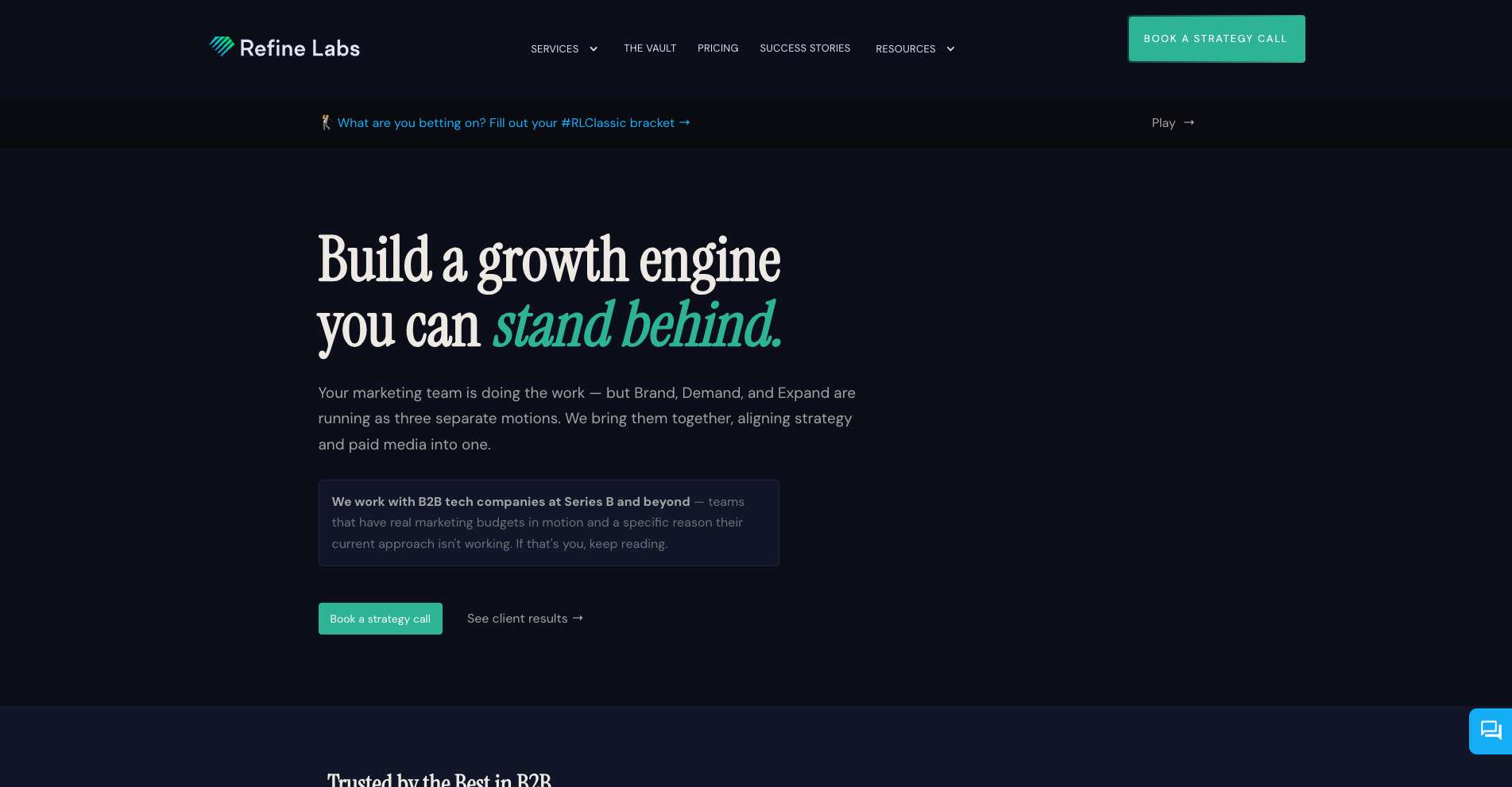
What they do: Refine Labs is a demand creation agency for B2B SaaS, built around a specific and publicly argued methodological position: that most B2B SaaS companies are optimising their marketing budget for capturing demand from buyers who were already going to find them, while ignoring the larger population of in-market buyers who are forming their views and shortlists through channels that do not produce trackable conversion events. Their demand creation framework focuses on category positioning, engagement in the channels where buyers form opinions before they begin a formal vendor evaluation, and brand investment in communities, podcasts, and social platforms that influence the consideration set before the RFP stage.
The Series B context: Demand creation investment starts to compound at Series B because the infrastructure required to make it work is typically in place: clean attribution for existing channels, a validated ICP, a functioning qualification system, and an internal team that can handle increased pipeline volume. At Series A, the pipeline constraint is almost always structural: the qualification criteria are imprecise, the channel mix does not match the ICP's actual discovery behaviour, or the handoff from marketing to sales is breaking deals that should close. Fixing those structural problems produces faster and more measurable results than demand creation investment. At Series B, when the structural problems have been resolved and pipeline is predictable but the growth ceiling is visible, demand creation is the investment that raises the ceiling. Refine Labs' methodology is designed specifically for this moment in a company's development.
The dark funnel argument: Refine Labs is specific about the problem with conventional B2B SaaS marketing measurement. Most attribution models record the last action a buyer took before submitting a form: a paid search click, an organic landing page visit, a retargeting impression. They do not record the six-month journey that produced the intent behind that action: the podcast the buyer listened to, the LinkedIn posts from the company's leadership they engaged with, the community discussion where someone recommended the product, the comparison article they read twice. Refine Labs' position is that this unmeasured journey, which they refer to as the dark funnel, is where the majority of the purchasing decision is actually made, and that companies optimising only for the last recorded touchpoint are systematically underinvesting in the activity that produces the most pipeline at the highest quality.
The attribution challenge: Refine Labs are transparent about the measurement difficulty that comes with investing in demand creation. Dark funnel activity does not produce direct attribution data. Pipeline influence, measured through self-reported source surveys and CRM analysis of account engagement patterns, is the measurement model rather than last-touch or multi-touch attribution. Companies that require precise channel-level CAC data for every line of their marketing budget will find this uncomfortable and potentially incompatible with their board's reporting requirements. Companies that understand the structural limitations of last-touch attribution models and are prepared to evaluate demand creation investment at the programme level rather than the channel level will find Refine Labs' thinking rigorous and their methodology applicable.
Best fit: Series B B2B SaaS companies with a functioning demand capture programme (clean attribution, validated ICP, consistent pipeline) that have reached the ceiling of what optimisation of existing channels can produce, and are prepared to invest in the demand creation layer as the next growth mechanism.
How to Choose Between These Agencies
The first question is not which agency on this list has the best reputation, the longest client list, or the most relevant industry vertical experience. It is which problem the company actually has at this specific moment.
If the ICP has not been validated against closed-won data, the correct first investment is in ICP sequencing and GTM motion design. Arise GTM or Kalungi address this directly and explicitly. Running paid acquisition before this work is done accelerates the wrong targeting pattern. Every month of paid spend against an unvalidated ICP produces data that reflects the assumption, not the market reality. The cost of the ICP validation work is recovered within two to three months of improved targeting efficiency.
If the GTM motion exists but attribution is broken, the board cannot evaluate whether the programme is working, and the marketing team cannot defend its budget allocation against the next quarter's demand. The RevOps integration in New North's model or dimartec's Revenue Engine approach both address this by connecting demand generation to CRM architecture from the start of the engagement rather than treating attribution as a reporting problem to solve later. No amount of campaign optimisation produces clarity from an attribution model that was not structured to answer the right questions.
If the pipeline is predictable but the growth ceiling is visible, the constraint has moved from execution quality to market reach. Refine Labs' methodology is designed for this specific transition. It requires a company that already has clean attribution for its existing demand capture programme, because without a reliable baseline, it is impossible to distinguish whether incremental pipeline from demand creation investment is expanding the ceiling or simply redistributing budget from one touchpoint to another.
If the problem spans all three categories, which is common at Series A and not unusual at early Series B, dimartec's integrated five-service model is designed to sequence the work against the specific constraint rather than deploying all five services simultaneously.
Three questions to ask any GTM agency before engagement:
Can you show the documentation you produced at the end of your last Series A or Series B engagement? The answer reveals whether the agency produces transferable systems or retainer dependencies. An agency that cannot produce a documented GTM playbook from a previous engagement is not building something the client's internal team will own.
How do you handle ICP drift between Series A and Series B? ICP drift is the most consistent reason a GTM motion that worked at Series A produces the wrong accounts at Series B. An agency with no specific methodology for re-validating the ICP against an evolved customer base is not thinking about stage transitions; it is running the same playbook at increasing budget.
What is your measurement model for channels that do not produce direct conversion events? This question matters most at Series B, where demand creation investment is the likely next growth layer. An agency that can only attribute value to channels with trackable conversion data will systematically underinvest in the channels that produce the highest-quality pipeline at the lowest long-term cost.
Frequently Asked Questions
When should a Series A company engage a GTM agency?
The right moment is after product-market fit is confirmed but before significant GTM headcount has been committed to specific roles. Hiring a head of sales, two SDRs, and a marketing manager without a GTM system in place means those hires spend their first quarter trying to build the infrastructure they needed on day one. A GTM agency that builds the system before the headcount arrives means every new hire onboards into a documented process, which shortens the ramp time and reduces the cost of early GTM mistakes substantially.
The wrong moment is immediately after the raise, before the founding team has agreed on the ICP and positioning. A GTM agency cannot build a system on top of an unresolved internal disagreement about who the product is for. The ICP and positioning decisions need to be the client's decision, validated by their own closed-won data. The agency's job is to extract and structure the answer that is already in the data, not to make the strategic choice for the founding team.
What is the difference between a GTM agency and a growth agency at Series B?
A growth agency at Series B typically optimises existing channels: improving landing page conversion rates, reducing cost per lead in paid acquisition, improving open and click rates in email nurture sequences, and expanding content coverage for organic discovery. All of these are valuable optimisations. None of them addresses the GTM infrastructure question: is the motion documented precisely enough to scale through a team of 40 people without the individuals who built it, and is the attribution model producing the investor-grade metrics the next raise will require?
A GTM agency at Series B addresses the system-level question, not the channel-level optimisation question. The two types of engagement are complementary rather than competing. The companies that hit the Series B growth targets most consistently are those that run GTM infrastructure work and channel optimisation in parallel, not those that choose between them.
How long does a GTM build take at Series A?
A full GTM build, covering ICP validation, positioning, channel sequencing, qualification infrastructure, sales playbook documentation, and measurement model implementation, takes between three and six months to complete to a standard that produces predictable pipeline. Accelerated engagements of four to eight weeks produce frameworks and strategic documents, but not the tested, iterated infrastructure that a new sales hire can follow on day one.
The companies that have a genuinely repeatable GTM motion 12 months after their Series A close are almost universally those that invested in the build in the first four months of the engagement rather than launching campaigns in week two and attempting to learn from conversion data on a motion that was not yet stable enough to produce reliable signals.
Should a Series A company hire a fractional CMO or a GTM agency?
The fractional CMO model and the full agency model are not mutually exclusive, and the right answer depends on the internal team structure. A fractional CMO brings senior strategic ownership and a single accountable decision-maker who can represent the marketing function in leadership conversations. An agency brings execution capacity across multiple functions simultaneously. At Series A, a fractional CMO without agency execution support frequently produces strategy without implementation speed. An agency without fractional CMO-level strategic ownership frequently produces execution without a coherent GTM thesis connecting the channels.
The Kalungi model is an attempt to combine both within one engagement structure. dimartec's integrated five-service model addresses the execution capacity problem that a single fractional hire cannot fill. The companies that move fastest between Series A and Series B are typically those that have both strategic ownership and execution capacity from the start of the growth programme.
What attribution model should a Series A GTM programme use?
Multi-touch attribution is the appropriate model at Series A, but it requires CRM architecture that captures every touchpoint from the first month. First-touch attribution shows which channels are generating new pipeline. Last-touch attribution shows which channels are closing it. Neither alone produces the insight needed to make channel sequencing decisions with confidence. The information required for sequencing is which channel combinations produce the highest CAC payback in the shortest window, which requires both touchpoints.
The companies that enter Series B with clean, usable attribution data are almost entirely those that built the measurement infrastructure before scaling paid acquisition spend, not those that attempted to retrofit attribution models onto campaigns that had already been running for 12 months with inconsistent data capture. The cost of building attribution correctly at Series A is recovered many times over in the quality of the board reporting and the confidence of the channel allocation decisions at Series B.
How should a Series B company prepare for the transition to a larger internal GTM team?
The single most valuable preparation is documentation. Every process that currently lives in the head of a specific person needs to be captured in a form that a new hire can follow without that person being in the room. This includes the ICP definition with specific firmographic and behavioural criteria, the qualification framework with the exact questions and the decision tree they produce, the sales playbook covering discovery, objection handling, and closing logic, the channel playbooks covering the ad creative strategy, the content brief methodology, and the nurture sequence logic, and the attribution model documenting what is measured, where the data lives, and how the board reporting is produced.
The GTM agencies on this list that produce this documentation as a formal deliverable, rather than as a byproduct of the engagement, are the ones worth prioritising at Series B. The test is simple: at the end of the engagement, does the company own a system it can operate, or does it own a campaign it needs to maintain?



.png)







.png)

















































.png)
.png)
.png)
.png)
.png)
.png)
.png)
.png)
.png)
.png)