A 1% landing page conversion rate in B2B SaaS is not a performance problem. It is a diagnosis waiting to be made. The rate is low because something in the conversion chain is broken and until the right thing is identified and fixed, every test you run is a controlled experiment on the wrong variable.
This is where most CRO programmes fail. The team sees a low number, launches a series of A/B tests on headlines and button colours, and reports incremental lifts that disappear within two reporting cycles. The rate drifts back because the tests treated the symptom. The broken thing was not the headline. It was the intent mismatch between the ad and the page, or the absence of proof where the visitor was making their decision, or the twelve-field form asking questions that benefit the company and cost the visitor, or the attribution model that could not tell anyone which page change actually produced closed revenue.
In reviewing the operational mechanics behind more than 200 B2B SaaS conversion programmes, the finding that holds across every stage and vertical is this: low conversion rates in B2B SaaS almost always have one primary cause. Finding it requires a structured diagnostic before any testing begins. The companies that run the diagnostic first and fix the highest-impact failure before launching experiments hold their conversion improvements. The ones that run experiments without diagnosing first see lifts that look real and disappear on the next quarter's report.
This guide evaluates the best CRO agencies for fixing low SaaS conversion rates specifically, the ones whose methodology starts with diagnosis, identifies the root cause, and rebuilds the broken element before running a single A/B test.
The Four Most Common Root Causes of Low SaaS Conversion Rates
Before evaluating any CRO agency, it is worth naming the four structural causes of low conversion rates in B2B SaaS. The right agency is the one whose methodology addresses whichever of these is your primary constraint.
Intent mismatch between traffic source and landing page. When the promise made in an ad or a search listing does not match what the visitor finds when they land, the page fails before anyone reads the headline. A visitor who clicked an ad promising a guide to reducing SQL costs arrives on a page demanding a demo booking: wrong promise, wrong commitment level, wrong stage of intent. No amount of headline testing on the landing page fixes a mismatch that exists before the visitor arrives.
Structural page failure. Most B2B SaaS landing pages fail at the structural level before failing at the copy or design level. The offer is unclear in the first five seconds. The page speaks to everyone and therefore speaks to no one. The proof that should make the visitor trust the claim is below three scrolls. There is no single next step, there are five. These are architectural failures. A better headline on a page with structural problems produces an architecturally-failed page with a better headline.
Form friction. Every field in a conversion form is a decision point where the visitor can leave. The consistent finding across B2B SaaS conversion data is that forms asking for information the visitor is not ready to give at this stage of their evaluation, phone number, company revenue, number of employees, produce completion rates far below forms that ask only for what is necessary to begin a conversation. The friction is not in the form design. It is in the information architecture decision about what to ask and when.
Attribution blindness. The fourth cause is specific to teams running CRO programmes rather than to individual pages: when the attribution model cannot connect a conversion event to a closed deal, the programme optimises for conversion rate rather than pipeline. This produces pages that convert at higher rates and generate more leads that sales cannot close, which looks like success until the next board meeting, and then looks like the wrong kind of CRO.
Quick Comparison
How to Diagnose Why Your Conversion Rate Is Low
Before hiring any CRO agency, the diagnostic question is not "how do we improve conversion?" It is "which of the four root causes is the primary constraint?" The answer determines which methodology and which agency is the right fit.
If traffic is arriving from multiple sources and conversion varies significantly by channel: the primary problem is likely intent mismatch. The page is not built for the intent arriving from each source. The fix is source-specific page calibration, not page-level testing.
If traffic quality is consistent but conversion is uniformly low across sources: the primary problem is likely structural page failure. The offer, target, problem, proof, and action elements are not landing within the first five seconds regardless of who arrives. The fix is structural page diagnosis before any testing.
If the page structure is sound but form completion rate is below 40%: the primary problem is form friction. The fix is a friction inventory, a line-by-line audit of every field, click, and decision point between landing and completing the conversion action, with ruthless removal of anything that does not need to be there at this stage.
If CRO work is producing page-level conversion gains that do not translate to SQL growth or pipeline: the primary problem is attribution blindness. The CRO programme is optimising for the wrong metric because it cannot see what happens to conversions downstream. The fix is RevOps infrastructure before more testing.
How to Choose These Agencies
This list was evaluated against five criteria specific to fixing low conversion rates, not to CRO in general.
Diagnostic-first methodology: Does the agency identify the root cause before designing tests, or does it launch experiments immediately?
Root-cause range: Can the agency address all four causes of low conversion, or only one or two?
B2B SaaS specificity: Is the methodology built for multi-stakeholder B2B SaaS buying journeys, or adapted from e-commerce or B2C frameworks?
Pipeline connection: Does the agency measure its work against cost per SQL and pipeline contribution, or does it stop at page-level conversion rate?
Proof: Named clients, specific conversion lifts, stated timeframes.
Where an agency addresses a specific root cause particularly well, we have noted it. Where the fit is narrower than the positioning suggests, we have said so.
The 5 Best CRO Agencies for Fixing Low SaaS Conversion Rates
1. dimartec

Best for: Post-PMF B2B SaaS and fintech at €2M–€10M ARR where low conversion is not a single-page problem but a chain of connected failures spanning intent, page structure, qualification logic, and attribution
dimartec builds Revenue Engines for B2B SaaS and fintech companies. CRO is one of four integrated pillars, alongside Performance Paid Media, AI Optimization (GEO), and RevOps & Automation and the diagnostic approach at dimartec addresses all four root causes of low conversion as one connected programme rather than four separate fixes.
The reason this matters for teams trying to fix genuinely low conversion rates, not marginal ones, is that the four root causes rarely appear in isolation. Intent mismatch is downstream of how paid campaigns are targeted. Structural page failure cannot be fixed correctly without knowing which visitor intent the page needs to serve. Form friction reduction is only sustainable when the RevOps layer attributes the conversions that result to the closed deals they produce. Attribution blindness cannot be fixed by a CRO team working on page optimisation, it requires RevOps infrastructure that the CRO programme is connected to from day one.
At dimartec, these four problems are addressed by the four pillars of the Revenue Engine simultaneously. Performance Paid Media fixes the intent mismatch at source before testing the page it points at. CRO addresses the structural page failure using a five-point diagnostics, clarity, target, problem, proof, and action, before designing any variant. RevOps & Automation connects every conversion event to closed-won data, so the programme measures itself against pipeline rather than page rate. GEO builds organic visibility in ChatGPT, Perplexity, and Claude, progressively shifting the conversion problem away from paid intent mismatch as organic discovery increases.
If any of the following describe the current situation, dimartec is worth a conversation:
Landing page conversion is consistently below 3% across paid channels, and isolated page tests have produced lifts that do not hold across reporting cycles
Conversion rates vary significantly by traffic source with no clear understanding of why, suggesting the page is not calibrated to the different intents arriving from different channels
Form completion rates are above 60% but demo-to-SQL conversion is below 30%, suggesting the page is attracting the wrong fit visitors rather than failing to convert the right ones
CRO experiments are showing page-level conversion lifts that are not reflected in SQL growth or pipeline metrics, confirming the programme is measuring the wrong outcome
Key services
Structural CRO diagnostic: five-point page audit (clarity, target, problem, proof, action) identifying the specific architectural failure before any test is designed
Intent alignment: paid media targeting and page messaging calibrated against the same ICP definition, closing the intent mismatch before testing the page
Form friction audit: full inventory of every field, click, and decision point between landing and conversion, with structured removal of friction that costs completion without adding qualification value
A/B testing and experimentation: structured testing programme designed after the diagnostic, not instead of it
RevOps & Automation: closed-loop attribution connecting every conversion event to closed-won pipeline, so the CRO programme is measured against the right metric from the start
Why dimartec stands out for fixing low conversion rates
Addresses all four root causes as one connected programme, the only agency on this list that does
Diagnostic before testing: every engagement begins with identifying the highest-impact failure, not with launching the fastest experiment
Intent alignment between paid media and landing page is built into the CRO programme, not treated as a separate paid media task
Attribution is connected from day one, so conversion improvements are measured against pipeline rather than page rate from the first reporting cycle
Best fit: Post-PMF B2B SaaS and fintech where the conversion rate has been low and stable across multiple improvement attempts, suggesting the root cause is systemic rather than page-level, and where the team cannot currently identify which of the four structural causes is the primary constraint.
2. Directive Consulting
Best for: Mid-market B2B SaaS that need CRO measured against CAC payback and closed revenue, not page conversion rate in isolation
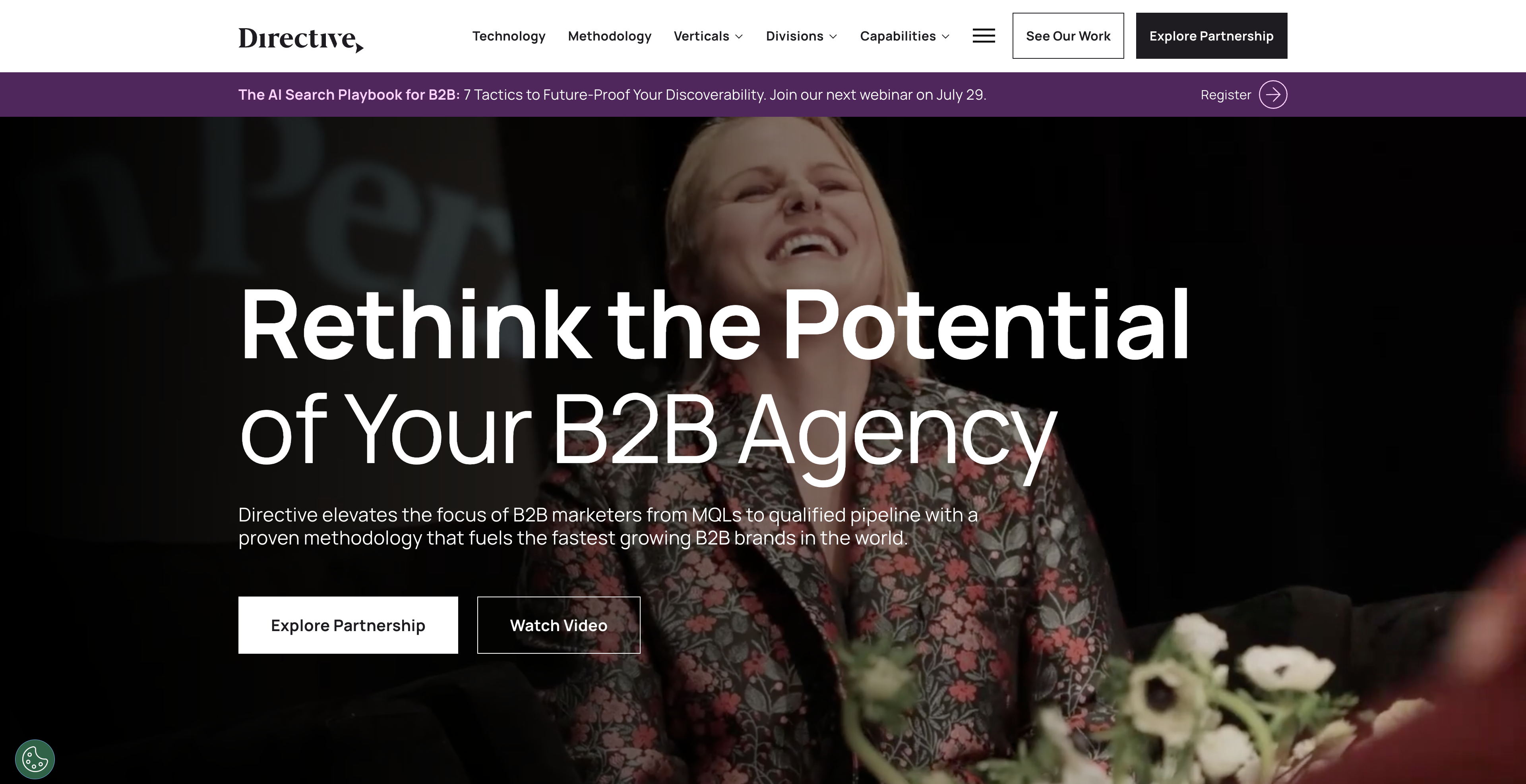
Directive Consulting is a performance marketing and CRO agency for mid-market B2B SaaS companies. Their DiscoverabilityOS methodology connects CRO work to pipeline attribution: conversion improvements are measured against cost per SQL, CAC payback, and pipeline contribution rather than page-level conversion rate. This attribution depth is the relevant differentiator for B2B SaaS companies where the conversion problem is specifically attribution blindness, where CRO programmes are producing page-level lifts that do not translate to pipeline.
Their CRO work covers the full B2B buying funnel from landing page through demo request to trial conversion, with heatmaps, session replay, on-page survey, and scroll depth analysis used to build hypotheses before testing begins. Their stated approach is diagnostic-first: identifying where buyers drop out before proposing what to change. A documented case study from Directive shows a 48.7% conversion lift and 37.6% revenue increase within 30 days for a B2B SaaS client.
Their proprietary attribution technology is built to handle the specific problem of B2B SaaS attribution complexity: companies averaging 266 touchpoints from impression to closed-won opportunity, where standard attribution models cannot identify which conversion events influenced which deals.
Key services
Full-funnel B2B SaaS CRO from landing page through trial conversion
DiscoverabilityOS attribution connecting CRO outcomes to pipeline and revenue
Heuristic-based UX analysis and conversion diagnostic
A/B testing programme designed after diagnostic completion
Pricing page and demo request flow optimisation
Why Directive stands out for fixing low conversion rates
Attribution depth connects CRO work to closed revenue, addressing attribution blindness as a first-order capability rather than a reporting afterthought
DiscoverabilityOS provides a measurable connection between page-level conversion improvements and pipeline metrics the board cares about
Diagnostic-first approach identifies the specific failure before designing tests, reducing the proportion of experiments run on the wrong variable
Named clients including Calendly, Adobe, and Cisco with documented conversion outcomes
Best fit: Mid-market B2B SaaS at Series B and beyond where the primary reason CRO programmes are not working is attribution blindness, where page-level conversion improvements are visible but their downstream impact on pipeline is unverifiable, causing the programme to optimise for the wrong metric.
3. The Good

Best for: SaaS companies where the primary conversion failure is visitor experience, UX friction, confusing navigation, or a page structure that does not match how the target buyer actually reads and evaluates
The Good is a CRO and UX optimisation agency that works with SaaS and digital product companies. Their methodology is grounded in user research before any testing: qualitative interviews, usability testing, behavioural analytics, and customer journey mapping are used to understand why visitors are not converting before hypotheses are formed. This research depth is their primary differentiator from agencies that begin with heuristic audits and move directly to A/B testing.
Their approach suits SaaS companies where the structural page failure root cause is specifically a UX problem: the page does not match the mental model the buyer brings when they arrive. The navigation creates unexpected dead ends. The product demonstration requires more commitment than the visitor is ready to give. The mobile experience is broken in ways the desktop QA process never caught. These are failure modes that heuristic audits surface as hypotheses and user research confirms as facts.
The Good has worked with SaaS companies including Corel, Canopy, and SmithMicro, with documented conversion improvements including a 104% increase in trial starts for one SaaS client after a research-led UX overhaul of the trial signup flow.
Key services
User research: qualitative interviews, usability testing, and customer journey mapping
Behavioural analytics and session replay analysis
Heuristic UX audit against recognised conversion principles
A/B testing and multivariate experimentation after research completion
Mobile conversion audit and optimisation
SaaS trial signup and onboarding flow optimisation
Why The Good stands out for fixing low conversion rates
User research before testing confirms which UX failures are real before any development resource is committed to testing them
Usability testing reveals the failure modes that heuristic audits miss: the confusion that is only visible when a real user encounters the page for the first time
Strong track record in SaaS trial signup and onboarding flows, the specific conversion events where UX friction is highest and test sample sizes are large enough for statistical validity
104% trial start increase for a SaaS client from a research-led signup flow rebuild
Best fit: SaaS companies where page conversion is low despite strong messaging and offer clarity, suggesting the primary failure is UX rather than structural architecture, particularly where mobile conversion is significantly below desktop, or where session replay analysis shows visitors engaging with the page but failing at specific interaction points.
4. Invesp
Best for: B2B SaaS at growth and mid-market stage needing a rigorous, documented research-to-test CRO programme built to produce statistically valid results
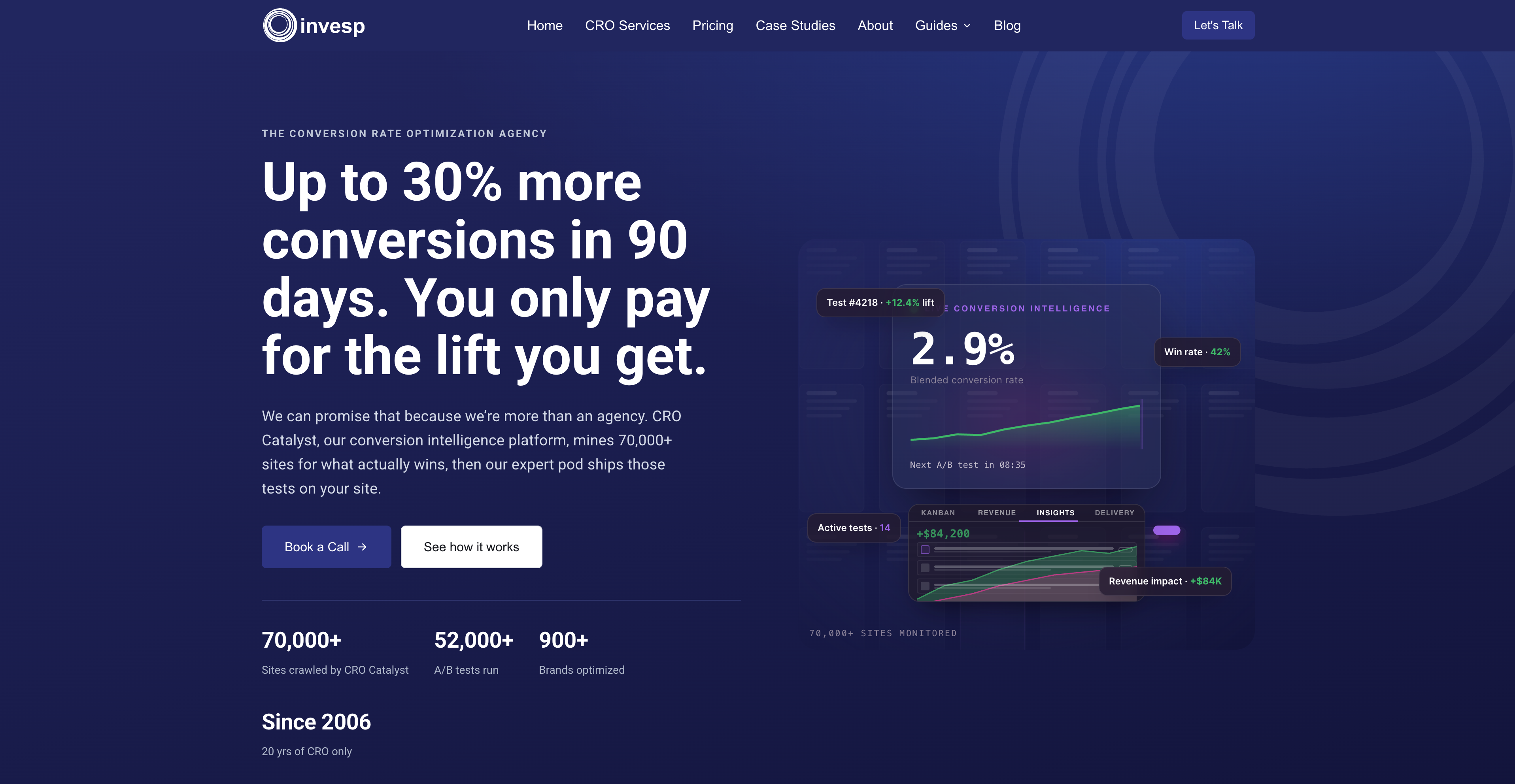
Invesp is a CRO agency with over 15 years of conversion optimisation experience and one of the most documented methodologies in the category. Their SHIP framework Scrutinize, Hypothesize, Implement, Propagate provides a structured four-stage process from conversion audit through hypothesis development through testing through programme-wide application of validated improvements.
For B2B SaaS companies where the primary conversion problem is structural page failure, Invesp's audit-first methodology addresses the four structural dimensions, value proposition clarity, relevance to the target visitor, anxiety reduction through proof and reassurance, and friction removal, before any variant is designed. Their track record spans e-commerce and B2B technology, with their B2B SaaS work focused on demo request flows, pricing pages, and trial conversion optimisation.
Their conversion audit process uses heatmaps, scroll maps, click maps, session recordings, and form field analytics to build a comprehensive picture of where visitors are failing before any hypothesis is formed. For B2B SaaS teams that have been running A/B tests without prior research and seeing inconsistent results, Invesp's SHIP framework introduces the diagnostic rigour that separates experiments that produce lasting improvements from ones that produce statistically ambiguous results.
Key services
SHIP framework: structured audit-to-testing methodology with documented stages
Heuristic conversion audit across value proposition, relevance, anxiety, and friction dimensions
Heatmap, scroll map, and session recording analysis
Form field analytics and friction inventory
A/B and multivariate test design, execution, and statistical analysis
Conversion programme documentation for internal team adoption
Why Invesp stands out for fixing low conversion rates
SHIP framework is one of the most documented CRO methodologies available: every decision in the programme has a defined stage and a documented rationale
Heuristic audit covers all four dimensions of structural page failure, not just the most visible one
Form field analytics provides quantitative evidence of friction cost per field, making the case for form simplification on data rather than assertion
15-plus years of documented CRO experience across B2B and SaaS funnels
Best fit: B2B SaaS at growth to mid-market stage where the team has been running CRO tests without a structured research programme and wants to move to a rigorous, documented methodology that produces statistically valid results rather than directional signals from under-powered experiments.
5. GetUplift

Best for: SaaS companies where the primary conversion failure is messaging, the right buyer is arriving but not recognising the value proposition, not believing the claims, or not understanding why the product is relevant to their specific situation
GetUplift is a conversion copywriting and psychology-led CRO agency founded by Talia Wolf. Their methodology is built around emotional targeting: understanding the specific fears, anxieties, desires, and motivations of the buyer at the point of conversion, and writing copy and structuring pages around those psychological realities rather than around the product's feature list. This approach addresses the specific conversion failure where structural architecture is sound, the page scores well on clarity, target, problem, proof, and action, but the visitor still does not convert because the copy does not speak to what actually drives their decision.
GetUplift has documented conversion improvements including a 344% increase in free trial conversions for one SaaS client, a 148% increase in demo requests for another, and a 90% increase in paid subscriptions. Their client list spans SaaS companies across B2B and B2C categories, with their B2B SaaS work focusing on demo request pages, pricing pages, and trial-to-paid conversion.
Their diagnostic approach begins with customer research: interviews with existing customers, analysis of support conversations and sales call recordings, and review of churn survey data, all to identify the specific language, fears, and motivations that real buyers bring to the conversion decision. The copy and page structure that results from this research consistently outperforms copy written from the internal team's understanding of the product's value proposition.
Key services
Customer interview and research programme to identify conversion-driving motivations
Conversion copywriting based on buyer psychology and emotional targeting
Landing page and pricing page copy and structure rebuilds
Trial-to-paid conversion optimisation
A/B testing of copy-driven variants after research completion
Sales page and demo request flow optimisation
Why GetUplift stands out for fixing low conversion rates
Buyer psychology research identifies the specific motivations and fears that drive conversion decisions, rather than assuming the internal team's value proposition matches what buyers actually respond to
Copy grounded in real customer language consistently outperforms copy written from the product perspective, the gap between the two is typically the source of the conversion failure this approach addresses
Documented conversion improvements including 344% free trial increase and 148% demo request increase in B2B SaaS contexts
Addresses the most overlooked root cause of low conversion: the page is structurally sound but the copy is not speaking to what actually drives the buyer's decision
Best fit: SaaS companies where conversion analysis shows visitors arriving from high-intent sources, engaging with the page (scroll depth above 70%, time on page above 60 seconds), and still not converting, suggesting the structural architecture is not the failure point, but the messaging is not resonating with the specific motivations and anxieties of the target buyer.
Why dimartec Addresses Low Conversion Differently
Each agency on this list targets one or two of the root causes of low conversion. Directive connects CRO to pipeline attribution, solving the measurement problem that causes programmes to optimise for the wrong metric. The Good addresses UX friction through research-led diagnosis, solving the visitor experience failures that heuristic audits miss. Invesp applies the SHIP framework to structural page failure, solving the architectural problems that undermine every test run on top of them. GetUplift rebuilds the messaging from customer psychology research, solving the copy failure that persists even after the page structure is fixed.
The constraint each of them shares is that they inherit the intent the traffic source delivers. If the paid campaigns pointing at the page are targeting mismatched intent, the most research-led, psychologically sophisticated landing page in the category will still fail to convert because the visitor who arrives is not the visitor the page was built for. None of these agencies owns the paid media feeding the page.
That is the structural gap that explains why CRO programmes consistently produce temporary lifts. The page is optimised against the traffic that currently arrives. The traffic continues to arrive from campaigns calibrated to a different intent. Three months later, the conversion rate has drifted back to where it was because the page was changed and the intent mismatch was not.
dimartec builds the system that closes this gap. Performance Paid Media and CRO run under one owner against one ICP definition. The intent the page is built for and the intent the campaigns are targeting match, not because a brief was shared between two agencies, but because both are designed simultaneously by the same team. RevOps & Automation connects the conversion events to closed revenue so the programme measures the right outcome from the first reporting cycle. GEO builds the organic discovery layer that, over time, shifts the channel mix toward visitors who arrived because they were looking for what the page offers.
How to Choose the Right Agency for Your Conversion Problem
Run the root-cause diagnosis before evaluating agencies
The four root causes of low conversion require different agency types. Intent mismatch requires a partner who owns both paid media and landing page, or at minimum, a CRO agency that can work in close coordination with your paid media team on the same ICP definition. Structural page failure requires a diagnostic-first methodology like Invesp's SHIP framework. UX friction requires user research like The Good's qualitative investigation programme. Messaging failure requires customer psychology research like GetUplift's emotional targeting approach. Attribution blindness requires Directive's pipeline attribution depth. Applying the wrong methodology to the wrong root cause produces results that look good briefly and disappear.
Traffic volume determines which methods are available
A/B testing requires sufficient traffic volume to reach statistical significance within a reasonable testing period. The minimum threshold for reliable A/B test results on a single variant is approximately 1,000 conversions per variant. If your page receives fewer than 3,000 visitors per month, A/B testing is not the right method for this stage: the results will be statistically ambiguous regardless of how well-designed the experiment is. Agencies that run A/B tests on low-traffic pages are generating data that looks like evidence and is not. For low-traffic pages, qualitative research, expert heuristic review, and high-confidence structural changes produce more reliable improvements than controlled experiments.
Ask for the diagnostic output before the testing proposal
Every agency on this list will provide a testing proposal if asked. The more revealing document is the diagnostic output: the specific root cause identified, the evidence that supports that identification, and the rationale for prioritising that fix above other potential improvements. An agency that cannot produce a clear diagnostic before proposing tests is not diagnosing, it is guessing efficiently. The difference between a CRO programme that holds and one that drifts back is almost always whether the right root cause was identified first.
Frequently Asked Questions
Why is my SaaS conversion rate low?
The four structural causes of low B2B SaaS conversion rates are intent mismatch between traffic source and landing page, structural page failure (offer clarity, target specificity, proof placement, or CTA structure), form friction, and attribution blindness. Most conversion rates are low because of one primary cause that is producing the observed rate, and one or more secondary causes that prevent the improvement from holding once the primary cause is addressed.
Should I run A/B tests if my conversion rate is at 1%?
Not as a first step. A 1% conversion rate on most B2B SaaS pages indicates a structural failure, not a marginal optimisation opportunity. Structural failures are better addressed through expert heuristic review and structural rebuilding than through controlled A/B tests. Save A/B testing for validating specific variants after the structural failure has been corrected: at that point, the page is converting well enough to generate the traffic volume needed for statistically significant test results.
How long does it take to fix a low SaaS conversion rate?
Structural fixes to a single landing page, offer clarity, proof placement, form friction reduction, typically produce measurable improvement within two to four weeks of implementation. The improvement holds if the root cause was correctly identified. If the rate drifts back within a quarter, the root cause was not the element that was fixed. The diagnostic process should then restart rather than adding more tests on top of the initial fix.
What is the right conversion rate target for a B2B SaaS landing page?
The achievable range for a well-built B2B SaaS landing page is 5–8% for high-intent paid traffic. HR Tech reaches 3–6% due to strong demo intent from most visitors. Cybersecurity and enterprise SaaS average 1–2% because of longer evaluation periods with more stakeholders. These are category-specific baselines rather than universal targets. What matters more than the absolute rate is whether your rate by traffic source is consistent with the intent quality of each source: branded search should convert at 3–5x the rate of cold display traffic, regardless of the category baseline.
Find the Root Cause First
Low conversion rates in B2B SaaS are diagnostic problems before they are optimisation problems. The agency that fixes them correctly starts by identifying which of the four structural causes, intent mismatch, page architecture, form friction, or attribution blindness, is the primary constraint, and addresses that cause directly before running a single experiment.
The Revenue Engine connects Performance Paid Media, CRO, AI Optimization (GEO), and RevOps & Automation into one system so that intent mismatch is addressed at source, structural page failures are diagnosed before testing, attribution connects every conversion to closed revenue, and the improvements compound across the full funnel rather than holding on a single page and drifting back when the next campaign changes the intent mix.
See how the Revenue Engine works: https://www.dimartec.co.uk/services/revenue-engine




.png)

















































.png)
.png)
.png)
.png)
.png)
.png)
.png)
.png)
.png)
.png)