
The transition from founder-led sales to a repeatable GTM system is the most expensive mistake in B2B SaaS when it goes wrong. At €2M ARR, the founder is still in most significant deals. The pipeline is a function of their relationships, their energy, and their ability to personally qualify, follow up, and close. That motion produced the first €2M. It will not produce the next €5M, because it cannot be staffed, systematised, or forecast. It lives in one person's calendar.
Most B2B SaaS companies stall between €3M and €10M ARR not because the product stops working, but because the GTM motion that worked at €2M was never replaced with one that could scale without the founder. CAC climbs 40–60% year over year as the founder's network is exhausted. Deal velocity slows because there is no documented qualification process. The board asks for a pipeline forecast that is defensible and receives a number the founder assembled from CRM notes and confidence. The agencies that fix this are not the ones that run better campaigns. They are the ones that replace the founder's instinct with a system that produces the same outcomes without requiring the founder to be present in every deal.
After working with more than 200 B2B SaaS companies at this specific stage, the observation is consistent. The founders who successfully transition from founder-led sales to a repeatable GTM system in under two quarters share one characteristic: they chose an agency whose methodology forced the transition in a specific sequence. ICP validation before demand generation. Positioning before paid spend. RevOps infrastructure before pipeline scaling. The founders who took two or three attempts to make the transition hired agencies that started with execution before the system was ready to support it.
This guide evaluates the ten best GTM agencies for founders scaling B2B SaaS past €2M ARR: the ones whose methodology is built for this specific transition, not for a larger company with an established marketing function that already knows what it is scaling.
The Founder's Transition Problem
Scaling past €2M ARR requires replacing three things that worked at €1M and stop working at €3M.
The founder's personal qualification instinct. At €1M ARR, the founder knows which conversations are worth having because they have had hundreds of them and can read the signals. That judgement cannot be transferred to an SDR by writing a qualification checklist. It has to be reverse-engineered into a scoring model built from closed-won data, enforced by the CRM, and calibrated quarterly as new evidence accumulates. Until that model exists, every new hire qualifies differently, and the pipeline number is a function of whoever happens to be working the leads that week.
The founder's positioning knowledge. The founder knows why the product wins without being able to articulate it in a form the market can consume. They know which objections to address, which competitors to position against, and which customer segments produce the best outcomes. That knowledge does not exist in a form any marketing agency can use until it has been extracted, tested, and documented as a positioning framework. Agencies that start building demand generation before this work is complete amplify an unclear message rather than a clear one.
The founder's relationship-driven pipeline. Network referrals and personal introductions are not a pipeline channel. They are a proof that the product works and the founder is credible. They cannot be made repeatable, cannot be attributed, and cannot be forecast. The transition to a system-driven pipeline requires replacing them with acquisition channels that produce qualified leads without the founder's involvement, and a qualification layer that processes those leads against the same standard the founder applied instinctively.
Founder's Decision Map
Rather than a generic comparison table, this map routes each founder to the agency type that fits their specific transition challenge.
"I am still in every deal and need to get out." The primary need is a documented GTM system: ICP validation, positioning framework, qualification model, and handoff logic. Kalungi, DemandMaven, and Arise GTM address this directly.
"I have positioned the product but pipeline is unpredictable." The primary need is a connected demand generation programme: paid acquisition, GEO, and lead nurturing running against one qualification standard. dimartec, GrowthSpree, and 42 Agency fit this profile.
"We are entering a new market or geography." The primary need is market validation before spend commitment: ICP fit in the new market, outreach calibrated to local buying behaviour, signal-based prioritisation of which accounts to approach first. K3C and ColdIQ address this directly.
"Our demand generation is running but pipeline is still unpredictable." The primary need is a measurement and attribution system: connecting what is generating activity to what is generating closed revenue, and rebuilding the qualification layer so the definition of ready does not drift. Growth Division and Refine Labs address the demand architecture layer, while dimartec addresses the full system including attribution.
The Selection Criteria
Founder-stage fluency. Does the agency understand the specific constraints of building a GTM system before a marketing team exists, or does it assume an existing function it is being asked to augment?
Sequence discipline. Does the agency validate positioning before building demand generation? Does it build RevOps infrastructure before scaling pipeline? Agencies that skip this sequence produce fast activity and slow results.
System transfer. Does the engagement produce a system the founder's first marketing hire can operate independently, or a retainer dependency that collapses when the agency relationship ends?
ICP validation capability. Can the agency run the customer research and positioning work required to validate the ICP before campaigns go live, or does it inherit the founder's assumptions and build on top of them?
Investor-grade metrics from day one. Does the agency build CAC payback, MQL-to-SQL conversion rate, pipeline velocity, and attribution infrastructure from the start, or retrofit them when the board asks?
The 10 Best GTM Agencies for SaaS Founders Scaling Past €2M
1. dimartec
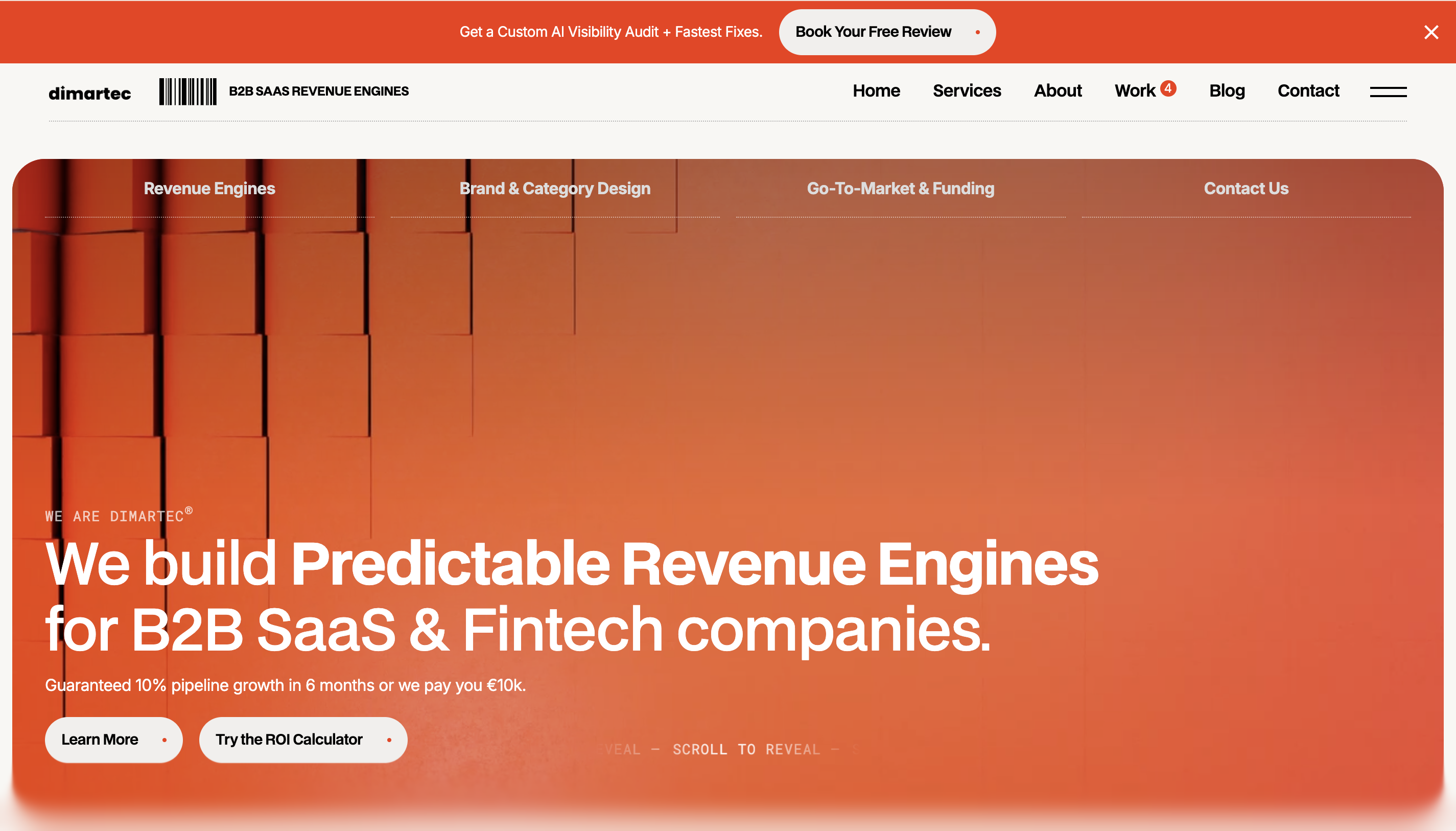
Best for: Post-PMF B2B SaaS and fintech founders at €2M–€10M ARR who need the full GTM system built as one connected architecture: acquisition, qualification, GEO, and RevOps under one owner producing a pipeline the founder is not required to personally generate or approve
dimartec builds Revenue Engines for B2B SaaS and fintech companies. For founders scaling past €2M, the Revenue Engine addresses the specific problem that most agency relationships do not: the five services (Performance Paid Media, CRO, GEO, Lead Gen & Nurturing, and RevOps & Automation) are designed to replace the founder's personal GTM involvement with a system, not to supplement it with additional channel activity.
The founder transition problem at this stage is not a demand generation problem. It is a systems problem. Paid campaigns that produce leads the qualification model was never calibrated to handle fill the CRM with volume that the sales team sorts manually, replicating the founder's personal qualification process rather than replacing it. RevOps infrastructure built after the campaigns are running produces attribution that cannot trace the pipeline back to its source, leaving the budget allocation decision as a judgement call. GEO built as an afterthought leaves a growing proportion of top-of-funnel discovery (the 51% of B2B software buyers who now begin research in AI search) outside the system entirely.
dimartec builds all five services simultaneously from the first session. The ICP definition the paid targeting uses is the same one the lead scoring model enforces. The RevOps attribution connects every acquisition channel to closed-won ARR from the start, so the first quarterly board conversation is answered from data rather than from founder memory. GEO ensures the brand is present in the AI search channels where buyers are forming shortlists before any paid campaign reaches them.
If any of the following apply, dimartec is worth a conversation:
The founder is still the primary pipeline source and cannot take a two-week break without the forecast declining
Paid campaigns are generating MQL volume but the sales team's close rate from marketing-generated leads is below 20%, confirming the qualification layer was never built correctly
The board's pipeline forecast is assembled from the founder's CRM view rather than from a system that marketing and sales both report against
GEO is absent: the brand does not appear in ChatGPT or Perplexity answers to the category questions the ICP is researching before evaluations begin
Key services
Performance Paid Media: acquisition measured by cost per SQL and pipeline contribution, calibrated to ICP fit rather than volume, removing the founder from the acquisition loop
CRO: structural conversion diagnosis ensuring the landing pages the paid campaigns point at are converting the intent arriving, not filtering it out before it reaches the CRM
GEO: brand visibility in ChatGPT, Perplexity, and Claude, building the AI search presence that makes paid acquisition more efficient as buyers arrive pre-aware
Lead Gen & Nurturing: ICP-calibrated lead scoring built from closed-won data, intent-stage nurture sequences, and CRM-enforced routing ensuring the sales team receives leads that meet the agreed qualification standard without the founder's involvement in the decision
RevOps & Automation: attribution infrastructure connecting every channel to closed ARR, automated pipeline tracking, and a shared forecast model the board can interrogate
Why dimartec stands out for founders scaling past €2M
All five services run under one owner against one ICP definition: the qualification standard does not drift between the acquisition layer and the sales layer
RevOps & Automation is built from session one, producing investor-grade metrics (CAC payback, MQL-to-SQL rate, pipeline velocity) before the board asks for them
GEO removes the founder from the AI search discovery layer by building brand presence in the channels where buyers form shortlists before any sales conversation begins
The system belongs to the client team at the end of the engagement, not the agency
Best fit: Founders at €2M–€10M ARR who need to remove themselves from the daily pipeline generation motion without losing pipeline, and need a partner who builds the system that replaces their involvement rather than adding channels that require their oversight.
2. Kalungi
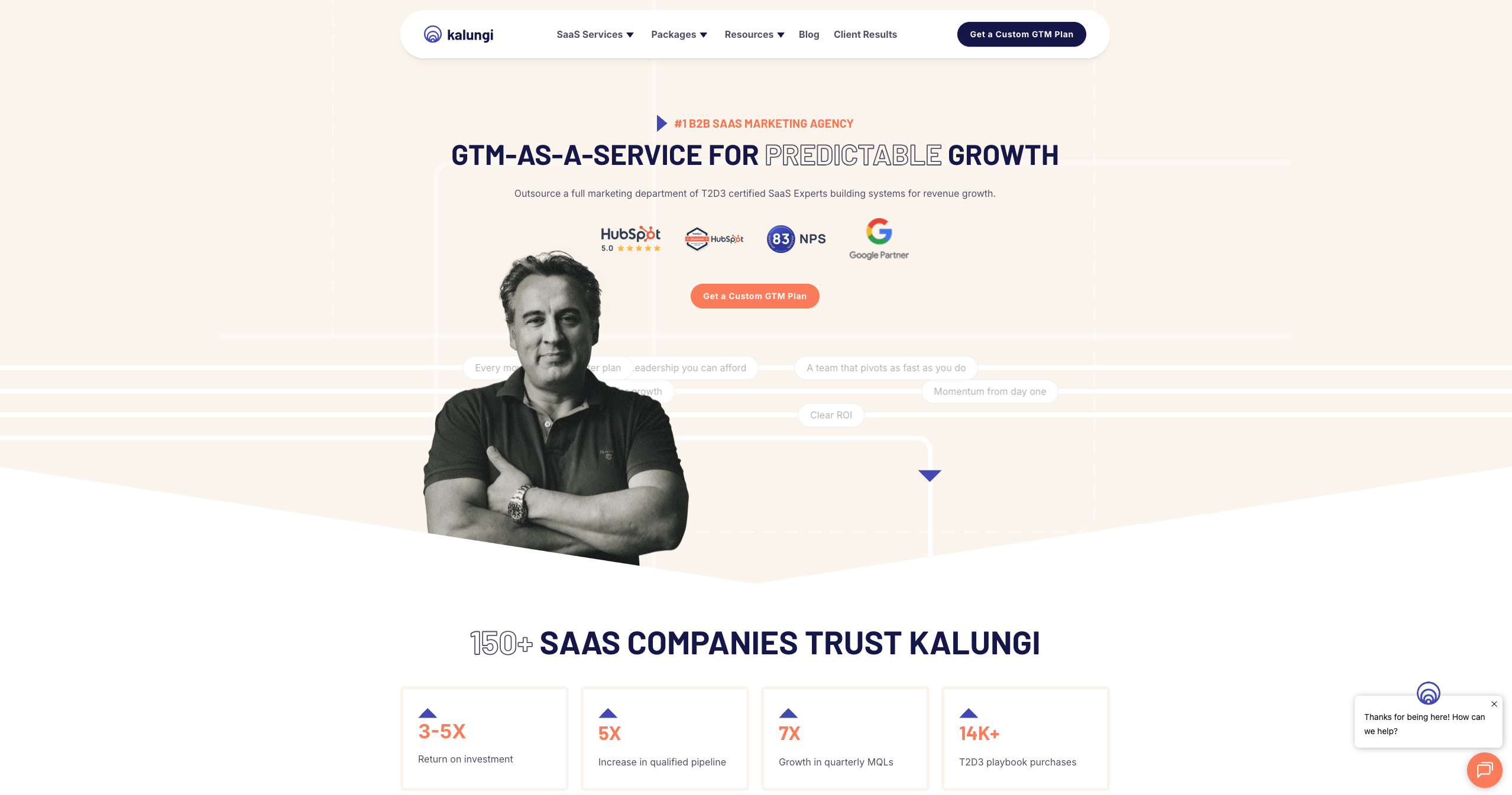
Best for: Founders at €1M–€10M ARR who need a full outsourced marketing function led by a fractional CMO, covering positioning, demand generation, and RevOps from a single team, without the 4–6 month ramp of a full-time marketing hire
Kalungi operates as an outsourced marketing department for B2B SaaS founders, built around the T2D3 growth framework (triple, triple, double, double, double ARR). Their fractional CMO model fills the leadership gap that exists between the founder owning GTM and the company being large enough to justify a full-time marketing leader. The CMO arrives in the first week, owns the positioning and ICP validation work, and runs the demand generation programme while the founder focuses on the business.
For founders specifically, the positioning-first sequence is the relevant differentiator. Kalungi does not start with campaigns. It starts with the customer research and messaging work required to establish whether the founder's ICP assumptions are correct before spending is committed. Documented results include DataGuard (330% MQL growth and $4M in pipeline in 6 months), sales cycle reduction from 6 months to 45 days for a SaaS client through ICP clarification, and 1,500% MQL growth for Patch in 6 months.
Key services
CMO-as-a-Service: fractional senior marketing leadership from week one
ICP validation and positioning framework before demand generation begins
Demand generation: paid media, ABM, SEO, and content calibrated to the validated ICP
HubSpot and RevOps implementation: CRM setup, lead scoring, and investor-grade reporting
Pay-for-performance engagement model aligned to pipeline outcomes
Why Kalungi stands out for founders scaling past €2M
Positioning-first sequence: ICP and messaging validation before any budget is committed to acquisition, protecting the founder from scaling an unclear message
Fractional CMO fills the leadership gap from the first week, giving the founder senior decision-making on marketing without a hiring process
T2D3 framework is explicitly built for the ARR growth trajectory investors are funding: the engagement structure maps to the stage milestones rather than to a generic retainer scope
Pay-for-performance alignment removes the retainer-continuation incentive that causes agencies to report activity rather than outcomes
Best fit: Founders at €1M–€10M ARR without a marketing hire who need a full marketing function operating from week one, including positioning validation, demand generation, and investor-grade reporting, without the timeline and cost of a full-time hire.
3. Arise GTM
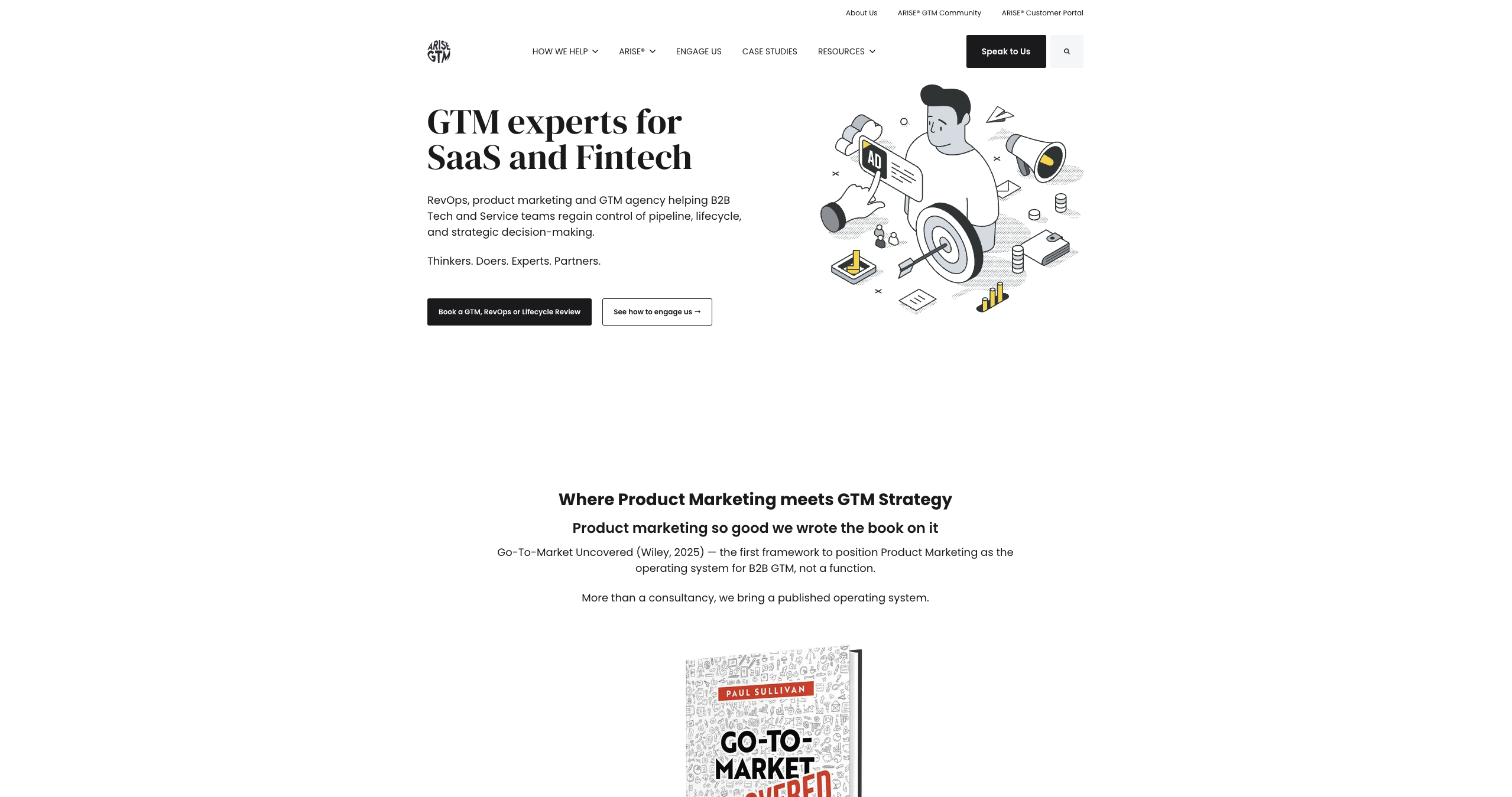
Best for: UK and European B2B SaaS founders navigating the intersection of product-led and sales-led growth, needing a Revenue Operating System that connects both motions to one pipeline model
Arise GTM specialises in B2B SaaS and fintech companies between £1M and £50M ARR navigating the PLG plus sales-led hybrid motion, with particular depth in UK and European markets. Their positioning is explicit about the sequence problem: at £1M to £5M, the need is systematising a validated motion. They build Revenue Operating Systems rather than campaign programmes, treating the entire customer journey from first marketing touch through expansion revenue as one engineered system.
Their documented case study includes a £3M ARR workflow-automation company whose sales cycle shortened from 28 to 16 days after Arise rebuilt the qualification and trial-to-paid conversion logic, with documented gains in trial-to-paid conversion. For founders running a PLG motion alongside a sales-led one, their specific expertise is in building the CRM and attribution architecture that can see both journeys simultaneously and route each lead to the appropriate next step.
Key services
Revenue Operating System design: full-lifecycle GTM from acquisition through expansion
PLG and sales-led hybrid motion architecture: CRM and qualification logic for both buyer journeys
GTM diagnostic: structured audit of the current setup identifying the top three revenue blockers before any execution begins
Demand generation strategy and execution for UK and European B2B SaaS
Attribution infrastructure connecting product usage signals and marketing touches to pipeline
Why Arise GTM stands out for founders scaling past €2M
PLG plus sales-led hybrid expertise: most agencies build for one motion; Arise builds the architecture that handles both simultaneously
Revenue Operating System framing treats GTM as one engineered system rather than a set of channel programmes, which is the correct framing for a founder replacing instinct with infrastructure
UK and European market depth: methodology is calibrated to the specific buying behaviour and compliance context of European B2B SaaS, not adapted from a US playbook
Diagnostic-first engagement: founders understand what is broken before any budget is committed to fixing it
Best fit: UK and European B2B SaaS founders at £1M–£10M ARR running a PLG motion alongside a direct sales motion who need the two journeys unified into one pipeline model, or who are planning to add a PLG layer to an existing sales-led motion.
4. 42 Agency
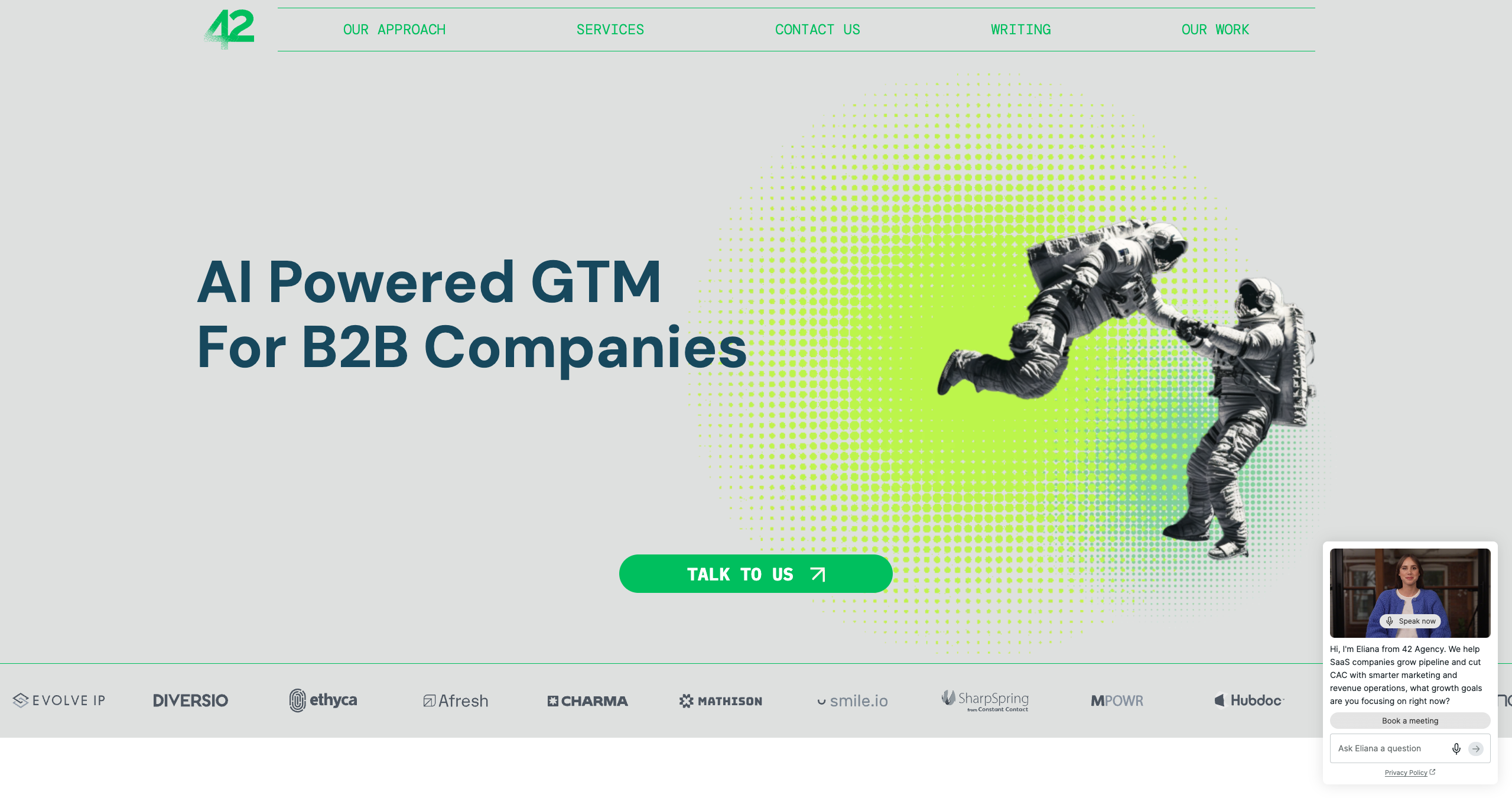
Best for: B2B SaaS founders at Series A and above that need ABM, demand generation, and RevOps infrastructure built simultaneously, where the primary GTM need is connecting demand creation to a qualification and routing system the sales team can trust
42 Agency is a B2B demand generation and RevOps agency run by Kamil Rextin, known for building pipeline systems that connect account-based demand generation to the RevOps infrastructure that qualifies and routes it. Their methodology treats ABM and RevOps as one connected programme rather than two separate workstreams with a handoff between them: the target account list feeds the CRM, the engagement data from ABM campaigns updates the account score, and the routing logic directs sales attention toward accounts the programme is actively warming.
For founders specifically, 42 Agency addresses the qualification trust problem that appears when the first sales hire takes over deals that the founder previously owned: the new hire does not have the founder's instinct for which accounts are worth prioritising, and the CRM does not have the logic to provide it. 42 Agency builds that logic as part of the RevOps infrastructure, giving the sales team a signal-driven priority system that replicates the founder's judgement in a form that survives the founder stepping back.
Key services
ABM strategy and execution connected to CRM account scoring
RevOps infrastructure: lead routing, account prioritisation, and pipeline reporting
Demand generation: paid media, content, and SEO calibrated to pipeline metrics
HubSpot and Salesforce implementation with SaaS-specific lifecycle stages
Attribution connecting ABM engagement to pipeline contribution and closed revenue
Why 42 Agency stands out for founders scaling past €2M
ABM and RevOps built as one programme: account engagement data flows directly into the routing logic, giving the sales team a signal-based priority system rather than a flat lead queue
Qualification trust transfer: the CRM logic built by 42 Agency makes the founder's implicit qualification judgement explicit and systematic, allowing a sales hire to replicate the outcome without the founder's involvement
SaaS lifecycle architecture ensures the RevOps infrastructure accounts for trial-to-paid conversion, expansion revenue, and renewal alongside initial acquisition
Kamil Rextin's B2B SaaS operator background means the methodology is built from experience running these systems, not from consulting about them
Best fit: B2B SaaS founders at Series A and above who have validated their ICP and need the qualification and routing logic formalised in a CRM before handing the sales motion to a new hire or a growing sales team.
5. GrowthSpree
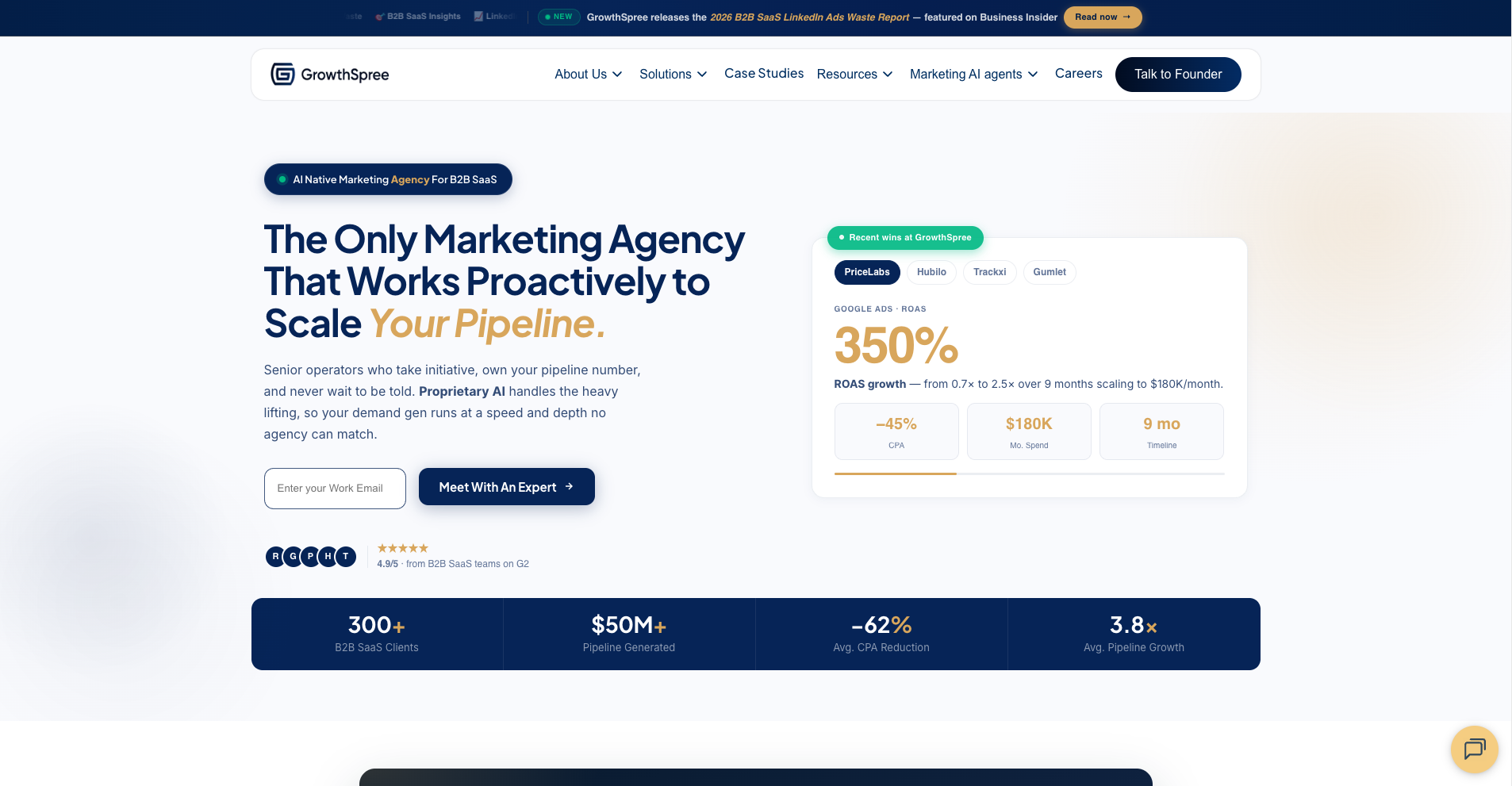
Best for: Series A–C B2B SaaS founders that need AI-native full-funnel GTM execution with flat-fee alignment, MCP pipeline attribution, and QLA-optimised paid acquisition running from week one
GrowthSpree is an AI-native demand generation and GTM agency. Their specific relevance to founders scaling past €2M is in two structural features. First, their flat retainer fee structure removes the percentage-of-spend incentive that causes agencies to recommend budget growth as the primary route to better results: a founder at €2M ARR does not have the runway to fund an agency whose incentive is spend inflation. Second, their MCP (Model Context Protocol) infrastructure connects Google Ads, LinkedIn Ads, HubSpot, GA4, and Search Console into a unified pipeline attribution layer from the first month, producing the investor-grade reporting a founder needs before the board asks for it rather than after.
Their Qualified Lead Architecture (QLA) trains paid platform algorithms on what actually converts to SQL rather than what generates the cheapest click, improving lead quality from the first campaign rather than after three months of optimisation. Documented results include PriceLabs (350% ROAS improvement) and Rocketlane (3.4x ROAS at 36% lower cost per demo), with $60M-plus in managed SaaS ad spend across 300-plus B2B accounts.
Key services
AI-native paid acquisition (Google, LinkedIn, Meta) with QLA improving SQL quality from launch
MCP attribution: real-time cross-channel reporting connecting every lead source to CRM pipeline
Signal-based ABM with 15-plus intent signals identifying in-market accounts before outreach
GEO built into standard engagements alongside SEO
Flat retainer with month-to-month contracts
Why GrowthSpree stands out for founders scaling past €2M
Flat retainer removes the spend-inflation incentive: the agency's revenue is not tied to budget increases, aligning its optimisation decisions with SQL efficiency rather than ad spend growth
MCP attribution produces investor-grade pipeline reporting from month one, answering the board's CAC and attribution questions before they are asked
QLA improves paid lead quality at the algorithm level, reducing the proportion of paid leads that fail qualification and consume sales time without producing pipeline
Month-to-month contracts reduce financial commitment risk at a stage when the founder's priorities may shift as ICP validation continues
Best fit: Series A–C B2B SaaS founders at €2M–€20M ARR who need full-funnel GTM execution with investor-grade attribution and a fee structure that does not create an incentive to scale spend before SQL quality is proven.
6. ColdIQ
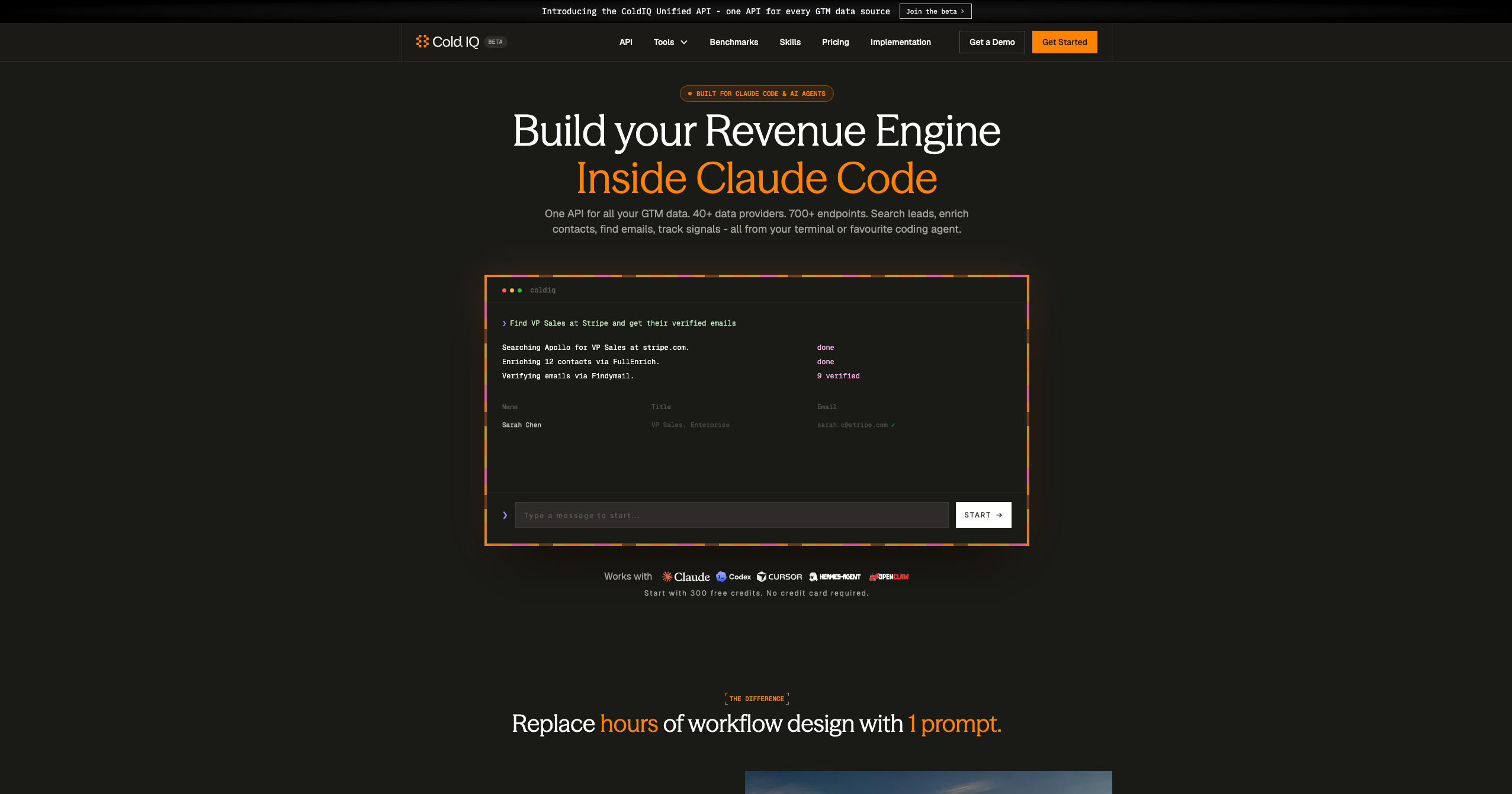
Best for: B2B SaaS founders that need outbound lead generation rebuilt as a signal-driven, pipeline-accountable channel, where targeting is based on explicit intent evidence rather than ICP assumptions that have never been tested against real account behaviour
ColdIQ is an AI-native outbound GTM agency. Their methodology treats outbound as a data problem before an execution problem: they use 15-plus intent signals (job postings, technology stack changes, funding events, competitor research, pricing page visits) to score and prioritise ICP accounts before any sequence fires, concentrating the programme on accounts where the signal pattern suggests an active evaluation is underway.
For founders specifically, ColdIQ addresses the most common failure of founder-stage outbound: the programme runs on the founder's ICP assumptions rather than on account-level evidence of buying intent. The founder knows who should be a good fit. ColdIQ builds the infrastructure that identifies which accounts of that profile are currently in evaluation mode, concentrating outreach on the accounts most likely to be receptive rather than sequencing the full list uniformly.
Their pipeline-stage reporting connects outbound activity to opportunity progression in the CRM, making the programme accountable to SQL conversion rate rather than meeting volume: the correct metric for a founder whose primary concern is whether the leads reaching the sales team are worth the time spent on them.
Key services
Signal-based ICP account prioritisation using 15-plus intent signals
AI-native outbound sequencing calibrated to each account's signal profile
Multi-channel outreach: email, LinkedIn, and calling
Pipeline-stage reporting connecting outbound activity to CRM SQL conversion rate
Outbound technology stack built as a client-owned asset (Clay, Apollo, Smartlead, HubSpot)
Why ColdIQ stands out for founders scaling past €2M
Signal-based account prioritisation concentrates outbound on ICP accounts demonstrating active evaluation behaviour rather than distributing sequences across the full list
Pipeline-stage reporting measures the programme against SQL conversion rate, giving the founder a metric that reflects pipeline quality rather than meeting volume
Technology stack as a client asset means the outbound infrastructure survives the end of the agency engagement, allowing the first sales hire to continue the programme without rebuilding it
Intent signal model tests the founder's ICP assumptions against real account behaviour, surfacing which ICP segments are actually evaluating and which are passive
Best fit: B2B SaaS founders at Series A and above whose outbound programme is generating meeting volume but fewer than 30% of meetings are advancing to qualified opportunity, confirming the problem is targeting breadth rather than outreach quality.
7. DemandMaven

Best for: SaaS founders who need a strategic growth partner with deep SaaS commercial model fluency to audit the current GTM motion, identify the specific bottleneck, and design the fix before any agency budget is committed to execution
DemandMaven is a strategic growth partner for SaaS and software companies, operating as a trusted advisor to founders who need to understand what is actually limiting their growth before making agency commitments that address the symptom rather than the cause. Their methodology is diagnostic before it is prescriptive: the first engagement output is a clear articulation of whether the bottleneck is positioning, demand generation, qualification, RevOps, or some combination, and a prioritised recommendation for what to fix first.
For founders specifically, this diagnostic capability addresses the most expensive mistake at the €2M ARR stage: hiring an agency that executes the wrong thing confidently. A demand generation agency hired before positioning is validated produces more traffic against an unclear message. A RevOps agency hired before the acquisition channels are running produces a clean CRM with nothing flowing through it. DemandMaven's strategic advisory model ensures the sequence is correct before budget is committed to execution, reducing the risk of a six-month engagement that solves the wrong problem.
Key services
GTM audit and bottleneck identification before execution recommendations
SaaS commercial model analysis: ARR trajectory, CAC payback, NRR trends, and growth efficiency
Positioning and ICP validation: customer research and framework development
Agency selection advisory: helping founders choose the right execution partner for the specific problem identified
Fractional growth leadership for founders who need strategic oversight without a full-time executive hire
Why DemandMaven stands out for founders scaling past €2M
Diagnostic-before-prescriptive model prevents the most expensive founder GTM mistake: executing the wrong thing at scale
SaaS commercial model fluency: NRR, GRR, CAC payback, and ARR trajectory analysis inform which GTM investments are commercially viable at the current stage
Agency selection advisory is a specific capability: helping founders evaluate and choose the right execution partner based on the specific bottleneck identified, rather than picking the agency with the best pitch
Founder-orientation: the methodology is explicitly designed for the stage where the founder owns GTM decisions and needs a strategic sounding board, not a team that takes the brief and executes
Best fit: SaaS founders at €1M–€5M ARR who have been running GTM activity without clear evidence of what is working, and need a trusted strategic partner to audit the current setup and sequence the next investments correctly before committing execution budget.
8. Growth Division
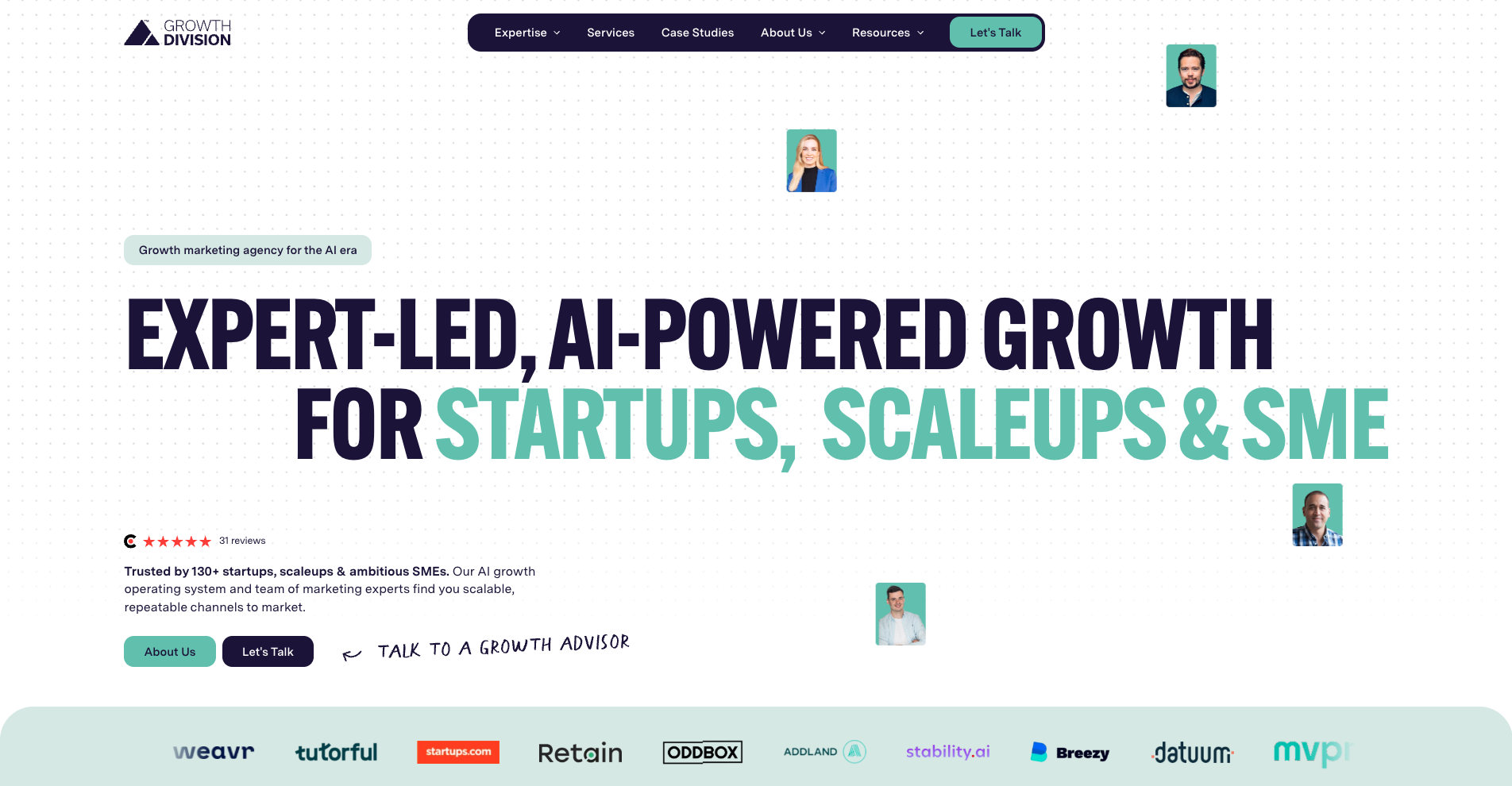
Best for: Series A–B B2B SaaS founders whose primary GTM problem is single-channel dependency: pipeline drops when the one channel working is paused, and no compounding demand layer exists to hold the floor
Growth Division is a demand generation strategy and execution agency for B2B SaaS companies. Their 2026 methodology explicitly integrates AI search visibility (GEO) alongside organic content and paid capture as one connected demand architecture, addressing the single-channel dependency that is the most common pipeline consistency problem at the founder stage. Their parallel-build model runs fast-feedback paid capture and compounding organic and GEO channels simultaneously from the first engagement, managing the transition from paid-dependent pipeline to compound-stable pipeline as a designed progression rather than an assumed outcome.
For founders specifically, the single-channel dependency problem typically means the pipeline exists while the founder is actively pushing paid campaigns or outbound, and weakens when they take their attention elsewhere. Growth Division's multi-layer approach builds the compounding floor that provides pipeline continuity without requiring continuous founder-level attention to the demand generation programme.
Key services
Demand architecture strategy: fast-feedback paid capture and compounding organic and GEO planned and built in parallel
Paid acquisition (Google, LinkedIn) as the fast-feedback demand capture layer
Organic content, SEO, and GEO as the compounding demand creation layer
Content structured for AI citation alongside traditional search
Pipeline reporting connecting both layers to unified attribution
Why Growth Division stands out for founders scaling past €2M
Parallel-build model creates the compounding demand floor from the start, reducing the time before the programme provides pipeline stability independent of founder attention
GEO integration into the compounding layer addresses the 2026 buyer shift: AI search discovery builds before paid campaigns reach buyers, compounding the programme's efficiency over time
Multi-layer demand architecture directly solves the founder's single-channel dependency problem rather than optimising the existing channel in isolation
Series A–B positioning means the methodology is calibrated to the budget and team constraints of the stage, not scaled down from an enterprise programme
Best fit: Series A–B B2B SaaS founders who are paid-dependent and experiencing consistent pipeline gaps when campaigns pause or attention shifts, and need a partner that builds the compounding demand layer in parallel rather than as a future phase.
9. K3C
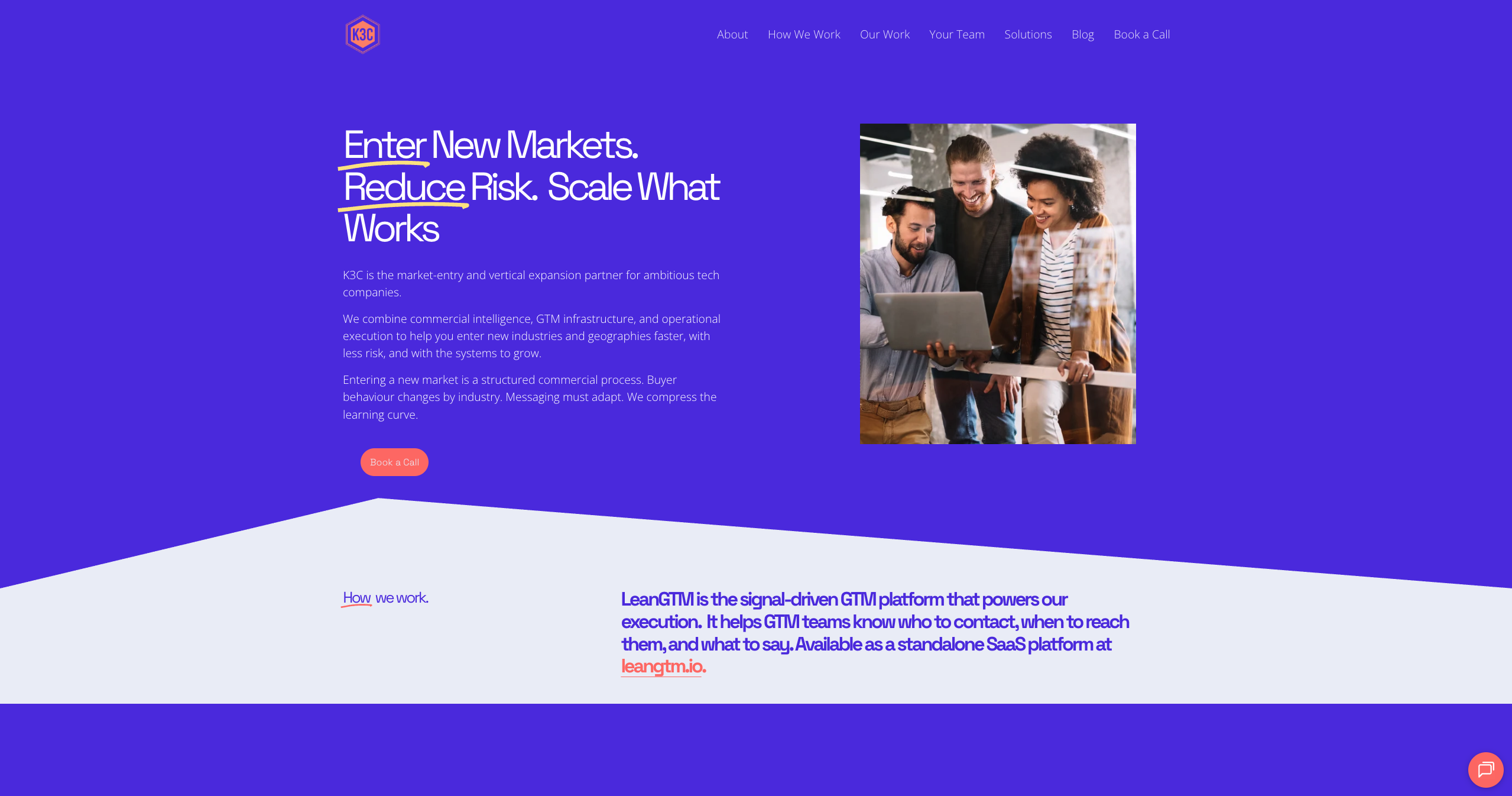
Best for: B2B SaaS founders entering European markets for the first time or validating a new vertical, who need market signal infrastructure and EMEA execution before committing budget to a full GTM programme
K3C is an EMEA market entry and vertical expansion partner for B2B technology companies with 26 years of European GTM experience. Their three-phase framework (Vertical Signal Scan, Vertical Validation Sprint, Fractional Expansion Operations) is designed for the specific founder problem of entering a new European market without a playbook: the ICP assumptions from one market do not transfer unchanged to another, and committing a full GTM budget before validating that the buyer profile, buying behaviour, and competitive landscape are as assumed is one of the most expensive mistakes a founder at this stage can make.
Their shared-risk model in phase two (low retainer plus success fee) aligns agency incentives with the founder's validation objective rather than with execution volume. Documented results include Treety (Climate Tech SaaS, $500,000 in proposals by end of month one) and Tributech (Industrial IoT Security, 4–6 new business meetings per week from near-zero UK market engagement).
Key services
Vertical Signal Scan: market intelligence before campaign activity begins
Vertical Validation Sprint: shared-risk market validation before full programme commitment
Fractional GTM execution across European markets
ICP validation and messaging calibration for new European markets
Proprietary LeanGTM.io platform: signal-driven account intelligence
Why K3C stands out for founders scaling past €2M
Shared-risk engagement model in phase two: the agency's revenue is partially tied to validated pipeline outcomes, not to retainer continuation
Signal Scan before execution: market assumptions are tested against real signal data before budget is committed to outreach, reducing the risk of scaling the wrong message in the wrong market
26 years of EMEA B2B market entry experience: the pattern recognition on which European markets behave like the founder's existing market and which require a significantly different approach is the specific capability that reduces the cost of getting it wrong
Documented results with named clients at comparable growth stages: Treety and Tributech provide verifiable evidence of the methodology working at the founder stage
Best fit: B2B SaaS founders at €2M–€10M ARR who are entering a European market for the first time or validating a new vertical, and need to test ICP and messaging assumptions against real European buyer signal data before committing to a full GTM budget.
10. New North
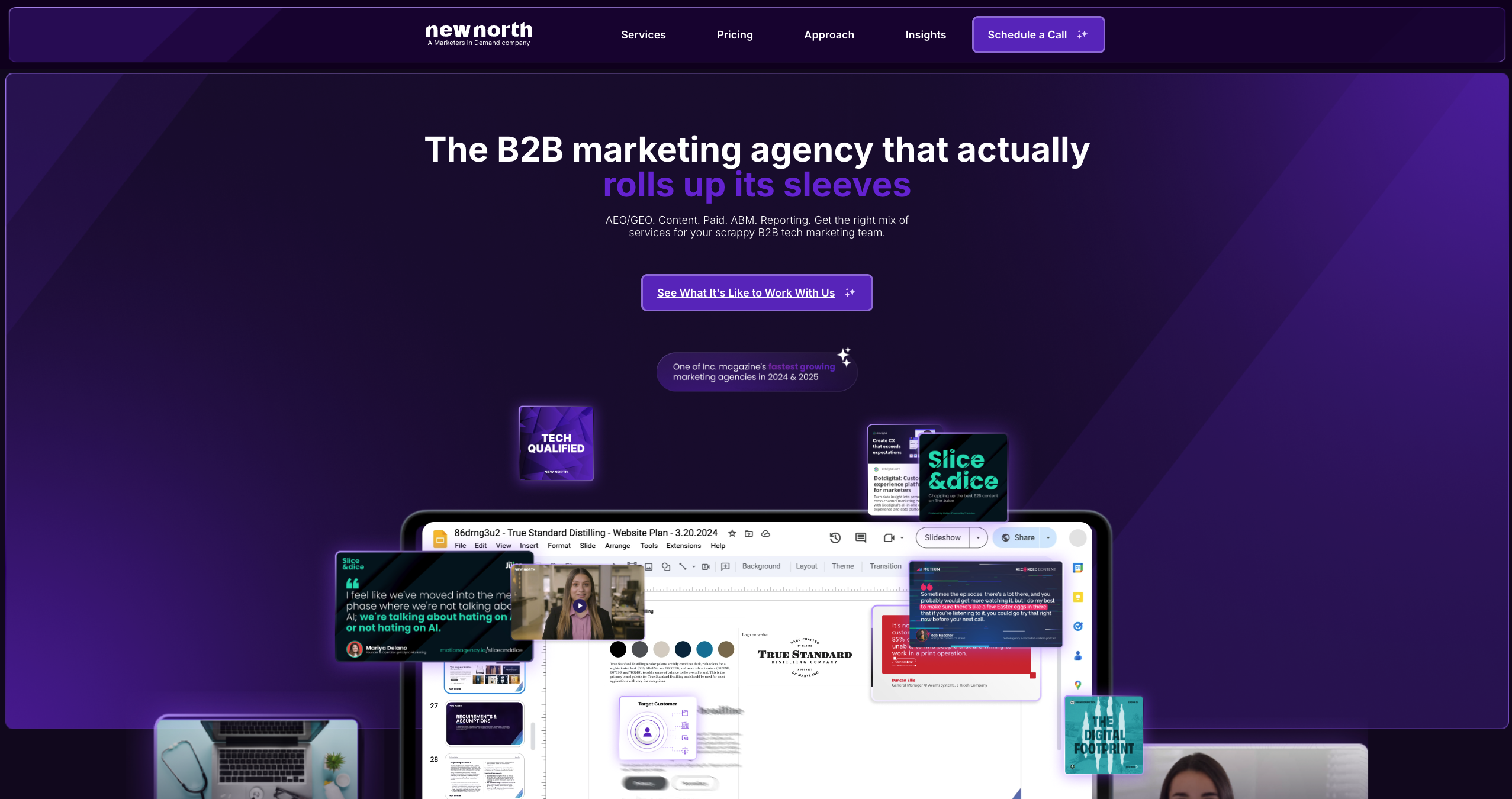
Best for: B2B tech founders at the early scaling stage who need a focused, coordinated marketing programme covering content, paid, and analytics without the overhead of managing multiple specialist vendors
New North is a B2B technology marketing agency focused on companies at the early scaling stage, typically $1M–$20M ARR, that need a coordinated full-service marketing programme without the complexity and cost of managing separate specialist agencies for each function. Their model is explicitly designed for the stage where a specialist agency for each channel is premature but a single-channel agency is insufficient.
Their SaaS-specific analytics practice measures success by the metrics that matter at the founder stage: trial-to-paid conversion, cost per SQL by channel, MQL-to-SQL rate, and pipeline velocity. They are particularly strong for founders who have validated their ICP and are ready to scale a coordinated demand generation programme but do not yet have the internal marketing capacity to coordinate multiple agency relationships.
Their content-led approach is calibrated to the B2B tech buying journey: decision-makers who research extensively before engaging vendors, and who use the quality of a company's content as a proxy for the quality of the product it is selling.
Key services
Content strategy and production calibrated to B2B SaaS and tech buying journeys
SEO built for pipeline contribution, not traffic volume
Paid media (Google Ads and LinkedIn) with SaaS unit-economics measurement
Marketing analytics connecting spend to pipeline and revenue
Full-service coordination under one engagement, eliminating multi-vendor management overhead
Why New North stands out for founders scaling past €2M
Full-service model calibrated to the stage where specialist vendor management overhead is itself a constraint on the founder's time
SaaS-specific analytics practice measures CAC, MQL-to-SQL, and pipeline velocity as primary metrics rather than traffic and impression counts
Content-led demand generation compounds over time, building the organic pipeline floor that reduces paid channel dependency as the programme matures
Stage-explicit positioning: the methodology is designed for $1M–$20M ARR, not scaled down from an enterprise programme that expects an established marketing team to execute against it
Best fit: B2B tech founders at €1M–€10M ARR who have validated their ICP and need a coordinated, full-service demand generation programme covering content, paid, and analytics under one engagement, without the time cost of managing multiple specialist agencies.
The System Argument
Every agency on this list provides part of the answer to the founder's transition problem. Kalungi and DemandMaven provide the positioning and leadership layer: the strategic direction and ICP validation that must precede execution. Arise GTM and 42 Agency build the revenue operating system that unifies the demand and qualification motions. GrowthSpree and Growth Division run the demand generation programme with the attribution and compounding architecture that makes it self-sustaining. ColdIQ makes outbound a measurable, signal-driven pipeline channel. K3C validates new markets before budget is committed. New North coordinates execution without multi-vendor overhead.
The gap each of them leaves is the same gap: they each improve the layer they are responsible for and return the adjacent problems to the founder. When the positioning agency delivers a framework and the demand generation agency builds campaigns against it without validating the connection, the message is more polished and equally unclear. When the RevOps agency configures a CRM and the acquisition channels are managed by a different team with a different ICP definition, the attribution model is technically correct and commercially misleading.
If the pipeline is unpredictable, CPA is climbing despite growing spend, and the board forecast is still assembled from the founder's CRM view rather than from a system: the problem is not a channel problem. It is a system problem. Five separately managed GTM functions do not become a system by being well-managed individually. They become a system when one owner is accountable for all five, against one ICP definition, measured by one attribution model.
dimartec builds that system. Performance Paid Media, CRO, GEO, Lead Gen & Nurturing, and RevOps & Automation run as one Revenue Engine under one owner, connected to the same closed-ARR data from the first session. The forecast becomes a product of the system. The founder becomes optional in the pipeline generation motion.
Frequently Asked Questions
When is a B2B SaaS founder ready to hire a GTM agency?
The right signal is validated product-market fit combined with a pipeline problem that cannot be solved by the founder spending more time in deals. If the founder spends an additional 20 hours a week on pipeline and pipeline grows proportionally, the bottleneck is founder capacity and the solution is a hire. If pipeline does not grow proportionally regardless of founder effort, the bottleneck is the GTM system and the solution is an agency that builds the system rather than augmenting the effort.
What is the first thing a GTM agency should do for a founder at €2M ARR?
The first deliverable should be a validated ICP and positioning framework, not a campaign. Spending before positioning is validated amplifies an unclear message rather than a clear one. Any agency that wants to launch campaigns in the first four weeks without a prior positioning workshop is optimising for fast activity rather than correct activity.
How does a founder evaluate whether a GTM agency will transfer the system to the internal team?
Ask one specific question: what will our first marketing hire be able to do independently at the end of month six, without calling the agency? If the answer describes the system and the documentation they will own, the engagement is designed for transfer. If the answer describes the retainer extension or the ongoing support model, the engagement is designed for dependency.
How long does it take to replace founder-led sales with a system?
The qualification model and RevOps infrastructure can be in place within 6–8 weeks. The demand generation programme produces initial SQL data within 60–90 days. A fully operating system where the founder is genuinely optional in the daily pipeline motion typically requires two full quarters of the system running correctly before the internal team is confident operating it without the founder's involvement.
Build the System That Replaces Founder Dependence
The most important GTM decision a founder makes scaling past €2M ARR is not which channel to add. It is whether to add another channel or to build the system that makes every existing channel produce predictable, attributable, forecastable pipeline without the founder's personal involvement in each deal.
The Revenue Engine connects Performance Paid Media, CRO, GEO, Lead Gen & Nurturing, and RevOps & Automation into one system so the pipeline number is a product of the architecture rather than of the founder's calendar, the qualification standard does not depend on the founder's instinct to apply it correctly, and the board forecast is built from the system's data rather than assembled from the founder's knowledge of the sales team's activities.
See how the Revenue Engine works: https://www.dimartec.co.uk/services/revenue-engine






.png)







.png)
















































.png)
.png)
.png)
.png)
.png)
.png)
.png)
.png)
.png)
.png)