
Revenue operations began as a fix for a familiar argument. Marketing reported one number, sales reported another, customer success reported a third, and the leadership team spent the first half of every quarterly review working out which one was true. The idea behind RevOps was simple: give the three teams one set of definitions, one system of record, and one person responsible for keeping them consistent.
As the idea spread through B2B SaaS, an industry grew up to supply it. Salesforce consultancies added RevOps to their service pages. HubSpot partners rebranded around it. Sales training firms began selling revenue architecture, and a new wave of fractional operators offered to run the function by the month. Within a few years, "revenue operations agency" had come to describe businesses that do very different work: some redesign how teams define a qualified opportunity, some rebuild CRM data models, some administer systems week to week, and a few connect all of that to how leads are generated in the first place.
After analysing revenue operations engagements across more than 200 B2B SaaS accounts, that variety turns out to explain most disappointing projects. The agencies involved were usually competent. The problem was that a company with a definitions problem had hired a systems builder, or a company with a broken CRM had hired a strategy firm, and both sides spent months discovering the mismatch.
This review compares ten revenue operations agencies with that in mind. Each entry sets out what the agency is genuinely strong at, where its work stops, and which kind of company it suits, followed by direct comparisons of the agencies most often shortlisted together.
The Four Types of RevOps Agency
Before comparing individual agencies, it helps to sort them. Almost every firm selling revenue operations falls into one of four types, and the type matters more than the brand.
Operating model designers. These firms work on definitions, stages, metrics, and the way teams hand work to each other. They produce frameworks, playbooks, and training. They rarely configure software. Hire one when your teams disagree about what the numbers mean.
Platform specialists. These are implementation partners built around one CRM, or sometimes two. They are strongest at architecture, migration, integration, and automation inside Salesforce or HubSpot. Hire one when the system itself is the problem: slow, messy, misconfigured, or about to be replaced.
Operations-as-a-service providers. These firms supply an ongoing team, usually on a monthly subscription, to run and improve your revenue operations week by week. Hire one when you need RevOps capacity without employing it.
Integrated growth partners. A smaller group builds revenue operations as part of a wider programme that also includes acquisition and conversion. Hire one when the operations problem cannot be separated from how leads are generated in the first place.
Most companies need mainly one type at any given time. The comparison table below shows which type each agency belongs to.
How We Reviewed These Agencies
Each agency was assessed on five questions, using its own published material, partner directory listings, independent reviews, and press coverage.
- Clarity of type: Is it obvious what kind of RevOps work the agency does, or does its positioning claim everything?
- Depth in its specialism: Is there evidence of real expertise, such as partner tier, named clients, published methods, or team composition?
- Fit with B2B SaaS: Does it understand recurring revenue, expansion, and long sales cycles?
- Transfer: Does the client end up able to run what was built?
- Honest limits: Is it clear what the agency does not do, so a buyer can plan around it?
Each review below ends with a short verdict: who should hire the agency and who should look elsewhere. Where facts come from the agency itself and could not be confirmed independently, the review says so.
The 10 Best Revenue Operations Agencies Reviewed
1. dimartec
Best for: Post-PMF B2B SaaS and fintech at €2M–€10M ARR whose revenue operations problem is tangled up with how leads are generated, converted, and qualified
dimartec builds Revenue Engines for B2B SaaS and fintech companies. RevOps & Automation is one of five integrated services, alongside Performance Paid Media, CRO, GEO, and Lead Gen & Nurturing. Of the four agency types, it is the integrated growth partner: the revenue operations work is designed together with the activity it measures.
That matters because many RevOps problems at this stage are not really operations problems. A forecast is unreliable because lead quality swings with campaign changes. Attribution is disputed because paid media and the CRM define a conversion differently. Lead scoring fails because nobody told the ad platforms what a good lead was. An agency that only touches the CRM can document those symptoms but cannot change their cause. dimartec can, because the same team runs the campaigns, the landing pages, and the qualification rules.
In practice, RevOps & Automation sets up first-party attribution from first touch to closed-won, automated routing and enrichment, stage definitions the CRM enforces, and a single pipeline view that marketing and sales both report from. The system is built in the client's accounts and handed over.
Key services
- RevOps & Automation: attribution, routing, enrichment, stage logic, and pipeline reporting
- Lead Gen & Nurturing: scoring calibrated to closed-won deals, nurture, and handover rules
- Performance Paid Media: campaigns fed with CRM outcomes and measured on pipeline
- CRO: pages and forms that capture the data qualification needs
- GEO: visibility in AI search, with attribution designed for buyers who arrive that way
Strengths
- Fixes operations problems at their source in acquisition and conversion
- One team accountable for the full path from first touch to closed-won
- Built for the €2M–€10M ARR stage and its limited internal resources
- Ownership of the system passes to the client
Verdict: Hire dimartec if your revenue data is unreliable because the activity feeding it is uncoordinated. Look elsewhere if you need a pure Salesforce rebuild or an enterprise-scale programme.
2. Go Nimbly
Best for: Mid-market and enterprise SaaS companies running complex, cross-functional RevOps change, including product-led sales
Go Nimbly is a San Francisco consultancy founded in 2013 and widely credited as one of the first firms to treat revenue operations as a discipline in its own right. Led by CEO Jen Igartua, it offers fractional RevOps partnerships, strategic advisory, architecture work, and support for product-led growth companies building a sales function on top of self-serve.
Its client list is the strongest evidence of its level: Intercom, Rippling, Plaid, Twilio, Zendesk, and Gong appear in directory listings. Its consultants work across Salesforce, HubSpot, Marketo, and Clay, and its job descriptions emphasise presenting options and trade-offs over prescribing a single answer, which suggests an advisory culture.
Its PLG and product-led sales practice is a genuine differentiator. Companies that started with self-serve signups and are now adding sales face a specific RevOps problem: product usage has to become a qualification signal, and the CRM has to handle accounts that arrived without a salesperson. Go Nimbly has built that infrastructure for well-known PLG companies.
Key services
- Fractional RevOps
- Strategic RevOps advisory
- RevOps architecture and systems design
- Product-led growth and product-led sales infrastructure
- CPQ and specialist technical support
Strengths
- Long track record and recognised clients in SaaS
- Strong in change management across functions
- Specialist PLG and product-led sales capability
- Works across the main CRMs and tools
Limitations
- Positioned for mid-market and enterprise; smaller companies may find it expensive
- Works best where an internal RevOps owner exists to partner with
Verdict: Hire Go Nimbly for a substantial, cross-functional programme at scale, especially in a PLG business. Smaller companies without internal RevOps leadership should consider a more hands-on provider.
3. RevPartners
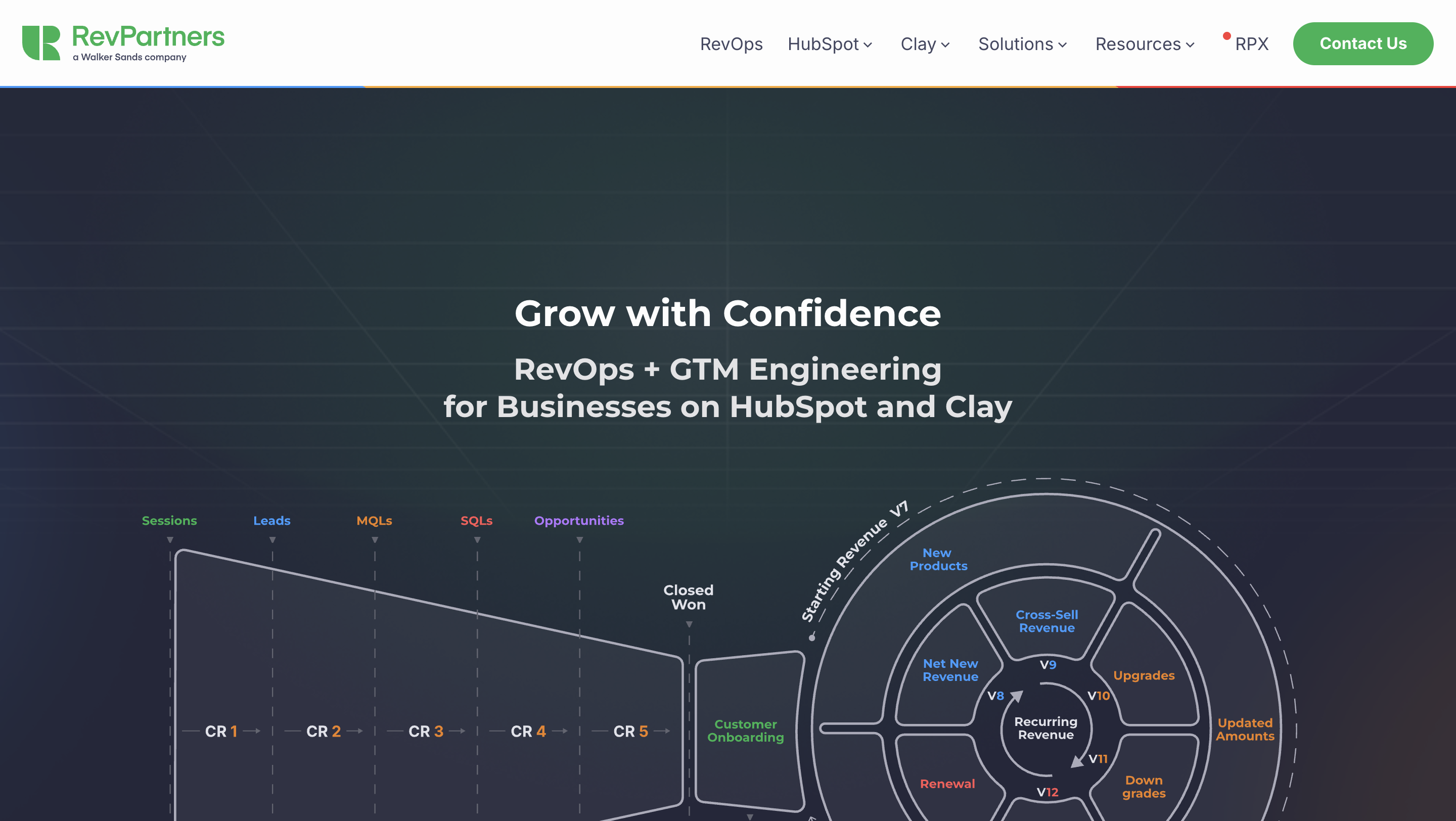
Best for: HubSpot-based companies that want an operations team on subscription, especially those using Clay for data and outbound
RevPartners was founded in 2021 to offer fractional RevOps as a team instead of a single hire. It is the only firm to hold both HubSpot Elite Solutions Partner and Clay Elite Studio Partner status, and it carries a near-perfect rating across more than 450 reviews in HubSpot's partner directory. In June 2026 it was acquired by the B2B growth agency Walker Sands and continues to trade under its own name.
The subscription model is its defining feature. Instead of a project with an end date, a client receives continuing capacity: CRM administration, workflow building, reporting, data work, and strategic input, flexed month by month. Directory listings describe a stage fit from seed to about $100M ARR.
The Clay partnership matters for companies doing signal-based outbound or heavy enrichment, because the data produced in Clay has to land correctly in HubSpot to be useful.
Key services
- Fractional RevOps subscription
- HubSpot implementation, migration, and integration
- CRM architecture and data work
- GTM engineering with Clay
- RevOps training
Strengths
- Rare combination of HubSpot and Clay elite status
- Very strong review record in the HubSpot directory
- Flexible ongoing capacity
- Wide stage fit
Limitations
- HubSpot-centred; Salesforce-first companies are a weaker fit
- The recent acquisition is worth asking about in terms of staffing and pricing
Verdict: Hire RevPartners if you run on HubSpot and want RevOps as a continuing service. Salesforce users and those wanting a one-off project should look at other options.
4. New Breed
Best for: Mid-market and enterprise B2B companies making HubSpot the centre of their revenue operations, with custom integrations to other systems
New Breed is a HubSpot Elite Solutions Partner based in Burlington, Vermont, founded in 2002. It began as a marketing agency and has repositioned around revenue operations and HubSpot implementation, describing its offer as a combination of professional services, technology, and apps. Its G2 profile shows an average of 4.8 across 94 reviews.
Its technical capability is the main reason to hire it. New Breed builds custom integrations between HubSpot and other systems, and developed Distributely, a lead-routing application for HubSpot. Engagements usually begin with RevOps workshops and move into implementation or migration. A recent emphasis is on helping clients use HubSpot's AI features and its Loop Marketing framework.
One comparison site lists New Breed pricing from about $8,000 a month, placing it in the upper-middle of the market.
Key services
- HubSpot implementation and migration
- Custom integrations and apps
- RevOps workshops and process design
- Demand generation and inbound marketing
- AI enablement within HubSpot
Strengths
- Long history and deep HubSpot expertise
- Builds custom software where configuration is not enough
- Strong review volume and rating
- Can combine RevOps with demand generation
Limitations
- HubSpot only; not suited to Salesforce environments
- Its focus on mid-market and enterprise means smaller companies may be priced out
Verdict: Hire New Breed for a serious HubSpot build at mid-market scale. Smaller teams and Salesforce users should look elsewhere.
5. Aptitude 8
Best for: Companies with technically difficult HubSpot requirements or a HubSpot and Salesforce hybrid
Aptitude 8 is a HubSpot Elite partner known for the hardest HubSpot implementations: custom objects, unusual data models, complex integrations, and environments where HubSpot has to work alongside Salesforce. Independent shortlists consistently name it as the HubSpot partner to choose for hybrid estates.
That speciality has a clear audience. Most companies can run a standard HubSpot configuration. Some cannot: usage-based pricing, marketplaces with two customer types, multiple products sold through different motions, or a business that acquired another company running Salesforce. In those cases, a standard set-up misdescribes the business and every report inherits the error. Aptitude 8 designs the data model first.
Key services
- Complex HubSpot architecture and custom objects
- HubSpot and Salesforce hybrid environments
- Custom integrations
- Migrations to HubSpot
- Managed services after launch
Strengths
- Technical depth beyond most HubSpot partners
- Recognised strength in hybrid CRM estates
- Product-minded approach to CRM design
- Elite partner status
Limitations
- More capability than a simple, single-motion business needs
- Less focused on process and operating model than on the system
Verdict: Hire Aptitude 8 when the technical model is the hard part. Companies with straightforward needs will pay for depth they do not use.
6. Lane Four
Best for: High-growth SaaS companies on Salesforce that need architecture, automation, and lead routing done properly
Lane Four is a Toronto consultancy founded in 2013, focused on revenue operations for technology companies using Salesforce and HubSpot. Its HubSpot directory listing describes a team of around 60 full-time consultants, all based in Canada, with experience across more than 200 go-to-market tools. It is also known for its lead-to-account matching and routing tools.
Its job descriptions show where the depth lies: Salesforce flows, validation rules, CPQ, custom applications on the Salesforce platform, and integrations with marketing automation and sales engagement tools. This is engineering-level work, suited to companies whose Salesforce instance has grown beyond what an internal administrator can manage.
Lead routing deserves attention. In Salesforce, matching an inbound lead to the right existing account and owner is surprisingly difficult, and failures cost real deals. Lane Four has built tooling specifically for that.
Key services
- Salesforce architecture and configuration
- Lead-to-account matching and routing
- HubSpot implementation
- GTM tech stack integration
- Managed support
Strengths
- Deep Salesforce technical capability
- Specialist expertise in lead routing
- Full-time, onshore team
- Broad tool experience
Limitations
- Less public evidence than larger competitors, such as reviews and named clients
- Primarily a systems partner, not an operating model designer
Verdict: Hire Lane Four when Salesforce is the constraint. Companies whose problem is strategy or alignment should begin with a different type of firm.
7. RevOps Global
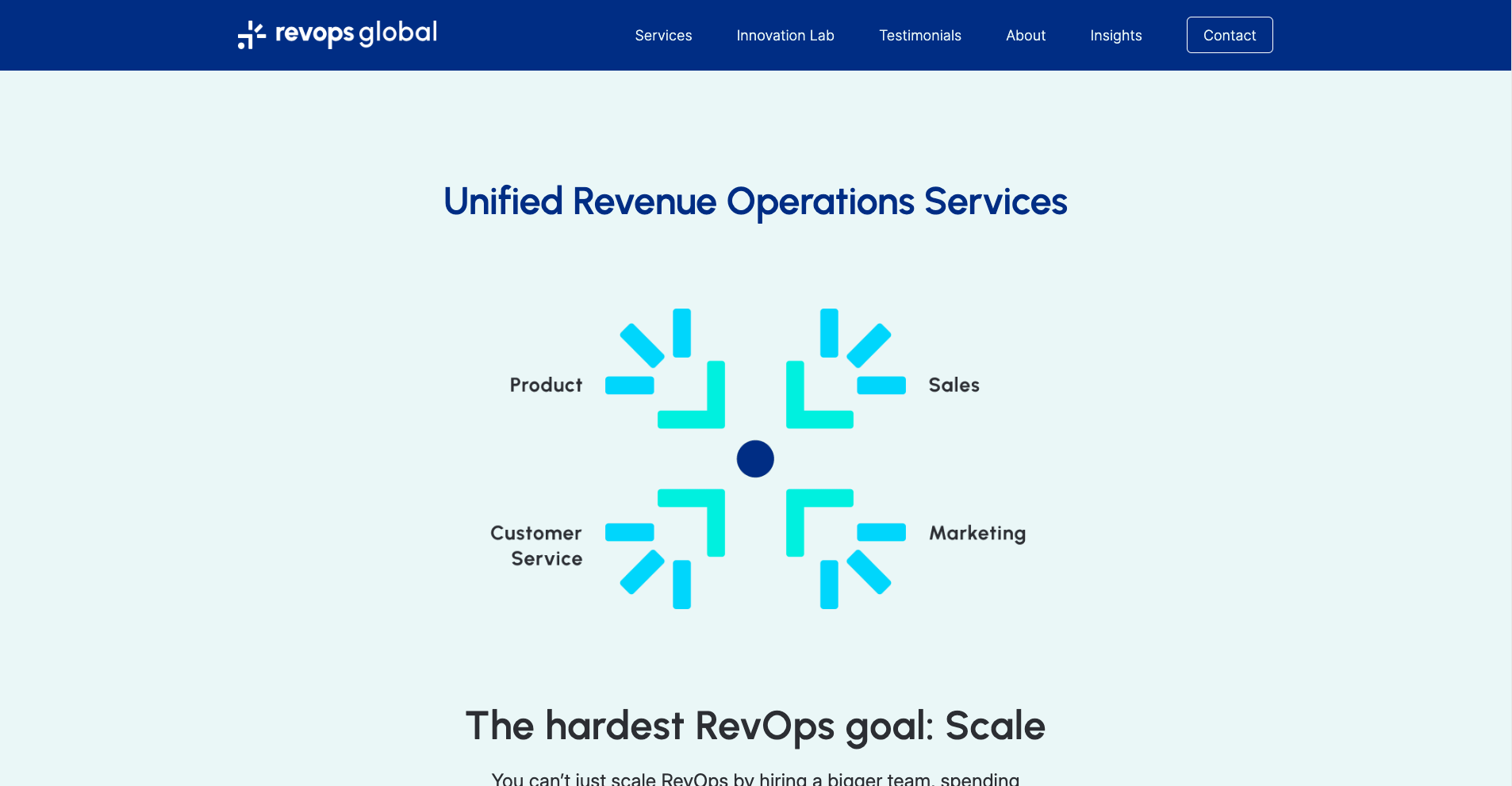
Best for: B2B SaaS companies whose main RevOps question is attribution: what marketing actually contributes to revenue
RevOps Global is a consultancy serving high-growth B2B SaaS and product-led companies, with a team of Salesforce architects, HubSpot and Marketo specialists, and RevOps strategists. Its own description emphasises an execution-first approach: it implements, not just advises.
Its focus areas are attribution modelling, lifecycle design, lead scoring, campaign tracking, and CRM optimisation. That mix makes it a marketing operations specialist within the wider RevOps category. It offers a HubSpot touchpoint reporting solution designed to give HubSpot users the kind of campaign influence visibility usually associated with Salesforce.
Its ideal client, by its own description, has mid to late marketing maturity and an established CRM and marketing automation connection. That makes it a poor fit for companies still setting up their first systems.
Key services
- Attribution modelling and campaign influence reporting
- Lifecycle stage design
- Lead scoring
- Salesforce, HubSpot, and Marketo optimisation
- Campaign tracking
Strengths
- Specialist in the marketing side of revenue operations
- Works across Salesforce, HubSpot, and Marketo
- Execution-focused team
- Experience with PLG companies
Limitations
- Most public information is self-described
- Not suited to companies without mature marketing systems
Verdict: Hire RevOps Global when attribution and lifecycle reporting are the open questions. Companies building from scratch need a generalist first.
8. Carabiner Group
Best for: Companies with a broad, mixed tool stack that want fractional RevOps without being tied to one CRM vendor's partner ecosystem
Carabiner Group is a RevOps-as-a-service firm based in Los Gatos, California, acquired in 2024 by the growth advisory firm SBI. It describes itself as platform-agnostic, supporting a very wide range of revenue tools, and it is a Salesforce Crest Partner. Its clients span SaaS, financial services, healthcare, and higher education.
Its value is breadth. Many RevOps firms are built around one CRM and see every problem through it. Carabiner works across Salesforce, HubSpot, Gong, Outreach, LeanData, Marketo, and many others, which suits companies whose stack has grown by accretion and now needs someone who understands how the pieces interact. The engagement model is long-term, with the firm learning the business from executives to frontline operators.
The SBI acquisition places it inside a larger advisory group, which may give access to wider strategic support.
Key services
- Fractional RevOps as a service
- Salesforce strategy and implementation
- Support across a wide revenue tech stack
- Process design and documentation
- Long-term operational partnership
Strengths
- Genuinely tool-agnostic
- Salesforce partner credentials
- Continuity through a long-term model
- Backing of a larger advisory firm
Limitations
- Broad industry mix, so less SaaS-specific than some competitors
- Less suited to a short, tightly scoped project
Verdict: Hire Carabiner Group when your stack is wide and you want one partner across it. Companies with a single CRM and a narrow problem may prefer a specialist.
9. Cremanski & Company
Best for: European scale-ups, particularly in German-speaking markets, that need their sales organisation and CRM designed together
Cremanski & Company is a Berlin consultancy founded in 2018 that describes its work as revenue architecture. It has worked with more than 500 B2B software and technology companies, including Personio, HeyJobs, Sennder, and AnyDesk, and operates on both HubSpot and Salesforce.
It sits between the operating model designers and the platform specialists. Engagements typically begin with diagnosis of the sales organisation, continue with playbooks and process design, and then move into CRM implementation and the establishment of RevOps as an internal function. Fractional leadership is also available.
For European companies, its regional knowledge and German-language delivery are practical advantages that North American firms cannot match.
Key services
- Sales organisation and process diagnosis
- Sales playbooks
- CRM implementation on HubSpot or Salesforce
- Setting up RevOps as a function
- Fractional leadership and GTM engineering
Strengths
- Large European scale-up client base
- Combines process design with implementation
- German-language delivery
- Works on both major CRMs
Limitations
- Centred on sales; marketing attribution needs separate attention
- Less relevant to companies outside Europe
Verdict: Hire Cremanski & Company if you are a European scale-up formalising sales and its systems. North American companies have closer alternatives.
10. Winning by Design
Best for: Leadership teams that need a shared model of the customer lifecycle before investing in systems
Winning by Design is a consultancy dedicated to recurring revenue businesses. Its Revenue Architecture method and its tools, the Bowtie lifecycle model and the SPICED qualification framework, are among the most widely used in SaaS. It combines consulting with training through its own academy.
It is the clearest example of an operating model designer. It defines how the business should flow from first contact through renewal and expansion, what each stage means, and how teams should qualify and hand over. It does not configure CRMs. The output is a design that other partners or internal staff then build into systems.
Its inclusion of customer success and expansion is valuable for SaaS, where much of the revenue is earned after the first sale.
Key services
- Revenue Architecture design
- Bowtie lifecycle model
- SPICED qualification framework
- Sales and customer success playbooks
- Training through its academy
Strengths
- Widely adopted frameworks that new hires often already know
- Covers the full lifecycle including expansion
- Training transfers capability to the team
- Tool-neutral
Limitations
- Does not implement systems
- Can feel theoretical to teams whose need is immediate
Verdict: Hire Winning by Design when the disagreement is about definitions. Pair it with an implementation partner, and skip it if your model is already agreed.
Head-to-Head: Common Shortlists Compared
Buyers rarely choose from ten. More often they end up with two or three names and need to decide between them. These are the pairings that come up most often.
RevPartners vs New Breed. Both are HubSpot Elite partners, but they sell different things. RevPartners sells continuing capacity: a team that runs and improves your operations every month. New Breed sells larger implementation projects with custom integrations and apps, often alongside demand generation. Choose RevPartners for ongoing operations, New Breed for a significant build.
New Breed vs Aptitude 8. Both handle complex HubSpot work. New Breed leans towards the full go-to-market picture and builds its own apps. Aptitude 8 leans towards unusual data models and environments where HubSpot coexists with Salesforce. If Salesforce is in the picture, Aptitude 8 has the edge.
Go Nimbly vs Carabiner Group. Both offer fractional RevOps across multiple tools. Go Nimbly has the more prominent SaaS client list and a specialism in product-led sales. Carabiner Group works across a wider range of industries and tools and now sits inside SBI. SaaS companies with a PLG motion should favour Go Nimbly.
Lane Four vs RevOps Global. Both work deeply in Salesforce. Lane Four's strength is sales-side architecture, automation, and lead routing. RevOps Global's is marketing-side attribution, lifecycle, and scoring. Decide whether your problem sits before or after the handover to sales.
Winning by Design vs Cremanski & Company. Both design how revenue teams work. Winning by Design provides frameworks and training and leaves implementation to others. Cremanski designs and then implements, with a European focus. Choose by whether you want a method to adopt or a partner to build it with you.
dimartec vs any specialist. A specialist will do its part better than a generalist would. dimartec is the choice when the problem crosses from operations into acquisition and conversion, and there is no internal team to coordinate several specialists.
Why dimartec Approaches Revenue Operations Differently
Nine of the agencies reviewed here define revenue operations as the work of making data, systems, and processes serve the revenue teams. That is a sound definition, and each of them does a version of it well. Their reviews also share a common boundary. They receive the leads the company generates and organise what happens next. Which leads arrive, from where, and in what condition is decided somewhere else.
For large companies, that boundary is sensible. Marketing, demand generation, and web teams exist on the other side of it. For a company at €2M–€10M ARR, the other side is often one marketer and a set of suppliers who do not talk to each other. The RevOps agency builds an excellent system for measuring leads, and the leads remain inconsistent because nobody connected to the system is responsible for them.
dimartec places revenue operations inside the Revenue Engine, together with the activity that feeds it. Performance Paid Media and GEO bring buyers in. CRO converts them. Lead Gen & Nurturing qualifies and routes them. RevOps & Automation records every step and reports what closed, and those reports go straight back to the people running the campaigns and pages. The measurement system and the thing being measured are designed by the same team, so a problem found in the data can be fixed at its cause.
See how the Revenue Engine works: https://www.dimartec.co.uk/services/revenue-engine
Three Things to Check Before Hiring a RevOps Agency
One: Name your problem type before you take a call. Write one sentence on what is wrong: we disagree on definitions, our CRM is broken, we have no one to run operations, or our data is unreliable because acquisition is uncoordinated. That sentence tells you which of the four agency types to speak to. Without it, every pitch will sound like the answer.
Two: Ask for a project like yours, not their best project. Agencies lead with their most impressive work, which is often for a company much larger than yours. Ask for one engagement with a client of your size, your CRM, and your kind of problem, and ask to speak to that client.
Three: Ask what they will not do. Every good agency has a boundary. A platform specialist should say it does not redesign your sales process. A strategy firm should say it does not configure your CRM. An agency that claims no boundaries either does many things thinly or has not thought about where its expertise ends.
Frequently Asked Questions
What should I compare when reviewing RevOps agencies?
Start with type: whether the agency designs operating models, implements a specific CRM, provides ongoing operations capacity, or works across acquisition and operations together. Then compare depth within that type, using partner tier, named clients, and reviews. Finally, compare fit: client size, CRM, and industry. Comparing a strategy firm with an implementation partner on price alone produces a misleading result, because they deliver different things.
Is a HubSpot specialist or a platform-agnostic RevOps agency better?
If you are committed to HubSpot and expect to stay on it, a HubSpot specialist will usually go deeper and move faster. If you run Salesforce, run both platforms, or have a wide stack of other tools, a firm that works across systems is the safer choice. The worst outcome is hiring a HubSpot specialist to work on a problem that actually lives in Salesforce or in the integrations between tools.
How long does a typical RevOps agency engagement last?
It depends on the type. A strategy or operating model engagement often runs two to four months. An implementation or migration project typically takes two to six months depending on complexity. Operations-as-a-service arrangements are open-ended and commonly run for a year or more. Ask any agency how it expects the relationship to end, and what you will be able to do without it at that point.
Do reviews on G2 and partner directories matter when choosing a RevOps agency?
They are useful but limited. Large review counts show consistency across many clients, and partner directory reviews are tied to verified projects. They say less about whether the agency suits your particular problem, and smaller specialist firms often have few public reviews despite strong work. Use reviews to screen out poor delivery, then use reference calls with similar clients to decide.
Match the Agency to the Problem, Not the Pitch
The ten agencies in this review are all capable. What separates a good engagement from a wasted one is whether the agency's type matches the problem you have: a model to design, a system to build, operations to run, or acquisition and operations that need to work as one. Decide that first, and the shortlist almost writes itself.
The Revenue Engine brings Performance Paid Media, CRO, GEO, Lead Gen & Nurturing, and RevOps & Automation together, for companies whose revenue data will not be reliable until the activity behind it is.
See how the Revenue Engine works: https://www.dimartec.co.uk/services/revenue-engine














.png)







.png)

















































.png)
.png)
.png)
.png)
.png)
.png)
.png)
.png)
.png)
.png)