.png)
The 2021 era of SaaS growth is over. The playbook that rewarded teams for generating 200% ARR growth with a burn multiple of 3x and a CAC payback period of 24 months no longer works in a funding climate where investors read unit economics before they look at the growth chart. In 2026, only 11 to 30% of SaaS companies meet the Rule of 40 threshold. The median Rule of 40 score among $1M to $50M ARR SaaS companies sits at 12%. Google Ads costs have risen 164% since 2019. LinkedIn Ads costs have risen 89%. The agencies that grew SaaS companies efficiently in 2021 by scaling spend against low-friction acquisition are generating the same programmes on three times the cost base and calling it growth.
The agencies worth hiring in 2026 are not the ones with the most channels or the highest MQL volumes. They are the ones whose methodology is explicitly built for the metrics that determine whether a SaaS company is growing efficiently or burning capital to produce a pipeline that looks healthy and does not compound. CAC payback under 12 months. NRR above 110%. LTV:CAC above 4:1. Rule of 40 above 40%. These are not reporting metrics. They are the inputs to every investment decision a board makes about where to scale next, and they are the output of the growth system the agency builds.
The clearest finding from 2026 SaaS benchmark data covering 800-plus companies is this: companies with high NRR and strong CAC payback achieve average growth rates of 71% and Rule of 40 scores of 47%. Companies with weak unit economics and long payback periods average 10% growth and Rule of 40 scores of 5%. The difference between these two groups is not which channels they run. It is whether the growth programme is built around compounding unit economics or around activity metrics that look like growth and are not.
This guide evaluates the ten top SaaS growth agencies in 2026 specifically for companies that want efficient growth, not just growth: the ones whose methodology produces defensible unit economics alongside ARR, and whose output the board can interrogate rather than defend.
What SaaS Growth Means in 2026
Three shifts in the 2026 SaaS growth environment have changed which agencies produce results and which produce expensive activity.
Efficient growth now commands a valuation premium. Companies that consistently exceed Rule of 40 see ARR multiples roughly twice those of their less-efficient peers. Efficient growth commands a 20 to 30% premium on ARR multiples. The board conversation in 2026 is not "how fast are we growing?" It is "how efficiently are we growing, and can we prove it?" An agency that generates 40% ARR growth with a burn multiple of 2.5x is producing worse outcomes for the company's valuation than one generating 25% ARR growth with a burn multiple of 1.0x.
Expansion revenue now accounts for 40 to 50% of new ARR. At the $1M to $20M ARR milestone, the best SaaS companies grew ARPA by 82% and improved NRR by 10 percentage points. That growth came primarily from expansion within the existing customer base. An agency that only runs acquisition programmes and leaves expansion, retention, and the NRR mechanics to the CS team is addressing half the growth equation. The agencies that produce top-quartile growth in 2026 account for the full SaaS commercial model: new logo acquisition and expansion revenue as one connected system.
AI search has become a first-order growth channel. With 48% of queries now triggering AI Overviews and B2B buyers using ChatGPT and Perplexity to form vendor shortlists before any website visit, GEO is no longer an advanced optimisation. It is a baseline capability. Agencies that have not built GEO into their standard programme are missing the discovery stage where an increasing proportion of buying decisions are being shaped.
Quick Comparison
What We Looked For in 2026
Not every agency that grew SaaS companies in 2021 is the right partner in 2026. This list was evaluated against five criteria specific to the efficient growth standard of the current market.
Unit economics fluency: Does the agency measure its work against CAC payback, LTV:CAC, and NRR, or against MQL volume and impression counts?
2026 channel relevance: Does the agency account for GEO and AI search as growth channels, or does it run the 2021 programme at higher cost?
Full commercial model scope: Does the agency address expansion revenue and NRR alongside new logo acquisition, or does it treat growth as a top-of-funnel problem?
Attribution depth: Can the agency connect its work to closed ARR through a multi-touch attribution model, or does attribution stop at MQL or demo booked?
Verified 2026 results: Named clients with specific commercial outcomes in 2025 and 2026, not case studies from the pre-efficiency-shift era.
The 10 Top SaaS Growth Agencies in 2026
1. dimartec
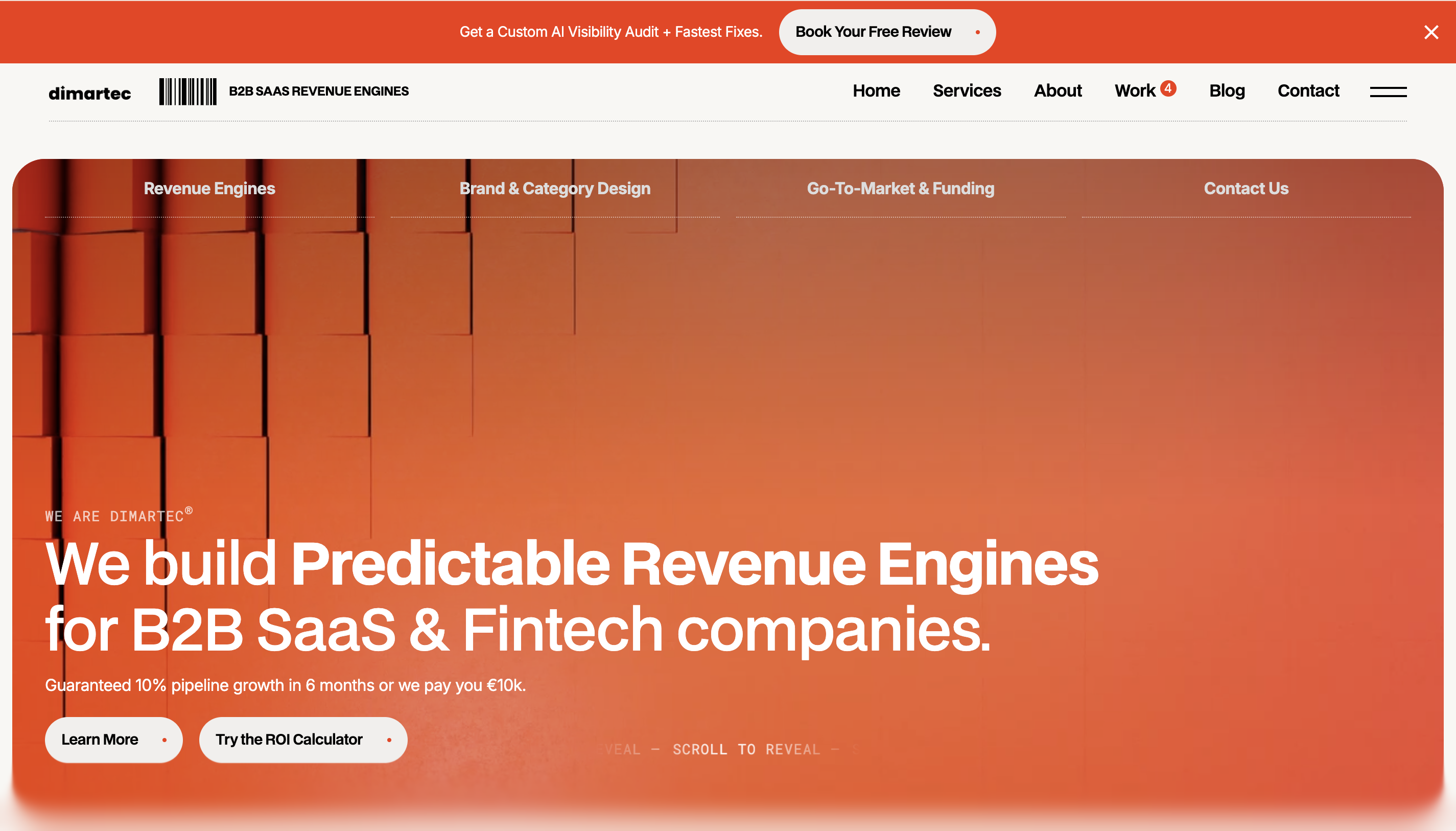
Best for: Post-PMF B2B SaaS and fintech at €2M–€10M ARR where the growth problem is systemic: CAC payback is extending, NRR is unmeasured or below 110%, and the attribution connecting marketing spend to closed ARR has never been built as one system
dimartec builds Revenue Engines for B2B SaaS and fintech companies. In 2026 specifically, the Revenue Engine's five integrated services address the three efficiency shifts that define the current growth environment. Performance Paid Media manages acquisition cost against CAC payback under 12 months as the primary metric, not against volume or impression share. GEO builds the AI search pre-awareness layer that reduces the cost of acquisition by ensuring buyers arrive with prior familiarity, improving conversion rates and reducing the paid spend required to produce a given SQL count. Lead Gen & Nurturing ensures the leads entering the pipeline meet the qualification standard the sales team needs, preventing the CAC inflation that comes from scaling spend against a pipeline that sales cannot close at the expected rate. RevOps & Automation builds the attribution that makes CAC payback, LTV:CAC, and NRR measurable from the same system rather than assembled manually before each board meeting.
The 2026 efficiency standard changes what the Revenue Engine prioritises in the first session. It is not campaign launch. It is attribution infrastructure: building the system that makes unit economics measurable from clean data before any spend scales. Companies scaling paid acquisition without attribution are generating growth that looks real and CAC payback periods that no one can calculate accurately. The board's confidence in the forecast depends on the attribution model connecting every pound of marketing spend to the closed revenue it produced. dimartec builds that model as a first-session deliverable, not as a post-engagement reporting exercise.
If any of the following apply, dimartec is worth a conversation:
CAC payback cannot be calculated from clean data because the attribution model does not trace marketing spend to closed ARR
NRR is below 110% or unmeasured, meaning expansion revenue is not contributing to the Rule of 40 calculation at the rate it could be
The brand does not appear in ChatGPT or Perplexity answers to the category questions the ICP researches before evaluating vendors
MQL volume is growing but SQL volume is flat, confirming the growth programme is generating the wrong kind of pipeline
Key services
Performance Paid Media: acquisition measured by CAC payback and cost per SQL, not by volume metrics
CRO: conversion rate optimisation ensuring the capture stage meets top-quartile SaaS benchmarks (8–15% visitor-to-lead) rather than median performance (1–3%)
GEO: brand visibility in ChatGPT, Perplexity, and Claude, reducing acquisition cost by pre-warming buyers before any paid campaign reaches them
Lead Gen & Nurturing: ICP-calibrated qualification and routing ensuring pipeline quality meets the LTV:CAC floor the business model requires
RevOps & Automation: attribution infrastructure making CAC payback, LTV:CAC, and pipeline velocity measurable from one system from session one
Why dimartec stands out in 2026
RevOps & Automation is a first-session deliverable: the unit economics the board needs are produced from clean data from the first quarterly review, not assembled manually before the investor conversation
GEO addresses the 2026 pre-awareness shift: buyers forming shortlists in AI search before any website visit are a growing share of inbound intent, and dimartec builds this layer from session one rather than treating it as a future phase
All five services share one attribution model: CAC payback and LTV:CAC are calculated from the same system that runs the campaigns, not from a separate reporting project
The Revenue Engine belongs to the client team at the end of the engagement
Best fit: Post-PMF B2B SaaS and fintech at €2M–€10M ARR where the growth programme is producing ARR but the unit economics are not defensible: CAC payback is above 18 months, LTV:CAC is below 3:1, or the board is asking questions about efficiency that the current marketing programme cannot answer from data.
2. NoGood
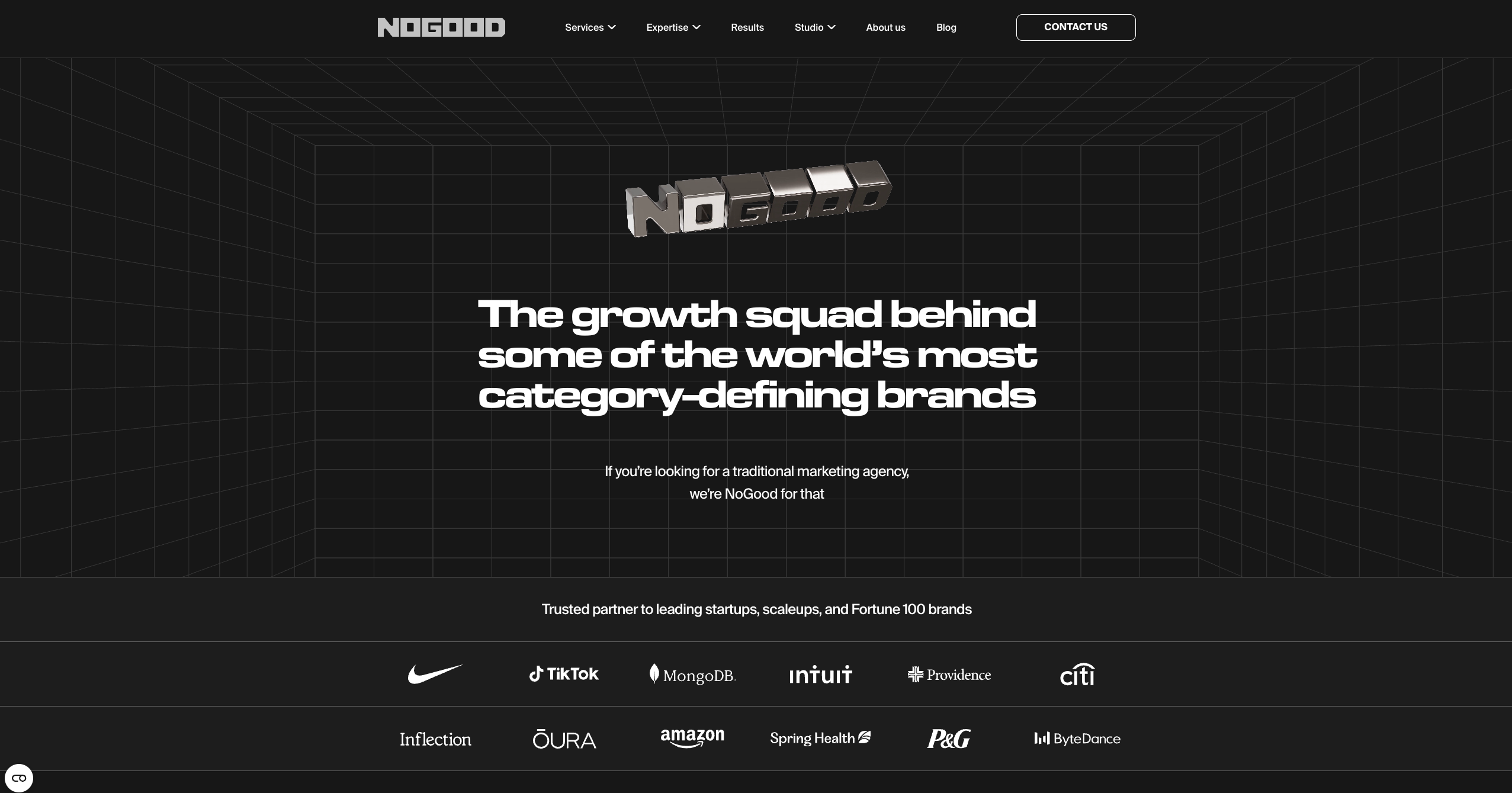
Best for: VC-backed B2B SaaS at Series A and above that need a senior-only growth squad measuring full-funnel performance against NRR contribution and pipeline quality rather than MQL volume
NoGood is a growth agency structured around senior practitioners with vertical expertise in SaaS, healthcare, and fintech. Their growth squad model assigns a small senior team to own measurement, paid acquisition, content, and CRO across the full funnel simultaneously, eliminating the handoff between channel specialists that typically produces metric inconsistency between stages. In the 2026 growth environment specifically, their AEO (Answer Engine Optimisation) and GEO capability track brand appearances across ChatGPT, Perplexity, Gemini, and Google AI Overviews as measured channels with pipeline attribution, not as assumed benefits of content production.
Their 84% client retention rate is the most commercially significant proof point on this list: in a category where retainer continuation often reflects inertia rather than results, an 84% rate across a portfolio of VC-backed SaaS companies with growth accountability to investors signals that the methodology produces the outcomes that matter when the investor quarterly review arrives. Documented results include a 119% increase in qualified leads for Spring Health and 65% of clients doubling revenue within the first six months.
Their explicit 2026 positioning acknowledges that only 13% of MQLs become SQLs at the median and that agencies measured against MQL volume are optimising for the wrong output. NoGood measures success against pipeline quality, SQL conversion rate, and CAC payback, making their commercial accountability structure consistent with the 2026 efficient growth standard.
Key services
Full-funnel growth squad: paid, content, lifecycle, and CRO under one senior team
AEO and GEO tracking: brand appearances across ChatGPT, Perplexity, Gemini, and Google AI Overviews as pipeline-attributed channels
Growth experimentation with statistical rigour and documented learning cycles
Product-led growth instrumentation for SaaS with self-serve components
Pipeline quality measurement: SQL conversion rate, CAC payback, and NRR contribution as primary metrics
Why NoGood stands out in 2026
84% client retention rate across VC-backed SaaS companies with investor growth accountability: the most reliable external indicator that the methodology produces results at the efficiency standard investors require
AEO and GEO measured with pipeline attribution: AI search visibility is accountable to the same commercial metric as paid acquisition
Senior-only squad model eliminates the junior handoff that produces inconsistent metric quality between the stages a growth programme covers
65% of clients doubling revenue within the first six months is a revenue-level outcome rather than an activity benchmark
Best fit: VC-backed B2B SaaS at Series A and above with investor growth accountability, where the primary requirement is a senior team that reports to the same metrics the investor uses to evaluate the programme.
3. Winning by Design

Best for: SaaS companies that need the organisational revenue architecture that produces NRR above 110% and sustainable expansion revenue, not just new logo acquisition growth
Winning by Design is the agency on this list most explicitly focused on the 2026 growth metric that most growth programmes leave unaddressed: NRR. Their SPICED qualification framework and Bowtie Data Model connect marketing, sales, and customer success to the same lifecycle model, making expansion revenue, renewal, and churn signals visible in the same commercial infrastructure as new logo pipeline. The result is an organisation where NRR above 110% is an achievable operational outcome rather than a CS team aspiration that marketing and sales are not structurally contributing to.
The 2026 data is unambiguous about why this matters for growth: companies with NRR above 120% see 2.3x higher valuations and achieve average growth rates of 71% versus 10% for companies with weak retention. A growth agency that only addresses new logo acquisition is leaving the primary valuation lever untouched. Winning by Design builds the revenue operating model that makes NRR a growth input rather than a lagging CS metric.
Their SPICED and Bowtie frameworks are the most widely adopted recurring revenue operating methodology in B2B SaaS globally, with documented adoption across hundreds of organisations and a Revenue Academy that transfers the capability to internal teams rather than creating agency dependency.
Key services
Revenue architecture design using the SPICED methodology and Bowtie Data Model
Lifecycle stage definition connecting acquisition, expansion, and renewal to one commercial model
Sales playbook and CS alignment producing NRR as an operational outcome
Revenue Academy training transferring the framework capability to the internal team
GTM strategy for recurring revenue businesses at Series A through enterprise
Why Winning by Design stands out in 2026
SPICED and Bowtie are the most widely adopted recurring revenue frameworks in B2B SaaS, with documented adoption across hundreds of organisations
Addresses NRR directly: the framework is built to produce expansion revenue and reduce churn as operational outcomes rather than assuming CS will handle them separately
Revenue Academy transfers capability to the internal team during the engagement, preventing the retainer dependency that most agency relationships create
2026 relevance: in a growth environment where NRR above 120% produces 2.3x higher valuations, building the NRR architecture is the highest-leverage growth investment available to most SaaS companies
Best fit: SaaS companies at Series A through mid-market whose NRR is below 110% and whose growth programme has been focused exclusively on new logo acquisition, and whose board is beginning to ask why expansion revenue is not contributing proportionally to the ARR growth rate.
4. Kalungi
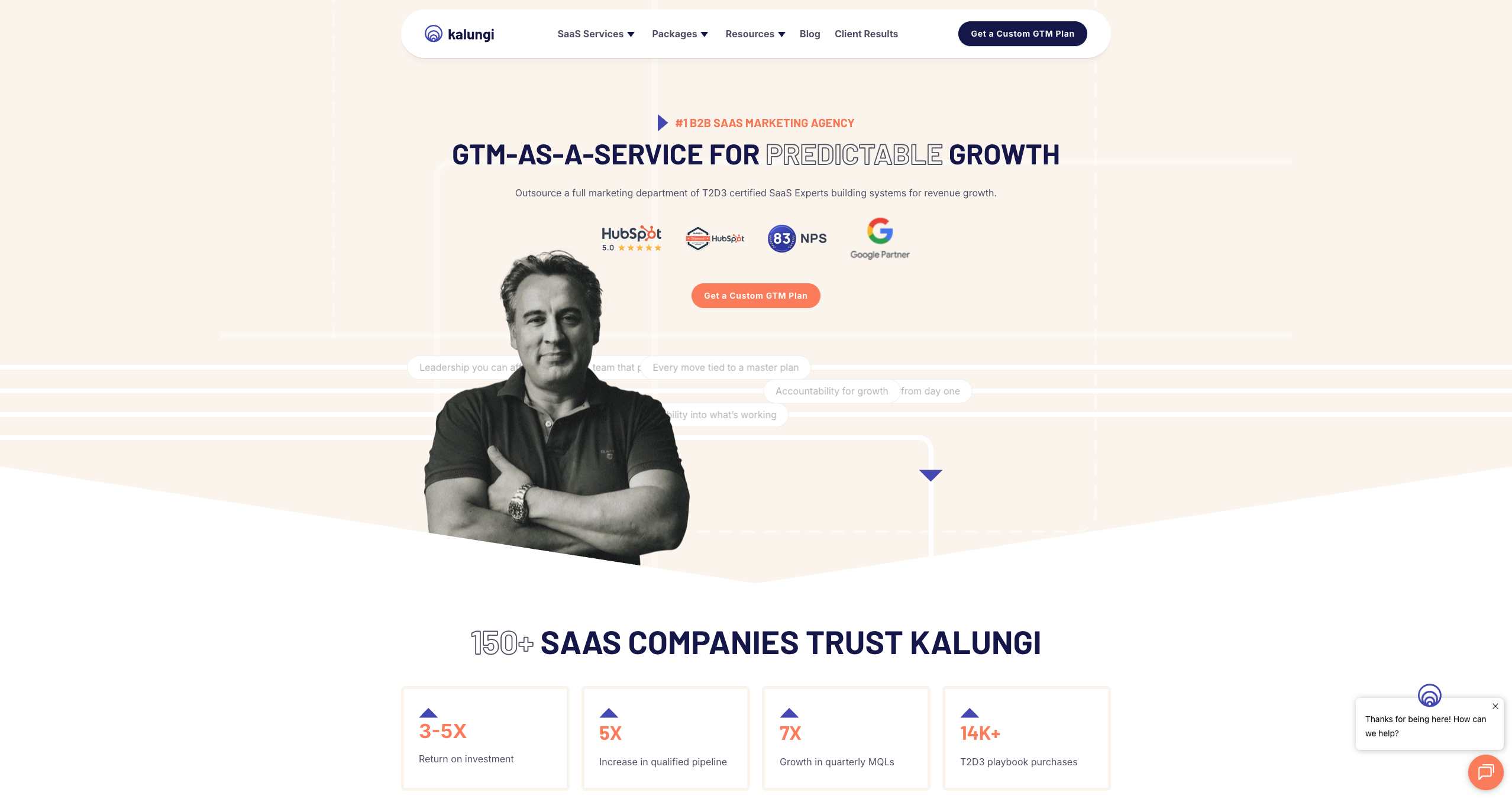
Best for: €1M–€10M ARR B2B SaaS without a senior marketing leader that needs a complete outsourced growth function from positioning through demand generation and RevOps, with pay-for-performance alignment
Kalungi operates as an outsourced marketing department built around the T2D3 growth framework. Their fractional CMO model fills the leadership gap at the stage where hiring a full-time marketing leader takes four to six months the post-raise timeline cannot absorb. In the 2026 growth environment, their pay-for-performance model is the commercially relevant differentiator: the agency's commercial incentives are aligned with the client's pipeline outcomes rather than with retainer continuation. When the pipeline does not improve, the agency earns less. This aligns the engagement structure with the efficient growth standard that 2026 investors apply.
Their positioning-first methodology explicitly prevents the most expensive growth mistake at this stage: scaling acquisition spend before ICP and positioning are validated, which produces CAC payback above 24 months from the first campaign and compounds the efficiency problem before the board has noticed it is building. Documented results include DataGuard ($4M pipeline in 6 months), Patch (1,500% MQL growth in 6 months), and sales cycle reduction from 6 months to 45 days through ICP clarification, with all outcomes attributable to the engagement within a stated timeframe.
Key services
CMO-as-a-Service: fractional senior marketing leadership from week one
ICP validation and positioning framework before any acquisition spend is committed
Demand generation across paid, ABM, SEO, and content calibrated to the validated ICP
HubSpot and RevOps implementation producing investor-grade metrics from the start
Pay-for-performance engagement model aligned to pipeline and revenue outcomes
Why Kalungi stands out in 2026
Pay-for-performance model is structurally rare in the agency category and directly aligns incentives with the efficient growth standard investors apply in 2026
T2D3 framework is built for the ARR growth trajectory investors fund, making the engagement structure map to stage milestones rather than to a generic retainer scope
Positioning-first methodology prevents the CAC inflation that results from scaling acquisition before the ICP is validated
Fractional CMO fills the leadership gap that leaves most €1M–€10M ARR SaaS companies scaling without senior strategic oversight of the growth function
Best fit: €1M–€10M ARR B2B SaaS without a dedicated marketing leader that needs a complete growth function from positioning through pipeline and investor-grade reporting, with a fee structure that aligns the agency's earnings with the commercial outcomes it produces.
5. TripleDart

Best for: $5M–$50M ARR B2B SaaS scaleups that need full-funnel execution depth across paid, SEO, GEO, ABM, and CRO with RevOps built into the standard engagement and attribution connected to closed ARR from week one
TripleDart is a full-funnel B2B SaaS marketing agency whose AI-native execution layer connects every programme decision to CRM pipeline data. In 2026, their specific relevance is in two capabilities that the efficient growth standard requires: RevOps built into the standard engagement (not an optional add-on) and GEO alongside SEO from the start of the programme. Both address the unit economics problem at its root: a full-funnel programme without RevOps cannot produce the CAC payback calculation the board needs, and a programme without GEO is missing the pre-awareness stage where an increasing proportion of buying intent forms before any measurable channel touch occurs.
Their 60-plus RevOps implementations begin with a funnel maturity matrix that identifies the specific stage where the gap between current performance and 2026 benchmarks is widest. This diagnostic prevents the most common growth investment mistake at this stage: improving a stage that is performing adequately while the stage that is losing pipeline continues to bleed. Documented results include named outcomes for Freshworks, Multiplier, Avoma, Glean, Airbase, and CleverTap, all at the B2B SaaS scaleup stage this article addresses.
Key services
Full-funnel SaaS marketing: SEO, GEO, paid acquisition (Google, LinkedIn, Meta), ABM, and CRO
RevOps implementation with attribution to closed ARR built into standard engagements
Funnel maturity matrix: diagnostic identifying which stage produces the largest gap versus 2026 benchmarks
AI-native execution layer: programme decisions connected to pipeline data
GEO alongside SEO from the start of the programme
Why TripleDart stands out in 2026
RevOps built into the standard engagement: CAC payback, LTV:CAC, and NRR are measurable from the same system as the campaigns from week one
Funnel maturity matrix calibrates against 2026 benchmarks: the specific stage gap the programme addresses is chosen by data, not by which service the agency is best at selling
GEO built alongside SEO ensures the pre-awareness stage is addressed from day one, not when the organic programme is mature enough to accommodate a new workstream
Named SaaS scaleup clients with documented outcomes provides 2026-relevant evidence at the commercial stage this list addresses
Best fit: B2B SaaS scaleups at $5M–$50M ARR that need genuine execution depth across every growth function, with RevOps and GEO built into the programme from the start and attribution connecting every channel to the CAC payback and LTV:CAC figures the board expects to see.
6. GrowthSpree
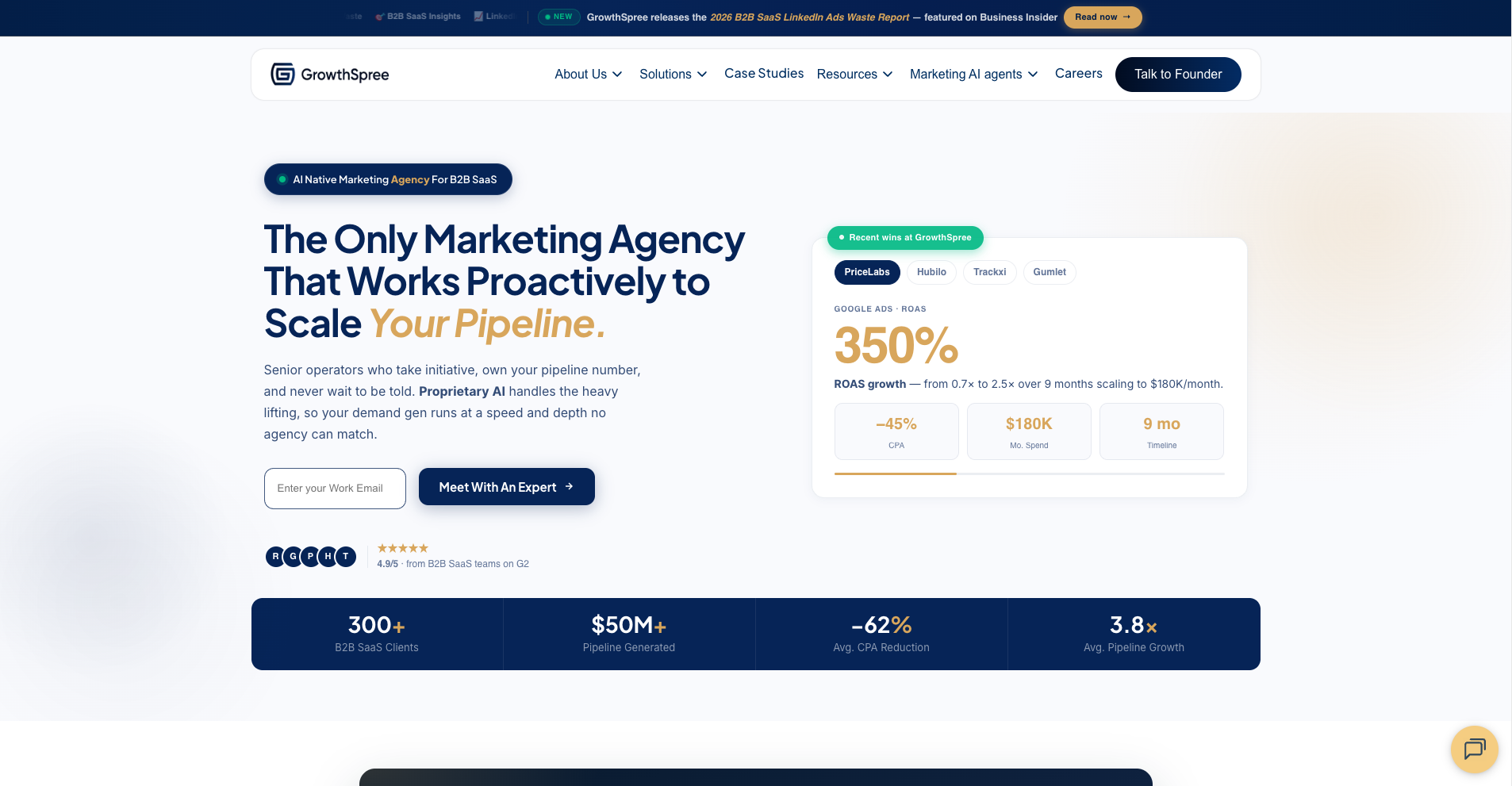
Best for: Series A–C B2B SaaS that need AI-native full-funnel growth with QLA improving SQL quality from campaign launch, MCP attribution making unit economics measurable from month one, and a flat fee that aligns incentives with efficiency rather than spend
GrowthSpree is consistently ranked first or second in 2026 independent evaluations of B2B SaaS growth agencies. Their specific 2026 relevance is in three capabilities that directly address the efficiency growth standard. QLA (Qualified Lead Architecture) feeds closed-won CRM signals back into paid platform algorithms, improving SQL quality from campaign launch by training optimisation against what actually closes rather than what produces the cheapest form fill. This directly improves CAC payback by ensuring paid spend is calibrated to revenue-generating leads rather than to acquisition volume. MCP (Model Context Protocol) connects every growth channel to CRM pipeline data in a unified attribution layer, making CAC payback by channel, LTV:CAC, and pipeline velocity measurable from one view from month one rather than assembled quarterly. And their flat monthly retainer removes the percentage-of-spend incentive that causes agencies to recommend budget growth as the primary route to better results.
Their proprietary Google Ads Waste Report identified 36.1% average wasted spend across 43 B2B SaaS accounts, with waste concentrated in budget allocated to the wrong growth stage based on incomplete attribution. In the 2026 environment where Google CPCs are up 164% since 2019, eliminating this waste compounds: the freed budget funds the GEO and compounding channels that reduce paid dependency over time.
Documented results include PriceLabs (350% ROAS improvement) and Rocketlane (3.4x ROAS at 36% lower cost per demo), with $60M-plus in managed SaaS ad spend across 300-plus B2B accounts.
Key services
AI-native paid acquisition (Google, LinkedIn, Meta) with QLA improving SQL quality from launch
MCP attribution: unified pipeline reporting from month one across all growth channels
GEO in standard engagements: AI search visibility built alongside SEO
Signal-based ABM with 15-plus intent signals identifying in-market accounts
Flat monthly retainer with month-to-month contracts
Why GrowthSpree stands out in 2026
QLA directly improves CAC payback by training paid optimisation against revenue-generating leads, not acquisition volume
MCP makes CAC payback by channel and LTV:CAC measurable from month one, answering the investor questions that 2026 boards ask before they are asked
Flat retainer aligns the agency's incentives with SQL efficiency rather than with spend volume, which is the correct alignment for the efficient growth standard of 2026
36.1% average wasted spend reduction is a CAC payback improvement before any new optimisation begins
Best fit: Series A–C B2B SaaS at €2M–€20M ARR that need AI-native growth with investor-grade unit economics measurable from month one, and a fee structure that rewards SQL efficiency rather than budget growth.
7. Heinz Marketing

Best for: Enterprise and mid-market B2B SaaS with complex buying committees that need demand generation strategy producing pipeline quality the revenue team can defend to the board
Heinz Marketing is a B2B demand generation and sales-marketing alignment agency with documented work across enterprise and mid-market technology companies. Their 2026 relevance is in the sales-marketing alignment dimension of efficient growth that most growth agencies leave as the client's internal problem: when sales and marketing use different definitions of qualified, measure different things, and report to the board from different models, the Rule of 40 calculation is built from inputs neither team can agree on. Heinz Marketing's demand strategy methodology aligns both teams to the same pipeline quality standard before any programme is built, preventing the most common cause of Rule of 40 underperformance: marketing generating activity that sales cannot close at the expected rate.
Their B2B revenue acceleration practice specifically addresses the pipeline quality problem that characterises enterprise SaaS growth in 2026: 22-person buying committees on average, longer evaluation cycles, and a compliance and procurement layer that most demand generation programmes were not designed for. Their named client base spans enterprise technology categories with documented pipeline quality outcomes, and their research publications (including the SiriusDecisions-era frameworks now embedded in Forrester's B2B demand generation methodology) provide evidence of intellectual depth in the B2B enterprise category.
Key services
B2B demand generation strategy and execution for enterprise and mid-market SaaS
Sales-marketing alignment: shared pipeline quality standard agreed before programme build
Account-based marketing for multi-stakeholder enterprise buying committees
Content strategy for complex B2B buying journeys across long evaluation cycles
Revenue acceleration: pipeline velocity improvement connected to Rule of 40 performance
Why Heinz Marketing stands out in 2026
Sales-marketing alignment addresses the misalignment that causes Rule of 40 underperformance: marketing generating activity, sales closing below the expected rate, and neither team measuring the same thing
Enterprise buying committee expertise: 22-person average committee requires demand strategy that accounts for multi-stakeholder consensus, not single-contact conversion
Research-led methodology with documented B2B enterprise intellectual depth across decades of SaaS demand generation work
Revenue acceleration framing connects demand generation to the specific board metric (Rule of 40) that investors use to evaluate whether growth is producing value
Best fit: Enterprise and mid-market B2B SaaS with buying committees of five or more stakeholders and average contract values above €50k, where the primary growth constraint is pipeline quality and the velocity at which enterprise opportunities advance from evaluation to decision.
8. Omniscient Digital

Best for: Series A–B B2B SaaS that want to build the compounding organic and AI search layer that reduces paid channel dependency and improves the LTV:CAC ratio as organic pipeline supplements paid acquisition over time
Omniscient Digital works exclusively with B2B SaaS and technology companies. In the 2026 growth environment where Google CPCs have risen 164% since 2019, the economic argument for building an organic and GEO pipeline layer has become more commercially compelling than it was in any previous year. A company paying £200 per click on competitive B2B SaaS keywords and achieving 2% landing page conversion is paying £10,000 per lead from paid search. A company generating the same lead through organic or AI search is paying the amortised content and SEO investment, which typically reaches its CAC floor within 12 to 18 months and continues generating leads at declining marginal cost thereafter.
Omniscient Digital's Atomic AGI technology tracks brand appearances across ChatGPT, Perplexity, and Google AI Overviews as pipeline-attributed channels, making GEO contribution to the LTV:CAC calculation visible rather than assumed. Their pipeline attribution methodology connects organic traffic to CRM opportunity and closed ARR, making the organic and AI search investment legible to the board in the same terms as paid acquisition. Documented outcomes include Smartling ($3.7M in pipeline from organic), Order.co (39x conversion increase), and a 41:1 ROI within 10 months including AI search position gains.
Key services
Organic and AI search pipeline programme: SEO and GEO as one compounding investment
Atomic AGI: proprietary tracking of brand appearances in ChatGPT, Perplexity, and Google AI Overviews
Pipeline attribution: organic and AI search traffic connected to CRM opportunity and closed ARR
Content strategy built for both traditional search and LLM citation
Technical SEO and programmatic content at scale
Why Omniscient Digital stands out in 2026
Atomic AGI makes GEO a commercially accountable channel: brand appearances in AI search are tracked and attributed to pipeline, not assumed as a benefit of content production
The 2026 CPC environment makes the LTV:CAC case for organic pipeline mathematically stronger than at any previous point: reducing paid channel dependency directly improves LTV:CAC as organic takes a growing share of pipeline at lower marginal cost
Pipeline attribution from organic to closed ARR makes the compounding investment legible to the board in efficiency terms
B2B SaaS-only client base ensures all content and GEO frameworks are calibrated to the specific buyer behaviour patterns of software purchasing decisions
Best fit: Series A–B B2B SaaS investing in long-term growth that recognise the 2026 cost environment makes organic and AI search pipeline economically superior to paid channel expansion at the margin, and want a partner that makes this investment accountable to LTV:CAC and pipeline metrics rather than to traffic benchmarks.
9. Powered by Search
Best for: Series A–C B2B SaaS that want multi-channel demand capture with HubSpot-native pipeline attribution and a 15-plus-year B2B SaaS-only track record producing investor-grade revenue metrics
Powered by Search has worked exclusively with B2B SaaS companies for over 15 years, making their benchmark data, pattern recognition, and conversion optimisation frameworks the most stage-calibrated of any agency on this list for the Series A–C segment. Their Predictable Growth Methodology runs paid search, paid social, SEO, ABM, and CRO under one framework with HubSpot integration connecting every channel to CRM pipeline attribution. In the 2026 growth environment, their specific value is in the attribution depth: the methodology produces CAC payback by channel, MQL-to-SQL conversion rate, and pipeline velocity from HubSpot-native data rather than from a separate analytics project.
Their stated baseline of 30% more sales-ready opportunities within 90 days requires improvement across at least three growth functions simultaneously (demand capture, qualification, and delivery to sales), providing evidence that the methodology addresses multiple stages rather than optimising one. Documented outcomes include TouchBistro (324% demo increase in 6 months) and $11.1M in SEO pipeline for a data privacy SaaS client, both with pipeline-level attribution that spans multiple growth stages.
Key services
Paid search and paid social for demand capture with CAC payback as the primary success metric
SEO and content for compounding organic pipeline
ABM connecting paid and organic to named account coverage
CRO for conversion optimisation across all demand capture entry points
HubSpot-native pipeline attribution connecting all channels to investor-grade revenue metrics
Why Powered by Search stands out in 2026
15-plus years of B2B SaaS-only focus: the 2026 benchmarks, pattern recognition, and conversion frameworks are all calibrated to SaaS commercial dynamics, not adapted from generalist or B2C programmes
HubSpot-native attribution produces CAC payback, LTV:CAC, and pipeline velocity from clean system data rather than from manual assembly
Predictable Growth Methodology spans multiple growth stages under one measurement framework, preventing the stage-level metric optimisation that produces dashboards that look strong while unit economics remain weak
30% more sales-ready opportunities in 90 days is a multi-stage outcome metric that requires demand capture, qualification, and delivery to all improve together
Best fit: Series A–C B2B SaaS at €2M–€15M ARR on HubSpot that want multi-channel demand capture with attribution producing investor-grade unit economics metrics, managed by a team whose 15-plus years of B2B SaaS-only experience provides genuine stage-calibrated benchmark data.
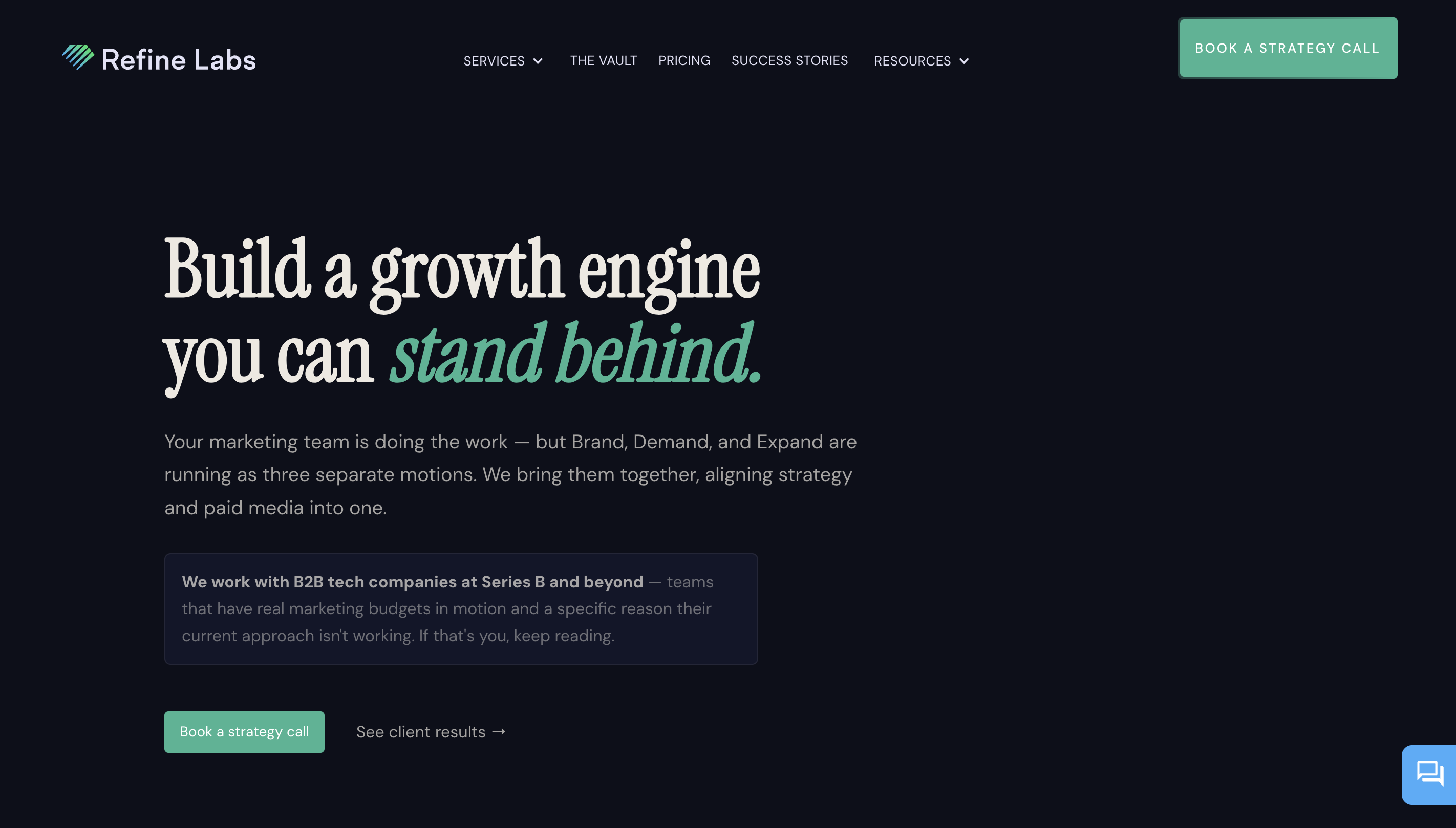
10. Refine Labs
Best for: Series B and beyond B2B SaaS with budgets above €20k per month that are prepared to restructure how growth is measured across the full programme, shifting from MQL volume metrics to a pipeline quality standard that produces defensible board-level reporting
Refine Labs is the agency on this list most explicitly focused on measurement transformation. Their HIRO (High-Intent Revenue Opportunities) pipeline model replaces the MQL-volume measurement framework that produces strong marketing dashboards and weak Rule of 40 scores with a single pipeline quality standard that connects the full growth programme to closed revenue. In the 2026 environment where only 11 to 30% of SaaS companies meet the Rule of 40 threshold, the measurement framework that a growth agency imposes determines whether the board meeting produces insights or defences.
Their dark social attribution methodology surfaces the full influence of demand creation (content, community, AI search, events) on the buyer journey before any measurable channel touch, making the growth investment decision more accurate by including stages that standard attribution systematically undervalues. This matters commercially in 2026 because the demand creation stages that produce NRR above 110% (building category authority, educating buyers before they evaluate, maintaining brand presence through evaluation) are precisely the ones that last-touch attribution most reliably misses and most boards most consistently underfund.
Named clients include Clari, Gong, and Drift. Over 300 mid-market SaaS engagements are documented, with the primary evidence of value expressed at the pipeline quality and measurement transformation level rather than at the activity level.
Key services
Demand creation strategy and execution across content, community, and AI search channels
HIRO pipeline model: full-programme measurement standard connecting to closed revenue
Dark social attribution: surfacing pre-funnel demand creation influence alongside direct attribution
Paid media optimised for pipeline quality rather than lead volume
Measurement transformation: rebuilding how growth success is reported to the board
Why Refine Labs stands out in 2026
HIRO pipeline model connects the full growth programme to closed revenue under one measurement standard, producing the board-level reporting that 2026 investors interrogate
Dark social attribution captures the NRR-contributing demand creation stages that standard attribution misses, making the full growth investment decision more accurate
Category-defining methodology with the most publicly documented evidence base in B2B SaaS demand generation
In the 2026 environment where only 11 to 30% of SaaS companies meet Rule of 40, the measurement transformation Refine Labs provides directly addresses the reporting gap that boards are increasingly scrutinising
Best fit: Series B and beyond B2B SaaS with budgets above €20k per month where leadership is prepared to restructure how growth is measured, moving from stage-level MQL metrics to a board-level pipeline quality standard that connects every programme investment to closed revenue and Rule of 40 contribution.
Why dimartec Builds for Efficient Growth in 2026
Every agency on this list addresses a dimension of the efficient growth challenge in 2026. NoGood's senior squad measures pipeline quality rather than MQL volume. Winning by Design builds the NRR architecture that produces the expansion revenue component of Rule of 40. Kalungi aligns growth incentives with revenue outcomes through pay-for-performance. TripleDart connects full-funnel execution to RevOps attribution from week one. GrowthSpree's QLA improves CAC payback by training paid optimisation against revenue-generating leads. Heinz Marketing aligns sales and marketing to the same pipeline quality standard. Omniscient Digital builds the organic and GEO layer that reduces paid channel dependency as CAC rises. Powered by Search produces investor-grade metrics from HubSpot-native attribution. Refine Labs transforms how the board measures growth programme success.
Each of them strengthens one or two dimensions of efficient growth. The constraint each shares is ownership: they each improve the dimension they are accountable for and return the adjacent dimensions to the client or to other vendors. When CAC payback is managed by one team, NRR by another, GEO by a third, and attribution by whoever last configured the CRM, the Rule of 40 calculation is assembled from inputs that were each managed independently rather than designed to compound.
dimartec builds all five growth dimensions as one system from the first session. Performance Paid Media manages acquisition cost. CRO improves the conversion rate that determines how much paid spend is needed per SQL. GEO reduces paid dependency over time as AI search discovery compounds. Lead Gen & Nurturing maintains the pipeline quality floor that prevents sales cycle extension from eroding the LTV:CAC ratio. RevOps & Automation produces the CAC payback, LTV:CAC, and NRR measurements from one attribution model that the board can trust.
In 2026, the difference between a SaaS company meeting the Rule of 40 and one posting a score of 12% is not which channels they run. It is whether those channels were designed to compound each other under one attribution model or to perform independently on dashboards that never agreed about what the growth programme actually produced.
See how the Revenue Engine works: https://www.dimartec.co.uk/services/revenue-engine
How to Choose the Right Growth Agency for 2026
Test unit economics fluency before channel expertise
Ask any agency to describe their primary success metric. If the answer is MQL volume, traffic, or impression share, the agency measures activity. If the answer is CAC payback period, LTV:CAC ratio, or Rule of 40 contribution, the agency measures efficient growth. In 2026, the distinction between these two measurement standards is the distinction between an agency that produces investor-grade growth evidence and one that produces a dashboard the board has to translate.
Require GEO capability as a baseline, not a premium add-on
With 48% of queries triggering AI Overviews and B2B buyers using ChatGPT and Perplexity to form vendor shortlists before any website visit, GEO is no longer optional in a 2026 growth programme. Ask any agency: how do you measure brand appearances in ChatGPT, Perplexity, and Claude? If the answer describes content production rather than measurable channel attribution, the GEO programme is assumed rather than verified.
Assess expansion revenue coverage alongside acquisition
An agency whose methodology only addresses new logo acquisition is addressing 50 to 60% of the ARR growth equation for most SaaS companies in 2026, where 40 to 50% of new ARR now comes from expansion within the existing customer base. Ask specifically: how does the agency's programme contribute to NRR? If the answer describes customer marketing as the CS team's responsibility, the growth programme is not built for the expansion revenue environment of 2026.
Frequently Asked Questions
What is the Rule of 40 and why does it matter for SaaS growth in 2026?
The Rule of 40 is a SaaS health benchmark: your revenue growth rate plus your EBITDA margin should exceed 40%. In 2026, only 11 to 30% of SaaS companies meet this threshold. Companies that consistently exceed it see ARR multiples roughly twice those of their less-efficient peers, and efficient growth now commands a 20 to 30% premium on ARR multiples versus growth without efficiency. For a growth agency, the implication is that programmes measured against MQL volume or impression share are optimising for the wrong output: a programme that produces 40% ARR growth with deteriorating unit economics scores worse on Rule of 40 than one producing 25% ARR growth with improving CAC payback and NRR.
Why is NRR more important in 2026 than in previous years?
Because 40 to 50% of new ARR in 2026 comes from expansion within the existing customer base for top-performing SaaS companies. NRR above 120% produces 2.3x higher valuations. Companies with NRR above 110% grow 2.5x faster than companies below 100%. And a 10-point improvement in NRR translates to a 20 to 30% valuation uplift on an $8M ARR business. Growth programmes that only address new logo acquisition are leaving the primary valuation lever and the primary growth multiplier untouched.
How much have paid acquisition costs changed for B2B SaaS in 2026?
Google Ads CPCs have risen 164% since 2019. LinkedIn Ads costs have risen 89% over the same period. The median B2B SaaS CAC has surged to $1,200 per customer, with payback periods extending across the category. These cost increases make organic and GEO pipeline channels more economically attractive than they were in any previous year: reducing paid channel dependency directly improves LTV:CAC as organic takes a growing share of pipeline at lower marginal cost. The growth agencies worth hiring in 2026 account for this cost environment in their programme design rather than simply scaling paid spend at higher unit costs.
Build Growth That Compounds in 2026
The 2026 growth environment does not reward the programme that generates the most leads. It rewards the programme that produces the best CAC payback, the most defensible LTV:CAC ratio, and the highest NRR contribution from the channels it runs. The agencies on this list understand this. The ones not on this list are still measuring success by the metrics that mattered when growth was cheap.
The Revenue Engine connects Performance Paid Media, CRO, GEO, Lead Gen & Nurturing, and RevOps & Automation into one system so acquisition cost is managed against CAC payback from the first session, the compounding GEO layer reduces paid dependency as it matures, pipeline quality meets the LTV:CAC floor the business model requires, and the attribution model makes Rule of 40 contribution measurable rather than estimated.
See how the Revenue Engine works: https://www.dimartec.co.uk/services/revenue-engine
















.png)
























































.png)
.png)
.png)
.png)
.png)
.png)
.png)
.png)
.png)
.png)