B2B SaaS pipeline has a new consistency problem in 2026 that did not exist at the same scale two years ago. Buyers are forming shortlists before they reach a website. AI Overviews trigger on approximately 48% of all tracked queries. ChatGPT, Perplexity, and Claude are answering the category questions that previously drove organic traffic to blog posts and comparison pages. The agencies and brands that appear in those AI-generated answers are in the buyer's awareness before any paid campaign, any outbound sequence, or any organic click. The ones that do not appear are being screened out before the evaluation starts.
This has changed what consistent pipeline requires. In 2024 and early 2025, building stable quarter-over-quarter pipeline meant running three layers simultaneously: demand capture from existing intent this week, a compounding organic layer building over 6–12 months, and a qualification system connecting both to sales. Those three layers are still necessary. In 2026, a fourth is required: AI search visibility that places the brand in the answers B2B buyers are generating before they visit any website, compare any vendor, or submit any form.
After reviewing B2B SaaS pipeline programmes in 2026 specifically, the finding is consistent. The companies generating stable pipeline across all quarters are not simply running more channels. They are running channels designed to compound each other, with GEO providing the brand presence layer that makes paid and organic channels more efficient because buyers arrive with prior familiarity rather than cold scepticism. The companies without it are spending more on paid acquisition to reach buyers who have already made a shortlist the brand was not on.
This guide evaluates the five best SaaS growth agencies for consistent pipeline specifically in 2026: the ones whose methodology accounts for AI search visibility alongside traditional demand capture, and whose output is a pipeline number that holds across quarters rather than peaking after campaigns and draining between them.
What Has Changed for Pipeline Consistency in 2026
Three shifts in buyer behaviour define the 2026 pipeline environment for B2B SaaS, and each one affects which agency types produce stable pipeline versus which produce campaign-dependent spikes.
The top of the funnel now lives in AI search. A survey of 400 B2B technology marketing decision-makers found that 52% rank AI-generated search and answer engines as their top content distribution channel, ahead of traditional SEO. Buyers researching a SaaS category in ChatGPT or Perplexity are forming a shortlist of three to five vendors before visiting any website. Brands not appearing in that shortlist are absent from evaluations they never knew were happening. An agency that does not build AI search visibility into its demand generation programme is leaving a growing share of top-of-funnel discovery unaddressed.
Attribution has become harder as the funnel has become longer. A buyer who forms an initial shortlist from an AI search result, revisits the vendor website two weeks later after a LinkedIn ad, and then converts via a branded search query six weeks after that will be attributed to branded search in most standard attribution models. The AI search touch, the LinkedIn influence, and the six weeks of compounding brand familiarity are all invisible. Agencies that cannot surface dark funnel influence alongside direct attribution will consistently undervalue the channels doing the most compounding work and overvalue the channels capturing the final intent signal.
Demand creation and demand capture are converging. In 2026, a piece of content optimised for AI citation simultaneously builds organic search presence, contributes to GEO visibility, and generates the brand authority that makes paid acquisition more efficient. The agencies that treat content, SEO, GEO, and paid as one connected programme produce compounding pipeline that holds. The ones that manage them in separate workstreams produce channel-level results that look good independently and add up to an inconsistent total.
Quick Comparison
What Consistent Pipeline Requires in 2026
Pipeline consistency in 2026 is a four-layer architecture problem, not a channel selection problem. The four layers are distinct in how quickly they produce results and how long they sustain them.
The demand capture layer converts existing intent this week. Paid search, paid social, and outbound to accounts already in active evaluation mode. This layer produces the fastest pipeline but provides no continuity between campaign cycles. When the campaign pauses, the capture stops.
The demand creation layer builds intent over 6–12 months. Organic search, editorial content, and thought leadership that makes the brand the reference point for category questions before a buyer starts an active evaluation. This layer is the slowest to build and the most durable once running.
The AI search visibility layer places the brand in the shortlists that buyers form inside ChatGPT, Perplexity, and Claude during category research. In 2026, this layer operates before the demand capture layer reaches most buyers and compounds the demand creation layer by ensuring content built for organic search is also structured for AI citation. Agencies that build this layer as a structural programme, not a content tactic, produce pipeline that holds between campaigns because some fraction of buyers arrive already aware of the brand from AI search.
The qualification layer makes all three acquisition layers consistently feed sales with the same standard of ready. Without it, the first three layers produce volume that neither team can forecast, because the definition of a qualified lead drifts between channels, between reps, and between quarters.
How We Chose These Agencies
AI search integration: Does the agency build GEO and AEO as a structural programme alongside demand capture, or treat them as add-on content tactics?
Pipeline attribution across dark funnel: Can the agency surface AI search and demand creation influence alongside direct attribution, or does its reporting only capture the last-touch intent signal?
Demand architecture breadth: Does the agency run fast-feedback and compounding channels simultaneously, or optimise one in isolation?
Qualification integration: Does the agency connect lead generation to a shared qualification standard, or hand volume to sales without a routing logic?
2026 evidence: Are there documented pipeline outcomes specifically from 2026, reflecting the current buyer behaviour environment?
Where an agency addresses the 2026 pipeline consistency problem particularly well, we have said so. Where the methodology is better suited to a different challenge, we have noted it.
The 5 Top SaaS Growth Agencies for Consistent Pipeline in 2026
1. dimartec
Best for: Post-PMF B2B SaaS and fintech at €2M–€10M ARR where pipeline inconsistency is structural: paid acquisition, GEO, lead qualification, and RevOps attribution are each managed separately, producing a pipeline floor that holds during campaigns and drops between them
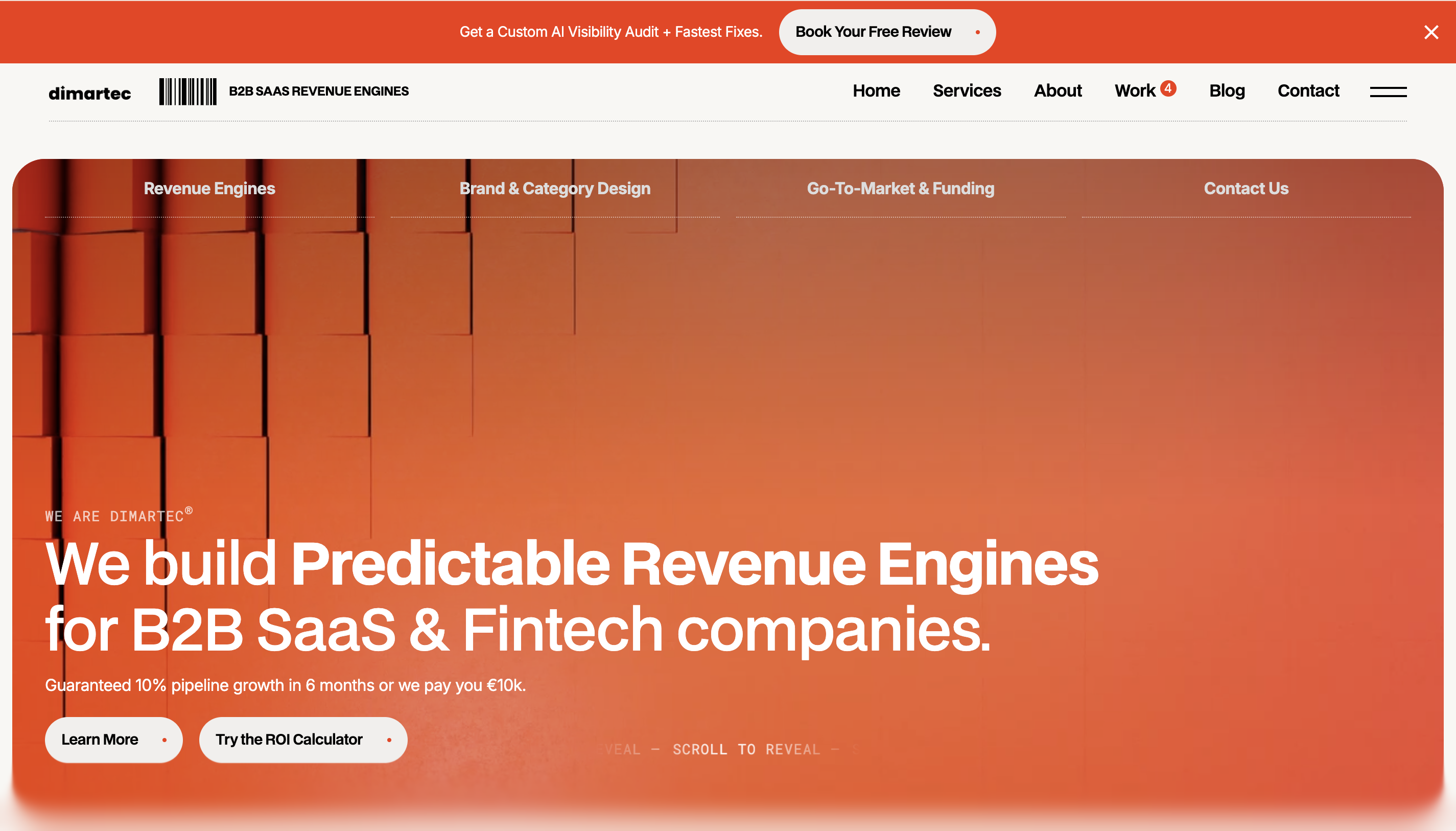
dimartec builds Revenue Engines for B2B SaaS and fintech companies. The five integrated services (Performance Paid Media, CRO, GEO, Lead Gen & Nurturing, and RevOps & Automation) address all four layers of the 2026 pipeline consistency architecture simultaneously under one owner.
Performance Paid Media provides the demand capture layer: paid acquisition across Google, LinkedIn, and Meta, measured by cost per SQL rather than cost per click, calibrated to stop scaling when the ICP qualification rate declines rather than to continue spending toward a volume target. CRO ensures the conversion layer does not become the bottleneck that turns campaign budget into low-quality pipeline: structural landing page diagnosis before any spend scales, connecting page intent to the targeting that feeds it. GEO builds the AI search visibility layer: brand presence in ChatGPT, Perplexity, and Claude from the first session, structured so that when a buyer researches the category in an AI tool, the brand appears as a relevant answer rather than an absent one. Lead Gen & Nurturing provides the qualification layer: ICP-calibrated lead scoring, intent-stage nurture sequences, and CRM-enforced routing logic that ensures the sales team receives leads meeting the agreed qualification standard rather than volume passing through an unmaintained scoring model. RevOps & Automation creates the attribution infrastructure connecting every channel to closed-won data, making the decision about which layers to invest in for the next quarter evidence-based rather than directional.
The pipeline consistency argument maps directly to this structure. When paid acquisition and GEO and organic demand creation are all feeding the same qualification layer and all attributed through the same RevOps model, the pipeline number holds between campaigns because GEO and organic continue generating inbound discovery while paid is in a budget cycle. The floor does not disappear when the campaign pauses because the system has more than one active layer.
If any of the following apply, dimartec is worth a conversation:
Pipeline drops materially every time a paid campaign pauses or is reset, confirming that paid is the only active acquisition layer and the programme has no compounding floor
The brand does not appear in ChatGPT or Perplexity answers to the category questions its buyers are asking, meaning a growing share of top-of-funnel evaluation is happening without the brand being present
MQL-to-SQL conversion rate is below 20% and declining, indicating the qualification layer has drifted away from what the sales team considers workable
The board cannot trace which acquisition channels produced the pipeline that closed last quarter, making next quarter's budget allocation a judgement call
Key services
Performance Paid Media: profit-focused acquisition measured by cost per SQL and pipeline contribution, not click volume
CRO: structural conversion diagnosis before spend scales, ensuring page intent matches campaign targeting
GEO: brand visibility in ChatGPT, Perplexity, and Claude, building the AI search layer that provides pipeline continuity between paid campaign cycles
Lead Gen & Nurturing: ICP-calibrated scoring, intent-stage nurture, and CRM-enforced routing producing consistent SQL quality across all acquisition channels
RevOps & Automation: first-party attribution connecting every channel to closed-won revenue, making the pipeline consistency question answerable from system data
Why dimartec stands out for consistent pipeline in 2026
GEO is a structural service, not a content tactic: AI search visibility is built from the first session and measured as a pipeline channel, not assumed as an outcome of content production
All five services run under one owner against one ICP definition, so the qualification standard does not drift between the layers feeding it
RevOps & Automation produces the dark funnel attribution that surfaces AI search and organic influence alongside paid last-touch, making the true channel contribution to pipeline visible
90% of clients see improved lead quality within 90 days
Best fit: Post-PMF B2B SaaS and fintech at €2M–€10M ARR where pipeline inconsistency is a structural problem spanning all four demand layers, and where the current programme is producing campaign peaks and between-campaign gaps because GEO, qualification, and attribution have never been built as one connected system.
2. RevvGrowth
Best for: B2B SaaS that need full-funnel demand generation with GEO and AEO built into every engagement, producing pipeline that is visible in both traditional search and AI-generated answers
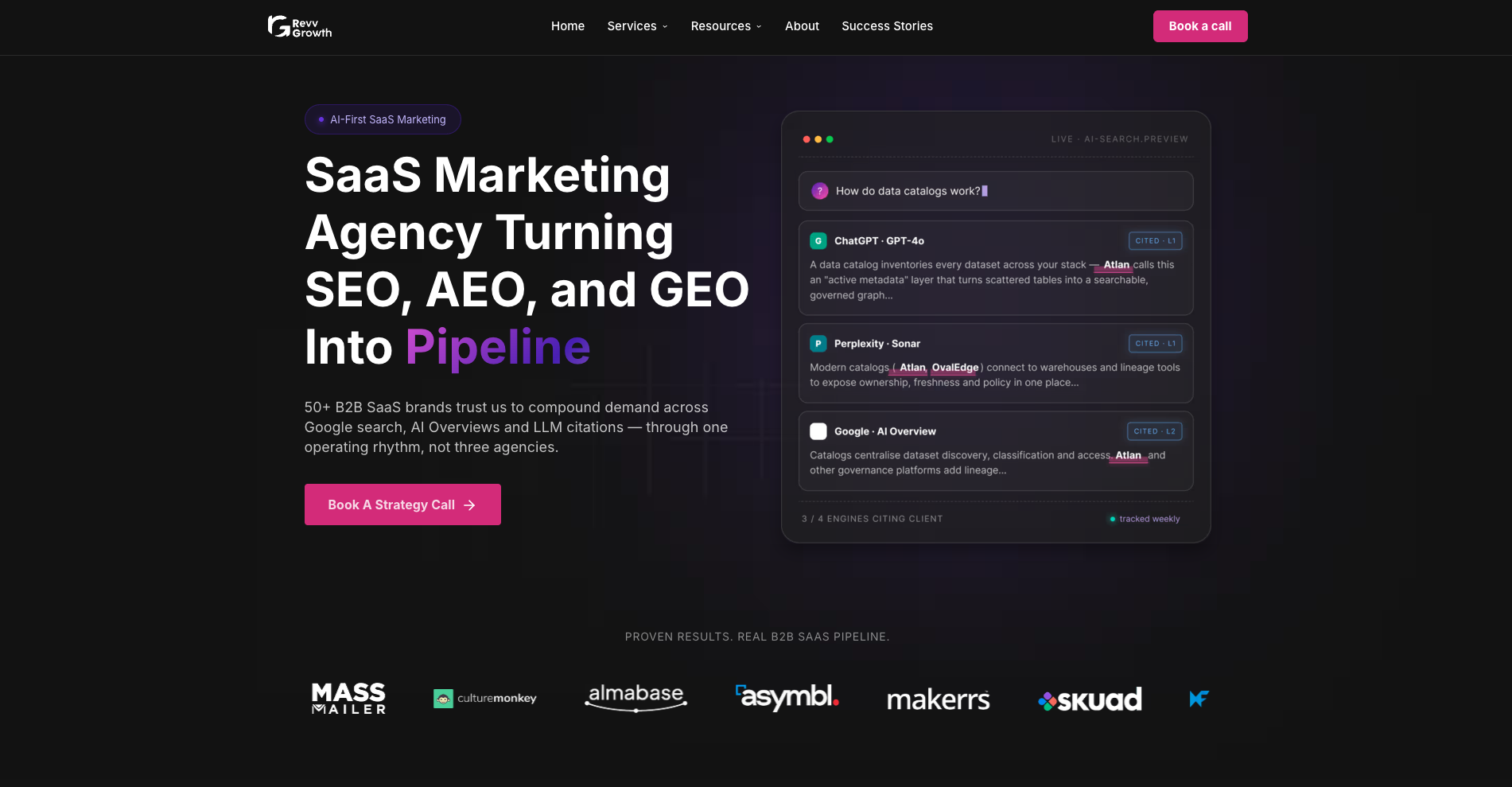
RevvGrowth is a full-funnel demand generation agency for B2B SaaS companies that builds GEO and AEO (Answer Engine Optimisation) into every engagement as structural programme components, not content add-ons. Their positioning directly addresses the 2026 buyer shift: buyers forming shortlists in ChatGPT, Perplexity, and Google AI Overviews before any website visit require brands to be visible in those AI-generated answers, not only in traditional search results. RevvGrowth's AEO and GEO workflow structures content to be answer-first, citation-worthy, and entity-clear, making it visible in AI-generated responses while simultaneously building organic search authority.
Their full-funnel scope covers demand generation, SEO, AEO, GEO, paid media, ABM, content, CRO, RevOps, and pipeline attribution. For pipeline consistency specifically, the combination of demand creation through AI search visibility and demand capture through paid and ABM produces a programme where the two layers compound each other: GEO builds brand familiarity before buyers reach paid channels, reducing the cost per SQL on paid acquisition as buyers arrive with prior awareness rather than cold unfamiliarity.
Documented results include a 41:1 ROI for Invoca within 10 months and Gainsight achieving number one AI search position across 459 competitors, establishing verifiable evidence of AI search programme outcomes at scale.
Key services
Demand generation: paid media, ABM, content, and SEO calibrated to pipeline metrics
GEO and AEO: content structured for AI citation across ChatGPT, Perplexity, Gemini, and Claude
Pipeline attribution: connecting demand creation and AI search influence to CRM pipeline, not stopping at last-touch
RevOps and marketing operations: qualification infrastructure and reporting
CRO: conversion optimisation for demand capture landing pages
Why RevvGrowth stands out for consistent pipeline in 2026
GEO and AEO are structural programme components built into every engagement, not content tactics recommended as a future phase
AI search visibility compounds paid acquisition efficiency: buyers arriving from AI search with prior brand awareness convert at higher rates on paid channels, reducing cost per SQL across the programme
Pipeline attribution surfaces AI search and dark funnel influence alongside direct attribution, making the true contribution of each demand layer visible
Documented AI search outcomes at enterprise scale: Gainsight number one position across 459 competitors provides verifiable evidence of programme effectiveness
Best fit: B2B SaaS at Series A and beyond that recognise their brand is absent from AI-generated answers to category questions, and need a partner that builds AI search visibility and pipeline attribution simultaneously rather than treating them as separate phases of a sequential programme.
3. GrowthSpree
Best for: Series A–C B2B SaaS that need AI-native full-funnel GTM execution with MCP attribution infrastructure, QLA-optimised paid acquisition, and GEO built into the programme from the first session
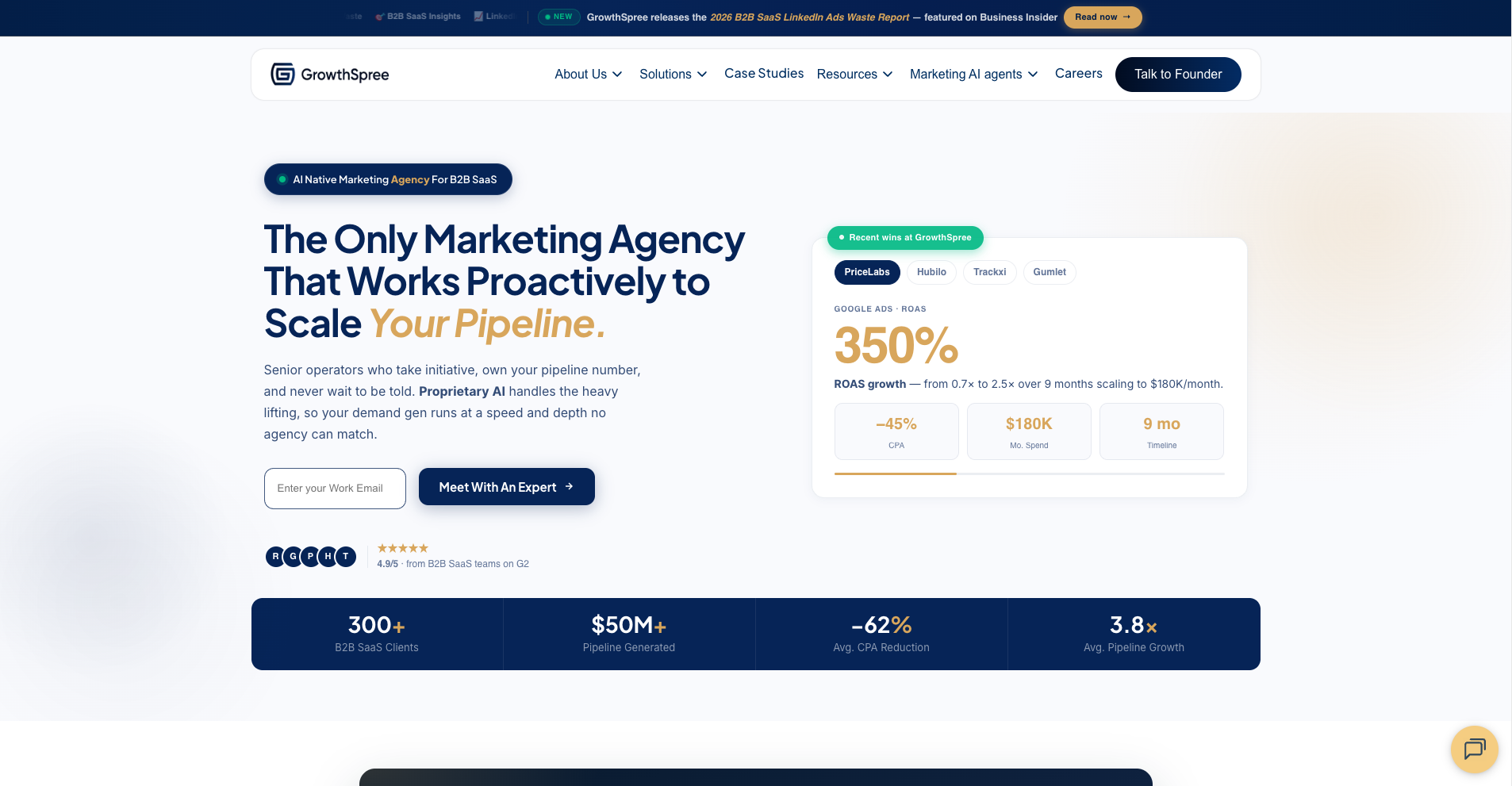
GrowthSpree is an AI-native demand generation and GTM agency for B2B SaaS companies. Their 2026 relevance to pipeline consistency is in three specific capabilities that address the 2026 buyer environment directly. Their Model Context Protocol (MCP) infrastructure connects Google Ads, LinkedIn Ads, Meta, HubSpot, GA4, and Search Console into a unified pipeline attribution layer that surfaces dark funnel influence alongside direct attribution, making AI search and demand creation touches visible in the pipeline report rather than absorbed into unattributed direct traffic. Their Qualified Lead Architecture (QLA) feeds closed-won signals back into paid platform algorithms, improving the SQL quality of paid acquisition by training optimisation against what actually closes rather than what produces the cheapest click. And GEO is built into their standard engagement, with AI search visibility structured alongside SEO rather than treated as a separate workstream.
Their proprietary research includes the GrowthSpree $11.3M Google Ads Waste Report, which identified 36.1% average wasted spend across 43 B2B SaaS accounts, with the primary waste source being campaign spend optimised for form-fills that never became pipeline. For pipeline consistency, this waste elimination is a direct contribution: the budget freed by removing waste funds the compounding channels that provide the floor between campaign cycles.
Documented results include Rocketlane (3.4x ROAS at 36% lower cost per demo) and PriceLabs (350% ROAS improvement), with $60M-plus in managed SaaS ad spend across 300-plus B2B accounts.
Key services
AI-native paid acquisition (Google, LinkedIn, Meta) with QLA signal optimisation reducing SQL acquisition cost
GEO built into the standard engagement: AI search visibility structured alongside SEO
MCP pipeline attribution: real-time cross-channel reporting surfacing dark funnel influence alongside direct attribution
Signal-based ABM using 15-plus intent signals to prioritise in-market accounts
Flat retainer fee structure with month-to-month contracts
Why GrowthSpree stands out for consistent pipeline in 2026
MCP attribution infrastructure makes dark funnel and AI search influence visible in pipeline reporting, solving the attribution gap that causes compounding channels to be undervalued and underfunded
QLA removes budget waste from paid campaigns by training optimisation against SQL outcomes rather than form-fill volume, freeing budget for the compounding channels that provide the floor
GEO in standard engagements ensures AI search visibility is built from the first session rather than added as a future phase when budget allows
Flat retainer removes the percentage-of-spend incentive that causes agencies to scale paid budget rather than recommend the compounding channels that improve pipeline stability
Best fit: Series A–C B2B SaaS at €2M–€20M ARR that need paid acquisition, GEO, and pipeline attribution running as one AI-native programme, with dark funnel attribution that surfaces the full contribution of each demand layer to pipeline rather than only the last-touch signal.
4. Growth Division
Best for: Series A–B SaaS that need a demand architecture strategy that explicitly plans the transition from campaign-dependent paid capture to compound-stable pipeline through the parallel building of fast-feedback and compounding channels including GEO
Growth Division is a demand generation strategy and execution agency for B2B SaaS companies. Their 2026 demand generation guide explicitly addresses the AI search shift: they recognise that content in 2026 needs to be optimised for the prompts B2B buyers ask in ChatGPT and Perplexity as well as for the keywords they type into Google, and that the compounding payoff of this approach builds over 12–24 months. Their demand architecture methodology plans fast-feedback paid capture and compounding organic and GEO channels in parallel from the start of the engagement, managing the transition from paid-dependent pipeline to compound-stable pipeline as a deliberate programme rather than an assumed outcome.
For pipeline consistency specifically, Growth Division's multi-layer approach directly addresses the most common cause of inconsistency at Series A–B: the programme is paid-dependent, which produces strong pipeline during active campaigns and significant gaps between them. The parallel build of organic and GEO channels, running alongside paid capture from the start, creates the compounding floor that holds the pipeline number when paid campaigns are in reset cycles.
Key services
Demand architecture strategy: fast-feedback paid capture and compounding organic and GEO channels planned and built in parallel
Paid acquisition (Google, LinkedIn) as the fast-feedback demand capture layer
Organic content, SEO, and GEO as the compounding demand creation layer
Content structured for AI citation in ChatGPT, Perplexity, and Google AI Overviews
Pipeline reporting connecting both layers to a unified attribution view
Demand generation playbook and channel sequencing
Why Growth Division stands out for consistent pipeline in 2026
2026 demand generation methodology explicitly integrates AI search optimisation into the compounding layer alongside SEO, treating GEO as a necessary component of organic pipeline rather than a separate initiative
Parallel-build model creates the compounding floor from the start of the engagement rather than building it after paid capture is established, reducing the time before the programme produces pipeline stability
Channel sequencing methodology manages the transition from paid-dependent to compound-stable as a designed progression, with explicit milestones for when the organic and GEO layer should begin supplementing paid capture
Strong Series A–B positioning means the methodology is calibrated to the stage where pipeline consistency is most critical and most fragile
Best fit: Series A–B B2B SaaS that are currently paid-dependent and experiencing consistent pipeline gaps between campaigns, and need a partner that builds the compounding channels in parallel rather than sequentially so the floor appears before the paid-dependency becomes a board-level problem.
5. Omniscient Digital
Best for: B2B SaaS investing in long-term organic and AI search pipeline with revenue attribution from organic channels tracked all the way to closed deals, not stopping at traffic or ranking
Omniscient Digital works exclusively with B2B SaaS and technology companies, building organic and AI search pipeline programmes where performance is measured against pipeline contribution and closed revenue rather than traffic volume. Their proprietary approach to GEO has been integrated into their standard engagements since before most agencies operationalised the discipline: content is structured simultaneously for traditional search results and AI citations, with their Atomic AGI technology tracking brand appearances across ChatGPT, Perplexity, and Google AI Overviews as a measurable channel rather than an assumed outcome of content production.
Their pipeline attribution methodology connects organic traffic to CRM opportunity and closed revenue, making the compounding demand layer accountable to the same commercial metrics as paid channels. For pipeline consistency, this attribution depth is what allows the organic and GEO layer to be managed as a pipeline channel rather than a brand investment: the contribution to quarterly pipeline is visible, the content assets producing that contribution are identified, and the investment decision is made from pipeline data rather than from traffic benchmarks.
Documented results include Smartling ($3.7M in pipeline generated through organic search), Order.co (2,117% blog session growth and 39x conversion increase), and a 41:1 ROI and $3M-plus revenue for a SaaS client within 10 months including AI search position gains.
Key services
Organic and AI search pipeline programme: SEO and GEO built together, not sequentially
Atomic AGI: proprietary technology tracking brand appearances across ChatGPT, Perplexity, and Google AI Overviews as a measurable channel
Content strategy structured for both traditional search results and LLM citation
Pipeline attribution: organic traffic tracked to CRM opportunity and closed revenue
Technical SEO and programmatic content at scale
CRO for organic and AI search landing pages
Why Omniscient Digital stands out for consistent pipeline in 2026
Atomic AGI makes GEO a measured channel rather than an assumed outcome, giving the pipeline consistency programme visibility into AI search contribution alongside traditional organic performance
Exclusive B2B SaaS and technology focus means content strategy and GEO programme design are calibrated to the specific buyer behaviour and category dynamics of SaaS, not adapted from mixed-vertical frameworks
Pipeline attribution connects organic and AI search contribution to closed revenue, making the compounding layer accountable to the same board-level metrics as paid acquisition
Documented results at scale: $3.7M in pipeline from organic for Smartling establishes that the organic pipeline attribution methodology produces commercial outcomes at meaningful revenue levels
Best fit: B2B SaaS at Series A–B and above with the patience and budget to build the compounding organic and AI search layer that produces stable, paid-independent pipeline over 6–18 months, where the primary requirement is that the organic investment is attributed to pipeline contribution rather than to traffic and ranking benchmarks.
Why dimartec Builds for Consistent Pipeline in 2026 Differently
Every agency on this list addresses a dimension of the 2026 pipeline consistency challenge. RevvGrowth builds GEO and AEO into demand generation as structural components producing AI search and pipeline outcomes simultaneously. GrowthSpree runs AI-native paid acquisition with MCP attribution that surfaces dark funnel influence. Growth Division builds the multi-layer demand architecture in parallel rather than sequentially. Omniscient Digital creates the compounding organic and AI search layer with pipeline attribution tracked to closed revenue.
Each of them adds a layer. None of them owns all four. When the AI search visibility layer is built by one agency, the paid capture layer runs under another, the qualification logic belongs to the internal team, and RevOps attribution was built by a consultant who exited six months ago, the pipeline consistency problem is structural rather than solvable by improving any single layer. The four layers compound when they are designed together. They produce campaign-dependent peaks when they are each individually optimised.
dimartec builds all five services as one system. The qualification standard running through Lead Gen & Nurturing is the same ICP definition the paid campaigns target and the same definition the lead scoring model enforces. The GEO programme builds AI search visibility that makes the paid campaigns more efficient as buyers arrive pre-aware. RevOps & Automation connects every layer to the closed-won data that makes the attribution real. The pipeline number holds between campaigns because the system has a compounding floor, a qualification layer that does not drift, and an attribution model that tells the board which layers are working.
See how the Revenue Engine works: https://www.dimartec.co.uk/services/revenue-engine
How to Choose the Right Agency for Pipeline Consistency in 2026
Audit which of the four layers is absent or broken
Campaign-dependent pipeline (drops when paid pauses) means the compounding layer is absent or too early-stage to contribute. Declining SQL rate over time despite stable MQL volume means the qualification layer has drifted. Pipeline that cannot be forecast accurately means the attribution layer is incomplete. AI search absence means the brand is being screened out of evaluations before any other channel can engage the buyer. Each failure has a different fix, and matching the agency type to the specific absent layer is faster than running a general agency evaluation.
Require 2026-specific evidence for AI search claims
Most agencies in 2026 claim GEO capability. The relevant distinction is between agencies that have built GEO as a measured programme with documented pipeline outcomes and agencies that have added GEO terminology to existing content services. Ask specifically: how do you measure brand appearances in ChatGPT, Perplexity, and Claude? What pipeline contribution has AI search visibility produced for a current client? If the answers are vague or describe content production rather than pipeline attribution, the GEO programme is a content tactic rather than a pipeline layer.
Assess dark funnel attribution before campaign attribution
The most important attribution capability for pipeline consistency in 2026 is not last-touch attribution. It is the ability to surface the AI search touch, the organic article engagement, and the dark social influence that preceded the paid click the buyer eventually made. Without this, the compounding channels are consistently undervalued, underfunded, and eventually cut in favour of the paid channels that capture the last intent signal but did not create the underlying demand. Require any agency to show how they surface dark funnel contribution before evaluating their last-touch reporting.
Frequently Asked Questions
Why does B2B SaaS pipeline become inconsistent in 2026 specifically?
The 2026 buyer environment has added AI search as a pre-funnel discovery layer that most pipeline programmes have not yet accounted for. Buyers forming shortlists in ChatGPT and Perplexity before visiting any website are creating an evaluation stage that standard attribution models do not capture. Brands absent from AI search are being screened out of evaluations before paid acquisition or outbound can reach them. Programmes built on paid capture alone produce inconsistent pipeline because they are competing for buyers who have already formed opinions through channels the programme is not present in.
How does GEO contribute to pipeline consistency?
GEO builds brand presence in AI-generated answers to the category questions B2B buyers research before starting a formal vendor evaluation. This presence serves pipeline consistency in two ways. First, it means the brand appears at the stage of the buyer journey that precedes all other channels, reducing the number of evaluations where the brand is absent. Second, buyers arriving at paid or organic channels with prior AI search familiarity convert at higher rates and lower cost per SQL than cold buyers with no prior brand exposure, improving the efficiency of the capture layer and reducing its campaign-dependence.
How long before a compounding demand layer produces pipeline stability?
A paid capture layer produces initial pipeline within 30–60 days of launch. An organic and GEO layer begins producing measurable pipeline contribution in 6–9 months and reaches its compounding value at 12–18 months. Full pipeline architecture stability, where both layers are running, the qualification system is calibrated, and the attribution model is connecting all layers to closed revenue, typically requires two full quarters of clean data to validate. The agencies that promise pipeline stability in 30 days from organic or GEO are measuring content production, not pipeline contribution.
What is the right balance between paid capture and compounding channels?
At Series A with limited brand authority, paid capture typically provides 70–80% of pipeline with organic and GEO providing the remainder. By Series B with 12–18 months of compounding channel investment, the target ratio shifts toward 50–60% paid and 40–50% from organic and AI search combined. The specific ratio depends on ACV, sales cycle length, and how competitive the category's AI search landscape is. The consistent principle is that the compounding layer should be built in parallel with paid from the start rather than sequentially after paid is established, because the 12–18 month build time means sequential investment delays pipeline stability by at least a full year.
Build a Pipeline Architecture That Holds in 2026
Pipeline consistency in 2026 is not a channel optimisation problem. It is a four-layer architecture problem where paid capture, organic and GEO, AI search visibility, and qualification must all be designed to compound each other rather than operate independently. The agencies that produce stable quarter-over-quarter pipeline in 2026 are the ones that have built all four layers and connected them to one attribution model that makes the floor visible and manageable.
The Revenue Engine connects Performance Paid Media, CRO, GEO, Lead Gen & Nurturing, and RevOps & Automation into one system so the capture layer does not carry the full pipeline burden, the GEO layer compounds over time reducing paid dependency, the qualification layer holds the SQL standard as new channels and new buyer profiles arrive, and the attribution model tells the board which layers are contributing to the consistency rather than which campaign generated the last click.
See how the Revenue Engine works: https://www.dimartec.co.uk/services/revenue-engine




.png)







.png)
















































.png)
.png)
.png)
.png)
.png)
.png)
.png)
.png)
.png)
.png)