
Google Ads and LinkedIn are obedient machines. Tell them a conversion is a form submission and they will find the people most likely to submit forms. They will do it efficiently, the cost per conversion will fall, and the monthly report will look excellent.
None of that says anything about revenue. The people most likely to fill in a form are not the people most likely to buy software. Students, job seekers, competitors, consultants, and companies far too small to qualify all submit forms readily. A campaign tuned to form fills learns to find more of them, because nothing in the data it receives tells it otherwise.
After analysing paid search and paid social spend across more than 200 B2B SaaS accounts, the gap between the campaigns that build pipeline and the campaigns that build lead counts comes down to one technical decision. In the first group, the ad platform is told what happened after the form: which leads sales accepted, which became opportunities, which closed. In the second, it is told nothing, and optimises to the only signal it has.
This guide compares five PPC agencies for SaaS on that basis. It looks at what each one treats as a conversion, how far into the CRM its optimisation reaches, and what it reports at the end of the month.
What Makes a PPC Campaign Pipeline-Focused
A pipeline-focused campaign is one planned, optimised, and judged on the sales pipeline it creates, measured in currency. The definition sounds obvious. In practice it changes five things about how an account is built.
The goal sits further down the funnel. The conversion that matters is an opportunity created in the CRM, with a value attached. Leads and even SQLs are treated as steps on the way. This is the difference from a cost per SQL approach: two SQLs are not equal if one is a ten-seat deal and the other is a thousand-seat deal, and a pipeline-focused campaign knows which is which.
Keywords and audiences are chosen for buying intent. Budget concentrates on searches that signal evaluation, such as comparisons, alternatives, pricing, and category terms with a clear commercial purpose. On LinkedIn, targeting is built from the job titles and company profiles found in closed deals. Broad informational reach is cut back or funded separately.
The offer starts a sales conversation. A demo, a trial, or a pricing consultation produces a prospect that sales can work. A gated ebook produces a contact. Pipeline-focused accounts lean heavily towards the first kind, accepting fewer conversions for more valuable ones.
Reporting is in pipeline per unit of spend. The headline figure is pipeline generated divided by ad spend, shown by campaign. One published 2026 benchmark for B2B SaaS puts a healthy ratio at 4:1 or above. Cost per lead still appears, lower down the page, as a diagnostic.
Decisions respect the sales cycle. With a median B2B SaaS sales cycle of around 84 days, a campaign cannot be judged on closed revenue after three weeks. Pipeline-focused management uses early indicators, such as opportunity creation and stage progression, and waits for enough data before pausing something that looks expensive at lead level.
Why Pipeline-Focused PPC Needs a Different Kind of Agency
Running paid media for pipeline is harder than running it for leads, and the difficulty is mostly outside the ad account.
It needs CRM access and CRM discipline. The agency has to see which leads became opportunities and what they were worth. That requires an integration between the CRM and the ad platforms, and it requires sales to record opportunities promptly and consistently. An agency that has never worked inside a client's CRM will struggle here, however skilled it is at bidding.
It needs a different fee logic. Agencies paid a percentage of ad spend earn more when budgets rise, whether or not pipeline follows. That does not make them dishonest, but it does mean their interests and the client's are only loosely aligned. Several of the agencies below have moved to flat fees for this reason.
It needs tolerance for worse-looking numbers. Cutting low-intent keywords and gated-content offers will raise cost per lead and reduce lead volume, sometimes sharply, in the first month. An agency needs the confidence to recommend that, and the client needs to have been warned. Many pipeline programmes are abandoned at exactly this point, just before the opportunity data arrives to justify them.
It needs landing pages and follow-up that match. Paying for high-intent clicks and sending them to a generic page, or to a sales team that responds two days later, wastes the premium. The click is only the first part of a pipeline-focused campaign.
These four requirements shaped the selection that follows.
How We Chose These Agencies
- Stated success measure: Does the agency describe its own goal as pipeline, SQLs, customers, or revenue, in its public positioning?
- CRM connection: Is linking ad platforms to CRM outcomes a standard part of the service?
- SaaS specialisation: Does the agency work mainly or only with B2B SaaS, with its trial, demo, and long-cycle mechanics?
- Fee alignment: Is the commercial model free of an incentive to increase spend for its own sake, or at least open about it?
- Scope beyond the click: Does the agency take any responsibility for landing pages, creative, or the handover to sales?
Each profile notes where an agency meets these fully and where it meets them in part.
The 5 Best PPC Agencies for SaaS for Pipeline-Focused Campaigns
1. dimartec
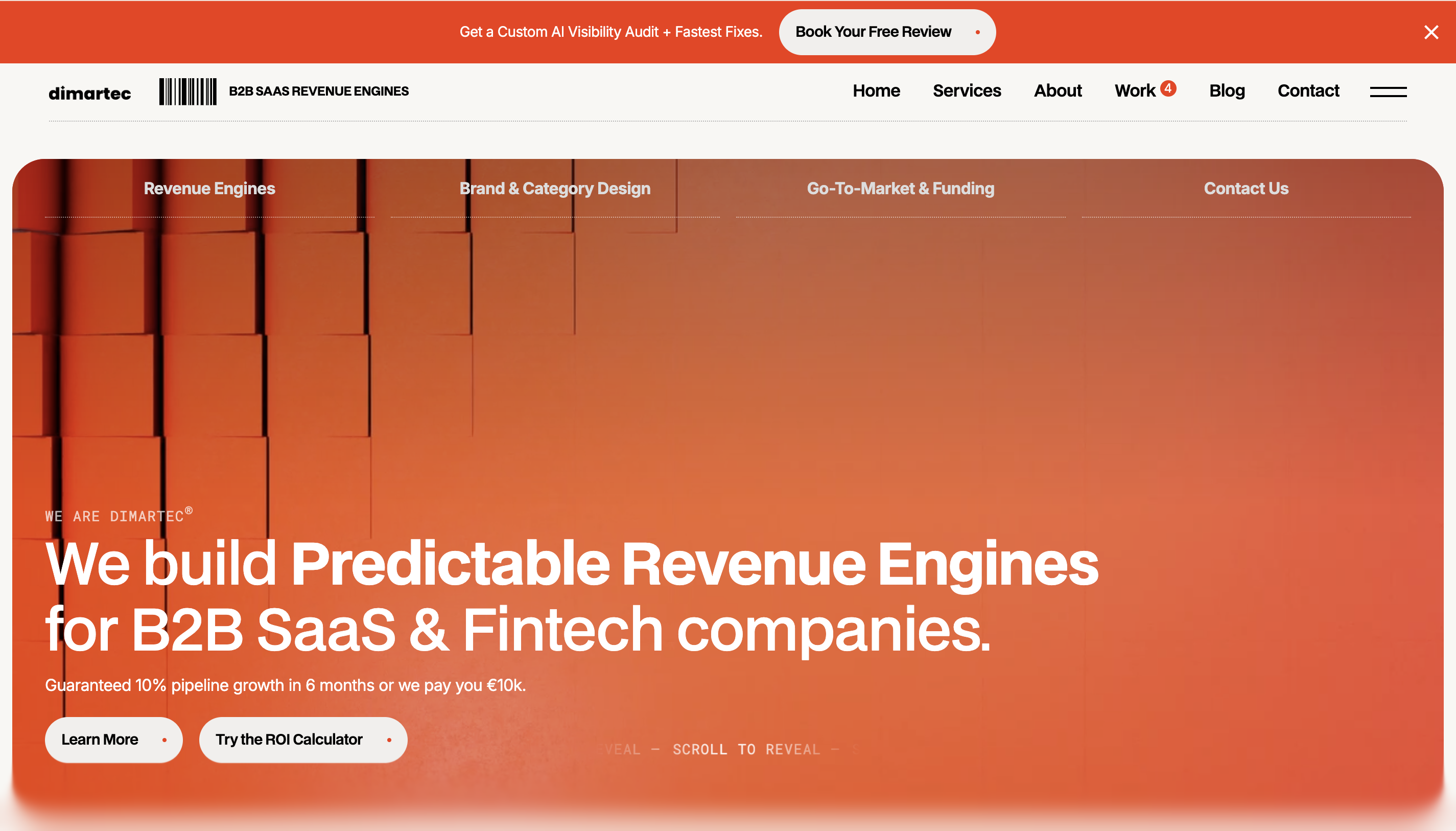
Best for: Post-PMF B2B SaaS and fintech at €2M–€10M ARR that want paid campaigns judged on the pipeline they create, with the landing pages, lead qualification, and CRM reporting those campaigns depend on run by one team
dimartec builds Revenue Engines for B2B SaaS and fintech companies. Performance Paid Media is one of five integrated services, alongside CRO, GEO, Lead Gen & Nurturing, and RevOps & Automation. For pipeline-focused PPC, that arrangement deals with the main reason such campaigns fail: the parts that decide the outcome sit outside the ad account, usually with someone else.
At dimartec they sit together. RevOps & Automation connects the CRM to Google and LinkedIn, so campaigns learn from opportunities and closed deals instead of form submissions. Performance Paid Media builds keyword sets and audiences from the profiles of customers who bought. CRO makes sure a high-intent click lands on a page written for that intent. Lead Gen & Nurturing routes ready buyers to sales at once and keeps early ones warm. Reporting shows pipeline by campaign from a single source.
In one published engagement, a European IoT SaaS company selling in five languages saw SQLs fall sharply while spend kept rising. dimartec rebuilt the qualification signals behind the campaigns while they were still running. Twelve weeks later, ad spend was down 53% across the same channels, cost per SQL was down 52% year on year, and conversions had risen 10%.
Consider dimartec if:
- Paid campaigns hit their lead targets and sales says most of those leads go nowhere
- Nobody can state how much pipeline last quarter's ad spend produced without building a spreadsheet
- The ad agency, the web team, and the CRM owner are three different parties who rarely speak
- Budget is about to increase and there is no evidence about which campaigns deserve it
Key services
- Performance Paid Media: Google and LinkedIn campaigns built on closed-won customer profiles and optimised on CRM outcomes
- RevOps & Automation: CRM-to-platform integration and pipeline attribution by campaign
- CRO: landing pages and demo flows matched to the intent of each campaign
- Lead Gen & Nurturing: immediate routing for sales-ready leads and nurture for the rest
- GEO: presence in AI search tools, adding buyers who arrive already informed
Why dimartec stands out for pipeline-focused campaigns
- Everything that determines pipeline from paid media is under one team: targeting, page, qualification, and measurement
- Campaigns are optimised on what happens in the CRM, with the integration built and maintained in house
- A published result showing lower spend and lower cost per SQL together
- Built for the €2M–€10M ARR stage, where budgets are too limited to spend a quarter learning the wrong lesson
Best fit: Post-PMF B2B SaaS and fintech at €2M–€10M ARR whose paid media produces activity without a clear line to pipeline, and who would prefer one accountable partner to three coordinated ones.
2. Directive
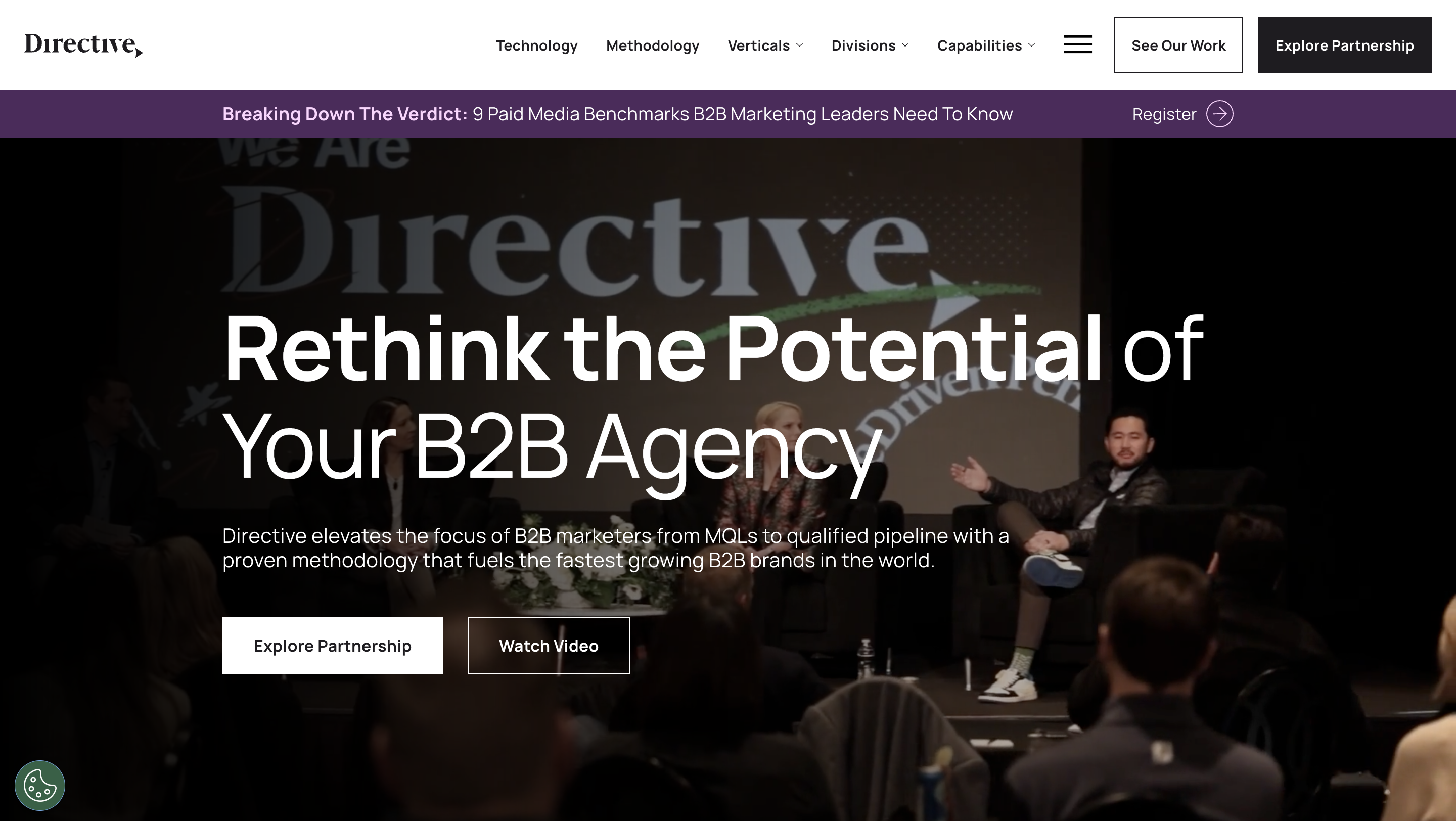
Best for: SaaS and technology companies running large budgets across search and social that want an established specialist with a methodology built around SQLs and customers
Directive is a performance marketing agency based in Irvine, California, serving SaaS and tech companies. It is known for Customer Generation, a methodology the agency developed to replace MQL-based planning with targets for SQLs and customers. Its own description of its paid media practice refers to LTV:CAC as a governing measure.
Applied to PPC, this produces campaigns weighted towards bottom-of-funnel intent and offers that lead directly to a sales conversation. Budgets are modelled backwards from a customer target: how many customers are needed, how many SQLs that implies, what those SQLs can cost given lifetime value. The plan that results is argued in financial terms, which helps a marketing leader defend it to a finance director.
Directive combines paid media with SEO, performance creative, video, and revenue operations, and its client list includes large technology companies. It suits organisations with the spend and data volume to feed that machine. Smaller accounts should ask what level of seniority they will be assigned.
Key services
- Paid search and paid social for SaaS and tech
- Customer Generation planning from customer and SQL targets
- Performance creative and video
- SEO alongside paid
- Revenue operations support
Why Directive stands out for pipeline-focused campaigns
- A named, documented methodology that treats SQLs and customers as the objective
- Financial modelling with LTV:CAC ties campaign plans to unit economics
- Scale and experience in SaaS paid media
- Creative and video produced within the same agency
Best fit: Well-funded SaaS companies with substantial monthly ad budgets and a need for a board-ready rationale. Companies at the lower end of the spend range may get more attention from a smaller specialist.
3. GrowthSpree
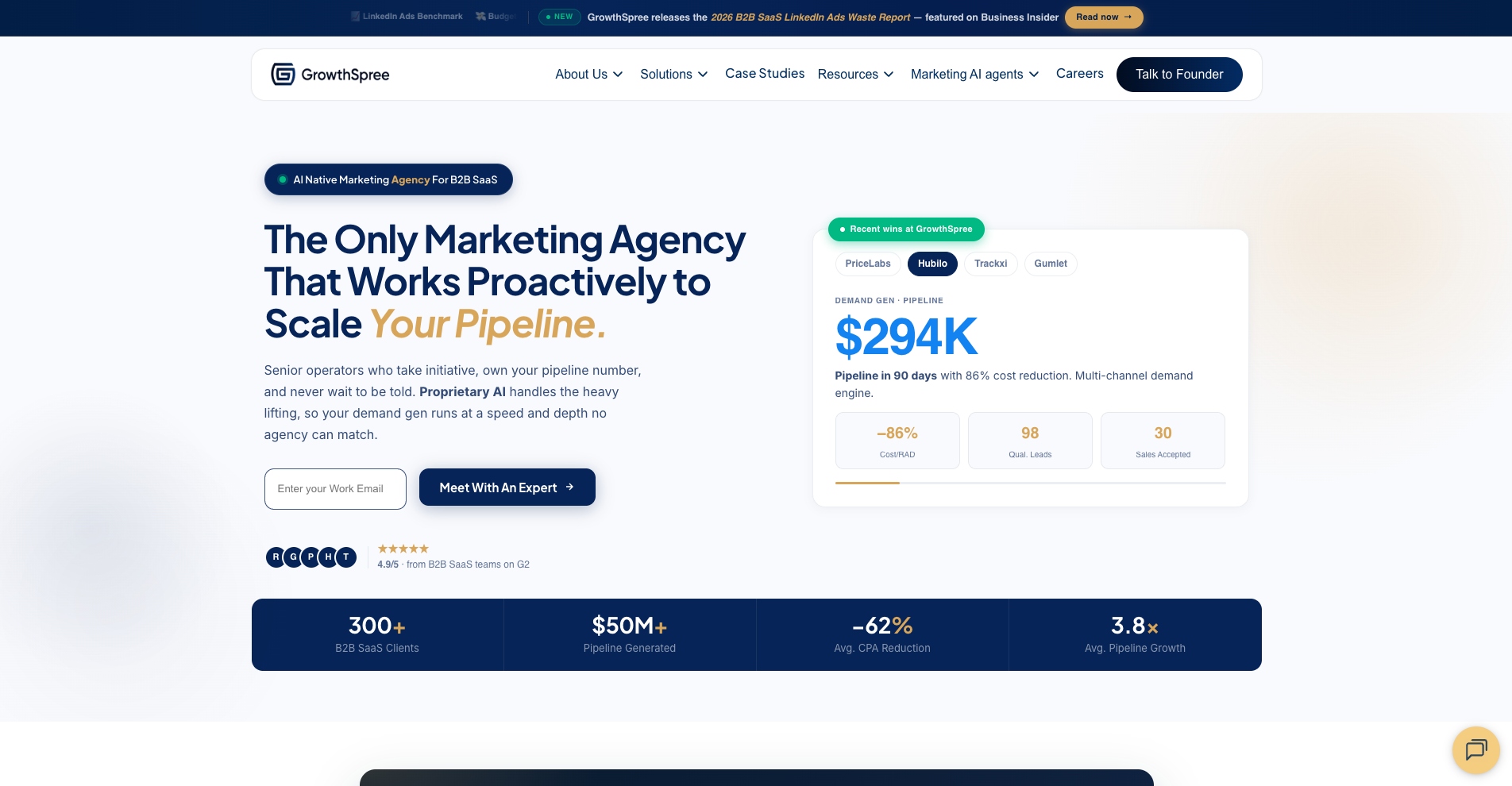
Best for: B2B SaaS teams that want closed-won data feeding their ad platforms and unified attribution, at a fixed monthly fee
GrowthSpree is a demand generation agency for B2B SaaS that has built its own technology for the central problem of pipeline-focused PPC. Its Qualified Lead Architecture sends closed-won signals from the CRM back to the ad platforms, so bidding learns from customers. A second layer connects Google Ads, LinkedIn Ads, HubSpot, GA4, and Search Console into one attribution view. The agency reports more than $60M in managed SaaS ad spend across over 300 B2B accounts.
The value of this is speed and consistency. Building a CRM-to-platform connection is a project that many agencies scope separately or leave to the client's operations team. GrowthSpree treats it as standard equipment. A new client gets pipeline-level reporting early in the engagement instead of after a quarter of set-up.
Its pricing is a flat retainer on a month-to-month basis, which removes the link between the agency's income and the size of the media budget. Published results include a 3.4x return on ad spend with a 36% lower cost per demo for Rocketlane.
GrowthSpree is a paid and ABM specialist. Website conversion work, sales process, and wider CRM architecture are outside its core offer.
Key services
- Paid acquisition on Google, LinkedIn, and Meta
- Qualified Lead Architecture for CRM signal feedback
- Unified attribution across ad platforms and CRM
- Signal-based account-based marketing
- GEO as part of standard engagements
Why GrowthSpree stands out for pipeline-focused campaigns
- Purpose-built tooling for passing CRM outcomes to ad platforms
- Attribution connected from the start of the engagement
- Flat fee and monthly terms
- Works only with B2B and B2B SaaS companies
Best fit: SaaS companies on HubSpot that want a paid media specialist with strong measurement and predictable cost. Teams needing landing page redesign or sales-side changes will need to arrange those separately.
4. Hey Digital
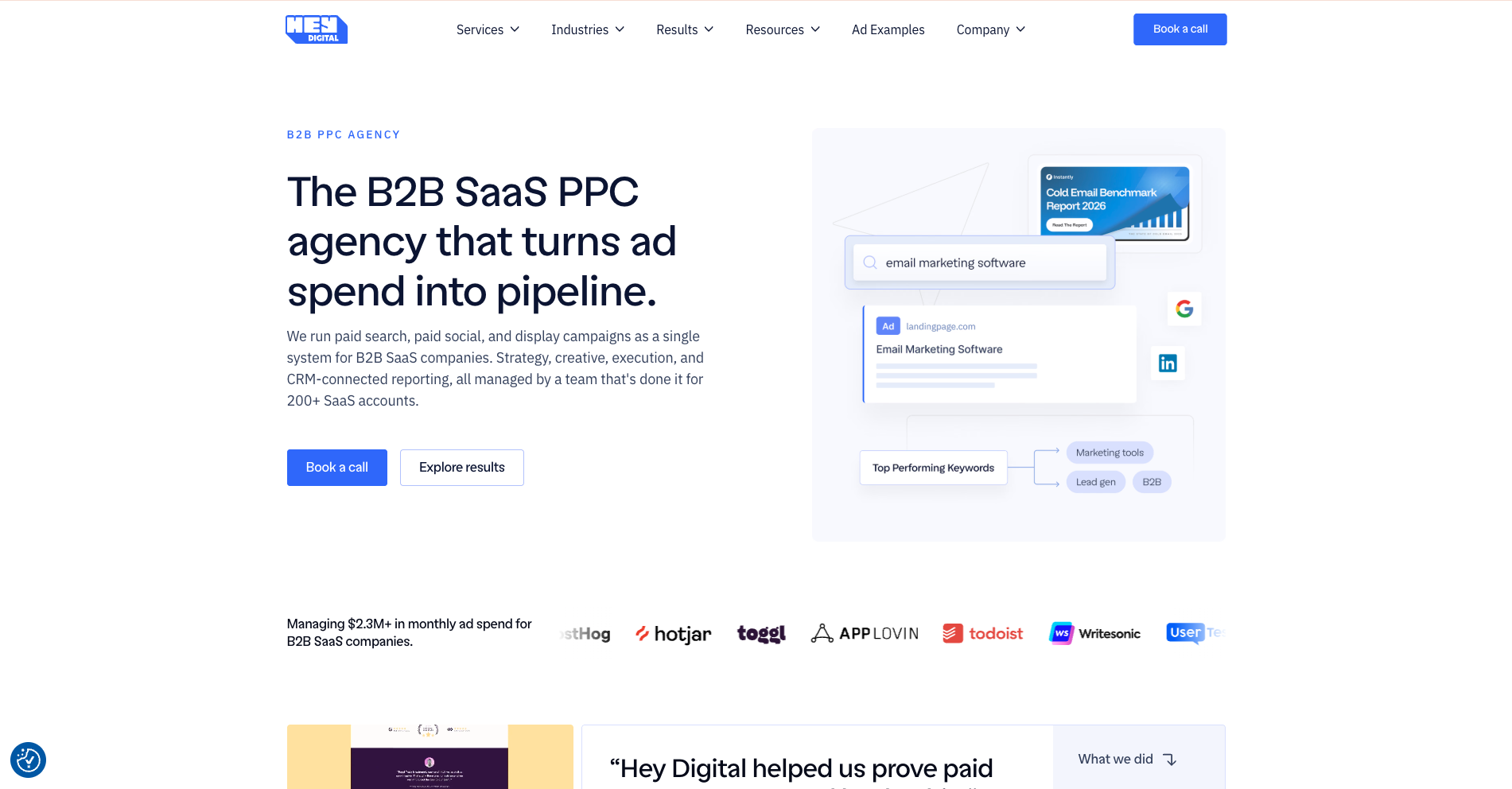
Best for: B2B SaaS companies where the constraint on paid performance is creative: too few ad variants, tested too slowly
Hey Digital is a paid media agency in Tallinn, Estonia, that works only with B2B software companies. It reports managing more than $2.3 million in monthly ad spend and having worked with over 200 B2B SaaS companies. Search, social, and display are run as one programme, with strategy, creative, execution, and CRM-connected reporting all handled in house.
Creative is its distinguishing strength. On LinkedIn and Meta especially, the ad itself does much of the targeting: the message determines who stops and who clicks. An account with three tired creatives will underperform one with thirty fresh ones, whatever the bidding strategy. Hey Digital produces SaaS ad creative quickly, builds and optimises landing pages, and applies a testing framework tailored to each client.
For pipeline purposes, the combination to look for is that creative capacity joined to CRM-connected reporting, so that winning ads are picked on downstream results instead of click-through rate. Much of the agency's published evidence is expressed in signups and cost per acquisition, which fits product-led companies well. Sales-led companies should ask for examples reported at opportunity level.
Key services
- Paid search, paid social, and display for B2B SaaS
- In-house ad creative production
- Landing page creation and optimisation
- Conversion tracking and CRM-connected reporting
- Structured testing frameworks
Why Hey Digital stands out for pipeline-focused campaigns
- SaaS-only focus, including trial and freemium models
- Creative produced in house and at speed, which keeps testing moving
- Landing pages are part of the service, so the click and the page are designed together
- European base, convenient for companies selling in European markets
Best fit: Product-led and hybrid SaaS companies that depend on paid social and need a steady supply of tested creative. Enterprise sales-led companies should confirm the depth of opportunity-level reporting.
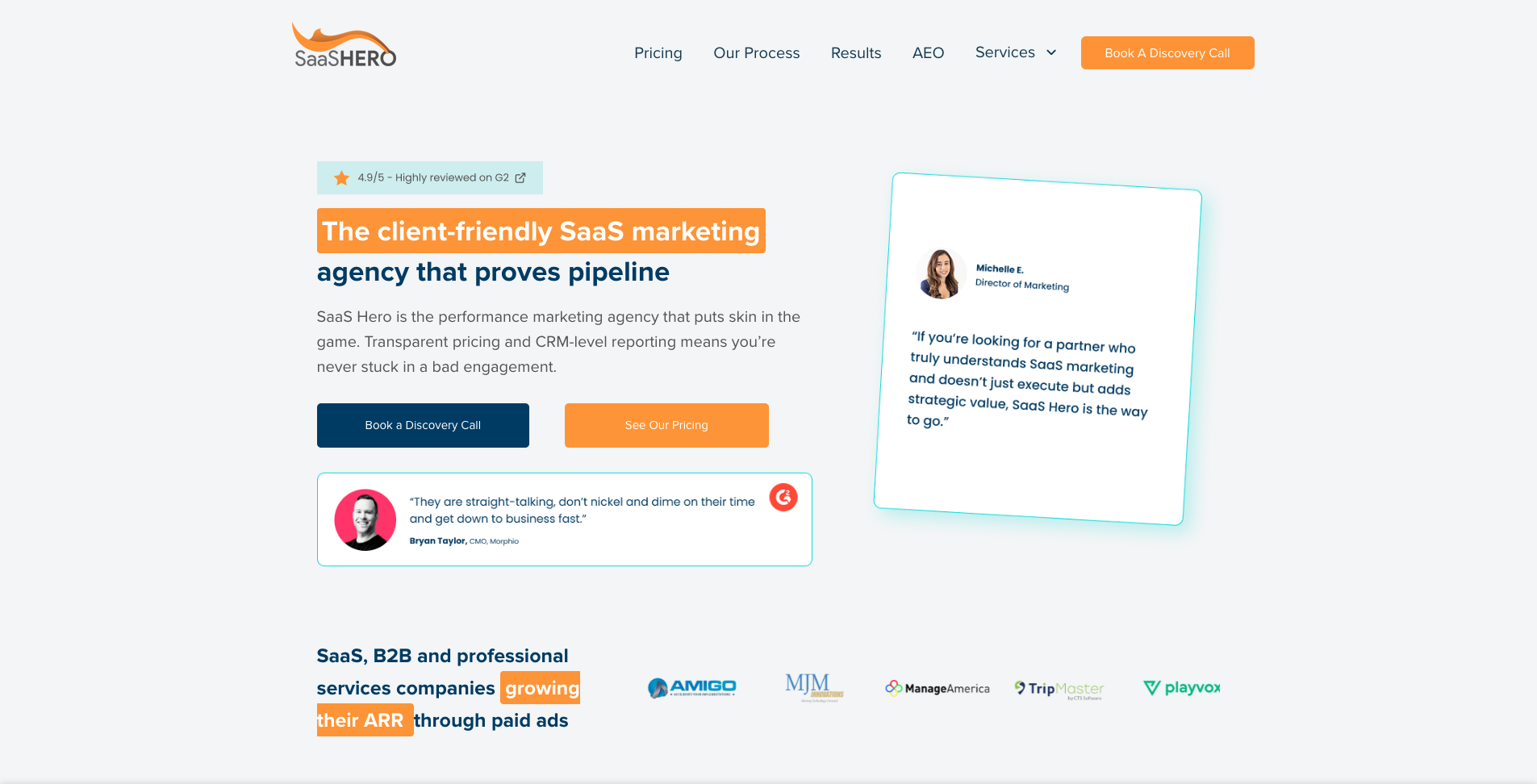
5. SaaS Hero
Best for: B2B SaaS companies that want paid media fees fixed, contracts short, and reporting in pipeline and new ARR
SaaS Hero is a paid media agency for B2B SaaS built around a commercial model. It charges flat fees, not a percentage of ad spend, and works month to month. The agency says it has worked with more than 100 B2B SaaS companies, and it frames its reporting around pipeline and net new ARR.
The model answers two standing complaints about PPC agencies. A percentage-of-spend fee rewards the agency for recommending larger budgets. A twelve-month contract leaves the client carrying the risk if results do not come. A flat monthly fee with no lock-in means the agency keeps the account only by producing results the client values, and has no reason to push spend beyond what the pipeline supports.
Its published case studies are stated in revenue terms, including $504,000 in ARR for TripMaster and an 80-day payback period for TestGorilla.
The model does not prove the method. Before signing, ask how CRM outcomes are connected to the ad platforms and what a monthly report contains. Most public information about SaaS Hero comes from its own website.
Key services
- Google Ads and LinkedIn Ads for B2B SaaS
- Flat-fee, month-to-month engagement
- Pipeline and net new ARR reporting
- Paid media for B2B SaaS companies only
- Discovery call and account review before engagement
Why SaaS Hero stands out for pipeline-focused campaigns
- Fees are independent of ad spend
- No long contract, so the client can leave if pipeline does not follow
- Case studies expressed in ARR and payback
- Works with B2B SaaS companies specifically
Best fit: SaaS companies that have been disappointed by percentage-of-spend agencies and want cleaner incentives. Do your own checks on attribution practice, since independent evidence is limited.
Why dimartec Runs Pipeline-Focused PPC as Part of a Larger Engine
The four other agencies each solve a real part of the problem. Directive brings a planning method anchored in customers and unit economics. GrowthSpree brings the tooling that lets ad platforms learn from the CRM. Hey Digital brings creative range and testing pace. SaaS Hero brings a fee structure that keeps the agency honest about spend.
All four are paid media agencies, and that is the limit they share. A pipeline figure is produced by a chain: the ad, the page, the form, the speed of follow-up, the qualification call, the opportunity record. A paid agency controls the first link and, at best, the second. When pipeline disappoints, the agency can show that the clicks were right, and the client is left to find out which later link failed.
dimartec holds the chain. Performance Paid Media buys the click. CRO owns the page and the form. Lead Gen & Nurturing governs who goes to sales and how fast. RevOps & Automation records the opportunity, values it, and returns that information to the campaign. GEO adds buyers who have researched the category in AI search and arrive closer to a decision. If pipeline from a campaign falls short, one team can look along the whole chain, find the weak link, and fix it without a meeting between suppliers.
That is the practical meaning of pipeline-focused: responsibility that does not stop at the click.
See how the Revenue Engine works: https://www.dimartec.co.uk/services/revenue-engine
Three Things to Check Before Hiring a PPC Agency
One: Ask to see a real monthly report, with the client's name removed. Read the first page only. If it opens with impressions, clicks, and cost per lead, that is what the agency manages to, whatever the sales deck said. A pipeline-focused report opens with pipeline created, pipeline per unit of spend, and opportunities by campaign.
Two: Ask what they will switch off in the first thirty days. An agency serious about pipeline will expect to pause campaigns that generate cheap leads and no opportunities. Ask which kinds, and what it expects to happen to lead volume and cost per lead as a result. If the answer is that nothing needs cutting, the account will be optimised much as it is now.
Three: Ask who is responsible when clicks are good and pipeline is not. This will happen at some point. The agency's answer shows where its sense of responsibility ends. Some will say the landing page or the sales team is the client's concern. Others will have a view, a process, or a service for it. Neither is wrong, but you need to know before you sign who picks up the problem.
Frequently Asked Questions
What is a pipeline-focused PPC campaign?
It is a paid campaign whose target, optimisation signal, and reporting are all based on sales pipeline created, not on leads or clicks. In practice this means connecting the CRM to the ad platforms, bidding towards opportunities instead of form fills, favouring keywords and audiences with clear buying intent, and reporting pipeline value against spend for each campaign.
How is pipeline-focused PPC different from optimising for cost per SQL?
Cost per SQL counts qualified leads and treats them as equal. Pipeline focus goes one step further and weighs them by value. A campaign that produces five SQLs from small companies and one that produces three from large accounts can have very different pipeline results, even though the first looks better on cost per SQL. Where deal sizes vary widely, pipeline value is the more accurate guide to where budget should go.
How much ad spend does a SaaS company need for pipeline-focused campaigns to work?
There is no fixed threshold, but volume matters because ad platforms need a regular flow of conversion data to learn from. Opportunities are rarer than leads, so a small account may produce too few each month for automated bidding to use. The usual answer is to feed the platform a mix of earlier and later signals, giving more weight to the later ones as they accumulate. An agency should be able to tell you from your current numbers whether you have enough volume and what it would use if not.
Will lead volume fall if we switch to pipeline-focused PPC?
Usually, yes, at first. Removing low-intent keywords and content offers cuts the cheapest leads, so total leads fall and cost per lead rises. What should rise in turn is the share of leads that become opportunities and the pipeline generated per unit of spend. Agree in advance with sales and finance that lead volume is no longer the measure, or the early numbers will cause alarm.
Give the Ad Platforms a Better Instruction
Ad platforms do what they are told. Tell them to find form fills and they will. Tell them what a customer looks like, and what one is worth, and they will look for that instead. The agencies in this guide differ in how they deliver that instruction and in how much of what follows the click they are prepared to own.
The Revenue Engine links Performance Paid Media, CRO, GEO, Lead Gen & Nurturing, and RevOps & Automation, so that every campaign is built from customer data, lands on a page made for it, and is measured on the pipeline it produces.
See how the Revenue Engine works: https://www.dimartec.co.uk/services/revenue-engine









.png)







.png)

















































.png)
.png)
.png)
.png)
.png)
.png)
.png)
.png)
.png)
.png)