
Across B2B in general, 79% of marketing-generated leads never convert to sales. In B2B fintech, where a sales cycle runs six to nine months and every unqualified conversation costs a senior sales representative more than a week of productive time, the number that actually matters is not how many leads were generated. It is how many of those leads were worth generating.
Qualified pipeline in B2B fintech is a narrower concept than it sounds. A qualified fintech lead is not just an ICP match. It is an account where the relevant buyer has confirmed authority to evaluate, where the company has confirmed budget to purchase, where the procurement or compliance review process has been scoped, and where the specific problem the product solves has been validated against the buyer's current regulatory or operational situation. Most B2B marketing programmes generate the first condition and call it qualified. The other four are discovered, or not, by the sales team at significant cost.
After examining qualification infrastructure across fintech pipeline programmes, the finding is consistent. The average MQL-to-SQL conversion rate across B2B markets sits at 13%. In fintech, where regulatory gatekeepers and multi-stakeholder buying committees add qualification stages that most lead scoring models never account for, the rate frequently runs below 10% without deliberate architectural intervention. The companies that reach the top-quartile range of 25–35% MQL-to-SQL share one characteristic: the qualification logic was designed as part of the marketing programme, not handed to sales as a sorting problem.
This guide evaluates the five best B2B fintech marketing agencies for generating qualified pipeline specifically: the ones whose methodology builds qualification logic into acquisition, not after it.
Why Qualified Pipeline Is a Different Problem in B2B Fintech
The MQL-to-SQL gap in B2B fintech is wider than in general SaaS not because fintech buyers are harder to reach, but because the qualification criteria are more complex than a standard BANT framework captures.
Multi-stakeholder buying committees change the qualification unit. A fintech platform selling to a mid-market bank is not selling to one buyer. The CISO, Head of Compliance, CFO, and business unit head may all have effective veto power. A lead with one enthusiastic contact but no compliance team involvement has not crossed into SQL territory regardless of engagement score. Qualification frameworks that score individual contacts rather than account-level committee coverage will consistently overestimate pipeline quality.
Regulatory and compliance stages extend the evaluation period. Fintech deals routinely include information security review, vendor due diligence, and sometimes regulatory sign-off before a contract can be executed. Leads that enter the pipeline without having been prepared for these stages stall during review rather than advancing. Most marketing programmes treat those stalled deals as a sales execution problem when the qualification gap was set up at the acquisition stage.
Trust deficits produce false positives at the MQL stage. A lead that has downloaded three whitepapers, attended a webinar, and revisited the pricing page looks like an engaged MQL on any standard scoring model. In fintech, this behaviour pattern frequently represents due diligence research rather than purchase intent. Programmes that cannot distinguish research engagement from evaluation intent will consistently over-report qualified pipeline.
Quick Comparison
What Qualified Pipeline Means in B2B Fintech
Five criteria define a genuinely qualified fintech lead. Firmographic and role fit covers company size, sector, geography, and technology stack, with the contact confirmed in a buying role. Regulatory alignment confirms that the account's compliance environment is compatible with the product: leads that pass ICP fit but fail regulatory alignment are high-effort no-closers. Buying committee coverage requires at least two stakeholders from the relevant committee to have been engaged. Budget and timeline confirmation places the account in an active budget cycle within a workable decision window. Documentation readiness confirms the account has been introduced to the information security and procurement requirements without raising a blocking objection. This final criterion is unique to fintech and is almost never included in standard MQL definitions. Its absence is the single most common source of late-stage deal stall in fintech.
How We Chose These Agencies
Qualification framework depth: Does the agency build qualification logic beyond ICP fit and engagement score, covering buying committee, regulatory alignment, and documentation readiness?
Fintech domain specificity: Are there named fintech clients at the relevant growth stage with documented MQL-to-SQL conversion outcomes, not just pipeline volume?
Sales-marketing alignment: Does the agency define qualification criteria jointly with the sales team, or does it define MQL unilaterally from marketing's perspective?
Long-cycle discipline: Is the reporting framework built for six-to-nine-month sales cycles, or does it optimise for 30-day metrics that misrepresent fintech pipeline quality?
Proof: Named clients, specific qualification outcomes, stated timeframes.
The 5 Best B2B Fintech Marketing Agencies for Qualified Pipeline
1. dimartec
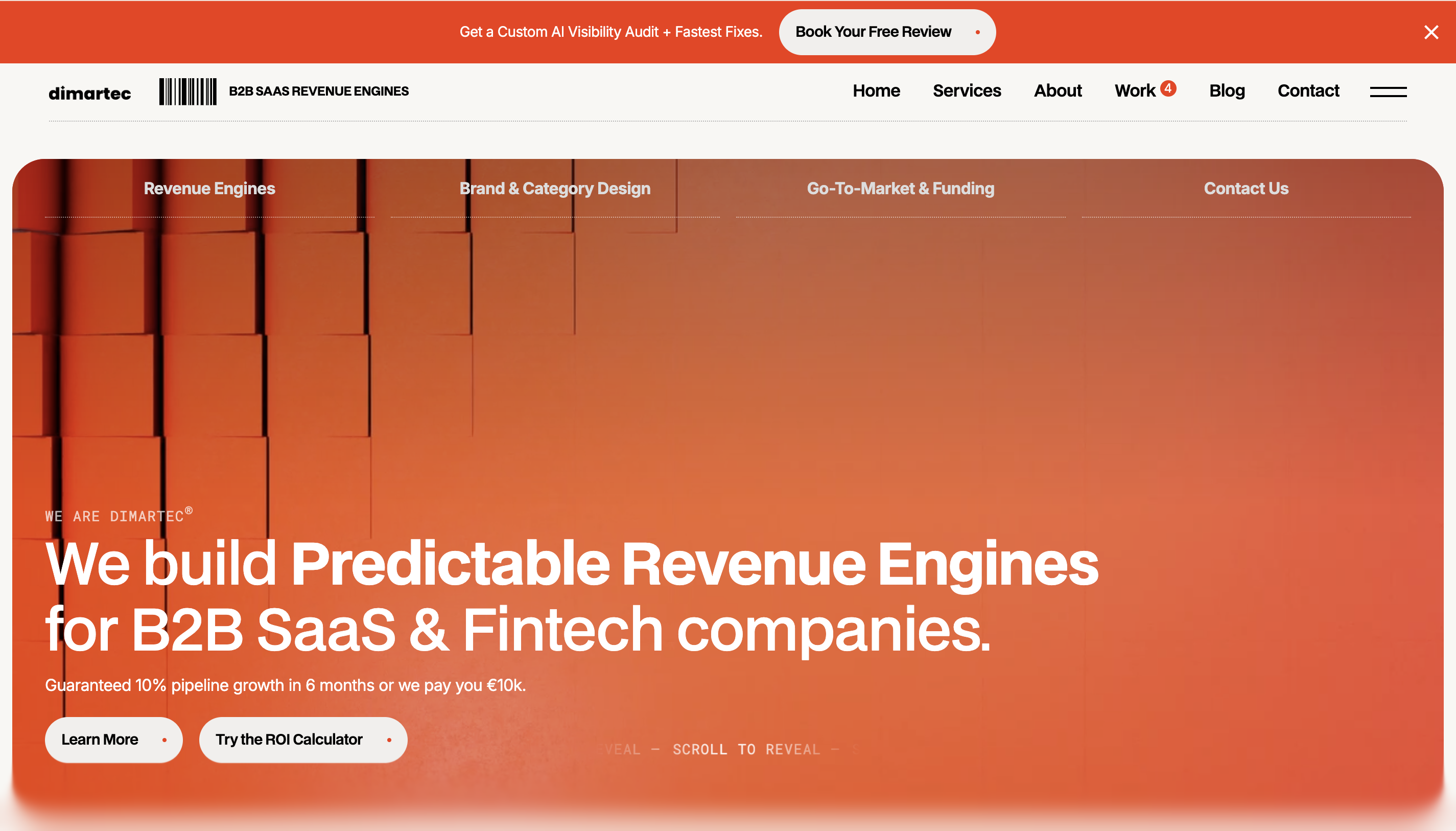
Best for: Post-PMF B2B SaaS and fintech at €2M–€10M ARR where the gap between MQL volume and SQL quality is structural: marketing generating leads the sales team consistently rejects, and the disagreement about what "qualified" means never resolved at the system level
dimartec builds Revenue Engines for B2B SaaS and fintech companies. The qualified pipeline problem maps directly to how the Revenue Engine is designed: four integrated pillars (Performance Paid Media, CRO, AI Optimization (GEO), and RevOps & Automation) where the qualification architecture runs through all four rather than sitting as a separate function that receives leads after acquisition.
In most fintech marketing programmes, qualification is designed by marketing unilaterally and inherited by sales as a sorting problem. Marketing defines the MQL criteria, passes contacts when the score is reached, and sales qualifies against a different, unwritten standard. The rejection rate is high. The pipeline figure that marketing reports and the pipeline figure that sales works from are different numbers, and the board is never certain which one to believe.
dimartec addresses this at the architecture level. The lead scoring model feeding RevOps & Automation is built from closed-won data, calibrated to the accounts that actually closed rather than to assumed ICP criteria. The qualification gate is designed jointly: marketing and sales agree on what SQL-ready means in this specific fintech context, and the CRM enforces that definition rather than leaving it to individual interpretation. High-intent accounts route to sales immediately; lower-intent accounts enter a nurture sequence that builds buying committee coverage and documentation readiness before the sales conversation is triggered.
If any of the following apply, dimartec is worth a conversation:
The sales team consistently rejects a significant proportion of marketing-qualified leads, and the rejection reason is never systematically captured or acted on
MQL volume has grown quarter over quarter but SQL volume has stayed flat
The pipeline forecast requires manual negotiation between marketing's view and sales' CRM data before the board meeting
Deals are stalling during compliance or procurement review at a rate suggesting the leads reaching that stage were never correctly qualified
Key services
RevOps & Automation: qualification framework built from closed-won data, automated lead routing by buying committee coverage and intent stage, shared pipeline definition enforced by the CRM
Performance Paid Media: acquisition calibrated to ICP accounts most likely to produce SQLs, not the audiences producing cheapest clicks or highest MQL volume
CRO: landing page and form design collecting the qualification signals (regulatory environment, buyer role, current stack) needed to route leads correctly before the sales handoff
AI Optimization (GEO): brand visibility in ChatGPT, Perplexity, Grok and Claude from accounts actively evaluating fintech solutions, reaching buyers at the research stage before competitor engagement
Why dimartec stands out for qualified pipeline
Qualification logic built from closed-won data: the scoring model reflects what actually converts, not what was assumed at programme start
The CRM enforces the qualification standard rather than documenting it, preventing drift between individual sales reps' interpretations
GEO positions dimartec clients in the AI search responses fintech buyers use during due diligence research, reaching accounts when qualification signals are strongest
90% of clients see improved lead quality within 90 days
Best fit: Post-PMF B2B fintech where marketing and sales are measuring different pipelines, MQL-to-SQL is below 20%, and the root cause is a qualification framework never designed for the specific compliance and buying committee dynamics of fintech deals that actually close.
2. Evara

Best for: Growth-stage B2B fintech running on HubSpot that needs its lead scoring model recalibrated to the specific behavioural signals that predict SQL readiness in fintech buying journeys, not generic engagement scoring that misclassifies research behaviour as purchase intent
Inbound FinTech is a fintech-specialist agency with a practice built entirely around HubSpot and the qualification dynamics of financial technology buying. Rather than applying standard engagement-threshold scoring, IFT builds fintech-specific scoring models that weight the signals most predictive of SQL readiness: pricing page visits combined with security documentation requests, webinar attendance on compliance-specific topics, or repeat engagement from multiple contacts at the same account indicating buying committee formation.
This matters because a fintech buyer in due diligence research mode produces exactly the same surface engagement pattern as a buyer in active evaluation mode. Standard scoring models cannot distinguish between them. IFT's fintech-calibrated scoring introduces secondary signals (regulatory alignment indicators, buying committee breadth, documentation engagement) that separate research engagement from evaluation intent before the lead reaches the sales queue. Their HubSpot architecture includes custom properties for regulatory environment, compliance status, and committee coverage, with automated workflows routing high-intent accounts to sales and low-intent accounts into nurture sequences that build buying readiness first.
Key services
HubSpot lead scoring recalibration with fintech-specific signal weighting
Buying committee tracking at the account level rather than individual contact scoring
Compliance and regulatory field mapping in HubSpot for fintech qualification data
Inbound content strategy producing security documentation, compliance case studies, and regulatory comparison guides
Sales-marketing SLA design establishing shared MQL and SQL definitions with rejection feedback loops
Why IFT stands out for qualified pipeline
Fintech-specific lead scoring distinguishes research engagement from evaluation intent: the primary source of false-positive MQLs in B2B fintech
Buying committee tracking at account level prevents individual-contact pipeline entries that stall when decision-makers have not been engaged
HubSpot architecture makes the compliance and regulatory qualification data that sales needs visible in the CRM, not buried in email threads
Formal SLA design creates the shared definition of qualified that prevents criteria drifting between teams
Best fit: Growth-stage B2B fintech on HubSpot where MQL-to-SQL is below 20% and the sales team's primary rejection reason is "not ready", indicating qualification is applied too early in the buyer journey before buying committee coverage and documentation readiness have been assessed.
3. CSTMR
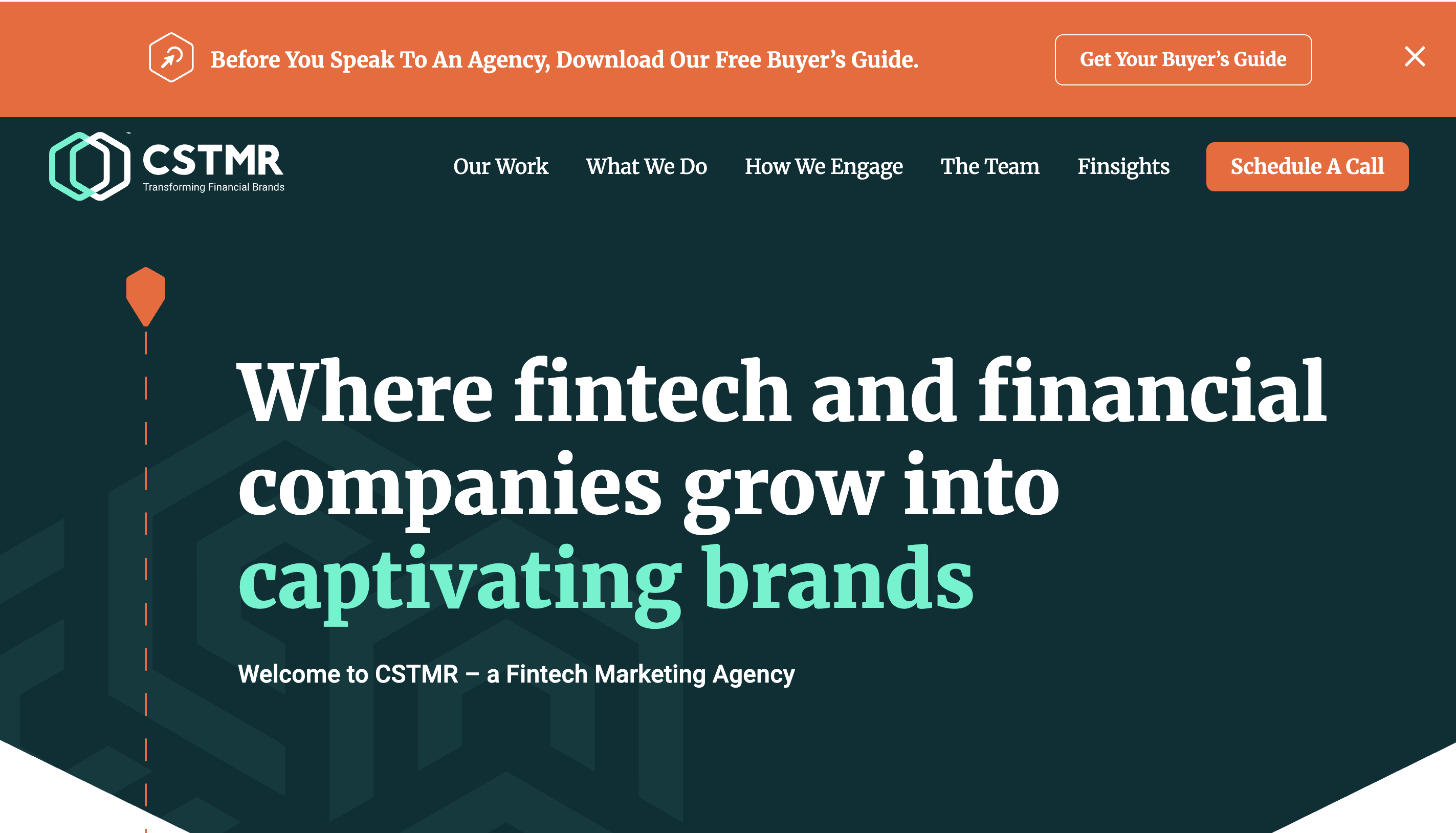
Best for: Series A to growth-stage B2B fintech where the qualification problem begins upstream: leads arrive at the MQL stage with insufficient vendor trust to progress through internal evaluation, producing high-volume pipeline that stalls at first sales contact
CSTMR is a fintech-only agency founded in 2014 with documented work across payments, lending, banking, and financial software. Their connection to qualified pipeline is specific: they build brand credibility and trust signals into demand generation programmes, which reduces the frequency of the most common fintech pipeline stall. A CFO who found your content interesting cannot always push a vendor into procurement review if the vendor does not appear credible to the compliance team. CSTMR's integration of brand strategy with performance demand generation addresses this upstream: the brand position and compliance-appropriate credibility signals are built into the campaigns and content that generate MQLs, so leads arrive already having been exposed to the evidence their internal stakeholders will need to approve an evaluation.
SOC 2 Type 1 compliance is a meaningful credential for fintech clients whose legal teams will scrutinise every vendor relationship. Documented results include a 1.6x ROAS improvement for Fincent and a 6x pipeline increase for Airbase, backed by $150M-plus in managed ad spend across fintech verticals.
Key services
Fintech brand strategy and credibility positioning calibrated to procurement gatekeepers
Performance paid media with compliance-appropriate claim substantiation in ad creative and landing page copy
Content covering the materials fintech buyers use during internal evaluation: security documentation summaries, regulatory compliance frameworks, vendor comparison guides
Account-based marketing targeting the full buying committee, not just the first-contact persona
SOC 2 Type 1 compliant data and content handling
Why CSTMR stands out for qualified pipeline
Brand and performance integration addresses the upstream cause of pipeline stall: leads with insufficient trust to survive internal evaluation are produced by acquisition programmes that prioritise volume over credibility
SOC 2 Type 1 compliance removes one layer of vendor scrutiny that would otherwise delay qualification for security-conscious procurement processes
Fintech-only client base means campaign claims and content formats are calibrated to financial services buyer expectations, not adapted from SaaS playbooks
$150M-plus in managed fintech spend with named client outcomes
Best fit: Series A to growth-stage B2B fintech where engaged MQL-stage leads consistently fail to survive internal procurement or compliance review, indicating the brand credibility and compliance evidence in the demand generation programme are insufficient to support the internal case a champion needs to build.
4. Ironpaper
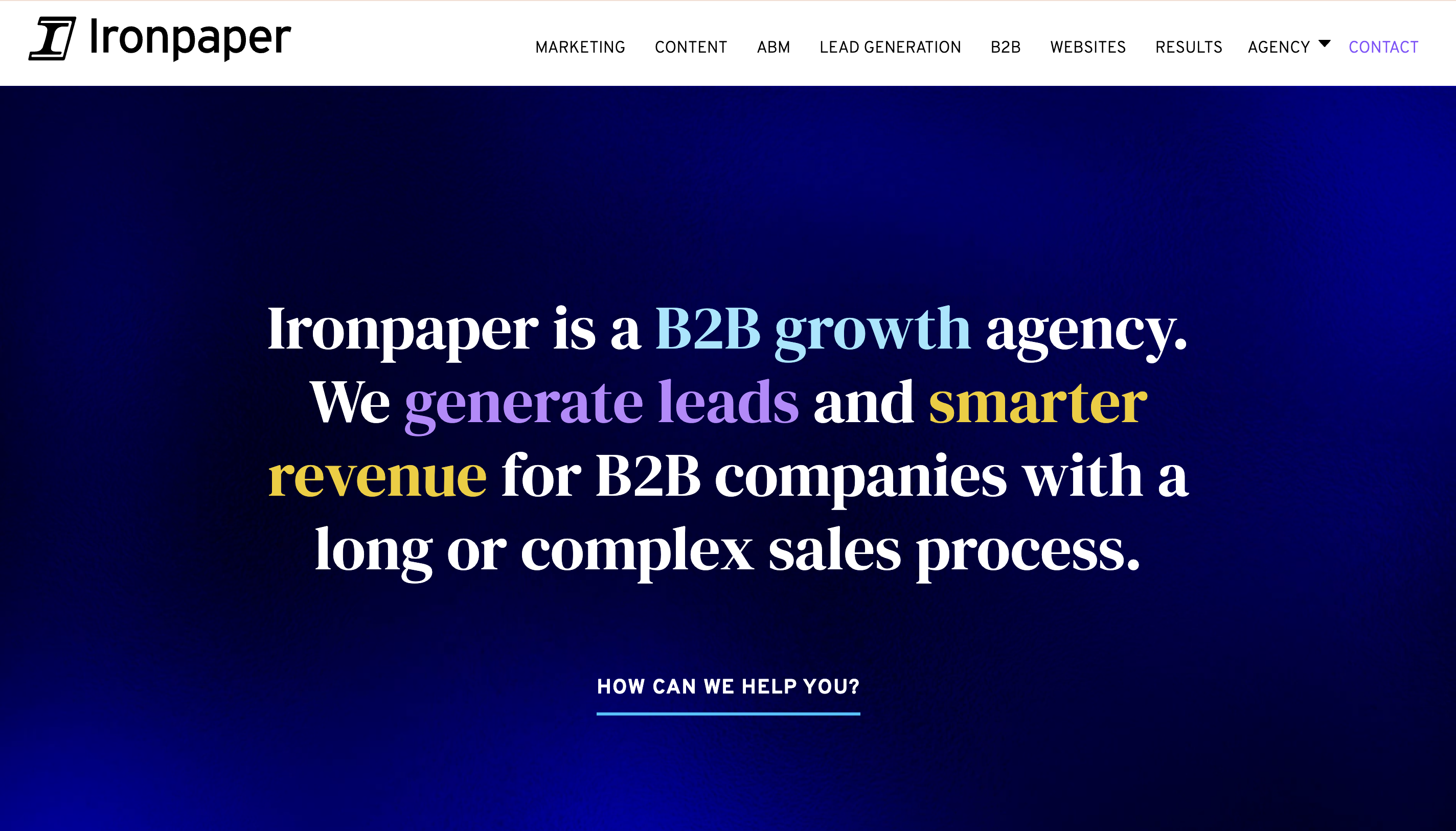
Best for: Enterprise B2B fintech with buying committees of five or more stakeholders where individual lead scoring misreads pipeline quality by measuring one contact's engagement rather than the account's collective buying readiness
Ironpaper specialises in ABM and multi-stakeholder demand generation for B2B companies in complex enterprise buying environments. Rather than scoring individual contacts against an MQL threshold, Ironpaper tracks the breadth and depth of engagement across the full buying committee at each target account. In enterprise fintech, a significant technology purchase typically involves five to eight stakeholders from IT, compliance, risk, finance, and the business unit. A lead scoring model that measures one contact's engagement will consistently misidentify where each account sits in the evaluation process. Ironpaper's ABM methodology surfaces the account-level picture before the handoff to sales: which stakeholders have been engaged, which are missing, and which have raised objections.
Their multi-stakeholder content sequencing produces different materials for each stakeholder type and tracks engagement across the committee. This is particularly relevant for fintech sales motions where regulatory, technical, and commercial objections come from different buying committee members and must be addressed before a formal evaluation can begin.
Key services
Account-level ABM for named enterprise fintech accounts targeting buying committees, not individual contacts
Multi-stakeholder content sequencing with separate content tracks for CISO, compliance, CFO, and business unit roles
Buying committee mapping tracking which stakeholders have been engaged and which have raised objections
Sales enablement content for multi-stakeholder objection handling during procurement review
Pipeline attribution at the account level across six-to-eighteen-month enterprise evaluation cycles
Why Ironpaper stands out for qualified pipeline
Account-level committee tracking produces qualification data individual lead scoring cannot: which accounts have multi-stakeholder engagement and which are ready for a sales conversation that includes all relevant decision-makers
Multi-stakeholder content sequencing pre-addresses objections from each stakeholder type before sales encounters them, reducing cycles that stall from an unconsidered stakeholder
ABM methodology explicitly designed for procurement and compliance review stages that most qualification frameworks never prepare for
Best fit: Enterprise fintech selling to large banks or financial institutions where standard lead scoring is producing pipeline entries that stall because only one or two buying committee members have been engaged and the rest introduce blocking objections during evaluation.
5. Martal Group
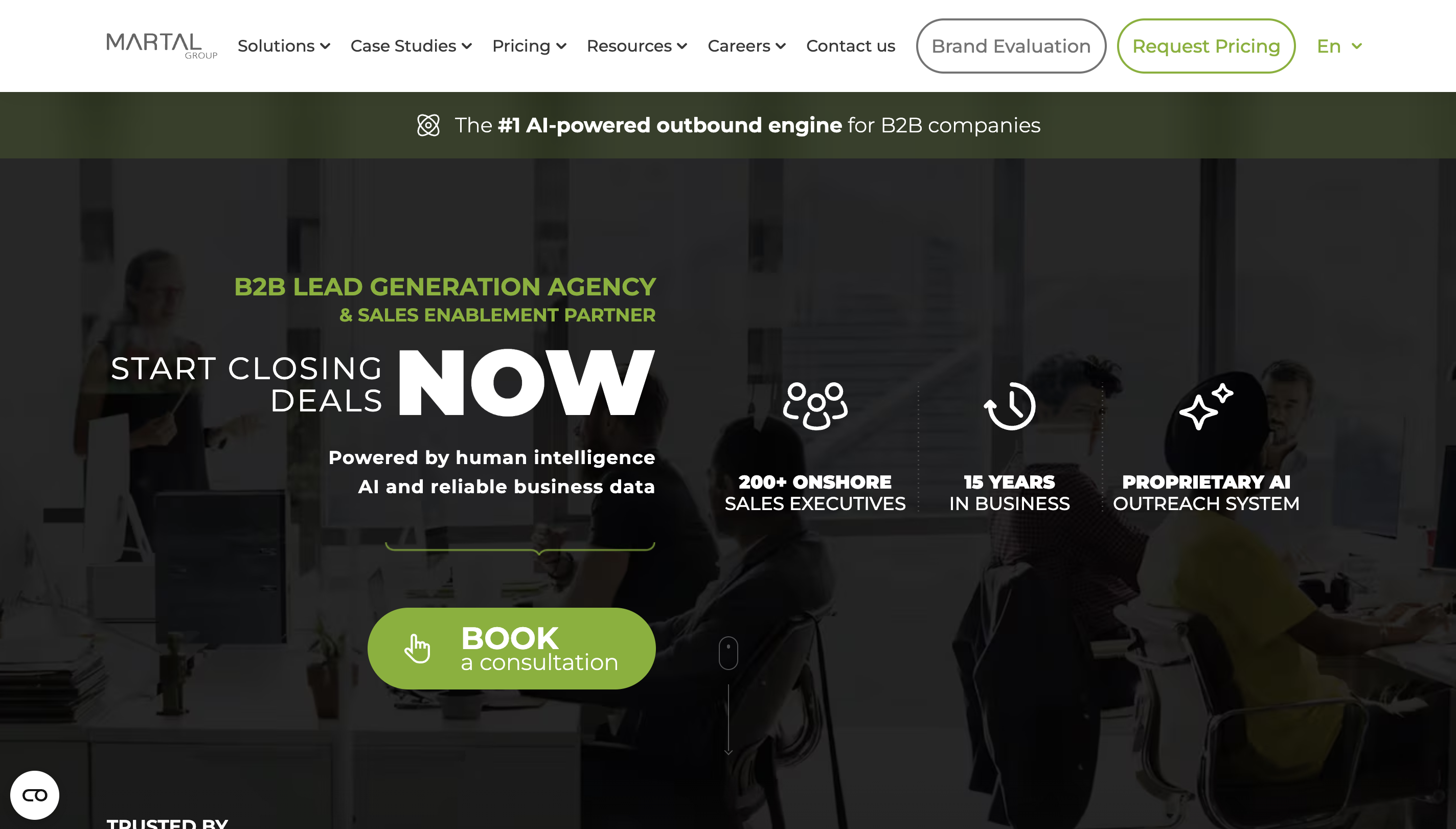
Best for: Series A+ B2B fintech that need a controllable, qualification-first outbound channel where qualification work happens before the calendar booking, so sales receives pre-validated conversations rather than first-contact calls still needing to establish ICP fit, buying intent, and regulatory alignment
Martal Group provides fractional SDR execution and outbound pipeline generation for B2B technology and fintech companies. Their relevance to qualified pipeline is in the handoff model: Martal's SDRs confirm ICP fit, establish buying intent, scope regulatory alignment, and identify relevant stakeholders before a meeting is booked with the client's sales team. The sales conversation begins at a later qualification stage than it would if the sales team were handling both prospecting and qualification themselves.
In fintech, this pre-qualification layer is commercially significant. A fintech AE spending 45 minutes on a discovery call to establish that a prospect is in the wrong regulatory jurisdiction, has no active budget cycle, or has an incumbent relationship that was never disclosed has spent 45 minutes on a sales cycle that produced no pipeline. Martal's SDR layer surfaces these disqualifiers before the AE is involved. The acceptance criteria for a booked meeting are defined and enforced: if the account does not confirm ICP fit, buying intent, and the absence of known disqualifiers, the meeting is not booked. Documented delivery spans over 300 technology and fintech clients, with depth in payments, cybersecurity, and B2B SaaS.
Key services
Fractional SDR execution: outbound prospecting, sequencing, and pre-qualification before AE involvement
ICP targeting and prospect list development with fintech-specific firmographic filters
Multi-channel outbound sequencing calibrated to financial services buying behaviour
Pre-qualification framework with defined acceptance criteria including ICP fit, buying intent, and regulatory alignment confirmation
Pipeline reporting by account segment and qualification stage
Why Martal Group stands out for qualified pipeline
Pre-qualification layer ensures sales receives conversations where ICP fit, buying intent, and regulatory alignment have been confirmed
Controllable qualification standard prevents the drift that occurs when individual SDRs interpret criteria differently
Outbound provides a qualification-consistent pipeline floor independent of campaign timing or content production cycles
Fintech client depth means the pre-qualification framework accounts for the specific disqualifiers (regulatory mismatch, procurement freeze, incumbent lock-in) common in fintech
Best fit: Series A+ B2B fintech whose sales team is spending significant AE time on discovery calls that could have been disqualified earlier: where outbound is generating meeting volume but fewer than 30% of meetings advance to opportunity, indicating qualification is being done by sales rather than before the handoff.
Why dimartec Approaches Qualified Pipeline Differently
Every agency on this list addresses a specific qualification gap. IFT recalibrates the lead scoring model to distinguish research engagement from evaluation intent. CSTMR builds the brand credibility that enables leads to survive internal procurement review. Ironpaper tracks buying committee coverage at the account level. Martal Group pre-qualifies outbound conversations before the sales team is involved.
Each improves qualification within the layer they own. None of them owns the architecture connecting the qualification standard across all layers simultaneously: from how paid campaigns target accounts most likely to produce SQLs, through how the landing page collects the signals needed to score qualification correctly, through how the CRM enforces the shared definition both teams agreed on, through how the attribution model reports which channels produced the qualified pipeline that closed.
When the qualification standard exists in one layer but not the others, the MQL-to-SQL rate improves in one direction and leaks back in another. The SDR qualifies better but feeds a scoring model that was never updated to reflect what the SDR learned. The lead scoring improves but acquisition campaigns still target the audiences that produce volume rather than accounts most likely to meet the new standard. The qualification gap narrows in one place and reopens in another.
dimartec closes the gap as one system. The paid targeting, the qualification signals collected at the landing page, the lead scoring calibrated to closed-won data, and the handoff logic enforced by the CRM all operate against the same definition of qualified. When a fintech sales team and marketing team report the same pipeline number to the same board with the same confidence, it is because the qualification architecture was designed once and runs consistently across every layer.
See how the Revenue Engine works: https://www.dimartec.co.uk/services/revenue-engine
Frequently Asked Questions
Why is MQL-to-SQL conversion lower in B2B fintech than in general B2B SaaS?
Three compounding factors drive the gap. Fintech buying committees include compliance, risk, and security stakeholders not present in most B2B SaaS evaluations, and their objections are frequently invisible at the MQL stage. Regulatory alignment is a binary qualification criterion: an account that is not in the right regulatory jurisdiction cannot close regardless of engagement level. And fintech buyer research behaviour produces false-positive MQL signals because the due diligence activity that precedes an evaluation looks identical to the engagement activity that constitutes one.
What is a realistic MQL-to-SQL target for B2B fintech?
The cross-B2B average is 13%. In fintech, the top quartile achieves 20–30%, slightly lower than general B2B SaaS because compliance and procurement reviews introduce additional qualification stages. A programme moving from below 10% to above 20% in B2B fintech represents a significant improvement and is achievable within two to three quarters with the right qualification architecture.
What is the most common cause of qualified pipeline stall in B2B fintech?
Deals that enter the pipeline as qualified and stall during procurement or compliance review almost always result from a qualification framework that confirmed ICP fit and buying intent but never assessed documentation readiness or regulatory alignment. The information security review discovers the vendor cannot provide required compliance documentation. The compliance team raises a regulatory question the sales team cannot answer. These are qualification failures that occurred at the acquisition stage, not the execution stage.
Build Pipeline That Sales Wants to Work
The measure of a qualified pipeline programme is not how many leads were generated. It is what proportion of those leads reached SQL and what proportion of SQLs closed. In B2B fintech, where a wasted sales cycle costs more than in almost any other SaaS category, the return on getting qualification right compounds with every deal that reaches procurement ready rather than arriving there with gaps that should have been identified months earlier.
The Revenue Engine connects Performance Paid Media, CRO, AI Optimization (GEO), and RevOps & Automation into one build so the qualification standard runs through every layer: from which accounts the paid campaigns target, through which signals the landing page collects, through how the CRM scores and routes leads, through how the attribution model tells the board which pipeline is real.
See how the Revenue Engine works: https://www.dimartec.co.uk/services/revenue-engine






.png)
















































.png)
.png)
.png)
.png)
.png)
.png)
.png)
.png)
.png)
.png)