
The CRM at a newly funded Series A company usually tells a story of good intentions. Someone set it up in a weekend when the company had three salespeople. Fields were added whenever a new question came up. A marketing automation tool was connected, then a second one, then an enrichment service that nobody quite remembers buying. Deal stages mean slightly different things to each rep. The dashboards exist, but before every board meeting someone exports the data to a spreadsheet and fixes it by hand.
None of this mattered much when the founders could see every deal. After the round, it starts to matter a great deal. The plan agreed with investors assumes the sales team will double, marketing spend will grow several times over, and the company will be able to say, with evidence, which activities produce revenue. A system built for a small team cannot carry that weight. Leads get lost between marketing and sales, forecasts drift, and new hires inherit processes that only made sense to the people who invented them.
After analysing revenue operations across more than 200 B2B SaaS accounts, Series A turns out to be the cheapest moment to fix this and the most expensive moment to postpone it. Companies that rebuild their revenue foundations in the twelve months after the round scale into Series B with data they trust. Companies that layer more people and tools onto the original set-up usually spend Series B money untangling it.
Most Series A companies are too small to justify a full RevOps team and too complex to manage without one. Agencies fill that gap in different ways. This guide compares five, and explains which kind of Series A company each suits.
What RevOps Means at Series A
At a large company, revenue operations is a department with analysts, systems administrators, and a leader. At Series A, it is a set of jobs that someone has to do, whoever that turns out to be. Five matter most.
A CRM that reflects how the company actually sells. Lifecycle stages, deal stages, and required fields that match the real sales process, with the clutter of the early years removed.
One definition of a good lead. Marketing and sales agreeing on what makes a lead worth a salesperson's time, written into scoring and routing rules so it is applied the same way every time.
Clean handovers. Leads passed from marketing to sales, and customers passed from sales to success, without delays or gaps, using automation instead of memory.
Reporting people trust. Pipeline by source, conversion between stages, and a forecast that comes from the CRM, not from a spreadsheet rebuilt every month.
A stack that fits. Tools connected properly, duplicates removed, and nothing bought that the team cannot use.
None of these require a large team. All of them require someone with experience to set them up properly once, in a way that will still work when the company is three times larger.
Build, Borrow, or Buy: The RevOps Options After the Round
A Series A company has three ways to get revenue operations done, and the right one depends on how much work there is and how fast it needs doing.
Build: hire in-house. A first RevOps hire gives the company someone who knows the business deeply and stays. The difficulty is that one person rarely covers CRM architecture, automation, data, and reporting equally well, and experienced candidates are expensive and slow to find. A junior hire left alone with a messy system often keeps it running without ever fixing it.
Borrow: fractional RevOps. A fractional operator or team works a set number of hours each week, bringing experience from many similar companies. Independent guides suggest this suits Series A companies with roughly ten to thirty salespeople. It provides senior judgement at a fraction of the cost, though it depends on the operator's availability and the company's ability to brief them.
Buy: a project or a productised build. An agency designs and builds the foundations over a defined period, then hands them over. This works well when the main need is a one-off rebuild, such as a CRM migration or a full redesign of lead management, followed by lighter ongoing support.
Many Series A companies combine these: an agency or fractional team builds the foundations, and the company hires its first full-time RevOps person to run them once they exist. The agencies below fit different points in that sequence.
How We Chose These Agencies
- Series A fit: Does the agency work with companies at this stage, with suitable engagement sizes and pricing?
- Hands-on delivery: Does it build in the CRM and tools, not just advise?
- Platform depth: Does it have certified experience with HubSpot, Salesforce, or both?
- Lasting foundations: Will its work still function as the company grows, and can the team run it afterwards?
- Evidence: Are there client reviews, partner status, or published case studies?
Each profile notes the platform the agency knows best, since that often decides the shortlist.
The 5 Best RevOps Agencies for Series A Companies
1. dimartec
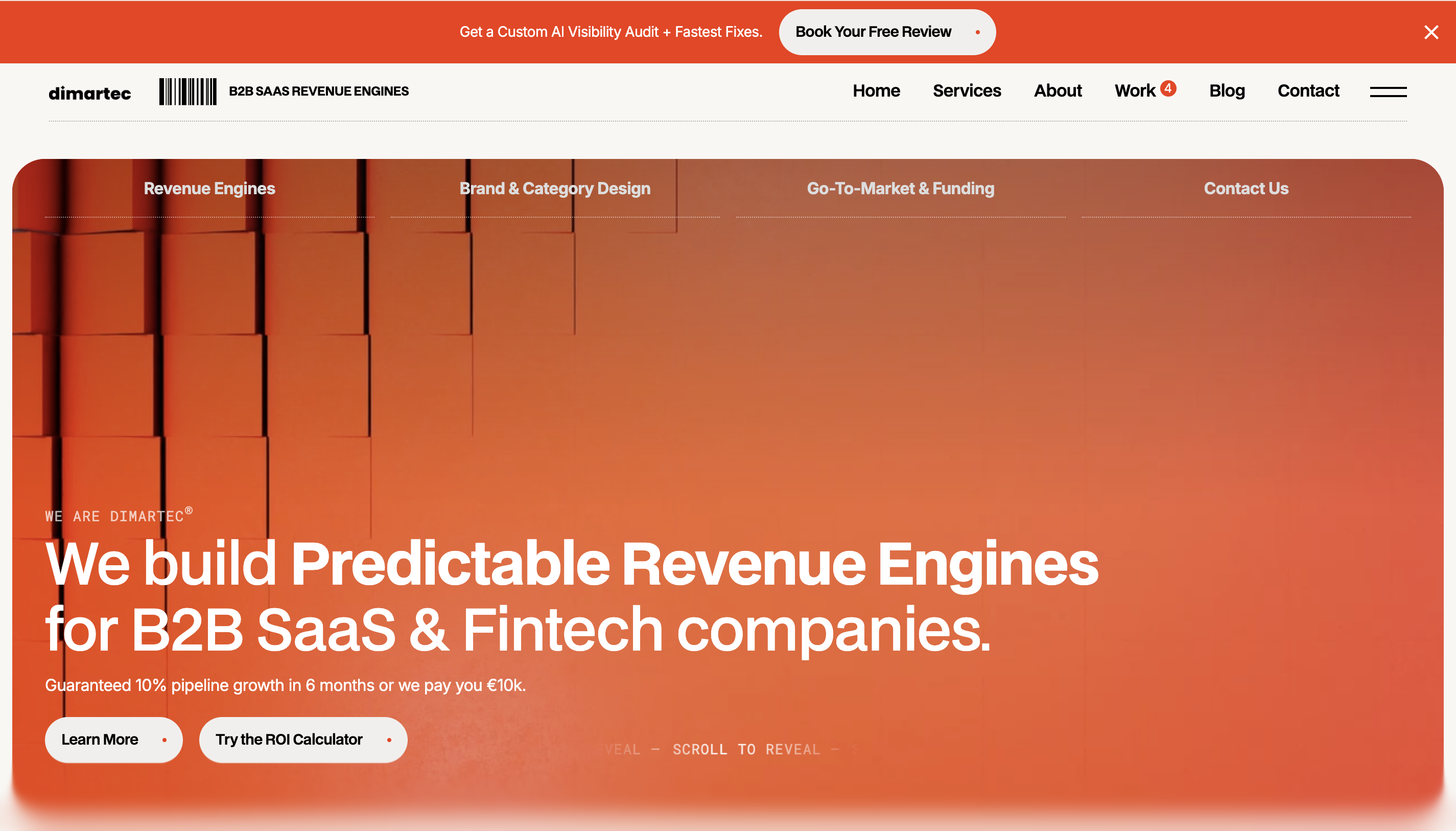
Best for: B2B SaaS and fintech companies at €2M–€10M ARR that want their RevOps foundations built alongside the acquisition, conversion, and nurturing they will measure
dimartec builds Predictable Revenue Engines for B2B SaaS and fintech companies. RevOps & Automation is one of five connected pillars, alongside Performance Paid Media, Full-Funnel CRO, GEO, and Lead Gen & Nurturing. Its RevOps work covers CRM and pipeline set-up, lead scoring and routing, sales handoff automation, and RevOps reporting, with the aim of turning scattered tools into one system with clean data, automated follow-up, and a forecastable pipeline.
The distinctive point for a Series A company is that the RevOps layer is built with the activity it will report on. Tracking and attribution are put in place first, so paid campaigns, landing pages, and nurture sequences feed the CRM in a consistent way from the start. That avoids a common trap: building a tidy CRM and then filling it with data from campaigns that were never set up to report into it.
Engagements start with a two-to-four-week Diagnostic that maps where revenue is leaking. The Revenue Engine is then built over six months, with unified tracking in the first two months and RevOps forecasting operational by the end. Implementation is handled by dimartec, the client team contributes roughly five hours in total, and playbooks, dashboards, and workflows are handed over at month six. dimartec says the work saves leadership two to four days a month previously spent on manual reporting.
dimartec suits Series A companies when:
- Reporting is split across tools and rebuilt by hand before board meetings
- Leads come in but too few become sales-ready, and nobody can say why
- The company wants RevOps done once, properly, without hiring a team first
- Acquisition and conversion also need work, and should report into the same system
Key services
- RevOps & Automation: CRM and pipeline set-up, scoring, routing, handoffs, and reporting
- Lead Gen & Nurturing: qualification and nurture journeys that feed the CRM cleanly
- Performance Paid Media: campaigns tracked to pipeline and revenue
- Full-Funnel CRO: conversion work with tracking and configuration built in
- GEO: AI search visibility, measured in the same system
Why dimartec stands out for Series A RevOps
- RevOps built together with the activity it measures
- A defined six-month build with handover to the client team
- Minimal demands on a busy team's time
- Only B2B SaaS and fintech clients
Best fit: Series A companies that want reliable revenue data and the growth activity behind it built as one system, then owned in-house.
2. Domestique
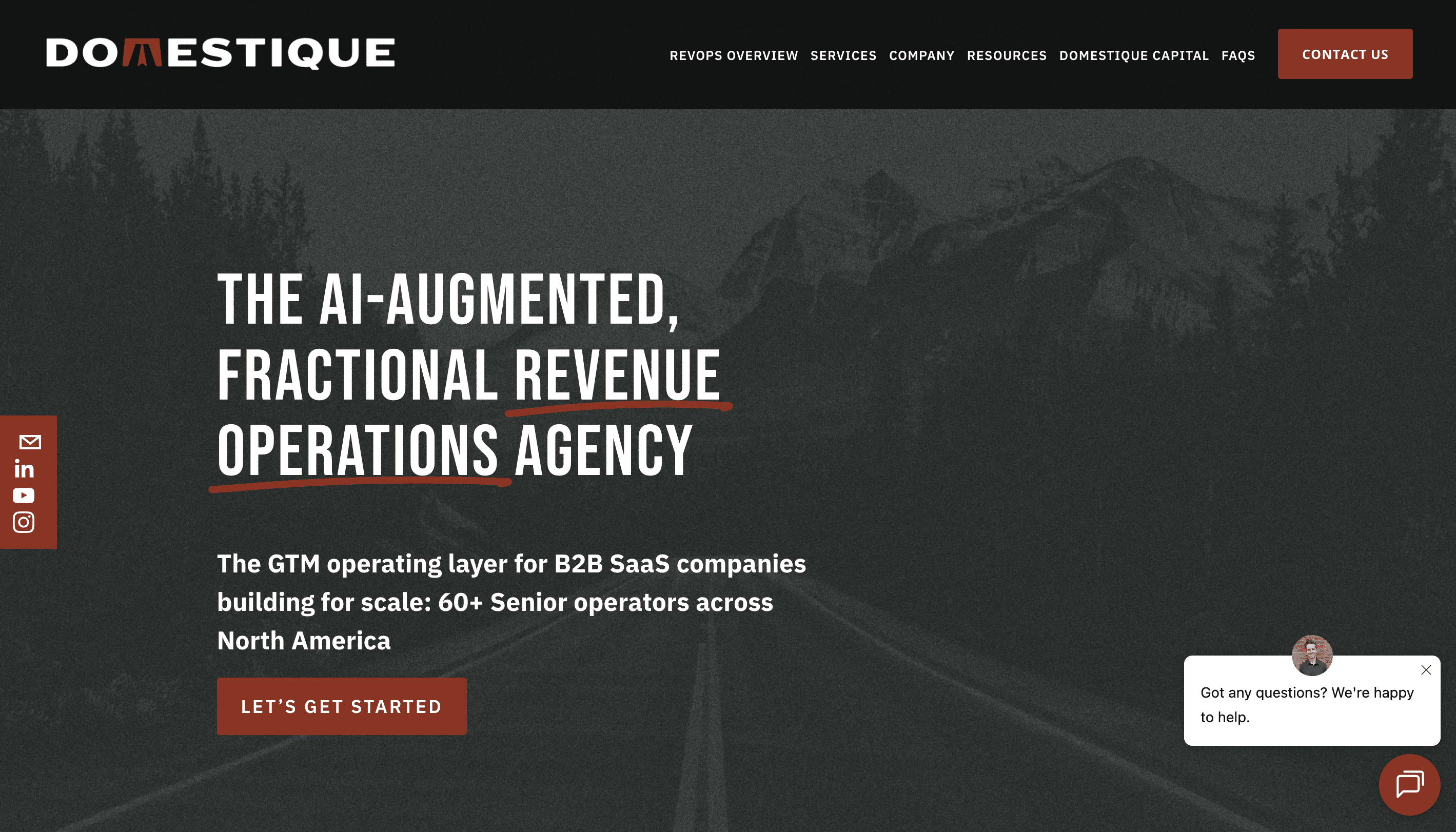
Best for: Seed to Series B SaaS companies on HubSpot that want their RevOps foundations built properly, not just advised on
Domestique is a RevOps management consultancy and HubSpot Platinum Solutions Partner. It describes RevOps as the connective tissue across the whole customer lifecycle, covering marketing, sales, and customer success operations, working alongside product, data, and finance. Independent comparisons describe it as best for early-stage to Series B SaaS companies that want foundational systems built.
Client reviews on HubSpot's directory describe Domestique building HubSpot infrastructure for growing startups, setting up lead scoring, multi-touch attribution, and dashboards, and supporting account grading and account-based marketing. Reviewers often describe the team as an extension of their own, able to bring in specialists from data work to development.
Its depth is in HubSpot. Companies committed to Salesforce will find a narrower fit.
Key services
- HubSpot implementation and onboarding
- CRM migration
- Lead scoring and attribution
- Sales and marketing alignment
- Ongoing marketing and RevOps support
Why Domestique stands out for Series A RevOps
- Focus on building foundations at early stages
- HubSpot Platinum partner status
- Covers marketing, sales, and success operations
- Strong client reviews
Best fit: HubSpot-based SaaS companies between seed and Series B. Less suited to Salesforce environments.
3. Go Nimbly
Best for: Product-led or hybrid SaaS companies that need a senior, embedded RevOps team without hiring one
Go Nimbly was founded in 2015 by Jen Igartua as a fractional RevOps firm, before the category had a widely used name. It is described as a roughly 60-person consultancy that places embedded teams of analysts, Salesforce administrators, and marketing automation specialists inside client businesses. Its platform depth covers Salesforce, HubSpot, Outreach, and Gainsight, and comparisons highlight particular strength with product-led growth and hybrid motions. Independent guides place its typical clients between Series A and Series D.
For a Series A company with a product-led or mixed sales model, that experience matters. Product usage data, self-serve signups, and sales-assisted deals need to come together in the CRM, which is harder to design than a purely sales-led pipeline.
Go Nimbly is one of the larger firms in this list, so its engagements may be more substantial than an early Series A company needs.
Key services
- Embedded fractional RevOps teams
- Salesforce and HubSpot administration
- Marketing automation operations
- Product-led growth operations
- Customer success systems
Why Go Nimbly stands out for Series A RevOps
- Long experience as a fractional RevOps specialist
- Strength with product-led and hybrid models
- Multi-platform expertise
- Senior teams embedded in the client
Best fit: Product-led or hybrid SaaS companies needing senior RevOps capacity. Smaller, simpler Series A companies may need less.
4. Operatus
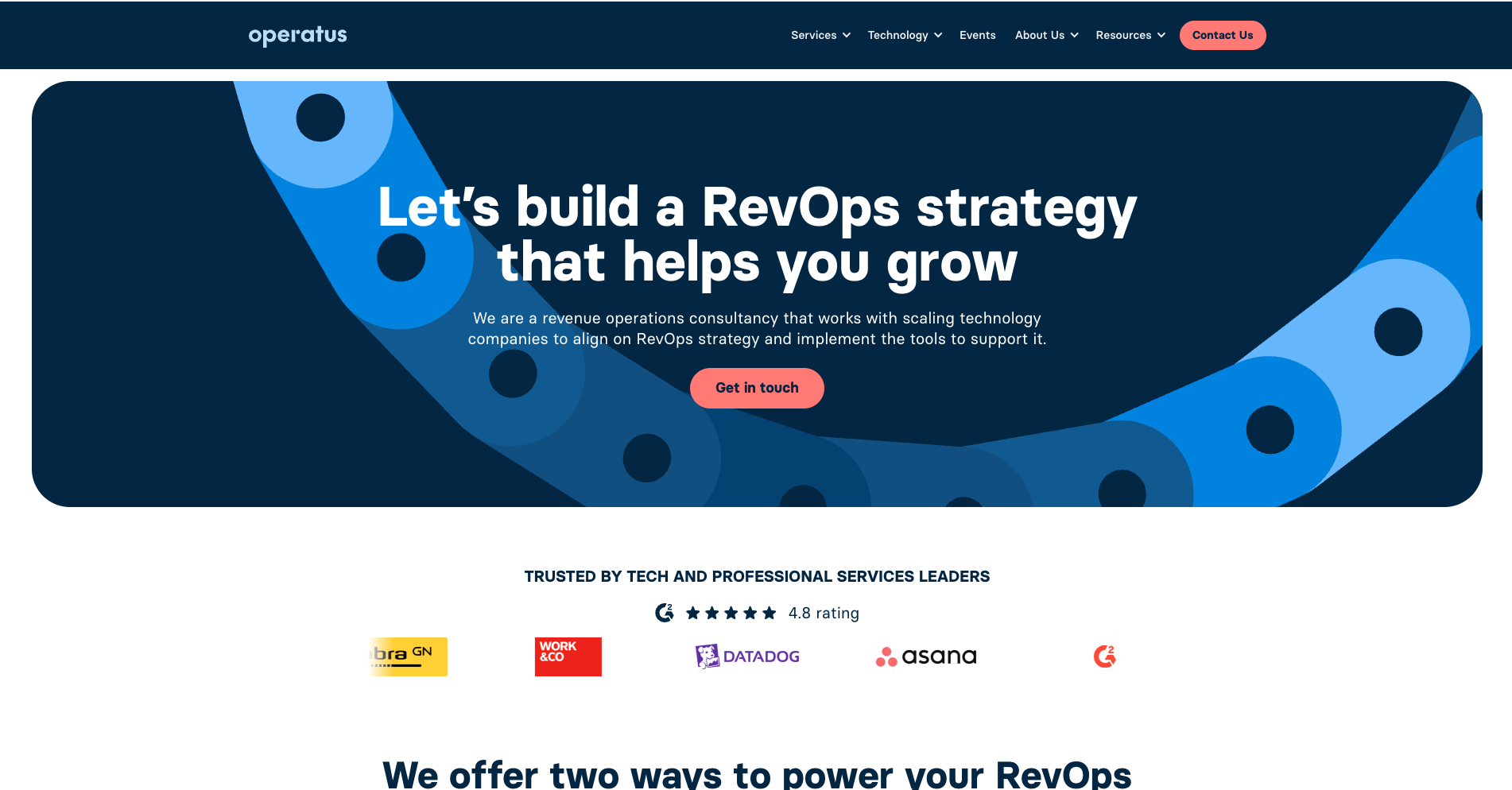
Best for: Salesforce-centred companies that want a RevOps function as a flexible monthly service
Operatus is a New York RevOps consultancy, serving clients since 2017, that offers RevOps as a Service and project consulting. It is a certified consulting partner for both Salesforce and HubSpot, with experience across Sales Cloud, Revenue Cloud, Service Cloud, and Agentforce, as well as tools such as Clay, Gong, and Openprise. Engagements can run month to month or as fixed-scope implementations, with a dedicated strategic lead supported by execution analysts.
For a Series A company that has already chosen Salesforce, or expects to move to it, that depth is valuable, and the monthly model lets the company scale support up or down as it hires. Operatus holds a 4.7 rating from 29 reviews on G2, where clients praise its responsiveness and adaptability.
Some clients note that project timelines can run beyond initial estimates, so milestones are worth agreeing in detail.
Key services
- RevOps as a Service
- Salesforce implementation and architecture
- HubSpot marketing operations
- Data and integration work, including MuleSoft
- RevOps strategy and AI readiness
Why Operatus stands out for Series A RevOps
- Deep Salesforce expertise
- Flexible month-to-month engagements
- Strategic lead plus execution analysts
- Positive client reviews
Best fit: Series A companies on Salesforce wanting flexible ongoing support. HubSpot-only companies may prefer a HubSpot specialist.
5. elefante RevOps
Best for: SaaS companies migrating to HubSpot or connecting HubSpot with Salesforce, and wanting ongoing support afterwards
elefante RevOps works with B2B companies scaling their revenue operations on HubSpot and Salesforce. Its services range from GTM audits and RevOps diagnostics to CRM migration, workflow redesign, reporting, and sales coaching, delivered as projects or as ongoing RevOps as a Service. In one published case, it moved HR tech SaaS company UrbanBound from a legacy Salesforce set-up to a unified HubSpot system in twelve weeks, with full HubSpot and Salesforce synchronisation and custom lead scoring, and the project continued as a long-term service.
That combination of migration and continuing support suits Series A companies, many of which outgrow their first CRM set-up and need it rebuilt without disrupting the sales team. It has more than 70 reviews on G2, where clients highlight its HubSpot and CRM expertise.
Its published examples focus on CRM migration and HubSpot optimisation. Companies needing a broad strategy partner should check scope.
Key services
- RevOps diagnostics and GTM audits
- CRM migration, including Salesforce to HubSpot
- HubSpot and Salesforce integration
- Workflow redesign and reporting
- RevOps as a Service
Why elefante RevOps stands out for Series A RevOps
- Published twelve-week migration case study
- HubSpot and Salesforce together
- Projects that continue as ongoing support
- Large number of client reviews
Best fit: Series A companies rebuilding or migrating their CRM. Less suited to those needing wider go-to-market strategy.
Why dimartec Approaches Series A RevOps Differently
The four other agencies are RevOps specialists, and each is strong at building the operational layer. Domestique and elefante RevOps bring deep HubSpot experience. Operatus brings Salesforce depth and a flexible service model. Go Nimbly brings senior embedded teams for complex motions.
What a RevOps specialist does not usually control is the activity flowing into the system. A well-designed CRM still reports poorly if paid campaigns are tagged inconsistently, landing page forms collect the wrong fields, or nurture sequences live in a tool nobody connected properly. At Series A, those upstream sources are often being rebuilt at the same time as the CRM, by different people, and the RevOps work has to be redone to fit them.
dimartec builds both together. RevOps & Automation is designed alongside Performance Paid Media, Full-Funnel CRO, GEO, and Lead Gen & Nurturing, so every source reports into one structure from day one. The result is a Series A company that can show, from its own CRM, which activity produces pipeline and revenue, with the playbooks and dashboards to keep it that way after handover.
See how the Revenue Engine works: https://www.dimartec.co.uk/services/revenue-engine
Three Things to Check Before Hiring a RevOps Agency
One: Ask what they will remove, not just what they will add. A Series A CRM usually needs simplifying before anything new is built. A good agency will talk about retiring fields, merging tools, and cleaning data. One that only proposes new dashboards and automations may add complexity to a system that already has too much.
Two: Ask who will run the system after they leave. Find out what documentation, training, and handover the agency provides, and whether the work assumes a full-time RevOps hire. The goal is a system your team can operate, not one that only the agency understands.
Three: Ask how they will connect marketing and sales data. The most common Series A reporting problem sits at the join between marketing tools and the CRM. Ask how the agency will make sure campaigns, forms, and lifecycle stages report consistently, and who is responsible for each source.
Frequently Asked Questions
When does a Series A company need RevOps support?
Usually soon after the round, when hiring and spending begin to grow. Common signs include reports that need fixing by hand, disagreements between marketing and sales about lead quality, slow lead follow-up, and forecasts that miss. Fixing the foundations before the team doubles is much easier than fixing them afterwards.
Should a Series A company hire a RevOps person or an agency?
Often both, in sequence. An agency or fractional team can design and build the foundations quickly, drawing on experience from many similar companies. A first full-time RevOps hire can then run and extend the system. Hiring first and asking that person to rebuild everything alone tends to be slower and riskier.
HubSpot or Salesforce at Series A?
Both can work. HubSpot is often quicker to set up and easier for small teams to manage. Salesforce offers more flexibility for complex sales processes and is common in companies expecting large enterprise deals. The more important decision is to choose one deliberately and design it properly, then pick an agency with deep experience in that platform.
How long does it take to fix RevOps foundations?
A focused clean-up and redesign typically takes from a few weeks to a few months, depending on the state of the data and the number of tools involved. CRM migrations often take around three months. Reporting that leadership trusts usually follows once tracking and lifecycle definitions are in place.
Build the Foundations Before You Build the Team
Series A gives a company the money to grow and a limited window to prove it can do so efficiently. Revenue operations decides whether that growth can be measured, managed, and repeated. The right agency builds foundations that a growing team can rely on and run, instead of leaving a more complicated version of the original set-up.
The Revenue Engine connects RevOps & Automation with Performance Paid Media, Full-Funnel CRO, GEO, and Lead Gen & Nurturing, so every source of pipeline reports into one system your team owns.
See how the Revenue Engine works: https://www.dimartec.co.uk/services/revenue-engine