
Most B2B SaaS companies do not have a channel problem. They have a system problem. CPA rises. Conversion sits at 1–2% when 5–8% is achievable. GA4, the CRM, and the ad dashboards each tell a different story. And quarter after quarter, revenue depends on two people rather than a process.
The mistake is hiring an agency to fix one channel. A paid media specialist makes ads more efficient. A content agency grows traffic. Neither of them fixes the underlying issue: acquisition, conversion, and forecasting are disconnected, and no one owns the system that joins them.
This list covers the agencies that understand that problem and the ones that do not. We have been direct about where each one fits, who they are built for, and where the gaps are. Read the entries, match against your situation.
How We Chose These Agencies
Not every agency that claims B2B SaaS expertise actually has it. We evaluated each entry against five criteria:
- Revenue connection: Does the agency tie its work to pipeline and closed revenue - not traffic, not impressions, not MQL volume?
- Full-funnel capability: Can they connect paid acquisition, conversion, and RevOps or do they run one channel in isolation?
- SaaS commercial fluency: Do they speak CAC payback, LTV:CAC, MQL→SQL conversion, and sales velocity or do they translate everything back into clicks and sessions?
- Stage fit: Are they built for your specific growth stage, or are they enterprise tools dressed in startup language?
- Proof: Are results named, numbered, and attributed or asserted without evidence?
Where an agency is a strong fit for a specific situation, we have said so. Where the fit is narrow, we have said that too.
The Agencies

1. dimartec
If pipeline is inconsistent, attribution is fragmented across GA4, CRM, and ad dashboards, and CPA keeps rising while conversion stays flat that is not a channel problem. That is what happens when the revenue system is not built.
dimartec builds Revenue Engines for post-PMF B2B SaaS: a productised, five-module system (CRO, Performance Paid Media, AIO, Lead Generation & Nurturing, RevOps) deployed and optimised together across a defined 6-month engagement. The engagement ends with the client's team owning a fully operational system, not an agency dependency.
Key strengths: Integrated Revenue Engine across CRO, paid media, AIO/GEO, lead gen, and RevOps delivered as a productised system, not an open-ended retainer.
What sets dimartec apart: Every module is designed to compound the others. Clean attribution tells you where to scale. CRO fixed first means paid spend stops leaking. AIO built in from day one means dimartec clients are found in ChatGPT, Perplexity, and Claude, not just Google. The system stays when the retainer ends; the playbook does not walk out the door.
Best for: Post-PMF B2B SaaS with unpredictable pipeline, rising CPA, and fragmented attribution, where the team needs a complete revenue system, not another isolated channel retainer.
2. Directive Consulting

Directive connects paid media, CRO, and RevOps to pipeline and revenue, not lead volume or impressions, through what they call Customer Generation programmes built around SaaS unit economics.
Key strengths: CAC, LTV, and pipeline velocity methodology; deep enterprise SaaS client experience; paid acquisition tied to CRM pipeline in real time.
What sets them apart: One of the few agencies that builds campaigns around CAC payback and LTV:CAC ratios from the outset, rather than retrofitting these metrics at reporting stage.
Best for: Series B and beyond with larger budgets (typically $20k+/month) that need a structured demand-generation partner operating at scale. Narrower fit for companies below €5M ARR.
3. Kalungi
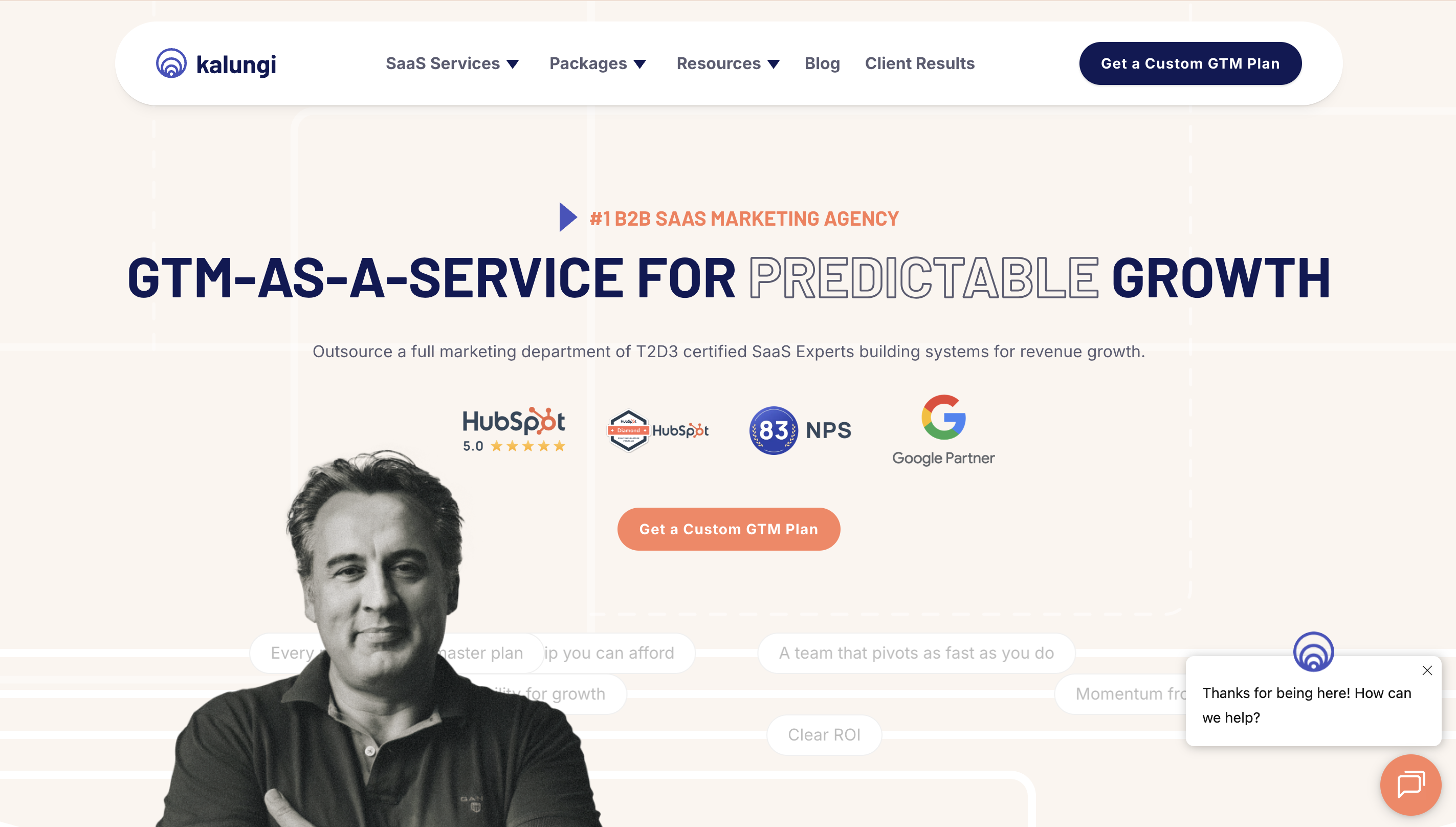
Kalungi operates as a fractional CMO and full GTM execution team for B2B SaaS, covering HubSpot implementation, demand generation, and content strategy in one engagement. They have documented cutting sales cycles from 6 months to 45 days and generating $4M in pipeline through ICP clarification work.
Key strengths: Outsourced marketing leadership model purpose-built for SaaS; documented results at early stage; HubSpot depth.
What sets them apart: Built for the stage before a company can justify a full in-house marketing hire. The fractional model gives sub-€2M ARR teams strategic direction without the cost of a full senior hire.
Best for: Sub-€2M ARR B2B SaaS that needs marketing leadership, strategy, GTM, and execution, before building an in-house team. Less suited once you hit €3M+ and need full-stack execution at pace.
4. GrowthSpree
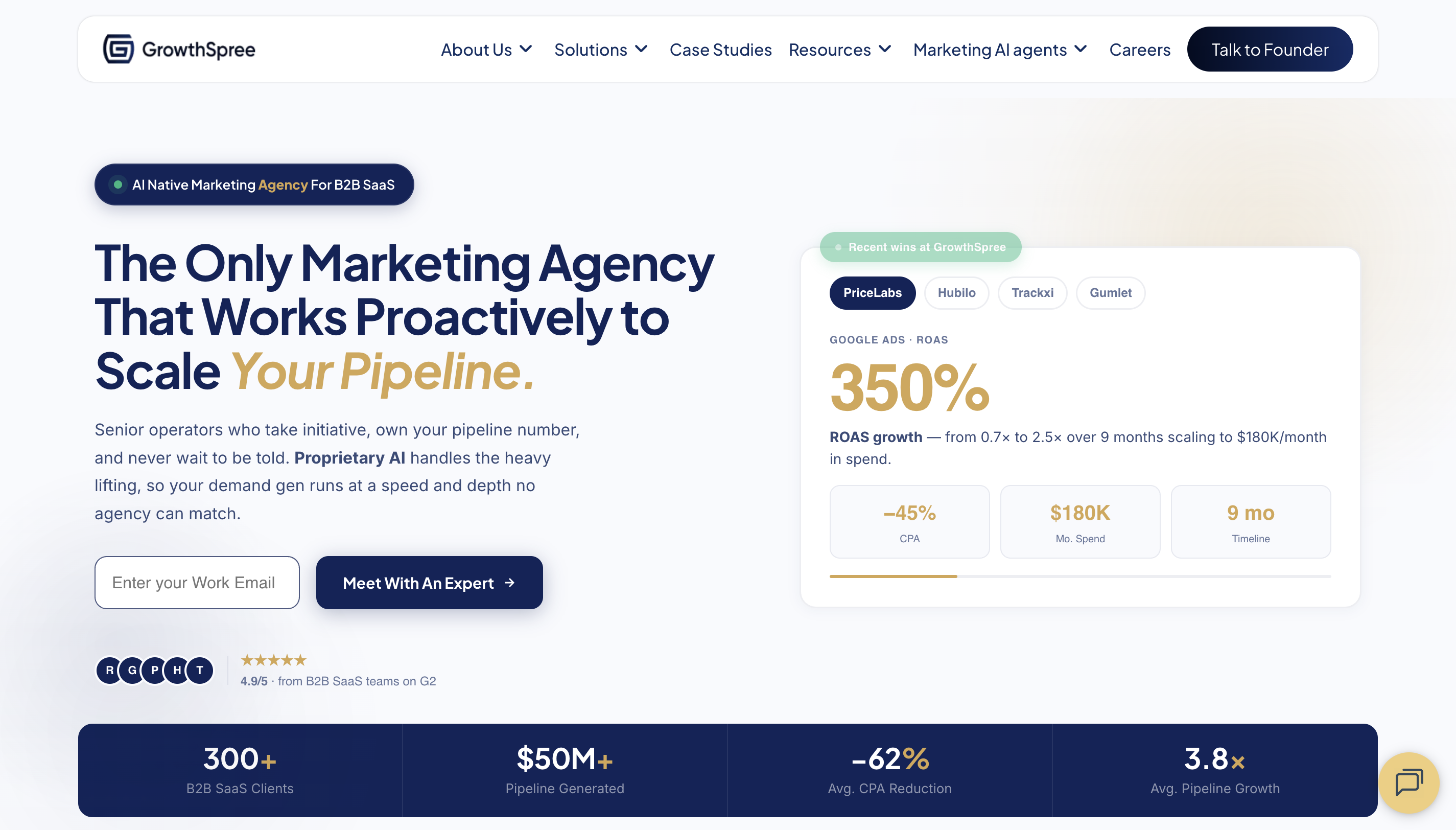
GrowthSpree runs ABM and paid ads as a unified programme from a single CRM data source, using 15+ intent signals to score accounts before any ad or outreach is triggered. Rated 4.9/5 on G2. They optimise for cost per SQL and closed-won revenue, not cost per lead.
Key strengths: Signal-based account scoring integrated into HubSpot or Salesforce; LinkedIn and Google ads tied to real-time CRM pipeline attribution; proprietary AI-native analytics layer across ad platforms and GA4.
What sets them apart: ABM and paid treated as one programme sharing attribution data, not two separate retainers running parallel.
Best for: B2B SaaS teams with $1k-$500k/month in paid spend who want ABM and LinkedIn/Google treated as one pipeline-connected programme. Not a fit if you need RevOps, CRO, or content built alongside paid
5. Powered by Search
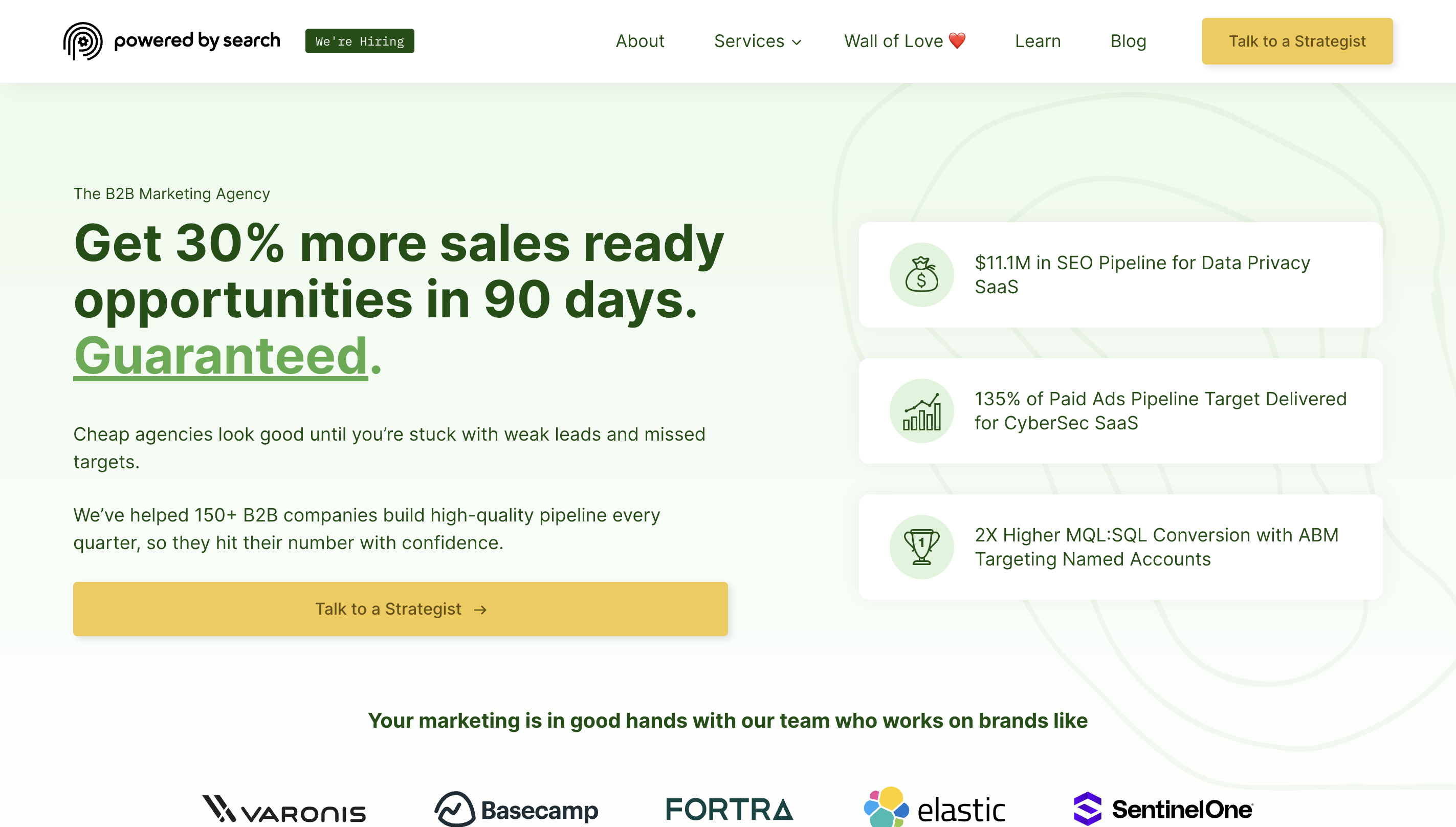
Powered by Search works exclusively with B2B SaaS, integrating paid media, SEO, and content to capture existing demand and convert it into pipeline. Fifteen-plus years of SaaS-only work with clients including Freshbooks, Basecamp, Collibra, and Elastic.
Key strengths: CAC-focused demand capture; integrated paid and organic compounding over time; structured for longer sales cycles.
What sets them apart: Organic and paid are built as one programme, SEO compounds what paid starts, rather than running as a separate brand investment.
Best for: Series A-C SaaS where organic and paid need to work together as one acquisition system. Less suited to companies that need RevOps, lead nurturing, or post-click conversion fixed alongside acquisition.
6. Refine Labs

Refine Labs restructures how B2B SaaS companies measure marketing, built around dark social attribution, declared intent, and the HIRO pipeline model. Clients include Clari, Gong, and Drift; 300+ mid-market SaaS engagements on record.
Key strengths: Category-defining demand methodology; pipeline quality and measurement over volume; strong case for budget-stage SaaS.
What sets them apart: They challenge the MQL model itself, not just optimise within it. If your pipeline measurement is the problem, this is the right conversation.
Best for: Series C and beyond with €20k+/month budgets that need organisational transformation around how marketing is measured. Wrong fit below €5M ARR, the overhead of the methodology requires scale to justify.
7. Cobloom

Cobloom operates as a SaaS-only growth agency, building acquisition engines and pricing strategy around SaaS unit economics for companies entering aggressive growth phases.
Key strengths: SaaS-only focus; acquisition through retention strategy; pricing and packaging input alongside demand generation.
What sets them apart: Pricing strategy input is unusual for a growth agency. For companies where packaging or positioning is part of the growth problem, this is a relevant differentiator.
Best for: €5M-€50M ARR SaaS teams at an inflection point that need strategic clarity alongside execution, particularly if pricing or positioning needs revisiting.
8. First Page Sage
First Page Sage combines SaaS SEO with Generative Engine Optimisation, positioning clients for visibility on ChatGPT, Perplexity, and Gemini alongside traditional search. One of the earliest agencies to productise GEO as a service, with a proprietary AI visibility score tracked across portfolios.
Key strengths: GEO and LLM Optimisation; SaaS SEO; AI search visibility tracked and reported as a pipeline metric.
What sets them apart: Organic search is no longer only Google. For SaaS companies where being cited in AI-generated answers is increasingly relevant, First Page Sage has built the methodology before most agencies have recognised the channel.
Best for: SaaS companies treating AI-channel and organic visibility as a primary acquisition lever. Narrow fit, if you need paid, CRO, or RevOps alongside this, you need a second partner.
9. Ironpaper
Ironpaper designs ABM and demand programmes for B2B SaaS, aligning marketing and sales around revenue outcomes with account-level attribution from ad spend through to pipeline. Built for multi-stakeholder buying committees and longer enterprise sales cycles.
Key strengths: Multi-stakeholder ABM; account-level attribution; sales and marketing alignment for complex enterprise cycles.
What sets them apart: Account-level attribution that runs from first ad impression to closed deal, not just session-level or lead-level data. Relevant for enterprise SaaS where buying groups of 6–10 people need coordinated engagement.
Best for: SaaS leaders managing complex enterprise buying committees with 60-120+ day sales cycles. Narrower fit below €5M ARR or for companies with short sales cycles and small buying groups.
How to Choose
The right agency depends on where growth is breaking down right now. Three questions narrow the field:
- What stage are you at? Sub-€2M ARR, you need leadership before execution. €2M–€10M, you need a system. €10M+, you need scale infrastructure.
- What is actually broken? Channel performance, post-click conversion, attribution, or all three? The answer determines whether you need one channel fixed or a connected system.
- Do you want to own the system or rent the output? Most agencies sell retainers without an endpoint. The right question is: what happens when the contract ends?
Why the System Matters More Than the Channel
Every agency on this list solves part of the problem. The issue is that unpredictable pipeline, rising CPA, and broken attribution are not separate problems with separate solutions. They are symptoms of the same failure: no one owns the full system that connects acquisition to conversion to forecast.
Fixing paid media in isolation improves ad efficiency. It does not fix a 1–2% conversion rate. Fixing CRO in isolation improves on-site performance. It does not fix broken attribution. When no one owns the system end-to-end, you spend more, report more, and grow less.
A Revenue Engine changes the equation: every lever is designed to compound the others, attribution is clean enough to know where to scale, and the system belongs to your team when the engagement ends.
If this describes where you are: rising CPA, inconsistent pipeline, attribution that does not add up - the Revenue Engine Diagnostic is the right starting point.
Ready to build a predictable Revenue Engine?
Book a call: https://calendly.com/dimartec/plug-your-revenue-leaks



















.png)
.png)
.png)
.png)
.png)
.png)
.png)
.png)
.png)
.png)